Precast Concrete for Rapid Repair and
Rehabilitation of High Traffic-Volume
Concrete and Asphalt Pavements
39th Annual Concrete Paving Workshop
January 16-17, 2018
Lincoln, Nebraska
Samuel Tyson, P.E.
Federal Highway Administration
Washington, District of Columbia
Precast Concrete Pavement (PCP)
• High Traffic Volumes
• Alternate Route Availability
• Rapid Renewal
• Lane-Closure Times
• Work-Zone Safety
• Opening to Traffic
• Concrete Quality
• Long-Life Performance
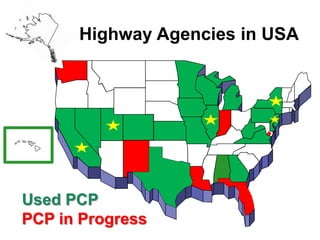
Highway Agencies in USA
Used PCP
PCP in Progress
Reinforcement & Prestressing
• Nominal reinforcement (0.12-0.15 %)
for handling stresses & to control
potential cracking.
• Pre-tensioning by fabricator allows
reduced panel thickness.
• Pre-tensioning also for wider and
longer panels (e.g., two-lane width).
• Post-tensioning applied on site to
connect a series of panels.
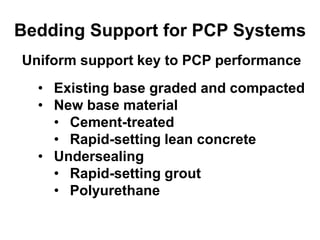
Bedding Support for PCP Systems
Uniform support key to PCP performance
• Existing base graded and compacted
• New base material
• Cement-treated
• Rapid-setting lean concrete
• Undersealing
• Rapid-setting grout
• Polyurethane
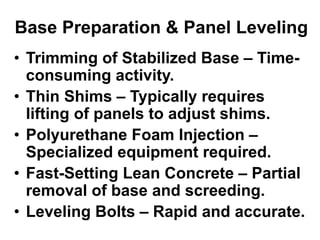
Base Preparation & Panel Leveling
• Trimming of Stabilized Base – Time-
consuming activity.
• Thin Shims – Typically requires
lifting of panels to adjust shims.
• Polyurethane Foam Injection –
Specialized equipment required.
• Fast-Setting Lean Concrete – Partial
removal of base and screeding.
• Leveling Bolts – Rapid and accurate.
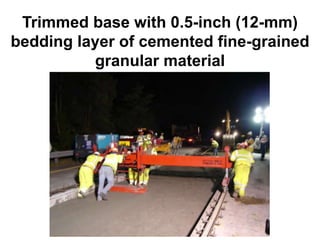
Trimmed base with 0.5-inch (12-mm)
bedding layer of cemented fine-grained
granular material
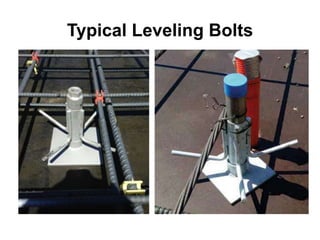
Typical Leveling Bolts
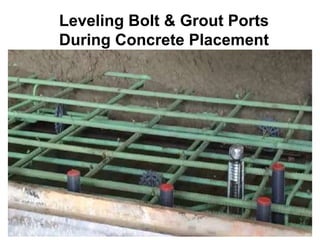
Leveling Bolt & Grout Ports
During Concrete Placement
Panel-to-Base Contact
• Panels Installed Directly on Base
–Grout injected through ports to fill
any voids.
–Panel raised to grade by injection
of polyurethane foam.
• Panels Installed with Leveling Bolts
–Grout fills 0.5-in. (12 mm) gap
between bottom of panel and base.
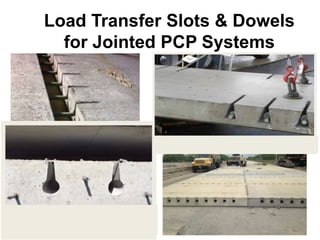
Load Transfer Slots & Dowels
for Jointed PCP Systems
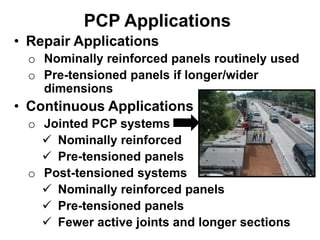
• Repair Applications
o Nominally reinforced panels routinely used
o Pre-tensioned panels if longer/wider
dimensions
• Continuous Applications
o Jointed PCP systems
 Nominally reinforced
 Pre-tensioned panels
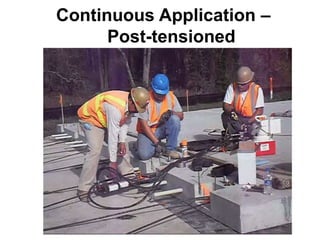
o Post-tensioned systems
 Nominally reinforced panels
 Pre-tensioned panels
 Fewer active joints and longer sections
PCP Applications
PCP Applications (continued)
• Repair Applications
–Service-life of 15 to 20 years is
predicted for PCP repairs.
–Existing pavement may need to be
reconstructed prior to 15 years.
–Exceeds 8 to 10 years experienced
with rapid-hardening concretes.
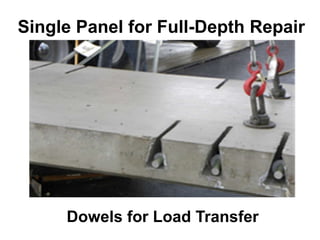
Single Panel for Full-Depth Repair
Dowels for Load Transfer
PCP Applications (continued)
• Continuous Applications
–Service-life of 40+ years.
–No early failures or materials-
related distress.
–Reduced potential for cracking,
faulting & spalling.
–Smoothness and surface texture
initially good & easily maintained.
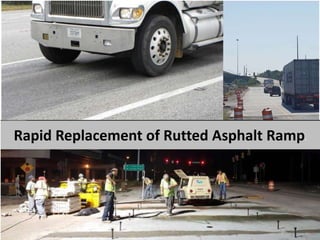
Rapid Replacement of Rutted Asphalt Ramp.
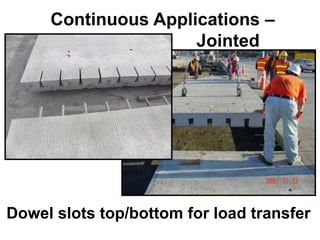
Continuous Applications –
Dowel slots top/bottom for load transfer
Jointed
Continuous Application –
Post-tensioned
Typical Uses/Nighttime Work
• Principal Uses
oHeavily-traveled interstate and primary
roadways – Critical need in all States.
oInterstate and urban ramps – Often no
convenient alternate routes.
• Special Uses
oIntersections – Traffic delays minimized.
oBridge approaches – Smooth transition
from pavement to bridge.
oBus pads – Avoid disruption of service.
oAirfields – A developing application.
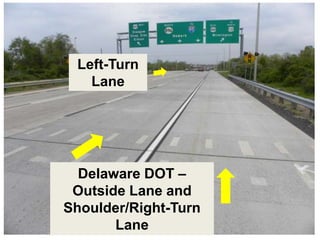
Delaware DOT –
Outside Lane and
Shoulder/Right-Turn
Lane
Left-Turn
Lane
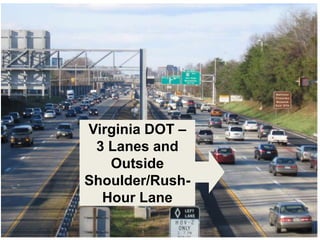
Virginia DOT –
3 Lanes and
Outside
Shoulder/Rush-
Hour Lane
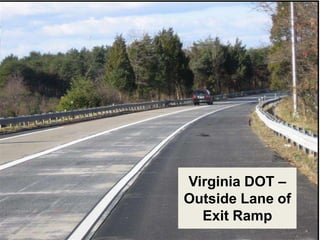
Virginia DOT –
Outside Lane of
Exit Ramp
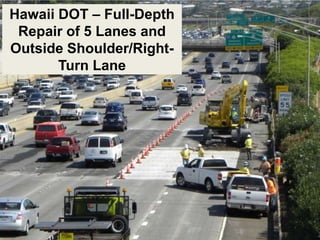
Hawaii DOT – Full-Depth
Repair of 5 Lanes and
Outside Shoulder/Right-
Turn Lane
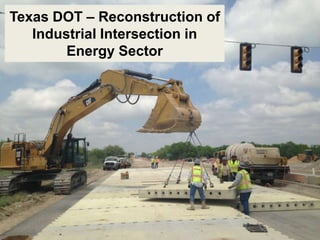
Texas DOT – Reconstruction of
Industrial Intersection in
Energy Sector
Surface Finishing
• Vertical tolerances with routine
leveling methods may or may not
be satisfactory for high-speed
roadways.
• Grinding may be needed for
smoothness due to vertical
differences at transverse joints.
• Smoothness and surface texture
achieved on-site with grinding.
• Panel fabrication rate –
–Inside plant; 10 panels/day.
–Pre-stressing bed; 30 panels/day.
• Panel installation rate –
–Repair; 20 panels/night.
–Continuous; 50 panels/night.
• Inventory – Several weeks (or months)
of panel production is needed before
installation on project can begin.
Panel Fabrication/Installation Rates
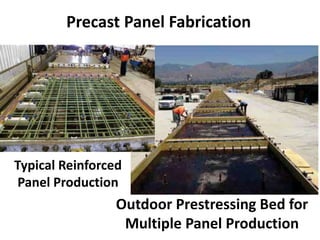
Precast Panel Fabrication
Outdoor Prestressing Bed for
Multiple Panel Production
Typical Reinforced
Panel Production
• Experience in the USA with PCP
systems is limited to 16 years.
• PCP systems are rapidly installed.
• PCP systems provide long-term
performance following satisfactory
design, fabrication and installation.
• Fabricators & contractors having
no prior experience are producing
and installing panels satisfactorily.
Summary

Nebraska Precast Concrete Pavement

  • 1.
    Precast Concrete forRapid Repair and Rehabilitation of High Traffic-Volume Concrete and Asphalt Pavements 39th Annual Concrete Paving Workshop January 16-17, 2018 Lincoln, Nebraska Samuel Tyson, P.E. Federal Highway Administration Washington, District of Columbia
  • 2.
    Precast Concrete Pavement(PCP) • High Traffic Volumes • Alternate Route Availability • Rapid Renewal • Lane-Closure Times • Work-Zone Safety • Opening to Traffic • Concrete Quality • Long-Life Performance
  • 3.
    Highway Agencies inUSA Used PCP PCP in Progress
  • 4.
    Reinforcement & Prestressing •Nominal reinforcement (0.12-0.15 %) for handling stresses & to control potential cracking. • Pre-tensioning by fabricator allows reduced panel thickness. • Pre-tensioning also for wider and longer panels (e.g., two-lane width). • Post-tensioning applied on site to connect a series of panels.
  • 5.
    Bedding Support forPCP Systems Uniform support key to PCP performance • Existing base graded and compacted • New base material • Cement-treated • Rapid-setting lean concrete • Undersealing • Rapid-setting grout • Polyurethane
  • 6.
    Base Preparation &Panel Leveling • Trimming of Stabilized Base – Time- consuming activity. • Thin Shims – Typically requires lifting of panels to adjust shims. • Polyurethane Foam Injection – Specialized equipment required. • Fast-Setting Lean Concrete – Partial removal of base and screeding. • Leveling Bolts – Rapid and accurate.
  • 7.
    Trimmed base with0.5-inch (12-mm) bedding layer of cemented fine-grained granular material
  • 8.
  • 9.
    Leveling Bolt &Grout Ports During Concrete Placement
  • 10.
    Panel-to-Base Contact • PanelsInstalled Directly on Base –Grout injected through ports to fill any voids. –Panel raised to grade by injection of polyurethane foam. • Panels Installed with Leveling Bolts –Grout fills 0.5-in. (12 mm) gap between bottom of panel and base.
  • 11.
    Load Transfer Slots& Dowels for Jointed PCP Systems
  • 12.
    • Repair Applications oNominally reinforced panels routinely used o Pre-tensioned panels if longer/wider dimensions • Continuous Applications o Jointed PCP systems  Nominally reinforced  Pre-tensioned panels o Post-tensioned systems  Nominally reinforced panels  Pre-tensioned panels  Fewer active joints and longer sections PCP Applications
  • 13.
    PCP Applications (continued) •Repair Applications –Service-life of 15 to 20 years is predicted for PCP repairs. –Existing pavement may need to be reconstructed prior to 15 years. –Exceeds 8 to 10 years experienced with rapid-hardening concretes.
  • 14.
    Single Panel forFull-Depth Repair Dowels for Load Transfer
  • 15.
    PCP Applications (continued) •Continuous Applications –Service-life of 40+ years. –No early failures or materials- related distress. –Reduced potential for cracking, faulting & spalling. –Smoothness and surface texture initially good & easily maintained.
  • 16.
    Rapid Replacement ofRutted Asphalt Ramp.
  • 17.
    Continuous Applications – Dowelslots top/bottom for load transfer Jointed
  • 18.
  • 19.
    Typical Uses/Nighttime Work •Principal Uses oHeavily-traveled interstate and primary roadways – Critical need in all States. oInterstate and urban ramps – Often no convenient alternate routes. • Special Uses oIntersections – Traffic delays minimized. oBridge approaches – Smooth transition from pavement to bridge. oBus pads – Avoid disruption of service. oAirfields – A developing application.
  • 20.
    Delaware DOT – OutsideLane and Shoulder/Right-Turn Lane Left-Turn Lane
  • 21.
    Virginia DOT – 3Lanes and Outside Shoulder/Rush- Hour Lane
  • 22.
    Virginia DOT – OutsideLane of Exit Ramp
  • 23.
    Hawaii DOT –Full-Depth Repair of 5 Lanes and Outside Shoulder/Right- Turn Lane
  • 24.
    Texas DOT –Reconstruction of Industrial Intersection in Energy Sector
  • 25.
    Surface Finishing • Verticaltolerances with routine leveling methods may or may not be satisfactory for high-speed roadways. • Grinding may be needed for smoothness due to vertical differences at transverse joints. • Smoothness and surface texture achieved on-site with grinding.
  • 26.
    • Panel fabricationrate – –Inside plant; 10 panels/day. –Pre-stressing bed; 30 panels/day. • Panel installation rate – –Repair; 20 panels/night. –Continuous; 50 panels/night. • Inventory – Several weeks (or months) of panel production is needed before installation on project can begin. Panel Fabrication/Installation Rates
  • 27.
    Precast Panel Fabrication OutdoorPrestressing Bed for Multiple Panel Production Typical Reinforced Panel Production
  • 28.
    • Experience inthe USA with PCP systems is limited to 16 years. • PCP systems are rapidly installed. • PCP systems provide long-term performance following satisfactory design, fabrication and installation. • Fabricators & contractors having no prior experience are producing and installing panels satisfactorily. Summary

Editor's Notes