Pavement Quality Concrete (PQC)
Production
CE60136 Highway Construction
Practice (3-0-0)
IIT Kharagpur, Spring 2017
Books/References
• MORTH- Specifications for Roads and bridge works,
5th edition, New Delhi, 2013.
• IRC 15 – Code of Practice for Construction of Jointed
Plane concrete.
• IRC:44 “Guidelines for Cement Concrete Mix Design
for Pavements”
• IRC:57 “Recommended Practice for Sealing of Joints
in Concrete Pavements”
https://www.youtube.com/watch?v=CZKlD
DaCIW8&t=719s
PQC ingredients
• Aggregate (Fine and coarse aggregates)
• Water and
• Cement
• Chemical Admixtures (Optional)
• Fly-ash/GGBS/Silica fumes (Optional)
• Fibre
• Steel Dowel Bars and Tie Bars
• Materials for Joint Sealing
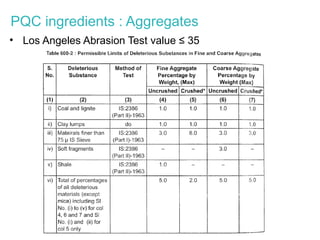
PQC ingredients : Aggregates
• Los Angeles Abrasion Test value ≤ 35
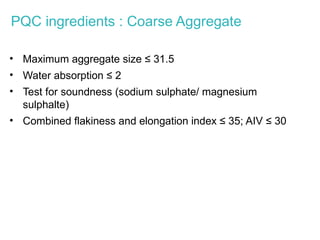
PQC ingredients : Coarse Aggregate
• Maximum aggregate size ≤ 31.5
• Water absorption ≤ 2
• Test for soundness (sodium sulphate/ magnesium
sulphalte)
• Combined flakiness and elongation index ≤ 35; AIV ≤ 30
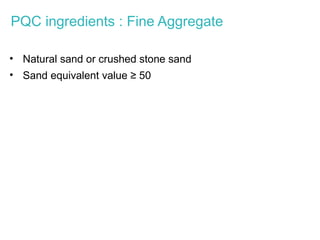
PQC ingredients : Fine Aggregate
• Natural sand or crushed stone sand
• Sand equivalent value ≥ 50
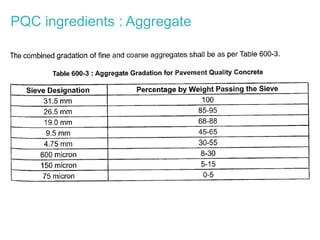
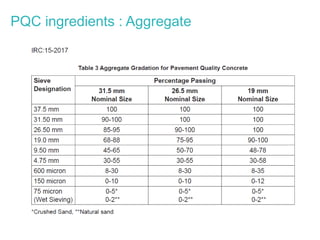
PQC ingredients : Aggregate
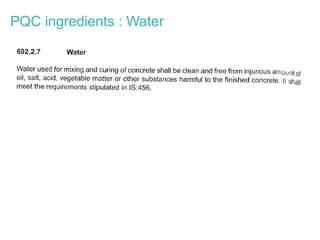
PQC ingredients : Water
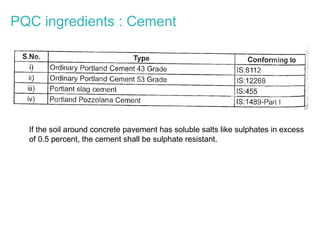
PQC ingredients : Cement
If the soil around concrete pavement has soluble salts like sulphates in excess
of 0.5 percent, the cement shall be sulphate resistant.
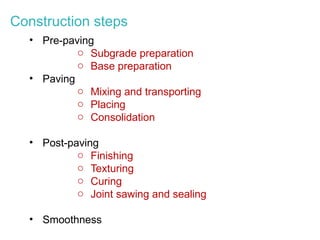
Construction steps
• Pre-paving
o Subgrade preparation
o Base preparation
• Paving
o Mixing and transporting
o Placing
o Consolidation
• Post-paving
o Finishing
o Texturing
o Curing
o Joint sawing and sealing
• Smoothness
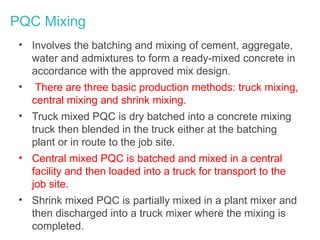
PQC Mixing
• Involves the batching and mixing of cement, aggregate,
water and admixtures to form a ready-mixed concrete in
accordance with the approved mix design.
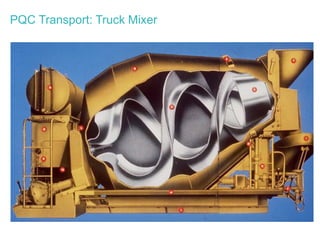
• There are three basic production methods: truck mixing,
central mixing and shrink mixing.
• Truck mixed PQC is dry batched into a concrete mixing
truck then blended in the truck either at the batching
plant or in route to the job site.
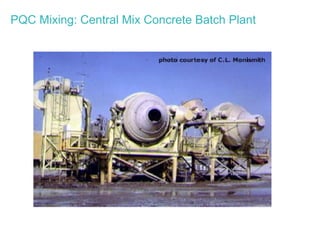
• Central mixed PQC is batched and mixed in a central
facility and then loaded into a truck for transport to the
job site.
• Shrink mixed PQC is partially mixed in a plant mixer and
then discharged into a truck mixer where the mixing is
completed.
PQC Mixing: Central Mix Concrete Batch Plant
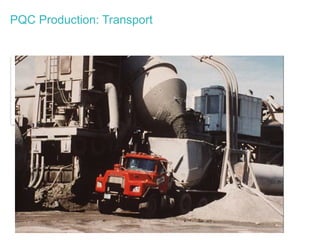
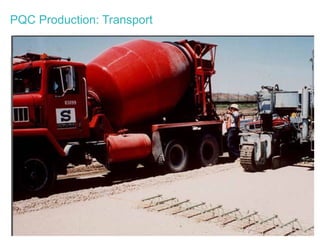
PQC Production: Transport
PQC Transport
• Involves conveying PQC from a batching facility to a
paving site including;
o truck loading
o weighing and ticketing
o hauling to the paving site
o mixing (if required)
o agitation
o placing
o truck washing
o truck return to the batching facility
PQC Transport
Transport practices can affect such mix characteristics as
(1) homogeneity,
(2) workability,
(3) water content and
(4) air content.
Transport considerations
o Loading at the production facility
o Truck drum/bed and chute cleanliness
o Water management
o Unloading at the paving site
o Operation synchronization
PQC Transport
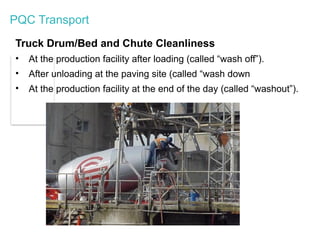
Truck Drum/Bed and Chute Cleanliness
• At the production facility after loading (called “wash off”).
• After unloading at the paving site (called “wash down
• At the production facility at the end of the day (called “washout”).
PQC Transport
Unloading at the Paving Site
• Should be unloaded quickly when it arrives at the paving
site. This will minimize the time available for water
evaporation and excessive agitation.
• Should be unloaded as close as possible to its final
placement spot. This will prevent mix segregation that can
occur if PQC is moved excessively.
PQC Transport
Operation Synchronization
• To minimize accumulation of excess material
• Number of trucks to be used.
• Truck type.
• Average truck hauling capacity.
• Production facility output rate.
• Availability and condition of materials at the
production facility.
• Time to wash off, down and out the transport truck.
• Waiting time at the production facility.
• Loading, weighing and ticketing time at the production
facility.
• Distance between the production facility and the
paving site.
• Average truck speed.
PQC Transport: Truck Mixer
Paving (Placing and
Consolidation)- cement
concrete
Cement Concrete Pavement- Construction
PQC Paving (Placing and Consolidation)
There are two basic methods of building concrete pavement:
fixed-form paving and slipform paving.
• Slipform paving is defined as a process used to consolidate, form into
geometric shape and surface finish a PQC mass by pulling the forms
continuously through and surrounding the plastic concrete mass.
• In fixed form paving, side forms are used to hold fresh PQC in place at
the proper grade and alignment until it sets and hardens.
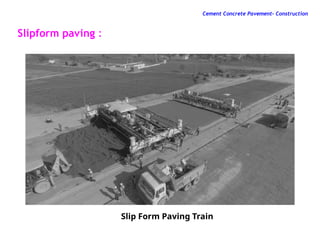
Slipform paving :
process used to consolidate, form into geometric shape and surface finish a
PCC mass by pulling the forms continuously through and surrounding the
plastic concrete mass.
- appropriate for larger jobs that require high production rates.
-Uses low-slump PCC. Low-slump PCC (on the order of 0 - 75 mm ) is
necessary so that the fresh PCC is able to hold its shape once the slipform
paver has passed.
- Low slump PCC - less water and usually has higher compression and
flexural strengths than comparable high slump mixes.
High productivity. Slipform paving production rates - typically in the
range of 65 - 100 m3/hr for mainline paving. That translates into between
70 - 90 m/hr of 3.66 m (12 ft.) wide, 250 mm thick PCC surface course.
Smooth riding surface. Automation and computer control allow slipform
pavers to produce very smooth riding surfaces (IRI on the order of 0.90
m/km or less).
Cement Concrete Pavement- Construction
Slipform paving :
Cement Concrete Pavement- Construction
Slip Form Paving Train
Cement Concrete Pavement- Construction
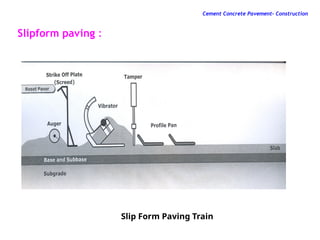
Slip Form Paving Train
Slipform paving :
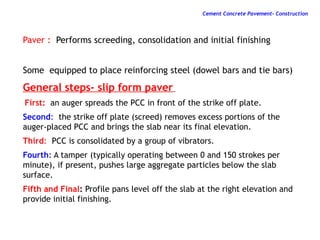
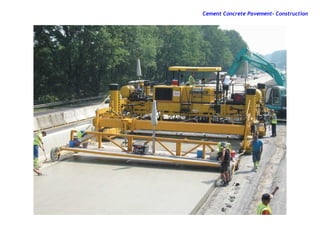
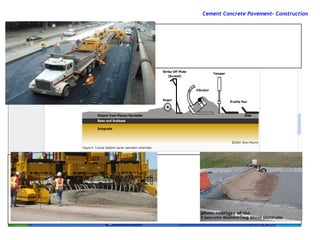
Paver : Performs screeding, consolidation and initial finishing
Some equipped to place reinforcing steel (dowel bars and tie bars)
General steps- slip form paver
First: an auger spreads the PCC in front of the strike off plate.
Second: the strike off plate (screed) removes excess portions of the
auger-placed PCC and brings the slab near its final elevation.
Third: PCC is consolidated by a group of vibrators.
Fourth: A tamper (typically operating between 0 and 150 strokes per
minute), if present, pushes large aggregate particles below the slab
surface.
Fifth and Final: Profile pans level off the slab at the right elevation and
provide initial finishing.
Cement Concrete Pavement- Construction
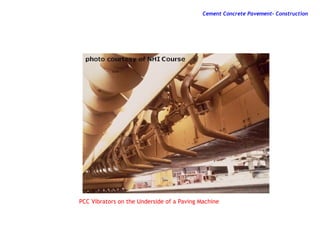
PCC Vibrators on the Underside of a Paving Machine
Cement Concrete Pavement- Construction
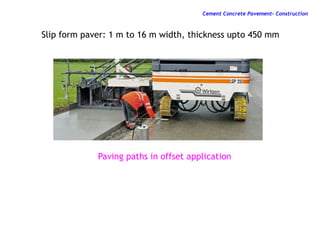
Paving paths in offset application
Slip form paver: 1 m to 16 m width, thickness upto 450 mm
Cement Concrete Pavement- Construction
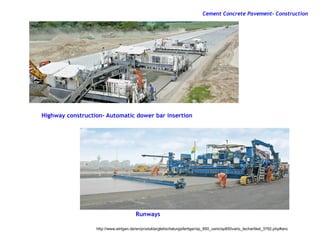
Highway construction- Automatic dower bar insertion
Runways
http://www.wirtgen.de/en/produkte/gleitschalungsfertiger/sp_850_vario/sp850vario_techartikel_3792.php#anc
Cement Concrete Pavement- Construction
Weather and Seasonal Limitations
Concrete during monsoon months:
When concrete is being placed during monsoon months and
when it may be expected to rain- sufficient supply of
tarpaulin or other water proof cloth shall be provided along
the line of the work.
Any time when it rains, all freshly laid concrete which had
not been covered for curing purposes - adequately protected.
Cement Concrete Pavement- Construction
Concreting in hot weather:
No concreting - when the concrete temperature is above 30
degree Centigrade.
- High temperature, low relative humidity, excessive wind velocity,
imminence of rains etc- tents on mobile trusses - provided over
the freshly laid concrete for a minimum period of 3 hours
To bring down the temperature, if necessary, chilled water or ice
flakes should be made use of.
No concreting - when the concrete temperature is below 5 degree
Centigrade and the temperature is descending
Cement Concrete Pavement- Construction
Paving equipment:
Fixed form or slip paver with independent units designed to (i) spread,
(ii) consolidate, screed and float-finish, (iii) texture and cure the freshly
placed concrete in one complete pass of the machine in such a manner
that a minimum of hand finishing will be necessary and so as to provide a
dense and homogeneous pavement in conformity with the plans and
Specifications
Vibrators - frequency of 8300 to 9600 impulses per minute under load at
a maximum spacing of 60 cm
Concrete saw- sufficient number of diamond-edge saw blades
Cement Concrete Pavement- Construction
Side Forms, Rails and Guidewires
Fixed form paving machines (separate powered machines
which spread , compact and finish concrete)
Side forms and rails:
All side forms - mild steel of depth equal to the thickness of
pavement or slightly less to accommodate the surface regularity
of the sub-base.
The forms - placed on series of steel packing plates or shims to
take care of irregularity of sub-base
Cement Concrete Pavement- Construction
Guidewire
-slip form paving (power machine which spreads, compacts
and finishes the concrete in a continuous operation )
-provided along both sides of the slab.
-Each guidewire - at a constant height above and parallel to the
required edges of the slab as described in the contract/drawing
within a vertical tolerance of  3 mm
Cement Concrete Pavement- Construction
Construction by slipform paver
-compact the concrete by internal vibration and shape it between
the side forms with either a conforming plate or by vibrating and
oscillating finishing beams.
-Concrete - deposited without segregation in front of slip form
paver across the whole width and to a height which at all times is
in excess of the required surcharge.
-Deposited concrete - struck off to the necessary average and
differential surcharge by means of the strike off plate or a screw
auger device extending across the whole width of the slab.
-The equipment for striking-off the concrete - capable of being
rapidly adjusted for changes of the average and differential
surcharge necessitated by change in slab thickness or crossfall.
Cement Concrete Pavement- Construction
-
Level of the conforming plate and finishing beams - controlled
automatically from the guide wires installed by sensors attached at
the four corners of the slip form paving machine
- Alignment and level of ancillary machines for finishing, texturing
and curing of the concrete shall be automatically controlled relative
to the guide wire or to the surface and edge of the slab
Construction by slipform paver
Cement Concrete Pavement- Construction
Vibrators of variable output, with a maximum energy output
of not less than 2.5 KW per metre width of slab per 300 mm
depth of slab for a laying speed upto 1.5 m per minute or pro-
rata for higher speeds.
Machines - sufficient mass to provide adequate reaction
during spreading and paving operations on the traction units
to maintain forward movements during the placing of
concrete in all situations.
Construction by slipform paver
Cement Concrete Pavement- Construction
Surface texture
After the final regulation of the slab and before the application
of the curing membrane, the surface of concrete slab - brush-
textured in a direction at right angles to the longitudinal axis of
the carriageway
Cement Concrete Pavement- Construction
Brushed surface texture - applied evenly across the slab in one
direction by the use of a wire brush not less than 450 mm wide
but longer brushes are preferred.
-made of 32 gauge tape wires grouped together in tufts spaced at
10 mm centres.
-The tufts shall contain an average of 14 wires and initially be 100
mm long.
-The brush - have two rows of tufts.
-The rows shall be 20 mm apart and the tufts in one row shall be
opposite the centre of the gap between tufts in the other row.
-The brush - replaced when the shortest tuft wears down to 90
mm long
Cement Concrete Pavement- Construction
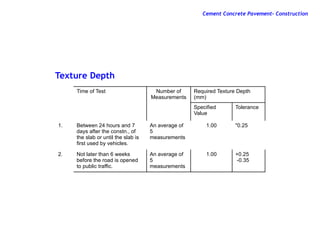
Texture Depth
Time of Test Number of
Measurements
Required Texture Depth
(mm)
Specified
Value
Tolerance
1. Between 24 hours and 7
days after the constn., of
the slab or until the slab is
first used by vehicles.
An average of
5
measurements
1.00 "0.25
2. Not later than 6 weeks
before the road is opened
to public traffic.
An average of
5
measurements
1.00 +0.25
-0.35
Cement Concrete Pavement- Construction
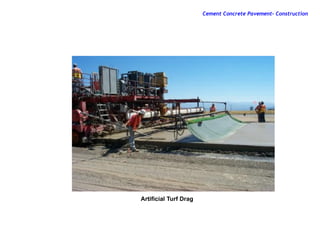
Artificial Turf Drag
Cement Concrete Pavement- Construction
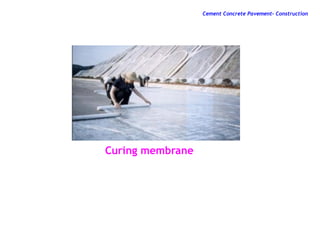
Curing
Immediately after the surface texturing, the surface
and sides of the slab - cured by the
- Application of approved resin-based aluminised
reflective curing compound which hardens into an
impervious film or membrane with the help of a
mechanical sprayer.
Cement Concrete Pavement- Construction
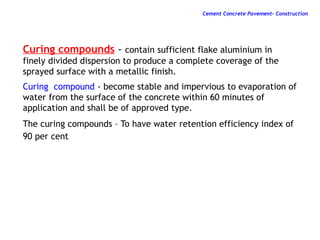
Curing compounds - contain sufficient flake aluminium in
finely divided dispersion to produce a complete coverage of the
sprayed surface with a metallic finish.
Curing compound - become stable and impervious to evaporation of
water from the surface of the concrete within 60 minutes of
application and shall be of approved type.
The curing compounds – To have water retention efficiency index of
90 per cent
Cement Concrete Pavement- Construction
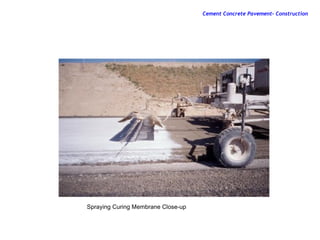
Spraying Curing Membrane Close-up
Cement Concrete Pavement- Construction
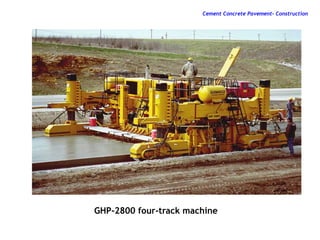
GHP-2800 four-track machine
Cement Concrete Pavement- Construction
Curing membrane
Cement Concrete Pavement- Construction
Trial length
Trial length - constructed at least one month in
advance of the proposed start of concrete paving
work
Cement Concrete Pavement- Construction

Lecture 10 PQC Production .pptx

  • 1.
    Pavement Quality Concrete(PQC) Production CE60136 Highway Construction Practice (3-0-0) IIT Kharagpur, Spring 2017
  • 2.
    Books/References • MORTH- Specificationsfor Roads and bridge works, 5th edition, New Delhi, 2013. • IRC 15 – Code of Practice for Construction of Jointed Plane concrete. • IRC:44 “Guidelines for Cement Concrete Mix Design for Pavements” • IRC:57 “Recommended Practice for Sealing of Joints in Concrete Pavements”
  • 3.
  • 4.
    PQC ingredients • Aggregate(Fine and coarse aggregates) • Water and • Cement • Chemical Admixtures (Optional) • Fly-ash/GGBS/Silica fumes (Optional) • Fibre • Steel Dowel Bars and Tie Bars • Materials for Joint Sealing
  • 5.
    PQC ingredients :Aggregates • Los Angeles Abrasion Test value ≤ 35
  • 6.
    PQC ingredients :Coarse Aggregate • Maximum aggregate size ≤ 31.5 • Water absorption ≤ 2 • Test for soundness (sodium sulphate/ magnesium sulphalte) • Combined flakiness and elongation index ≤ 35; AIV ≤ 30
  • 7.
    PQC ingredients :Fine Aggregate • Natural sand or crushed stone sand • Sand equivalent value ≥ 50
  • 8.
  • 9.
  • 10.
  • 11.
    PQC ingredients :Cement If the soil around concrete pavement has soluble salts like sulphates in excess of 0.5 percent, the cement shall be sulphate resistant.
  • 12.
    Construction steps • Pre-paving oSubgrade preparation o Base preparation • Paving o Mixing and transporting o Placing o Consolidation • Post-paving o Finishing o Texturing o Curing o Joint sawing and sealing • Smoothness
  • 13.
    PQC Mixing • Involvesthe batching and mixing of cement, aggregate, water and admixtures to form a ready-mixed concrete in accordance with the approved mix design. • There are three basic production methods: truck mixing, central mixing and shrink mixing. • Truck mixed PQC is dry batched into a concrete mixing truck then blended in the truck either at the batching plant or in route to the job site. • Central mixed PQC is batched and mixed in a central facility and then loaded into a truck for transport to the job site. • Shrink mixed PQC is partially mixed in a plant mixer and then discharged into a truck mixer where the mixing is completed.
  • 14.
    PQC Mixing: CentralMix Concrete Batch Plant
  • 15.
  • 16.
  • 17.
    PQC Transport • Involvesconveying PQC from a batching facility to a paving site including; o truck loading o weighing and ticketing o hauling to the paving site o mixing (if required) o agitation o placing o truck washing o truck return to the batching facility
  • 18.
    PQC Transport Transport practicescan affect such mix characteristics as (1) homogeneity, (2) workability, (3) water content and (4) air content. Transport considerations o Loading at the production facility o Truck drum/bed and chute cleanliness o Water management o Unloading at the paving site o Operation synchronization
  • 19.
    PQC Transport Truck Drum/Bedand Chute Cleanliness • At the production facility after loading (called “wash off”). • After unloading at the paving site (called “wash down • At the production facility at the end of the day (called “washout”).
  • 20.
    PQC Transport Unloading atthe Paving Site • Should be unloaded quickly when it arrives at the paving site. This will minimize the time available for water evaporation and excessive agitation. • Should be unloaded as close as possible to its final placement spot. This will prevent mix segregation that can occur if PQC is moved excessively.
  • 21.
    PQC Transport Operation Synchronization •To minimize accumulation of excess material • Number of trucks to be used. • Truck type. • Average truck hauling capacity. • Production facility output rate. • Availability and condition of materials at the production facility. • Time to wash off, down and out the transport truck. • Waiting time at the production facility. • Loading, weighing and ticketing time at the production facility. • Distance between the production facility and the paving site. • Average truck speed.
  • 22.
  • 23.
    Paving (Placing and Consolidation)-cement concrete Cement Concrete Pavement- Construction
  • 24.
    PQC Paving (Placingand Consolidation) There are two basic methods of building concrete pavement: fixed-form paving and slipform paving. • Slipform paving is defined as a process used to consolidate, form into geometric shape and surface finish a PQC mass by pulling the forms continuously through and surrounding the plastic concrete mass. • In fixed form paving, side forms are used to hold fresh PQC in place at the proper grade and alignment until it sets and hardens.
  • 25.
    Slipform paving : processused to consolidate, form into geometric shape and surface finish a PCC mass by pulling the forms continuously through and surrounding the plastic concrete mass. - appropriate for larger jobs that require high production rates. -Uses low-slump PCC. Low-slump PCC (on the order of 0 - 75 mm ) is necessary so that the fresh PCC is able to hold its shape once the slipform paver has passed. - Low slump PCC - less water and usually has higher compression and flexural strengths than comparable high slump mixes. High productivity. Slipform paving production rates - typically in the range of 65 - 100 m3/hr for mainline paving. That translates into between 70 - 90 m/hr of 3.66 m (12 ft.) wide, 250 mm thick PCC surface course. Smooth riding surface. Automation and computer control allow slipform pavers to produce very smooth riding surfaces (IRI on the order of 0.90 m/km or less). Cement Concrete Pavement- Construction
  • 26.
    Slipform paving : CementConcrete Pavement- Construction Slip Form Paving Train
  • 27.
    Cement Concrete Pavement-Construction Slip Form Paving Train Slipform paving :
  • 28.
    Paver : Performsscreeding, consolidation and initial finishing Some equipped to place reinforcing steel (dowel bars and tie bars) General steps- slip form paver First: an auger spreads the PCC in front of the strike off plate. Second: the strike off plate (screed) removes excess portions of the auger-placed PCC and brings the slab near its final elevation. Third: PCC is consolidated by a group of vibrators. Fourth: A tamper (typically operating between 0 and 150 strokes per minute), if present, pushes large aggregate particles below the slab surface. Fifth and Final: Profile pans level off the slab at the right elevation and provide initial finishing. Cement Concrete Pavement- Construction
  • 29.
  • 30.
  • 31.
    PCC Vibrators onthe Underside of a Paving Machine Cement Concrete Pavement- Construction
  • 32.
    Paving paths inoffset application Slip form paver: 1 m to 16 m width, thickness upto 450 mm Cement Concrete Pavement- Construction
  • 33.
    Highway construction- Automaticdower bar insertion Runways http://www.wirtgen.de/en/produkte/gleitschalungsfertiger/sp_850_vario/sp850vario_techartikel_3792.php#anc Cement Concrete Pavement- Construction
  • 34.
    Weather and SeasonalLimitations Concrete during monsoon months: When concrete is being placed during monsoon months and when it may be expected to rain- sufficient supply of tarpaulin or other water proof cloth shall be provided along the line of the work. Any time when it rains, all freshly laid concrete which had not been covered for curing purposes - adequately protected. Cement Concrete Pavement- Construction
  • 35.
    Concreting in hotweather: No concreting - when the concrete temperature is above 30 degree Centigrade. - High temperature, low relative humidity, excessive wind velocity, imminence of rains etc- tents on mobile trusses - provided over the freshly laid concrete for a minimum period of 3 hours To bring down the temperature, if necessary, chilled water or ice flakes should be made use of. No concreting - when the concrete temperature is below 5 degree Centigrade and the temperature is descending Cement Concrete Pavement- Construction
  • 36.
    Paving equipment: Fixed formor slip paver with independent units designed to (i) spread, (ii) consolidate, screed and float-finish, (iii) texture and cure the freshly placed concrete in one complete pass of the machine in such a manner that a minimum of hand finishing will be necessary and so as to provide a dense and homogeneous pavement in conformity with the plans and Specifications Vibrators - frequency of 8300 to 9600 impulses per minute under load at a maximum spacing of 60 cm Concrete saw- sufficient number of diamond-edge saw blades Cement Concrete Pavement- Construction
  • 37.
    Side Forms, Railsand Guidewires Fixed form paving machines (separate powered machines which spread , compact and finish concrete) Side forms and rails: All side forms - mild steel of depth equal to the thickness of pavement or slightly less to accommodate the surface regularity of the sub-base. The forms - placed on series of steel packing plates or shims to take care of irregularity of sub-base Cement Concrete Pavement- Construction
  • 38.
    Guidewire -slip form paving(power machine which spreads, compacts and finishes the concrete in a continuous operation ) -provided along both sides of the slab. -Each guidewire - at a constant height above and parallel to the required edges of the slab as described in the contract/drawing within a vertical tolerance of  3 mm Cement Concrete Pavement- Construction
  • 39.
    Construction by slipformpaver -compact the concrete by internal vibration and shape it between the side forms with either a conforming plate or by vibrating and oscillating finishing beams. -Concrete - deposited without segregation in front of slip form paver across the whole width and to a height which at all times is in excess of the required surcharge. -Deposited concrete - struck off to the necessary average and differential surcharge by means of the strike off plate or a screw auger device extending across the whole width of the slab. -The equipment for striking-off the concrete - capable of being rapidly adjusted for changes of the average and differential surcharge necessitated by change in slab thickness or crossfall. Cement Concrete Pavement- Construction
  • 40.
    - Level of theconforming plate and finishing beams - controlled automatically from the guide wires installed by sensors attached at the four corners of the slip form paving machine - Alignment and level of ancillary machines for finishing, texturing and curing of the concrete shall be automatically controlled relative to the guide wire or to the surface and edge of the slab Construction by slipform paver Cement Concrete Pavement- Construction
  • 41.
    Vibrators of variableoutput, with a maximum energy output of not less than 2.5 KW per metre width of slab per 300 mm depth of slab for a laying speed upto 1.5 m per minute or pro- rata for higher speeds. Machines - sufficient mass to provide adequate reaction during spreading and paving operations on the traction units to maintain forward movements during the placing of concrete in all situations. Construction by slipform paver Cement Concrete Pavement- Construction
  • 42.
    Surface texture After thefinal regulation of the slab and before the application of the curing membrane, the surface of concrete slab - brush- textured in a direction at right angles to the longitudinal axis of the carriageway Cement Concrete Pavement- Construction
  • 43.
    Brushed surface texture- applied evenly across the slab in one direction by the use of a wire brush not less than 450 mm wide but longer brushes are preferred. -made of 32 gauge tape wires grouped together in tufts spaced at 10 mm centres. -The tufts shall contain an average of 14 wires and initially be 100 mm long. -The brush - have two rows of tufts. -The rows shall be 20 mm apart and the tufts in one row shall be opposite the centre of the gap between tufts in the other row. -The brush - replaced when the shortest tuft wears down to 90 mm long Cement Concrete Pavement- Construction
  • 44.
    Texture Depth Time ofTest Number of Measurements Required Texture Depth (mm) Specified Value Tolerance 1. Between 24 hours and 7 days after the constn., of the slab or until the slab is first used by vehicles. An average of 5 measurements 1.00 "0.25 2. Not later than 6 weeks before the road is opened to public traffic. An average of 5 measurements 1.00 +0.25 -0.35 Cement Concrete Pavement- Construction
  • 45.
    Artificial Turf Drag CementConcrete Pavement- Construction
  • 46.
    Curing Immediately after thesurface texturing, the surface and sides of the slab - cured by the - Application of approved resin-based aluminised reflective curing compound which hardens into an impervious film or membrane with the help of a mechanical sprayer. Cement Concrete Pavement- Construction
  • 47.
    Curing compounds -contain sufficient flake aluminium in finely divided dispersion to produce a complete coverage of the sprayed surface with a metallic finish. Curing compound - become stable and impervious to evaporation of water from the surface of the concrete within 60 minutes of application and shall be of approved type. The curing compounds – To have water retention efficiency index of 90 per cent Cement Concrete Pavement- Construction
  • 48.
    Spraying Curing MembraneClose-up Cement Concrete Pavement- Construction
  • 49.
    GHP-2800 four-track machine CementConcrete Pavement- Construction
  • 50.
    Curing membrane Cement ConcretePavement- Construction
  • 51.
    Trial length Trial length- constructed at least one month in advance of the proposed start of concrete paving work Cement Concrete Pavement- Construction