International Research Journal of Engineering and Technology (IRJET) e-ISSN: 2395-0056
Volume: 09 Issue: 05 | May 2022 www.irjet.net p-ISSN: 2395-0072
© 2022, IRJET | Impact Factor value: 7.529 | ISO 9001:2008 Certified Journal | Page 71
Challenges and Opportunities of FPGA Acceleration in Big Data
Neetu Reji1, Smitha C Thomas2, Reshma Suku.3
1
M. Tech Student, Computer Science and Engineering, APJ Abdul Kalam Technological University, Kerala,India
23
Asst. Professor, Computer Science and Engineering, Mount Zion College of Engineering, Kadammanitta,
Kerala, India
---------------------------------------------------------------------***---------------------------------------------------------------------
Abstract - FPGA with customized IP helps to lower the
power consumption to accelerate computation intensive
segment for the application and optimize the performance. To
transfer raw data from source server to data ware house ETL
procedure is used in big data field. FPGA has been noticed in
the industry because of its performance- re-programmable
flexibility, per-power efficiency, and wide range of
applicableness. In this paper we will discuss how
programmable gate arrays help a Spark ETL workload to
reduce high CPU utilization issue. It should release more CPU
power to run some compute intensive jobs. Alsowe willdiscuss
about benefits of FPGA in deep learning applications for AI.
Key Words: Cloud computing, Computational Modeling,
Field Programmable Gate Arrays, Parallel Processing,
Flash EPROM.
1. INTRODUCTION
“Big Data” is a broad term fordatasets that are so large or
complex. Workflows are the task oriented and often require
more specific data than process. The Process is designedona
higher level scenarios that helps for decision making in
organizational level. Big Data workflow is best illustrated in
comparing traditionalITworkloadswithBigDataworkloads.
It may require many servers to run one application whereas
traditional IT workloads requires one server to run many
application. Big Data workloads run to the completion and
traditional IT workloads run forever. The scale of big data
will be representing the volume, velocity and variety of data.
Volume indicate how much amount of data is generated.
Velocity is used to indicate the speed of generating data and
data generated in real time. Variety indicates the wide range
in which the data can be encode.
To increasing the processing capacity has been a main
area of prior research. Examples include CPU optimizations
and the use of dedicatedhardwareacceleratorssuchasGPUs.
Another accelerator is the field programmable gate array or
FPGA. These FPGAs consist of a re-configurable fabric that
can be programmed to implement custom integrated circuit
(IC) designs. This work investigates how these FPGA
accelerators can be efficiently deployed to increase
processing capacity in a big data context.
Nowadays in every field of industry we are using some
form of data analytics. The impact and possibilities of
transparent and efficient integration of FPGAs in big data
frameworks are therefore limitless. The three areas of
applications that could benefit from FPGA accelerated big
data frameworks; applications with long-running queries,
latency sensitive applications, and applications that aim to
achieve a high energy efficiency.
Challenges: There are two mainchallengesinintegrating
FPGA accelerators with big data frameworks are
transparency and efficiency. The user should not be awareof
the FPGA acceleration and does not have to tune certain
parameters in the framework. It is important because
transparent integration lowers the barrier to adopt these
technologies. The system should autonomously identify
where and when certain parts of the computation can be
accelerated to achieve transparency. There are two factors
that play a role in the context of FPGA accelerators. First, the
initial cost of developing an FPGA. It is generally more time
consuming than software development for CPUs and GPUs,
and requires in-depth knowledgeaboutcircuitdesign.Lastly,
theseFPGAacceleratorsareexpensive.Theindustrystandard
is to run big data applications in a cloud environment so
there is no need for end-users to buy any specialized
hardware.
FPGA is an IC form that have internal logic design which we
can configure after manufacturing helps programmer to
implement different IC without having to go through the
manufacturing process, which is time consuming and
expensive. This reconfiguration of the FPGA is done using
description language. Data is processed in a dataflow
manner. FPGAs implementing dataflow-oriented
architectures with high levels of (pipeline) parallelism can
provide high application throughput, often providing high
energy efficiency. Latency-sensitive applications can
leverage FPGA accelerators by directly connecting to the
physical layer of a network, and perform data
transformations without going through the software stacks
of the host system. While these advantages of FPGA
accelerators hold promise, difficulties associated with
programming and integration limit their use.
It can be integrated into big data systems, can discriminate
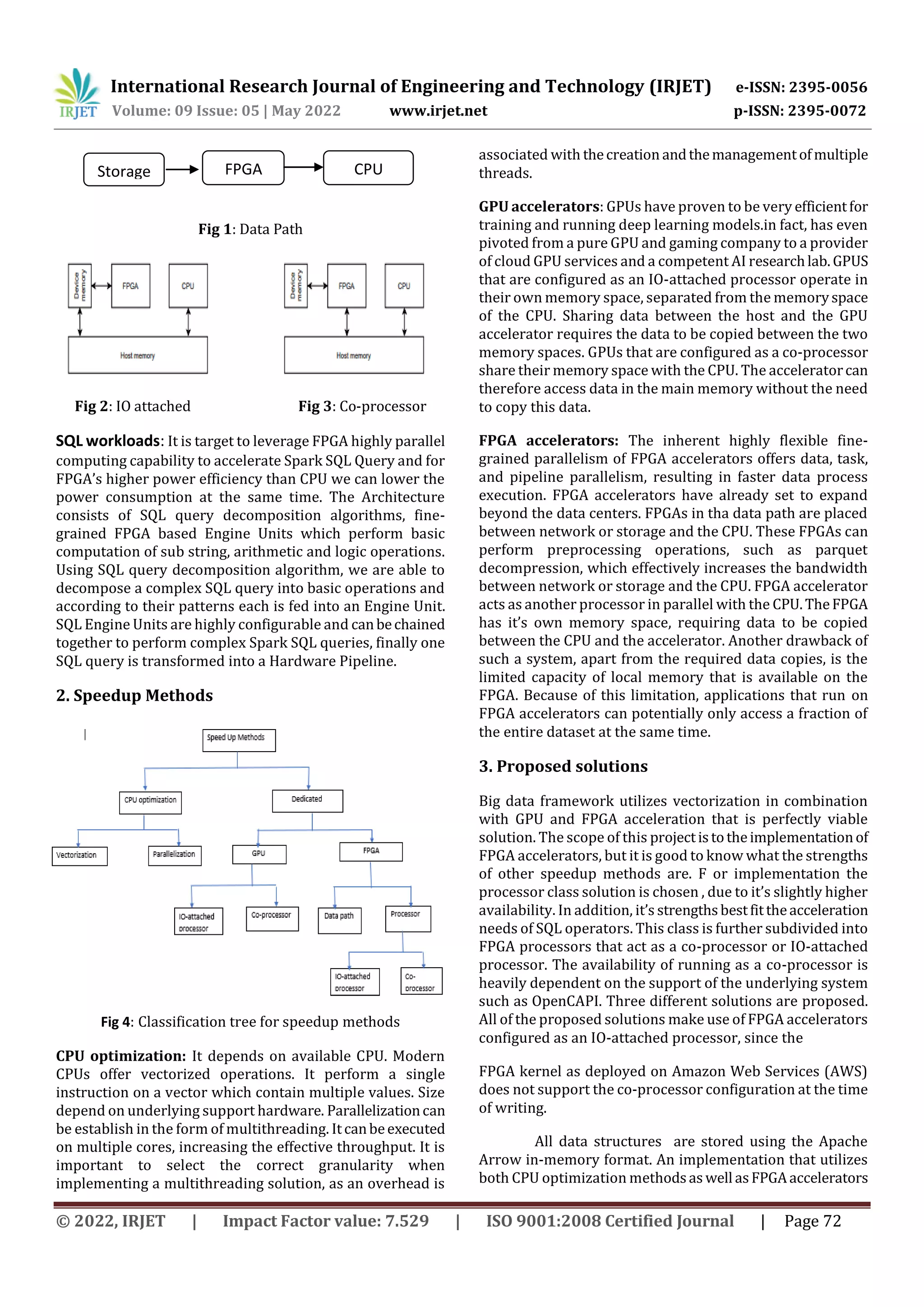
into three configuration of the FPGA in the system. The
accelerator can either be placed in the data path between
network or storage and the CPU. It can be made between an
IO-attached accelerator, where the FPGA has its own
memory space, and a co-processor, in which the FPGA and
the CPU communicate through shared memory.
International Research Journal of Engineering and Technology (IRJET) e-ISSN: 2395-0056
Volume: 09 Issue: 05 | May 2022 www.irjet.net p-ISSN: 2395-0072
© 2022, IRJET | Impact Factor value: 7.529 | ISO 9001:2008 Certified Journal | Page 72
Fig 1: Data Path
Fig 2: IO attached Fig 3: Co-processor
SQL workloads: It is target to leverage FPGA highly parallel
computing capability to accelerate Spark SQL Query and for
FPGA’s higher power efficiency than CPU we can lower the
power consumption at the same time. The Architecture
consists of SQL query decomposition algorithms, fine-
grained FPGA based Engine Units which perform basic
computation of sub string, arithmetic and logic operations.
Using SQL query decomposition algorithm, we are able to
decompose a complex SQL query into basic operations and
according to their patterns each is fed into an Engine Unit.
SQL Engine Units are highly configurable and canbechained
together to perform complex Spark SQL queries, finally one
SQL query is transformed into a Hardware Pipeline.
2. Speedup Methods
Fig 4: Classification tree for speedup methods
CPU optimization: It depends on available CPU. Modern
CPUs offer vectorized operations. It perform a single
instruction on a vector which contain multiple values. Size
depend on underlying support hardware. Parallelizationcan
be establish in the form of multithreading. Itcanbeexecuted
on multiple cores, increasing the effective throughput. It is
important to select the correct granularity when
implementing a multithreading solution, as an overhead is
associated with thecreation andthemanagementofmultiple
threads.
FPGA accelerators: The inherent highly flexible fine-
grained parallelism of FPGA accelerators offers data, task,
and pipeline parallelism, resulting in faster data process
execution. FPGA accelerators have already set to expand
beyond the data centers. FPGAs in tha data path are placed
between network or storage and the CPU. These FPGAs can
perform preprocessing operations, such as parquet
decompression, which effectively increases the bandwidth
between network or storage and the CPU. FPGA accelerator
acts as another processor in parallel with the CPU.TheFPGA
has it’s own memory space, requiring data to be copied
between the CPU and the accelerator. Another drawback of
such a system, apart from the required data copies, is the
limited capacity of local memory that is available on the
FPGA. Because of this limitation, applications that run on
FPGA accelerators can potentially only access a fraction of
the entire dataset at the same time.
3. Proposed solutions
Big data framework utilizes vectorization in combination
with GPU and FPGA acceleration that is perfectly viable
solution. The scope of this projectistotheimplementationof
FPGA accelerators, but it is good to know what the strengths
of other speedup methods are. F or implementation the
processor class solution is chosen , due to it’s slightly higher
availability. In addition, it’s strengthsbestfittheacceleration
needs of SQL operators. This class is further subdivided into
FPGA processors that act as a co-processor or IO-attached
processor. The availability of running as a co-processor is
heavily dependent on the support of the underlying system
such as OpenCAPI. Three different solutions are proposed.
All of the proposed solutions make use of FPGA accelerators
configured as an IO-attached processor, since the
FPGA kernel as deployed on Amazon Web Services (AWS)
does not support the co-processor configuration at the time
of writing.
All data structures are stored using the Apache
Arrow in-memory format. An implementation that utilizes
both CPU optimization methodsas well asFPGAaccelerators
Storage FPGA CPU
GPU accelerators: GPUs have proven to be very efficientfor
training and running deep learning models.in fact, has even
pivoted from a pure GPU and gaming company to a provider
of cloud GPU services and a competent AI researchlab. GPUS
that are configured as an IO-attached processor operate in
their own memory space, separated from the memoryspace
of the CPU. Sharing data between the host and the GPU
accelerator requires the data to be copied between the two
memory spaces. GPUs that are configured as a co-processor
share their memory space with the CPU. The acceleratorcan
therefore access data in the main memory without the need
to copy this data.
International Research Journal of Engineering and Technology (IRJET) e-ISSN: 2395-0056
Volume: 09 Issue: 05 | May 2022 www.irjet.net p-ISSN: 2395-0072
© 2022, IRJET | Impact Factor value: 7.529 | ISO 9001:2008 Certified Journal | Page 73
is a good demonstration of multiple big data speedup
methods working together. Another it is chosen as the
second framework for acceleration with FPGA accelerators
configured as processors. These are identified as the most
promising candidates for integration based on the required
development effort, expected performance, and potential
impact. Finally, Dask distributed is selected for the third
integration. It is specifically designed to run in a cluster
setting and is therefore the perfect candidatetoinvestigate a
cluster deployment with anaccelerationaware worker node.
4.Implementation
Sabot planner is based on the open-source Apache Calcite
SQL optimizer.An FPGA kernel that can perform regular
expression matching is selectedforintegration.Itisextended
in two places : planner & operator package. Sabot planner
has number of planning phases.Each phase transpose the
coming execution tree by use of a number of optimization
rules.The validation phase validates the query based on the
schema of the dataset. In the next phase, the SQL query is
parsed and converted to an expression tree of logical
operations. This tree is then optimized ina numberoflogical
planning phases.
Fig 5: Sabot planner phases including the new FPGA
acceleration planning phase.
Developing an efficient FPGA implementation of a SQL
operator islaborintensive.FPGAaccelerationplanningphase
such that they can match the optimization rules in cases
where they normally would not. The FPGA acceleration
planning phase transforms the physical execution plan by
substituting the filter operator with the accelerated
version.The accelerated operator can either offload the
evaluation of the filter to the RE2 library or to an FPGA
accelerator through the Tidre package.The the results of
accelerating Dremio with the RE2library,whichimplements
a regular expression engine optimized for the CPU.
Fig 6: Execution plan transformation for the regular
expression use case.
Dask distributed is a different version of Dask which can be
run on a cluster. It provides the potential foraddedcompute
power and parallelization, but at the same time it also adds
additional complexity. The client node is controlled by the
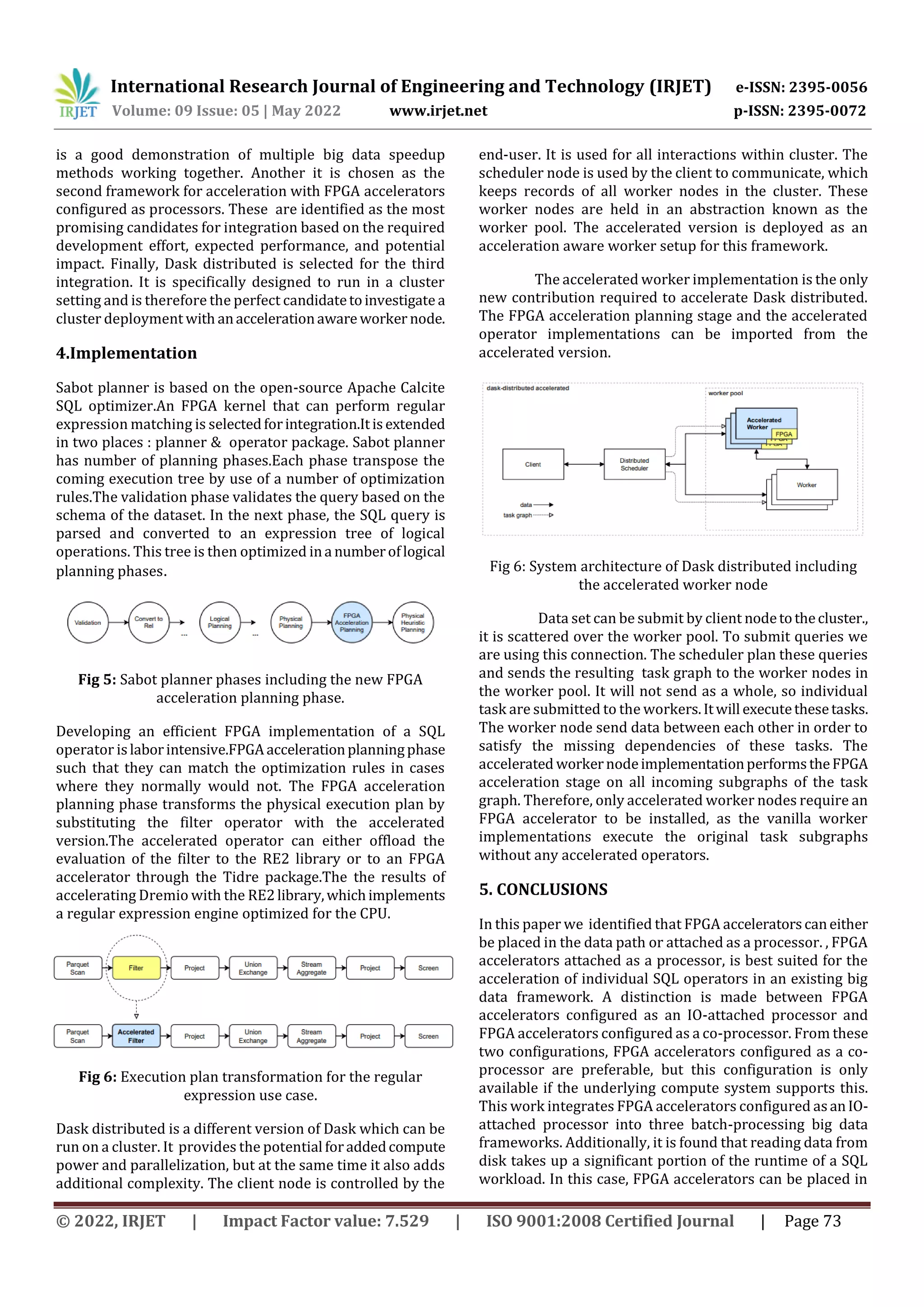
end-user. It is used for all interactions within cluster. The
scheduler node is used by the client to communicate, which
keeps records of all worker nodes in the cluster. These
worker nodes are held in an abstraction known as the
worker pool. The accelerated version is deployed as an
acceleration aware worker setup for this framework.
The accelerated worker implementation is the only
new contribution required to accelerate Dask distributed.
The FPGA acceleration planning stage and the accelerated
operator implementations can be imported from the
accelerated version.
Fig 6: System architecture of Dask distributed including
the accelerated worker node
Data set can be submit by client nodetothecluster.,
it is scattered over the worker pool. To submit queries we
are using this connection. The scheduler plan these queries
and sends the resulting task graph to the worker nodes in
the worker pool. It will not send as a whole, so individual
task are submitted to the workers.Itwill executethesetasks.
The worker node send data between each other in order to
satisfy the missing dependencies of these tasks. The
accelerated workernodeimplementationperformstheFPGA
acceleration stage on all incoming subgraphs of the task
graph. Therefore, only accelerated worker nodes require an
FPGA accelerator to be installed, as the vanilla worker
implementations execute the original task subgraphs
without any accelerated operators.
5. CONCLUSIONS
In this paper we identified that FPGA acceleratorscaneither
be placed in the data path or attached as a processor. , FPGA
accelerators attached as a processor, is best suited for the
acceleration of individual SQL operators in an existing big
data framework. A distinction is made between FPGA
accelerators configured as an IO-attached processor and
FPGA accelerators configured as a co-processor. From these
two configurations, FPGA accelerators configured as a co-
processor are preferable, but this configuration is only
available if the underlying compute system supports this.
This work integrates FPGA accelerators configured asanIO-
attached processor into three batch-processing big data
frameworks. Additionally, it is found that reading data from
disk takes up a significant portion of the runtime of a SQL
workload. In this case, FPGA accelerators can be placed in
International Research Journal of Engineering and Technology (IRJET) e-ISSN: 2395-0056
Volume: 09 Issue: 05 | May 2022 www.irjet.net p-ISSN: 2395-0072
© 2022, IRJET | Impact Factor value: 7.529 | ISO 9001:2008 Certified Journal | Page 74
between storage and the CPU. These accelerators could
perform algorithms such as parquet decompression,
projection, or filtering to reduce the runtime of these
operations. Two absolute requirements for the efficient
integration of FPGA accelerator in big data frameworks are
the presence of a flexible API for the manipulation of
execution plans and the use of a hardware-friendly and
language-independent in-memory data format such as
Apache Arrow.
REFERENCES
[1] Robert Chang. A beginner’s guide to data engineering —
part ii, . URL https://medium. com/@rchang/a-
beginners-guide-to-data-engineering-part-ii-
47c4e7cbda71. accessed on 2021-06-09.
[2] https://ieeexplore.ieee.org/document/9439431/metric
s#metrics
[3] https://www.semanticscholar.org/paper/FPGA-
Acceleration-for-Big-Data-Analytics%3A-and-
Hoozemans-
Peltenburg/76c087bd67124a3b3d8df3c8100564d14cf
5f1b0
[4] https://www.stemmer-imaging.com/en/technical-
tips/introduction-to-fpga-
acceleration/#:~:text=An%20FPGA%20(Field%20Prog
rammable%20Gate,together%20in%20many%20differe
nt%20ways
[5] https://www.intel.com/content/www/us/en/artificial-
intelligence/programmable/fpga-gpu.html.
[6] https://bdtechtalks.com/2020/11/09/fpga-vs-gpu-
deep-learning/
[7] https://sites.usc.edu/fpga/big-data-analytics-on-
heterogeneous-architectures/
[8] https://www.datacenterdynamics.com/en/opinions/tu
rning-big-data-challenges-opportunities-fpga-
accelerated-computing/
Neetu Reji, currently pursuing
MTech degreeinComputerScience
and Engineering from APJ Abdul
Kalam Technological University,
Kerala, India at Mount ZionCollege
of Engineering, Kadammanitta,
Kerala, India.
Smitha C Thomas received the
MTech degree in Computerscience
and Engineering.. She is currently
working as Assistant Professor in
the Department of Computer
science and Engineering at Mount
Zion College of Engineering,
Kadammanitta, Kerala, India.
Reshma Suku received the MTech
degree in Computer science and
Engineering.. She is currently
working as Assistant Professor in
the Department of Computer
science and Engineering at Mount
Zion College of Engineering,
Kadammanitta, Kerala, India.
BIOGRAPHIES

Challenges and Opportunities of FPGA Acceleration in Big Data

  • 1.
    International Research Journalof Engineering and Technology (IRJET) e-ISSN: 2395-0056 Volume: 09 Issue: 05 | May 2022 www.irjet.net p-ISSN: 2395-0072 © 2022, IRJET | Impact Factor value: 7.529 | ISO 9001:2008 Certified Journal | Page 71 Challenges and Opportunities of FPGA Acceleration in Big Data Neetu Reji1, Smitha C Thomas2, Reshma Suku.3 1 M. Tech Student, Computer Science and Engineering, APJ Abdul Kalam Technological University, Kerala,India 23 Asst. Professor, Computer Science and Engineering, Mount Zion College of Engineering, Kadammanitta, Kerala, India ---------------------------------------------------------------------***--------------------------------------------------------------------- Abstract - FPGA with customized IP helps to lower the power consumption to accelerate computation intensive segment for the application and optimize the performance. To transfer raw data from source server to data ware house ETL procedure is used in big data field. FPGA has been noticed in the industry because of its performance- re-programmable flexibility, per-power efficiency, and wide range of applicableness. In this paper we will discuss how programmable gate arrays help a Spark ETL workload to reduce high CPU utilization issue. It should release more CPU power to run some compute intensive jobs. Alsowe willdiscuss about benefits of FPGA in deep learning applications for AI. Key Words: Cloud computing, Computational Modeling, Field Programmable Gate Arrays, Parallel Processing, Flash EPROM. 1. INTRODUCTION “Big Data” is a broad term fordatasets that are so large or complex. Workflows are the task oriented and often require more specific data than process. The Process is designedona higher level scenarios that helps for decision making in organizational level. Big Data workflow is best illustrated in comparing traditionalITworkloadswithBigDataworkloads. It may require many servers to run one application whereas traditional IT workloads requires one server to run many application. Big Data workloads run to the completion and traditional IT workloads run forever. The scale of big data will be representing the volume, velocity and variety of data. Volume indicate how much amount of data is generated. Velocity is used to indicate the speed of generating data and data generated in real time. Variety indicates the wide range in which the data can be encode. To increasing the processing capacity has been a main area of prior research. Examples include CPU optimizations and the use of dedicatedhardwareacceleratorssuchasGPUs. Another accelerator is the field programmable gate array or FPGA. These FPGAs consist of a re-configurable fabric that can be programmed to implement custom integrated circuit (IC) designs. This work investigates how these FPGA accelerators can be efficiently deployed to increase processing capacity in a big data context. Nowadays in every field of industry we are using some form of data analytics. The impact and possibilities of transparent and efficient integration of FPGAs in big data frameworks are therefore limitless. The three areas of applications that could benefit from FPGA accelerated big data frameworks; applications with long-running queries, latency sensitive applications, and applications that aim to achieve a high energy efficiency. Challenges: There are two mainchallengesinintegrating FPGA accelerators with big data frameworks are transparency and efficiency. The user should not be awareof the FPGA acceleration and does not have to tune certain parameters in the framework. It is important because transparent integration lowers the barrier to adopt these technologies. The system should autonomously identify where and when certain parts of the computation can be accelerated to achieve transparency. There are two factors that play a role in the context of FPGA accelerators. First, the initial cost of developing an FPGA. It is generally more time consuming than software development for CPUs and GPUs, and requires in-depth knowledgeaboutcircuitdesign.Lastly, theseFPGAacceleratorsareexpensive.Theindustrystandard is to run big data applications in a cloud environment so there is no need for end-users to buy any specialized hardware. FPGA is an IC form that have internal logic design which we can configure after manufacturing helps programmer to implement different IC without having to go through the manufacturing process, which is time consuming and expensive. This reconfiguration of the FPGA is done using description language. Data is processed in a dataflow manner. FPGAs implementing dataflow-oriented architectures with high levels of (pipeline) parallelism can provide high application throughput, often providing high energy efficiency. Latency-sensitive applications can leverage FPGA accelerators by directly connecting to the physical layer of a network, and perform data transformations without going through the software stacks of the host system. While these advantages of FPGA accelerators hold promise, difficulties associated with programming and integration limit their use. It can be integrated into big data systems, can discriminate into three configuration of the FPGA in the system. The accelerator can either be placed in the data path between network or storage and the CPU. It can be made between an IO-attached accelerator, where the FPGA has its own memory space, and a co-processor, in which the FPGA and the CPU communicate through shared memory.
  • 2.
    International Research Journalof Engineering and Technology (IRJET) e-ISSN: 2395-0056 Volume: 09 Issue: 05 | May 2022 www.irjet.net p-ISSN: 2395-0072 © 2022, IRJET | Impact Factor value: 7.529 | ISO 9001:2008 Certified Journal | Page 72 Fig 1: Data Path Fig 2: IO attached Fig 3: Co-processor SQL workloads: It is target to leverage FPGA highly parallel computing capability to accelerate Spark SQL Query and for FPGA’s higher power efficiency than CPU we can lower the power consumption at the same time. The Architecture consists of SQL query decomposition algorithms, fine- grained FPGA based Engine Units which perform basic computation of sub string, arithmetic and logic operations. Using SQL query decomposition algorithm, we are able to decompose a complex SQL query into basic operations and according to their patterns each is fed into an Engine Unit. SQL Engine Units are highly configurable and canbechained together to perform complex Spark SQL queries, finally one SQL query is transformed into a Hardware Pipeline. 2. Speedup Methods Fig 4: Classification tree for speedup methods CPU optimization: It depends on available CPU. Modern CPUs offer vectorized operations. It perform a single instruction on a vector which contain multiple values. Size depend on underlying support hardware. Parallelizationcan be establish in the form of multithreading. Itcanbeexecuted on multiple cores, increasing the effective throughput. It is important to select the correct granularity when implementing a multithreading solution, as an overhead is associated with thecreation andthemanagementofmultiple threads. FPGA accelerators: The inherent highly flexible fine- grained parallelism of FPGA accelerators offers data, task, and pipeline parallelism, resulting in faster data process execution. FPGA accelerators have already set to expand beyond the data centers. FPGAs in tha data path are placed between network or storage and the CPU. These FPGAs can perform preprocessing operations, such as parquet decompression, which effectively increases the bandwidth between network or storage and the CPU. FPGA accelerator acts as another processor in parallel with the CPU.TheFPGA has it’s own memory space, requiring data to be copied between the CPU and the accelerator. Another drawback of such a system, apart from the required data copies, is the limited capacity of local memory that is available on the FPGA. Because of this limitation, applications that run on FPGA accelerators can potentially only access a fraction of the entire dataset at the same time. 3. Proposed solutions Big data framework utilizes vectorization in combination with GPU and FPGA acceleration that is perfectly viable solution. The scope of this projectistotheimplementationof FPGA accelerators, but it is good to know what the strengths of other speedup methods are. F or implementation the processor class solution is chosen , due to it’s slightly higher availability. In addition, it’s strengthsbestfittheacceleration needs of SQL operators. This class is further subdivided into FPGA processors that act as a co-processor or IO-attached processor. The availability of running as a co-processor is heavily dependent on the support of the underlying system such as OpenCAPI. Three different solutions are proposed. All of the proposed solutions make use of FPGA accelerators configured as an IO-attached processor, since the FPGA kernel as deployed on Amazon Web Services (AWS) does not support the co-processor configuration at the time of writing. All data structures are stored using the Apache Arrow in-memory format. An implementation that utilizes both CPU optimization methodsas well asFPGAaccelerators Storage FPGA CPU GPU accelerators: GPUs have proven to be very efficientfor training and running deep learning models.in fact, has even pivoted from a pure GPU and gaming company to a provider of cloud GPU services and a competent AI researchlab. GPUS that are configured as an IO-attached processor operate in their own memory space, separated from the memoryspace of the CPU. Sharing data between the host and the GPU accelerator requires the data to be copied between the two memory spaces. GPUs that are configured as a co-processor share their memory space with the CPU. The acceleratorcan therefore access data in the main memory without the need to copy this data.
  • 3.
    International Research Journalof Engineering and Technology (IRJET) e-ISSN: 2395-0056 Volume: 09 Issue: 05 | May 2022 www.irjet.net p-ISSN: 2395-0072 © 2022, IRJET | Impact Factor value: 7.529 | ISO 9001:2008 Certified Journal | Page 73 is a good demonstration of multiple big data speedup methods working together. Another it is chosen as the second framework for acceleration with FPGA accelerators configured as processors. These are identified as the most promising candidates for integration based on the required development effort, expected performance, and potential impact. Finally, Dask distributed is selected for the third integration. It is specifically designed to run in a cluster setting and is therefore the perfect candidatetoinvestigate a cluster deployment with anaccelerationaware worker node. 4.Implementation Sabot planner is based on the open-source Apache Calcite SQL optimizer.An FPGA kernel that can perform regular expression matching is selectedforintegration.Itisextended in two places : planner & operator package. Sabot planner has number of planning phases.Each phase transpose the coming execution tree by use of a number of optimization rules.The validation phase validates the query based on the schema of the dataset. In the next phase, the SQL query is parsed and converted to an expression tree of logical operations. This tree is then optimized ina numberoflogical planning phases. Fig 5: Sabot planner phases including the new FPGA acceleration planning phase. Developing an efficient FPGA implementation of a SQL operator islaborintensive.FPGAaccelerationplanningphase such that they can match the optimization rules in cases where they normally would not. The FPGA acceleration planning phase transforms the physical execution plan by substituting the filter operator with the accelerated version.The accelerated operator can either offload the evaluation of the filter to the RE2 library or to an FPGA accelerator through the Tidre package.The the results of accelerating Dremio with the RE2library,whichimplements a regular expression engine optimized for the CPU. Fig 6: Execution plan transformation for the regular expression use case. Dask distributed is a different version of Dask which can be run on a cluster. It provides the potential foraddedcompute power and parallelization, but at the same time it also adds additional complexity. The client node is controlled by the end-user. It is used for all interactions within cluster. The scheduler node is used by the client to communicate, which keeps records of all worker nodes in the cluster. These worker nodes are held in an abstraction known as the worker pool. The accelerated version is deployed as an acceleration aware worker setup for this framework. The accelerated worker implementation is the only new contribution required to accelerate Dask distributed. The FPGA acceleration planning stage and the accelerated operator implementations can be imported from the accelerated version. Fig 6: System architecture of Dask distributed including the accelerated worker node Data set can be submit by client nodetothecluster., it is scattered over the worker pool. To submit queries we are using this connection. The scheduler plan these queries and sends the resulting task graph to the worker nodes in the worker pool. It will not send as a whole, so individual task are submitted to the workers.Itwill executethesetasks. The worker node send data between each other in order to satisfy the missing dependencies of these tasks. The accelerated workernodeimplementationperformstheFPGA acceleration stage on all incoming subgraphs of the task graph. Therefore, only accelerated worker nodes require an FPGA accelerator to be installed, as the vanilla worker implementations execute the original task subgraphs without any accelerated operators. 5. CONCLUSIONS In this paper we identified that FPGA acceleratorscaneither be placed in the data path or attached as a processor. , FPGA accelerators attached as a processor, is best suited for the acceleration of individual SQL operators in an existing big data framework. A distinction is made between FPGA accelerators configured as an IO-attached processor and FPGA accelerators configured as a co-processor. From these two configurations, FPGA accelerators configured as a co- processor are preferable, but this configuration is only available if the underlying compute system supports this. This work integrates FPGA accelerators configured asanIO- attached processor into three batch-processing big data frameworks. Additionally, it is found that reading data from disk takes up a significant portion of the runtime of a SQL workload. In this case, FPGA accelerators can be placed in
  • 4.
    International Research Journalof Engineering and Technology (IRJET) e-ISSN: 2395-0056 Volume: 09 Issue: 05 | May 2022 www.irjet.net p-ISSN: 2395-0072 © 2022, IRJET | Impact Factor value: 7.529 | ISO 9001:2008 Certified Journal | Page 74 between storage and the CPU. These accelerators could perform algorithms such as parquet decompression, projection, or filtering to reduce the runtime of these operations. Two absolute requirements for the efficient integration of FPGA accelerator in big data frameworks are the presence of a flexible API for the manipulation of execution plans and the use of a hardware-friendly and language-independent in-memory data format such as Apache Arrow. REFERENCES [1] Robert Chang. A beginner’s guide to data engineering — part ii, . URL https://medium. com/@rchang/a- beginners-guide-to-data-engineering-part-ii- 47c4e7cbda71. accessed on 2021-06-09. [2] https://ieeexplore.ieee.org/document/9439431/metric s#metrics [3] https://www.semanticscholar.org/paper/FPGA- Acceleration-for-Big-Data-Analytics%3A-and- Hoozemans- Peltenburg/76c087bd67124a3b3d8df3c8100564d14cf 5f1b0 [4] https://www.stemmer-imaging.com/en/technical- tips/introduction-to-fpga- acceleration/#:~:text=An%20FPGA%20(Field%20Prog rammable%20Gate,together%20in%20many%20differe nt%20ways [5] https://www.intel.com/content/www/us/en/artificial- intelligence/programmable/fpga-gpu.html. [6] https://bdtechtalks.com/2020/11/09/fpga-vs-gpu- deep-learning/ [7] https://sites.usc.edu/fpga/big-data-analytics-on- heterogeneous-architectures/ [8] https://www.datacenterdynamics.com/en/opinions/tu rning-big-data-challenges-opportunities-fpga- accelerated-computing/ Neetu Reji, currently pursuing MTech degreeinComputerScience and Engineering from APJ Abdul Kalam Technological University, Kerala, India at Mount ZionCollege of Engineering, Kadammanitta, Kerala, India. Smitha C Thomas received the MTech degree in Computerscience and Engineering.. She is currently working as Assistant Professor in the Department of Computer science and Engineering at Mount Zion College of Engineering, Kadammanitta, Kerala, India. Reshma Suku received the MTech degree in Computer science and Engineering.. She is currently working as Assistant Professor in the Department of Computer science and Engineering at Mount Zion College of Engineering, Kadammanitta, Kerala, India. BIOGRAPHIES