Previous Issue: 30 March 2005 Next Planned Update: 4 October 2014
Revised paragraphs are indicated in the right margin Page 1 of 10
Primary contact: Awwami, Adnan Ni'Mah on 966-3-8760230
Copyright©Saudi Aramco 2009. All rights reserved.
Engineering Standard
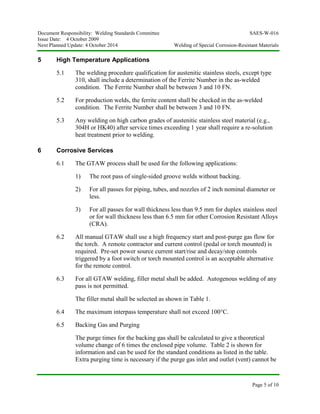
SAES-W-016 4 October 2009
Welding of Special Corrosion-Resistant Materials
Welding Standards Committee Members
Awwami, Adnan N., Chairman
Rao, Sanyasi X., Vice Chairman
Carrera, Rene L.
Carswell, Raymond J.
Chiang, Howard
Juraifani, Hatim H.
Keen, Peter David
Muslim, Husain Muhammad
Nasir, Ghalib Taher
Nasri, Nadhir Ibrahim
Niemeyer, Dennis Charles
Sabti, Tareq Ibrahim
Saudi Aramco DeskTop Standards
Table of Contents
1 Scope............................................................ 2
2 Conflicts and Deviations................................ 3
3 References.................................................... 3
4 General.......................................................... 4
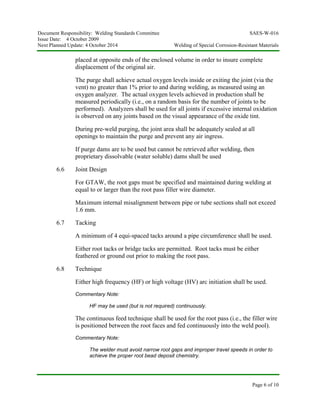
5 High Temperature Applications..................... 5
6 Corrosive Services........................................ 5
7 Special Requirements for Duplex
Stainless Steels..................................... 8
Document Responsibility: Welding Standards Committee SAES-W-016
Issue Date: 4 October 2009
Next Planned Update: 4 October 2014 Welding of Special Corrosion-Resistant Materials
Page 2 of 10
1 Scope
1.1 This standard specifies the requirements for welding and testing of special
corrosion-resistant piping materials. This is defined as stainless steel and nickel-
based alloys for piping in severe corrosion service and high temperature service,
as defined below.
Severe corrosion service is defined as:
a) Any service listed in SAES-L-032 which specifies the use of either
austenitic stainless steel, excluding types 304/304L/316/316L, or nickel-
based alloys.
b) Any service that uses duplex stainless steels.
Commentary Note:
Use of stainless steel or nickel-based alloys for product cleanliness (e.g., lube oil
piping or aircraft refueling facilities) or mechanical properties (e.g., low
temperature service requiring impact toughness) are not included.
High temperature service is defined as any application with a design temperature
above 427°C.
Additional requirements for duplex stainless steel for any service are included.
Strip lining and weld overlay applications are not included.
Commentary Note:
Refer to SAES-W-014 for welding requirements for overlays and SAES-W-015 for
strip lining requirements.
This standard is to be considered as a supplement to SAES-W-011. Other
applications (e.g., vessels, heat exchangers, valves, or pumps) may also be
subject to this standard if the application standard or job specification makes
reference to this standard. These requirements are in addition to the
requirements of ASME SEC IX.
This entire standard may be attached to and made part of purchase orders.
1.2 Additional requirements may be contained in Scopes of Work, Drawings, or
other Instructions or Specifications pertaining to specific items of work.
1.3 Any reference to Consulting Services Department (CSD) shall be interpreted as
the CSD Welding Specialist or a representative designated by CSD.
Document Responsibility: Welding Standards Committee SAES-W-016
Issue Date: 4 October 2009
Next Planned Update: 4 October 2014 Welding of Special Corrosion-Resistant Materials
Page 3 of 10
2 Conflicts and Deviations
2.1 Any conflicts between this Standard and other applicable Saudi Aramco
Engineering Standards (SAESs), Materials System Specifications (SAMSSs),
Standard Drawings (SASDs), or industry standards, codes, and forms shall be
resolved in writing by the Company or Buyer Representative through the
Manager, Consulting Services Department of Saudi Aramco, Dhahran.
2.2 Direct all requests to deviate from this standard in writing to the Company or
Buyer Representative, who shall follow internal company procedure SAEP-302
and forward such requests to the Manager, Consulting Services Department of
Saudi Aramco, Dhahran.
3 References
The selection of material and equipment, and the design, construction, maintenance, and
repair of equipment and facilities covered by this standard shall comply with the latest
edition of the references listed below, unless otherwise noted.
3.1 Saudi Aramco References
Saudi Aramco Engineering Procedure
SAEP-302 Instructions for Obtaining a Waiver of a
Mandatory Saudi Aramco Engineering
Requirement
Saudi Aramco Engineering Standards
SAES-L-032 Material Selection for Piping Systems
SAES-W-011 Welding Requirements for On-Plot Piping
Saudi Aramco Standard Drawing
AB-036386 Hardness Testing for Welding Procedure
Qualifications
3.2 Industry Codes and Standards
American Society of Mechanical Engineers
ASME SEC IX Welding and Brazing Qualifications
ASME B31.3 Chemical Plant and Petroleum Refinery Piping
Document Responsibility: Welding Standards Committee SAES-W-016
Issue Date: 4 October 2009
Next Planned Update: 4 October 2014 Welding of Special Corrosion-Resistant Materials
Page 4 of 10
American Society for Testing and Materials
ASTM A833 Indentation Hardness of Metallic Materials by
Comparison Hardness Testers
ASTM E140 Hardness Conversion Tables for Metals
ASTM E562 Standard Test Method for Determining Volume
Fraction by Systematic Manual Point Count
ASTM G48 Standard Test Methods for Pitting and Crevice
Corrosion Resistance of Stainless Steels and
Related Alloys by the Use of Ferric Chloride
Solution
American Welding Society
AWS A4.2 Standard Procedures for Calibrating Magnetic
Instruments to Measure the Delta Ferrite
Content of Austenitic and Duplex Austenitic-
Ferritic Stainless Steel Weld Metal
National Association of Corrosion Engineers/International Standardization
Organization
NACE MR0175/ISO 15156 Petroleum and Natural Gas Industries-
Materials for use in H2S-Containing
Environments in Oil and Gas Production
4 General
4.1 All welding procedures shall be qualified in accordance with ASME SEC IX
plus the additional requirements of SAES-W-011 and this standard.
4.2 Ferrite measurements shall be performed in accordance with AWS A4.2.
4.3 Abrasive tooling and/or grinding disks shall not have been used on either carbon
steel or any other grade of stainless steel material. The selection of grinding and
cleaning tools shall be appropriate for the base material, e.g., carbon steel
brushes shall not be used on stainless steel material.
4.4 All filler materials should be individually and clearly stamped, flagged or
stenciled to ensure traceability and correct usage on site.
Document Responsibility: Welding Standards Committee SAES-W-016
Issue Date: 4 October 2009
Next Planned Update: 4 October 2014 Welding of Special Corrosion-Resistant Materials
Page 5 of 10
5 High Temperature Applications
5.1 The welding procedure qualification for austenitic stainless steels, except type
310, shall include a determination of the Ferrite Number in the as-welded
condition. The Ferrite Number shall be between 3 and 10 FN.
5.2 For production welds, the ferrite content shall be checked in the as-welded
condition. The Ferrite Number shall be between 3 and 10 FN.
5.3 Any welding on high carbon grades of austenitic stainless steel material (e.g.,
304H or HK40) after service times exceeding 1 year shall require a re-solution
heat treatment prior to welding.
6 Corrosive Services
6.1 The GTAW process shall be used for the following applications:
1) The root pass of single-sided groove welds without backing.
2) For all passes for piping, tubes, and nozzles of 2 inch nominal diameter or
less.
3) For all passes for wall thickness less than 9.5 mm for duplex stainless steel
or for wall thickness less than 6.5 mm for other Corrosion Resistant Alloys
(CRA).
6.2 All manual GTAW shall use a high frequency start and post-purge gas flow for
the torch. A remote contractor and current control (pedal or torch mounted) is
required. Pre-set power source current start/rise and decay/stop controls
triggered by a foot switch or torch mounted control is an acceptable alternative
for the remote control.
6.3 For all GTAW welding, filler metal shall be added. Autogenous welding of any
pass is not permitted.
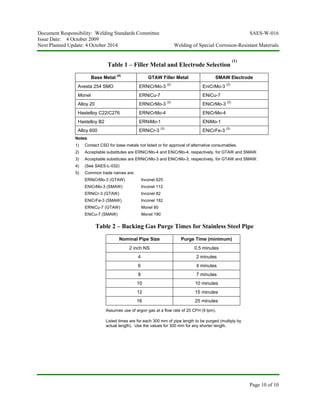
The filler metal shall be selected as shown in Table 1.
6.4 The maximum interpass temperature shall not exceed 100°C.
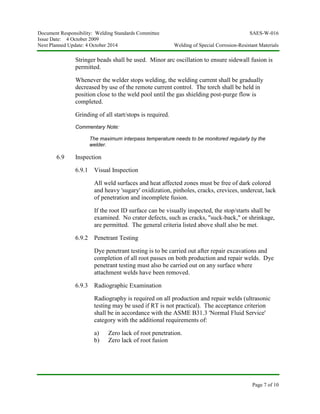
6.5 Backing Gas and Purging
The purge times for the backing gas shall be calculated to give a theoretical
volume change of 6 times the enclosed pipe volume. Table 2 is shown for
information and can be used for the standard conditions as listed in the table.
Extra purging time is necessary if the purge gas inlet and outlet (vent) cannot be
Document Responsibility: Welding Standards Committee SAES-W-016
Issue Date: 4 October 2009
Next Planned Update: 4 October 2014 Welding of Special Corrosion-Resistant Materials
Page 6 of 10
placed at opposite ends of the enclosed volume in order to insure complete
displacement of the original air.
The purge shall achieve actual oxygen levels inside or exiting the joint (via the
vent) no greater than 1% prior to and during welding, as measured using an
oxygen analyzer. The actual oxygen levels achieved in production shall be
measured periodically (i.e., on a random basis for the number of joints to be
performed). Analyzers shall be used for all joints if excessive internal oxidation
is observed on any joints based on the visual appearance of the oxide tint.
During pre-weld purging, the joint area shall be adequately sealed at all
openings to maintain the purge and prevent any air ingress.
If purge dams are to be used but cannot be retrieved after welding, then
proprietary dissolvable (water soluble) dams shall be used
6.6 Joint Design
For GTAW, the root gaps must be specified and maintained during welding at
equal to or larger than the root pass filler wire diameter.
Maximum internal misalignment between pipe or tube sections shall not exceed
1.6 mm.
6.7 Tacking
A minimum of 4 equi-spaced tacks around a pipe circumference shall be used.
Either root tacks or bridge tacks are permitted. Root tacks must be either
feathered or ground out prior to making the root pass.
6.8 Technique
Either high frequency (HF) or high voltage (HV) arc initiation shall be used.
Commentary Note:
HF may be used (but is not required) continuously.
The continuous feed technique shall be used for the root pass (i.e., the filler wire
is positioned between the root faces and fed continuously into the weld pool).
Commentary Note:
The welder must avoid narrow root gaps and improper travel speeds in order to
achieve the proper root bead deposit chemistry.
Document Responsibility: Welding Standards Committee SAES-W-016
Issue Date: 4 October 2009
Next Planned Update: 4 October 2014 Welding of Special Corrosion-Resistant Materials
Page 7 of 10
Stringer beads shall be used. Minor arc oscillation to ensure sidewall fusion is
permitted.
Whenever the welder stops welding, the welding current shall be gradually
decreased by use of the remote current control. The torch shall be held in
position close to the weld pool until the gas shielding post-purge flow is
completed.
Grinding of all start/stops is required.
Commentary Note:
The maximum interpass temperature needs to be monitored regularly by the
welder.
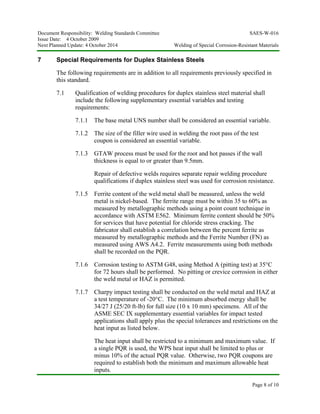
6.9 Inspection
6.9.1 Visual Inspection
All weld surfaces and heat affected zones must be free of dark colored
and heavy 'sugary' oxidization, pinholes, cracks, crevices, undercut, lack
of penetration and incomplete fusion.
If the root ID surface can be visually inspected, the stop/starts shall be
examined. No crater defects, such as cracks, "suck-back," or shrinkage,
are permitted. The general criteria listed above shall also be met.
6.9.2 Penetrant Testing
Dye penetrant testing is to be carried out after repair excavations and
completion of all root passes on both production and repair welds. Dye
penetrant testing must also be carried out on any surface where
attachment welds have been removed.
6.9.3 Radiographic Examination
Radiography is required on all production and repair welds (ultrasonic
testing may be used if RT is not practical). The acceptance criterion
shall be in accordance with the ASME B31.3 'Normal Fluid Service'
category with the additional requirements of:
a) Zero lack of root penetration.
b) Zero lack of root fusion
Document Responsibility: Welding Standards Committee SAES-W-016
Issue Date: 4 October 2009
Next Planned Update: 4 October 2014 Welding of Special Corrosion-Resistant Materials
Page 8 of 10
7 Special Requirements for Duplex Stainless Steels
The following requirements are in addition to all requirements previously specified in
this standard.
7.1 Qualification of welding procedures for duplex stainless steel material shall
include the following supplementary essential variables and testing
requirements:
7.1.1 The base metal UNS number shall be considered an essential variable.
7.1.2 The size of the filler wire used in welding the root pass of the test
coupon is considered an essential variable.
7.1.3 GTAW process must be used for the root and hot passes if the wall
thickness is equal to or greater than 9.5mm.
Repair of defective welds requires separate repair welding procedure
qualifications if duplex stainless steel was used for corrosion resistance.
7.1.5 Ferrite content of the weld metal shall be measured, unless the weld
metal is nickel-based. The ferrite range must be within 35 to 60% as
measured by metallographic methods using a point count technique in
accordance with ASTM E562. Minimum ferrite content should be 50%
for services that have potential for chloride stress cracking. The
fabricator shall establish a correlation between the percent ferrite as
measured by metallographic methods and the Ferrite Number (FN) as
measured using AWS A4.2. Ferrite measurements using both methods
shall be recorded on the PQR.
7.1.6 Corrosion testing to ASTM G48, using Method A (pitting test) at 35°C
for 72 hours shall be performed. No pitting or crevice corrosion in either
the weld metal or HAZ is permitted.
7.1.7 Charpy impact testing shall be conducted on the weld metal and HAZ at
a test temperature of -20°C. The minimum absorbed energy shall be
34/27 J (25/20 ft-lb) for full size (10 x 10 mm) specimens. All of the
ASME SEC IX supplementary essential variables for impact tested
applications shall apply plus the special tolerances and restrictions on the
heat input as listed below.
The heat input shall be restricted to a minimum and maximum value. If
a single PQR is used, the WPS heat input shall be limited to plus or
minus 10% of the actual PQR value. Otherwise, two PQR coupons are
required to establish both the minimum and maximum allowable heat
inputs.
Document Responsibility: Welding Standards Committee SAES-W-016
Issue Date: 4 October 2009
Next Planned Update: 4 October 2014 Welding of Special Corrosion-Resistant Materials
Page 9 of 10
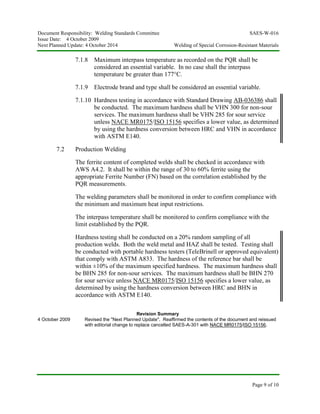
7.1.8 Maximum interpass temperature as recorded on the PQR shall be
considered an essential variable. In no case shall the interpass
temperature be greater than 177°C.
7.1.9 Electrode brand and type shall be considered an essential variable.
7.1.10 Hardness testing in accordance with Standard Drawing AB-036386 shall
be conducted. The maximum hardness shall be VHN 300 for non-sour
services. The maximum hardness shall be VHN 285 for sour service
unless NACE MR0175/ISO 15156 specifies a lower value, as determined
by using the hardness conversion between HRC and VHN in accordance
with ASTM E140.
7.2 Production Welding
The ferrite content of completed welds shall be checked in accordance with
AWS A4.2. It shall be within the range of 30 to 60% ferrite using the
appropriate Ferrite Number (FN) based on the correlation established by the
PQR measurements.
The welding parameters shall be monitored in order to confirm compliance with
the minimum and maximum heat input restrictions.
The interpass temperature shall be monitored to confirm compliance with the
limit established by the PQR.
Hardness testing shall be conducted on a 20% random sampling of all
production welds. Both the weld metal and HAZ shall be tested. Testing shall
be conducted with portable hardness testers (TeleBrinell or approved equivalent)
that comply with ASTM A833. The hardness of the reference bar shall be
within ±10% of the maximum specified hardness. The maximum hardness shall
be BHN 285 for non-sour services. The maximum hardness shall be BHN 270
for sour service unless NACE MR0175/ISO 15156 specifies a lower value, as
determined by using the hardness conversion between HRC and BHN in
accordance with ASTM E140.
Revision Summary
4 October 2009 Revised the "Next Planned Update". Reaffirmed the contents of the document and reissued
with editorial change to replace cancelled SAES-A-301 with NACE MR0175/ISO 15156.
Document Responsibility: Welding Standards Committee SAES-W-016
Issue Date: 4 October 2009
Next Planned Update: 4 October 2014 Welding of Special Corrosion-Resistant Materials
Page 10 of 10
Table 1 – Filler Metal and Electrode Selection
(1)
Base Metal
(4)
GTAW Filler Metal SMAW Electrode
Avesta 254 SMO ERNiCrMo-3
(2)
EniCrMo-3
(2)
Monel ERNiCu-7 ENiCu-7
Alloy 20 ERNiCrMo-3
(2)
ENiCrMo-3
(2)
Hastelloy C22/C276 ERNiCrMo-4 ENiCrMo-4
Hastelloy B2 ERNiMo-1 ENiMo-1
Alloy 600 ERNiCr-3
(3)
ENiCrFe-3
(3)
Notes:
1) Contact CSD for base metals not listed or for approval of alternative consumables.
2) Acceptable substitutes are ERNiCrMo-4 and ENiCrMo-4, respectively, for GTAW and SMAW.
3) Acceptable substitutes are ERNiCrMo-3 and ENiCrMo-3, respectively, for GTAW and SMAW.
4) (See SAES-L-032)
5) Common trade names are:
ERNiCrMo-3 (GTAW) Inconel 625
ENiCrMo-3 (SMAW) Inconel 112
ERNiCr-3 (GTAW) Inconel 82
ENiCrFe-3 (SMAW) Inconel 182
ERNiCu-7 (GTAW) Monel 60
ENiCu-7 (SMAW) Monel 190
Table 2 – Backing Gas Purge Times for Stainless Steel Pipe
Nominal Pipe Size Purge Time (minimum)
2 inch NS 0.5 minutes
4 2 minutes
6 4 minutes
8 7 minutes
10 10 minutes
12 15 minutes
16 25 minutes
Assumes use of argon gas at a flow rate of 20 CFH (9 lpm).
Listed times are for each 300 mm of pipe length to be purged (multiply by
actual length). Use the values for 300 mm for any shorter length.

Saes w-016-welding special corrosion materials

  • 1.
    Previous Issue: 30March 2005 Next Planned Update: 4 October 2014 Revised paragraphs are indicated in the right margin Page 1 of 10 Primary contact: Awwami, Adnan Ni'Mah on 966-3-8760230 Copyright©Saudi Aramco 2009. All rights reserved. Engineering Standard SAES-W-016 4 October 2009 Welding of Special Corrosion-Resistant Materials Welding Standards Committee Members Awwami, Adnan N., Chairman Rao, Sanyasi X., Vice Chairman Carrera, Rene L. Carswell, Raymond J. Chiang, Howard Juraifani, Hatim H. Keen, Peter David Muslim, Husain Muhammad Nasir, Ghalib Taher Nasri, Nadhir Ibrahim Niemeyer, Dennis Charles Sabti, Tareq Ibrahim Saudi Aramco DeskTop Standards Table of Contents 1 Scope............................................................ 2 2 Conflicts and Deviations................................ 3 3 References.................................................... 3 4 General.......................................................... 4 5 High Temperature Applications..................... 5 6 Corrosive Services........................................ 5 7 Special Requirements for Duplex Stainless Steels..................................... 8
  • 2.
    Document Responsibility: WeldingStandards Committee SAES-W-016 Issue Date: 4 October 2009 Next Planned Update: 4 October 2014 Welding of Special Corrosion-Resistant Materials Page 2 of 10 1 Scope 1.1 This standard specifies the requirements for welding and testing of special corrosion-resistant piping materials. This is defined as stainless steel and nickel- based alloys for piping in severe corrosion service and high temperature service, as defined below. Severe corrosion service is defined as: a) Any service listed in SAES-L-032 which specifies the use of either austenitic stainless steel, excluding types 304/304L/316/316L, or nickel- based alloys. b) Any service that uses duplex stainless steels. Commentary Note: Use of stainless steel or nickel-based alloys for product cleanliness (e.g., lube oil piping or aircraft refueling facilities) or mechanical properties (e.g., low temperature service requiring impact toughness) are not included. High temperature service is defined as any application with a design temperature above 427°C. Additional requirements for duplex stainless steel for any service are included. Strip lining and weld overlay applications are not included. Commentary Note: Refer to SAES-W-014 for welding requirements for overlays and SAES-W-015 for strip lining requirements. This standard is to be considered as a supplement to SAES-W-011. Other applications (e.g., vessels, heat exchangers, valves, or pumps) may also be subject to this standard if the application standard or job specification makes reference to this standard. These requirements are in addition to the requirements of ASME SEC IX. This entire standard may be attached to and made part of purchase orders. 1.2 Additional requirements may be contained in Scopes of Work, Drawings, or other Instructions or Specifications pertaining to specific items of work. 1.3 Any reference to Consulting Services Department (CSD) shall be interpreted as the CSD Welding Specialist or a representative designated by CSD.
  • 3.
    Document Responsibility: WeldingStandards Committee SAES-W-016 Issue Date: 4 October 2009 Next Planned Update: 4 October 2014 Welding of Special Corrosion-Resistant Materials Page 3 of 10 2 Conflicts and Deviations 2.1 Any conflicts between this Standard and other applicable Saudi Aramco Engineering Standards (SAESs), Materials System Specifications (SAMSSs), Standard Drawings (SASDs), or industry standards, codes, and forms shall be resolved in writing by the Company or Buyer Representative through the Manager, Consulting Services Department of Saudi Aramco, Dhahran. 2.2 Direct all requests to deviate from this standard in writing to the Company or Buyer Representative, who shall follow internal company procedure SAEP-302 and forward such requests to the Manager, Consulting Services Department of Saudi Aramco, Dhahran. 3 References The selection of material and equipment, and the design, construction, maintenance, and repair of equipment and facilities covered by this standard shall comply with the latest edition of the references listed below, unless otherwise noted. 3.1 Saudi Aramco References Saudi Aramco Engineering Procedure SAEP-302 Instructions for Obtaining a Waiver of a Mandatory Saudi Aramco Engineering Requirement Saudi Aramco Engineering Standards SAES-L-032 Material Selection for Piping Systems SAES-W-011 Welding Requirements for On-Plot Piping Saudi Aramco Standard Drawing AB-036386 Hardness Testing for Welding Procedure Qualifications 3.2 Industry Codes and Standards American Society of Mechanical Engineers ASME SEC IX Welding and Brazing Qualifications ASME B31.3 Chemical Plant and Petroleum Refinery Piping
  • 4.
    Document Responsibility: WeldingStandards Committee SAES-W-016 Issue Date: 4 October 2009 Next Planned Update: 4 October 2014 Welding of Special Corrosion-Resistant Materials Page 4 of 10 American Society for Testing and Materials ASTM A833 Indentation Hardness of Metallic Materials by Comparison Hardness Testers ASTM E140 Hardness Conversion Tables for Metals ASTM E562 Standard Test Method for Determining Volume Fraction by Systematic Manual Point Count ASTM G48 Standard Test Methods for Pitting and Crevice Corrosion Resistance of Stainless Steels and Related Alloys by the Use of Ferric Chloride Solution American Welding Society AWS A4.2 Standard Procedures for Calibrating Magnetic Instruments to Measure the Delta Ferrite Content of Austenitic and Duplex Austenitic- Ferritic Stainless Steel Weld Metal National Association of Corrosion Engineers/International Standardization Organization NACE MR0175/ISO 15156 Petroleum and Natural Gas Industries- Materials for use in H2S-Containing Environments in Oil and Gas Production 4 General 4.1 All welding procedures shall be qualified in accordance with ASME SEC IX plus the additional requirements of SAES-W-011 and this standard. 4.2 Ferrite measurements shall be performed in accordance with AWS A4.2. 4.3 Abrasive tooling and/or grinding disks shall not have been used on either carbon steel or any other grade of stainless steel material. The selection of grinding and cleaning tools shall be appropriate for the base material, e.g., carbon steel brushes shall not be used on stainless steel material. 4.4 All filler materials should be individually and clearly stamped, flagged or stenciled to ensure traceability and correct usage on site.
  • 5.
    Document Responsibility: WeldingStandards Committee SAES-W-016 Issue Date: 4 October 2009 Next Planned Update: 4 October 2014 Welding of Special Corrosion-Resistant Materials Page 5 of 10 5 High Temperature Applications 5.1 The welding procedure qualification for austenitic stainless steels, except type 310, shall include a determination of the Ferrite Number in the as-welded condition. The Ferrite Number shall be between 3 and 10 FN. 5.2 For production welds, the ferrite content shall be checked in the as-welded condition. The Ferrite Number shall be between 3 and 10 FN. 5.3 Any welding on high carbon grades of austenitic stainless steel material (e.g., 304H or HK40) after service times exceeding 1 year shall require a re-solution heat treatment prior to welding. 6 Corrosive Services 6.1 The GTAW process shall be used for the following applications: 1) The root pass of single-sided groove welds without backing. 2) For all passes for piping, tubes, and nozzles of 2 inch nominal diameter or less. 3) For all passes for wall thickness less than 9.5 mm for duplex stainless steel or for wall thickness less than 6.5 mm for other Corrosion Resistant Alloys (CRA). 6.2 All manual GTAW shall use a high frequency start and post-purge gas flow for the torch. A remote contractor and current control (pedal or torch mounted) is required. Pre-set power source current start/rise and decay/stop controls triggered by a foot switch or torch mounted control is an acceptable alternative for the remote control. 6.3 For all GTAW welding, filler metal shall be added. Autogenous welding of any pass is not permitted. The filler metal shall be selected as shown in Table 1. 6.4 The maximum interpass temperature shall not exceed 100°C. 6.5 Backing Gas and Purging The purge times for the backing gas shall be calculated to give a theoretical volume change of 6 times the enclosed pipe volume. Table 2 is shown for information and can be used for the standard conditions as listed in the table. Extra purging time is necessary if the purge gas inlet and outlet (vent) cannot be
  • 6.
    Document Responsibility: WeldingStandards Committee SAES-W-016 Issue Date: 4 October 2009 Next Planned Update: 4 October 2014 Welding of Special Corrosion-Resistant Materials Page 6 of 10 placed at opposite ends of the enclosed volume in order to insure complete displacement of the original air. The purge shall achieve actual oxygen levels inside or exiting the joint (via the vent) no greater than 1% prior to and during welding, as measured using an oxygen analyzer. The actual oxygen levels achieved in production shall be measured periodically (i.e., on a random basis for the number of joints to be performed). Analyzers shall be used for all joints if excessive internal oxidation is observed on any joints based on the visual appearance of the oxide tint. During pre-weld purging, the joint area shall be adequately sealed at all openings to maintain the purge and prevent any air ingress. If purge dams are to be used but cannot be retrieved after welding, then proprietary dissolvable (water soluble) dams shall be used 6.6 Joint Design For GTAW, the root gaps must be specified and maintained during welding at equal to or larger than the root pass filler wire diameter. Maximum internal misalignment between pipe or tube sections shall not exceed 1.6 mm. 6.7 Tacking A minimum of 4 equi-spaced tacks around a pipe circumference shall be used. Either root tacks or bridge tacks are permitted. Root tacks must be either feathered or ground out prior to making the root pass. 6.8 Technique Either high frequency (HF) or high voltage (HV) arc initiation shall be used. Commentary Note: HF may be used (but is not required) continuously. The continuous feed technique shall be used for the root pass (i.e., the filler wire is positioned between the root faces and fed continuously into the weld pool). Commentary Note: The welder must avoid narrow root gaps and improper travel speeds in order to achieve the proper root bead deposit chemistry.
  • 7.
    Document Responsibility: WeldingStandards Committee SAES-W-016 Issue Date: 4 October 2009 Next Planned Update: 4 October 2014 Welding of Special Corrosion-Resistant Materials Page 7 of 10 Stringer beads shall be used. Minor arc oscillation to ensure sidewall fusion is permitted. Whenever the welder stops welding, the welding current shall be gradually decreased by use of the remote current control. The torch shall be held in position close to the weld pool until the gas shielding post-purge flow is completed. Grinding of all start/stops is required. Commentary Note: The maximum interpass temperature needs to be monitored regularly by the welder. 6.9 Inspection 6.9.1 Visual Inspection All weld surfaces and heat affected zones must be free of dark colored and heavy 'sugary' oxidization, pinholes, cracks, crevices, undercut, lack of penetration and incomplete fusion. If the root ID surface can be visually inspected, the stop/starts shall be examined. No crater defects, such as cracks, "suck-back," or shrinkage, are permitted. The general criteria listed above shall also be met. 6.9.2 Penetrant Testing Dye penetrant testing is to be carried out after repair excavations and completion of all root passes on both production and repair welds. Dye penetrant testing must also be carried out on any surface where attachment welds have been removed. 6.9.3 Radiographic Examination Radiography is required on all production and repair welds (ultrasonic testing may be used if RT is not practical). The acceptance criterion shall be in accordance with the ASME B31.3 'Normal Fluid Service' category with the additional requirements of: a) Zero lack of root penetration. b) Zero lack of root fusion
  • 8.
    Document Responsibility: WeldingStandards Committee SAES-W-016 Issue Date: 4 October 2009 Next Planned Update: 4 October 2014 Welding of Special Corrosion-Resistant Materials Page 8 of 10 7 Special Requirements for Duplex Stainless Steels The following requirements are in addition to all requirements previously specified in this standard. 7.1 Qualification of welding procedures for duplex stainless steel material shall include the following supplementary essential variables and testing requirements: 7.1.1 The base metal UNS number shall be considered an essential variable. 7.1.2 The size of the filler wire used in welding the root pass of the test coupon is considered an essential variable. 7.1.3 GTAW process must be used for the root and hot passes if the wall thickness is equal to or greater than 9.5mm. Repair of defective welds requires separate repair welding procedure qualifications if duplex stainless steel was used for corrosion resistance. 7.1.5 Ferrite content of the weld metal shall be measured, unless the weld metal is nickel-based. The ferrite range must be within 35 to 60% as measured by metallographic methods using a point count technique in accordance with ASTM E562. Minimum ferrite content should be 50% for services that have potential for chloride stress cracking. The fabricator shall establish a correlation between the percent ferrite as measured by metallographic methods and the Ferrite Number (FN) as measured using AWS A4.2. Ferrite measurements using both methods shall be recorded on the PQR. 7.1.6 Corrosion testing to ASTM G48, using Method A (pitting test) at 35°C for 72 hours shall be performed. No pitting or crevice corrosion in either the weld metal or HAZ is permitted. 7.1.7 Charpy impact testing shall be conducted on the weld metal and HAZ at a test temperature of -20°C. The minimum absorbed energy shall be 34/27 J (25/20 ft-lb) for full size (10 x 10 mm) specimens. All of the ASME SEC IX supplementary essential variables for impact tested applications shall apply plus the special tolerances and restrictions on the heat input as listed below. The heat input shall be restricted to a minimum and maximum value. If a single PQR is used, the WPS heat input shall be limited to plus or minus 10% of the actual PQR value. Otherwise, two PQR coupons are required to establish both the minimum and maximum allowable heat inputs.
  • 9.
    Document Responsibility: WeldingStandards Committee SAES-W-016 Issue Date: 4 October 2009 Next Planned Update: 4 October 2014 Welding of Special Corrosion-Resistant Materials Page 9 of 10 7.1.8 Maximum interpass temperature as recorded on the PQR shall be considered an essential variable. In no case shall the interpass temperature be greater than 177°C. 7.1.9 Electrode brand and type shall be considered an essential variable. 7.1.10 Hardness testing in accordance with Standard Drawing AB-036386 shall be conducted. The maximum hardness shall be VHN 300 for non-sour services. The maximum hardness shall be VHN 285 for sour service unless NACE MR0175/ISO 15156 specifies a lower value, as determined by using the hardness conversion between HRC and VHN in accordance with ASTM E140. 7.2 Production Welding The ferrite content of completed welds shall be checked in accordance with AWS A4.2. It shall be within the range of 30 to 60% ferrite using the appropriate Ferrite Number (FN) based on the correlation established by the PQR measurements. The welding parameters shall be monitored in order to confirm compliance with the minimum and maximum heat input restrictions. The interpass temperature shall be monitored to confirm compliance with the limit established by the PQR. Hardness testing shall be conducted on a 20% random sampling of all production welds. Both the weld metal and HAZ shall be tested. Testing shall be conducted with portable hardness testers (TeleBrinell or approved equivalent) that comply with ASTM A833. The hardness of the reference bar shall be within ±10% of the maximum specified hardness. The maximum hardness shall be BHN 285 for non-sour services. The maximum hardness shall be BHN 270 for sour service unless NACE MR0175/ISO 15156 specifies a lower value, as determined by using the hardness conversion between HRC and BHN in accordance with ASTM E140. Revision Summary 4 October 2009 Revised the "Next Planned Update". Reaffirmed the contents of the document and reissued with editorial change to replace cancelled SAES-A-301 with NACE MR0175/ISO 15156.
  • 10.
    Document Responsibility: WeldingStandards Committee SAES-W-016 Issue Date: 4 October 2009 Next Planned Update: 4 October 2014 Welding of Special Corrosion-Resistant Materials Page 10 of 10 Table 1 – Filler Metal and Electrode Selection (1) Base Metal (4) GTAW Filler Metal SMAW Electrode Avesta 254 SMO ERNiCrMo-3 (2) EniCrMo-3 (2) Monel ERNiCu-7 ENiCu-7 Alloy 20 ERNiCrMo-3 (2) ENiCrMo-3 (2) Hastelloy C22/C276 ERNiCrMo-4 ENiCrMo-4 Hastelloy B2 ERNiMo-1 ENiMo-1 Alloy 600 ERNiCr-3 (3) ENiCrFe-3 (3) Notes: 1) Contact CSD for base metals not listed or for approval of alternative consumables. 2) Acceptable substitutes are ERNiCrMo-4 and ENiCrMo-4, respectively, for GTAW and SMAW. 3) Acceptable substitutes are ERNiCrMo-3 and ENiCrMo-3, respectively, for GTAW and SMAW. 4) (See SAES-L-032) 5) Common trade names are: ERNiCrMo-3 (GTAW) Inconel 625 ENiCrMo-3 (SMAW) Inconel 112 ERNiCr-3 (GTAW) Inconel 82 ENiCrFe-3 (SMAW) Inconel 182 ERNiCu-7 (GTAW) Monel 60 ENiCu-7 (SMAW) Monel 190 Table 2 – Backing Gas Purge Times for Stainless Steel Pipe Nominal Pipe Size Purge Time (minimum) 2 inch NS 0.5 minutes 4 2 minutes 6 4 minutes 8 7 minutes 10 10 minutes 12 15 minutes 16 25 minutes Assumes use of argon gas at a flow rate of 20 CFH (9 lpm). Listed times are for each 300 mm of pipe length to be purged (multiply by actual length). Use the values for 300 mm for any shorter length.