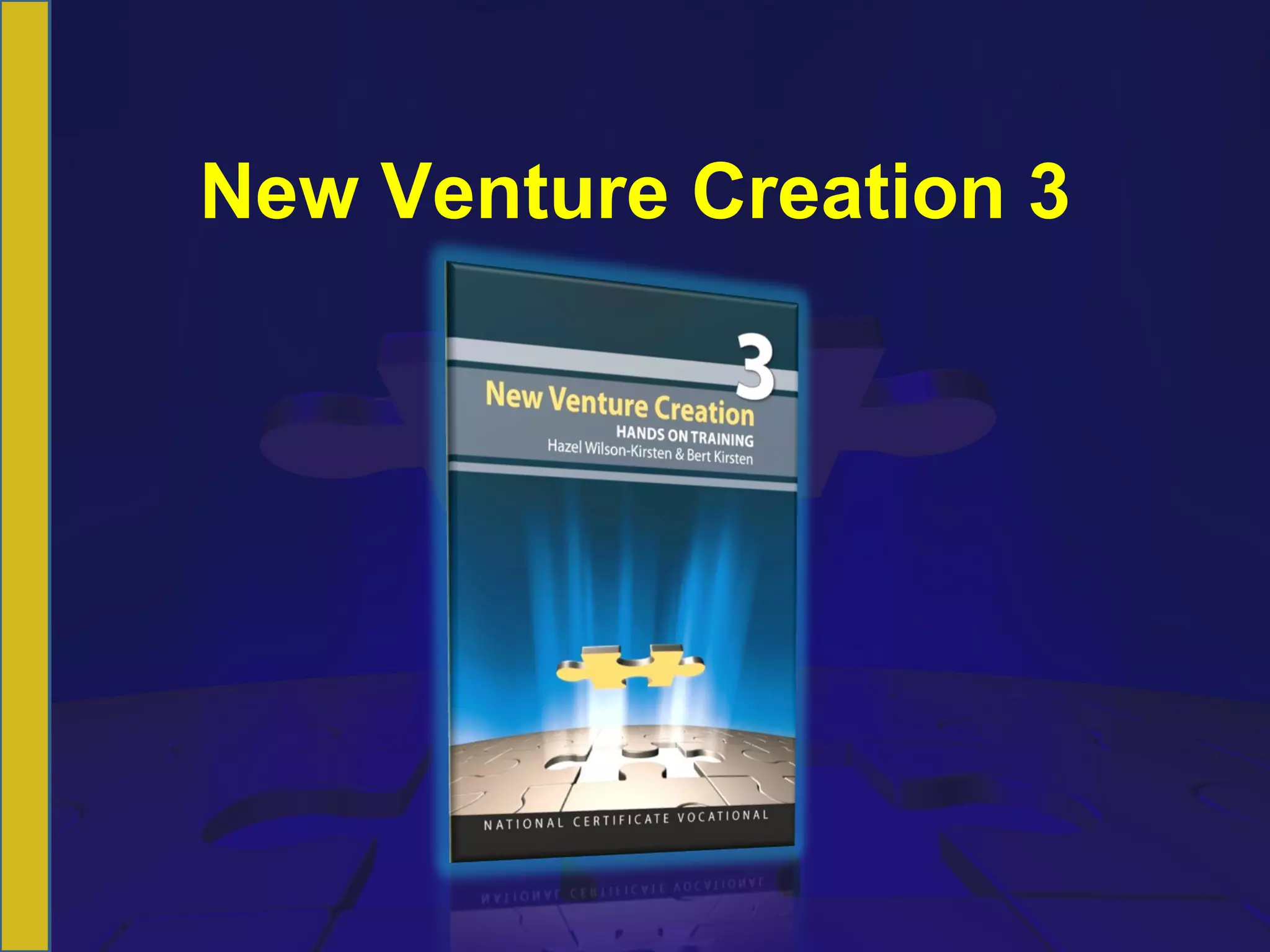
New Venture Creation 3
What we cover Module 1:  Internal and external  stakeholders Module 2: The structure of a selected  workplace organisation Module 3: Basic HR principles in a new  venture Module 4: Implementing a business plan  for business operations
Module 1: Internal and external stakeholders
Module 1: Internal and external stakeholders At the end of this outcome you will be able to: Identify internal and external stakeholders Categorise stakeholders into internal and external groups Explain the difference between internal and external stakeholders Clarify requirements for stakeholders
SECTION 1: IDENTIFY AND LIST SHAREHOLDERS After completing this module, you will be able to: Identify internal and external stakeholders Categorise stakeholders into internal and external groups Explain the difference between internal and external stakeholders Clarify requirements of stakeholders
1.1 Identify internal and external stakeholders What is a stakeholder? A stakeholder can be described as any person (or group of people) who has an interest (a stake) in the business and its ability to achieve its objectives What is an internal stakeholder? A stakeholder inside the business What is an external stakeholder? A stakeholder outside of the business
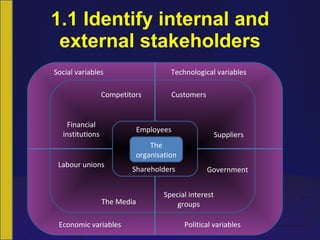
1.1 Identify internal and external stakeholders The organisation Employees Shareholders The Media Labour unions Financial institutions Competitors Customers Suppliers Special interest groups Government Social variables Economic variables Political variables Technological variables
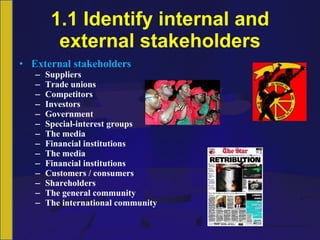
1.1 Identify internal and external stakeholders External stakeholders Suppliers Trade unions Competitors Investors Government Special-interest groups The media Financial institutions The media Financial institutions Customers / consumers Shareholders The general community The international community
1.1 Identify internal and external stakeholders External stakeholders can be divided into the following sub-groups: Social groups  Political groups  Economic groups  Technological groups  Physical groups  International groups
1.2 Requirements of stakeholders Why do we need to understand stakeholder requirements? Project scoping Actual cost estimating Continuous budgeting Project management Software design Documentation and training manuals
1.2 Requirements of stakeholders How do you discover what stakeholders needs are? Brainstorming One-on-one interviews Competitive product analysis Task and workflow analysis Feedback
1.2 The requirements of stakeholders Process of planning stakeholder requirements: Identify all stakeholders Identify the needs of stakeholders Draw up the requirement specifications Prioritise the requirements Give the requirements attributes for the purposes of tracking and reporting
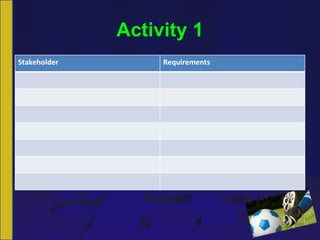
Activity 1 Make a list of all the external and internal stakeholders of your college and describe what each of the stakeholder’s requirements are of the college. Use the table on the next page
Activity 1 Stakeholder Requirements
Activity 1 Then do the following: Identify common areas Prioritise the requirements Draw up specifications for the first three requirements
Activity 2 - Quiz Test yourself by answering the following questions Define “stakeholder” Name the six sub-groups of external stakeholders Why is it necessary to identify the requirements of stakeholders Describe the process whereby a stakeholder’s requirements are identified.
SECTION 2: STAKEHOLDER'S RELATIONSHIPS WITH THE ORGANISATION At the end of this outcome you will be able to: Explain the impact and importance of stakeholders on the organisation Differentiate relationships that have an impact on each other Describe the importance and implications of inter-relationships Explain how to implement strategies to improve stakeholder relationships according to organisational relationships.
2.1 The impact and importance of stakeholders What does the business want from each of the following: Shareholders Customers Employees What must it give in return? What happens if the business doesn’t give stakeholders what they want?
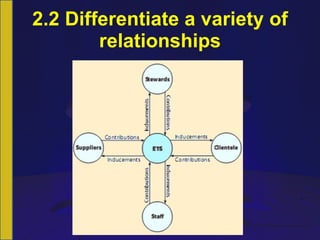
2.2 Differentiate a variety of relationships
2.3 Importance and implications of inter-relationships Stakeholders make a contribution in return for an inducement What is an inducement? An inducement is something (tangible or intangible) received in exchange for a thing or an action What are employees’, shareholders and customers’ inducements? What are their contributions?
2.3 Importance and implications of inter-relationships Advantages include: Access  to usable information Positive influence on group norms and solidarity Not breaking away from group norms and making sure that solidarity (oneness) exists Adding business value to the organisational strategic goals. This means that everything that is done in order to make people’s lives better Prediction of future business performance Good governance. This includes the setting of fair and just rules and managing people fairly and equitably equally
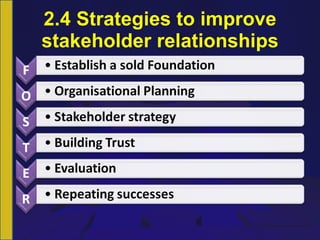
2.4 Strategies to improve stakeholder relationships
2.4 Steps to improve stakeholder relationships Steps to develop a stakeholder strategy Identify the key stakeholder groups For each stakeholder group, identify the contributions received from the group and the inducements offered the group in return Once the contributions and inducements have been identified, the next task is to prioritize the two, that is, identify the most important contributions and the most important inducements Then, determine basic ways of testing contributions and inducements Then, put the measures into effect and determine what they say about the extent to which the contributions received satisfy the needs and requirements of the organisation and the extent to which the inducements provided meet the needs and requirements of the various stakeholder groups
2.4 Steps to improve stakeholder relationships Evaluate and improve relationships Organisations can benefit from a regular review of their relationships. Using a stakeholder audit, companies can:  monitor their performance on relationship goals;  speak to stakeholders to gain an understanding of how they view the organisation’s commitments, the relationship-building process and the outcome of those relationships explain and improve performance build employee and stakeholder support increase transparency through the reporting of this information
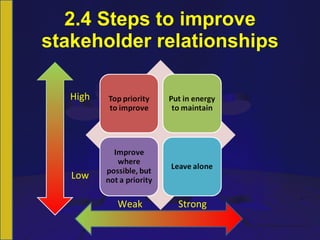
2.4 Steps to improve stakeholder relationships High Low Strong Weak
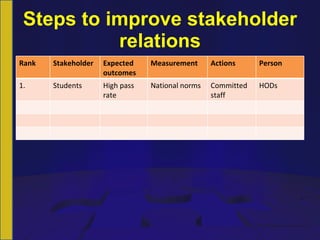
Steps to improve stakeholder relations Rank Stakeholder Expected outcomes Measurement Actions Person 1. Students High pass rate National norms Committed staff HODs
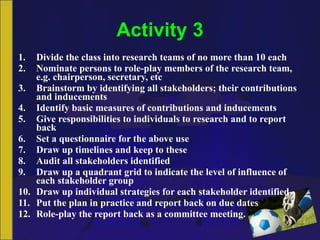
Activity 3 Divide the class into research teams of no more than 10 each Nominate persons to role-play members of the research team, e.g. chairperson, secretary, etc Brainstorm by identifying all stakeholders; their contributions and inducements Identify basic measures of contributions and inducements Give responsibilities to individuals to research and to report back Set a questionnaire for the above use Draw up timelines and keep to these Audit all stakeholders identified Draw up a quadrant grid to indicate the level of influence of each stakeholder group Draw up individual strategies for each stakeholder identified Put the plan in practice and report back on due dates Role-play the report back as a committee meeting.

NCV 3 New Venture Creation Hands-On Support Slide Show - Module1

  • 1.
  • 2.
    What we coverModule 1: Internal and external stakeholders Module 2: The structure of a selected workplace organisation Module 3: Basic HR principles in a new venture Module 4: Implementing a business plan for business operations
  • 3.
    Module 1: Internaland external stakeholders
  • 4.
    Module 1: Internaland external stakeholders At the end of this outcome you will be able to: Identify internal and external stakeholders Categorise stakeholders into internal and external groups Explain the difference between internal and external stakeholders Clarify requirements for stakeholders
  • 5.
    SECTION 1: IDENTIFYAND LIST SHAREHOLDERS After completing this module, you will be able to: Identify internal and external stakeholders Categorise stakeholders into internal and external groups Explain the difference between internal and external stakeholders Clarify requirements of stakeholders
  • 6.
    1.1 Identify internaland external stakeholders What is a stakeholder? A stakeholder can be described as any person (or group of people) who has an interest (a stake) in the business and its ability to achieve its objectives What is an internal stakeholder? A stakeholder inside the business What is an external stakeholder? A stakeholder outside of the business
  • 7.
    1.1 Identify internaland external stakeholders The organisation Employees Shareholders The Media Labour unions Financial institutions Competitors Customers Suppliers Special interest groups Government Social variables Economic variables Political variables Technological variables
  • 8.
    1.1 Identify internaland external stakeholders External stakeholders Suppliers Trade unions Competitors Investors Government Special-interest groups The media Financial institutions The media Financial institutions Customers / consumers Shareholders The general community The international community
  • 9.
    1.1 Identify internaland external stakeholders External stakeholders can be divided into the following sub-groups: Social groups Political groups Economic groups Technological groups Physical groups International groups
  • 10.
    1.2 Requirements ofstakeholders Why do we need to understand stakeholder requirements? Project scoping Actual cost estimating Continuous budgeting Project management Software design Documentation and training manuals
  • 11.
    1.2 Requirements ofstakeholders How do you discover what stakeholders needs are? Brainstorming One-on-one interviews Competitive product analysis Task and workflow analysis Feedback
  • 12.
    1.2 The requirementsof stakeholders Process of planning stakeholder requirements: Identify all stakeholders Identify the needs of stakeholders Draw up the requirement specifications Prioritise the requirements Give the requirements attributes for the purposes of tracking and reporting
  • 13.
    Activity 1 Makea list of all the external and internal stakeholders of your college and describe what each of the stakeholder’s requirements are of the college. Use the table on the next page
  • 14.
  • 15.
    Activity 1 Thendo the following: Identify common areas Prioritise the requirements Draw up specifications for the first three requirements
  • 16.
    Activity 2 -Quiz Test yourself by answering the following questions Define “stakeholder” Name the six sub-groups of external stakeholders Why is it necessary to identify the requirements of stakeholders Describe the process whereby a stakeholder’s requirements are identified.
  • 17.
    SECTION 2: STAKEHOLDER'SRELATIONSHIPS WITH THE ORGANISATION At the end of this outcome you will be able to: Explain the impact and importance of stakeholders on the organisation Differentiate relationships that have an impact on each other Describe the importance and implications of inter-relationships Explain how to implement strategies to improve stakeholder relationships according to organisational relationships.
  • 18.
    2.1 The impactand importance of stakeholders What does the business want from each of the following: Shareholders Customers Employees What must it give in return? What happens if the business doesn’t give stakeholders what they want?
  • 19.
    2.2 Differentiate avariety of relationships
  • 20.
    2.3 Importance andimplications of inter-relationships Stakeholders make a contribution in return for an inducement What is an inducement? An inducement is something (tangible or intangible) received in exchange for a thing or an action What are employees’, shareholders and customers’ inducements? What are their contributions?
  • 21.
    2.3 Importance andimplications of inter-relationships Advantages include: Access to usable information Positive influence on group norms and solidarity Not breaking away from group norms and making sure that solidarity (oneness) exists Adding business value to the organisational strategic goals. This means that everything that is done in order to make people’s lives better Prediction of future business performance Good governance. This includes the setting of fair and just rules and managing people fairly and equitably equally
  • 22.
    2.4 Strategies toimprove stakeholder relationships
  • 23.
    2.4 Steps toimprove stakeholder relationships Steps to develop a stakeholder strategy Identify the key stakeholder groups For each stakeholder group, identify the contributions received from the group and the inducements offered the group in return Once the contributions and inducements have been identified, the next task is to prioritize the two, that is, identify the most important contributions and the most important inducements Then, determine basic ways of testing contributions and inducements Then, put the measures into effect and determine what they say about the extent to which the contributions received satisfy the needs and requirements of the organisation and the extent to which the inducements provided meet the needs and requirements of the various stakeholder groups
  • 24.
    2.4 Steps toimprove stakeholder relationships Evaluate and improve relationships Organisations can benefit from a regular review of their relationships. Using a stakeholder audit, companies can: monitor their performance on relationship goals; speak to stakeholders to gain an understanding of how they view the organisation’s commitments, the relationship-building process and the outcome of those relationships explain and improve performance build employee and stakeholder support increase transparency through the reporting of this information
  • 25.
    2.4 Steps toimprove stakeholder relationships High Low Strong Weak
  • 26.
    Steps to improvestakeholder relations Rank Stakeholder Expected outcomes Measurement Actions Person 1. Students High pass rate National norms Committed staff HODs
  • 27.
    Activity 3 Dividethe class into research teams of no more than 10 each Nominate persons to role-play members of the research team, e.g. chairperson, secretary, etc Brainstorm by identifying all stakeholders; their contributions and inducements Identify basic measures of contributions and inducements Give responsibilities to individuals to research and to report back Set a questionnaire for the above use Draw up timelines and keep to these Audit all stakeholders identified Draw up a quadrant grid to indicate the level of influence of each stakeholder group Draw up individual strategies for each stakeholder identified Put the plan in practice and report back on due dates Role-play the report back as a committee meeting.