6/1/16
1
Deaf Identity 102
Intersectionality and D/deaf experiences for
higher education professionals
Olugbenga Aina, MSW
Genie Gertz, Ph.D.
Judy Mounty Ed.D., MSW
Edgar Palmer, M.Ed, MS
NCORE 2016: Session 4421
Introductions
•  ’Bunmi
•  Genie
•  Judy
Session goals
•  Conceptual framework
•  Deaf identities
•  Intersectionality
•  Paradigm shift
•  Implications for higher education
Conceptual framework
•  Understanding Deaf identity development
and experiences as related to:
– Nigrescence
– Audism
– Empowerment
– Consciousness
Nigrescence
•  The process of becoming Black
•  Negro-to-Black conversion experience
•  Involves identity development in which one
becomes more enculturated in the Black
experience
•  Adapted to describe comparable experience
of deaf and hard of hearing individuals
Cross, W. E. (1991). Shades of black: Diversity in African-American identity. Philadelphia, PA: Temple University Press.
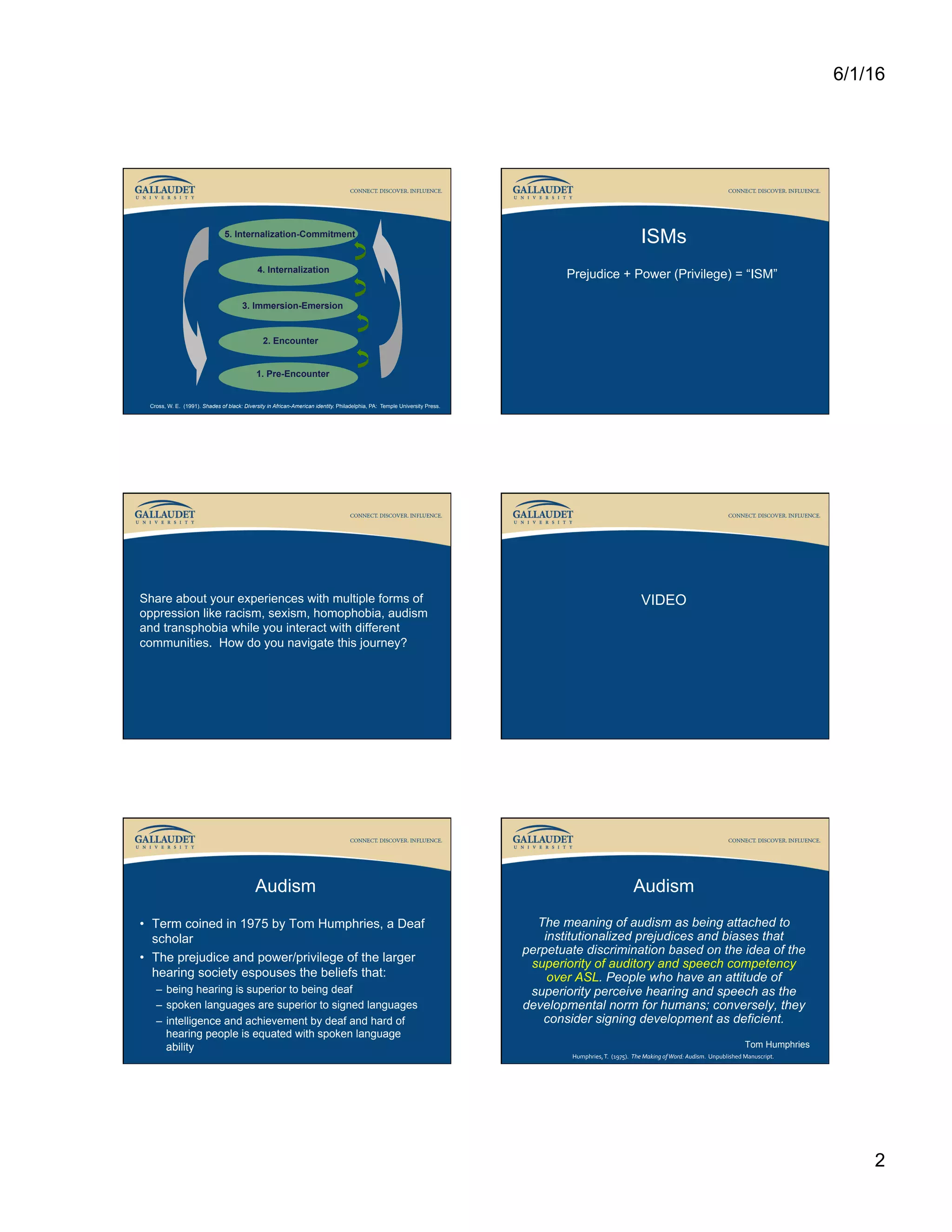
Nigrescence development stages:
Cyclical process
6/1/16
2
Cross, W. E. (1991). Shades of black: Diversity in African-American identity. Philadelphia, PA: Temple University Press.
5. Internalization-Commitment
4. Internalization
3. Immersion-Emersion
2. Encounter
1. Pre-Encounter
ISMs
Prejudice + Power (Privilege) = “ISM”
Share about your experiences with multiple forms of
oppression like racism, sexism, homophobia, audism
and transphobia while you interact with different
communities. How do you navigate this journey?
VIDEO
Audism
•  Term coined in 1975 by Tom Humphries, a Deaf
scholar
•  The prejudice and power/privilege of the larger
hearing society espouses the beliefs that:
–  being hearing is superior to being deaf
–  spoken languages are superior to signed languages
–  intelligence and achievement by deaf and hard of
hearing people is equated with spoken language
ability
Audism
The meaning of audism as being attached to
institutionalized prejudices and biases that
perpetuate discrimination based on the idea of the
superiority of auditory and speech competency
over ASL. People who have an attitude of
superiority perceive hearing and speech as the
developmental norm for humans; conversely, they
consider signing development as deficient.
Tom Humphries
Humphries,	
  T.	
  	
  (1975).	
  	
  The	
  Making	
  of	
  Word:	
  Audism.	
  	
  Unpublished	
  Manuscript.	
  	
  
6/1/16
3
Because of audism…
•  Deaf people have systematically been deprived
of the power to:
•  Communicate freely
•  Receive quality education in a fully accessible
language
•  Gain respect for their language and culture
•  Possess voice in shaping policies and
practices of institutions serving them
Examples of audism
•  “The deaf must learn English (forget ASL) because when they
grow up they will have to function in the hearing society and
need it to find good jobs, find happiness, and have full and
useful lives.”
•  “We want to hire more deaf people but there just are not any
deaf Ph.D.s.”
•  “He/she is nice and very intelligent but his/her English is
terrible.”
•  “Oh! You have such beautiful speech. What is your hearing
loss?”
•  “But we don’t need TTY. There are no deaf people in this
office.”
Dysconscious audism
…a form of audism that tacitly accepts
dominant hearing norms and privileges. It
is not the absence of consciousness but an
impaired consciousness or distorted way of
thinking about Deaf consciousness.
Genie Gertz
VIDEO
Paradigm shift VIDEO
6/1/16
4
Empowerment theories
•  Focus on assets rather than problems
•  Strengths perspective, concept of resiliency,
and principle of self- determination at
community level
•  Problems and internal conflicts can provide
opportunities for positive change and growth
VIDEO
Consciousness
A state of in-depth understanding about the
world and resulting freedom from oppression.
Paulo Freire
Consciousness
•  Awareness of self
•  Awareness of culture and attitudes
•  Critical reflection of community
•  Ability to perceive social, political oppression
•  Ability to analyze one’s beliefs and behaviors
•  Ability to analyze and take action against oppressive
elements for social justice
Construction of deaf consciousness
•  Awareness of oppression
•  Rejection of audism
•  Positive language attitudes toward ASL
•  Deaf cultural behaviors
•  Deaf identity
•  Cultural acceptance of Deaf living
Paradigm shift – Deafhood
•  Deaf people are visually oriented in dealing with the environment and
feel most at ease using a signed language rather than a spoken
language. The degree of your hearing or speaking ability is
irrelevant. Each person’s search for Deafhood occurs on all levels:
physical, emotional, mental, spiritual, cultural and linguistic. And
through that search, each Deaf person is linked to the amazing
collective experience called the Deaf community and culture.
•  Deafhood is a journey that we undertake to discover our true identity
and purpose as a Deaf person. This journey is for anybody who is
what George Veditz calls “first and foremost, people of the eye”.
6/1/16
5
Paradigm shift – Deaf Gain
“Deaf Gain” is a positive counter to the negative “hearing loss”
and encompasses the myriad ways that both deaf people and
society at large have benefited from the existence of deaf people
and sign language throughout recorded human history. The
notion of Deaf Gain asks the question: is the world better off with
Deaf people and their signed languages, or should they be
diminished to the point of extinction? Is the audiological status of
deafness worth preserving or should it be eradicated? What
would society lose if it were to do away with hearing loss?
Intersectionality
•  Individuals are complex and can be members of or
identify with overlapping diverse groups
•  Identity not easily defined, not unidimensional or binary
(i.e., only X or only Y, not “X” plus “Y”)
•  Can’t separate out the elements of a person’s identity
•  Oppression can be experienced on multiple levels at the
same time; or a person may have privilege in some
domains and not others
Intersectionality
Intersectionality is an analytic sensibility, a way of thinking about identity
and its relationship to power. The term brought to light the invisibility of
many constituents within groups that claim them as members, but often
fail to represent them. Intersectional erasures include People of color
within LGBTQ movements; girls of color in the fight against the school-
to-prison pipeline; women within immigration movements; trans women
within feminist movements; and people with disabilities fighting police
abuse — all face vulnerabilities that reflect the intersections of racism,
sexism, class oppression, transphobia, able-ism and more.
Intersectionality has given many advocates a way to frame their
circumstances and to fight for their visibility and inclusion.
Kimberlé Crenshaw
VIDEO
How has your identity developed and
evolved over the years before and since
coming to Gallaudet?
VIDEO
6/1/16
6
With the identities you have discussed, what
is it like to be a college student at Gallaudet,
a Predominantly White University (PWU)?
Belonging
...in Deaf communities, with their strong
belief in cultural collectivism, attitude is, or
can be, all.
Paddy Ladd
VIDEO
References
Bauman, H.-D. L., & Murray, J. J. (Eds.) (2014). Deaf Gain: Raising the stakes for human diversity. Minneapolis, MN:
University of Minnesota Press.
Crenshaw, K. (2015, September 24). Why intersectionality can’t wait. The Washington Post. Retrieved from https://
www.washingtonpost.com/news/in-theory/wp/2015/09/24/why-intersectionality-cant-wait/
Cross, W. E. (1991). Shades of black: Diversity in African-American identity. Philadelphia, PA: Temple University Press.
Gertz, G. (2003). Dysconscious audism and critical deaf studies: Deaf crit’s analysis of unconscious internalization of
hegemony within the deaf community. Unpublished doctoral dissertation, University of California, Los Angeles,
California.
Humphries, T. (1975). The Making of Word: Audism. Unpublished manuscript.
Kirst-Ashman, K. K. (2014). Human Behavior in the Macro Social Environment: An Empowerment Approach to
Understanding Communities, Organizations, and Groups (4th ed.). Belmont, CA: Brooks/Cole.
Ladd, P. (2003). Understanding Deaf Culture: In Search of Deafhood. Bristol, England: Multilingual Matters.
Thank you!
Olugbenga Aina
olugbenga.aina@gallaudet.edu
Genie Gertz
genie.gertz@gallaudet.edu
Judy Mounty
judith.mounty@gallaudet.edu

NCORE2016-DeafIdentity102 (1)

  • 1.
    6/1/16 1 Deaf Identity 102 Intersectionalityand D/deaf experiences for higher education professionals Olugbenga Aina, MSW Genie Gertz, Ph.D. Judy Mounty Ed.D., MSW Edgar Palmer, M.Ed, MS NCORE 2016: Session 4421 Introductions •  ’Bunmi •  Genie •  Judy Session goals •  Conceptual framework •  Deaf identities •  Intersectionality •  Paradigm shift •  Implications for higher education Conceptual framework •  Understanding Deaf identity development and experiences as related to: – Nigrescence – Audism – Empowerment – Consciousness Nigrescence •  The process of becoming Black •  Negro-to-Black conversion experience •  Involves identity development in which one becomes more enculturated in the Black experience •  Adapted to describe comparable experience of deaf and hard of hearing individuals Cross, W. E. (1991). Shades of black: Diversity in African-American identity. Philadelphia, PA: Temple University Press. Nigrescence development stages: Cyclical process
  • 2.
    6/1/16 2 Cross, W. E.(1991). Shades of black: Diversity in African-American identity. Philadelphia, PA: Temple University Press. 5. Internalization-Commitment 4. Internalization 3. Immersion-Emersion 2. Encounter 1. Pre-Encounter ISMs Prejudice + Power (Privilege) = “ISM” Share about your experiences with multiple forms of oppression like racism, sexism, homophobia, audism and transphobia while you interact with different communities. How do you navigate this journey? VIDEO Audism •  Term coined in 1975 by Tom Humphries, a Deaf scholar •  The prejudice and power/privilege of the larger hearing society espouses the beliefs that: –  being hearing is superior to being deaf –  spoken languages are superior to signed languages –  intelligence and achievement by deaf and hard of hearing people is equated with spoken language ability Audism The meaning of audism as being attached to institutionalized prejudices and biases that perpetuate discrimination based on the idea of the superiority of auditory and speech competency over ASL. People who have an attitude of superiority perceive hearing and speech as the developmental norm for humans; conversely, they consider signing development as deficient. Tom Humphries Humphries,  T.    (1975).    The  Making  of  Word:  Audism.    Unpublished  Manuscript.    
  • 3.
    6/1/16 3 Because of audism… • Deaf people have systematically been deprived of the power to: •  Communicate freely •  Receive quality education in a fully accessible language •  Gain respect for their language and culture •  Possess voice in shaping policies and practices of institutions serving them Examples of audism •  “The deaf must learn English (forget ASL) because when they grow up they will have to function in the hearing society and need it to find good jobs, find happiness, and have full and useful lives.” •  “We want to hire more deaf people but there just are not any deaf Ph.D.s.” •  “He/she is nice and very intelligent but his/her English is terrible.” •  “Oh! You have such beautiful speech. What is your hearing loss?” •  “But we don’t need TTY. There are no deaf people in this office.” Dysconscious audism …a form of audism that tacitly accepts dominant hearing norms and privileges. It is not the absence of consciousness but an impaired consciousness or distorted way of thinking about Deaf consciousness. Genie Gertz VIDEO Paradigm shift VIDEO
  • 4.
    6/1/16 4 Empowerment theories •  Focuson assets rather than problems •  Strengths perspective, concept of resiliency, and principle of self- determination at community level •  Problems and internal conflicts can provide opportunities for positive change and growth VIDEO Consciousness A state of in-depth understanding about the world and resulting freedom from oppression. Paulo Freire Consciousness •  Awareness of self •  Awareness of culture and attitudes •  Critical reflection of community •  Ability to perceive social, political oppression •  Ability to analyze one’s beliefs and behaviors •  Ability to analyze and take action against oppressive elements for social justice Construction of deaf consciousness •  Awareness of oppression •  Rejection of audism •  Positive language attitudes toward ASL •  Deaf cultural behaviors •  Deaf identity •  Cultural acceptance of Deaf living Paradigm shift – Deafhood •  Deaf people are visually oriented in dealing with the environment and feel most at ease using a signed language rather than a spoken language. The degree of your hearing or speaking ability is irrelevant. Each person’s search for Deafhood occurs on all levels: physical, emotional, mental, spiritual, cultural and linguistic. And through that search, each Deaf person is linked to the amazing collective experience called the Deaf community and culture. •  Deafhood is a journey that we undertake to discover our true identity and purpose as a Deaf person. This journey is for anybody who is what George Veditz calls “first and foremost, people of the eye”.
  • 5.
    6/1/16 5 Paradigm shift –Deaf Gain “Deaf Gain” is a positive counter to the negative “hearing loss” and encompasses the myriad ways that both deaf people and society at large have benefited from the existence of deaf people and sign language throughout recorded human history. The notion of Deaf Gain asks the question: is the world better off with Deaf people and their signed languages, or should they be diminished to the point of extinction? Is the audiological status of deafness worth preserving or should it be eradicated? What would society lose if it were to do away with hearing loss? Intersectionality •  Individuals are complex and can be members of or identify with overlapping diverse groups •  Identity not easily defined, not unidimensional or binary (i.e., only X or only Y, not “X” plus “Y”) •  Can’t separate out the elements of a person’s identity •  Oppression can be experienced on multiple levels at the same time; or a person may have privilege in some domains and not others Intersectionality Intersectionality is an analytic sensibility, a way of thinking about identity and its relationship to power. The term brought to light the invisibility of many constituents within groups that claim them as members, but often fail to represent them. Intersectional erasures include People of color within LGBTQ movements; girls of color in the fight against the school- to-prison pipeline; women within immigration movements; trans women within feminist movements; and people with disabilities fighting police abuse — all face vulnerabilities that reflect the intersections of racism, sexism, class oppression, transphobia, able-ism and more. Intersectionality has given many advocates a way to frame their circumstances and to fight for their visibility and inclusion. Kimberlé Crenshaw VIDEO How has your identity developed and evolved over the years before and since coming to Gallaudet? VIDEO
  • 6.
    6/1/16 6 With the identitiesyou have discussed, what is it like to be a college student at Gallaudet, a Predominantly White University (PWU)? Belonging ...in Deaf communities, with their strong belief in cultural collectivism, attitude is, or can be, all. Paddy Ladd VIDEO References Bauman, H.-D. L., & Murray, J. J. (Eds.) (2014). Deaf Gain: Raising the stakes for human diversity. Minneapolis, MN: University of Minnesota Press. Crenshaw, K. (2015, September 24). Why intersectionality can’t wait. The Washington Post. Retrieved from https:// www.washingtonpost.com/news/in-theory/wp/2015/09/24/why-intersectionality-cant-wait/ Cross, W. E. (1991). Shades of black: Diversity in African-American identity. Philadelphia, PA: Temple University Press. Gertz, G. (2003). Dysconscious audism and critical deaf studies: Deaf crit’s analysis of unconscious internalization of hegemony within the deaf community. Unpublished doctoral dissertation, University of California, Los Angeles, California. Humphries, T. (1975). The Making of Word: Audism. Unpublished manuscript. Kirst-Ashman, K. K. (2014). Human Behavior in the Macro Social Environment: An Empowerment Approach to Understanding Communities, Organizations, and Groups (4th ed.). Belmont, CA: Brooks/Cole. Ladd, P. (2003). Understanding Deaf Culture: In Search of Deafhood. Bristol, England: Multilingual Matters. Thank you! Olugbenga Aina olugbenga.aina@gallaudet.edu Genie Gertz genie.gertz@gallaudet.edu Judy Mounty judith.mounty@gallaudet.edu