Discriminatory Language * creates or reinforces a hierarchy of difference between people. * a symptom of and a contributor to  the unequal social status of  for example women, people with disabilities and people  from various ethnic and social backgrounds
Identifying Relevant Qualities In many contexts it is unnecessary to mention a person's sex, race, ethnic background, sexuality, age, disability, or physical appearance.  For members of minority, or less powerful groups, these characteristics are often highlighted, even to the exclusion of other information which would have been more relevant in the context.
Stereotypes a male professor, a heterosexual teacher, a female  professor,  an attractive young doctor extra information irrelevant: no impact on the qualities or experience the person may bring to their role.   Including irrelevant information can be discriminatory where that information: Overemphasises a particular characteristic that is irrelevant or of minor importance, or  Sensationalises aspects of a person's life or life style
Language can challenge and change stereotypes rarely a male academic, a heterosexual teacher or a white lawyer are used  as these adjectives are often assumed Irrelevant information qualifies the other information about a person, making the person secondary.  It also perpetuates beliefs about how society is structured and who belongs in certain role or positions.  Only refer to ethnicity, age, disability etc. within your stories when it makes a difference to the point of the story.
Say it with words!
Recognise Individuality In writing about disability issues the following  general points need to be borne in mind.  See people with a disability as equals and as part of  the diversity of humanity focus on what people can do Recognise individuality.  One person with quadriplegia may be training for  the Paralympics, another studying at university,  another becoming a disability advocate,yet another may be more interested in the racing form guide.
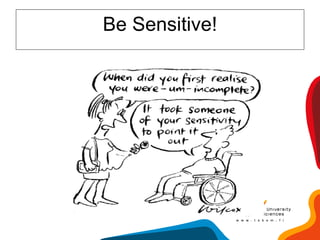
Be Sensitive!
Words change over time Words change in meaning over time.  cripple (the Old English crypel, meaning one who can only creep) word was once in common and respectable use. Today it is regarded as offensive and unacceptable.  Other offensive words include mentally retarded, insane, nut case, crazed, victim, freak, spastic, subnormal, and expressions like deaf and dumb, the disabled and handicapped.  Think of other words that have changed over time.
PC Lnaguage Chairman Chair Handicapped People with special needs;  people who  are physically/mentally  challenged; people with  disabilities Retarded Developmentally challenged Gifted children Advanced learners Race Ethnicity or nationality (There  is only one race--human) Uneducated (when referring to adults) Lacking a formal education
The little woman;  the wifeYour wife; his wife Old people  Seniors;  "Chronologically Advantaged” wheel-chair bound A person who uses a wheel-chair Blacklisted  Banned Manning" the project  Staffing the project
Black sheep  Outcast Guys" (when referring to a mixed group) Friends; folks; group Oriental (when referring to people) Asian (using the specific nationality, i.e. Korean is even better, when possible) Acting like wild Indians Out of control Girls (when referring to coworkers) Women Policemen/postman Police officer/mail carrier Manhole Utility hole
Prevention of harassment & victimisation: An education provider must develop and implement strategies and programs to prevent harassment or victimisation of a student with a disability, or a student who has an associate with a disability, in relation to the disability.
Right to Health Care Services Disabled women are the largest majority among female population because disability is a category that crosses all other categories; gender, race, age, sexual orientation, religion, etc. But even though disabled persons constitute the world largest minority (encompassing more then 600 Million people) we are rarely recognized in the six major human rights treaties. Disabled women find themselves at an even greater disadvantage: we are invisible in all human rights treaties and in most so called "soft laws" that exist for the protection of human rights of disabled people. The International Convention on the Elimination of All Forms of Discrimination Against Women (CEDAW ) doesn't mention disabled women at all.
References Disabled women:  http://www.disabilityworld.org/Aug-Sept2000/Women/HealthCare.htm Don’t call me handicapped!  http://news.bbc.co.uk/2/hi/uk_news/magazine/3708576.stm PC Language http://www.sideroad.com/Business_Communication/politically-correct-language.html

Don’t Call Me Handicapped

  • 1.
    Discriminatory Language *creates or reinforces a hierarchy of difference between people. * a symptom of and a contributor to the unequal social status of for example women, people with disabilities and people from various ethnic and social backgrounds
  • 2.
    Identifying Relevant QualitiesIn many contexts it is unnecessary to mention a person's sex, race, ethnic background, sexuality, age, disability, or physical appearance. For members of minority, or less powerful groups, these characteristics are often highlighted, even to the exclusion of other information which would have been more relevant in the context.
  • 3.
    Stereotypes a maleprofessor, a heterosexual teacher, a female professor, an attractive young doctor extra information irrelevant: no impact on the qualities or experience the person may bring to their role. Including irrelevant information can be discriminatory where that information: Overemphasises a particular characteristic that is irrelevant or of minor importance, or Sensationalises aspects of a person's life or life style
  • 4.
    Language can challengeand change stereotypes rarely a male academic, a heterosexual teacher or a white lawyer are used as these adjectives are often assumed Irrelevant information qualifies the other information about a person, making the person secondary. It also perpetuates beliefs about how society is structured and who belongs in certain role or positions. Only refer to ethnicity, age, disability etc. within your stories when it makes a difference to the point of the story.
  • 5.
  • 6.
    Recognise Individuality Inwriting about disability issues the following general points need to be borne in mind. See people with a disability as equals and as part of the diversity of humanity focus on what people can do Recognise individuality. One person with quadriplegia may be training for the Paralympics, another studying at university, another becoming a disability advocate,yet another may be more interested in the racing form guide.
  • 7.
  • 8.
    Words change overtime Words change in meaning over time. cripple (the Old English crypel, meaning one who can only creep) word was once in common and respectable use. Today it is regarded as offensive and unacceptable. Other offensive words include mentally retarded, insane, nut case, crazed, victim, freak, spastic, subnormal, and expressions like deaf and dumb, the disabled and handicapped. Think of other words that have changed over time.
  • 9.
    PC Lnaguage ChairmanChair Handicapped People with special needs; people who are physically/mentally challenged; people with disabilities Retarded Developmentally challenged Gifted children Advanced learners Race Ethnicity or nationality (There is only one race--human) Uneducated (when referring to adults) Lacking a formal education
  • 10.
    The little woman; the wifeYour wife; his wife Old people Seniors; "Chronologically Advantaged” wheel-chair bound A person who uses a wheel-chair Blacklisted Banned Manning" the project Staffing the project
  • 11.
    Black sheep Outcast Guys" (when referring to a mixed group) Friends; folks; group Oriental (when referring to people) Asian (using the specific nationality, i.e. Korean is even better, when possible) Acting like wild Indians Out of control Girls (when referring to coworkers) Women Policemen/postman Police officer/mail carrier Manhole Utility hole
  • 12.
    Prevention of harassment& victimisation: An education provider must develop and implement strategies and programs to prevent harassment or victimisation of a student with a disability, or a student who has an associate with a disability, in relation to the disability.
  • 13.
    Right to HealthCare Services Disabled women are the largest majority among female population because disability is a category that crosses all other categories; gender, race, age, sexual orientation, religion, etc. But even though disabled persons constitute the world largest minority (encompassing more then 600 Million people) we are rarely recognized in the six major human rights treaties. Disabled women find themselves at an even greater disadvantage: we are invisible in all human rights treaties and in most so called "soft laws" that exist for the protection of human rights of disabled people. The International Convention on the Elimination of All Forms of Discrimination Against Women (CEDAW ) doesn't mention disabled women at all.
  • 14.
    References Disabled women: http://www.disabilityworld.org/Aug-Sept2000/Women/HealthCare.htm Don’t call me handicapped! http://news.bbc.co.uk/2/hi/uk_news/magazine/3708576.stm PC Language http://www.sideroad.com/Business_Communication/politically-correct-language.html

Editor's Notes

  • #3 In many contexts it is quite unnecessary to mention a person's sex, race, ethnic background, sexuality, age, disability, or physical appearance. For members of minority, or less powerful groups, these characteristics are often highlighted, even to the exclusion of other information which would have been more relevant in the context. Including irrelevant information can be discriminatory where that information: Overemphasises a particular characteristic that is irrelevant or of minor importance, or Sensationalises aspects of a person's life or life style It is extremely rare that we hear or read, a male academic, a heterosexual teacher or a white lawyer, as these adjectives are often assumed. Irrelevant information qualifies the other information about a person, making the person secondary. It also perpetuates beliefs about how society is structured and who belongs in certain role or positions. Unfortunately it is common to read a lesbian teacher, a koori lawyer or a female professor. This extra information is irrelevant. It has no impact on the qualities or experience the person may bring to their role.
  • #5 If it is relevant, do use it. Don't clean your stories up so much that people cannot follow your point.
  • #8 new expressions not negro but afroamerican
  • #10 The following list highlights words and phrases that can be substituted for the less respectful terms. Insensitive Words & PhrasesPossible Alternatives Actions to Make a Difference Ask several people within the same cultural group which terms they prefer. Since everyone will not agree, use the term most often stated as acceptable. Include diversity-related questions on your pre-program questionnaire to help you plan your presentation. Will there be visually-challenged or hearing-impaired attendees? Knowing this can help you design visuals and inter-active exercises more effectively. What is the age range? You will know when to use examples from Star Trek of the Captain Kirk era, vs. Seinfield. What is the gender mix? Stories should include sports as well as other life analogies. (For great ideas listen to Eastern Educational Workshop, 1998 tape # 34- Customizing Presentations to the Gender of your Audience, by Lee E. Robert.) What is the ethnic mix? In addition to using correct terms, you could use various names that show ethnicity when using scenarios and vignettes during workshops, instead of only relying on Dick and Jane. Omit slang terms when referring to others. Ask a colleague to review your presentations, audiotapes, videos etc. to identify slang terms you frequently use. As audiences become more multi-cultural many participants speak English as a second language, or their primary language is British English. The slang terms have greatly differing meanings. You may not recognize your own habits. Use 14-pt. or larger fonts on handouts. 50% of the workforce will be 50 years old or older by the year 2000. Do not use derogatory terms to describe others even if people within the cultural group do. For example, if a Scottish person tells a joke about Scots, or a southern tells jokes about Alabama that is not permission for others, not in the group, to do the same.
  • #13 The effect of the following standards is to give students with disabilities the right to participate in the courses or programs, and to use services and facilities, provided by an educational institution, on the same basis as students without disabilities, including the right to reasonable adjustments, where necessary, to ensure they are able to participate in education and training, on the same basis as students without disabilities.