January 24, 2011 New Faculty Academy: I.E. & Evaluation in the Community College Dr. Bud Joyner President Emeritus Danita McAnally Dean of Assessment and Development
Questions to be Answered How do outcomes, assessments and accreditation relate? How does instruction and assessment correlate? What role does the strategic plan have? How is strategic planning accomplished? Why should this matter to me?
Overview 1. Correlating Instruction & Assessments 2. Institutional Effectiveness (I.E.) 3. Planning 101 4. Assessment 101 5. Planning & Assessment at AC 6. Why Plan and Assess? 7. Accreditation & Governance 8. Why should this matter to you?
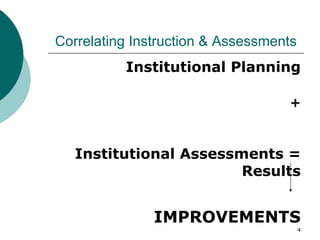
Correlating Instruction & Assessments Institutional Planning + Institutional Assessments = Results IMPROVEMENTS
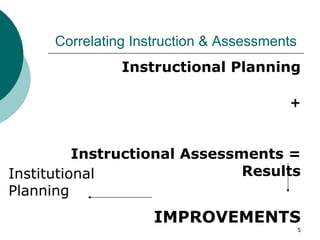
Correlating Instruction & Assessments Instructional Planning + Instructional Assessments = Results IMPROVEMENTS Institutional Planning
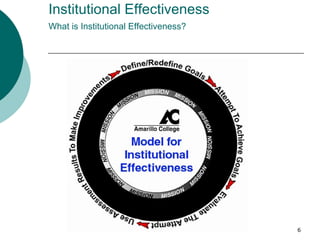
Institutional Effectiveness What is Institutional Effectiveness?
Institutional Effectiveness What are the 3 components in I.E.? Includes:  Planning  Assessing (including evaluation)  Using results to make improvements
Planning 101
Vision and Mission The reasons for existence The “ideal” state that can be achieved Major goals
SWOT Strengths Weaknesses Opportunities Threats
Environmental Scan (SWOT) External – economic, social, demographic, political, legal, technological, etc. Internal – organization, leadership, financial, efficiency, effectiveness, evaluation, etc.
Gap Analysis Evaluate difference between current position and desired future to enable development of specific strategies and resource identification and allocation.
Strategy Development Setting strategic goals, action plans, and time lines SMART model – goals are specific, measurable, agreed upon, realistic, and time/cost bound Scenario Planning
Evaluation Specific and regular assessments of the process and plan to evaluate strategies, tactics, and action programs Are they meeting expectations? If not, what changes must be made?
Benefits of Successful Planning Defines mission, vision and goals Produces a comprehensive plan that can be communicated to constituents Develops a sense of ownership in a plan Helps ensure effective, focused use of resources
Benefits of Successful Planning (cont’d) Provides a basis for assessment and change Brings together constituents, board and staff Gives the organization its best chance to survive and meet its  mission
Action Verbs  (examples) Acquire Expand Assess Improve Build Increase Conduct Maintain Create Provide Decrease Recruit (and retain) Design Refine Develop Renovate Eliminate Replace Enable Review Enhance Revise Ensure Train Establish Use Evaluate (and…)
Effective Planning “ None of us is as smart as all of us”.  Alan Weber “ If you don’t know where you’re going, how will you know when you get there.”  Mager, et al “ It’s not who you are or where you’ve been, but where you’re going that counts.”  Cal Farley
Strategic Plan Foundation planning document  – all other planning documents link to it Current Strategic Plan - designed to provide direction for through 2010 Strategic Plan under development – will provide direction through 2015 Annually audit to determine if we are accomplishing the goals within our strategic plan
Strategic Plan  through 2010 Available at: http://www.actx.edu/strategic/
Strategic Plan  through 2015  UNDER DEVELOPMENT VALUES At Amarillo College, we value: Student Success Quality Education Opportunity for All Collaboration Community Responsiveness Responsible Stewardship VISION At Amarillo College, we aspire for every student to have a success story. CORE PURPOSE At Amarillo College, we help each student to succeed.
Strategic Plan  through 2010 Includes the current  mission : “ Amarillo College, a public community college, is dedicated to providing educational, cultural and community services and resources to enhance the quality of life for the diverse population in the service area.”
Strategic Plan  through 2015   UNDER DEVELOPMENT Proposed  mission : “ Amarillo College – enriching the lives of our students and our community.”  Must be vetted with following key ?s: Does this mission encompass  everything  (e.g. all instruction and public service) Amarillo College is doing to serve all of its stakeholders (i.e. students, community, employees, Board of Regents, etc.)? Does the new mission reflect the current economic downturn, budget limitations & how AC is adjusting to these new conditions? If not, how will AC accomplish being sustainable under these conditions? What  effectiveness indicators  will be used to regularly  and systematically in decision-making and reported publicly to validate that the mission is being accomplished?
Assessment 101
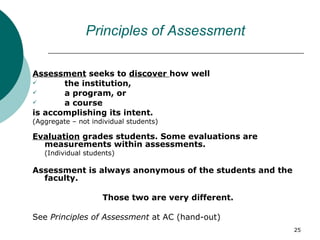
Principles of Assessment Assessment  seeks to  discover  how well the institution,  a program, or  a course  is accomplishing its intent.  (Aggregate – not individual students) Evaluation  grades students. Some evaluations are measurements within assessments. (Individual students) Assessment is always anonymous of the students and the faculty. Those two are very different.  See  Principles of Assessment  at AC (hand-out)
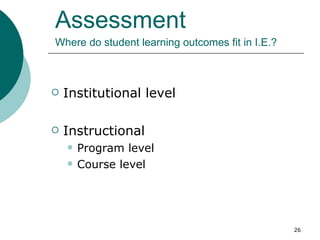
  Assessment   Where do student learning outcomes fit in I.E.? Institutional level Instructional Program level Course level
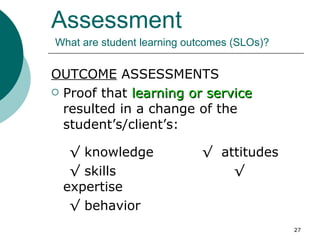
Assessment   What are student learning outcomes (SLOs)? OUTCOME  ASSESSMENTS Proof that  learning or service  resulted in a change of the student’s/client’s: √   knowledge   √  attitudes √   skills   √   expertise √   behavior
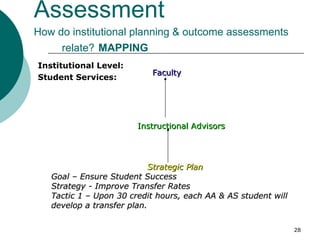
  Assessment   How do institutional planning & outcome assessments  relate?   MAPPING Institutional Level: Student Services: Strategic Plan Goal – Ensure Student Success Strategy - Improve Transfer Rates Tactic 1 – Upon 30 credit hours, each AA & AS student will develop a transfer plan. Faculty Instructional Advisors
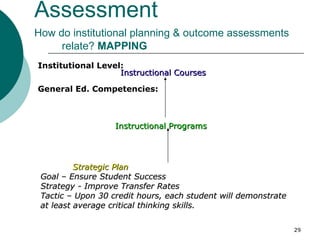
  Assessment   How do institutional planning & outcome assessments  relate?  MAPPING  Institutional Level: General Ed. Competencies: Strategic Plan Goal – Ensure Student Success Strategy - Improve Transfer Rates Tactic – Upon 30 credit hours, each student will demonstrate at least average critical thinking skills. Instructional Courses Instructional Programs
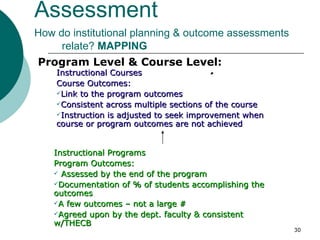
  Assessment   How do institutional planning & outcome assessments  relate?  MAPPING  Program Level & Course Level: Instructional Courses Course Outcomes: Link to the program outcomes Consistent across multiple sections of the course Instruction is adjusted to seek improvement when course or program outcomes are not achieved Instructional Programs Program Outcomes: Assessed by the end of the program Documentation of % of students accomplishing the outcomes A few outcomes – not a large # Agreed upon by the dept. faculty & consistent w/THECB
  Outcomes Assessments Referred to as student learning outcomes or student service outcomes Most often called  outcomes  (SLOs)
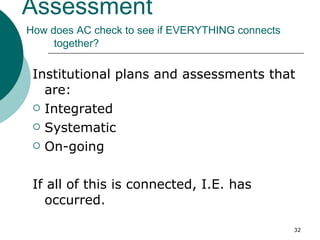
Assessment   How does AC check to see if EVERYTHING connects  together? Institutional plans and assessments that are: Integrated Systematic On-going If all of this is connected, I.E. has occurred.
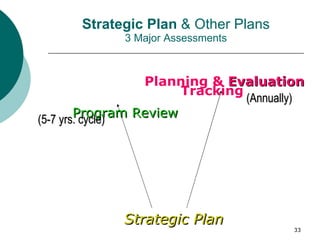
Strategic Plan  & Other Plans 3 Major Assessments Planning &  Evaluation   Tracking   Program Review (Annually) (5-7 yrs. cycle) Strategic Plan
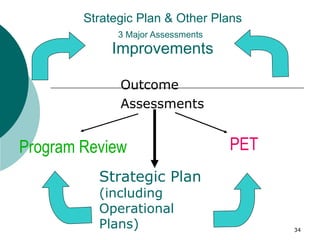
Strategic Plan & Other Plans 3 Major Assessments   Improvements Outcome Assessments Program Review PET Strategic Plan  (including Operational Plans)
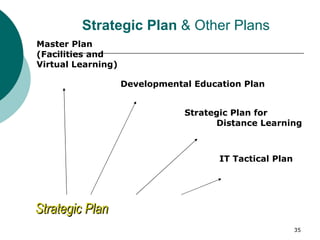
Strategic Plan  & Other Plans Master Plan  (Facilities and  Virtual Learning)   Developmental Education Plan   Strategic Plan for  Distance Learning     IT Tactical Plan   Strategic Plan
Planning + Assessments (including Evaluations) = Improvements based on recommendations  ( Institutional Effectiveness – I.E.)
PET Forms  All   departments/offices plan  annually   PET forms are available on the AC website’s Electronic Archive. (http://archives.actx.edu/)
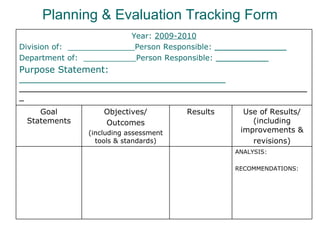
Planning & Evaluation Tracking Form Year:  2009-2010 Division of:  ______________Person Responsible:  _______________ Department of:  ___________Person Responsible:  ___________   Purpose Statement:   ___________________________________________ _____________________________________________________________ Goal Statements Objectives/ Outcomes (including assessment tools & standards) Results Use of Results/ (including improvements & revisions) ANALYSIS: RECOMMENDATIONS:
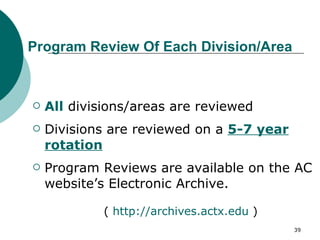
Program Review Of Each Division/Area All   divisions/areas are reviewed Divisions are reviewed on a   5-7 year rotation Program Reviews are available on the AC website’s Electronic Archive. (  http://archives.actx.edu  )
Why should AC plan? #1. Best way to do business:  If we don’t plan: we won’t know where we are headed or when we arrive and our ability to serve our students will be less than if we plan and follow through with assessment. #2. Accreditation association and state’s coordinating board require it.
SACSCOC Southern Association of Colleges and Schools –  Commission on Colleges   (www.sacscoc.org) and  Latin America TX LA MS AL TN KY VA NC SC GA FL
THECB Texas Higher Education Coordinating Board (CoBoard) (www.thecb.state.tx.us/)
  to   make improvements .  Not Success or Failure – Continual Improvement ! The goal of institutional effectiveness  is to use evidence resulting from planning and  assessments
Institutional Effectiveness Why should all this matter to you? YOUR  ONE-TWO SENTENCE ANSWERS.
  Contact information: Dr. Bud Joyner [email_address] Danita McAnally [email_address] Questions?
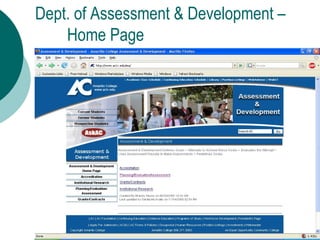
Dept. of Assessment & Development –  Home Page
Copyright 2010

New facultyie&evaluationjan2011 1

  • 1.
    January 24, 2011New Faculty Academy: I.E. & Evaluation in the Community College Dr. Bud Joyner President Emeritus Danita McAnally Dean of Assessment and Development
  • 2.
    Questions to beAnswered How do outcomes, assessments and accreditation relate? How does instruction and assessment correlate? What role does the strategic plan have? How is strategic planning accomplished? Why should this matter to me?
  • 3.
    Overview 1. CorrelatingInstruction & Assessments 2. Institutional Effectiveness (I.E.) 3. Planning 101 4. Assessment 101 5. Planning & Assessment at AC 6. Why Plan and Assess? 7. Accreditation & Governance 8. Why should this matter to you?
  • 4.
    Correlating Instruction &Assessments Institutional Planning + Institutional Assessments = Results IMPROVEMENTS
  • 5.
    Correlating Instruction &Assessments Instructional Planning + Instructional Assessments = Results IMPROVEMENTS Institutional Planning
  • 6.
    Institutional Effectiveness Whatis Institutional Effectiveness?
  • 7.
    Institutional Effectiveness Whatare the 3 components in I.E.? Includes: Planning Assessing (including evaluation) Using results to make improvements
  • 8.
  • 9.
    Vision and MissionThe reasons for existence The “ideal” state that can be achieved Major goals
  • 10.
    SWOT Strengths WeaknessesOpportunities Threats
  • 11.
    Environmental Scan (SWOT)External – economic, social, demographic, political, legal, technological, etc. Internal – organization, leadership, financial, efficiency, effectiveness, evaluation, etc.
  • 12.
    Gap Analysis Evaluatedifference between current position and desired future to enable development of specific strategies and resource identification and allocation.
  • 13.
    Strategy Development Settingstrategic goals, action plans, and time lines SMART model – goals are specific, measurable, agreed upon, realistic, and time/cost bound Scenario Planning
  • 14.
    Evaluation Specific andregular assessments of the process and plan to evaluate strategies, tactics, and action programs Are they meeting expectations? If not, what changes must be made?
  • 15.
    Benefits of SuccessfulPlanning Defines mission, vision and goals Produces a comprehensive plan that can be communicated to constituents Develops a sense of ownership in a plan Helps ensure effective, focused use of resources
  • 16.
    Benefits of SuccessfulPlanning (cont’d) Provides a basis for assessment and change Brings together constituents, board and staff Gives the organization its best chance to survive and meet its mission
  • 17.
    Action Verbs (examples) Acquire Expand Assess Improve Build Increase Conduct Maintain Create Provide Decrease Recruit (and retain) Design Refine Develop Renovate Eliminate Replace Enable Review Enhance Revise Ensure Train Establish Use Evaluate (and…)
  • 18.
    Effective Planning “None of us is as smart as all of us”. Alan Weber “ If you don’t know where you’re going, how will you know when you get there.” Mager, et al “ It’s not who you are or where you’ve been, but where you’re going that counts.” Cal Farley
  • 19.
    Strategic Plan Foundationplanning document – all other planning documents link to it Current Strategic Plan - designed to provide direction for through 2010 Strategic Plan under development – will provide direction through 2015 Annually audit to determine if we are accomplishing the goals within our strategic plan
  • 20.
    Strategic Plan through 2010 Available at: http://www.actx.edu/strategic/
  • 21.
    Strategic Plan through 2015 UNDER DEVELOPMENT VALUES At Amarillo College, we value: Student Success Quality Education Opportunity for All Collaboration Community Responsiveness Responsible Stewardship VISION At Amarillo College, we aspire for every student to have a success story. CORE PURPOSE At Amarillo College, we help each student to succeed.
  • 22.
    Strategic Plan through 2010 Includes the current mission : “ Amarillo College, a public community college, is dedicated to providing educational, cultural and community services and resources to enhance the quality of life for the diverse population in the service area.”
  • 23.
    Strategic Plan through 2015 UNDER DEVELOPMENT Proposed mission : “ Amarillo College – enriching the lives of our students and our community.” Must be vetted with following key ?s: Does this mission encompass everything (e.g. all instruction and public service) Amarillo College is doing to serve all of its stakeholders (i.e. students, community, employees, Board of Regents, etc.)? Does the new mission reflect the current economic downturn, budget limitations & how AC is adjusting to these new conditions? If not, how will AC accomplish being sustainable under these conditions? What effectiveness indicators will be used to regularly and systematically in decision-making and reported publicly to validate that the mission is being accomplished?
  • 24.
  • 25.
    Principles of AssessmentAssessment seeks to discover how well the institution, a program, or a course is accomplishing its intent. (Aggregate – not individual students) Evaluation grades students. Some evaluations are measurements within assessments. (Individual students) Assessment is always anonymous of the students and the faculty. Those two are very different. See Principles of Assessment at AC (hand-out)
  • 26.
    Assessment Where do student learning outcomes fit in I.E.? Institutional level Instructional Program level Course level
  • 27.
    Assessment What are student learning outcomes (SLOs)? OUTCOME ASSESSMENTS Proof that learning or service resulted in a change of the student’s/client’s: √ knowledge √ attitudes √ skills √ expertise √ behavior
  • 28.
    Assessment How do institutional planning & outcome assessments relate? MAPPING Institutional Level: Student Services: Strategic Plan Goal – Ensure Student Success Strategy - Improve Transfer Rates Tactic 1 – Upon 30 credit hours, each AA & AS student will develop a transfer plan. Faculty Instructional Advisors
  • 29.
    Assessment How do institutional planning & outcome assessments relate? MAPPING Institutional Level: General Ed. Competencies: Strategic Plan Goal – Ensure Student Success Strategy - Improve Transfer Rates Tactic – Upon 30 credit hours, each student will demonstrate at least average critical thinking skills. Instructional Courses Instructional Programs
  • 30.
    Assessment How do institutional planning & outcome assessments relate? MAPPING Program Level & Course Level: Instructional Courses Course Outcomes: Link to the program outcomes Consistent across multiple sections of the course Instruction is adjusted to seek improvement when course or program outcomes are not achieved Instructional Programs Program Outcomes: Assessed by the end of the program Documentation of % of students accomplishing the outcomes A few outcomes – not a large # Agreed upon by the dept. faculty & consistent w/THECB
  • 31.
    OutcomesAssessments Referred to as student learning outcomes or student service outcomes Most often called outcomes (SLOs)
  • 32.
    Assessment How does AC check to see if EVERYTHING connects together? Institutional plans and assessments that are: Integrated Systematic On-going If all of this is connected, I.E. has occurred.
  • 33.
    Strategic Plan & Other Plans 3 Major Assessments Planning & Evaluation Tracking Program Review (Annually) (5-7 yrs. cycle) Strategic Plan
  • 34.
    Strategic Plan &Other Plans 3 Major Assessments Improvements Outcome Assessments Program Review PET Strategic Plan (including Operational Plans)
  • 35.
    Strategic Plan & Other Plans Master Plan (Facilities and Virtual Learning) Developmental Education Plan Strategic Plan for Distance Learning IT Tactical Plan Strategic Plan
  • 36.
    Planning + Assessments(including Evaluations) = Improvements based on recommendations ( Institutional Effectiveness – I.E.)
  • 37.
    PET Forms All departments/offices plan annually PET forms are available on the AC website’s Electronic Archive. (http://archives.actx.edu/)
  • 38.
    Planning & EvaluationTracking Form Year: 2009-2010 Division of: ______________Person Responsible: _______________ Department of: ___________Person Responsible: ___________ Purpose Statement: ___________________________________________ _____________________________________________________________ Goal Statements Objectives/ Outcomes (including assessment tools & standards) Results Use of Results/ (including improvements & revisions) ANALYSIS: RECOMMENDATIONS:
  • 39.
    Program Review OfEach Division/Area All divisions/areas are reviewed Divisions are reviewed on a 5-7 year rotation Program Reviews are available on the AC website’s Electronic Archive. ( http://archives.actx.edu )
  • 40.
    Why should ACplan? #1. Best way to do business: If we don’t plan: we won’t know where we are headed or when we arrive and our ability to serve our students will be less than if we plan and follow through with assessment. #2. Accreditation association and state’s coordinating board require it.
  • 41.
    SACSCOC Southern Associationof Colleges and Schools – Commission on Colleges (www.sacscoc.org) and Latin America TX LA MS AL TN KY VA NC SC GA FL
  • 42.
    THECB Texas HigherEducation Coordinating Board (CoBoard) (www.thecb.state.tx.us/)
  • 43.
    to make improvements . Not Success or Failure – Continual Improvement ! The goal of institutional effectiveness is to use evidence resulting from planning and assessments
  • 44.
    Institutional Effectiveness Whyshould all this matter to you? YOUR ONE-TWO SENTENCE ANSWERS.
  • 45.
    Contactinformation: Dr. Bud Joyner [email_address] Danita McAnally [email_address] Questions?
  • 46.
    Dept. of Assessment& Development – Home Page
  • 47.