Grade 9 Visual Art AVI10 Sarah Kim and Jennifer Ellis
Transitions The transition into high school can be daunting….. Building on prior knowledge can give students confidence….. The grade 9 curriculum focuses on the students’ culture and perspectives.  Use this knowledge to create more sophisticated art in Grade 9
Grade 8 Expectations: What do they already know? organize their art works to create a specific effect, using at least two of the principles of design specified for this grade produce two- and three-dimensional works of art that communicate a range of thoughts, feelings, and experiences for specific purposes and to specific audiences; describe, in their plan for a work of art, the main idea they wish to communicate and the artistic decisions they have made to support that message.
Grade 9 Expectations: How they will build use materials and processes to create art objects that express their intent; apply the elements and principles of design; produce two- and three-dimensional artworks, using a variety of materials, tools, processes, and technologies; apply the creative process (i.e., perception, exploration, experimentation, production, and evaluation) in their work; explain the function of research and technology in visual arts.
Overall, The Students will….. Apply their knowledge of the principles of design and create work that is more research based and one that exemplifies a process to making art.  The work will deal with issues of social and cultural issues that are often perceived in art. The students will refine their drawing and painting skills by learning different techniques and perspectives used in art.
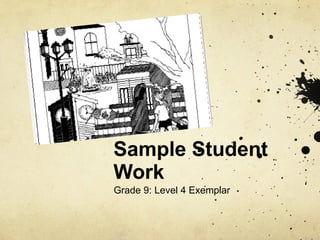
Sample Student Work Grade 9: Level 4 Exemplar
What Can Art Lead to? Many parents assume that art leads to a life of poverty and struggle.  However, art can lead to a wide range of interesting possibilities for students who wish to pursue their artistic side.
Jobs Related to Art Interior/Exterior Design Creative Director Advertising Animation and Technology Fashion Design Architecture Photography Web Designer Art Therapy Set Design/Production Film Make-Up Artist Magazine Layout Product Designer Art Conservation Curator
Art Schools in Canada Ryerson University:  Urban Planning, Interior Design, Film, and Fashion. Sheridan Tech College: Animation York University: Fine Arts The Art Institute of Vancouver: Graphic Design Concordia University: Art Therapy University of Toronto: Architecture Queen’s University: Art Conservation OCAD: Criticism and Curatorial Practice
More than just  P a i n t ! We work with other disciplines to explore and showcase our talent!
Cross-Curricular Connections Art with no Borders
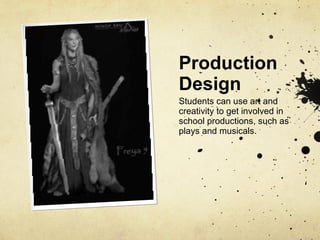
Production Design  Students can use art and creativity to get involved in school productions, such as plays and musicals.
History History and art go hand in hand.  While viewing master works, students will learn the artists’ political and social intentions.
Science Student learn aspects of movement, perception, depth, and colour in visual arts.
Mathematics Students will learn the “golden ratio” in a composition, a classical compositional technique used to divide the picture plane using an easily-calculated formula corresponding to the golden ratio of 1:1.6, which can be seen in examples like da Vinci's Vitruvian Man
D IPLOMA   AND RELATED PROCEDURES The Requirements for the OSSD earn  18 compulsory credits ; earn  12 optional credits complete  40 hours of community involvement  activities; successfully complete  the provincial school literacy test.
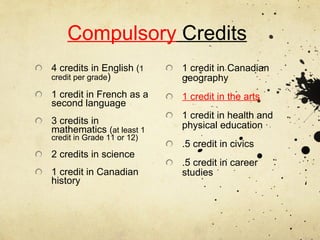
Compulsory  Credits   4 credits in English  ( 1 credit per grade ) 1 credit in French as a second language 3 credits in mathematics  ( at least 1 credit in Grade 11 or 12) 2 credits in science 1 credit in Canadian history 1 credit in Canadian geography 1 credit in the arts 1 credit in health and physical education .5 credit in civics .5 credit in career studies
PLUS 1 additional credit in English,  or  a third language,  or  social sciences and the humanities, or  Canadian and world studies 1 additional credit in health and physical education,  or  the arts ,  or  business studies 1 additional credit in science (Grade 11 or 12) or  technological education (Grades 9–12)
Types of Art Courses: Academic, Applied, and Open Academic-   Emphasis on theory and abstract concepts, application.  Applied -  Focus on practical applications and concrete examples. Open -  An overview in the arts to enrich their overall study.
Transfer Courses Should goals change, students may take a transfer course which will allow them to change focus of their Diploma.
 

Grade 9

  • 1.
    Grade 9 VisualArt AVI10 Sarah Kim and Jennifer Ellis
  • 2.
    Transitions The transitioninto high school can be daunting….. Building on prior knowledge can give students confidence….. The grade 9 curriculum focuses on the students’ culture and perspectives. Use this knowledge to create more sophisticated art in Grade 9
  • 3.
    Grade 8 Expectations:What do they already know? organize their art works to create a specific effect, using at least two of the principles of design specified for this grade produce two- and three-dimensional works of art that communicate a range of thoughts, feelings, and experiences for specific purposes and to specific audiences; describe, in their plan for a work of art, the main idea they wish to communicate and the artistic decisions they have made to support that message.
  • 4.
    Grade 9 Expectations:How they will build use materials and processes to create art objects that express their intent; apply the elements and principles of design; produce two- and three-dimensional artworks, using a variety of materials, tools, processes, and technologies; apply the creative process (i.e., perception, exploration, experimentation, production, and evaluation) in their work; explain the function of research and technology in visual arts.
  • 5.
    Overall, The Studentswill….. Apply their knowledge of the principles of design and create work that is more research based and one that exemplifies a process to making art. The work will deal with issues of social and cultural issues that are often perceived in art. The students will refine their drawing and painting skills by learning different techniques and perspectives used in art.
  • 6.
    Sample Student WorkGrade 9: Level 4 Exemplar
  • 7.
    What Can ArtLead to? Many parents assume that art leads to a life of poverty and struggle. However, art can lead to a wide range of interesting possibilities for students who wish to pursue their artistic side.
  • 8.
    Jobs Related toArt Interior/Exterior Design Creative Director Advertising Animation and Technology Fashion Design Architecture Photography Web Designer Art Therapy Set Design/Production Film Make-Up Artist Magazine Layout Product Designer Art Conservation Curator
  • 9.
    Art Schools inCanada Ryerson University: Urban Planning, Interior Design, Film, and Fashion. Sheridan Tech College: Animation York University: Fine Arts The Art Institute of Vancouver: Graphic Design Concordia University: Art Therapy University of Toronto: Architecture Queen’s University: Art Conservation OCAD: Criticism and Curatorial Practice
  • 10.
    More than just P a i n t ! We work with other disciplines to explore and showcase our talent!
  • 11.
  • 12.
    Production Design Students can use art and creativity to get involved in school productions, such as plays and musicals.
  • 13.
    History History andart go hand in hand. While viewing master works, students will learn the artists’ political and social intentions.
  • 14.
    Science Student learnaspects of movement, perception, depth, and colour in visual arts.
  • 15.
    Mathematics Students willlearn the “golden ratio” in a composition, a classical compositional technique used to divide the picture plane using an easily-calculated formula corresponding to the golden ratio of 1:1.6, which can be seen in examples like da Vinci's Vitruvian Man
  • 16.
    D IPLOMA AND RELATED PROCEDURES The Requirements for the OSSD earn 18 compulsory credits ; earn 12 optional credits complete 40 hours of community involvement activities; successfully complete the provincial school literacy test.
  • 17.
    Compulsory Credits 4 credits in English ( 1 credit per grade ) 1 credit in French as a second language 3 credits in mathematics ( at least 1 credit in Grade 11 or 12) 2 credits in science 1 credit in Canadian history 1 credit in Canadian geography 1 credit in the arts 1 credit in health and physical education .5 credit in civics .5 credit in career studies
  • 18.
    PLUS 1 additionalcredit in English, or a third language, or social sciences and the humanities, or Canadian and world studies 1 additional credit in health and physical education, or the arts , or business studies 1 additional credit in science (Grade 11 or 12) or technological education (Grades 9–12)
  • 19.
    Types of ArtCourses: Academic, Applied, and Open Academic- Emphasis on theory and abstract concepts, application. Applied - Focus on practical applications and concrete examples. Open - An overview in the arts to enrich their overall study.
  • 20.
    Transfer Courses Shouldgoals change, students may take a transfer course which will allow them to change focus of their Diploma.
  • 21.