Natureview Farm
HARVARD BUSINESSSCHOOL
Case Study
What is Natureview
Farm?
A small yogurt
manufacturer
(Since 1989)
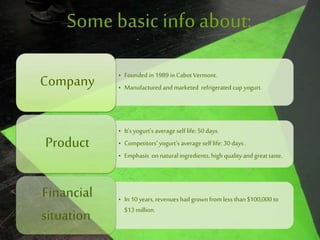
• Founded in 1989 in Cabot Vermont.
• Manufactured and marketed refrigerated cupyogurt.Company
• It’s yogurt’s average self life: 50 days.
• Competitors’ yogurt’s average self life: 30 days .
• Emphasis on natural ingredients, high quality and great taste.
Product
• In 10 years, revenues had grown from less than$100,000 to
$13 million.
Financial
situation
Some basic info about:
Who are the key players?
ChiefExecutive Officer: Barry Landers
ChiefFinance Officer: Jim Wagner
Vise president: ChristineWalker
Vise President of Sales: Walter Bellini
Vice president of Operations: Jack Gottlieb
Assistant MarketingDirector: KellyRiley
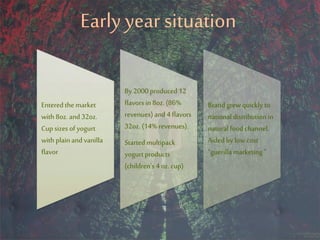
Early year situation
Entered the market
with 8oz. and 32oz.
Cup sizes of yogurt
with plain and vanilla
flavor
By 2000 produced 12
flavors in 8oz. (86%
revenues) and 4 flavors
32oz. (14% revenues).
Started multipack yogurt
products (children’s 4 oz.
cup)
Brand grew quickly
to national
distribution in
naturalfood
channel.Aided by
low cost “guerilla
marketing ”
GOAL?
To grownatureview’s revenues to
$20 million from $13 million before
the endof 2001
Team’s Three Options
1 2 3
Which onetochoose?
To expand sixSKUs of the 8-oz.
product line into one or two selected
supermarket channel regions- was
advocatedby WalterBellini,vice
presidentof sales
PROS
• Eight-ounce cups providing significant revenue potential.
• Supermarketretailers would likely authorize only oneorganic yogurt brand. The first
brand to enter the channel could therefore have a significant first-mover advantage.
• Two such brands—Silk Soymilk and Amy’s OrganicFoods—had increasedrevenues by
over 200% within two years of entering supermarkets
CONS
• The 8-oz.sizereceived thehighest level ofcompetitivetradepromotionand marketingspending.
• comprehensiveadvertising planwouldcostNatureview $1.2million perregion per year.
• Natureview’ssales, general, andadministrativeexpenses (SG&A) wouldincreaseby$320,000
• $200,000wouldbeincrementalSG&A foradditionsto salesstaffrequired tomanage the supermarket
brokersin thetworegions
• $120,000wouldgo towardsadditionalmarketing staffannually.
To expandfourSKUs of the 32-oz. size
nationally—was advocated by Jack
Gottlieb,vice president of operations
PROS
• 32-oz.cupsgeneratedanabove-averagegrossprofitmargin forNatureview(43.6% vs. 36.0%forthe8-
oz.line).
• Therewerefewercompetitiveofferingsin thissize,andNatureviewFarmhada strongcompetitive
advantagebecauseofthe product’slonger shelf life.
• Natureview’sbrandhadachieved a 45%shareofthis size segment in the naturalfoodschannel.The
managementteamfeltthatit wasrealistictoassumethatthecompanycould sell approximately5.5
million incremental unitsin thefirstyear.
• Slottingfees,promotionalexpenses,marketingexpenses wouldbesignificantlylower.
CONS
• newusers would readily “enter the brand” via a multi-use size.
• expansion option would increase SG&Aby $160,000.
• Inefficient sales team.
To introduce two SKUs of a children’s multi-pack
into thenaturalfoods channel—
was advocated by Walker’s colleague KellyRiley,
the assistant marketingdirector
PROS
• Gross profitability of the line would be37.6%.
• Thenatural foods channel was growing almost seven times faster than the supermarket
channel
• Sales and marketing expenses in this channel were lower
CONS
• Retailers demandmore as they grew.
• Retailers may impose the same demands as of super markets.
• Might loose an opportunity to step in supermarket expansion.
RECAP
• Introduction
• About Natureview Farm
• Key players
• Challenge
• Goal
• Options
• Option 1
• Option 2
• Option 3
DISCLAIMER
Created by RohitSinghduring marketinginternshipunder prof
Sameer Mathur

Natureview farm

  • 1.
  • 2.
  • 3.
  • 4.
    • Founded in1989 in Cabot Vermont. • Manufactured and marketed refrigerated cupyogurt.Company • It’s yogurt’s average self life: 50 days. • Competitors’ yogurt’s average self life: 30 days . • Emphasis on natural ingredients, high quality and great taste. Product • In 10 years, revenues had grown from less than$100,000 to $13 million. Financial situation Some basic info about:
  • 5.
    Who are thekey players?
  • 6.
    ChiefExecutive Officer: BarryLanders ChiefFinance Officer: Jim Wagner Vise president: ChristineWalker Vise President of Sales: Walter Bellini Vice president of Operations: Jack Gottlieb Assistant MarketingDirector: KellyRiley
  • 7.
    Early year situation Enteredthe market with 8oz. and 32oz. Cup sizes of yogurt with plain and vanilla flavor By 2000 produced 12 flavors in 8oz. (86% revenues) and 4 flavors 32oz. (14% revenues). Started multipack yogurt products (children’s 4 oz. cup) Brand grew quickly to national distribution in naturalfood channel.Aided by low cost “guerilla marketing ”
  • 8.
  • 9.
    To grownatureview’s revenuesto $20 million from $13 million before the endof 2001
  • 10.
    Team’s Three Options 12 3 Which onetochoose?
  • 11.
    To expand sixSKUsof the 8-oz. product line into one or two selected supermarket channel regions- was advocatedby WalterBellini,vice presidentof sales
  • 12.
    PROS • Eight-ounce cupsproviding significant revenue potential. • Supermarketretailers would likely authorize only oneorganic yogurt brand. The first brand to enter the channel could therefore have a significant first-mover advantage. • Two such brands—Silk Soymilk and Amy’s OrganicFoods—had increasedrevenues by over 200% within two years of entering supermarkets
  • 13.
    CONS • The 8-oz.sizereceivedthehighest level ofcompetitivetradepromotionand marketingspending. • comprehensiveadvertising planwouldcostNatureview $1.2million perregion per year. • Natureview’ssales, general, andadministrativeexpenses (SG&A) wouldincreaseby$320,000 • $200,000wouldbeincrementalSG&A foradditionsto salesstaffrequired tomanage the supermarket brokersin thetworegions • $120,000wouldgo towardsadditionalmarketing staffannually.
  • 14.
    To expandfourSKUs ofthe 32-oz. size nationally—was advocated by Jack Gottlieb,vice president of operations
  • 15.
    PROS • 32-oz.cupsgeneratedanabove-averagegrossprofitmargin forNatureview(43.6%vs. 36.0%forthe8- oz.line). • Therewerefewercompetitiveofferingsin thissize,andNatureviewFarmhada strongcompetitive advantagebecauseofthe product’slonger shelf life. • Natureview’sbrandhadachieved a 45%shareofthis size segment in the naturalfoodschannel.The managementteamfeltthatit wasrealistictoassumethatthecompanycould sell approximately5.5 million incremental unitsin thefirstyear. • Slottingfees,promotionalexpenses,marketingexpenses wouldbesignificantlylower.
  • 16.
    CONS • newusers wouldreadily “enter the brand” via a multi-use size. • expansion option would increase SG&Aby $160,000. • Inefficient sales team.
  • 17.
    To introduce twoSKUs of a children’s multi-pack into thenaturalfoods channel— was advocated by Walker’s colleague KellyRiley, the assistant marketingdirector
  • 18.
    PROS • Gross profitabilityof the line would be37.6%. • Thenatural foods channel was growing almost seven times faster than the supermarket channel • Sales and marketing expenses in this channel were lower
  • 19.
    CONS • Retailers demandmoreas they grew. • Retailers may impose the same demands as of super markets. • Might loose an opportunity to step in supermarket expansion.
  • 20.
    RECAP • Introduction • AboutNatureview Farm • Key players • Challenge • Goal • Options • Option 1 • Option 2 • Option 3
  • 21.
    DISCLAIMER Created by RohitSinghduringmarketinginternshipunder prof Sameer Mathur