NATUREVIEW
FARM
CASE STUDY
CONTENTS Introduction
Problems
Market Trends
Options
Decision
2
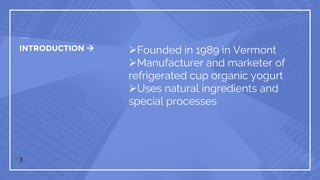
INTRODUCTION  Founded in 1989 in Vermont
Manufacturer and marketer of
refrigerated cup organic yogurt
Uses natural ingredients and
special processes
3
POINTS OF
PARITY 
Uses natural ingredients
Much longer shelf life
Strong reputation for high quality
and great taste
4
WHY IT
WORKS
Good product
Guerrilla Marketing
Strong relationship with distributors
5
PROBLEMS VCs need to cash out investment
Need to find a way to increase
revenues by 50 % to $20 million
6
4Ps Product
Place
Price
Promotion
7
Product Natural yogurt
8 –oz size with 12 flavors
32 –oz size with 4 flavors
8
Price Affordable
More than that at supermarkets
which explains its quality
9
Promotion Low cost Guerrilla Marketing
Good relationships with distributors
10
Place Natural channel
Wholesale club
National retailer channel
Convenience and drug stores
11
▫MARKET TRENDS
Different ways in which market
share is divided
12
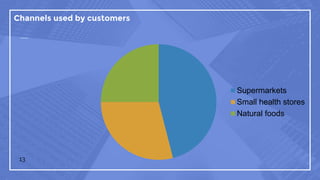
Channels used by customers
13
Supermarkets
Small health stores
Natural foods
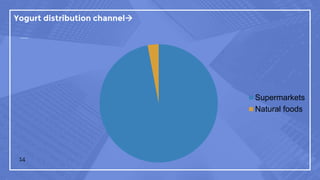
Yogurt distribution channel
14
Supermarkets
Natural foods
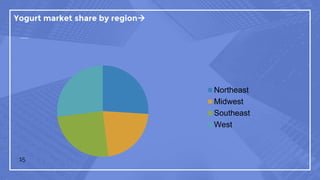
Yogurt market share by region
15
Northeast
Midwest
Southeast
West
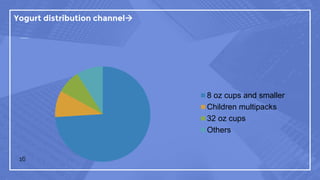
Yogurt distribution channel
16
8 oz cups and smaller
Children multipacks
32 oz cups
Others
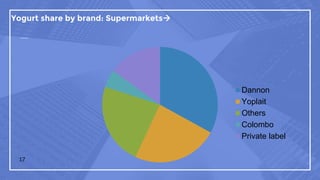
Yogurt share by brand: Supermarkets
17
Dannon
Yoplait
Others
Colombo
Private label
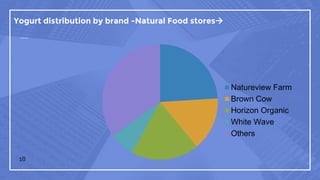
Yogurt distribution by brand -Natural Food stores
18
Natureview Farm
Brown Cow
Horizon Organic
White Wave
Others
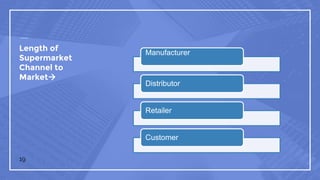
Length of
Supermarket
Channel to
Market
19
Manufacturer
Distributor
Retailer
Customer
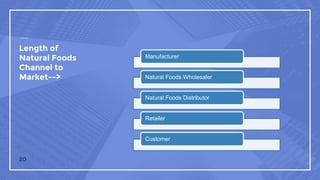
Length of
Natural Foods
Channel to
Market-->
20
Manufacturer
Natural Foods Wholesaler
Natural Foods Distributor
Retailer
Customer
OPTIONS Three options suggested
21
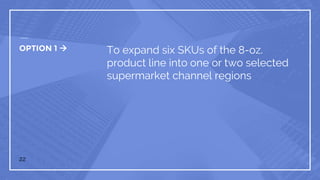
OPTION 1  To expand six SKUs of the 8-oz.
product line into one or two selected
supermarket channel regions
22
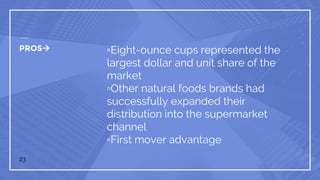
PROS ▫Eight-ounce cups represented the
largest dollar and unit share of the
market
▫Other natural foods brands had
successfully expanded their
distribution into the supermarket
channel
▫First mover advantage
23
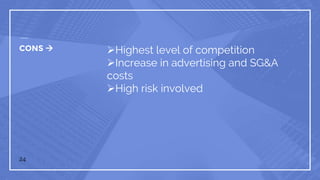
CONS  Highest level of competition
Increase in advertising and SG&A
costs
High risk involved
24
SUPERMARKET
CHANNEL
ANALYSIS

25
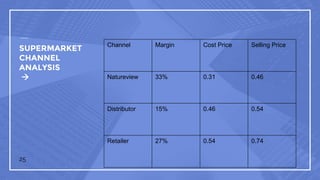
Channel Margin Cost Price Selling Price
Natureview 33% 0.31 0.46
Distributor 15% 0.46 0.54
Retailer 27% 0.54 0.74
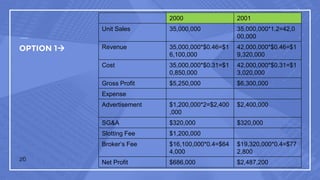
OPTION 1
26
2000 2001
Unit Sales 35,000,000 35,000,000*1.2=42,0
00,000
Revenue 35,000,000*$0.46=$1
6,100,000
42,000,000*$0.46=$1
9,320,000
Cost 35,000,000*$0.31=$1
0,850,000
42,000,000*$0.31=$1
3,020,000
Gross Profit $5,250,000 $6,300,000
Expense
Advertisement $1,200,000*2=$2,400
,000
$2,400,000
SG&A $320,000 $320,000
Slotting Fee $1,200,000
Broker’s Fee $16,100,000*0.4=$64
4,000
$19,320,000*0.4=$77
2,800
Net Profit $686,000 $2,487,200
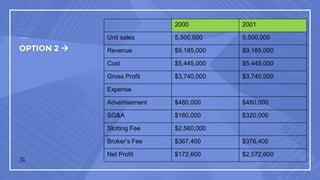
OPTION 2 To expand four SKUs of the 32-oz.
size nationally
27
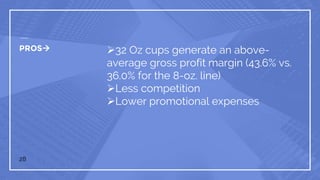
PROS 32 Oz cups generate an above-
average gross profit margin (43.6% vs.
36.0% for the 8-oz. line)
Less competition
Lower promotional expenses
28
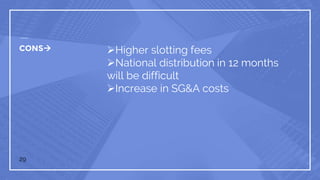
CONS Higher slotting fees
National distribution in 12 months
will be difficult
Increase in SG&A costs
29
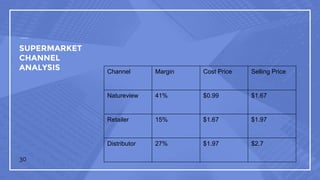
SUPERMARKET
CHANNEL
ANALYSIS
30
Channel Margin Cost Price Selling Price
Natureview 41% $0.99 $1.67
Retailer 15% $1.67 $1.97
Distributor 27% $1.97 $2.7
OPTION 2 
31
2000 2001
Unit sales 5,500,000 5,500,000
Revenue $9,185,000 $9,185,000
Cost $5,445,000 $5,445,000
Gross Profit $3,740,000 $3,740,000
Expense
Advertisement $480,000 $480,000
SG&A $160,000 $320,000
Slotting Fee $2,560,000
Broker’s Fee $367,400 $376,400
Net Profit $172,600 $2,572,600
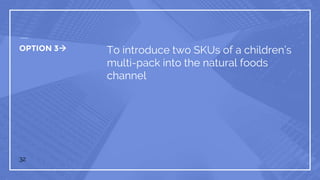
OPTION 3 To introduce two SKUs of a children’s
multi-pack into the natural foods
channel
32
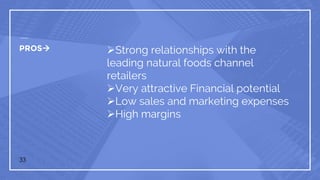
PROS Strong relationships with the
leading natural foods channel
retailers
Very attractive Financial potential
Low sales and marketing expenses
High margins
33
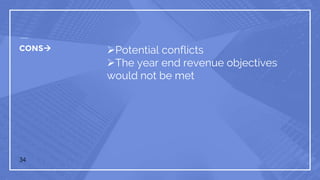
CONS Potential conflicts
The year end revenue objectives
would not be met
34
SUPERMARKET
CHANNEL
ANALYSIS
35
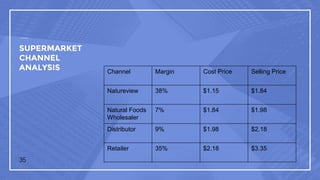
Channel Margin Cost Price Selling Price
Natureview 38% $1.15 $1.84
Natural Foods
Wholesaler
7% $1.84 $1.98
Distributor 9% $1.98 $2.18
Retailer 35% $2.18 $3.35
OPTION3
36
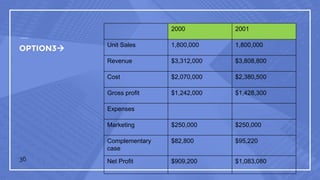
2000 2001
Unit Sales 1,800,000 1,800,000
Revenue $3,312,000 $3,808,800
Cost $2,070,000 $2,380,500
Gross profit $1,242,000 $1,428,300
Expenses
Marketing $250,000 $250,000
Complementary
case
$82,800 $95,220
Net Profit $909,200 $1,083,080
DECISION Option 1 is more favorable
37
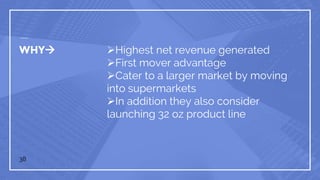
WHY Highest net revenue generated
First mover advantage
Cater to a larger market by moving
into supermarkets
In addition they also consider
launching 32 oz product line

38
DISCLAIMER Created by Bharat, IIT BHU, during
a Marketing Internship under Prof.
Sameer Mathur (IIM Lucknow)
39
40
THANKS Any questions?
You can find me at

Bharat.bharat.min14@iitbhu.ac.in

Natureview Farm Case Analysis