RISK AND INSURANCE

    The Nature of Risks
CONCEPT OF RISK
• Risk is a situation in which some kind of loss
  is possible. Risk is a part of life.
• Insurance protects against risk, in the sense
  that people who buy insurance are
  financially compensated in case of loss.
• Purchasing insurance does not remove risk.
  It merely provides compensation for the loss
  and spreads the cost of sharing the risk.
CONCEPT OF RISK
• Because insurance is intangible, you do not
  actually see what you are getting which
  some people cannot bring themselves to
  spend money on something they cannot see
  and might not need.
• Risk is intangible too, until you experience a
  loss, or survive a close call.
CONCEPT OF RISK
• Dealing with risk
  – There are several ways to handle risk.
    • Avoid risk for example, decided not to smoke
    • Reduce risk, by limiting the number of
      cigarettes you smoke if you are a smoker
    • Ignore risk
    • Transfer risk
PROBABILITY THEORY
• A Priori Probability
  – Determined when the total number of possible
    events are known.
  – Example: the probability of getting a six on a
    roll of dice is 1/6.
  – This concept has a limited practical
    application in the study of risk because
    situations where a number of possible outcome
    are known are very rare.
PROBABILITY THEORY
• Empirical Probability
  – Determined on the basis of historical data
  – Example: road accidents.
  – The underlying concept that makes it possible
    for empirical probability to be measured
    accurately is that as the number of
    observations increases, the predicted loss
    tends to approach the actual loss (the law of
    large numbers)
PROBABILITY THEORY –
    Empirical Probability
• Law of large numbers is a concept with the
  following requirements:
  – Large number of similar loss exposures
  – Loss exposures must be independent
  – Random occurrence of losses.
PROBABILITY THEORY
• Judgemental Probability
  – Determined based on the judgement of the
    person predicting the outcome.
  – It is used when there is lack of historical data
    or credible statistics.
  – Example: Astronaut program by Malaysia.
    The insurance company in Malaysia uses
    judgemental probability due to lack of credible
    statistics.
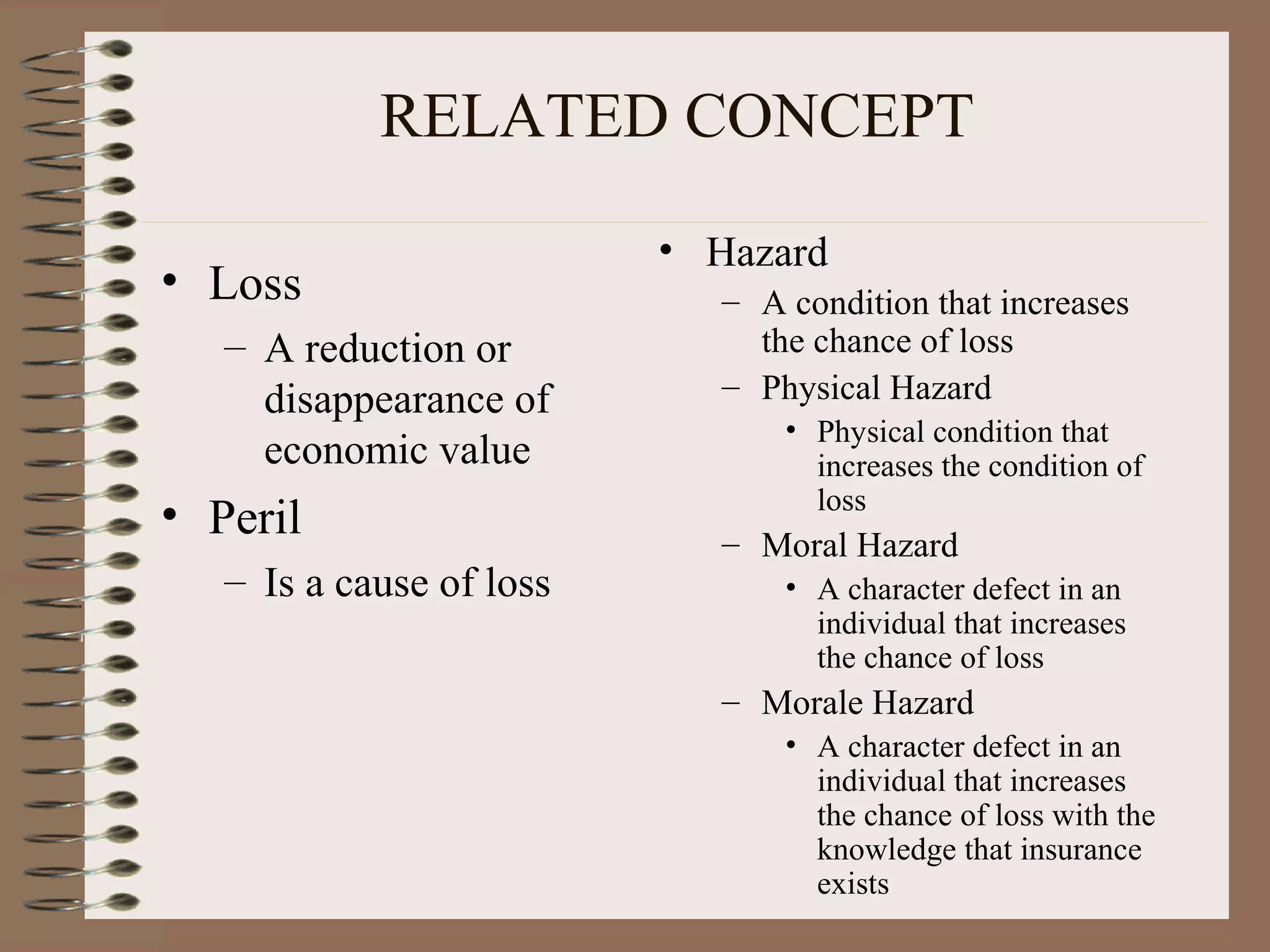
RELATED CONCEPT
                          • Hazard
• Loss                      – A condition that increases
   – A reduction or           the chance of loss
     disappearance of       – Physical Hazard
                                • Physical condition that
     economic value               increases the condition of
                                  loss
• Peril                     – Moral Hazard
   – Is a cause of loss         • A character defect in an
                                  individual that increases
                                  the chance of loss
                            – Morale Hazard
                                • A character defect in an
                                  individual that increases
                                  the chance of loss with the
                                  knowledge that insurance
                                  exists
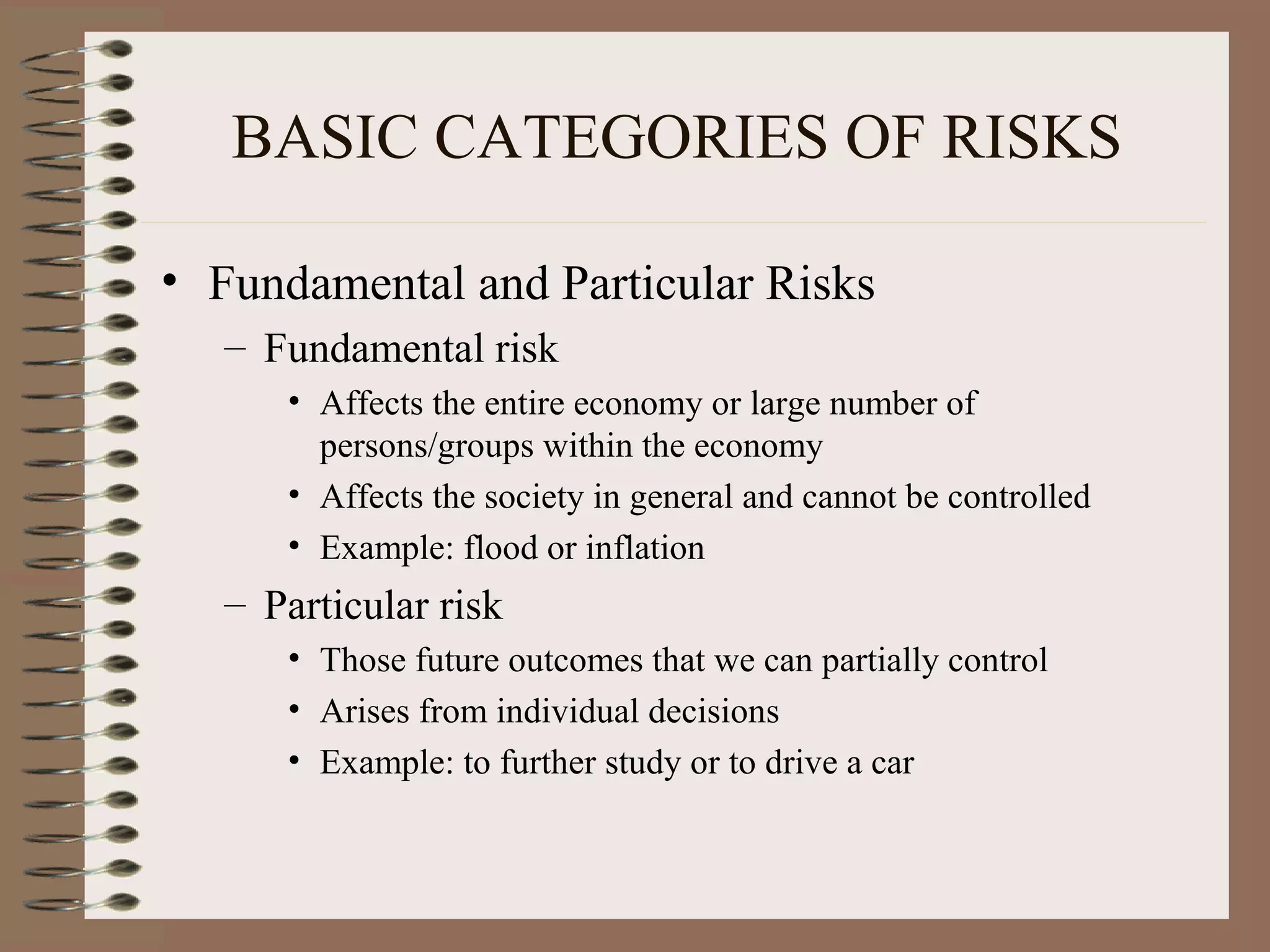
BASIC CATEGORIES OF RISKS

• Fundamental and Particular Risks
   – Fundamental risk
      • Affects the entire economy or large number of
        persons/groups within the economy
      • Affects the society in general and cannot be controlled
      • Example: flood or inflation
   – Particular risk
      • Those future outcomes that we can partially control
      • Arises from individual decisions
      • Example: to further study or to drive a car
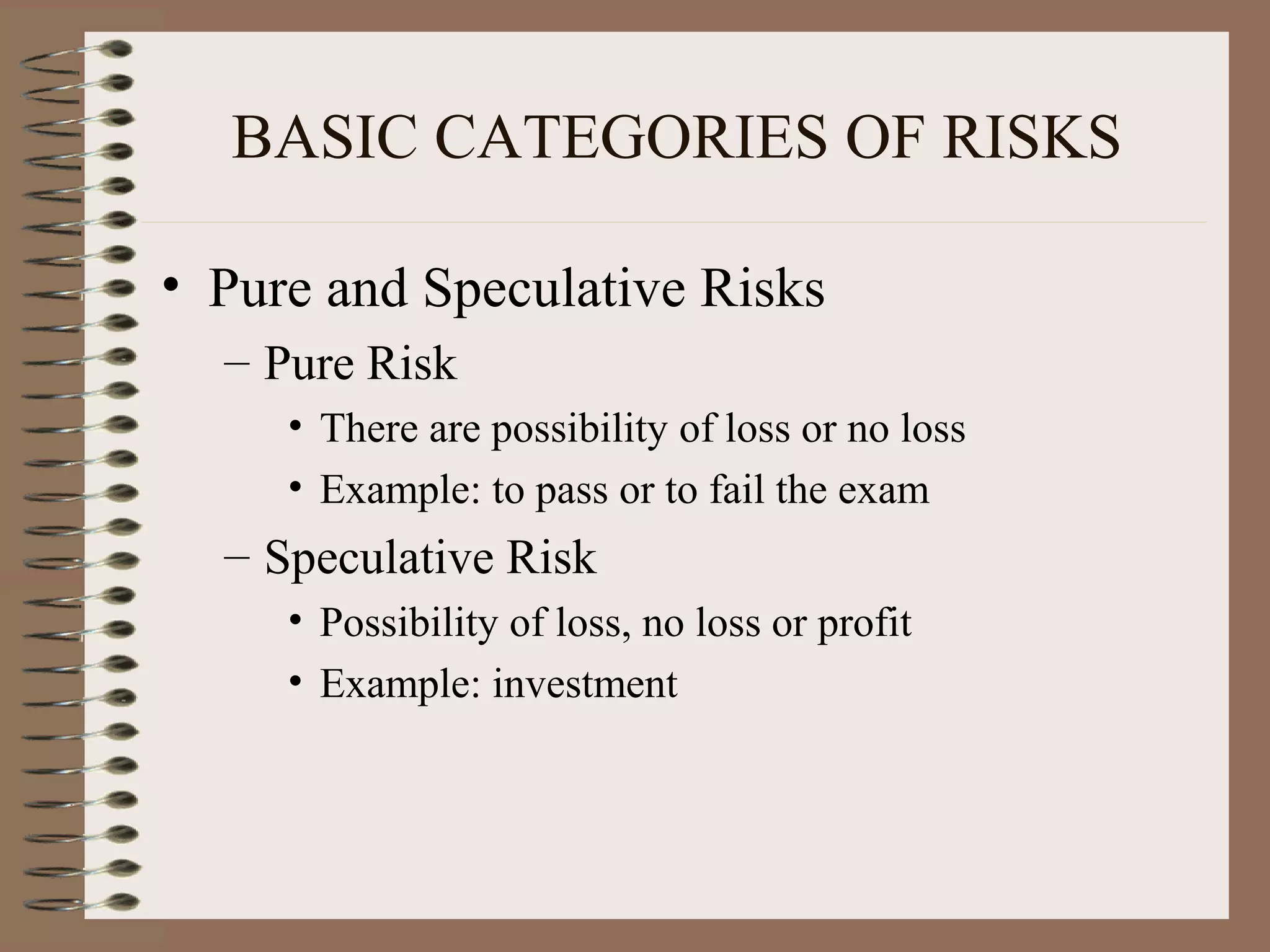
BASIC CATEGORIES OF RISKS

• Pure and Speculative Risks
  – Pure Risk
     • There are possibility of loss or no loss
     • Example: to pass or to fail the exam
  – Speculative Risk
     • Possibility of loss, no loss or profit
     • Example: investment
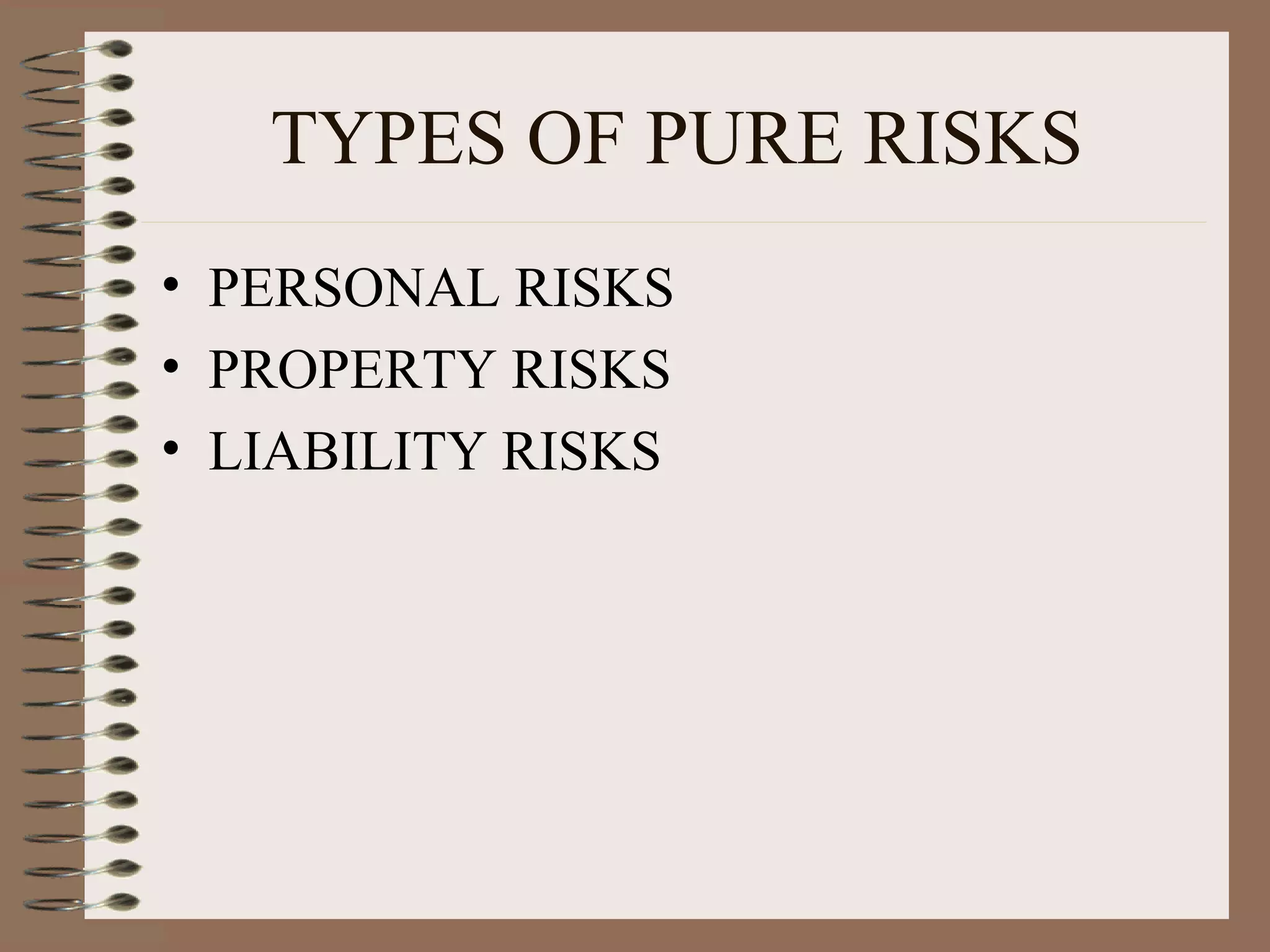
TYPES OF PURE RISKS
• PERSONAL RISKS
• PROPERTY RISKS
• LIABILITY RISKS
TYPES OF PURE RISKS
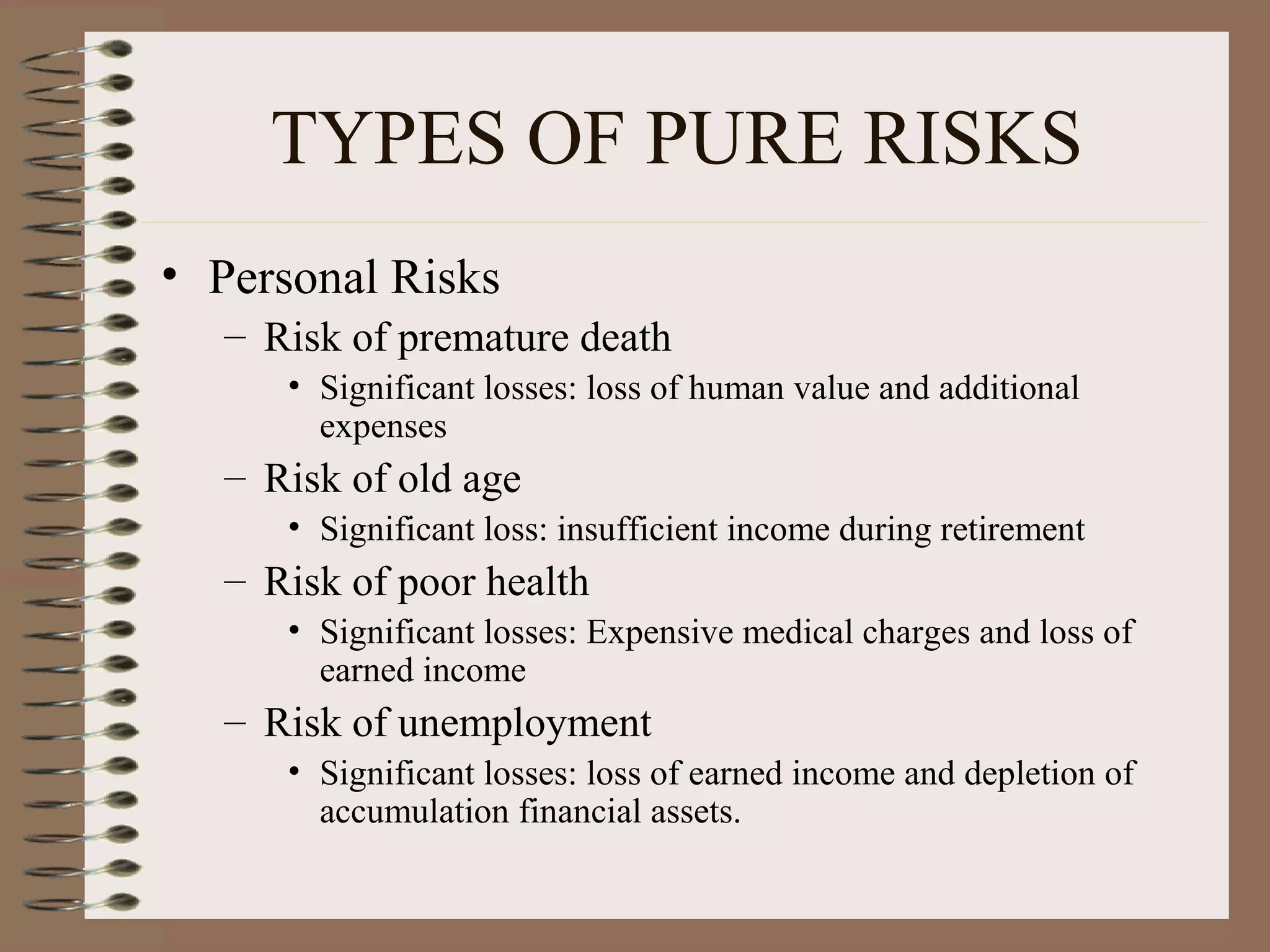
• Personal Risks
  – Risk of premature death
     • Significant losses: loss of human value and additional
       expenses
  – Risk of old age
     • Significant loss: insufficient income during retirement
  – Risk of poor health
     • Significant losses: Expensive medical charges and loss of
       earned income
  – Risk of unemployment
     • Significant losses: loss of earned income and depletion of
       accumulation financial assets.
TYPES OF PURE RISKS
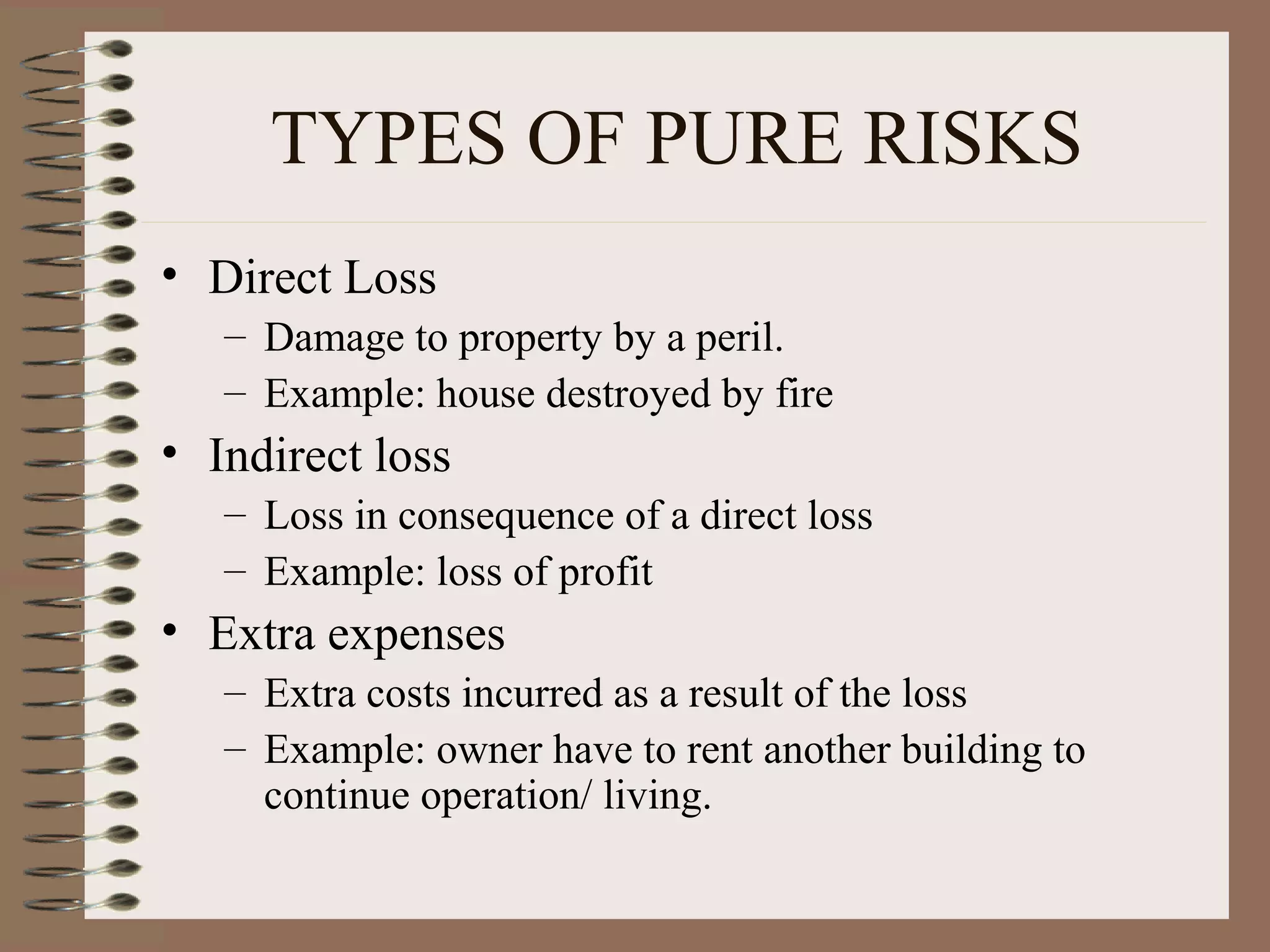
• Direct Loss
   – Damage to property by a peril.
   – Example: house destroyed by fire
• Indirect loss
   – Loss in consequence of a direct loss
   – Example: loss of profit
• Extra expenses
   – Extra costs incurred as a result of the loss
   – Example: owner have to rent another building to
     continue operation/ living.
TYPES OF PURE RISKS
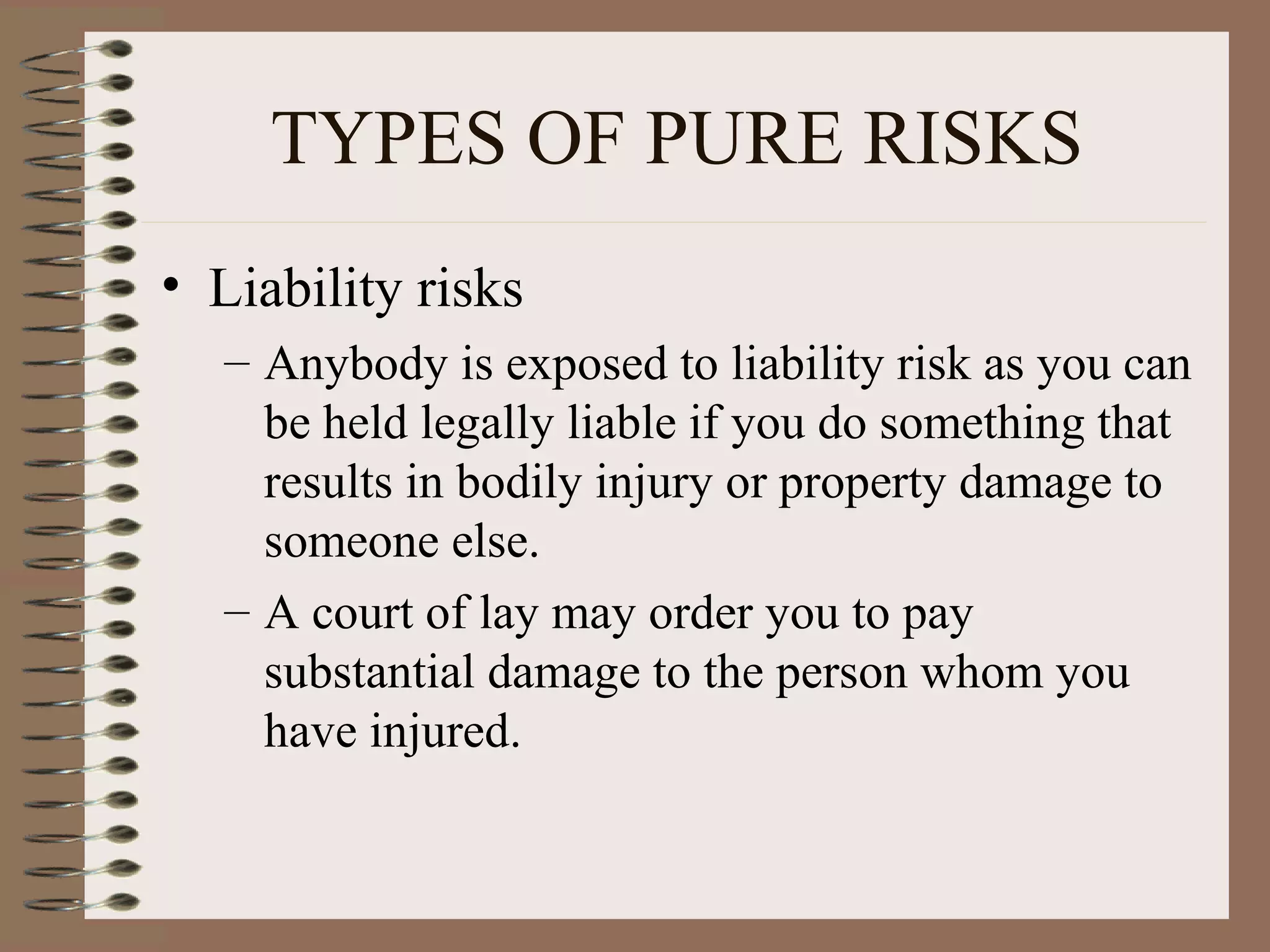
• Liability risks
  – Anybody is exposed to liability risk as you can
    be held legally liable if you do something that
    results in bodily injury or property damage to
    someone else.
  – A court of lay may order you to pay
    substantial damage to the person whom you
    have injured.

nature of risk

  • 1.
    RISK AND INSURANCE The Nature of Risks
  • 2.
    CONCEPT OF RISK •Risk is a situation in which some kind of loss is possible. Risk is a part of life. • Insurance protects against risk, in the sense that people who buy insurance are financially compensated in case of loss. • Purchasing insurance does not remove risk. It merely provides compensation for the loss and spreads the cost of sharing the risk.
  • 3.
    CONCEPT OF RISK •Because insurance is intangible, you do not actually see what you are getting which some people cannot bring themselves to spend money on something they cannot see and might not need. • Risk is intangible too, until you experience a loss, or survive a close call.
  • 4.
    CONCEPT OF RISK •Dealing with risk – There are several ways to handle risk. • Avoid risk for example, decided not to smoke • Reduce risk, by limiting the number of cigarettes you smoke if you are a smoker • Ignore risk • Transfer risk
  • 5.
    PROBABILITY THEORY • APriori Probability – Determined when the total number of possible events are known. – Example: the probability of getting a six on a roll of dice is 1/6. – This concept has a limited practical application in the study of risk because situations where a number of possible outcome are known are very rare.
  • 6.
    PROBABILITY THEORY • EmpiricalProbability – Determined on the basis of historical data – Example: road accidents. – The underlying concept that makes it possible for empirical probability to be measured accurately is that as the number of observations increases, the predicted loss tends to approach the actual loss (the law of large numbers)
  • 7.
    PROBABILITY THEORY – Empirical Probability • Law of large numbers is a concept with the following requirements: – Large number of similar loss exposures – Loss exposures must be independent – Random occurrence of losses.
  • 8.
    PROBABILITY THEORY • JudgementalProbability – Determined based on the judgement of the person predicting the outcome. – It is used when there is lack of historical data or credible statistics. – Example: Astronaut program by Malaysia. The insurance company in Malaysia uses judgemental probability due to lack of credible statistics.
  • 9.
    RELATED CONCEPT • Hazard • Loss – A condition that increases – A reduction or the chance of loss disappearance of – Physical Hazard • Physical condition that economic value increases the condition of loss • Peril – Moral Hazard – Is a cause of loss • A character defect in an individual that increases the chance of loss – Morale Hazard • A character defect in an individual that increases the chance of loss with the knowledge that insurance exists
  • 10.
    BASIC CATEGORIES OFRISKS • Fundamental and Particular Risks – Fundamental risk • Affects the entire economy or large number of persons/groups within the economy • Affects the society in general and cannot be controlled • Example: flood or inflation – Particular risk • Those future outcomes that we can partially control • Arises from individual decisions • Example: to further study or to drive a car
  • 11.
    BASIC CATEGORIES OFRISKS • Pure and Speculative Risks – Pure Risk • There are possibility of loss or no loss • Example: to pass or to fail the exam – Speculative Risk • Possibility of loss, no loss or profit • Example: investment
  • 12.
    TYPES OF PURERISKS • PERSONAL RISKS • PROPERTY RISKS • LIABILITY RISKS
  • 13.
    TYPES OF PURERISKS • Personal Risks – Risk of premature death • Significant losses: loss of human value and additional expenses – Risk of old age • Significant loss: insufficient income during retirement – Risk of poor health • Significant losses: Expensive medical charges and loss of earned income – Risk of unemployment • Significant losses: loss of earned income and depletion of accumulation financial assets.
  • 14.
    TYPES OF PURERISKS • Direct Loss – Damage to property by a peril. – Example: house destroyed by fire • Indirect loss – Loss in consequence of a direct loss – Example: loss of profit • Extra expenses – Extra costs incurred as a result of the loss – Example: owner have to rent another building to continue operation/ living.
  • 15.
    TYPES OF PURERISKS • Liability risks – Anybody is exposed to liability risk as you can be held legally liable if you do something that results in bodily injury or property damage to someone else. – A court of lay may order you to pay substantial damage to the person whom you have injured.