RISK AND
INSURANCE


   NATURE OF
   INSURANCE
DEFINITION
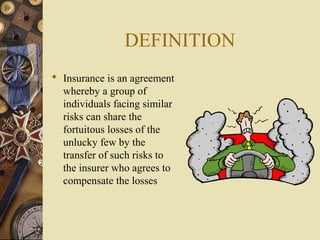
 Insurance is an agreement
  whereby a group of
  individuals facing similar
  risks can share the
  fortuitous losses of the
  unlucky few by the
  transfer of such risks to
  the insurer who agrees to
  compensate the losses
HOW DOES INSURANCE
           WORK?
 Insurer can collect premiums from a group
  of people in similar circumstances not all
  of whom will suffer losses in any one year.
 These premiums are then pooled together
  and used by the insurer to pay losses.
 Losses are thus shared out among all the
  policyholders rather than borne solely by
  the unlucky few.
COMMON POOL
 An insurance company sets
  itself up to operate the pool.
 It takes contributions, in the
  form of insurance premiums
  from many insureds and pay
  for the losses of a few.
 The operation of the
  common pool is very much
  based on the successful
  application of the Law of
  Large Numbers.
LAW OF LARGE NUMBERS
      Law of large numbers states that the
       larger the group of similar risks, the
       closer the actual losses experienced by
       the group will approach the expected
       losses
      This law implies that the greater the
       number of similar risk, the more
       accurate the insurer can be in predicting
       the future losses.
      Allows the insurer to fix premium in
       advance
      Insurer can assess the risk and fix a
       premium which reflects the hazard and
       value of the risk which an insured brings
       to the pool.
INSURANCE PREMIUM
 Contribution =
  premium which is the
  consideration an
  insured pays to the
  insure for an
  insurance coverage of
  a specified nature for
  a specified policy
  period
BREAKDOWN OF THE
    PREMIUM
         PURE PREMIUM
          RISK
         EXPENSE
          LOADING
         CONTINGENCY
          LOADING
         PROFIT LOADING
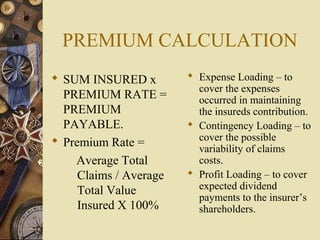
PREMIUM CALCULATION
 SUM INSURED x          Expense Loading – to
                          cover the expenses
  PREMIUM RATE =          occurred in maintaining
  PREMIUM                 the insureds contribution.
  PAYABLE.               Contingency Loading – to
 Premium Rate =          cover the possible
                          variability of claims
    Average Total         costs.
     Claims / Average    Profit Loading – to cover
     Total Value          expected dividend
                          payments to the insurer’s
     Insured X 100%       shareholders.
CXTS OF INSURABLE RISKS
 Financial Value
 Large number of similar
  risks
 Pure risks only
 No catastrophic loss
 Fortuitous Loss
 Insurable Interest
 Legal and not against
  public policy
 Reasonable premium
FUNCTION OF INSURANCE
            PRIMARY
             FUNCTION
             – Risk transfer
               mechanism
FUNCTION OF INSURANCE
 SECONDARY FUNCTIONS
   – Releasing funds otherwise
     tied up in reserves.
   – Stimulate business
     enterprise
   – Insurance also stimulates
     business
   – Remove fear and worry
   – Reduction of losses
   – Savings
   – Social benefits
FUNCTION OF INSURANCE
 INDIRECT FUNCTION
 – Investments of funds
 – Invisible exports
OTHERS
 Sources of Employment
   – Insurance industry has generated numerous
     employment opportunities
 Classes of Insurance
   – Life Assurance
   – General Insurance
 Risks Covered by Life Assurance
   – Premature Death
   – Continuous Stream of Income during retirement
   – Sickness or Disability
 Risks Covered by General Insurance
   – Motor Vehicles
   – Marine and Aviation
   – Products or goods sold
DIFFERENCES BETWEEN LIFE
     AND OTHER FORMS OF
         INSURANCE
 Life – Certain event, the only uncertainty
  is when the time it will occur
 General – term of contract is only one year
  and it is cancelable by both parties
 Life longer term and can only be cancel by
  insured
 General is subject to principle of indemnity