“ STUDY OFACID BASE INDICATOR PROPERTY
FOR ETHANOLIC EXTRACT OF NERIUM
INDICUM FLOWER ”
SUBMITTED BY
MISS. VAISHALI D. DANDGE
B PHARM 3RD YEAR VI SEMESTER
GUIDED BY
DR. K. B. GABHANE
Vidyabharati College Of Pharmacy, Amravati
(2018-2019)
INTRODUCTION
• Indicators are used to determine the equivalence point in acid – base titrations
(neutralization titrations). They exhibit sharp color change with respect to change
in pH.
• A study has been done to investigate the indicator property of ethanolic extract
of Nerium indicum.
• The commonly used synthetics indicators cause environmental pollution and
pose hazardous effects in human body.
• Natural pigments in plants are highly coloured substance and may change with
pH variation.
• The equivalence points of the titrations using flower extract is almost close or
coincide with that of phenolphthalein (synthetic indicator).
• Therefore, use of ethanolic extract of Nerium indicum as an indicator for acid-
base titration could be effectively employed as a substitute to the synthetic acid-
base indicators.
NATURAL SOURCES OF PH INDICATOR
• Any Flowers Such As Blue, Purple Or Red In Colour Contain A Class Of
Organic Pigment Called Anthocyanins that Change Colour With pH.
1. Dianthus Plumarius
2. Antirrhium Majus ,
3. Nerium Odoratum ,
4. Ipomoea Biloba ,
5. JacarandaAcutifolia Flower,
6. Pride Of Barbados ,
7. Morus Alba Linn Fruit
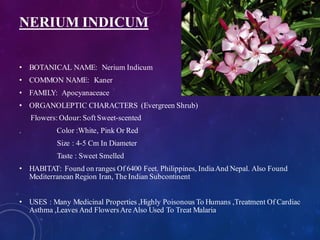
NERIUM INDICUM
• BOTANICAL NAME: Nerium Indicum
• COMMON NAME: Kaner
• FAMILY: Apocyanaceace
• ORGANOLEPTIC CHARACTERS (Evergreen Shrub)
Flowers: Odour: Soft Sweet-scented
. Color :White, Pink Or Red
Size : 4-5 Cm In Diameter
Taste : Sweet Smelled
• HABITAT: Found on ranges Of 6400 Feet. Philippines, IndiaAnd Nepal. Also Found
Mediterranean Region Iran, The Indian Subcontinent
• USES : Many Medicinal Properties ,Highly Poisonous To Humans ,Treatment Of Cardiac
Asthma ,Leaves And FlowersAre Also Used To Treat Malaria
pH INDICATORS
• DEFINITION: “pH indicator is the halochromic chemical compound which exhibits
different colors at various values of pH.” It is also called as ‘acid base indicator’.
• Example:
1) Methyl yellow:
pH range:2.9-4.0
2) Phenolphthalein:
pH range:8.3-10.0
3) Methyl red:
pH range:4.8-6.0
• They are very much useful for the identification of equivalence point in
neutralization titrations.
❑ TYPES OF INDICATORS
Naturalindicator: Examples- litmus, China rose, red cabbage, turmeric etc.
Synthetic indicator: Examples- phenolphthalein, methyl red, methyl orange etc.
NATURALINDICATORS
• Red Roses, As Well As Many Other Flowers And Fruits, Contain Natural
Indicators That Are Sensitive To Acids And Bases.
• The Color Of A Natural Acid–base Indicator Depends On Ph.
• One Of The Most Well-known Effects Of Natural Indicators In Plants
Occurs In The Hydrangea Or Snowball Plant . Hydrangea Flowers Are
Blue When Grown In Acidic Soils And Pink Or Red In Basic Soils.
• Many Of These Molecules Of Indicators Occur Naturally.
• For Example:- Anthrocyanins Found In Flowers. Fruits, And Vegetables
Are Ph Indicators.
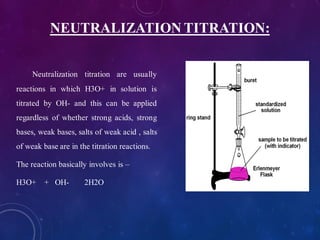
NEUTRALIZATION TITRATION:
Neutralization titration are usually
reactions in which H3O+ in solution is
titrated by OH- and this can be applied
regardless of whether strong acids, strong
bases, weak bases, salts of weak acid , salts
of weak base are in the titration reactions.
The reaction basically involves is –
H3O+ + OH- 2H2O
HARMFUL EFFECTS:
• Most of the indicators used nowadays are of synthetic origin. These are man
made indicators.
• They suffer various demerits, majority of which belong to their toxic effects.
Besides their harmful health effects, they are also expensive and less available.
• It has been reported that the synthetic indicators causes environmental pollution
particularly soil pollution. Some of their health hazards include hypoglycemia,
pancreatitis, pulmonary edema, diarrhea, abdominal cramps and skin rashes.
• Studies done on organic man made indicators like phenolphthalein, methyl
orange helped to identify their toxic and hazardous effects.
• The objective of the present study is to find a suitable substitute to replace the
organic indicators and to introduce flower pigments as indicators in neutralization
titrations.
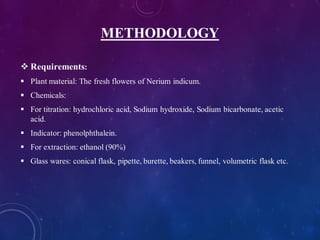
METHODOLOGY
❖ Requirements:
▪ Plant material: The fresh flowers of Nerium indicum.
▪ Chemicals:
▪ For titration: hydrochloric acid, Sodium hydroxide, Sodium bicarbonate, acetic
acid.
▪ Indicator: phenolphthalein.
▪ For extraction: ethanol (90%)
▪ Glass wares: conical flask, pipette, burette, beakers, funnel, volumetric flask etc.
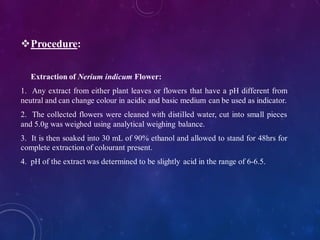
❖Procedure:
Extraction of Nerium indicum Flower:
1. Any extract from either plant leaves or flowers that have a pH different from
neutral and can change colour in acidic and basic medium can be used as indicator.
2. The collected flowers were cleaned with distilled water, cut into small pieces
and 5.0g was weighed using analytical weighing balance.
3. It is then soaked into 30 mL of 90% ethanol and allowed to stand for 48hrs for
complete extraction of colourant present.
4. pH of the extract was determined to be slightly acid in the range of 6-6.5.
Titration:
1. Take about 50ml of 1N acid solution in conical flask add 0.1ml of flower extract
as indicator and titrate it agent 1N base solution which is present in burette.
2. All four types of neutralization titration is carry out, strong acid against strong
base[HCl versus NaOH], strong acid against weak base[HCl versus NaHCO3],
weak acid against strong base[CH3COOH versus NaOH], weak acid against weak
base[CH3COOH versus NaHCO3].
3. The trials were repeated 3 times to check the precision.
4. Repeat the titration by using phenolphthalein indicator as standard
5. The results obtained were compared with the results of titrations using the flower
extract indicator.
6. The end points of the titrations using the extract were reached when colour
changed from yellow to light pink
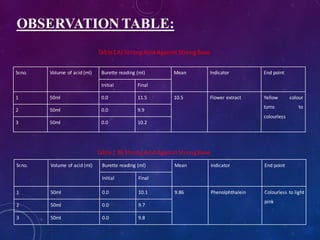
OBSERVATION TABLE:
Table 1 B) Strong Acid Against StrongBase
Table1A) Strong Acid Against StrongBase
Sr.no. Volume of acid (ml) Burette reading (ml) Mean Indicator End point
Initial Final
1 50ml 0.0 11.5 10.5 Flower extract Yellow colour
turns to
colourless
2 50ml 0.0 9.9
3 50ml 0.0 10.2
Sr.no. Volume of acid (ml) Burette reading (ml) Mean Indicator End point
Initial Final
1 50ml 0.0 10.1 9.86 Phenolphthalein Colourless to light
pink
2 50ml 0.0 9.7
3 50ml 0.0 9.8
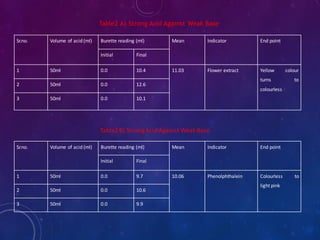
Table2B) StrongAcid Against WeakBase
Sr.no. Volume of acid (ml) Burette reading (ml) Mean Indicator End point
Initial Final
1 50ml 0.0 10.4 11.03 Flower extract Yellow colour
turns to
colourless
2 50ml 0.0 12.6
3 50ml 0.0 10.1
Sr.no. Volume of acid (ml) Burette reading (ml) Mean Indicator End point
Initial Final
1 50ml 0.0 9.7 10.06 Phenolphthalein Colourless to
light pink
2 50ml 0.0 10.6
3 50ml 0.0 9.9
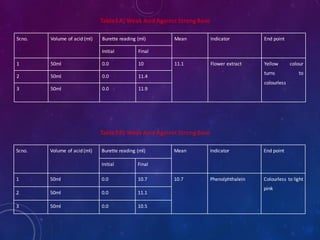
Table3B) Weak Acid Against StrongBase
Table3A) Weak Acid Against StrongBase
Sr.no. Volume of acid (ml) Burette reading (ml) Mean Indicator End point
Initial Final
1 50ml 0.0 10 11.1 Flower extract Yellow colour
turns to
colourless
2 50ml 0.0 11.4
3 50ml 0.0 11.9
Sr.no. Volume of acid (ml) Burette reading (ml) Mean Indicator End point
Initial Final
1 50ml 0.0 10.7 10.7 Phenolphthalein Colourless to light
pink
2 50ml 0.0 11.1
3 50ml 0.0 10.5
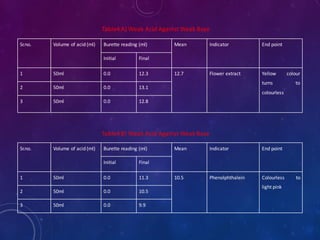
Table4B) Weak Acid Against WeakBase
Table4A) Weak Acid Against Weak Base
Sr.no. Volume of acid (ml) Burette reading (ml) Mean Indicator End point
Initial Final
1 50ml 0.0 12.3 12.7 Flower extract Yellow colour
turns to
colourless
2 50ml 0.0 13.1
3 50ml 0.0 12.8
Sr.no. Volume of acid (ml) Burette reading (ml) Mean Indicator End point
Initial Final
1 50ml 0.0 11.3 10.5 Phenolphthalein Colourless to
light pink
2 50ml 0.0 10.5
3 50ml 0.0 9.9
RESULT
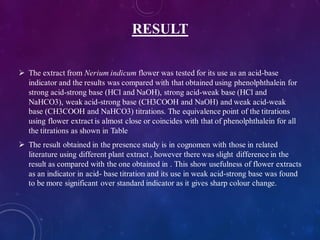
➢ The extract from Nerium indicum flower was tested for its use as an acid-base
indicator and the results was compared with that obtained using phenolphthalein for
strong acid-strong base (HCl and NaOH), strong acid-weak base (HCl and
NaHCO3), weak acid-strong base (CH3COOH and NaOH) and weak acid-weak
base (CH3COOH and NaHCO3) titrations. The equivalence point of the titrations
using flower extract is almost close or coincides with that of phenolphthalein for all
the titrations as shown in Table
➢ The result obtained in the presence study is in cognomen with those in related
literature using different plant extract , however there was slight difference in the
result as compared with the one obtained in . This show usefulness of flower extracts
as an indicator in acid- base titration and its use in weak acid-strong base was found
to be more significant over standard indicator as it gives sharp colour change.
CONCLUSION:
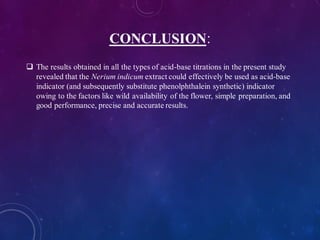
❑ The results obtained in all the types of acid-base titrations in the present study
revealed that the Nerium indicum extract could effectively be used as acid-base
indicator (and subsequently substitute phenolphthalein synthetic) indicator
owing to the factors like wild availability of the flower, simple preparation, and
good performance, precise and accurate results.
REFERENCES
1. Vaibhav GN, Vishal BK, Prashant DN, Ganpatrao NM, Suresh TS, Ashish SS. Study
of Nerium odoratum as natural, economical and effective alternative to synthetic
indicator and litmus paper. Intl. J. Pharm. Chem. Sci. 2014;3(2):440.
2. Nwosu FO, Adekola FA, Ihedioha KC. Simple titrimetric colour indicators from
some natural flower petals. Centre Point (science edition). 2004;12(1):74-89.
3. Saini P, Kannapan N, Kumar P, Diwan A, Antil V, Sharma S, Singh S. CNS activity
of Nerium indicum flower part. Res. J. Pharm. Bio. Chem. Sci. 2010;1(3):546 -550.
4. Dr. A.V. Kasture and Dr. S. G. Wadodkar. Pharmaceutical analysis volume 1, Nirali
prakashan . pH indicator and theory of indicator.
5. G. H. Jeffery , J. Bassett, J Mendham, R. C. Denney. Vogel’s Textbook of
quantitative chemical analysis, fifth edition. Neutralization titration.

Natural Indicator Preparation

  • 1.
    “ STUDY OFACIDBASE INDICATOR PROPERTY FOR ETHANOLIC EXTRACT OF NERIUM INDICUM FLOWER ” SUBMITTED BY MISS. VAISHALI D. DANDGE B PHARM 3RD YEAR VI SEMESTER GUIDED BY DR. K. B. GABHANE Vidyabharati College Of Pharmacy, Amravati (2018-2019)
  • 2.
    INTRODUCTION • Indicators areused to determine the equivalence point in acid – base titrations (neutralization titrations). They exhibit sharp color change with respect to change in pH. • A study has been done to investigate the indicator property of ethanolic extract of Nerium indicum. • The commonly used synthetics indicators cause environmental pollution and pose hazardous effects in human body. • Natural pigments in plants are highly coloured substance and may change with pH variation. • The equivalence points of the titrations using flower extract is almost close or coincide with that of phenolphthalein (synthetic indicator). • Therefore, use of ethanolic extract of Nerium indicum as an indicator for acid- base titration could be effectively employed as a substitute to the synthetic acid- base indicators.
  • 3.
    NATURAL SOURCES OFPH INDICATOR • Any Flowers Such As Blue, Purple Or Red In Colour Contain A Class Of Organic Pigment Called Anthocyanins that Change Colour With pH. 1. Dianthus Plumarius 2. Antirrhium Majus , 3. Nerium Odoratum , 4. Ipomoea Biloba , 5. JacarandaAcutifolia Flower, 6. Pride Of Barbados , 7. Morus Alba Linn Fruit
  • 4.
    NERIUM INDICUM • BOTANICALNAME: Nerium Indicum • COMMON NAME: Kaner • FAMILY: Apocyanaceace • ORGANOLEPTIC CHARACTERS (Evergreen Shrub) Flowers: Odour: Soft Sweet-scented . Color :White, Pink Or Red Size : 4-5 Cm In Diameter Taste : Sweet Smelled • HABITAT: Found on ranges Of 6400 Feet. Philippines, IndiaAnd Nepal. Also Found Mediterranean Region Iran, The Indian Subcontinent • USES : Many Medicinal Properties ,Highly Poisonous To Humans ,Treatment Of Cardiac Asthma ,Leaves And FlowersAre Also Used To Treat Malaria
  • 5.
    pH INDICATORS • DEFINITION:“pH indicator is the halochromic chemical compound which exhibits different colors at various values of pH.” It is also called as ‘acid base indicator’. • Example: 1) Methyl yellow: pH range:2.9-4.0 2) Phenolphthalein: pH range:8.3-10.0 3) Methyl red: pH range:4.8-6.0 • They are very much useful for the identification of equivalence point in neutralization titrations. ❑ TYPES OF INDICATORS Naturalindicator: Examples- litmus, China rose, red cabbage, turmeric etc. Synthetic indicator: Examples- phenolphthalein, methyl red, methyl orange etc.
  • 6.
    NATURALINDICATORS • Red Roses,As Well As Many Other Flowers And Fruits, Contain Natural Indicators That Are Sensitive To Acids And Bases. • The Color Of A Natural Acid–base Indicator Depends On Ph. • One Of The Most Well-known Effects Of Natural Indicators In Plants Occurs In The Hydrangea Or Snowball Plant . Hydrangea Flowers Are Blue When Grown In Acidic Soils And Pink Or Red In Basic Soils. • Many Of These Molecules Of Indicators Occur Naturally. • For Example:- Anthrocyanins Found In Flowers. Fruits, And Vegetables Are Ph Indicators.
  • 7.
    NEUTRALIZATION TITRATION: Neutralization titrationare usually reactions in which H3O+ in solution is titrated by OH- and this can be applied regardless of whether strong acids, strong bases, weak bases, salts of weak acid , salts of weak base are in the titration reactions. The reaction basically involves is – H3O+ + OH- 2H2O
  • 8.
    HARMFUL EFFECTS: • Mostof the indicators used nowadays are of synthetic origin. These are man made indicators. • They suffer various demerits, majority of which belong to their toxic effects. Besides their harmful health effects, they are also expensive and less available. • It has been reported that the synthetic indicators causes environmental pollution particularly soil pollution. Some of their health hazards include hypoglycemia, pancreatitis, pulmonary edema, diarrhea, abdominal cramps and skin rashes. • Studies done on organic man made indicators like phenolphthalein, methyl orange helped to identify their toxic and hazardous effects. • The objective of the present study is to find a suitable substitute to replace the organic indicators and to introduce flower pigments as indicators in neutralization titrations.
  • 9.
    METHODOLOGY ❖ Requirements: ▪ Plantmaterial: The fresh flowers of Nerium indicum. ▪ Chemicals: ▪ For titration: hydrochloric acid, Sodium hydroxide, Sodium bicarbonate, acetic acid. ▪ Indicator: phenolphthalein. ▪ For extraction: ethanol (90%) ▪ Glass wares: conical flask, pipette, burette, beakers, funnel, volumetric flask etc.
  • 10.
    ❖Procedure: Extraction of Neriumindicum Flower: 1. Any extract from either plant leaves or flowers that have a pH different from neutral and can change colour in acidic and basic medium can be used as indicator. 2. The collected flowers were cleaned with distilled water, cut into small pieces and 5.0g was weighed using analytical weighing balance. 3. It is then soaked into 30 mL of 90% ethanol and allowed to stand for 48hrs for complete extraction of colourant present. 4. pH of the extract was determined to be slightly acid in the range of 6-6.5.
  • 11.
    Titration: 1. Take about50ml of 1N acid solution in conical flask add 0.1ml of flower extract as indicator and titrate it agent 1N base solution which is present in burette. 2. All four types of neutralization titration is carry out, strong acid against strong base[HCl versus NaOH], strong acid against weak base[HCl versus NaHCO3], weak acid against strong base[CH3COOH versus NaOH], weak acid against weak base[CH3COOH versus NaHCO3]. 3. The trials were repeated 3 times to check the precision. 4. Repeat the titration by using phenolphthalein indicator as standard 5. The results obtained were compared with the results of titrations using the flower extract indicator. 6. The end points of the titrations using the extract were reached when colour changed from yellow to light pink
  • 12.
    OBSERVATION TABLE: Table 1B) Strong Acid Against StrongBase Table1A) Strong Acid Against StrongBase Sr.no. Volume of acid (ml) Burette reading (ml) Mean Indicator End point Initial Final 1 50ml 0.0 11.5 10.5 Flower extract Yellow colour turns to colourless 2 50ml 0.0 9.9 3 50ml 0.0 10.2 Sr.no. Volume of acid (ml) Burette reading (ml) Mean Indicator End point Initial Final 1 50ml 0.0 10.1 9.86 Phenolphthalein Colourless to light pink 2 50ml 0.0 9.7 3 50ml 0.0 9.8
  • 13.
    Table2B) StrongAcid AgainstWeakBase Sr.no. Volume of acid (ml) Burette reading (ml) Mean Indicator End point Initial Final 1 50ml 0.0 10.4 11.03 Flower extract Yellow colour turns to colourless 2 50ml 0.0 12.6 3 50ml 0.0 10.1 Sr.no. Volume of acid (ml) Burette reading (ml) Mean Indicator End point Initial Final 1 50ml 0.0 9.7 10.06 Phenolphthalein Colourless to light pink 2 50ml 0.0 10.6 3 50ml 0.0 9.9
  • 14.
    Table3B) Weak AcidAgainst StrongBase Table3A) Weak Acid Against StrongBase Sr.no. Volume of acid (ml) Burette reading (ml) Mean Indicator End point Initial Final 1 50ml 0.0 10 11.1 Flower extract Yellow colour turns to colourless 2 50ml 0.0 11.4 3 50ml 0.0 11.9 Sr.no. Volume of acid (ml) Burette reading (ml) Mean Indicator End point Initial Final 1 50ml 0.0 10.7 10.7 Phenolphthalein Colourless to light pink 2 50ml 0.0 11.1 3 50ml 0.0 10.5
  • 15.
    Table4B) Weak AcidAgainst WeakBase Table4A) Weak Acid Against Weak Base Sr.no. Volume of acid (ml) Burette reading (ml) Mean Indicator End point Initial Final 1 50ml 0.0 12.3 12.7 Flower extract Yellow colour turns to colourless 2 50ml 0.0 13.1 3 50ml 0.0 12.8 Sr.no. Volume of acid (ml) Burette reading (ml) Mean Indicator End point Initial Final 1 50ml 0.0 11.3 10.5 Phenolphthalein Colourless to light pink 2 50ml 0.0 10.5 3 50ml 0.0 9.9
  • 16.
    RESULT ➢ The extractfrom Nerium indicum flower was tested for its use as an acid-base indicator and the results was compared with that obtained using phenolphthalein for strong acid-strong base (HCl and NaOH), strong acid-weak base (HCl and NaHCO3), weak acid-strong base (CH3COOH and NaOH) and weak acid-weak base (CH3COOH and NaHCO3) titrations. The equivalence point of the titrations using flower extract is almost close or coincides with that of phenolphthalein for all the titrations as shown in Table ➢ The result obtained in the presence study is in cognomen with those in related literature using different plant extract , however there was slight difference in the result as compared with the one obtained in . This show usefulness of flower extracts as an indicator in acid- base titration and its use in weak acid-strong base was found to be more significant over standard indicator as it gives sharp colour change.
  • 17.
    CONCLUSION: ❑ The resultsobtained in all the types of acid-base titrations in the present study revealed that the Nerium indicum extract could effectively be used as acid-base indicator (and subsequently substitute phenolphthalein synthetic) indicator owing to the factors like wild availability of the flower, simple preparation, and good performance, precise and accurate results.
  • 18.
    REFERENCES 1. Vaibhav GN,Vishal BK, Prashant DN, Ganpatrao NM, Suresh TS, Ashish SS. Study of Nerium odoratum as natural, economical and effective alternative to synthetic indicator and litmus paper. Intl. J. Pharm. Chem. Sci. 2014;3(2):440. 2. Nwosu FO, Adekola FA, Ihedioha KC. Simple titrimetric colour indicators from some natural flower petals. Centre Point (science edition). 2004;12(1):74-89. 3. Saini P, Kannapan N, Kumar P, Diwan A, Antil V, Sharma S, Singh S. CNS activity of Nerium indicum flower part. Res. J. Pharm. Bio. Chem. Sci. 2010;1(3):546 -550. 4. Dr. A.V. Kasture and Dr. S. G. Wadodkar. Pharmaceutical analysis volume 1, Nirali prakashan . pH indicator and theory of indicator. 5. G. H. Jeffery , J. Bassett, J Mendham, R. C. Denney. Vogel’s Textbook of quantitative chemical analysis, fifth edition. Neutralization titration.