Submitted by
HUGAR SIDDESH
USN:3VC20ME419
V.V. Sangha’s
RAO BAHADUR Y MAHABALESWARAPPA ENGINEERING COLLEGE
Department of Mechanical Engineering
2022-2023
Under the guidance of
Dr. Kottresh Sardar
Contents:
1) Introduction
2) Types of Natural disaster
3) Reasons for Natural disaster
4) Solution for Natural disaster
5) conclusion
6) References
Introduction
 A natural disaster is a disaster caused by nature, such as floods,
volcanic eruptions, earthquakes, tsunamis, landslides, sinkholes,
drought, heat waves, tropical storms, typhoons, Ice Ages,
tornadoes, and wildfires.
 A biological threat such as locusts or toxic fungi could also
be considered a natural disaster.
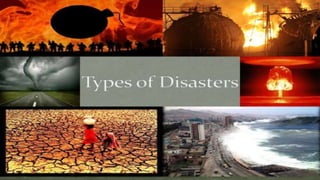
Disasters can be broadly classified into two
types
 Natural disasters
 Man- made disasters
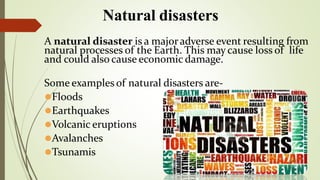
A natural disaster is a majoradverse event resulting from
natural processes of the Earth. This may cause loss of life
and could also cause economic damage.
Some examples of natural disasters are-
⚫Floods
⚫Earthquakes
⚫Volcanic eruptions
⚫Avalanches
⚫Tsunamis
Natural disasters
MAN MADE DISASTERS
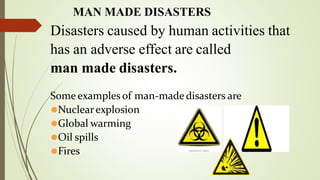
Disasters caused by human activities that
has an adverse effect are called
man made disasters.
Some examples of man-made disasters are
⚫Nuclearexplosion
⚫Global warming
⚫Oil spills
⚫Fires
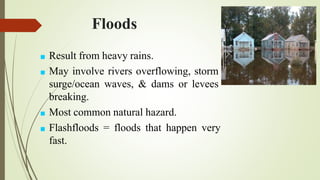
■ Result from heavy rains.
■ May involve rivers overflowing, storm
surge/ocean waves, & dams or levees
breaking.
■ Most common natural hazard.
■ Flashfloods = floods that happen very
fast.
Floods
Effects of Floods
Tsunamis
■ Form as a result of earthquakes,
volcanoes, or landsides under the
ocean.
■ Waves grow taller as they reach the
coast.
■ Four out of Five occur in the Ring of
Fire.
■ Over 200,000 people Died in the
26/12/2005 Indian Ocean tsunami.
Effects of Tsunamis
Indian Ocean Tsunami – December 26, 2005
Wildfires
■ Occur in forests, grasslands, and
wooded areas.
■ Most common causes: lightning
and human accidents.
■ Burn more than 4 million acres in
the U.S. each year.
Effects of Wildfires
 Earthquakes are usually
caused when underground rock
suddenly breaks and there is rapid
motion along a fault.
 This sudden release of energy
causes the seismic waves that
make the ground shake
Earthquakes
Effects of Earthquakes
REASONS FOR NATURAL DISASTERS
Natural phenomenon
Moon activities
Soil erosion
Deforestation
Ocean currents
Air pressure
Pollution
Global warming
Mining
Awareness, education, preparedness,
and prediction and warning systems can
reduce the disruptive impacts of a natural
disaster on communities
SOLUTIONS FOR NATURAL DISASTERS
CONCLUSION
Natural disasters can cause severe damage to the environment. It is
high time we must be aware that natural disasters can also be
triggered by mankind. Our activities which affect nature can lead
nature to backfire on us. Natural disasters can not be stopped when
they occur, but they can be prevented to some extent.
References
 WWW.GOOGLE.COM
 WWW.SLIDESHARE.COM
 https://www.slideshare.net/VenkatBaboo/natural-disasters-64481694
Natural Disasters .pptx

Natural Disasters .pptx

  • 1.
    Submitted by HUGAR SIDDESH USN:3VC20ME419 V.V.Sangha’s RAO BAHADUR Y MAHABALESWARAPPA ENGINEERING COLLEGE Department of Mechanical Engineering 2022-2023 Under the guidance of Dr. Kottresh Sardar
  • 2.
    Contents: 1) Introduction 2) Typesof Natural disaster 3) Reasons for Natural disaster 4) Solution for Natural disaster 5) conclusion 6) References
  • 3.
    Introduction  A naturaldisaster is a disaster caused by nature, such as floods, volcanic eruptions, earthquakes, tsunamis, landslides, sinkholes, drought, heat waves, tropical storms, typhoons, Ice Ages, tornadoes, and wildfires.  A biological threat such as locusts or toxic fungi could also be considered a natural disaster.
  • 5.
    Disasters can bebroadly classified into two types  Natural disasters  Man- made disasters
  • 6.
    A natural disasteris a majoradverse event resulting from natural processes of the Earth. This may cause loss of life and could also cause economic damage. Some examples of natural disasters are- ⚫Floods ⚫Earthquakes ⚫Volcanic eruptions ⚫Avalanches ⚫Tsunamis Natural disasters
  • 7.
    MAN MADE DISASTERS Disasterscaused by human activities that has an adverse effect are called man made disasters. Some examples of man-made disasters are ⚫Nuclearexplosion ⚫Global warming ⚫Oil spills ⚫Fires
  • 8.
    ■ Result fromheavy rains. ■ May involve rivers overflowing, storm surge/ocean waves, & dams or levees breaking. ■ Most common natural hazard. ■ Flashfloods = floods that happen very fast. Floods
  • 9.
  • 10.
    Tsunamis ■ Form asa result of earthquakes, volcanoes, or landsides under the ocean. ■ Waves grow taller as they reach the coast. ■ Four out of Five occur in the Ring of Fire. ■ Over 200,000 people Died in the 26/12/2005 Indian Ocean tsunami.
  • 11.
    Effects of Tsunamis IndianOcean Tsunami – December 26, 2005
  • 12.
    Wildfires ■ Occur inforests, grasslands, and wooded areas. ■ Most common causes: lightning and human accidents. ■ Burn more than 4 million acres in the U.S. each year.
  • 13.
  • 14.
     Earthquakes areusually caused when underground rock suddenly breaks and there is rapid motion along a fault.  This sudden release of energy causes the seismic waves that make the ground shake Earthquakes
  • 15.
  • 16.
    REASONS FOR NATURALDISASTERS Natural phenomenon Moon activities Soil erosion Deforestation Ocean currents Air pressure Pollution Global warming Mining
  • 17.
    Awareness, education, preparedness, andprediction and warning systems can reduce the disruptive impacts of a natural disaster on communities SOLUTIONS FOR NATURAL DISASTERS
  • 18.
    CONCLUSION Natural disasters cancause severe damage to the environment. It is high time we must be aware that natural disasters can also be triggered by mankind. Our activities which affect nature can lead nature to backfire on us. Natural disasters can not be stopped when they occur, but they can be prevented to some extent.
  • 19.
    References  WWW.GOOGLE.COM  WWW.SLIDESHARE.COM https://www.slideshare.net/VenkatBaboo/natural-disasters-64481694