Language
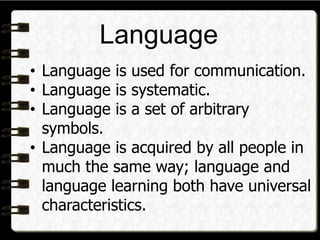
• Language is used for communication.
• Language is systematic.
• Language is a set of arbitrary
symbols.
• Language is acquired by all people in
much the same way; language and
language learning both have universal
characteristics.
First Language Acquisition
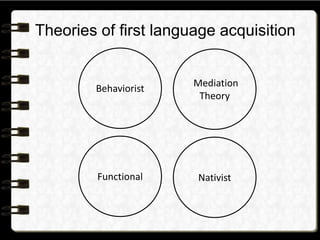
Theories of first language acquisition
Nativist
Functional
Mediation
Theory
Behaviorist
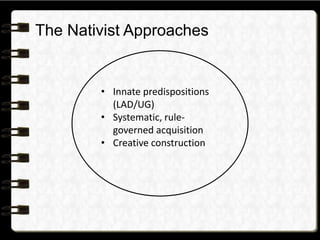
The Nativist Approaches
• Innate predispositions
(LAD/UG)
• Systematic, rule-
governed acquisition
• Creative construction
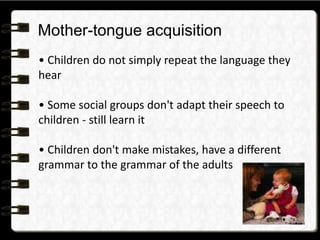
Mother-tongue acquisition
• Children do not simply repeat the language they
hear
• Some social groups don't adapt their speech to
children - still learn it
• Children don't make mistakes, have a different
grammar to the grammar of the adults
Noam
Chomsky:
A New Paradigm
in Modern
Linguistics.
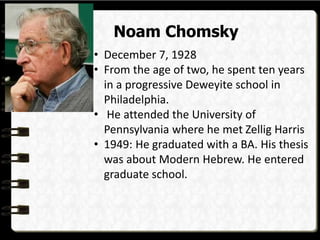
Noam Chomsky
• December 7, 1928
• From the age of two, he spent ten years
in a progressive Deweyite school in
Philadelphia.
• He attended the University of
Pennsylvania where he met Zellig Harris
• 1949: He graduated with a BA. His thesis
was about Modern Hebrew. He entered
graduate school.
Key Concepts:
• Some language ability is innate.
• A Universal Grammar exists for all
languages.
• Children are equipped with a
Language Acquisition Device.
Language is an innate faculty
• Human beings are pre-wired to learn language
and in fact are born with the basic rules for
language intact.
• Children do not know anything about grammar or
syntax but still they can produce grammatical
sentences in most of the time.
Universal Grammar
 is the basis upon which all human languages build.
 Children do not simply copy the language that
they hear around them.
 Children are born, then, with the Universal
Grammar wired into their brains.
 75% of the world's languages use SVO structure
or SOV
Setting the Parameters
• Child recognizes which kind of language the
parents are dealing with
• Child sets his grammar to the correct one
• Child has a number of hypotheses
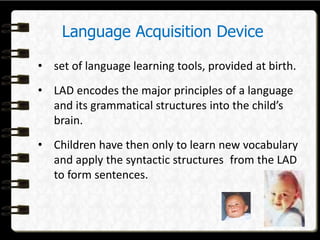
Language Acquisition Device
• set of language learning tools, provided at birth.
• LAD encodes the major principles of a language
and its grammatical structures into the child’s
brain.
• Children have then only to learn new vocabulary
and apply the syntactic structures from the LAD
to form sentences.
Dialogue –
Parent and Child (3 years old)
Parent: What did you do today?
Child: Me drawed a cat. (applies –ed suffix rule but
gets wrong)
Parent: You drew a cat?
Child: Yeah. (understands correction)
Parent: Who did you play with at breaktime?
Child: Me played with Sarah and Helen. (wrong
pronoun – not learnt passively)
Parent: That sound fun. Now what do you want for
tea?
Child: Dunno. What you having?
Parent: Daddy and I are having fish.
Child: You having fishes? (incorrect use of plural noun
but shows child applying rules)
Parent: Yes. I’ll do you some fish fingers and if you’re
a good girl and eat them all you
can have a sweetie. (applying plural noun rule)
Child: Me want two sweeties.
Parent: Alright then. Now go and watch Postman Pat
while I start the tea.
Child: When Daddy coming home? (gets SVO order
correct all the time)
Parent: He’ll be here soon.
In conclusion:
• Infants are born with Language Acquisition
Device (LAD).
• Exposure to language is all that is needed
for a child to discover the system of
language.
• Exposure is critical as evidenced from cases
of children in isolation.

Noam_Chomsky_theories_on_Language_Acquis.pptx

  • 2.
    Language • Language isused for communication. • Language is systematic. • Language is a set of arbitrary symbols. • Language is acquired by all people in much the same way; language and language learning both have universal characteristics.
  • 3.
  • 4.
    Theories of firstlanguage acquisition Nativist Functional Mediation Theory Behaviorist
  • 5.
    The Nativist Approaches •Innate predispositions (LAD/UG) • Systematic, rule- governed acquisition • Creative construction
  • 6.
    Mother-tongue acquisition • Childrendo not simply repeat the language they hear • Some social groups don't adapt their speech to children - still learn it • Children don't make mistakes, have a different grammar to the grammar of the adults
  • 7.
  • 8.
    Noam Chomsky • December7, 1928 • From the age of two, he spent ten years in a progressive Deweyite school in Philadelphia. • He attended the University of Pennsylvania where he met Zellig Harris • 1949: He graduated with a BA. His thesis was about Modern Hebrew. He entered graduate school.
  • 9.
    Key Concepts: • Somelanguage ability is innate. • A Universal Grammar exists for all languages. • Children are equipped with a Language Acquisition Device.
  • 10.
    Language is aninnate faculty • Human beings are pre-wired to learn language and in fact are born with the basic rules for language intact. • Children do not know anything about grammar or syntax but still they can produce grammatical sentences in most of the time.
  • 11.
    Universal Grammar  isthe basis upon which all human languages build.  Children do not simply copy the language that they hear around them.  Children are born, then, with the Universal Grammar wired into their brains.  75% of the world's languages use SVO structure or SOV
  • 12.
    Setting the Parameters •Child recognizes which kind of language the parents are dealing with • Child sets his grammar to the correct one • Child has a number of hypotheses
  • 13.
    Language Acquisition Device •set of language learning tools, provided at birth. • LAD encodes the major principles of a language and its grammatical structures into the child’s brain. • Children have then only to learn new vocabulary and apply the syntactic structures from the LAD to form sentences.
  • 14.
    Dialogue – Parent andChild (3 years old) Parent: What did you do today? Child: Me drawed a cat. (applies –ed suffix rule but gets wrong) Parent: You drew a cat? Child: Yeah. (understands correction) Parent: Who did you play with at breaktime? Child: Me played with Sarah and Helen. (wrong pronoun – not learnt passively) Parent: That sound fun. Now what do you want for tea?
  • 15.
    Child: Dunno. Whatyou having? Parent: Daddy and I are having fish. Child: You having fishes? (incorrect use of plural noun but shows child applying rules) Parent: Yes. I’ll do you some fish fingers and if you’re a good girl and eat them all you can have a sweetie. (applying plural noun rule)
  • 16.
    Child: Me wanttwo sweeties. Parent: Alright then. Now go and watch Postman Pat while I start the tea. Child: When Daddy coming home? (gets SVO order correct all the time) Parent: He’ll be here soon.
  • 17.
    In conclusion: • Infantsare born with Language Acquisition Device (LAD). • Exposure to language is all that is needed for a child to discover the system of language. • Exposure is critical as evidenced from cases of children in isolation.

Editor's Notes

  • #11 Language is an innate faculty - that is to say that we are born with a set of rules about language in our minds, which he refers to as the 'Universal Grammar'. Children learn their first or second language at an early age. They learn, for example, single word formation at the age one, and learn the basic grammar around age six. At this age, no one has the cognitive ability to understand the principles of grammar as a system, but because some innate capacity, is still capable of using it. Put it differently, children do not know anything about grammar or syntax but still they can produce grammatical sentences in most of the time. Chomsky rejects the idea that human mind is a clean slate at birth and is filled in by experience. He suggested that the there are components of mind which are innately determined about languages and other systems of knowledge.
  • #12  75% of the world's languages such as English, French, and Vietnamese use either this structure or Subject Object Verb (SOV) including Japanese, Tibetan, and Korean Language rules are complicated and complex. If there is not a Universal Grammar, how do children make sense of it all?
  • #13 Language rules are complicated and complex. If there is not a Universal Grammar, how do children make sense of it all? When the child begins to listen to his parents, he will unconsciously recognize which kind of a language he is dealing with - and he will set his grammar to the correct one - this is known as 'setting the parameters'.
  • #14 The child knows intuitively that there are some words that behave like verbs, and others like nouns, and that there is a limited set of possibilities for ordering them within a phrase. This is not information that the child is taught directly by adults, but information that is given for the child to decipher. Chomsky believes that every child has a ‘language acquisition device’ or LAD which encodes the major principles of a language and its grammatical structures into the child’s brain. Children have then only to learn new vocabulary and apply the syntactic structures from the LAD to form sentences. Chomsky points out that a child could not possibly learn a language through imitation alone because the language spoken around them is highly irregular – adult’s speech is often broken up and even sometimes ungrammatical.