Downloaded 24 times
![ With a view to converge Dengue/Dengue
Haemorrhagic fever and Japanese
Encephalitis with the three on-going centrally
sponsored schemes [National Anti-Malaria
Programme (NAMP), National Filaria Control
Programme (NFCP) and Kala-azar Control
Programme], the integrated scheme was
renamed as National Vector Borne Disease
Control Programme (NVBDCP) from 2nd
December, 2003.](https://image.slidesharecdn.com/nvbdcp-150906074536-lva1-app6891-170308061010/85/national-vector-born-disear-5-320.jpg)

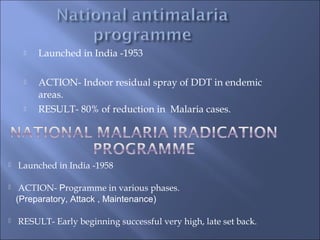

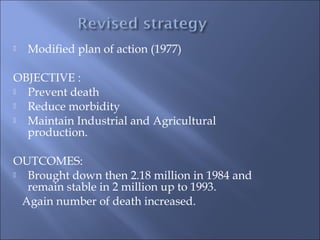
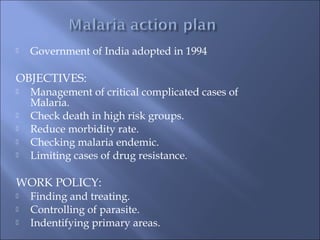
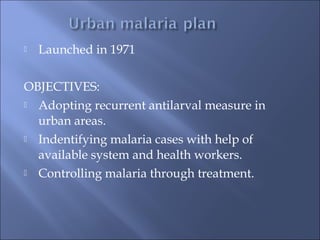
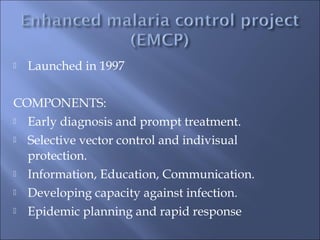
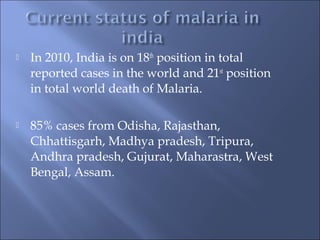
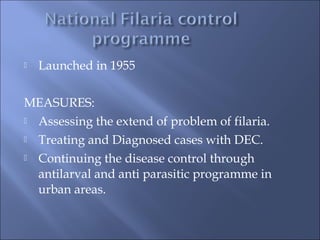
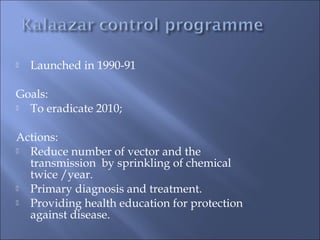

The National Vector Borne Disease Control Programme (NVBDCP) was established in 2003 to consolidate prevention and control of six vector-borne diseases: malaria, dengue, chikungunya, Japanese encephalitis, kala-azar, and filariasis. Previously, these diseases were managed under separate national programs. NVBDCP oversees strategies like indoor residual spraying, early diagnosis and treatment, selective vector control, and health education campaigns. National malaria elimination efforts since the 1950s have significantly reduced cases but ongoing transmission remains a challenge.


