CURRICULUM
FRAMEWORK:
B.ED. PROGRAMME
Dr. S. P. Sharma
Principal,
L. N. K. College of
Education
Patan
Dr. S. H. Tandel
Asst. Professor,
Dept. of Education,
H. N. G. Uni.,
Patan
National Advisory Committee on
Learning Without Burden (1993)
 Professor Yash Pal
The report of the
committee, entitled
"Learning without
Burden", is now
regarded as a
seminal document
in Indian education.
National Advisory Committee on
Learning Without Burden (1993)
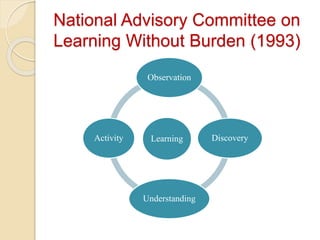
Learning
Observation
Discovery
Understanding
Activity
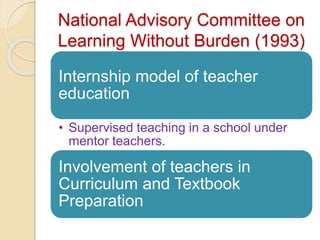
National Advisory Committee on
Learning Without Burden (1993)
Internship model of teacher
education
• Supervised teaching in a school under
mentor teachers.
Involvement of teachers in
Curriculum and Textbook
Preparation
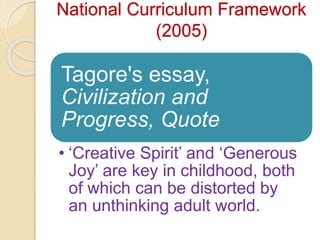
National Curriculum Framework
(2005)
Tagore's essay,
Civilization and
Progress, Quote
• ‘Creative Spirit’ and ‘Generous
Joy’ are key in childhood, both
of which can be distorted by
an unthinking adult world.
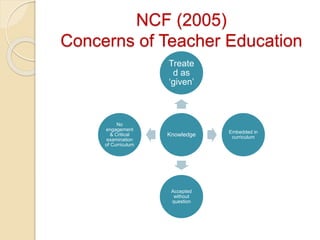
NCF (2005)
Concerns of Teacher Education
Knowledge
Treate
d as
‘given’
Embedded in
curriculum
Accepted
without
question
No
engagement
& Critical
examination
of Curriculum
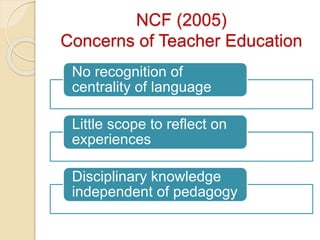
NCF (2005)
Concerns of Teacher Education
No recognition of
centrality of language
Little scope to reflect on
experiences
Disciplinary knowledge
independent of pedagogy
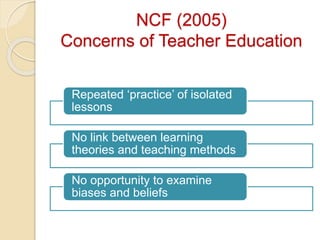
NCF (2005)
Concerns of Teacher Education
Repeated ‘practice’ of isolated
lessons
No link between learning
theories and teaching methods
No opportunity to examine
biases and beliefs
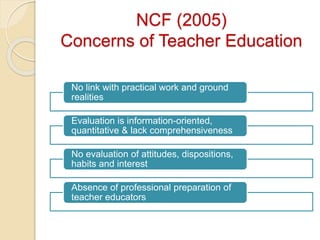
NCF (2005)
Concerns of Teacher Education
No link with practical work and ground
realities
Evaluation is information-oriented,
quantitative & lack comprehensiveness
No evaluation of attitudes, dispositions,
habits and interest
Absence of professional preparation of
teacher educators
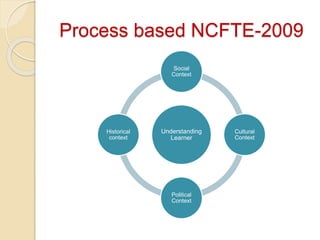
Process based NCFTE-2009
Understanding
Learner
Social
Context
Cultural
Context
Political
Context
Historical
context
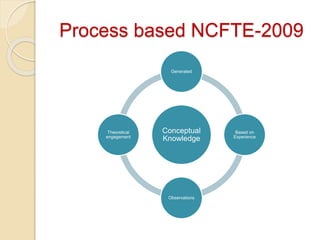
Process based NCFTE-2009
Conceptual
Knowledge
Generated
Based on
Experience
Observations
Theoretical
engagement
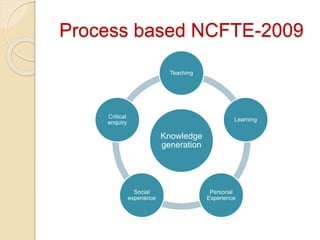
Process based NCFTE-2009
Knowledge
generation
Teaching
Learning
Personal
Experience
Social
experience
Critical
enquiry
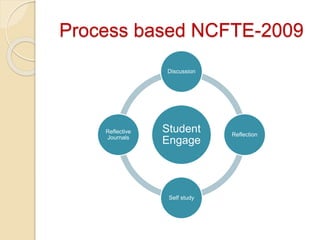
Process based NCFTE-2009
Student
Engage
Discussion
Reflection
Self study
Reflective
Journals
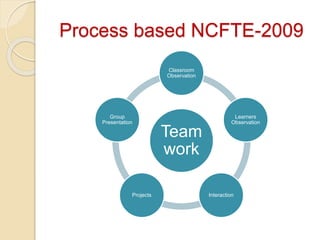
Process based NCFTE-2009
Team
work
Classroom
Observation
Learners
Observation
InteractionProjects
Group
Presentation
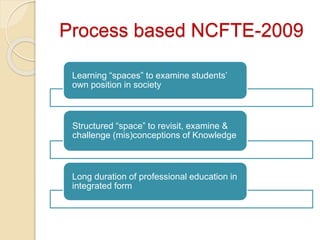
Process based NCFTE-2009
Learning “spaces” to examine students’
own position in society
Structured “space” to revisit, examine &
challenge (mis)conceptions of Knowledge
Long duration of professional education in
integrated form
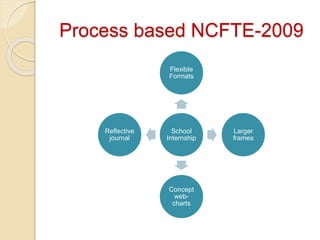
Process based NCFTE-2009
School
Internship
Flexible
Formats
Larger
frames
Concept
web-
charts
Reflective
journal
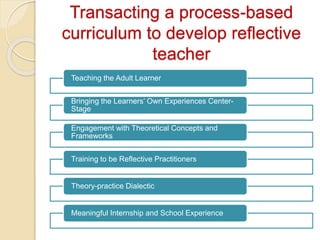
Transacting a process-based
curriculum to develop reflective
teacher
Teaching the Adult Learner
Bringing the Learners’ Own Experiences Center-
Stage
Engagement with Theoretical Concepts and
Frameworks
Training to be Reflective Practitioners
Theory-practice Dialectic
Meaningful Internship and School Experience
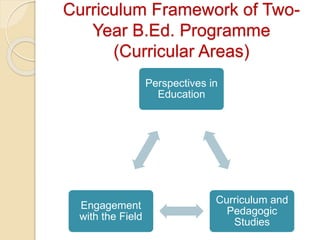
Curriculum Framework of Two-
Year B.Ed. Programme
(Curricular Areas)
Perspectives in
Education
Curriculum and
Pedagogic
Studies
Engagement
with the Field
Perspectives in Education
 Course 1Childhood and Growing Up
 Course 2 Contemporary India and
Education
 Course 3 Learning and Teaching
 Course 6 Gender, School and Society
(1/2)
 Course 8 Knowledge and Curriculum
 Course 10 Creating an Inclusive
School (1/2)
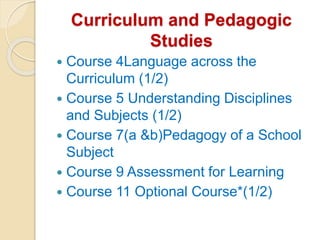
Curriculum and Pedagogic
Studies
 Course 4Language across the
Curriculum (1/2)
 Course 5 Understanding Disciplines
and Subjects (1/2)
 Course 7(a &b)Pedagogy of a School
Subject
 Course 9 Assessment for Learning
 Course 11 Optional Course*(1/2)
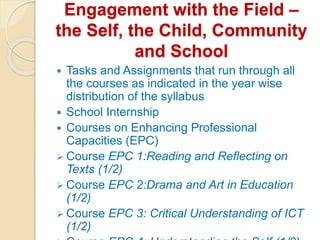
Engagement with the Field –
the Self, the Child, Community
and School
 Tasks and Assignments that run through all
the courses as indicated in the year wise
distribution of the syllabus
 School Internship
 Courses on Enhancing Professional
Capacities (EPC)
 Course EPC 1:Reading and Reflecting on
Texts (1/2)
 Course EPC 2:Drama and Art in Education
(1/2)
 Course EPC 3: Critical Understanding of ICT
(1/2)

CURRICULUM FRAMEWORK final