


ACCIONES DE LAS OPERADORAS ANTE EL DESARROLLO DE LA BANDA ANCHA MÓVIL  ( 28 Septiembre 2010)
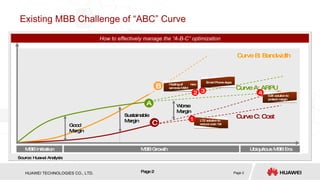
Page  Existing MBB Challenge of “ABC” Curve How to effectively manage the “A-B-C” optimization Curve A: ARPU Curve C: Cost Curve B: Bandwidth Source: Huawei Analysis Good Margin MBB Growth MBB Initiation Ubiquitous MBB Era Worse Margin Sustainable Margin C B A LTE solution to reduce cost / bit 1 Smart Phone Apps Hosting of  new services M2M 2 3 E2E solution to protect margin 4
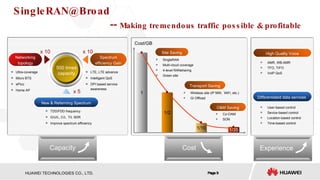
SingleRAN@Broad  --  Making tremendous traffic possible & profitable   Page  Networking topology Spectrum efficiency Gain x 10 x 5 x 10 Ultra-coverage Micro BTS ePico Home AP TDD/FDD frequency G/U/L, C/L. T/L SDR Improve spectrum efficiency New & Refarming Spectrum LTE, LTE advance Intelligent QoS DPI based service awareness Capacity Cost Co-OAM SON Wireless site (IP MW,  WiFi, etc.) Gi Offload SingleRAN Multi-cloud coverage 4-level RANsharing Green site Cost/GB 1 1/2 1/10 1/35 Site Saving Transport Saving O&M Saving Experience High Quality Voice Differentiated data services  AMR, WB-AMR TFO, TrFO VoIP QoS User-based control Sevice-based control Location-based control Time-based control 500 times capacity
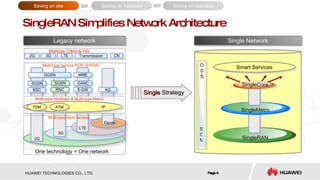
Page  SingleRAN Simplifies Network Architecture Saving on site Saving on operation Saving on transport Single Network SingleRAN SingleMetro SingleCore Smart Services Single  Strategy One technology = One network Multi-type backhaul & Multi-type Metro Multi-type radio access Multi-type service POP (S-POP) 2G 3G IP BSC RNC AG S-GW SGSN SGSN GANC GGSN MME Femto LTE TDM ATM 2G Transmission CN Multiple O&M & HR 3G LTE Legacy network O S S SON
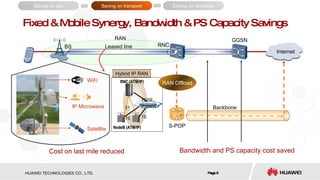
Page  S-POP RNC GGSN BS RAN Offload Leased line Backbone Bandwidth and PS capacity cost saved Fixed & Mobile Synergy, Bandwidth & PS Capacity Savings Internet WiFi IP Microwave Satellite Cost on last mile reduced Saving on site Saving on operation Saving on transport RAN Hybrid IP RAN
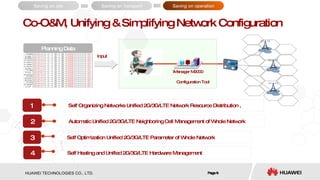
Page  Co-O&M, Unifying & Simplifying Network Configuration  Saving on site Saving on operation Saving on transport Planning Data Input Configuration Tool iManager M2000 Self Organizing Networks Unified 2G/3G/LTE Network Resource Distribution ,  1 Automatic Unified 2G/3G/LTE Neighboring Cell Management of Whole Network 2 Self Optimization Unified 2G/3G/LTE Parameter of Whole Network 3 Self Healing and Unified 2G/3G/LTE Hardware Management  4
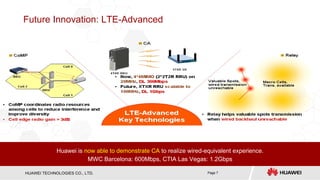
Future Innovation: LTE-Advanced Huawei is  now able to demonstrate CA  to realize wired-equivalent experience. MWC Barcelona: 600Mbps, CTIA Las Vegas: 1.2Gbps
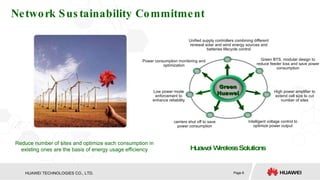
Network Sustainability Commitment Green BTS, modular design to reduce feeder loss and save power consumption Unified supply controllers combining different renewal solar and wind energy sources and batteries lifecycle control High power amplifier to extend cell size to cut number of sites Low power mode enforcement to enhance reliability Intelligent voltage control to optimize power output carriers shut off to save power consumption Power consumption monitoring and optimization Huawei Wireless Solutions Reduce number of sites and optimize each consumption in existing ones are the basis of energy usage efficiency Green Huawei
Thank you Fernando V ázquez Wireless Product Manager Huawei Technologies  www.huawei.com
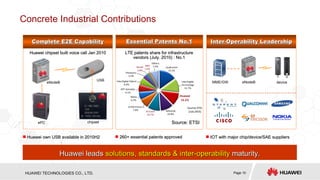
260+ essential patents approved Huawei leads  solutions,   standards & inter-operability  maturity. Huawei own USB available in 2010H2 IOT with major chip/device/SAE suppliers Complete E2E Capability eNodeB chipset USB Huawei chipset built voice call Jan 2010 ePC Concrete Industrial Contributions Essential Patents No.1 LTE patents share for infrastructure vendors (July. 2010) : No.1 Source: ETSI Inter-Operability Leadership eNodeB device MME/GW
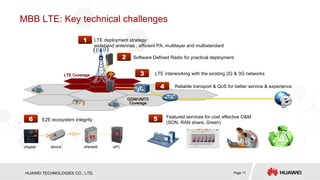
MBB LTE: Key technical challenges GSM/UMTS Coverage LTE interworking with the existing 2G & 3G networks 3 LTE Coverage LTE deployment strategy:  wideband antennas , efficient PA, multilayer and multistandard 1 Software Defined Radio for practical deployment 2 Reliable transport & QoS for better service & experience 4 eNodeB chipset ePC device E2E ecosystem integrity 6 Featured services for cost effective O&M (SON, RAN share, Green) 5
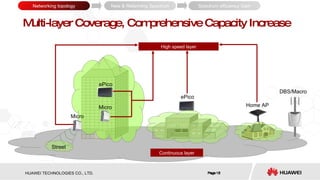
Page  Home AP ePico DBS/Macro Continuous layer Multi-layer Coverage, Comprehensive Capacity Increase High speed layer ePico Micro Micro Street Networking topology Spectrum efficiency Gain New & Refarming Spectrum
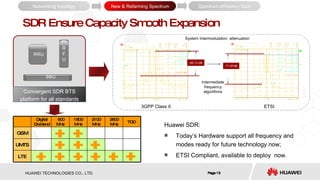
TDD 2100 MHz 2600 MHz Page  Convergent SDR BTS platform for all standards SDR Ensure Capacity Smooth Expansion GSM LTE UMTS 1800 MHz 900 MHz Digital Dividend ETSI 3GPP Class II -71.97dB -60.13 dB Intermediate frequency algorithms System Intermodulation  attenuation Huawei SDR:  Today’s Hardware support all frequency and modes ready for future technology now; ETSI Compliant, available to deploy  now. Networking topology Spectrum efficiency Gain New & Refarming Spectrum BBU RRU R F U
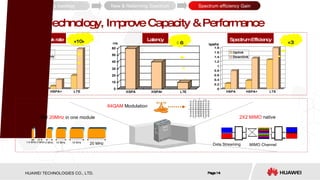
Page  LTE Technology, Improve Capacity & Performance Networking topology Spectrum efficiency Gain New & Refarming Spectrum BW  20MHz  in one module MIMO Channel Data Streaming 2X2 MIMO  native 64QAM  Modulation Peak rate Mbps ×10+ Latency ms ÷ 6 Spectrum Efficiency bps/hz ×3 10 MHz 15 MHz 20 MHz 3 MHz 5 MHz 1.4 MHz
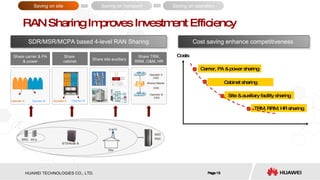
Page  RAN Sharing Improves Investment Efficiency TRM, RRM, HR sharing Site & auxiliary facility sharing Carrier, PA & power sharing Costs Cabinet sharing Cost saving enhance competitiveness  SDR/MSR/MCPA based 4-level RAN Sharing Operator A Operator B Operator A Operator B Share carrier & PA & power Share  cabinet Share site auxiliary Operator A OSS Operator B OSS Shared Master OSS Share TRM, RRM, O&M, HR Saving on site Saving on operation Saving on transport R F U R F U R F U R F U R F U R F U RRU RFU BTS/Node B Site BSC RNC
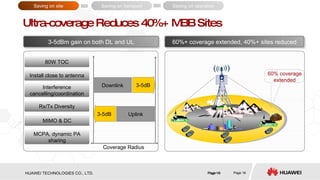
Page  60%+ coverage extended, 40%+ sites reduced 3-5dBm gain on both DL and UL 3-5dB 3-5dB 80W TOC Install close to antenna Interference cancelling/coordination Rx/Tx Diversity MIMO & DC MCPA, dynamic PA sharing 60% coverage extended Downlink Uplink Coverage Radius Ultra-coverage Reduces 40%+ MBB Sites Saving on site Saving on operation Saving on transport
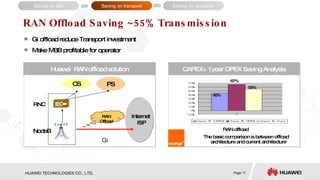
RAN Offload Saving ~55% Transmission Gi offload reduce Transport investment Make MBB profitable for operator NodeB RNC Internet  ISP CS PS RAN Offload Huawei  RAN offload solution Gi Saving on site Saving on operation Saving on transport RAN offload The basic comparison is between offload architecture and current architecture 45% 67% 55% CAPEX+ 1year OPEX Saving Analysis
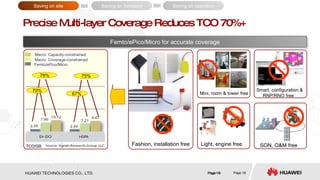
Page  75% 76% 67% 70% Precise Multi-layer Coverage Reduces TCO 70%+ Mini, room & tower free Light, engine free  Fashion, installation free Smart, configuration & RNP/RNO free  SON, O&M free Femto/ePico/Micro for accurate coverage TCO/GB Saving on site Saving on operation Saving on transport Macro: Coverage-constrained Macro: Capacity-constrained Femto/ePico/Micro
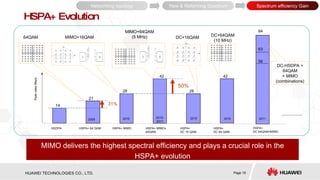
HSPA+ Evolution 14 21 28 42 28 42 HSDPA HSPA+ 64 QAM HSPA+ MIMO HSPA+ MIMO+ 64QAM HSPA+  DC 16 QAM HSPA+  DC 64 QAM 50% 31% 64QAM MIMO+16QAM MIMO+64QAM (5 MHz) DC+16QAM DC+64QAM (10 MHz) MIMO delivers the highest spectral efficiency and plays a crucial role in the HSPA+ evolution HSPA+  DC 64QAM+MIMO DC-HSDPA + 64QAM + MIMO (combinations) 84 63 56 ................. 2009 2010 2010- 2011 2010 2010 2011 Peak rates Mbps Networking topology Spectrum efficiency Gain New & Refarming Spectrum
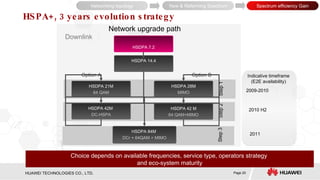
HSPA+, 3 years evolution strategy  Step 3 HSDPA 42 M 64 QAM+MIMO HSDPA 21M 64 QAM HSDPA 14.4 Network upgrade path Downlink Option A Option B Step 1 Step 2 HSDPA 42M  DC-HSPA HSDPA 28M MIMO HSDPA 84M  DCr + 64QAM + MIMO Choice depends on available frequencies, service type, operators strategy  and eco-system maturity HSDPA 7.2 Indicative timeframe (E2E availability) 2009-2010 2010 H2 2011 Networking topology Spectrum efficiency Gain New & Refarming Spectrum

Huawei telecom i+d 2010v4

  • 1.
    ACCIONES DE LASOPERADORAS ANTE EL DESARROLLO DE LA BANDA ANCHA MÓVIL ( 28 Septiembre 2010)
  • 2.
    Page ExistingMBB Challenge of “ABC” Curve How to effectively manage the “A-B-C” optimization Curve A: ARPU Curve C: Cost Curve B: Bandwidth Source: Huawei Analysis Good Margin MBB Growth MBB Initiation Ubiquitous MBB Era Worse Margin Sustainable Margin C B A LTE solution to reduce cost / bit 1 Smart Phone Apps Hosting of new services M2M 2 3 E2E solution to protect margin 4
  • 3.
    SingleRAN@Broad -- Making tremendous traffic possible & profitable Page Networking topology Spectrum efficiency Gain x 10 x 5 x 10 Ultra-coverage Micro BTS ePico Home AP TDD/FDD frequency G/U/L, C/L. T/L SDR Improve spectrum efficiency New & Refarming Spectrum LTE, LTE advance Intelligent QoS DPI based service awareness Capacity Cost Co-OAM SON Wireless site (IP MW, WiFi, etc.) Gi Offload SingleRAN Multi-cloud coverage 4-level RANsharing Green site Cost/GB 1 1/2 1/10 1/35 Site Saving Transport Saving O&M Saving Experience High Quality Voice Differentiated data services AMR, WB-AMR TFO, TrFO VoIP QoS User-based control Sevice-based control Location-based control Time-based control 500 times capacity
  • 4.
    Page SingleRANSimplifies Network Architecture Saving on site Saving on operation Saving on transport Single Network SingleRAN SingleMetro SingleCore Smart Services Single Strategy One technology = One network Multi-type backhaul & Multi-type Metro Multi-type radio access Multi-type service POP (S-POP) 2G 3G IP BSC RNC AG S-GW SGSN SGSN GANC GGSN MME Femto LTE TDM ATM 2G Transmission CN Multiple O&M & HR 3G LTE Legacy network O S S SON
  • 5.
    Page S-POPRNC GGSN BS RAN Offload Leased line Backbone Bandwidth and PS capacity cost saved Fixed & Mobile Synergy, Bandwidth & PS Capacity Savings Internet WiFi IP Microwave Satellite Cost on last mile reduced Saving on site Saving on operation Saving on transport RAN Hybrid IP RAN
  • 6.
    Page Co-O&M,Unifying & Simplifying Network Configuration Saving on site Saving on operation Saving on transport Planning Data Input Configuration Tool iManager M2000 Self Organizing Networks Unified 2G/3G/LTE Network Resource Distribution , 1 Automatic Unified 2G/3G/LTE Neighboring Cell Management of Whole Network 2 Self Optimization Unified 2G/3G/LTE Parameter of Whole Network 3 Self Healing and Unified 2G/3G/LTE Hardware Management 4
  • 7.
    Future Innovation: LTE-AdvancedHuawei is now able to demonstrate CA to realize wired-equivalent experience. MWC Barcelona: 600Mbps, CTIA Las Vegas: 1.2Gbps
  • 8.
    Network Sustainability CommitmentGreen BTS, modular design to reduce feeder loss and save power consumption Unified supply controllers combining different renewal solar and wind energy sources and batteries lifecycle control High power amplifier to extend cell size to cut number of sites Low power mode enforcement to enhance reliability Intelligent voltage control to optimize power output carriers shut off to save power consumption Power consumption monitoring and optimization Huawei Wireless Solutions Reduce number of sites and optimize each consumption in existing ones are the basis of energy usage efficiency Green Huawei
  • 9.
    Thank you FernandoV ázquez Wireless Product Manager Huawei Technologies www.huawei.com
  • 10.
    260+ essential patentsapproved Huawei leads solutions, standards & inter-operability maturity. Huawei own USB available in 2010H2 IOT with major chip/device/SAE suppliers Complete E2E Capability eNodeB chipset USB Huawei chipset built voice call Jan 2010 ePC Concrete Industrial Contributions Essential Patents No.1 LTE patents share for infrastructure vendors (July. 2010) : No.1 Source: ETSI Inter-Operability Leadership eNodeB device MME/GW
  • 11.
    MBB LTE: Keytechnical challenges GSM/UMTS Coverage LTE interworking with the existing 2G & 3G networks 3 LTE Coverage LTE deployment strategy: wideband antennas , efficient PA, multilayer and multistandard 1 Software Defined Radio for practical deployment 2 Reliable transport & QoS for better service & experience 4 eNodeB chipset ePC device E2E ecosystem integrity 6 Featured services for cost effective O&M (SON, RAN share, Green) 5
  • 12.
    Page HomeAP ePico DBS/Macro Continuous layer Multi-layer Coverage, Comprehensive Capacity Increase High speed layer ePico Micro Micro Street Networking topology Spectrum efficiency Gain New & Refarming Spectrum
  • 13.
    TDD 2100 MHz2600 MHz Page Convergent SDR BTS platform for all standards SDR Ensure Capacity Smooth Expansion GSM LTE UMTS 1800 MHz 900 MHz Digital Dividend ETSI 3GPP Class II -71.97dB -60.13 dB Intermediate frequency algorithms System Intermodulation attenuation Huawei SDR: Today’s Hardware support all frequency and modes ready for future technology now; ETSI Compliant, available to deploy now. Networking topology Spectrum efficiency Gain New & Refarming Spectrum BBU RRU R F U
  • 14.
    Page LTETechnology, Improve Capacity & Performance Networking topology Spectrum efficiency Gain New & Refarming Spectrum BW 20MHz in one module MIMO Channel Data Streaming 2X2 MIMO native 64QAM Modulation Peak rate Mbps ×10+ Latency ms ÷ 6 Spectrum Efficiency bps/hz ×3 10 MHz 15 MHz 20 MHz 3 MHz 5 MHz 1.4 MHz
  • 15.
    Page RANSharing Improves Investment Efficiency TRM, RRM, HR sharing Site & auxiliary facility sharing Carrier, PA & power sharing Costs Cabinet sharing Cost saving enhance competitiveness SDR/MSR/MCPA based 4-level RAN Sharing Operator A Operator B Operator A Operator B Share carrier & PA & power Share cabinet Share site auxiliary Operator A OSS Operator B OSS Shared Master OSS Share TRM, RRM, O&M, HR Saving on site Saving on operation Saving on transport R F U R F U R F U R F U R F U R F U RRU RFU BTS/Node B Site BSC RNC
  • 16.
    Page 60%+coverage extended, 40%+ sites reduced 3-5dBm gain on both DL and UL 3-5dB 3-5dB 80W TOC Install close to antenna Interference cancelling/coordination Rx/Tx Diversity MIMO & DC MCPA, dynamic PA sharing 60% coverage extended Downlink Uplink Coverage Radius Ultra-coverage Reduces 40%+ MBB Sites Saving on site Saving on operation Saving on transport
  • 17.
    RAN Offload Saving~55% Transmission Gi offload reduce Transport investment Make MBB profitable for operator NodeB RNC Internet ISP CS PS RAN Offload Huawei RAN offload solution Gi Saving on site Saving on operation Saving on transport RAN offload The basic comparison is between offload architecture and current architecture 45% 67% 55% CAPEX+ 1year OPEX Saving Analysis
  • 18.
    Page 75%76% 67% 70% Precise Multi-layer Coverage Reduces TCO 70%+ Mini, room & tower free Light, engine free Fashion, installation free Smart, configuration & RNP/RNO free SON, O&M free Femto/ePico/Micro for accurate coverage TCO/GB Saving on site Saving on operation Saving on transport Macro: Coverage-constrained Macro: Capacity-constrained Femto/ePico/Micro
  • 19.
    HSPA+ Evolution 1421 28 42 28 42 HSDPA HSPA+ 64 QAM HSPA+ MIMO HSPA+ MIMO+ 64QAM HSPA+ DC 16 QAM HSPA+ DC 64 QAM 50% 31% 64QAM MIMO+16QAM MIMO+64QAM (5 MHz) DC+16QAM DC+64QAM (10 MHz) MIMO delivers the highest spectral efficiency and plays a crucial role in the HSPA+ evolution HSPA+ DC 64QAM+MIMO DC-HSDPA + 64QAM + MIMO (combinations) 84 63 56 ................. 2009 2010 2010- 2011 2010 2010 2011 Peak rates Mbps Networking topology Spectrum efficiency Gain New & Refarming Spectrum
  • 20.
    HSPA+, 3 yearsevolution strategy Step 3 HSDPA 42 M 64 QAM+MIMO HSDPA 21M 64 QAM HSDPA 14.4 Network upgrade path Downlink Option A Option B Step 1 Step 2 HSDPA 42M DC-HSPA HSDPA 28M MIMO HSDPA 84M DCr + 64QAM + MIMO Choice depends on available frequencies, service type, operators strategy and eco-system maturity HSDPA 7.2 Indicative timeframe (E2E availability) 2009-2010 2010 H2 2011 Networking topology Spectrum efficiency Gain New & Refarming Spectrum