

Microwave Solutions for LTE Wireless NetworksPresented By: Stuart Little, Director of Global Corporate Marketing, AviatNetworks Taking the ‘haul’ out of backhaul
The Mobile Internet Tsunami meets the Backhaul BottleneckBackhaul is the central battleground for LTE network migrationEven now backhaul is not meeting the demand of 3G/HSPALTE backhaul requirements are still not well understood by operators*2MARCH 23, 2010AVIAT NETWORKS   |* Source: Heavy Reading, 4th Annual Multi-Client Study On Mobile Backhaul, December  2009
Hybrid fiber/microwave backhaulNearly 1 million new sites worldwide by 2013Fiber is the natural choice for LTE backhaul, but connects less than 20% of NA sites todayCopper lines will not provide the capacity scalability neededMicrowave is the natural choice for sites where fiber cannot reach economically3Source: Ovum, Wireless Backhaul Forecast 2009-2015, November, 2009MARCH 23, 2010AVIAT NETWORKS   |
An Opportunity for Fiber WholesalersMajority of cellsite connections today using leased copper
These connections will migrate to leased Ethernet Private Lines over fiber
Both Verizon and AT&T are targeting 90% penetration in the next 2 to 5 years
Wholesalers and MSOs are ideally positioned for this opportunity
Microwave economics work for aerial fiber runs beyond 1 ¾ miles.
Microwave can play a key role, but wholesalers generally lack microwave expertise4MARCH 23, 2010AVIAT NETWORKS   |
Mobile Network Evolution, not RevolutionMobile backhaul networks must evolveMaintain essential high-quality TDM voice servicesGradual migration path to all-IP for next generation 4G/LTEThere’s no silver bullet or one size fits all5TransitionMaintainTransformMARCH 23, 2010AVIAT NETWORKS   |
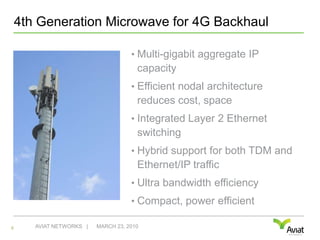
4th Generation Microwave for 4G BackhaulMulti-gigabit aggregate IP capacityEfficient nodal architecture reduces cost, spaceIntegrated Layer 2 Ethernet switchingHybrid support for both TDM and Ethernet/IP trafficUltra bandwidth efficiencyCompact, power efficient6MARCH 23, 2010AVIAT NETWORKS   |
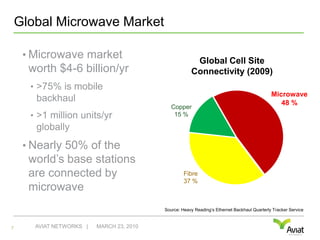
Global Microwave MarketMicrowave market worth $4-6 billion/yr>75% is mobile backhaul>1 million units/yr globallyNearly 50% of the world’s base stations are connected by microwaveGlobal Cell Site Connectivity (2009)Microwave 48 %Copper 15 %Fibre 37 %Source: Heavy Reading’s Ethernet Backhaul Quarterly Tracker ServiceMARCH 23, 20107AVIAT NETWORKS   |

Microwave Solutions for LTE Networks

  • 1.
    Microwave Solutions forLTE Wireless NetworksPresented By: Stuart Little, Director of Global Corporate Marketing, AviatNetworks Taking the ‘haul’ out of backhaul
  • 2.
    The Mobile InternetTsunami meets the Backhaul BottleneckBackhaul is the central battleground for LTE network migrationEven now backhaul is not meeting the demand of 3G/HSPALTE backhaul requirements are still not well understood by operators*2MARCH 23, 2010AVIAT NETWORKS |* Source: Heavy Reading, 4th Annual Multi-Client Study On Mobile Backhaul, December 2009
  • 3.
    Hybrid fiber/microwave backhaulNearly1 million new sites worldwide by 2013Fiber is the natural choice for LTE backhaul, but connects less than 20% of NA sites todayCopper lines will not provide the capacity scalability neededMicrowave is the natural choice for sites where fiber cannot reach economically3Source: Ovum, Wireless Backhaul Forecast 2009-2015, November, 2009MARCH 23, 2010AVIAT NETWORKS |
  • 4.
    An Opportunity forFiber WholesalersMajority of cellsite connections today using leased copper
  • 5.
    These connections willmigrate to leased Ethernet Private Lines over fiber
  • 6.
    Both Verizon andAT&T are targeting 90% penetration in the next 2 to 5 years
  • 7.
    Wholesalers and MSOsare ideally positioned for this opportunity
  • 8.
    Microwave economics workfor aerial fiber runs beyond 1 ¾ miles.
  • 9.
    Microwave can playa key role, but wholesalers generally lack microwave expertise4MARCH 23, 2010AVIAT NETWORKS |
  • 10.
    Mobile Network Evolution,not RevolutionMobile backhaul networks must evolveMaintain essential high-quality TDM voice servicesGradual migration path to all-IP for next generation 4G/LTEThere’s no silver bullet or one size fits all5TransitionMaintainTransformMARCH 23, 2010AVIAT NETWORKS |
  • 11.
    4th Generation Microwavefor 4G BackhaulMulti-gigabit aggregate IP capacityEfficient nodal architecture reduces cost, spaceIntegrated Layer 2 Ethernet switchingHybrid support for both TDM and Ethernet/IP trafficUltra bandwidth efficiencyCompact, power efficient6MARCH 23, 2010AVIAT NETWORKS |
  • 12.
    Global Microwave MarketMicrowavemarket worth $4-6 billion/yr>75% is mobile backhaul>1 million units/yr globallyNearly 50% of the world’s base stations are connected by microwaveGlobal Cell Site Connectivity (2009)Microwave 48 %Copper 15 %Fibre 37 %Source: Heavy Reading’s Ethernet Backhaul Quarterly Tracker ServiceMARCH 23, 20107AVIAT NETWORKS |

Editor's Notes

  • #3 Backhaul is now the central battleground for LTE network migration, after years where backhaul was never an issue.But even now backhaul is not meeting the demand of 3G/HSPA in parts of the USA and Europe, so that users are now being seriously affected by bottlenecks in the backhaul network.Even now at this advanced stage, LTE backhaul requirements are still not well understood by operators. Three quarters of respondents to a Heavy Reading survey believed either that LTE backhaul requirements are not well understood or that whatever people believe now may change significantly over the next couple of years. Operators are divided over the expected capacity needs for typical LTE sites, and over what transport technology is best deployed in the access/low RAN and metro aggregation/high RAN – whether Carrier Ethernet (L2/VPN) or L3 IP/MPLS.
  • #4 According to Infonetics (July 2009) total installed cell sites grew 10% from 2007 to 2008, from 2.0M to 2.2M, and will grow to 3.1M by 2013, a 2008-2013 CAGR of 7%. They also predict that microwave will dominate the mobile backhaul market, overshadowing nearly all other technologysolutions. Two thirds of mobile operators expect that microwave will account for more than 25% of their last mile backhaul to the cell site three years from now. 42% of operators believe that microwave will account for more than 50% of their last mile backhaul to the cell site in that timeframe. Heavy Reading Backhaul Survey 2009It offers mobile operators smooth migration from TDMto Ethernetbackhaul, as well as:• T1/E1 lines do not scale for bandwidth needs, and are not cost-efficient, even in NA where they are much cheaper• Fiber is not available or cost-effective to deploy for the majority of cell sites – can cost > $1million per mile.• The capacities can be 'turned up' as the mobile operator needs it• A single product can support voice on TDM, data on Ethernet• Microwave is the most appropriate solution for remote/rural base stations• Microwave is likely to also be widely used for microcell/picocell deployment• Microwave is usually quicker to deploy than landline
  • #5 There is no “one-size-fits-all” situation that leads to the conclusion that fiber will be the sole media used for cellular backhaul in North America.Although fiber may be the preferred media by many operators, many of the major US operators are buying an Ethernet transport service rather than owning their own backhaul. Mobile operators that lease backhaul capacity from local exchange carriers (LECs) or from alternative transport carriers do not view backhaul transport as a core competency. Ovum’s carrier interviews for this report showed no material shift from buy to build and thus the lease-line model is likely to continue — with the difference being Ethernet will be substituted for traditional T1.
  • #6 Mobile backhaul networks must evolve to support the introduction of IP transport to support new broadband services, increase network capacity and flexibility and support lower overall operational costs.Optimizing the network to support hybrid TDM+IP helps maintain high quality TDM voice services – the bread and butter, while enabling network expansion and gradual migration path to the next generation 4G
  • #10 MW is well placed to meet LTE backhaul network requirements. Cost as well as time to establish links is very competitive.
  • #11 “In the middle of difficulty lies opportunity.” Albert Einstein3.5G HSPA+ and LTE require Ethernet backhaul to decouple network capacity increases from network cost increases