To Mesh or Not to Mesh for OSP?
Advantages of Wireless Mesh Systems for OSP Environments


                Mike Intag, RCDD, Firetide                 1
Objectives


Understand wireless options and their
differentiators in OSP environments
Discuss considerations for high-performance
wireless networks
Review mesh applications, design approaches and
best practices


                                                  2
Why High-performance Wireless for OSP?


  Property protection/   Mobility of workers &
                                                   Security of remote
 Vandalism prevention        equipment
                                                 areas / Access control


                                                                          3
Why Wireless Infrastructure?

Deploy virtually anywhere
Portability and mobility
Extend, back-up, or replace
wired infrastructure
Cost savings vs wire


                                        4
Wireless Challenges


Availability of channels & spectrum
RF interference
Dynamic RF & physical environment
“Trust but verify” attitude required


                                       5
Wireless Options


                   6
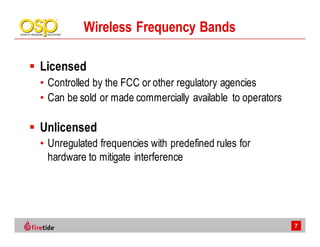
Wireless Frequency Bands

Licensed
• Controlled by the FCC or other regulatory agencies
• Can be sold or made commercially available to operators

Unlicensed
• Unregulated frequencies with predefined rules for
  hardware to mitigate interference


                                                            7
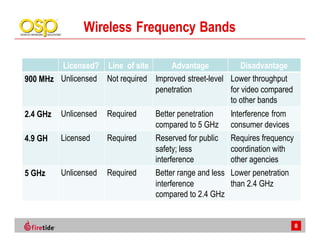
Wireless Frequency Bands

        Licensed? Line of site       Advantage            Disadvantage
900 MHz Unlicensed Not required Improved street-level Lower throughput
                                penetration           for video compared
                                                      to other bands
2.4 GHz   Unlicensed   Required    Better penetration      Interference from
                                   compared to 5 GHz       consumer devices
4.9 GH    Licensed     Required    Reserved for public     Requires frequency
                                   safety; less            coordination with
                                   interference            other agencies
5 GHz     Unlicensed   Required    Better range and less   Lower penetration
                                   interference            than 2.4 GHz
                                   compared to 2.4 GHz


                                                                                8
Point to Point


Pros
   Dedicated connection
   Highest bandwidth for backhaul
Cons
   Does not scale; no flexibility
   Single point of failure


                                     9
Point-to-Point


                 Firetide Confidential   10
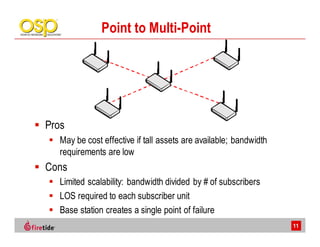
Point to Multi-Point


Pros
   May be cost effective if tall assets are available; bandwidth
   requirements are low
Cons
   Limited scalability: bandwidth divided by # of subscribers
   LOS required to each subscriber unit
   Base station creates a single point of failure
                                                                   11
Point-to-Multi-point


                       12
Multi-Point to Multi-Point (Mesh)


Pros
   Reach & scalability with multi-hop connections
   Flexibility – can be deployed a PtP, PtMP or mesh
Cons
   Variable performance from different vendors
   More expertise required vs PtP or PtMP

                                                       13
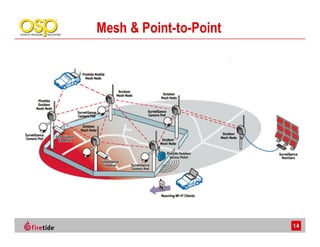
Mesh & Point-to-Point


                        14
Why is Redundancy Important?

Radio equipment is very reliable….
…but they are frequently installed
on light poles which aren’t


                                         15
Not All ‘Wireless Mesh’
    Created Equal


                          16
Imagine a Traditional Wired Switch
Most efficient mesh utilizes L2 distributed wireless switch architecture


                       (Wired Ethernet infrastructure)


                                                                           17
Now, Give Each Port Wireless Capability


        (Wired Ethernet infrastructure)


                                          18
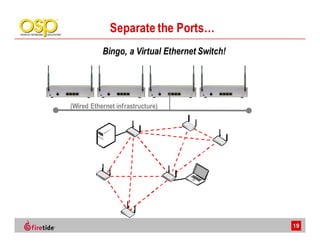
Separate the Ports…
           Bingo, a Virtual Ethernet Switch!


(Wired Ethernet infrastructure)


                                               19
Key Requirements

   Voice                 Video          High-bandwidth
                                        data
 High call capacity                 High throughput

           Low latency
Low jitter (variation in latency)
                 Multicast support

      End-to-end QoS & traffic prioritization


                                                         20
Wireless: How Good Is It?


                            21
What About Throughput?

   Point to point
        Up to 1 Gig+
   Point to multi-point
        WiMAX: 20-30 Mbps total capacity (divided by # of subscribers)
        MIMO-based PtMP systems: 100-125 Mbps
   Wireless mesh
        Up to 250-300 Mbps in PtP mode or 100-150 Mbps sustained
        over multiple hops
        Varies by vendor: from 10-15 Mbps to 100-150 Mbps per radio

Numbers listed are usable throughput, not theoretical data rate


                                                                         22
Is Wireless Secure?

Standards-based               Encapsulation w/ Firetide Mesh Routing Protocol

   Radio layer encryption
                                     AES   WPA2 Encryption
   FIPS 140-2 certification
                              Packet                                  Packet
Propitiatory                  Filtering                               Filtering


   Encapsulation
   Digital certificates &
   MAC filtering
   VLANs


                                                                           23
Wi-Fi Access vs Mesh

Wi-Fi for client access
Useful for live video in Wi-Fi ‘hot spots’
• Laptops, PDAs
• Local and remote viewing


                      Wi-Fi enabled          Radio, AP & Camera
                       patrol car

                                                                  24
Can I Use Low-cost Point-to-Point?

Low-cost PtP has a cost advantage, but:
   Only for a few outlying cameras / 1 hop
Disadvantages beyond that:
   No scalability
   Complex to manage
   More real estate required


                                             25
Limitations of PtP & PtMP Systems

Rigid architecture
   Does not allow multi-hop
   Requires towers / tall buildings
   No infrastructure mobility
Require backhaul for each base
station: high costs of deployments
Quickly run out of usable spectrum
   Transition to MIMO 40 MHz channels
   creates challenges


                                        Urban canyons a challenge to PtP & PtMP

                                                                             26
Key Technology Differentiators

Customer            Infrastructure            Mesh AP                   PtP                   PtMP
Benefit                 Mesh
Scalability for
video
Security


Infrastructure
Mobility
Backhaul           Every 10-15 hops         Every 2-3 hops           Every link          Every base station
requirement

Investment        Indoor and outdoor,     Indoor and outdoor,   Outdoor only, complex      Outdoor only,
Protection        multiple applications   access point based,   network management,      complex network
                  (data, video, voice)     data support only        no scalability      management, limited
                                                                                            scalability


                                                                                                              27
Design Considerations


                        28
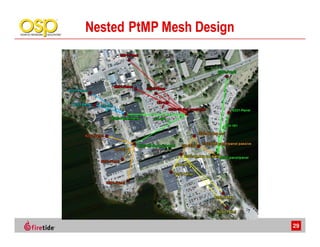
Nested PtMP Mesh Design


                          29
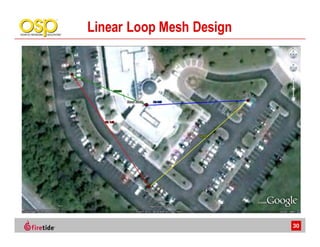
Linear Loop Mesh Design


                          30
Linear Mesh Design


10 hops in both directions
Multi-application: VoIP, video,
Wi-Fi data


                                        31
Infrastructure Mesh
    Applications


                      32
Wireless-Enabled Campus


                          33
Industrial Sites


                   34
Smart Grid; Utility WAN


                          35
Wi-Fi Hotspots


                 36
Cellular Base Station Interconnect


                                     37
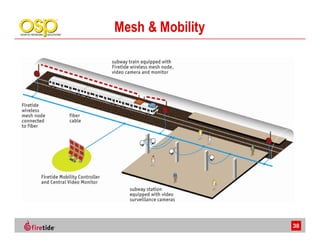
Mesh & Mobility


                  38
Planning & Deployment


                        39
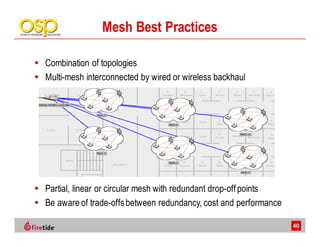
Mesh Best Practices

Combination of topologies
Multi-mesh interconnected by wired or wireless backhaul


Partial, linear or circular mesh with redundant drop-off points
Be aware of trade-offs between redundancy, cost and performance

                                                                  40
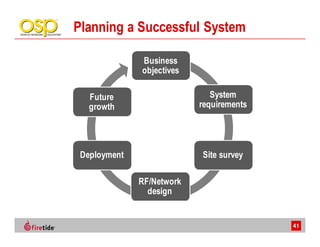
Planning a Successful System

              Business
              objectives

   Future                     System
   growth                  requirements


 Deployment                Site survey

              RF/Network
                design


                                          41
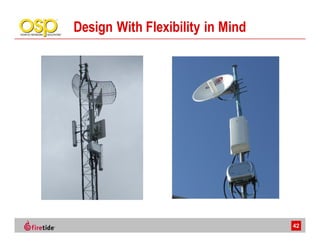
Design With Flexibility in Mind


                                  42
Prepare for a Variety of Conditions


                                      43
Future Growth

Make sure the network can scale
Evaluate new applications
   Cameras technology: ALPR, infrared, HD, megapixel
   Other services: Wi-Fi access, VoIP
   Mobility: real-time mobile video


                                                       44
Questions?


             Mike Intag, Firetide
             mintag@firetide.com
             partners@firetide.com


             www.firetide.com

             Presentation is available
             on SlideShare; Search
             for: Firetide OSP


                                         45

Wireless Mesh for OSP, Presented by Firetide at OSP Expo

  • 1.
    To Mesh orNot to Mesh for OSP? Advantages of Wireless Mesh Systems for OSP Environments Mike Intag, RCDD, Firetide 1
  • 2.
    Objectives Understand wireless optionsand their differentiators in OSP environments Discuss considerations for high-performance wireless networks Review mesh applications, design approaches and best practices 2
  • 3.
    Why High-performance Wirelessfor OSP? Property protection/ Mobility of workers & Security of remote Vandalism prevention equipment areas / Access control 3
  • 4.
    Why Wireless Infrastructure? Deployvirtually anywhere Portability and mobility Extend, back-up, or replace wired infrastructure Cost savings vs wire 4
  • 5.
    Wireless Challenges Availability ofchannels & spectrum RF interference Dynamic RF & physical environment “Trust but verify” attitude required 5
  • 6.
  • 7.
    Wireless Frequency Bands Licensed •Controlled by the FCC or other regulatory agencies • Can be sold or made commercially available to operators Unlicensed • Unregulated frequencies with predefined rules for hardware to mitigate interference 7
  • 8.
    Wireless Frequency Bands Licensed? Line of site Advantage Disadvantage 900 MHz Unlicensed Not required Improved street-level Lower throughput penetration for video compared to other bands 2.4 GHz Unlicensed Required Better penetration Interference from compared to 5 GHz consumer devices 4.9 GH Licensed Required Reserved for public Requires frequency safety; less coordination with interference other agencies 5 GHz Unlicensed Required Better range and less Lower penetration interference than 2.4 GHz compared to 2.4 GHz 8
  • 9.
    Point to Point Pros Dedicated connection Highest bandwidth for backhaul Cons Does not scale; no flexibility Single point of failure 9
  • 10.
    Point-to-Point Firetide Confidential 10
  • 11.
    Point to Multi-Point Pros May be cost effective if tall assets are available; bandwidth requirements are low Cons Limited scalability: bandwidth divided by # of subscribers LOS required to each subscriber unit Base station creates a single point of failure 11
  • 12.
  • 13.
    Multi-Point to Multi-Point(Mesh) Pros Reach & scalability with multi-hop connections Flexibility – can be deployed a PtP, PtMP or mesh Cons Variable performance from different vendors More expertise required vs PtP or PtMP 13
  • 14.
  • 15.
    Why is RedundancyImportant? Radio equipment is very reliable…. …but they are frequently installed on light poles which aren’t 15
  • 16.
    Not All ‘WirelessMesh’ Created Equal 16
  • 17.
    Imagine a TraditionalWired Switch Most efficient mesh utilizes L2 distributed wireless switch architecture (Wired Ethernet infrastructure) 17
  • 18.
    Now, Give EachPort Wireless Capability (Wired Ethernet infrastructure) 18
  • 19.
    Separate the Ports… Bingo, a Virtual Ethernet Switch! (Wired Ethernet infrastructure) 19
  • 20.
    Key Requirements Voice Video High-bandwidth data High call capacity High throughput Low latency Low jitter (variation in latency) Multicast support End-to-end QoS & traffic prioritization 20
  • 21.
  • 22.
    What About Throughput? Point to point Up to 1 Gig+ Point to multi-point WiMAX: 20-30 Mbps total capacity (divided by # of subscribers) MIMO-based PtMP systems: 100-125 Mbps Wireless mesh Up to 250-300 Mbps in PtP mode or 100-150 Mbps sustained over multiple hops Varies by vendor: from 10-15 Mbps to 100-150 Mbps per radio Numbers listed are usable throughput, not theoretical data rate 22
  • 23.
    Is Wireless Secure? Standards-based Encapsulation w/ Firetide Mesh Routing Protocol Radio layer encryption AES WPA2 Encryption FIPS 140-2 certification Packet Packet Propitiatory Filtering Filtering Encapsulation Digital certificates & MAC filtering VLANs 23
  • 24.
    Wi-Fi Access vsMesh Wi-Fi for client access Useful for live video in Wi-Fi ‘hot spots’ • Laptops, PDAs • Local and remote viewing Wi-Fi enabled Radio, AP & Camera patrol car 24
  • 25.
    Can I UseLow-cost Point-to-Point? Low-cost PtP has a cost advantage, but: Only for a few outlying cameras / 1 hop Disadvantages beyond that: No scalability Complex to manage More real estate required 25
  • 26.
    Limitations of PtP& PtMP Systems Rigid architecture Does not allow multi-hop Requires towers / tall buildings No infrastructure mobility Require backhaul for each base station: high costs of deployments Quickly run out of usable spectrum Transition to MIMO 40 MHz channels creates challenges Urban canyons a challenge to PtP & PtMP 26
  • 27.
    Key Technology Differentiators Customer Infrastructure Mesh AP PtP PtMP Benefit Mesh Scalability for video Security Infrastructure Mobility Backhaul Every 10-15 hops Every 2-3 hops Every link Every base station requirement Investment Indoor and outdoor, Indoor and outdoor, Outdoor only, complex Outdoor only, Protection multiple applications access point based, network management, complex network (data, video, voice) data support only no scalability management, limited scalability 27
  • 28.
  • 29.
  • 30.
  • 31.
    Linear Mesh Design 10hops in both directions Multi-application: VoIP, video, Wi-Fi data 31
  • 32.
    Infrastructure Mesh Applications 32
  • 33.
  • 34.
  • 35.
  • 36.
  • 37.
    Cellular Base StationInterconnect 37
  • 38.
  • 39.
  • 40.
    Mesh Best Practices Combinationof topologies Multi-mesh interconnected by wired or wireless backhaul Partial, linear or circular mesh with redundant drop-off points Be aware of trade-offs between redundancy, cost and performance 40
  • 41.
    Planning a SuccessfulSystem Business objectives Future System growth requirements Deployment Site survey RF/Network design 41
  • 42.
  • 43.
    Prepare for aVariety of Conditions 43
  • 44.
    Future Growth Make surethe network can scale Evaluate new applications Cameras technology: ALPR, infrared, HD, megapixel Other services: Wi-Fi access, VoIP Mobility: real-time mobile video 44
  • 45.
    Questions? Mike Intag, Firetide mintag@firetide.com partners@firetide.com www.firetide.com Presentation is available on SlideShare; Search for: Firetide OSP 45