Adopting and Implementing an
Open Access Policy: The Library’s
Role
Brian Kern
Head of Technical Services
Pelletier Library
bkern@allegheny.edu
Outline
• Institutional profile
• Adopting the policy
• Implementing the policy
• Conclusion: Lessons Learned
INSTITUTIONAL PROFILE
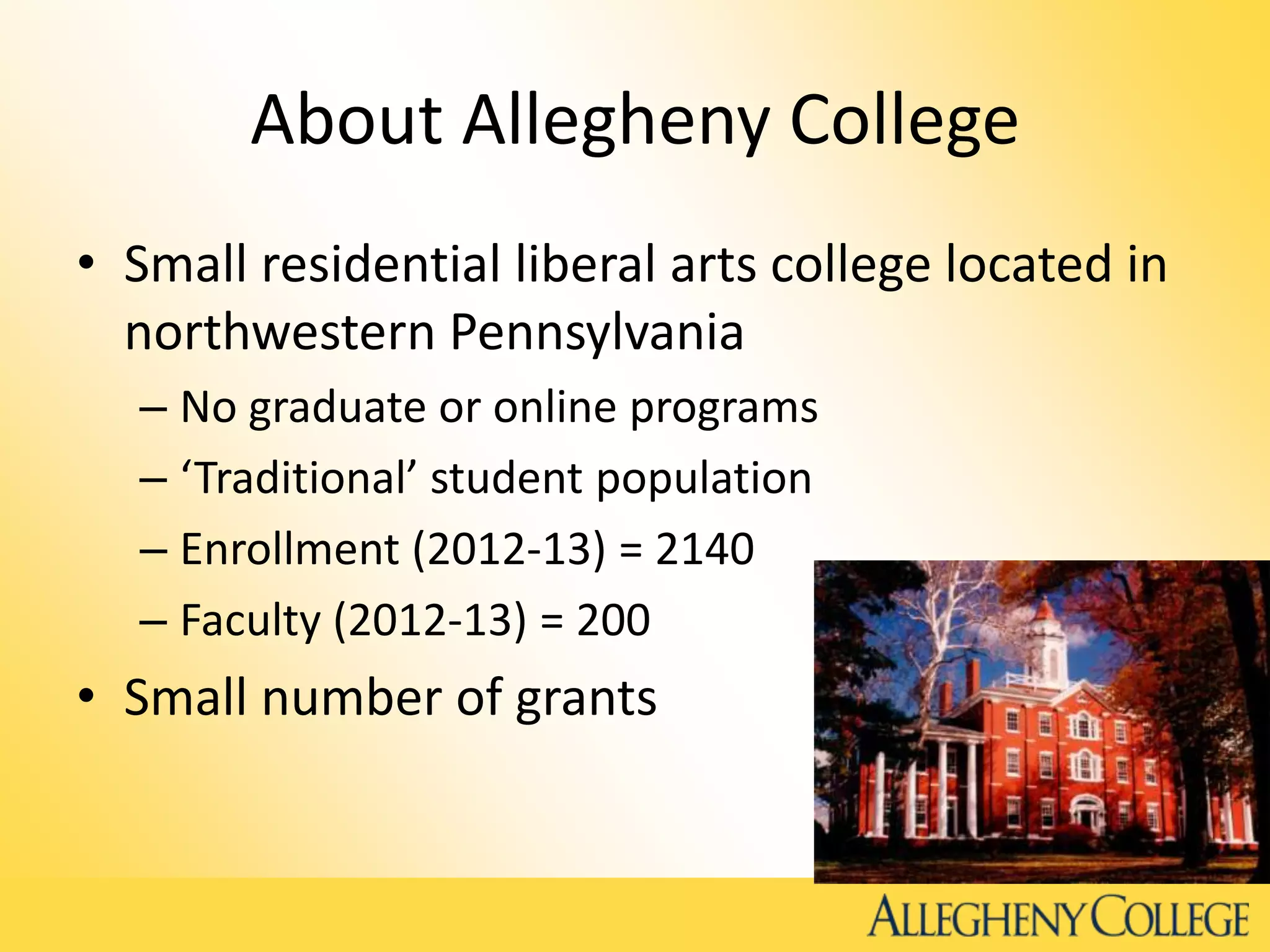
About Allegheny College
• Small residential liberal arts college located in
northwestern Pennsylvania
– No graduate or online programs
– ‘Traditional’ student population
– Enrollment (2012-13) = 2140
– Faculty (2012-13) = 200
• Small number of grants
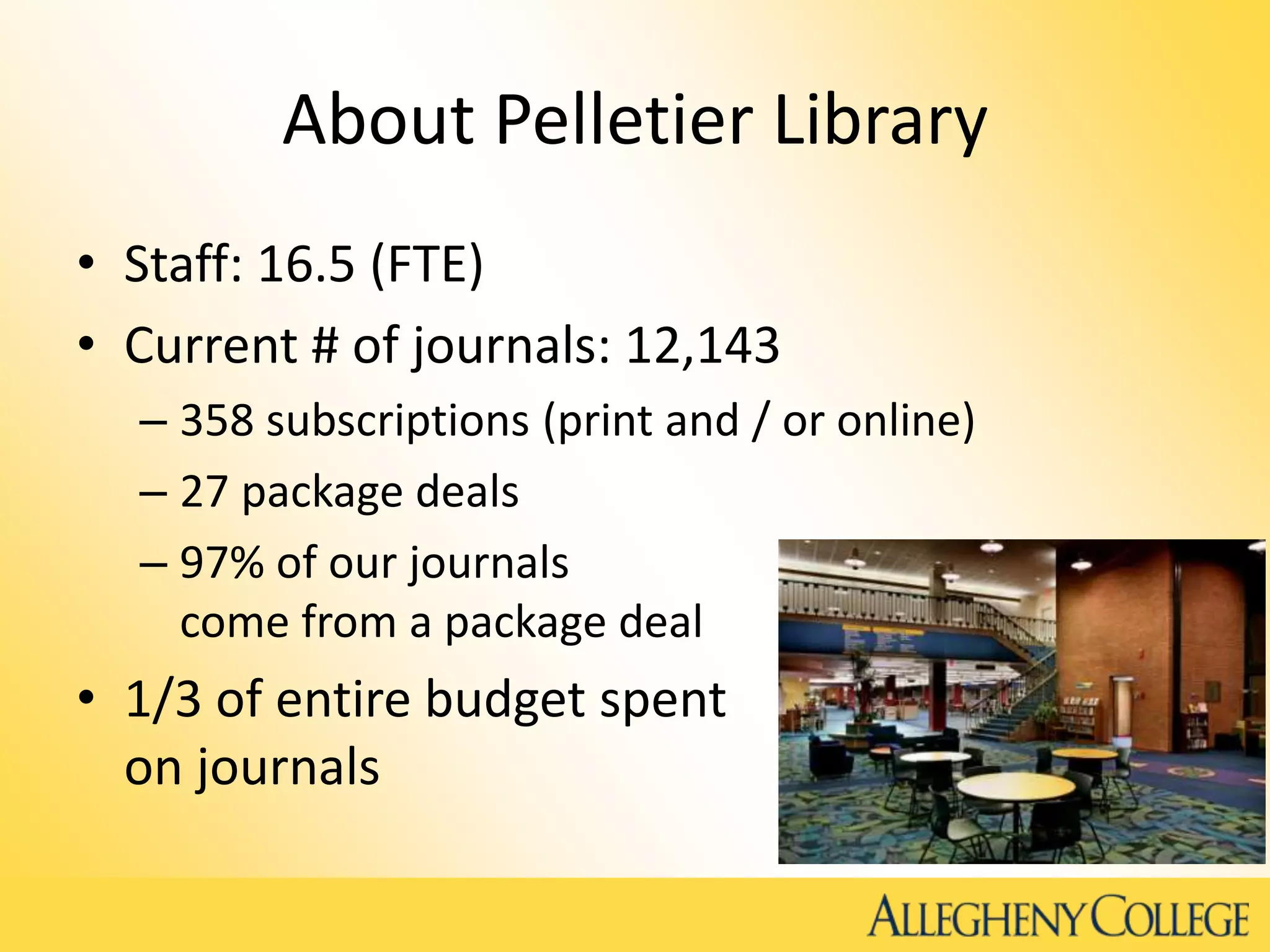
About Pelletier Library
• Staff: 16.5 (FTE)
• Current # of journals: 12,143
– 358 subscriptions (print and / or online)
– 27 package deals
– 97% of our journals
come from a package deal
• 1/3 of entire budget spent
on journals
• Journal cancellations in 2004 and 2010
– Over 2/3 of collection has been cut in last decade
– Preference for publisher deals when they make
economic sense
• Advocating for open access is a primary goal
of the library.
Open Source Software
• DSpace: open source institutional repository
– Hosted and supported by a third party vendor
• Also using open source software for learning
management system (LMS), ERM, and serials
management.
ADOPTING AN OPEN ACCESS
POLICY
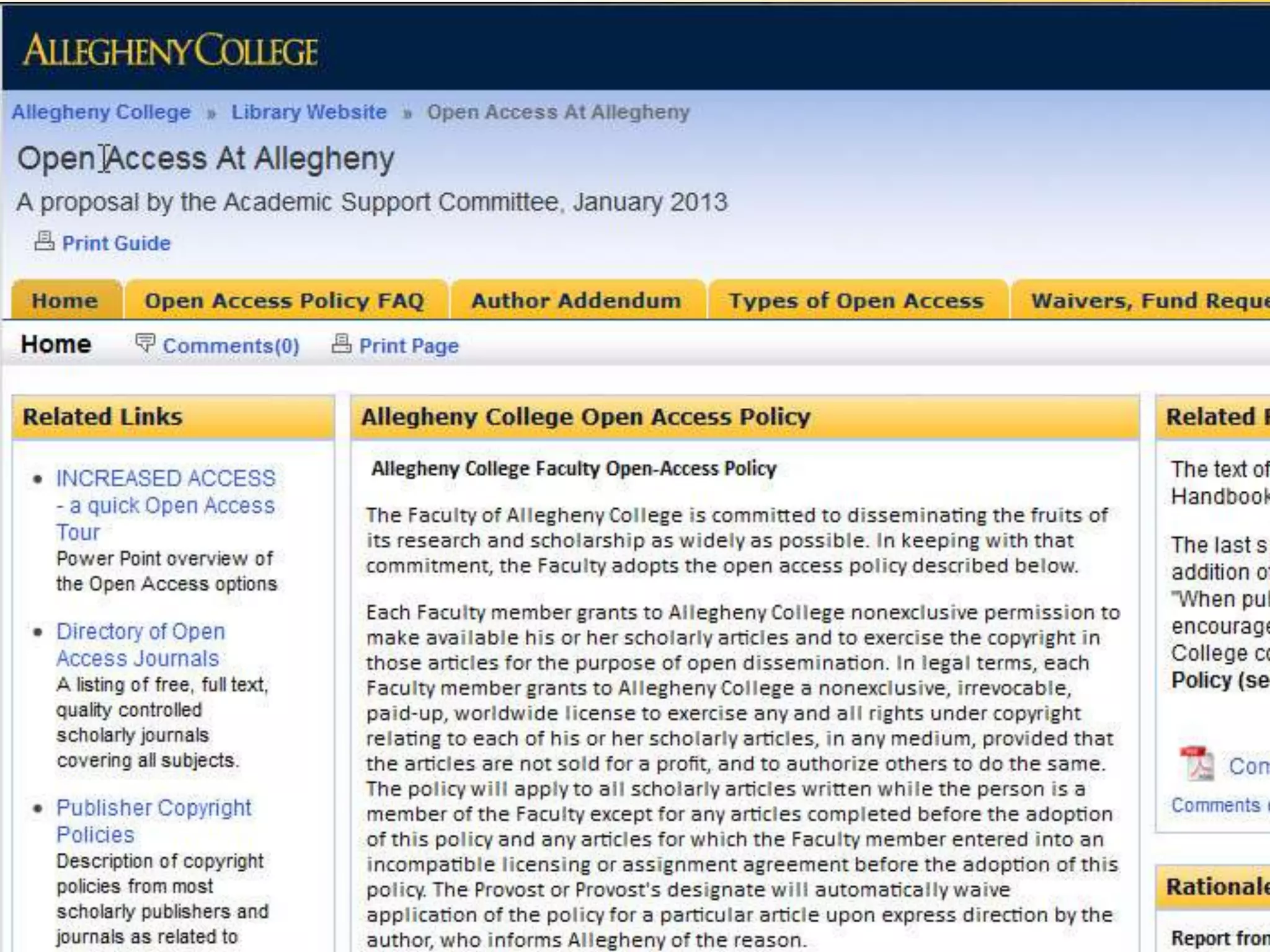
Allegheny’s Open Access Policy
• Officially adopted by the faculty on March
14, 2013.
• Developed by a faculty committee whose
charge includes sabbatical requests and local
funding for research projects.
• http://library.allegheny.edu/openaccess
Policy
• Permission based policy
– “Harvard-style policy”
– Faculty gives College nonexclusive right to make
their work available through Open Access
– Early drafts of the policy were ‘encouragement
pledges’
• No specifics about implementation in the
policy
Waiver
• Policy states it will be automatically granted
• Waivers are necessary when
– Embargo
– Publisher prohibits participation
– Author does not want to participate
• No restrictions on where to publish
• Encouraged to remove restrictive language
from contracts
Closed Archive
• Despite obtaining a waiver, the article still has
to be archived
– “Closed” archive where only the author can access
the article
Scholarly articles
• Only interested in peer-reviewed articles, not
conference proceedings, etc.
• There is no stipulation on what form the
article is
– Published article
– Prior to peer-review (preprint)
– After peer-review, but before publication
(postprint)
• Contracts with publisher dictates the form
Exceptions
• No obligation to self-archive articles written
prior to the adoption of this policy
• No need to renegotiate licenses prior to the
adoption of this policy
Funding
• Library offers $3,000 funding for open access
fees
• Provost matching $3,000 funding
• Hope is to carry over unused funds to build up
the fund (maximum $12,000)
Role of the Library
• Indirect
– Journal cancellations
– Marketing through newsletters
– Speaking at committee meetings
• Direct
– Implementing the policy
IMPLEMENTING AN OPEN ACCESS
POLICY
Staff and setup
• Setup
– Website
– DSpace (Institutional Repository)
• Staffing
– Library director: website and policy questions
– Instructional technologist: website and copyright
issues
– Head of Technical Services: DSpace
– Student assistant
Website
• Policy
• FAQ
• Author addendums
• Waivers
• Funding requests
• Terminology and related information
DSpace
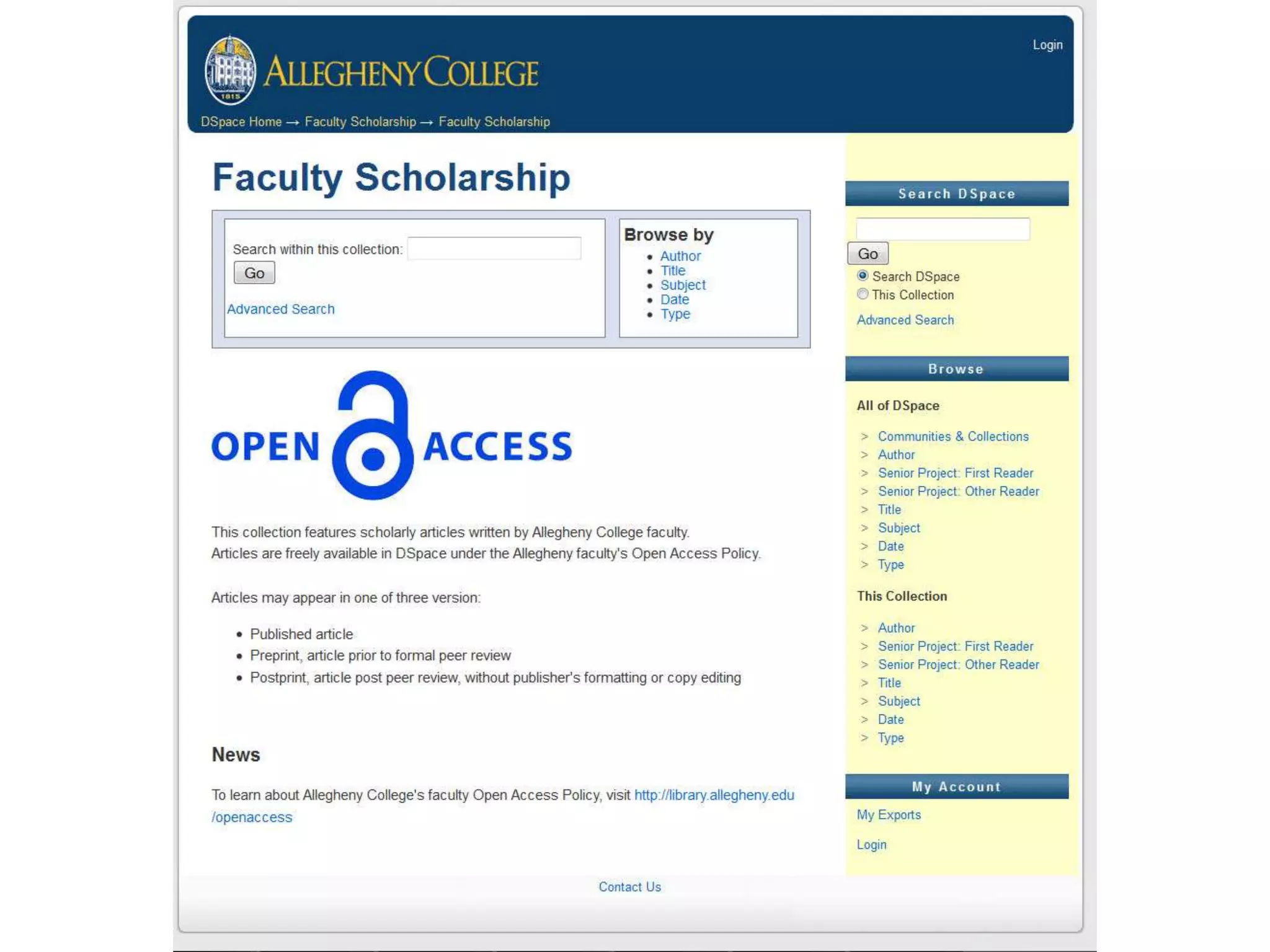
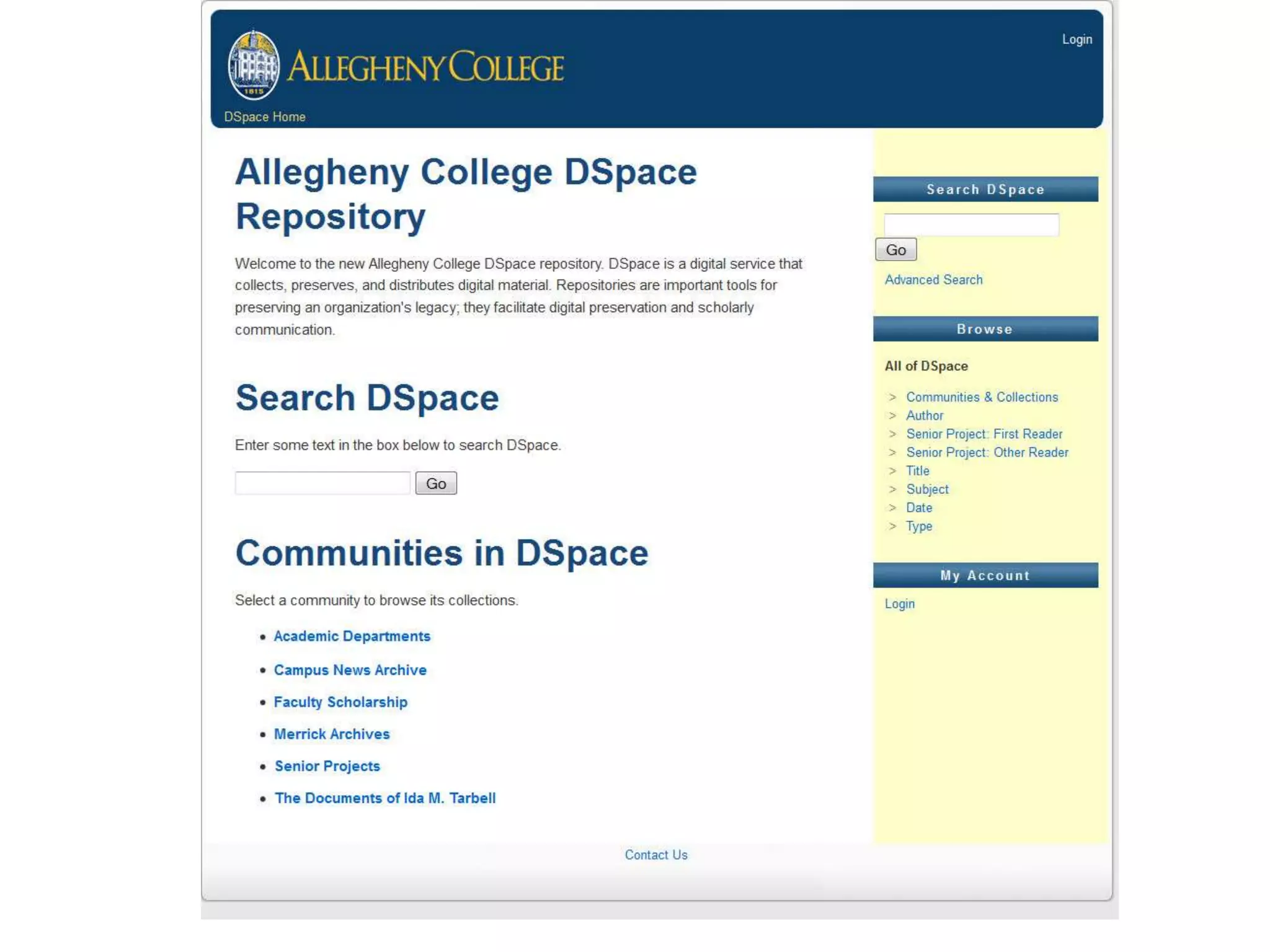
• Faculty Scholarship collection
– https://dspace.allegheny.edu/handle/10456/34250
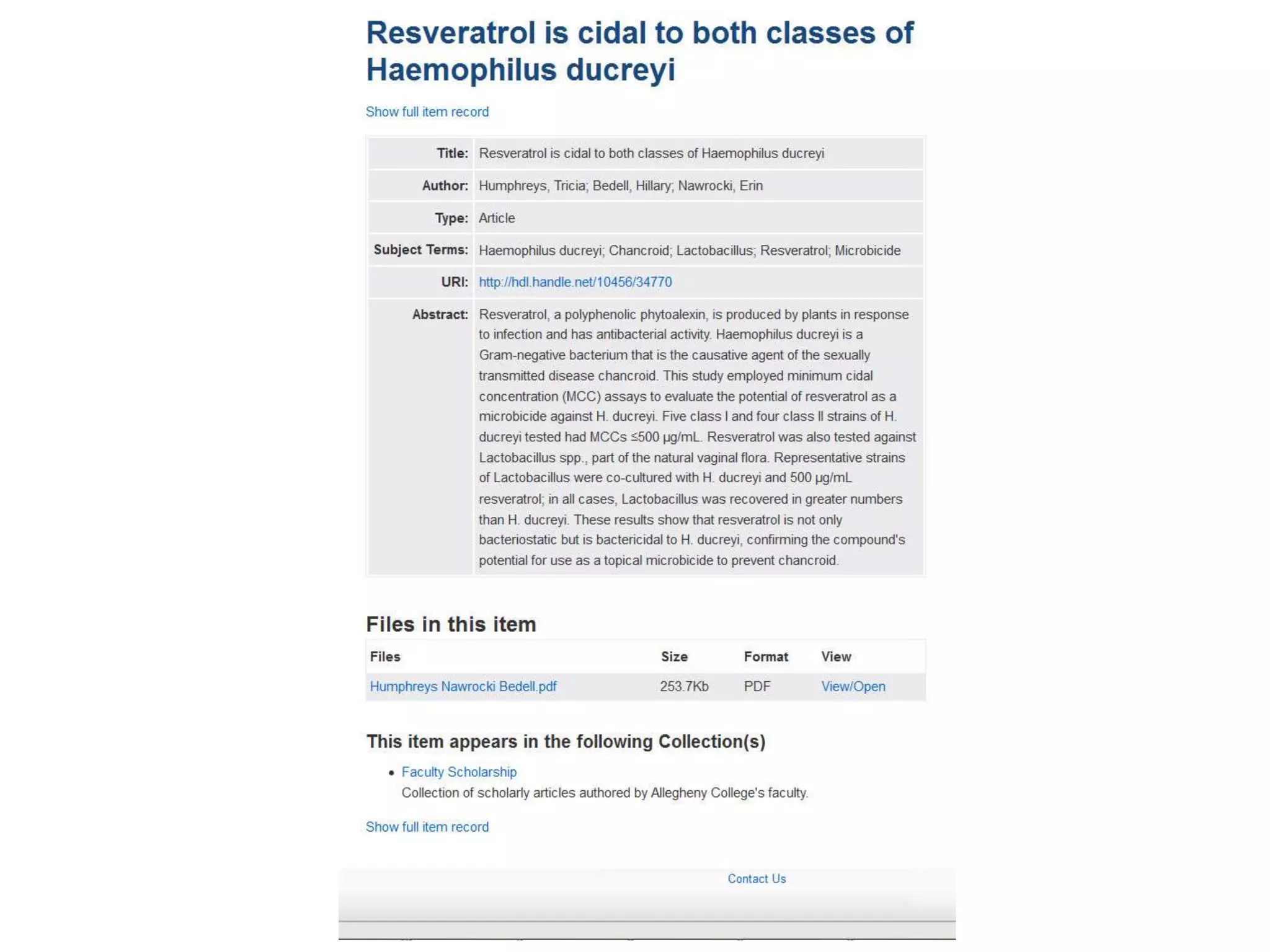
• Faculty will submit articles through DSpace
– Basic citation information
– Abstract
– Embargo
– Files
• Submissions are reviewed/accepted and
additional metadata is added
People and Places
• Monthly e-mail newsletter / blog of student
and faculty publication, proceedings, and
other scholarly achievements
– Library uses this resource to identify and acquire
faculty publications such as books and articles
– Most faculty are used to contributing to this
source
– http://sites.allegheny.edu/news/people_place
CHALLENGES: IR, OAI & GOOGLE
Implementing an Open Access Policy:
Building the Repository
• Adding faculty articles that were already OA
prior to enactment of the policy
– Initial focus on published articles that are OA
• Using Stephen X. Flynn’s code for seeking out
OA articles
• See his ACRL poster / blog entry at
http://www.sxflynn.net/journal/2013/4/14/ki
ckstart-your-institutional-repository-with-
content-from-pu.html
DSpace @ Allegheny
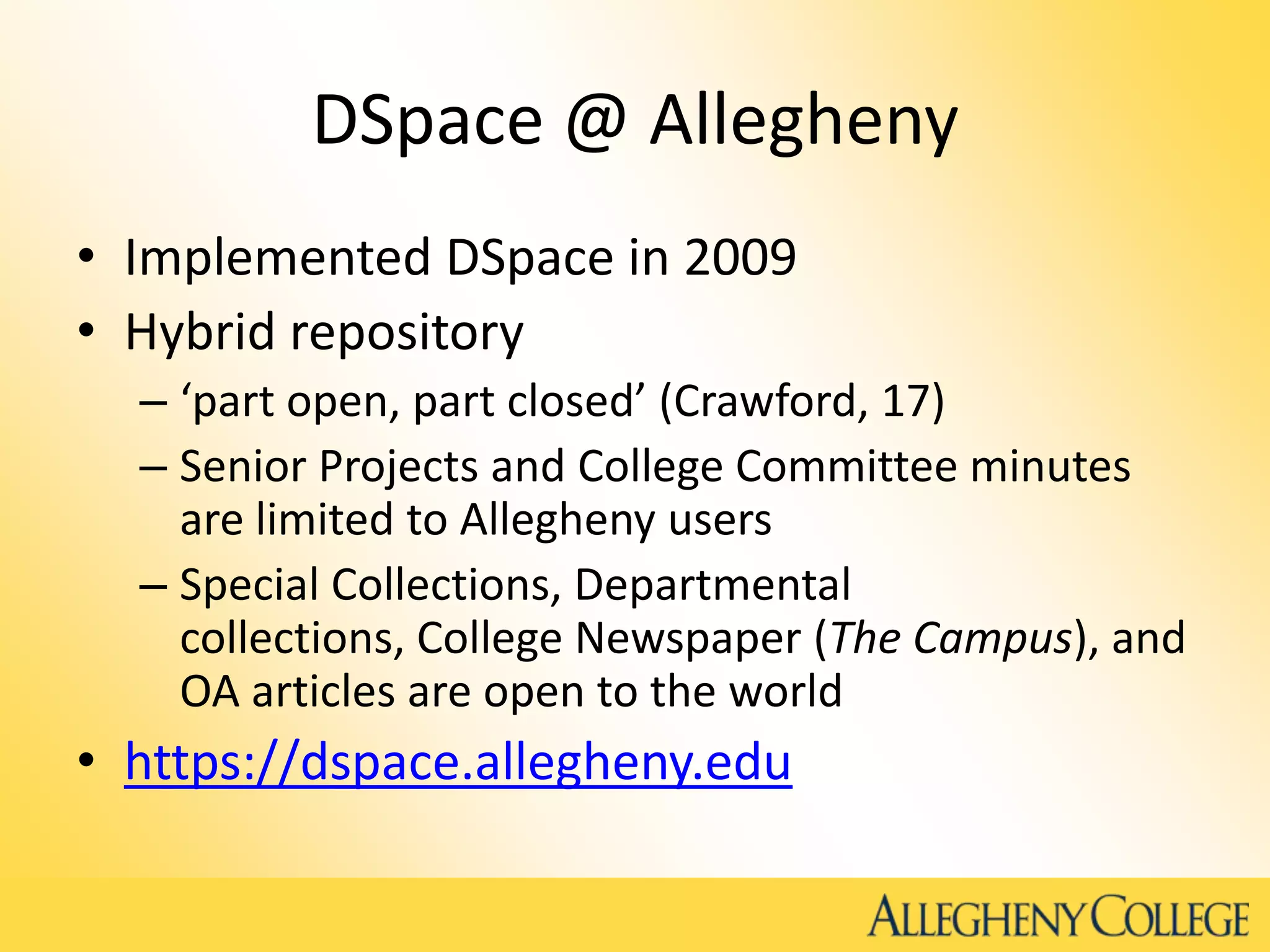
• Implemented DSpace in 2009
• Hybrid repository
– ‘part open, part closed’ (Crawford, 17)
– Senior Projects and College Committee minutes
are limited to Allegheny users
– Special Collections, Departmental
collections, College Newspaper (The Campus), and
OA articles are open to the world
• https://dspace.allegheny.edu
Open Collections
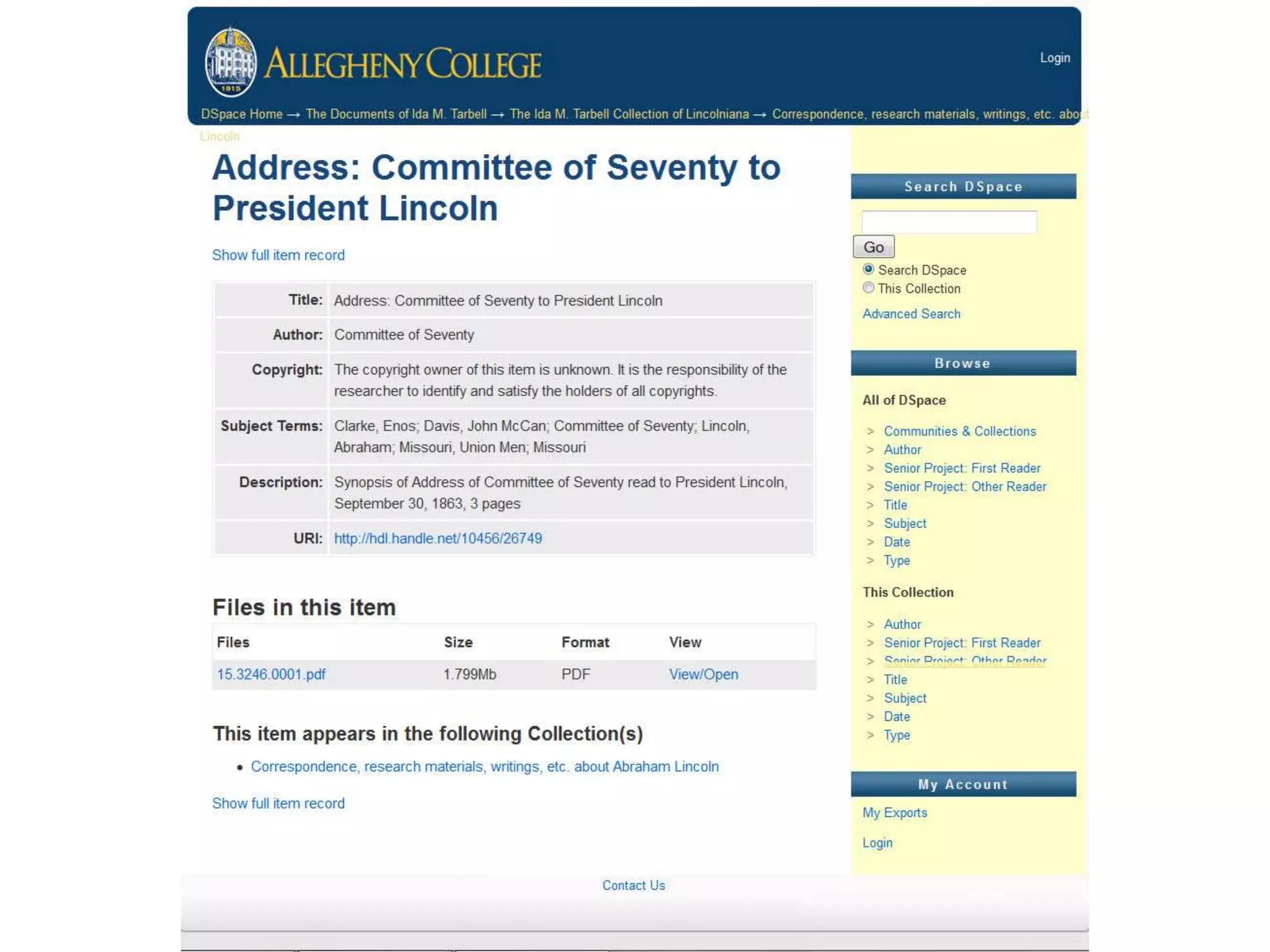
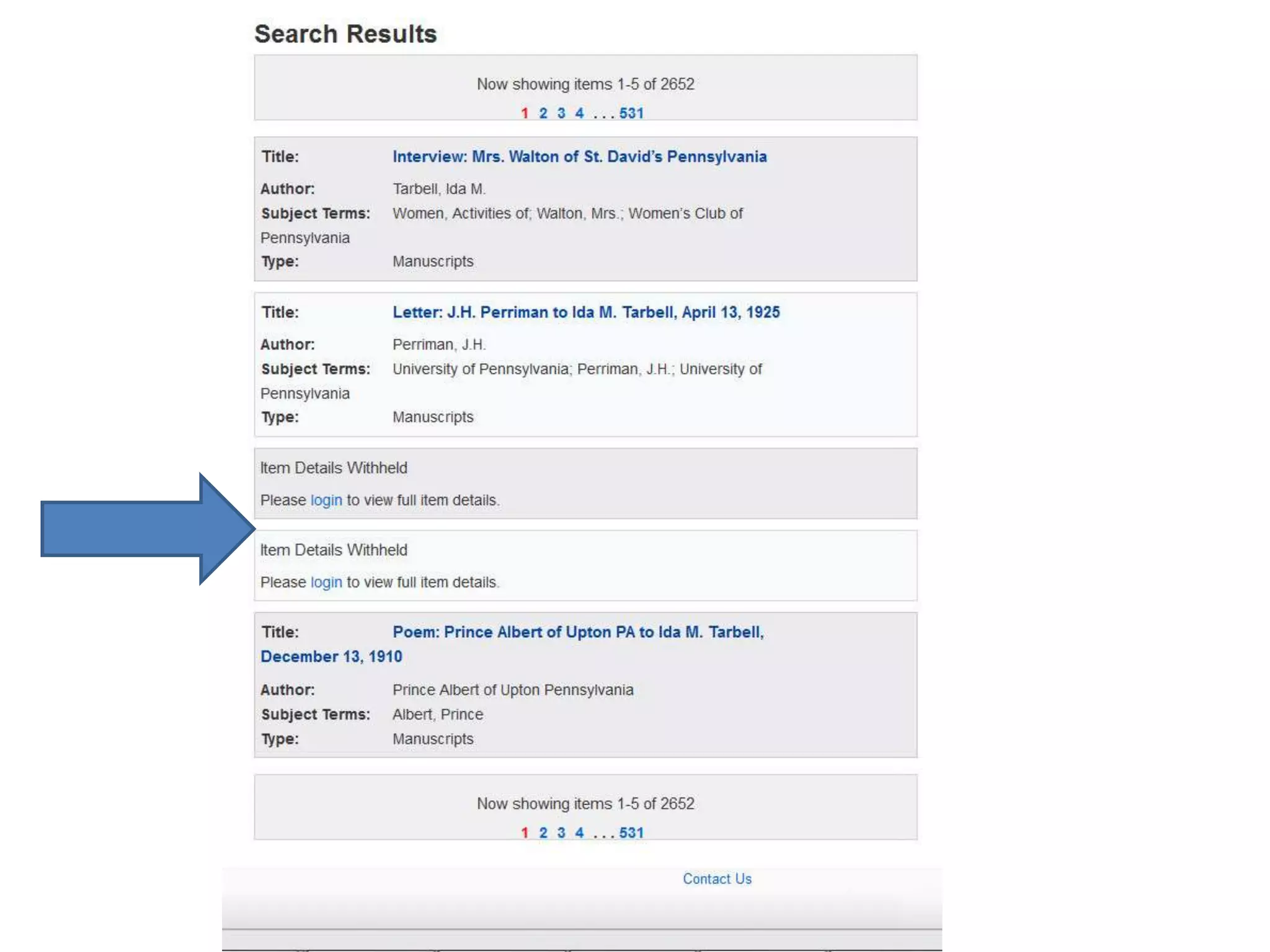
• The Documents of Ida M. Tarbell
– Online collection started in 2009
– Supported by NEH grant
– 14,500 records and still growing
– All metadata and image files available to the world
Closed collections
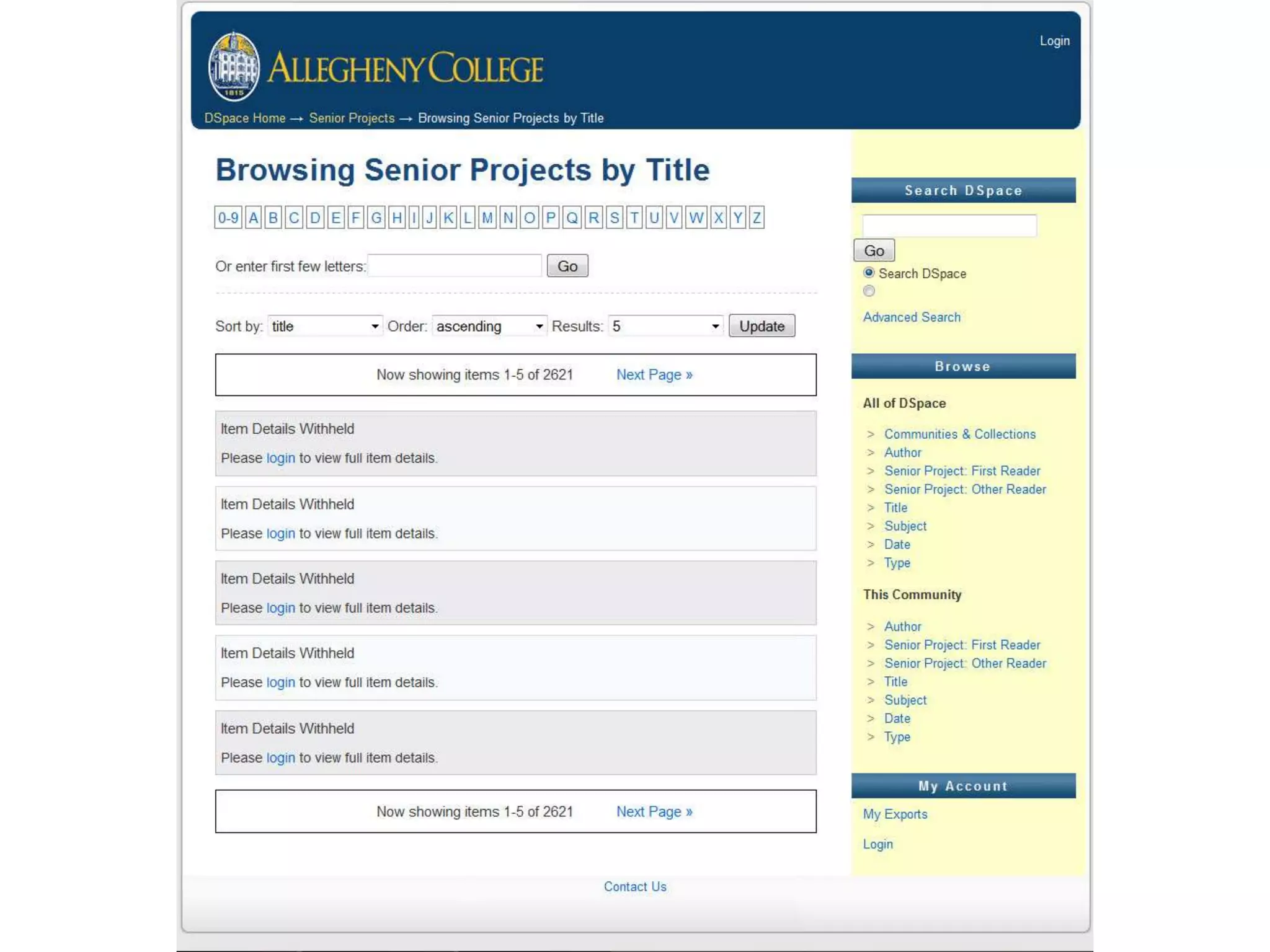
• Senior Projects
– Started in 2009
– Voluntary, unless department mandates
– No metadata or projects are available to the world
• Necessary for the project to get off the ground
– Library acquires permission from students to
make projects available to Allegheny users and the
world
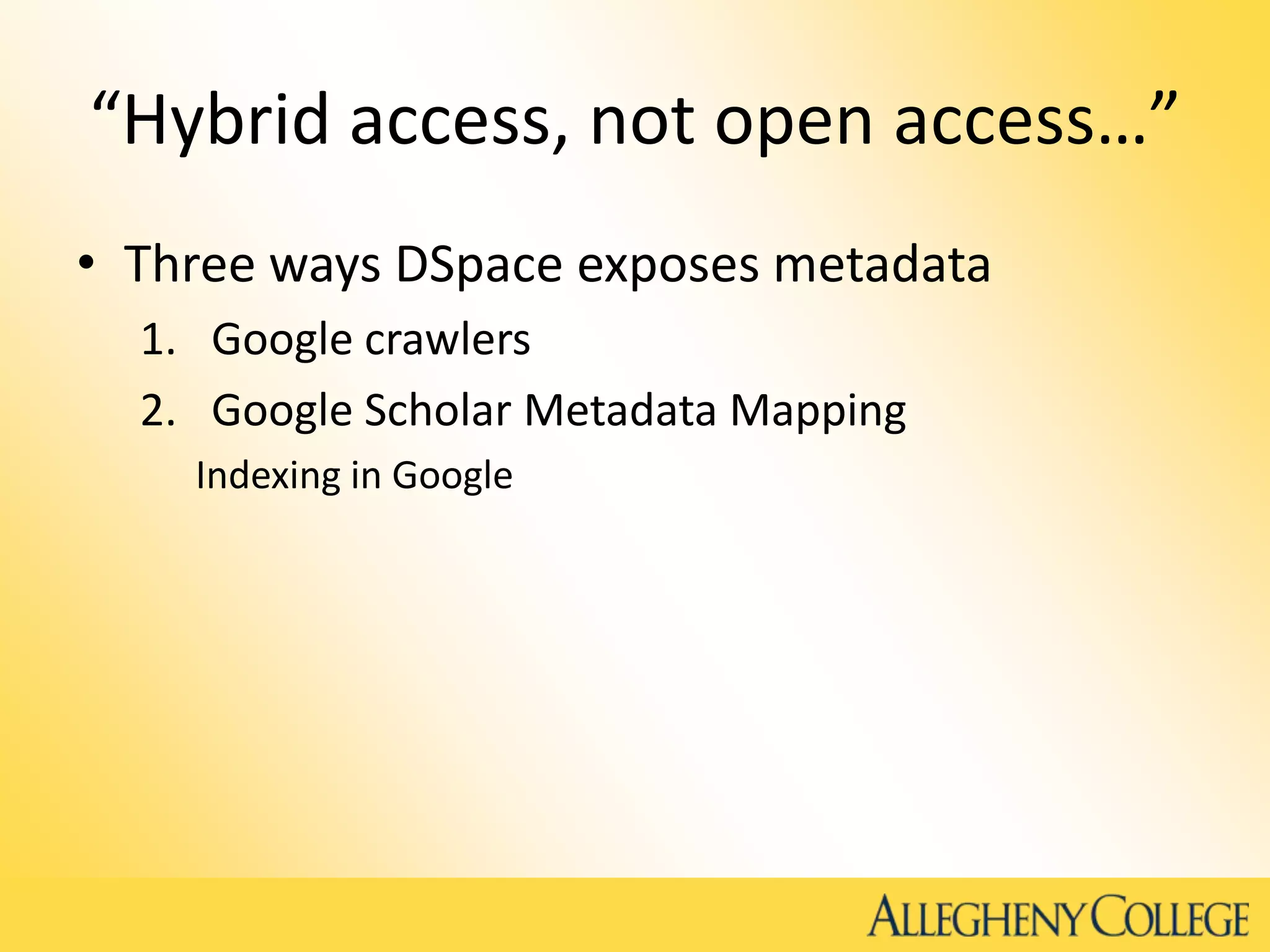
“Hybrid access, not open access…”
• Three ways DSpace exposes metadata
1. Google crawlers
2. Google Scholar Metadata Mapping
Indexing in Google
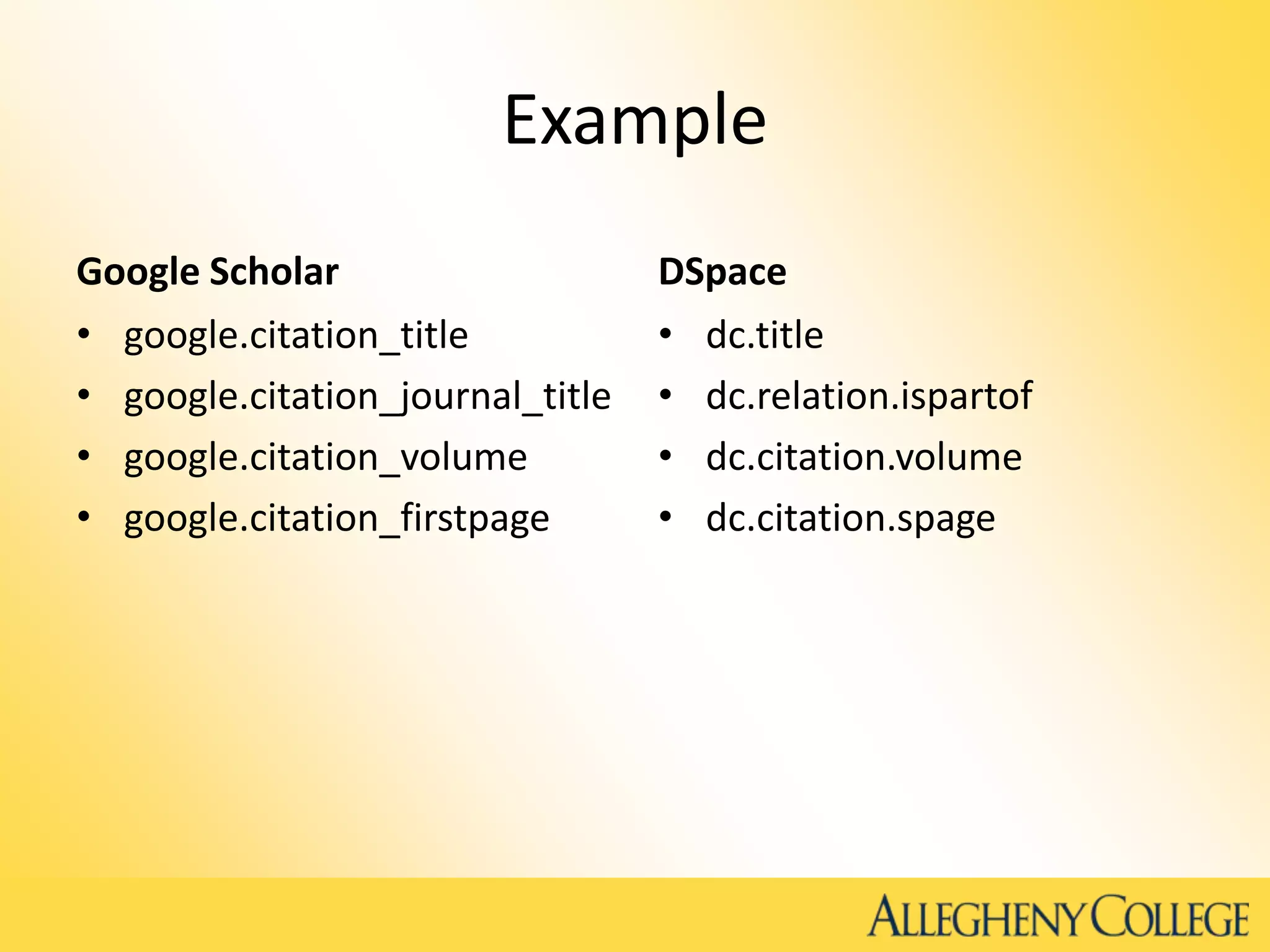
Example
Google Scholar
• google.citation_title
• google.citation_journal_title
• google.citation_volume
• google.citation_firstpage
DSpace
• dc.title
• dc.relation.ispartof
• dc.citation.volume
• dc.citation.spage
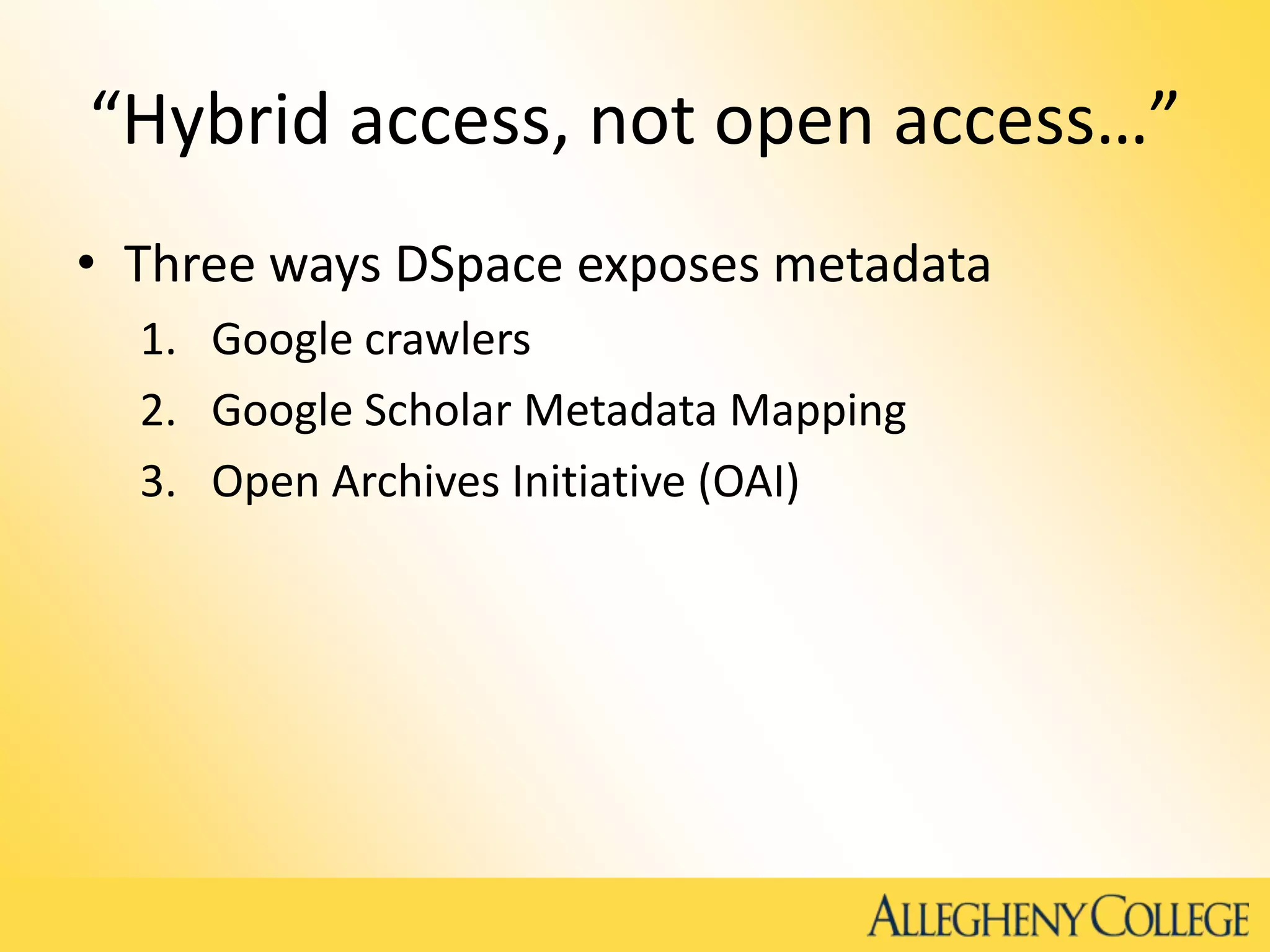
“Hybrid access, not open access…”
• Three ways DSpace exposes metadata
1. Google crawlers
2. Google Scholar Metadata Mapping
3. Open Archives Initiative (OAI)
Metadata Exposure at Allegheny
• Allegheny has implemented
– Google crawlers
– Google Scholar Metadata Mapping
• Allegheny cannot implement OAI
– Closed collections
• This is not an issue for us, but…
• Most discovery platforms rely on OAI
– Allegheny does not have a discovery platform
• Limiting our ability to make OA articles
available to the world
• Fortunately, users can access our OA
collections through Google
Opportunities
• A new version of DSpace will
– fix the OAI issue
– introduce new embargo capabilities
• ‘Restricted’ metadata will likely go away
• OA has forced Allegheny and DSpace to
improve their systems.
LESSONS LEARNED (IN 86 DAYS)
Conclusion
Adopting an OA Policy
• Allegheny’s open access policy is dependent
on:
– Faculty with a passion to see open access a reality
– Library keeping faculty informed of the issues
• Funding plan was our most urgent need
• “It’s not about us…”
– It’s about author rights!
Implementing a policy
• Make sure plans for submitting articles are in
place
• Help faculty comply with the policy
– Don’t expect faculty to be copyright lawyers
– Use existing resources
• People and Places
• SHERPA / RoMEO
• Keep the submission process simple
– IR
– E-mail
– Whatever is convenient for them
• Expose your collection!
Acknowledgements
• Linda Bills, Director of the Library, Allegheny
College
• Academic Support Committee at Allegheny
College
– Dr. Bradley Hersh, chair
• Ellen Finnie Duranceau, Program Manager for
Scholarly Publishing & Licensing, MIT Libraries
• Stephen X. Flynn, Emerging Technologies
Librarian, College of Wooster
References
Allegheny College DSpace Repository. https://dspace.allegheny.edu
[accessed May 11, 2013].
Allegheny College Open Access Policy.
http://library.allegheny.edu/openaccess [accessed May 11, 2013].
Bills, Linda. Open Access Journals: Reclaiming Scholarship. @theLibrary
2.0 1, no.1 (Fall 2011): n.p.
Crawford, Walt. Open Access: What You Need to Know Now. ALA Editions
Special Reports. Chicago: American Library Association, 2011.
Duranceau, Ellen Finnie and Sue Kriegsman. Implementing Open Access
Policies Using Institutional Repositories. In The Institutional
Repository: Benefits and Challenges, ed. Pamela Bluh and Cindy
Hepfer, 75-97. Association for Library Collections & Technical
Services, 2013.
http://www.ala.org/alcts/sites/ala.org.alcts/files/content/resources/p
apers/ir_ch05_.pdf [accessed May 11, 2013].
References (cont).
EBSCO. Serials Price Projections for 2013.
Flynn, Stephen X. “Kickstart your Institutional Repository
with Content from Publishers.” Poster presented at
Association for College and Research Libraries (ACRL)
2013 Conference, Indianapolis, IN, April 11, 2013.
http://www.sxflynn.net/journal/2013/4/14/kickstart-
your-institutional-repository-with-content-from-
pu.html [accessed May 11, 2013].
Google. Google Scholar: Inclusion Guidelines for
Webmasters.
http://scholar.google.com/intl/en/scholar/inclusion.ht
ml [accessed May 11, 2013].
Suber, Peter. Open Access. MIT Press Essential Knowledge
Series. Cambridge, MA: MIT Press, 2012.

Adopting and Implementing an Open Access Policy: The Library's Role

  • 1.
    Adopting and Implementingan Open Access Policy: The Library’s Role Brian Kern Head of Technical Services Pelletier Library bkern@allegheny.edu
  • 2.
    Outline • Institutional profile •Adopting the policy • Implementing the policy • Conclusion: Lessons Learned
  • 3.
  • 4.
    About Allegheny College •Small residential liberal arts college located in northwestern Pennsylvania – No graduate or online programs – ‘Traditional’ student population – Enrollment (2012-13) = 2140 – Faculty (2012-13) = 200 • Small number of grants
  • 5.
    About Pelletier Library •Staff: 16.5 (FTE) • Current # of journals: 12,143 – 358 subscriptions (print and / or online) – 27 package deals – 97% of our journals come from a package deal • 1/3 of entire budget spent on journals
  • 6.
    • Journal cancellationsin 2004 and 2010 – Over 2/3 of collection has been cut in last decade – Preference for publisher deals when they make economic sense • Advocating for open access is a primary goal of the library.
  • 7.
    Open Source Software •DSpace: open source institutional repository – Hosted and supported by a third party vendor • Also using open source software for learning management system (LMS), ERM, and serials management.
  • 8.
    ADOPTING AN OPENACCESS POLICY
  • 9.
    Allegheny’s Open AccessPolicy • Officially adopted by the faculty on March 14, 2013. • Developed by a faculty committee whose charge includes sabbatical requests and local funding for research projects. • http://library.allegheny.edu/openaccess
  • 11.
    Policy • Permission basedpolicy – “Harvard-style policy” – Faculty gives College nonexclusive right to make their work available through Open Access – Early drafts of the policy were ‘encouragement pledges’ • No specifics about implementation in the policy
  • 12.
    Waiver • Policy statesit will be automatically granted • Waivers are necessary when – Embargo – Publisher prohibits participation – Author does not want to participate • No restrictions on where to publish • Encouraged to remove restrictive language from contracts
  • 13.
    Closed Archive • Despiteobtaining a waiver, the article still has to be archived – “Closed” archive where only the author can access the article
  • 14.
    Scholarly articles • Onlyinterested in peer-reviewed articles, not conference proceedings, etc. • There is no stipulation on what form the article is – Published article – Prior to peer-review (preprint) – After peer-review, but before publication (postprint) • Contracts with publisher dictates the form
  • 15.
    Exceptions • No obligationto self-archive articles written prior to the adoption of this policy • No need to renegotiate licenses prior to the adoption of this policy
  • 16.
    Funding • Library offers$3,000 funding for open access fees • Provost matching $3,000 funding • Hope is to carry over unused funds to build up the fund (maximum $12,000)
  • 17.
    Role of theLibrary • Indirect – Journal cancellations – Marketing through newsletters – Speaking at committee meetings • Direct – Implementing the policy
  • 18.
    IMPLEMENTING AN OPENACCESS POLICY
  • 19.
    Staff and setup •Setup – Website – DSpace (Institutional Repository) • Staffing – Library director: website and policy questions – Instructional technologist: website and copyright issues – Head of Technical Services: DSpace – Student assistant
  • 20.
    Website • Policy • FAQ •Author addendums • Waivers • Funding requests • Terminology and related information
  • 21.
    DSpace • Faculty Scholarshipcollection – https://dspace.allegheny.edu/handle/10456/34250 • Faculty will submit articles through DSpace – Basic citation information – Abstract – Embargo – Files • Submissions are reviewed/accepted and additional metadata is added
  • 24.
    People and Places •Monthly e-mail newsletter / blog of student and faculty publication, proceedings, and other scholarly achievements – Library uses this resource to identify and acquire faculty publications such as books and articles – Most faculty are used to contributing to this source – http://sites.allegheny.edu/news/people_place
  • 25.
    CHALLENGES: IR, OAI& GOOGLE Implementing an Open Access Policy:
  • 26.
    Building the Repository •Adding faculty articles that were already OA prior to enactment of the policy – Initial focus on published articles that are OA • Using Stephen X. Flynn’s code for seeking out OA articles • See his ACRL poster / blog entry at http://www.sxflynn.net/journal/2013/4/14/ki ckstart-your-institutional-repository-with- content-from-pu.html
  • 27.
    DSpace @ Allegheny •Implemented DSpace in 2009 • Hybrid repository – ‘part open, part closed’ (Crawford, 17) – Senior Projects and College Committee minutes are limited to Allegheny users – Special Collections, Departmental collections, College Newspaper (The Campus), and OA articles are open to the world • https://dspace.allegheny.edu
  • 29.
    Open Collections • TheDocuments of Ida M. Tarbell – Online collection started in 2009 – Supported by NEH grant – 14,500 records and still growing – All metadata and image files available to the world
  • 31.
    Closed collections • SeniorProjects – Started in 2009 – Voluntary, unless department mandates – No metadata or projects are available to the world • Necessary for the project to get off the ground – Library acquires permission from students to make projects available to Allegheny users and the world
  • 34.
    “Hybrid access, notopen access…” • Three ways DSpace exposes metadata 1. Google crawlers 2. Google Scholar Metadata Mapping Indexing in Google
  • 35.
    Example Google Scholar • google.citation_title •google.citation_journal_title • google.citation_volume • google.citation_firstpage DSpace • dc.title • dc.relation.ispartof • dc.citation.volume • dc.citation.spage
  • 36.
    “Hybrid access, notopen access…” • Three ways DSpace exposes metadata 1. Google crawlers 2. Google Scholar Metadata Mapping 3. Open Archives Initiative (OAI)
  • 37.
    Metadata Exposure atAllegheny • Allegheny has implemented – Google crawlers – Google Scholar Metadata Mapping • Allegheny cannot implement OAI – Closed collections • This is not an issue for us, but…
  • 38.
    • Most discoveryplatforms rely on OAI – Allegheny does not have a discovery platform • Limiting our ability to make OA articles available to the world • Fortunately, users can access our OA collections through Google
  • 39.
    Opportunities • A newversion of DSpace will – fix the OAI issue – introduce new embargo capabilities • ‘Restricted’ metadata will likely go away • OA has forced Allegheny and DSpace to improve their systems.
  • 40.
    LESSONS LEARNED (IN86 DAYS) Conclusion
  • 41.
    Adopting an OAPolicy • Allegheny’s open access policy is dependent on: – Faculty with a passion to see open access a reality – Library keeping faculty informed of the issues • Funding plan was our most urgent need • “It’s not about us…” – It’s about author rights!
  • 42.
    Implementing a policy •Make sure plans for submitting articles are in place • Help faculty comply with the policy – Don’t expect faculty to be copyright lawyers – Use existing resources • People and Places • SHERPA / RoMEO
  • 43.
    • Keep thesubmission process simple – IR – E-mail – Whatever is convenient for them • Expose your collection!
  • 44.
    Acknowledgements • Linda Bills,Director of the Library, Allegheny College • Academic Support Committee at Allegheny College – Dr. Bradley Hersh, chair • Ellen Finnie Duranceau, Program Manager for Scholarly Publishing & Licensing, MIT Libraries • Stephen X. Flynn, Emerging Technologies Librarian, College of Wooster
  • 45.
    References Allegheny College DSpaceRepository. https://dspace.allegheny.edu [accessed May 11, 2013]. Allegheny College Open Access Policy. http://library.allegheny.edu/openaccess [accessed May 11, 2013]. Bills, Linda. Open Access Journals: Reclaiming Scholarship. @theLibrary 2.0 1, no.1 (Fall 2011): n.p. Crawford, Walt. Open Access: What You Need to Know Now. ALA Editions Special Reports. Chicago: American Library Association, 2011. Duranceau, Ellen Finnie and Sue Kriegsman. Implementing Open Access Policies Using Institutional Repositories. In The Institutional Repository: Benefits and Challenges, ed. Pamela Bluh and Cindy Hepfer, 75-97. Association for Library Collections & Technical Services, 2013. http://www.ala.org/alcts/sites/ala.org.alcts/files/content/resources/p apers/ir_ch05_.pdf [accessed May 11, 2013].
  • 46.
    References (cont). EBSCO. SerialsPrice Projections for 2013. Flynn, Stephen X. “Kickstart your Institutional Repository with Content from Publishers.” Poster presented at Association for College and Research Libraries (ACRL) 2013 Conference, Indianapolis, IN, April 11, 2013. http://www.sxflynn.net/journal/2013/4/14/kickstart- your-institutional-repository-with-content-from- pu.html [accessed May 11, 2013]. Google. Google Scholar: Inclusion Guidelines for Webmasters. http://scholar.google.com/intl/en/scholar/inclusion.ht ml [accessed May 11, 2013]. Suber, Peter. Open Access. MIT Press Essential Knowledge Series. Cambridge, MA: MIT Press, 2012.