Video Delivery Partner
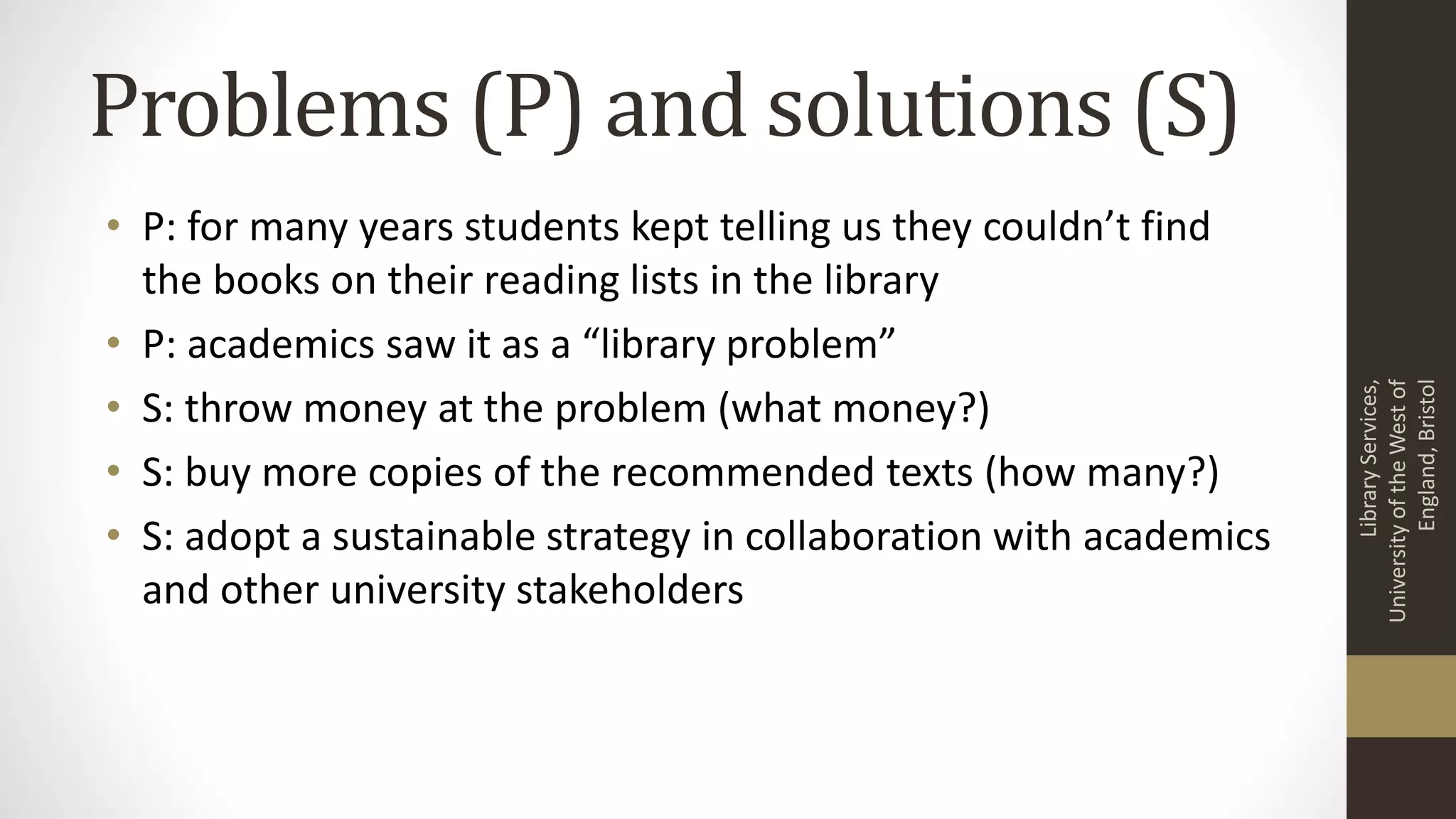
500 into 4 won’t go – re-aligning
“reading strategies” for the
advent of reading list software
Talis Insight Europe 2016
Jackie Chelin, Deputy Director of Library Services
LibraryServices,
UniversityoftheWestof
England,Bristol
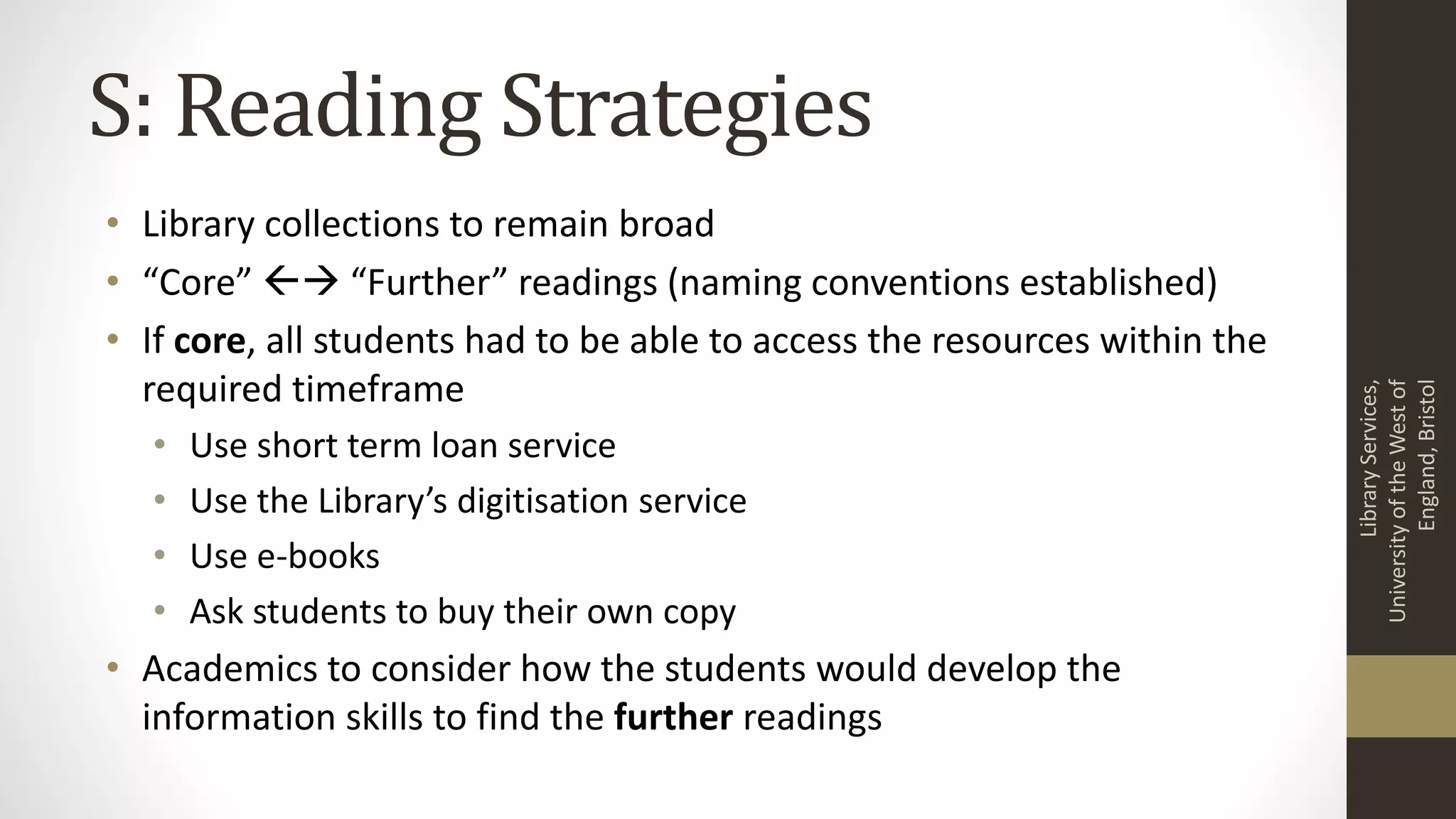
Problems (P) and solutions (S)
• P: for many years students kept telling us they couldn’t find
the books on their reading lists in the library
• P: academics saw it as a “library problem”
• S: throw money at the problem (what money?)
• S: buy more copies of the recommended texts (how many?)
• S: adopt a sustainable strategy in collaboration with academics
and other university stakeholders
LibraryServices,
UniversityoftheWestof
England,Bristol
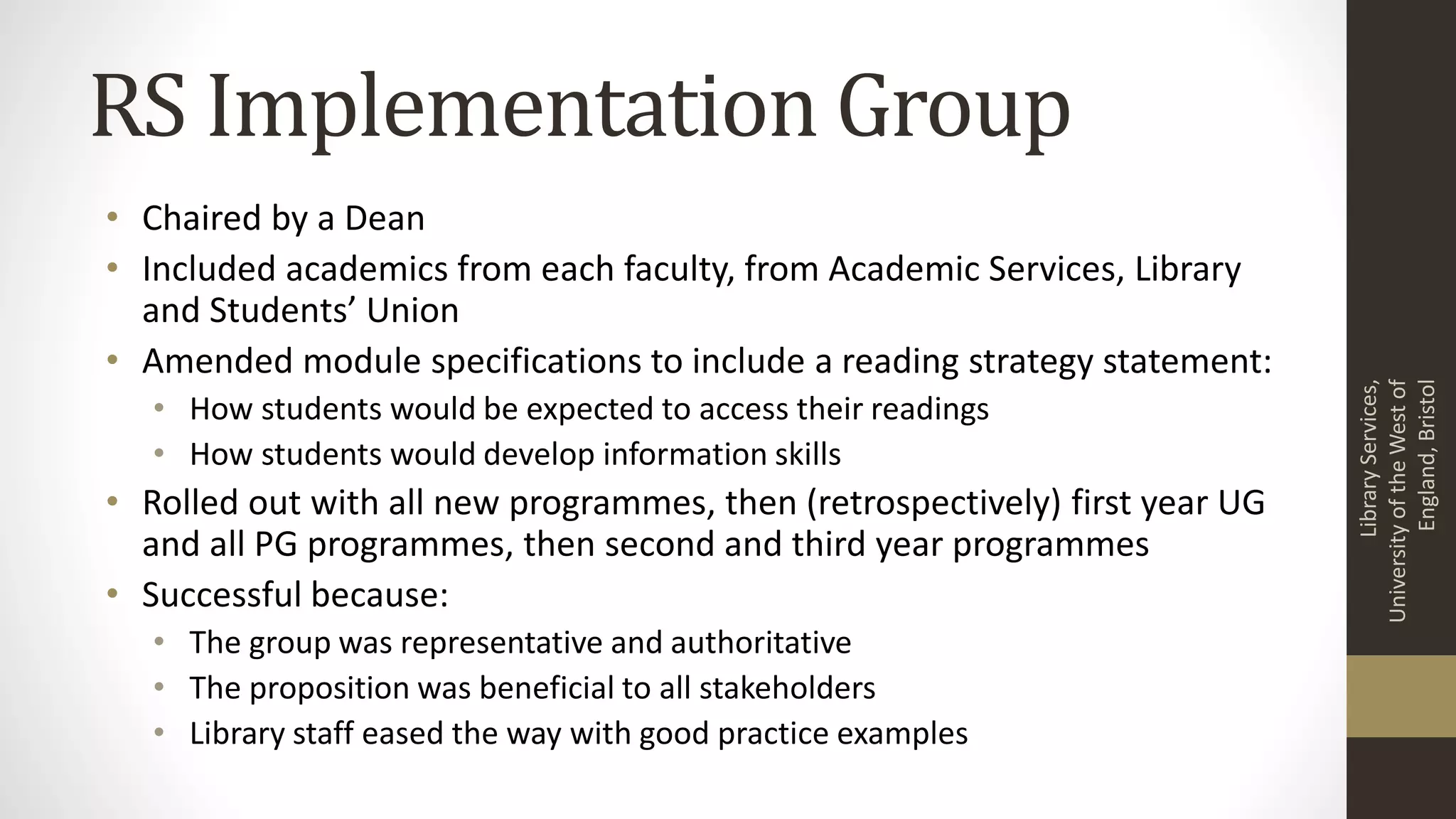
S: Reading Strategies
• Library collections to remain broad
• “Core”  “Further” readings (naming conventions established)
• If core, all students had to be able to access the resources within the
required timeframe
• Use short term loan service
• Use the Library’s digitisation service
• Use e-books
• Ask students to buy their own copy
• Academics to consider how the students would develop the
information skills to find the further readings
LibraryServices,
UniversityoftheWestof
England,Bristol
RS Implementation Group
• Chaired by a Dean
• Included academics from each faculty, from Academic Services, Library
and Students’ Union
• Amended module specifications to include a reading strategy statement:
• How students would be expected to access their readings
• How students would develop information skills
• Rolled out with all new programmes, then (retrospectively) first year UG
and all PG programmes, then second and third year programmes
• Successful because:
• The group was representative and authoritative
• The proposition was beneficial to all stakeholders
• Library staff eased the way with good practice examples
LibraryServices,
UniversityoftheWestof
England,Bristol
S: Reading List Software?
• Felt that software could not solve a cultural problem
• It was not needed to automate a “formula” approach to
purchasing multiple copies (500 into 4 still doesn’t go)
• Academic staff had endured a series of “initiatives”, including
online marking, and were becoming fatigued and cynical
• But, now things have changed…..
LibraryServices,
UniversityoftheWestof
England,Bristol
Developments
• No more short loan collections (“Go digital” library policy)
• Digitisation service improved
• Second extract service; alternative formats for disabled students
(for core readings)
• Many more e-books available (although access is now becoming
more restrictive again for some!)
• SU “hidden costs” campaign
• Library now responsible for wider academic skills support and
development
LibraryServices,
UniversityoftheWestof
England,Bristol
Enhanced Reading List Project
• Various streams
1. Awareness raising (guidelines for a good reading list)
2. Reading list software (currently out to tender)
3. Extend digital provision (different models, incl PDA/EBA)
4. Copyright/licensing considerations (building on CLA licence)
5. Alternative formats development (more effective workflow)
6. Open Educational Resources (pilots with faculties)
• The project reports, overall, to UWE’s Learning, Teaching and Student
Experience Committee
• Challenges include academic staff engagement
(relevance/timing/workload)
• Solutions rely on strong liaison work and librarians present at all
relevant faculty meetings to advocate and support
LibraryServices,
UniversityoftheWestof
England,Bristol
Implementation (1)
• Planning a similar approach to Reading Strategies
• Defining principles of a good reading list - in collaboration with
academic staff
• Working with Academic Services staff to:
• Negotiate changes to module specifications - just include the link
to the reading list (available also to external advisors/examiners)
• Changes to the programme specifications - identify where
academic skills will be developed throughout the three years
(links with learning outcomes and assessment strategies)
LibraryServices,
UniversityoftheWestof
England,Bristol
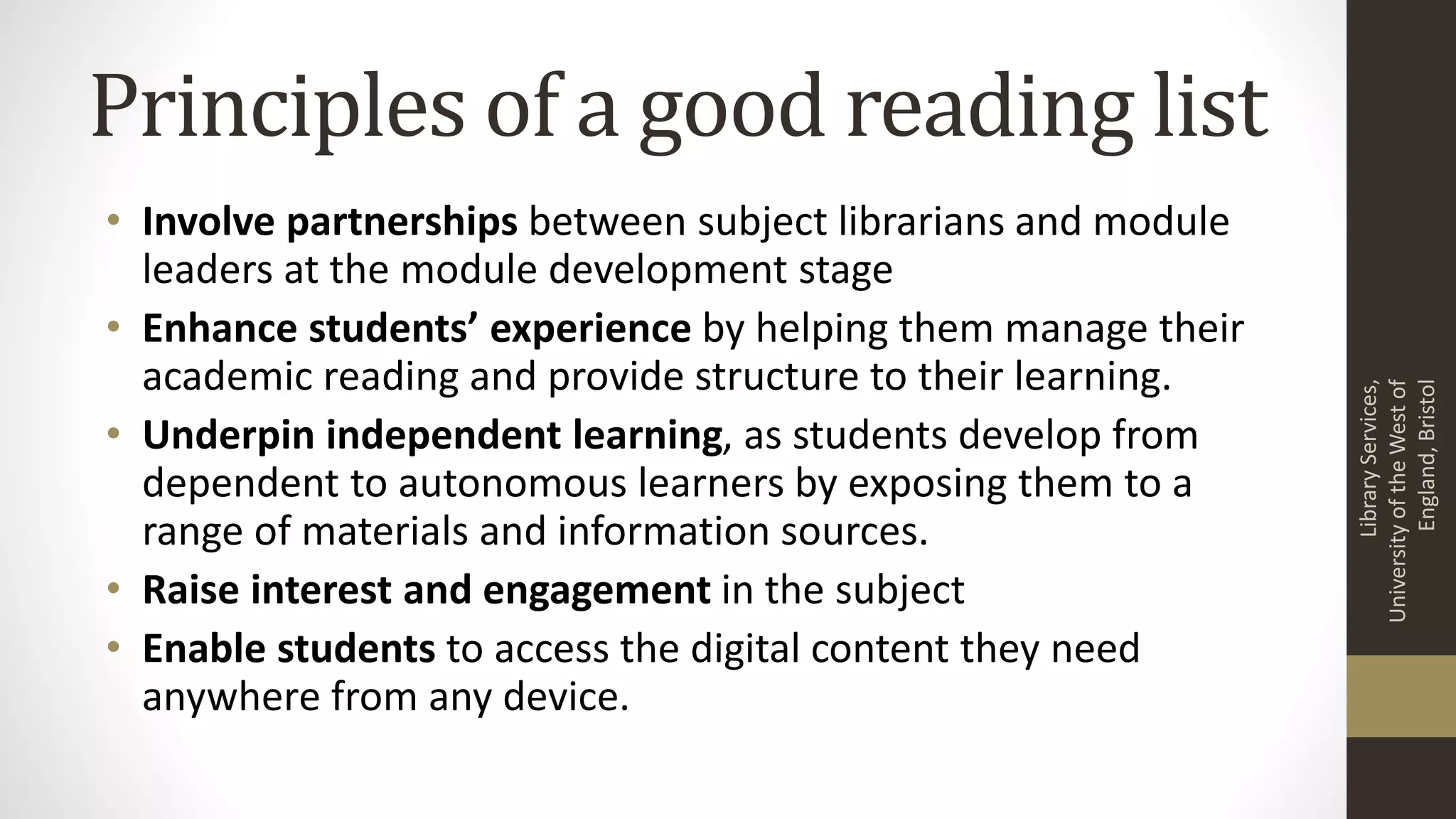
Principles of a good reading list
• Involve partnerships between subject librarians and module
leaders at the module development stage
• Enhance students’ experience by helping them manage their
academic reading and provide structure to their learning.
• Underpin independent learning, as students develop from
dependent to autonomous learners by exposing them to a
range of materials and information sources.
• Raise interest and engagement in the subject
• Enable students to access the digital content they need
anywhere from any device.
LibraryServices,
UniversityoftheWestof
England,Bristol
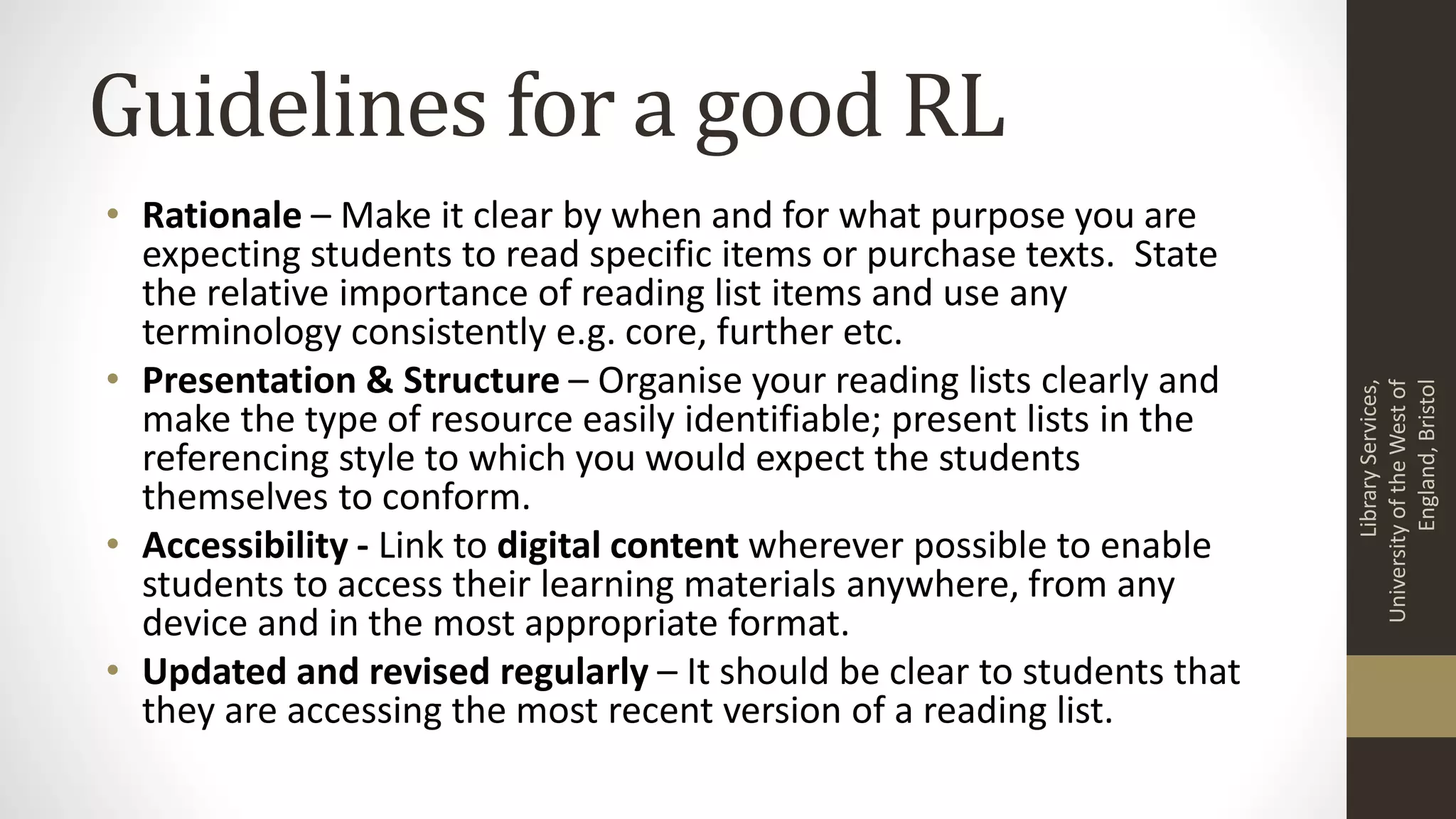
Guidelines for a good RL
• Rationale – Make it clear by when and for what purpose you are
expecting students to read specific items or purchase texts. State
the relative importance of reading list items and use any
terminology consistently e.g. core, further etc.
• Presentation & Structure – Organise your reading lists clearly and
make the type of resource easily identifiable; present lists in the
referencing style to which you would expect the students
themselves to conform.
• Accessibility - Link to digital content wherever possible to enable
students to access their learning materials anywhere, from any
device and in the most appropriate format.
• Updated and revised regularly – It should be clear to students that
they are accessing the most recent version of a reading list.
LibraryServices,
UniversityoftheWestof
England,Bristol
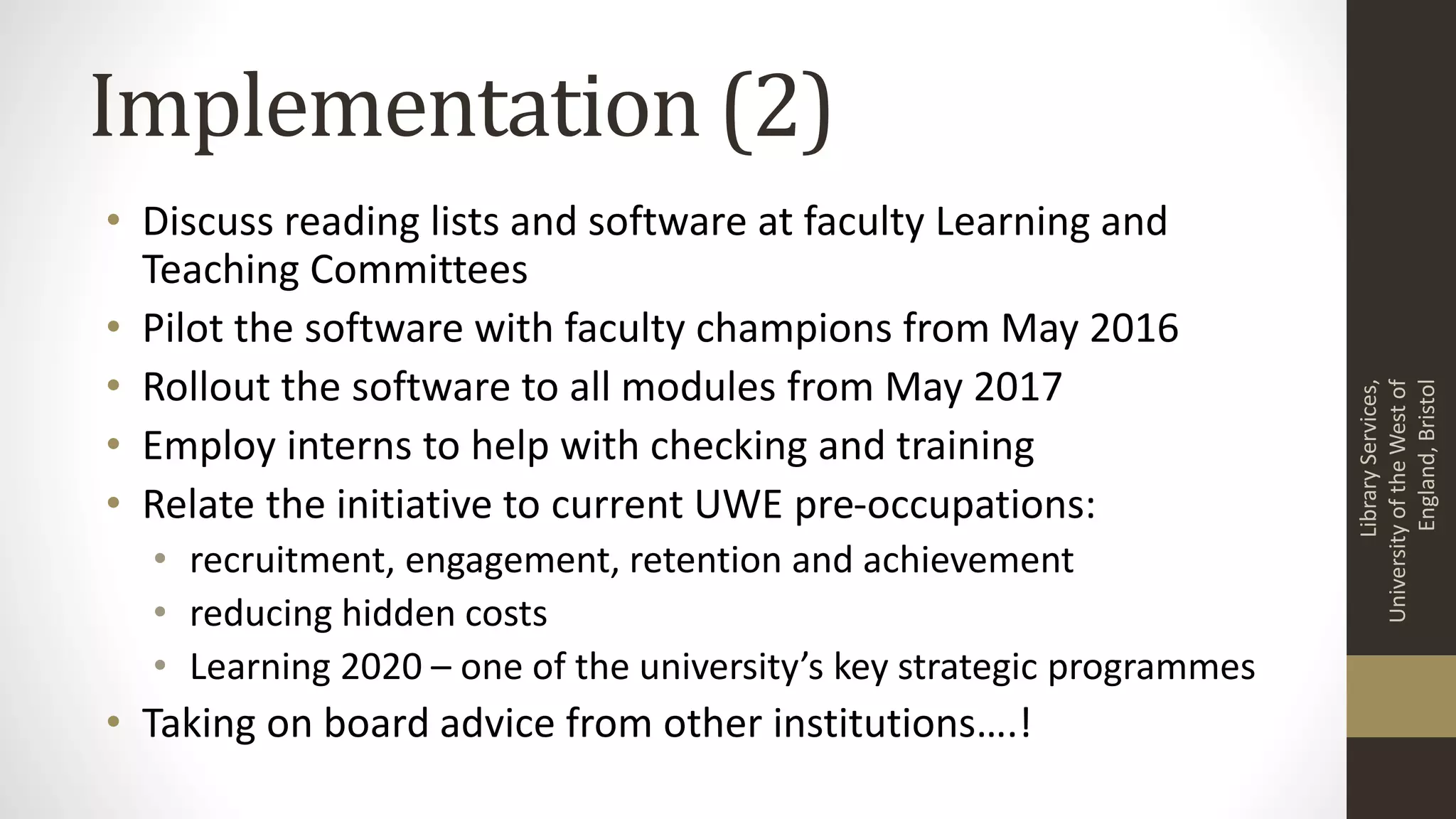
Implementation (2)
• Discuss reading lists and software at faculty Learning and
Teaching Committees
• Pilot the software with faculty champions from May 2016
• Rollout the software to all modules from May 2017
• Employ interns to help with checking and training
• Relate the initiative to current UWE pre-occupations:
• recruitment, engagement, retention and achievement
• reducing hidden costs
• Learning 2020 – one of the university’s key strategic programmes
• Taking on board advice from other institutions….!
LibraryServices,
UniversityoftheWestof
England,Bristol
Many thanks
Any questions/comments/suggestions?
Jacqueline.Chelin@uwe.ac.uk
LibraryServices,
UniversityoftheWestof
England,Bristol
Fact or Fiction : the success of
Reading lists at Teesside
University
Carol Dell-Price
Academic librarian
(Research Support & Bus.Engagement )
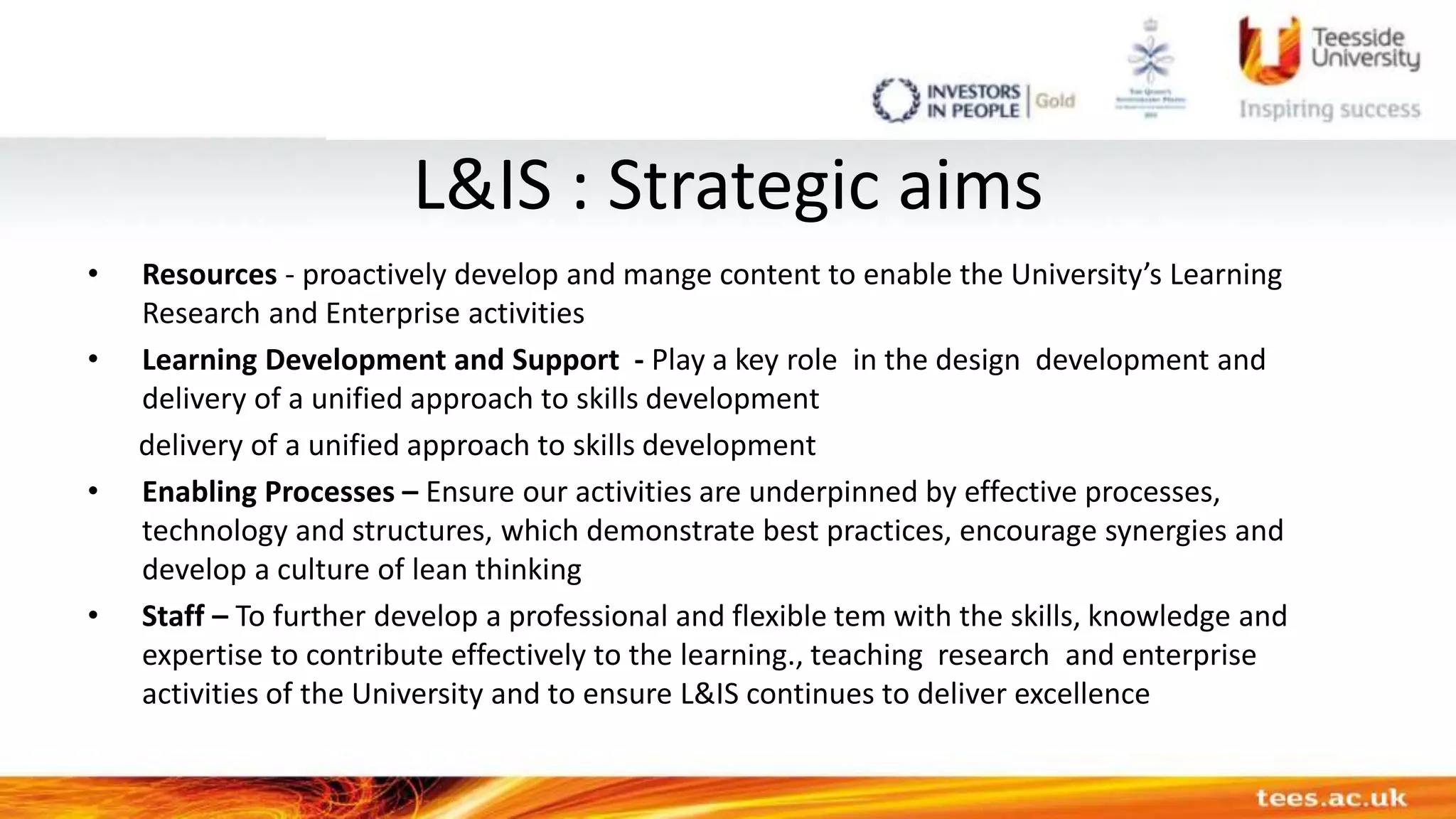
L&IS : Strategic aims
• Resources - proactively develop and mange content to enable the University’s Learning
Research and Enterprise activities
• Learning Development and Support - Play a key role in the design development and
delivery of a unified approach to skills development
• Enabling Processes – Ensure our activities are underpinned by effective processes,
technology and structures, which demonstrate best practices, encourage synergies and
develop a culture of lean thinking
• Staff – To further develop a professional and flexible tem with the skills, knowledge and
expertise to contribute effectively to the learning., teaching research and enterprise
activities of the University and to ensure L&IS continues to deliver excellence
Need for change
• University drive for a better student experience
• Reading lists are a core part of that student
experience
• University Wide Working Group had already
identified need for a new reading list system
Working groups
• Project Tender Group included senior staff from
schools and departments – (pre implementation )
• Advisory Group – members were senior staff across
the University
• Project Management group consisted of L&IS and IT
staff –
Strategic Plan :Key elements
• Rollout : successful launch in September 2014
• Engagement : all staff and students to have seamless
access to up to date reading lists
• Integration : the system worked with our VLE and
our module documentation for approval and review
of programmes
Culture Change
• Must be viewed as a University system
• Very different workflow for LRS team
• Academic staff were given the opportunity to publish
and review from day one
Rollout :Preparing the ground
• We converted approx. 1500 Reading Lists from our
old system
• Tidied up level 4 ( first year UG ) lists
• Organised and publicised group training sessions
Selling the Benefits
Academics
Students
Library
University
Sp
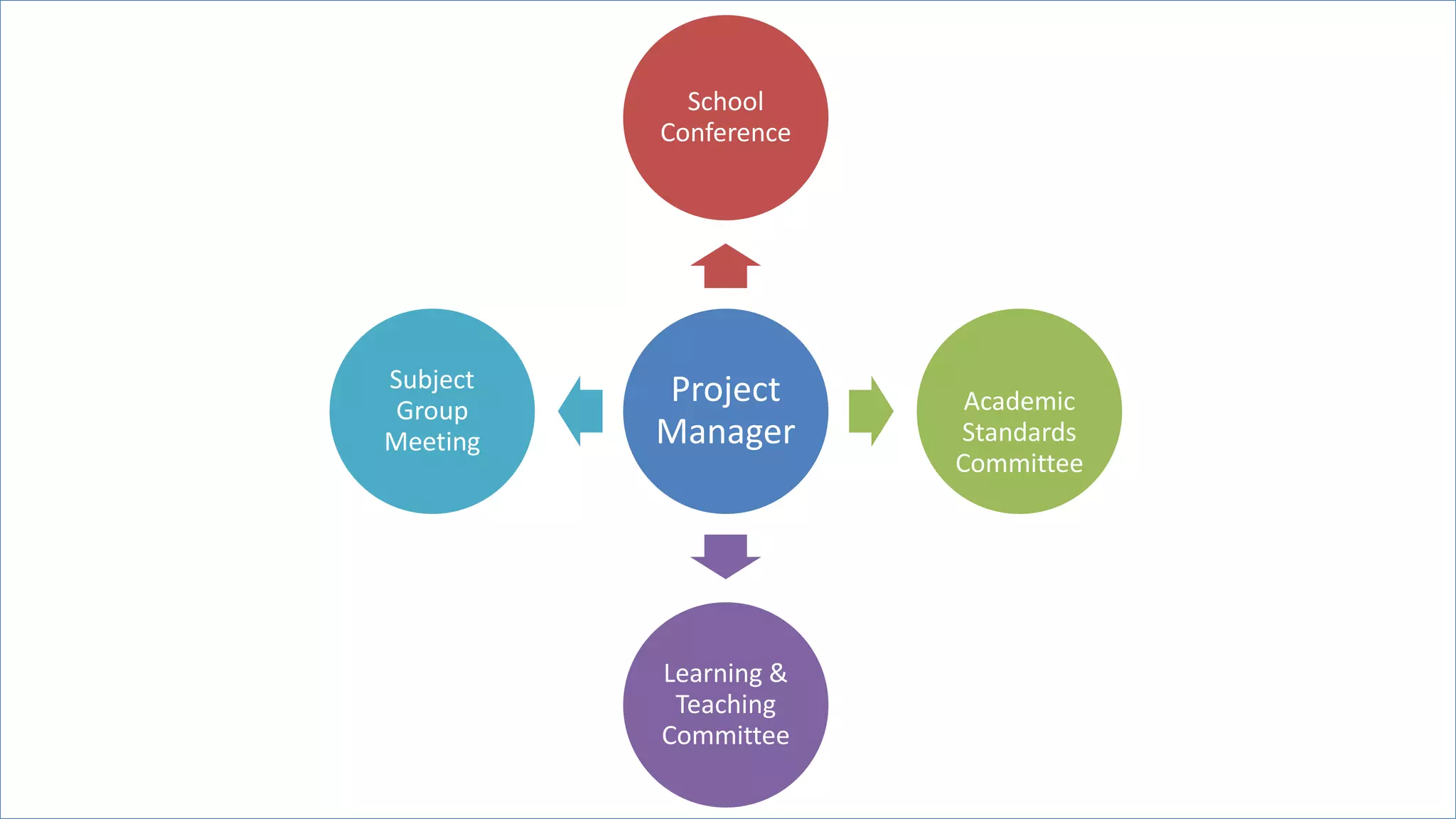
Project
Manager
School
Conference
Academic
Standards
Committee
Learning &
Teaching
Committee
Subject
Group
Meeting
Engagement :academic staff
• Slot at school conferences/away days useful – swap
shop of ideas at one school
• We offered 30 min group training sessions
throughout the first term of the launch
• 1-2-1 training in staff offices most effective
Integration
• Summon
• VLE
• Also linked RLO to module documentation being
submitted for programme approval and review in
the University
Where are we now?
• 51% academic staff now trained in RLO
• 1118 published reading lists currently in the system
• 60% of our budget has been spent by academic staff
using RLO
Lessons learnt
• Rollout :we wouldn’t try to convert old reading list
data
• Engagement : still viewed in some areas as a library
system
• Integration : We would regularly review key
stakeholders in future developments
What’s Next
• Semesterisation
• Customer Account Planning
• Rollover
Video Delivery Partner

Planning to Succeed – Reading Lists strategies - Jackie Chelin and Carol Dell-Price | Talis Insight Europe 2016

  • 1.
  • 2.
    500 into 4won’t go – re-aligning “reading strategies” for the advent of reading list software Talis Insight Europe 2016 Jackie Chelin, Deputy Director of Library Services LibraryServices, UniversityoftheWestof England,Bristol
  • 3.
    Problems (P) andsolutions (S) • P: for many years students kept telling us they couldn’t find the books on their reading lists in the library • P: academics saw it as a “library problem” • S: throw money at the problem (what money?) • S: buy more copies of the recommended texts (how many?) • S: adopt a sustainable strategy in collaboration with academics and other university stakeholders LibraryServices, UniversityoftheWestof England,Bristol
  • 4.
    S: Reading Strategies •Library collections to remain broad • “Core”  “Further” readings (naming conventions established) • If core, all students had to be able to access the resources within the required timeframe • Use short term loan service • Use the Library’s digitisation service • Use e-books • Ask students to buy their own copy • Academics to consider how the students would develop the information skills to find the further readings LibraryServices, UniversityoftheWestof England,Bristol
  • 5.
    RS Implementation Group •Chaired by a Dean • Included academics from each faculty, from Academic Services, Library and Students’ Union • Amended module specifications to include a reading strategy statement: • How students would be expected to access their readings • How students would develop information skills • Rolled out with all new programmes, then (retrospectively) first year UG and all PG programmes, then second and third year programmes • Successful because: • The group was representative and authoritative • The proposition was beneficial to all stakeholders • Library staff eased the way with good practice examples LibraryServices, UniversityoftheWestof England,Bristol
  • 6.
    S: Reading ListSoftware? • Felt that software could not solve a cultural problem • It was not needed to automate a “formula” approach to purchasing multiple copies (500 into 4 still doesn’t go) • Academic staff had endured a series of “initiatives”, including online marking, and were becoming fatigued and cynical • But, now things have changed….. LibraryServices, UniversityoftheWestof England,Bristol
  • 7.
    Developments • No moreshort loan collections (“Go digital” library policy) • Digitisation service improved • Second extract service; alternative formats for disabled students (for core readings) • Many more e-books available (although access is now becoming more restrictive again for some!) • SU “hidden costs” campaign • Library now responsible for wider academic skills support and development LibraryServices, UniversityoftheWestof England,Bristol
  • 8.
    Enhanced Reading ListProject • Various streams 1. Awareness raising (guidelines for a good reading list) 2. Reading list software (currently out to tender) 3. Extend digital provision (different models, incl PDA/EBA) 4. Copyright/licensing considerations (building on CLA licence) 5. Alternative formats development (more effective workflow) 6. Open Educational Resources (pilots with faculties) • The project reports, overall, to UWE’s Learning, Teaching and Student Experience Committee • Challenges include academic staff engagement (relevance/timing/workload) • Solutions rely on strong liaison work and librarians present at all relevant faculty meetings to advocate and support LibraryServices, UniversityoftheWestof England,Bristol
  • 9.
    Implementation (1) • Planninga similar approach to Reading Strategies • Defining principles of a good reading list - in collaboration with academic staff • Working with Academic Services staff to: • Negotiate changes to module specifications - just include the link to the reading list (available also to external advisors/examiners) • Changes to the programme specifications - identify where academic skills will be developed throughout the three years (links with learning outcomes and assessment strategies) LibraryServices, UniversityoftheWestof England,Bristol
  • 10.
    Principles of agood reading list • Involve partnerships between subject librarians and module leaders at the module development stage • Enhance students’ experience by helping them manage their academic reading and provide structure to their learning. • Underpin independent learning, as students develop from dependent to autonomous learners by exposing them to a range of materials and information sources. • Raise interest and engagement in the subject • Enable students to access the digital content they need anywhere from any device. LibraryServices, UniversityoftheWestof England,Bristol
  • 11.
    Guidelines for agood RL • Rationale – Make it clear by when and for what purpose you are expecting students to read specific items or purchase texts. State the relative importance of reading list items and use any terminology consistently e.g. core, further etc. • Presentation & Structure – Organise your reading lists clearly and make the type of resource easily identifiable; present lists in the referencing style to which you would expect the students themselves to conform. • Accessibility - Link to digital content wherever possible to enable students to access their learning materials anywhere, from any device and in the most appropriate format. • Updated and revised regularly – It should be clear to students that they are accessing the most recent version of a reading list. LibraryServices, UniversityoftheWestof England,Bristol
  • 12.
    Implementation (2) • Discussreading lists and software at faculty Learning and Teaching Committees • Pilot the software with faculty champions from May 2016 • Rollout the software to all modules from May 2017 • Employ interns to help with checking and training • Relate the initiative to current UWE pre-occupations: • recruitment, engagement, retention and achievement • reducing hidden costs • Learning 2020 – one of the university’s key strategic programmes • Taking on board advice from other institutions….! LibraryServices, UniversityoftheWestof England,Bristol
  • 13.
  • 14.
    Fact or Fiction: the success of Reading lists at Teesside University Carol Dell-Price Academic librarian (Research Support & Bus.Engagement )
  • 15.
    L&IS : Strategicaims • Resources - proactively develop and mange content to enable the University’s Learning Research and Enterprise activities • Learning Development and Support - Play a key role in the design development and delivery of a unified approach to skills development delivery of a unified approach to skills development • Enabling Processes – Ensure our activities are underpinned by effective processes, technology and structures, which demonstrate best practices, encourage synergies and develop a culture of lean thinking • Staff – To further develop a professional and flexible tem with the skills, knowledge and expertise to contribute effectively to the learning., teaching research and enterprise activities of the University and to ensure L&IS continues to deliver excellence
  • 16.
    Need for change •University drive for a better student experience • Reading lists are a core part of that student experience • University Wide Working Group had already identified need for a new reading list system
  • 17.
    Working groups • ProjectTender Group included senior staff from schools and departments – (pre implementation ) • Advisory Group – members were senior staff across the University • Project Management group consisted of L&IS and IT staff –
  • 18.
    Strategic Plan :Keyelements • Rollout : successful launch in September 2014 • Engagement : all staff and students to have seamless access to up to date reading lists • Integration : the system worked with our VLE and our module documentation for approval and review of programmes
  • 19.
    Culture Change • Mustbe viewed as a University system • Very different workflow for LRS team • Academic staff were given the opportunity to publish and review from day one
  • 20.
    Rollout :Preparing theground • We converted approx. 1500 Reading Lists from our old system • Tidied up level 4 ( first year UG ) lists • Organised and publicised group training sessions
  • 21.
  • 22.
  • 23.
    Engagement :academic staff •Slot at school conferences/away days useful – swap shop of ideas at one school • We offered 30 min group training sessions throughout the first term of the launch • 1-2-1 training in staff offices most effective
  • 24.
    Integration • Summon • VLE •Also linked RLO to module documentation being submitted for programme approval and review in the University
  • 25.
    Where are wenow? • 51% academic staff now trained in RLO • 1118 published reading lists currently in the system • 60% of our budget has been spent by academic staff using RLO
  • 26.
    Lessons learnt • Rollout:we wouldn’t try to convert old reading list data • Engagement : still viewed in some areas as a library system • Integration : We would regularly review key stakeholders in future developments
  • 27.
    What’s Next • Semesterisation •Customer Account Planning • Rollover
  • 28.

Editor's Notes

  • #17 These are our strategic aims ( lightly abbreviated ) which map directly onto the University strategy Important to remember that when introducing and asking to pay for any new system or resource we must be able to demonstrate we are meeting these strategic aims
  • #18 Buy in from the top is extremely important and cannot be underestimated. Being able to find and locate resources for your programme is a fundamental part of student achievement Directly linked to a successful learning and teaching experience and strategy We only received 30% of reading lists for updating Potentially 3 different versions of a reading list were available for staff and students to use……
  • #19 Very important to have a range of staff at different stages of the project We were praised for our project management skills for RLO and another department asked us to advise them on how we did it ( Use of Project Initiation Documentation (PID )
  • #20 The move to TalisAspire represented a real change in the way we would purchase our resources and manage and develop the collection, for both Library staff and for teaching staff
  • #21 We went for the big bang approach and wanted academics to have control and publish their own lists from the very beginning Doesn’t meant to say we haven’t created any reading lists for academic staff but the message has been that they are their lists not ours. Important to reassure colleagues that the library budget would not be spent in a day Make sure your purchasing guideline as are in place and available for everyone to see This was a major change in both the culture and working roles of library staff. Make sure they are supported through the changes and understand the process from start to finish Queries from Deans about budget being spent within the first 2 weeks of term - gave reassurance around formulas we already had in place L&IS already had a good relationship and profile in the University…successful academic skills programme..we were trusted but also heavily relied upon to do enormous amount of checking of lists and resources – reading lists online presented a good opportunity to change this
  • #22 Clean Up: almost 1500 lists to be carried over into Talis Aspire – this is quite a complex job and I am not sure we would do it again. Tim from TalisAspire was extremely helpful and it was very good PR to be able to say we were starting off with something already in the system. But it took a lot more time and effort than we ever anticipated. We would have a much harder look at the quality of our data if we were to do it again. 2. Although our approach was to give academics the rights to create and publish from the beginning we started by tidying up level 4 ( first year Undergraduate) lists ourselves 3. It is a University product and NOT a Library system – we said this a lot ! Branding: Choose a clear design (we used the university colours & styling - It needs to look good in your VLE as this is how most students will access their reading lists
  • #23  We promoted it to staff in the following way : Academics: Organised in a way that matches your teaching Not starting from scratch. We have rolled over 1500 lists which were already in the system Create Manage Maintain lists online Dashboard - You take ownership and you can view usage and evaluate how students are engaging with the resources Allows you to find and collect resources and provides a simple means of building reading lists and sharing these with the students Students: Easy online access via Bb Wider range of resources available, e.g. YouTube Lists more up to date (we had a poor response rate to our email requests for updates) Personalisation option Improve student satisfaction & experience of accessing resources (NSS) Library: Changes to workflow LRS will be trainers & list reviewers not list creators/managers Training – we will have a test system with sample reading lists and training will be done in a range of ways – drop in workshops, face to face, in your office, within the subject group . Each school may have different needs University Module documentation ie UTReg forms – creation of the indicative resources will be copied from RLO. Big change to the way things are done now One central point for creating, managing & accessing lists Value for money – linking with the new Discovery system
  • #24 Advisory Group were key to making sure our strategy aligned with University aims and objectives ie re rollout time / communication academic engagement /budget formulas etc but we need to constantly make sure the detail of the strategy is being communicated/facilitated at operational level throughout a range of University and school forums . Take up of the system will not happen if you don’t tell people about it Academic librarians play an important role in this ………..be honest and realistic in your expectations…academics have many other pressures being placed upon them. Success due to als aready being embedded into school practice and policy Reading list Online Development Group meets monthly to deal with the ongoing detail and development of the system
  • #25 If library staff don’t have this involvement and confidence in the system then all queries come back to the project manager and the workload can’t be managed Even with a set script and examples group sessions were more difficult to deliver (as soon as an academic locates their own list they want to get on with that ) We did see 150 staff in the first 6 weeks Offering 1-2-1 support in their own office is much more productive We spent a lot of time thinking about promotional materials. To be honest just choose something and get on with it !. We had mugs and coasters but in hindsight merchandise is just not that important - coffee and biscuits are probably more useful Also this is a change in culture and needs to be managed well
  • #26 VLE :This was a reasonably straightforward process and will drive the need for Reading Lists Online (RLO) from students – who are our best advocates Module Documentation: Very challenging and still has some teething problems but is a significant step forward and has really raised the profile of L&IS and RLO Example .. Andrew Cree - long list MA HRM review….students really understood how he was using the list despite it being very long Linked to Summon
  • #27 51% - We trained a lot of staff in the first few months of having the system but we also wanted them to go away and use it…attendance isn’t the same as engagement 1118 published lists – many more in draft 60%- One of the concerns raised by academic staff was that too much money would be spent ‘in one go’ if they could publish and review rather than us controlling the budget singlehandedly But we had clear purchasing guidelines and procedures to deal with this and we knew it wasn’t an issue
  • #28 Rollout: Our old data just wasn’t good enough…would a clean slate have been better…almost jeopardised our launch date Engagement Be prepared to go and tell your story numerous times to everyone who will be involved in using it – ie committees and other groups . – and be prepared to answer questions!! Use the ‘give me 5/10 minute rule’. If you want to get onto busy agendas you need to make it short and simple – Not necessary to give too much detail at the beginning – explain the timescales and the key changes which will be taking place and give reassurances of support Give it a name from the beginning and stick to it. Ours is Reading Lists Online and is now commonly referred to as RLO – helps if it explains what it actually does It is a University product and NOT a Library system..we said this at every opportunity we had Benefits ! benefit !benefits! –we sold it at every opportunity – see following slide Integration We spent a lot of time thinking about academics and students but didn’t always consider school support staff who are key to many of the processes working and being successfully implemented.
  • #29 Move to Semesterisation by the university will test our integration of RLO with University systems and documentation We have an annual Customer Account Planning document which is presented to School Deans and gives details on all the activities and services which L&IS and the subject team have delivered to staff and students in their school. This has been discussed with 2 schools already and because there is a section on Reading lists senior management in both schools have made Reading list engagement an action point to be addressed To ‘publish’ or to draft;