Talking about Open Access: 
SMASH and Subtler Tactics 
Jill Cirasella 
The Graduate Center, CUNY 
jcirasella@gc.cuny.edu 
Open Access Week 2014 
Slides at: http://tinyurl.com/OASMASH
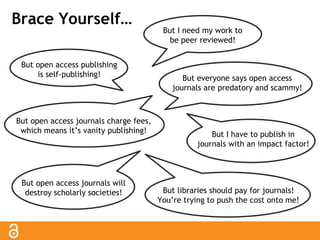
Brace Yourself… 
But open access publishing 
is self-publishing! 
But open access journals charge fees, 
which means it’s vanity publishing! 
But I need my work to 
be peer reviewed! 
But everyone says open access 
journals are predatory and scammy! 
But I have to publish in 
journals with an impact factor! 
But open access journals will 
destroy scholarly societies! But libraries should pay for journals! 
You’re trying to push the cost onto me!
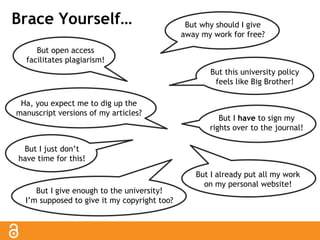
Brace Yourself… But why should I give 
away my work for free? 
But this university policy 
feels like Big Brother! 
But open access 
facilitates plagiarism! 
But I give enough to the university! 
I’m supposed to give it my copyright too? 
But I have to sign my 
rights over to the journal! 
But I just don’t 
have time for this! 
But I already put all my work 
on my personal website! 
Ha, you expect me to dig up the 
manuscript versions of my articles?
Brace Yourself… 
And my all-time favorite…
Brace Yourself… 
You’re espousing 
Venezuelan economics!* 
* Yes, someone really did counter my open access arguments with that!
Why Open Access? 
An Argument in Three Slides
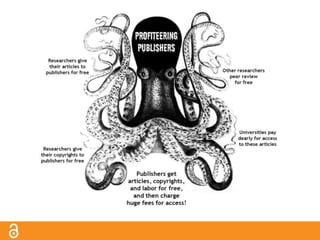
Me
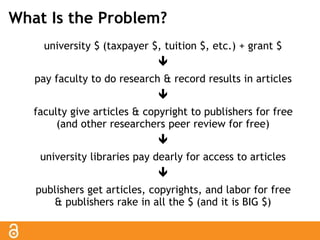
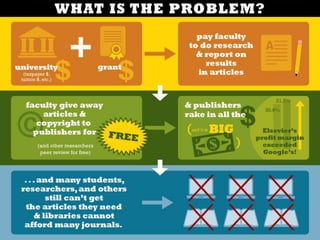
What Is the Problem? 
university $ (taxpayer $, tuition $, etc.) + grant $ 
 
pay faculty to do research & record results in articles 
 
faculty give articles & copyright to publishers for free 
(and other researchers peer review for free) 
 
university libraries pay dearly for access to articles 
 
publishers get articles, copyrights, and labor for free 
& publishers rake in all the $ (and it is BIG $)
Me + Flickr
Me + Designer
Open Access Made It Better 
Better content. 
Better for you. 
Better for me.
Open Access Makes It Better 
For whom? 
For what? 
How?
Who Benefits from OA? 
Readers: 
More content is available to everyone, regardless of 
institutional affiliation or ability to pay 
Students: 
Students have access to the literature they need to 
master their fields, no matter what college/university 
they attend
Who Else Benefits? 
Authors: 
Increased availability 
 More readers 
 More scholarly citations, impact in the field 
Easy to link to 
 More mentions/links in news, blogs, etc. 
 Broader awareness in the world 
Greater control over own work 
 No need to relinquish copyright to publishers 
 Publishers don't dictate copying, sharing, etc.
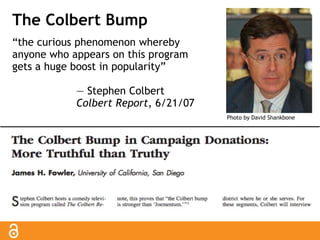
The Colbert Bump 
“the curious phenomenon whereby 
anyone who appears on this program 
gets a huge boost in popularity” 
— Stephen Colbert 
Colbert Report, 6/21/07 
Photo by David Shankbone
The Open Access Bump 
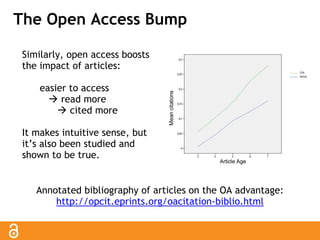
Similarly, open access boosts 
the impact of articles: 
easier to access 
 read more 
 cited more 
It makes intuitive sense, but 
it’s also been studied and 
shown to be true. 
Annotated bibliography of articles on the OA advantage: 
http://opcit.eprints.org/oacitation-biblio.html
What Benefits from OA? 
Libraries: 
As OA becomes increasingly prevalent, libraries will be 
no longer be hamstrung by astronomical journal prices. 
Institutions: 
Institutions no longer pay twice for research: 
researchers’ salaries + journal subscriptions 
In the case of public institutions, the tax-paying public 
no longer pays three times for research: 
salaries + research grants + journal subscriptions
What Else Benefits? 
Fields of Study: 
Greater access to information 
 More informed research 
 Better research 
Articles made OA before they appear in journal 
 Ends reliance on journal publication cycles 
 Allows others to respond more quickly 
 Speeds innovation
And What Else? 
The Public: 
Greater access to information 
 Better informed doctors, teachers, journalists, etc. 
 Better informed individuals, voters, etc. 
 Healthier, better educated people 
 A cleaner, safer, more evidence-based world
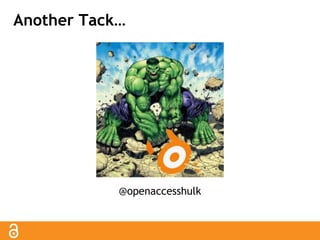
Another Tack… 
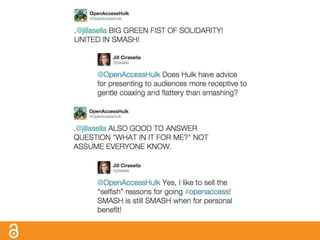
@openaccesshulk
SMASH! 
“Closed access means people die.” 
— Peter Murray-Rust, University of Cambridge 
Read more at: 
http://blogs.ch.cam.ac.uk/pmr/2011/10/23/ 
open-research-reports-what-jenny-and-i-said-and-why-i-am-angry/
SMASH? 
“Elsevier disseminates and preserves 
STM literature to meet the information needs 
of the world’s present and future scientists 
and clinicians — linking thinkers with ideas.” 
from Elsevier’s Mission Statement 
http://www.elsevier.com/about/mission
SMASH! 
“Elsevier disseminates and preserves 
STM literature to meet the information needs 
of the world’s present and future scientists 
and clinicians — linking thinkers with ideas.” 
from Elsevier’s Mission Statement 
http://www.elsevier.com/about/mission
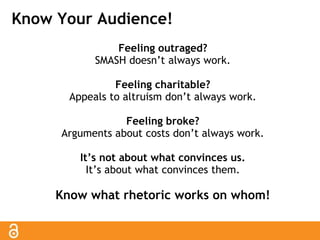
Know Your Audience! 
Feeling outraged? 
SMASH doesn’t always work. 
Feeling charitable? 
Appeals to altruism don’t always work. 
Feeling broke? 
Arguments about costs don’t always work. 
It’s not about what convinces us. 
It’s about what convinces them. 
Know what rhetoric works on whom!
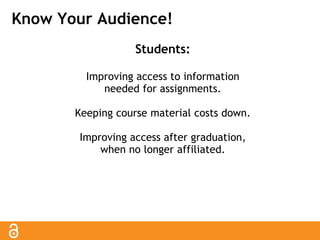
Know Your Audience! 
Students: 
Improving access to information 
needed for assignments. 
Keeping course material costs down. 
Improving access after graduation, 
when no longer affiliated.
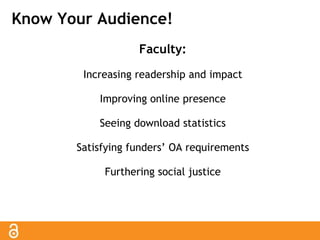
Know Your Audience! 
Faculty: 
Increasing readership and impact 
Improving online presence 
Seeing download statistics 
Satisfying funders’ OA requirements 
Furthering social justice
Know Your Audience! 
Librarians: 
Tackling the cost crisis 
Improving access & services 
Ensuring ongoing relevance of librarians 
OA is no longer a niche — it’s a necessity!
Know Your Audience! 
Administrators: 
Maximizing institution’s visibility, prestige, etc. 
Better achieving institution’s mission 
Collecting and quantifying scholarly output 
Assessment! Metrics! Widgets! 
Cost savings, eventually…
Know Your Audience! 
Administrators: 
Open access institutional repositories can “serve 
as tangible indicators of a university’s quality” 
and “demonstrate the scientific, societal, and 
economic relevance of its research activities, 
thus increasing the institution’s visibility, 
status, and public value.” 
— Raym Crow, “The Case for Institutional 
Repositories: A SPARC Position Paper” 
http://scholarship.utm.edu/20/
Know Your Audience! 
Lawmakers: 
Taxpayer access to tax-funded research 
Demonstrating value of tax dollars 
Promoting innovation
Know Your Audience! 
Revolutionaries: 
Access to information 
Educational opportunity 
Empowerment & equality 
Retaining rights to one’s own work 
Stopping profiteering off unpaid labor
Know Your Audience! 
Traditionalists: 
Ensuring legacy 
Increasing impact 
Becoming a public intellectual
Know Your Audience! 
“Blah blah open access blah blah.” 
Learn to talk about open access 
without constantly saying “open access”! 
There is a Far Side cartoon that perfectly 
suits this slide. But Gary Larson dislikes 
online sharing and likes cease-and-desist 
letters. And it’s hard to say what counts 
as fair use when you’re dealing with a 
two-panel cartoon. So you don’t get to 
see it. Gary Larson wants to you go buy a 
book instead. If you could see this 
cartoon, maybe you would. But since you 
can’t, you probably won’t. 
Well under 10% 
of the cartoon
Know Your Audience! 
Sneak open access into related conversations: 
• Retaining rights to one’s own work 
• Exploring the future of scholarly communication 
• Updating tenure & promotion practices 
• Improving peer review 
• Rethinking indicators of quality 
• Modernizing the university press 
• Accelerating scientific discoveries 
• Abandoning unnecessary vestiges of print publishing 
• Reimagining the basic unit of scholarship 
• Linking publications to associated data 
• Allowing for multi-modal and interactive scholarship
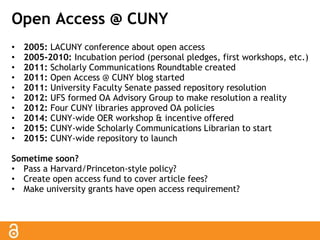
Open Access @ CUNY 
• 2005: LACUNY conference about open access 
• 2005-2010: Incubation period (personal pledges, first workshops, etc.) 
• 2011: Scholarly Communications Roundtable created 
• 2011: Open Access @ CUNY blog started 
• 2011: University Faculty Senate passed repository resolution 
• 2012: UFS formed OA Advisory Group to make resolution a reality 
• 2012: Four CUNY libraries approved OA policies 
• 2014: CUNY-wide OER workshop & incentive offered 
• 2015: CUNY-wide Scholarly Communications Librarian to start 
• 2015: CUNY-wide repository to launch 
Sometime soon? 
• Pass a Harvard/Princeton-style policy? 
• Create open access fund to cover article fees? 
• Make university grants have open access requirement?
Open Access @ CUNY 
• 2005: LACUNY conference about open access 
• 2005-2010: Incubation period (personal pledges, first workshops, etc.) 
• 2011: Scholarly Communications Roundtable created 
• 2011: Open Access @ CUNY blog started 
• 2011: University Faculty Senate passed repository resolution 
• 2012: UFS forms OA Advisory Group to make resolution a reality 
• 2012: Four libraries approve OA policies 
• 2014: CUNY-wide OER workshop & incentive offered 
• 2015: CUNY-wide Scholarly Communications Librarian to start 
• 2015: CUNY-wide repository to launch 
Sometime soon? 
• Pass a Harvard/Princeton-style policy? 
• Create open access fund to cover article fees? 
• Make university grants have open access requirement?
Open Access @ CUNY 
• 2005: LACUNY conference about open access 
• 2005-2010: Incubation period (personal pledges, first workshops, etc.) 
• 2011: Scholarly Communications Roundtable created 
• 2011: Open Access @ CUNY blog started 
• 2011: University Faculty Senate passed repository resolution 
• 2012: UFS forms OA Advisory Group to make resolution a reality 
• 2012: Four libraries approve OA policies 
• 2014: CUNY-wide OER workshop & incentive offered 
• 2015: CUNY-wide Scholarly Communications Librarian to start 
• 2015: CUNY-wide repository to launch 
Sometime soon? 
• Pass a Harvard/Princeton-style policy? 
• Create open access fund to cover article fees? 
• Make university grants have open access requirement?
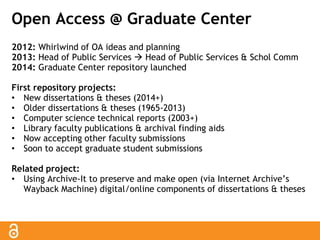
Open Access @ Graduate Center 
2012: Whirlwind of OA ideas and planning 
2013: Head of Public Services  Head of Public Services & Schol Comm 
2014: Graduate Center repository launched 
First repository projects: 
• New dissertations & theses (2014+) 
• Older dissertations & theses (1965-2013) 
• Computer science technical reports (2003+) 
• Library faculty publications & archival finding aids 
• Now accepting other faculty submissions 
• Soon to accept graduate student submissions 
Related project: 
• Using Archive-It to preserve and make open (via Internet Archive’s 
Wayback Machine) digital/online components of dissertations & theses
Open Access @ Graduate Center 
2012: Whirlwind of OA ideas and planning 
2013: Head of Public Services  Head of Public Services & Schol Comm 
2014: Graduate Center repository launched 
First repository projects: 
• New dissertations & theses (2014+) 
• Older dissertations & theses (1965-2013) 
• Computer science technical reports (2001+) 
• Archival finding aids 
• Now ready for faculty self-submissions 
• Soon: Graduate student self-submission 
Related project: 
• Using Archive-It to preserve and make open (via Internet Archive’s 
Wayback Machine) digital/online components of dissertations & theses
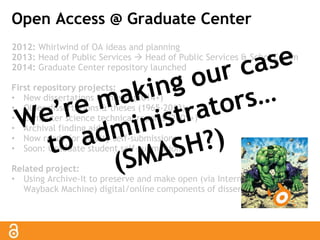
Open Access @ Graduate Center 
2012: Whirlwind of OA ideas and planning 
2013: Head of Public Services  Head of Public Services & Schol Comm 
2014: Graduate Center repository launched 
First repository projects: 
• New dissertations & theses (2014+) 
• Older dissertations & theses (1965-2013) 
• Computer science technical reports (2001+) 
• Archival finding aids 
• Now ready for faculty self-submissions 
• Soon: Graduate student self-submission 
Related project: 
• Using Archive-It to preserve and make open (via Internet Archive’s 
Wayback Machine) digital/online components of dissertations & theses
Open Access @ Graduate Center 
2012: Whirlwind of OA ideas and planning 
2013: Head of Public Services  Head of Public Services & Schol Comm 
2014: Graduate Center repository launched 
First repository projects: 
• New dissertations & theses (2014+) 
• Older dissertations & theses (1965-2013) 
• Computer science technical reports (2001+) 
• Archival finding aids 
• Now ready for faculty self-submissions 
• Soon: Graduate student self-submission 
Related project: 
• Using Archive-It to preserve and make open (via Internet Archive’s 
Wayback Machine) digital/online components of dissertations & theses
Credits 
This slideshow is licensed under a 
Creative Commons Attribution 3.0 Unported License. 
Specific graphics may have different licenses: 
“What Is the Problem?” graphic, 
content by Jill Cirasella / graphic design by Les LaRue, http://www.leslarue.com/, 
licensed under a Creative Commons Attribution-ShareAlike 3.0 Unported License 
Octopus image is adapted from 
http://www.flickr.com/photos/luca-beanone-barcellona/4776886666/ 
Open access advantage graph from Gargouri Y, Hajjem C, Larivière V, Gingras Y, et al. 
http://www.plosone.org/article/info:doi/10.1371/journal.pone.0013636 
Open Access Hulk image from https://twitter.com/openaccesshulk 
“What We Say To Dogs / What They Hear” Far Side cartoon by Gary Larson 
Stephen Colbert photo by David Shankbone 
http://commons.wikimedia.org/wiki/File:Stephen_Colbert_2_by_David_Shankbone.jpg
Thank you! 
Questions? 
Jill Cirasella 
jcirasella@gc.cuny.edu 
Slides 
http://tinyurl.com/OASMASH 
Open Access @ CUNY blog 
http://openaccess.commons.gc.cuny.edu/

Talking about Open Access: SMASH and Subtler Tactics

  • 1.
    Talking about OpenAccess: SMASH and Subtler Tactics Jill Cirasella The Graduate Center, CUNY jcirasella@gc.cuny.edu Open Access Week 2014 Slides at: http://tinyurl.com/OASMASH
  • 2.
    Brace Yourself… Butopen access publishing is self-publishing! But open access journals charge fees, which means it’s vanity publishing! But I need my work to be peer reviewed! But everyone says open access journals are predatory and scammy! But I have to publish in journals with an impact factor! But open access journals will destroy scholarly societies! But libraries should pay for journals! You’re trying to push the cost onto me!
  • 3.
    Brace Yourself… Butwhy should I give away my work for free? But this university policy feels like Big Brother! But open access facilitates plagiarism! But I give enough to the university! I’m supposed to give it my copyright too? But I have to sign my rights over to the journal! But I just don’t have time for this! But I already put all my work on my personal website! Ha, you expect me to dig up the manuscript versions of my articles?
  • 4.
    Brace Yourself… Andmy all-time favorite…
  • 5.
    Brace Yourself… You’reespousing Venezuelan economics!* * Yes, someone really did counter my open access arguments with that!
  • 6.
    Why Open Access? An Argument in Three Slides
  • 7.
  • 8.
    What Is theProblem? university $ (taxpayer $, tuition $, etc.) + grant $  pay faculty to do research & record results in articles  faculty give articles & copyright to publishers for free (and other researchers peer review for free)  university libraries pay dearly for access to articles  publishers get articles, copyrights, and labor for free & publishers rake in all the $ (and it is BIG $)
  • 9.
  • 11.
  • 13.
    Open Access MadeIt Better Better content. Better for you. Better for me.
  • 14.
    Open Access MakesIt Better For whom? For what? How?
  • 15.
    Who Benefits fromOA? Readers: More content is available to everyone, regardless of institutional affiliation or ability to pay Students: Students have access to the literature they need to master their fields, no matter what college/university they attend
  • 16.
    Who Else Benefits? Authors: Increased availability  More readers  More scholarly citations, impact in the field Easy to link to  More mentions/links in news, blogs, etc.  Broader awareness in the world Greater control over own work  No need to relinquish copyright to publishers  Publishers don't dictate copying, sharing, etc.
  • 17.
    The Colbert Bump “the curious phenomenon whereby anyone who appears on this program gets a huge boost in popularity” — Stephen Colbert Colbert Report, 6/21/07 Photo by David Shankbone
  • 18.
    The Open AccessBump Similarly, open access boosts the impact of articles: easier to access  read more  cited more It makes intuitive sense, but it’s also been studied and shown to be true. Annotated bibliography of articles on the OA advantage: http://opcit.eprints.org/oacitation-biblio.html
  • 19.
    What Benefits fromOA? Libraries: As OA becomes increasingly prevalent, libraries will be no longer be hamstrung by astronomical journal prices. Institutions: Institutions no longer pay twice for research: researchers’ salaries + journal subscriptions In the case of public institutions, the tax-paying public no longer pays three times for research: salaries + research grants + journal subscriptions
  • 20.
    What Else Benefits? Fields of Study: Greater access to information  More informed research  Better research Articles made OA before they appear in journal  Ends reliance on journal publication cycles  Allows others to respond more quickly  Speeds innovation
  • 21.
    And What Else? The Public: Greater access to information  Better informed doctors, teachers, journalists, etc.  Better informed individuals, voters, etc.  Healthier, better educated people  A cleaner, safer, more evidence-based world
  • 22.
  • 23.
    SMASH! “Closed accessmeans people die.” — Peter Murray-Rust, University of Cambridge Read more at: http://blogs.ch.cam.ac.uk/pmr/2011/10/23/ open-research-reports-what-jenny-and-i-said-and-why-i-am-angry/
  • 24.
    SMASH? “Elsevier disseminatesand preserves STM literature to meet the information needs of the world’s present and future scientists and clinicians — linking thinkers with ideas.” from Elsevier’s Mission Statement http://www.elsevier.com/about/mission
  • 25.
    SMASH! “Elsevier disseminatesand preserves STM literature to meet the information needs of the world’s present and future scientists and clinicians — linking thinkers with ideas.” from Elsevier’s Mission Statement http://www.elsevier.com/about/mission
  • 27.
    Know Your Audience! Feeling outraged? SMASH doesn’t always work. Feeling charitable? Appeals to altruism don’t always work. Feeling broke? Arguments about costs don’t always work. It’s not about what convinces us. It’s about what convinces them. Know what rhetoric works on whom!
  • 28.
    Know Your Audience! Students: Improving access to information needed for assignments. Keeping course material costs down. Improving access after graduation, when no longer affiliated.
  • 29.
    Know Your Audience! Faculty: Increasing readership and impact Improving online presence Seeing download statistics Satisfying funders’ OA requirements Furthering social justice
  • 30.
    Know Your Audience! Librarians: Tackling the cost crisis Improving access & services Ensuring ongoing relevance of librarians OA is no longer a niche — it’s a necessity!
  • 31.
    Know Your Audience! Administrators: Maximizing institution’s visibility, prestige, etc. Better achieving institution’s mission Collecting and quantifying scholarly output Assessment! Metrics! Widgets! Cost savings, eventually…
  • 32.
    Know Your Audience! Administrators: Open access institutional repositories can “serve as tangible indicators of a university’s quality” and “demonstrate the scientific, societal, and economic relevance of its research activities, thus increasing the institution’s visibility, status, and public value.” — Raym Crow, “The Case for Institutional Repositories: A SPARC Position Paper” http://scholarship.utm.edu/20/
  • 33.
    Know Your Audience! Lawmakers: Taxpayer access to tax-funded research Demonstrating value of tax dollars Promoting innovation
  • 34.
    Know Your Audience! Revolutionaries: Access to information Educational opportunity Empowerment & equality Retaining rights to one’s own work Stopping profiteering off unpaid labor
  • 35.
    Know Your Audience! Traditionalists: Ensuring legacy Increasing impact Becoming a public intellectual
  • 36.
    Know Your Audience! “Blah blah open access blah blah.” Learn to talk about open access without constantly saying “open access”! There is a Far Side cartoon that perfectly suits this slide. But Gary Larson dislikes online sharing and likes cease-and-desist letters. And it’s hard to say what counts as fair use when you’re dealing with a two-panel cartoon. So you don’t get to see it. Gary Larson wants to you go buy a book instead. If you could see this cartoon, maybe you would. But since you can’t, you probably won’t. Well under 10% of the cartoon
  • 37.
    Know Your Audience! Sneak open access into related conversations: • Retaining rights to one’s own work • Exploring the future of scholarly communication • Updating tenure & promotion practices • Improving peer review • Rethinking indicators of quality • Modernizing the university press • Accelerating scientific discoveries • Abandoning unnecessary vestiges of print publishing • Reimagining the basic unit of scholarship • Linking publications to associated data • Allowing for multi-modal and interactive scholarship
  • 39.
    Open Access @CUNY • 2005: LACUNY conference about open access • 2005-2010: Incubation period (personal pledges, first workshops, etc.) • 2011: Scholarly Communications Roundtable created • 2011: Open Access @ CUNY blog started • 2011: University Faculty Senate passed repository resolution • 2012: UFS formed OA Advisory Group to make resolution a reality • 2012: Four CUNY libraries approved OA policies • 2014: CUNY-wide OER workshop & incentive offered • 2015: CUNY-wide Scholarly Communications Librarian to start • 2015: CUNY-wide repository to launch Sometime soon? • Pass a Harvard/Princeton-style policy? • Create open access fund to cover article fees? • Make university grants have open access requirement?
  • 40.
    Open Access @CUNY • 2005: LACUNY conference about open access • 2005-2010: Incubation period (personal pledges, first workshops, etc.) • 2011: Scholarly Communications Roundtable created • 2011: Open Access @ CUNY blog started • 2011: University Faculty Senate passed repository resolution • 2012: UFS forms OA Advisory Group to make resolution a reality • 2012: Four libraries approve OA policies • 2014: CUNY-wide OER workshop & incentive offered • 2015: CUNY-wide Scholarly Communications Librarian to start • 2015: CUNY-wide repository to launch Sometime soon? • Pass a Harvard/Princeton-style policy? • Create open access fund to cover article fees? • Make university grants have open access requirement?
  • 41.
    Open Access @CUNY • 2005: LACUNY conference about open access • 2005-2010: Incubation period (personal pledges, first workshops, etc.) • 2011: Scholarly Communications Roundtable created • 2011: Open Access @ CUNY blog started • 2011: University Faculty Senate passed repository resolution • 2012: UFS forms OA Advisory Group to make resolution a reality • 2012: Four libraries approve OA policies • 2014: CUNY-wide OER workshop & incentive offered • 2015: CUNY-wide Scholarly Communications Librarian to start • 2015: CUNY-wide repository to launch Sometime soon? • Pass a Harvard/Princeton-style policy? • Create open access fund to cover article fees? • Make university grants have open access requirement?
  • 42.
    Open Access @Graduate Center 2012: Whirlwind of OA ideas and planning 2013: Head of Public Services  Head of Public Services & Schol Comm 2014: Graduate Center repository launched First repository projects: • New dissertations & theses (2014+) • Older dissertations & theses (1965-2013) • Computer science technical reports (2003+) • Library faculty publications & archival finding aids • Now accepting other faculty submissions • Soon to accept graduate student submissions Related project: • Using Archive-It to preserve and make open (via Internet Archive’s Wayback Machine) digital/online components of dissertations & theses
  • 43.
    Open Access @Graduate Center 2012: Whirlwind of OA ideas and planning 2013: Head of Public Services  Head of Public Services & Schol Comm 2014: Graduate Center repository launched First repository projects: • New dissertations & theses (2014+) • Older dissertations & theses (1965-2013) • Computer science technical reports (2001+) • Archival finding aids • Now ready for faculty self-submissions • Soon: Graduate student self-submission Related project: • Using Archive-It to preserve and make open (via Internet Archive’s Wayback Machine) digital/online components of dissertations & theses
  • 44.
    Open Access @Graduate Center 2012: Whirlwind of OA ideas and planning 2013: Head of Public Services  Head of Public Services & Schol Comm 2014: Graduate Center repository launched First repository projects: • New dissertations & theses (2014+) • Older dissertations & theses (1965-2013) • Computer science technical reports (2001+) • Archival finding aids • Now ready for faculty self-submissions • Soon: Graduate student self-submission Related project: • Using Archive-It to preserve and make open (via Internet Archive’s Wayback Machine) digital/online components of dissertations & theses
  • 45.
    Open Access @Graduate Center 2012: Whirlwind of OA ideas and planning 2013: Head of Public Services  Head of Public Services & Schol Comm 2014: Graduate Center repository launched First repository projects: • New dissertations & theses (2014+) • Older dissertations & theses (1965-2013) • Computer science technical reports (2001+) • Archival finding aids • Now ready for faculty self-submissions • Soon: Graduate student self-submission Related project: • Using Archive-It to preserve and make open (via Internet Archive’s Wayback Machine) digital/online components of dissertations & theses
  • 46.
    Credits This slideshowis licensed under a Creative Commons Attribution 3.0 Unported License. Specific graphics may have different licenses: “What Is the Problem?” graphic, content by Jill Cirasella / graphic design by Les LaRue, http://www.leslarue.com/, licensed under a Creative Commons Attribution-ShareAlike 3.0 Unported License Octopus image is adapted from http://www.flickr.com/photos/luca-beanone-barcellona/4776886666/ Open access advantage graph from Gargouri Y, Hajjem C, Larivière V, Gingras Y, et al. http://www.plosone.org/article/info:doi/10.1371/journal.pone.0013636 Open Access Hulk image from https://twitter.com/openaccesshulk “What We Say To Dogs / What They Hear” Far Side cartoon by Gary Larson Stephen Colbert photo by David Shankbone http://commons.wikimedia.org/wiki/File:Stephen_Colbert_2_by_David_Shankbone.jpg
  • 47.
    Thank you! Questions? Jill Cirasella jcirasella@gc.cuny.edu Slides http://tinyurl.com/OASMASH Open Access @ CUNY blog http://openaccess.commons.gc.cuny.edu/