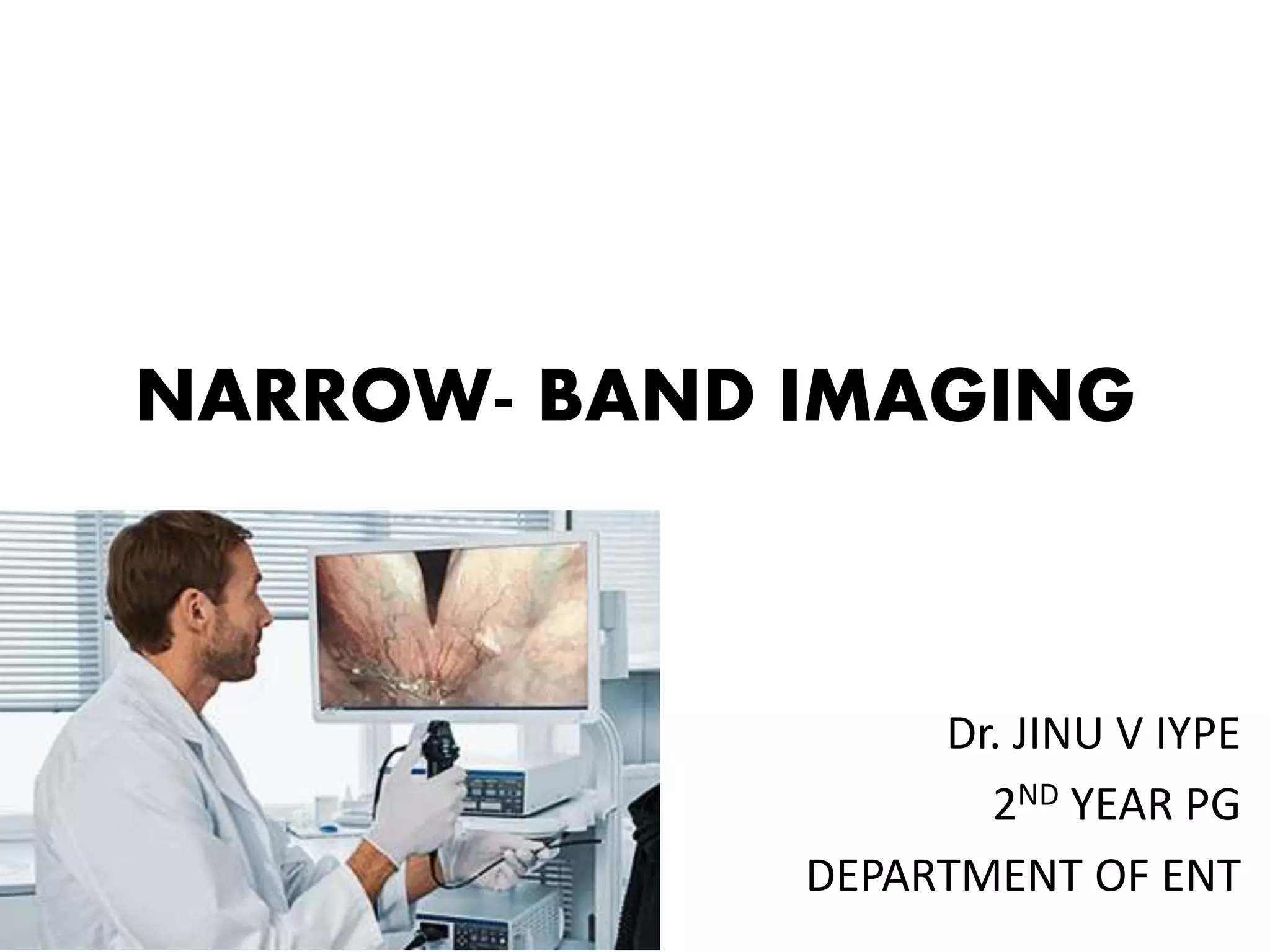
NARROW- BAND IMAGING
Dr. JINU V IYPE
2ND YEAR PG
DEPARTMENT OF ENT
• Cummings otolaryngology – 6th edition.
• Comprehensive Atlas of High Resolution
Endoscopy and Narrowband Imaging by
Jonathan Cohen
Narrow-band imaging (NBI)
• It is a newer endoscopic imaging technique that
uses the absorption characteristics of light to
enable a detailed analysis of vascular and
mucosal structure within and outside a lesion.
• In the larynx, it has been used to
– Identification of recurrent respiratory papillomatosis
– To screen for malignancies by identifying high-yield
areas to sample for biopsy.
Narrow-band imaging (NBI) is based on the
principle, where white light of specific blue and
green wavelengths is used to enhance the detail
of certain aspects of the surface of the mucosa.
• The blue narrow-band wavelength (390 to
445 nm) is used for imaging superficial capillaries of
the mucosal layer, is better absorbed by
haemoglobin.
• whereas thick vessels within the mucosal layer are
best visualized using the green narrow band
(530 to 550 nm)
• With the use of mechanical light-filtering
technology to pass only the blue subset of the
white light spectrum, structures with high
hemoglobin concentration become more
apparent with increased visualization of
tissue’s vascular pattern
NBI takes advantage of the differential
absorption characteristics of tissues.
• This creates a sharper contrast for better
visualization of fine mucosal detail and helps to
better identify subtle microvascular
abnormalities.
– True vocal fold scar
– at the anterior
commissure.
White light imaging
Narrow-band imaging 
• Initially developed for better identification
of Barrett esophagus at the
squamocolumnar junction of the lower
esophageal sphincter.
• Narrow-band imaging also used for better
identification of abnormalities at the
Gastroesophageal junction
Stomach
Colon
• And also improving the yield of biopsies by
directing the examiner to the more suspicious
areas.
Esophagoscopy
Normal light imaging of the GEJ was enhanced with narrow-band imaging during flexible
esophagoscopy to help direct biopsy showing reflex changes without Barrett metaplasia
Biopsy
forceps
Biopsy
site
• It is currently available for gastroscopes,
including transnasal esophagoscopes
and flexible laryngoscopes.
• Also beginning to explore the utility of
NBI in laryngeal and hypopharyngeal
lesions.
Vascular patterns associated with pathology include:-
Dotted
Tortuous
Abruptly ending vessels
• Squamous cell carcinoma is more likely
to be associated with tortuous and
abruptly ending vessels
• Dotted vascular pattern is more likely to
be seen in adenocarcinoma.
Function of the various switches
on the NBI endoscopes: (1)
switch to NBI from white light,
(2) digital magnification and (3
and 4) to freeze and capture the
image.
Carcinoma in
situ of the left
true vocal fold.
White light
imaging
Narrow-band imaging 
Small nodule on
arytenoid
and cyst on vocal cord
Small nodule on arytenoid
and
cyst on vocal cord seen more
easily on NBI
low-magnification view
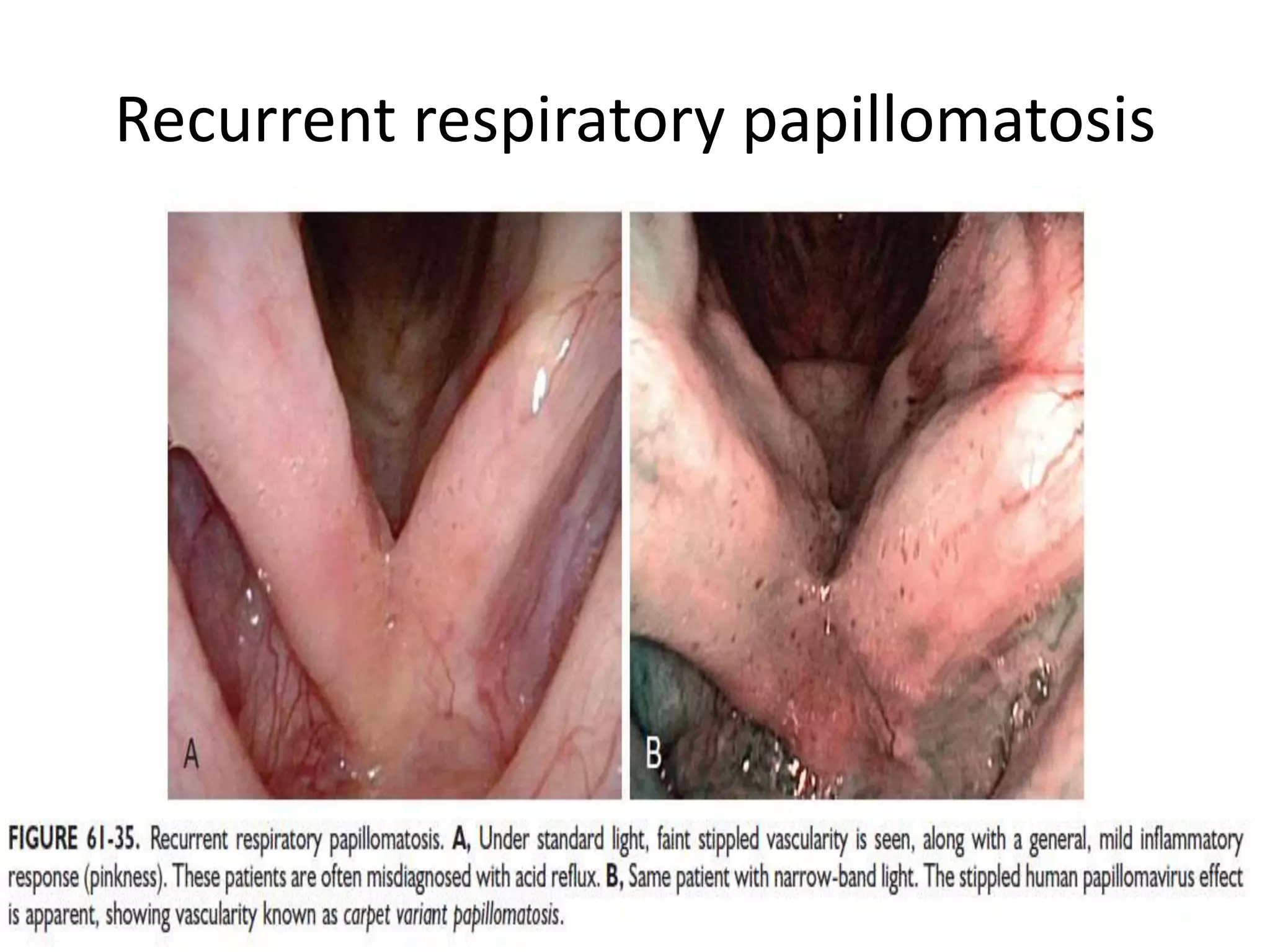
Recurrent respiratory papillomatosis
In-clinic evaluation with transnasalflexible
laryngoscopy with high definition permits
remarkable clarity in imaging
leukoplakia involving the left vocal cord
Narrow-band imaging
highlights vascularity
and may add to the
quality of the
evaluation
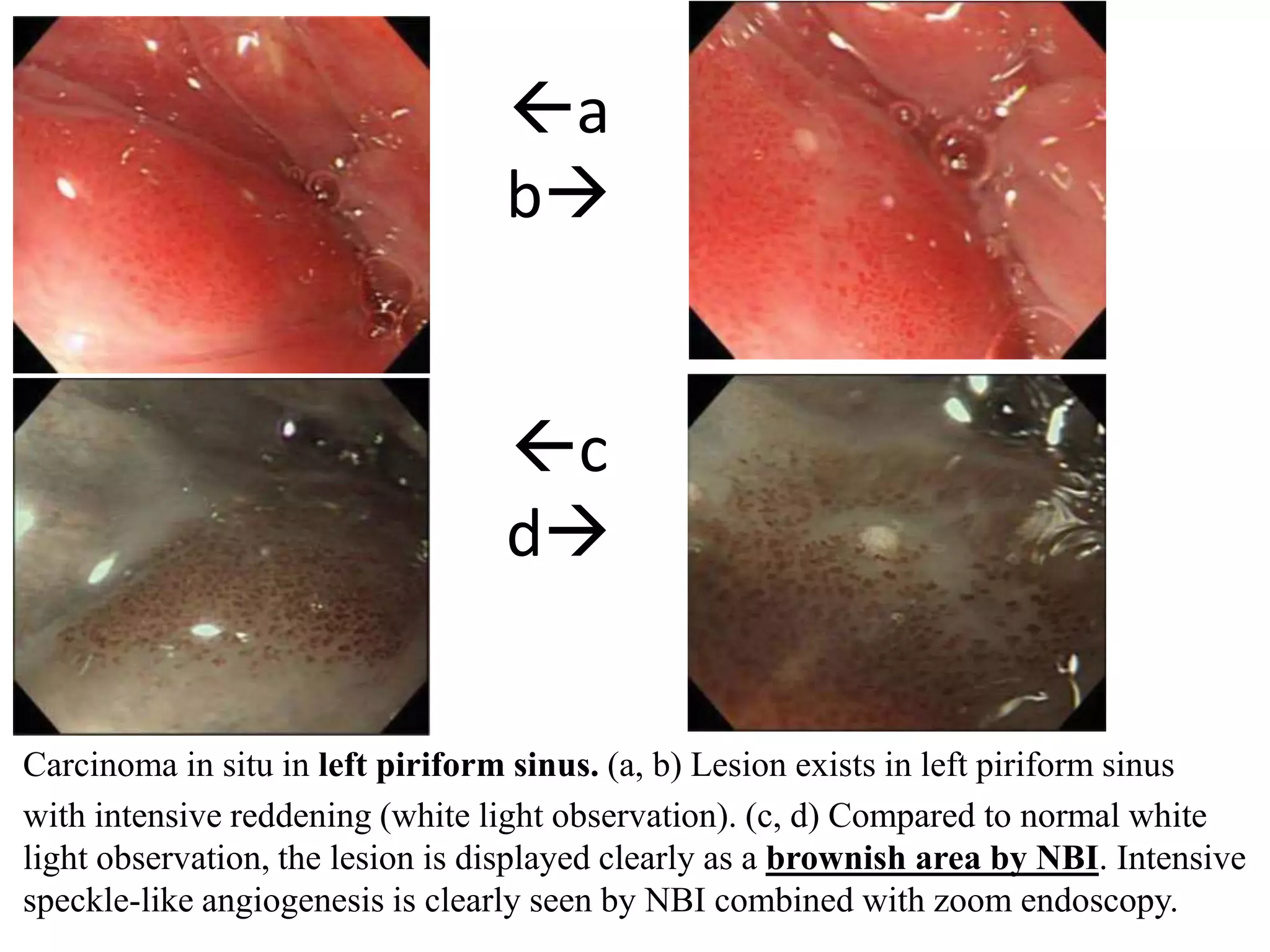
a
b
c
d
Carcinoma in situ in left piriform sinus. (a, b) Lesion exists in left piriform sinus
with intensive reddening (white light observation). (c, d) Compared to normal white
light observation, the lesion is displayed clearly as a brownish area by NBI. Intensive
speckle-like angiogenesis is clearly seen by NBI combined with zoom endoscopy.
Carcinoma in situ in left lateral
wall of oropharynx.
(a, b) Lesion exists in left
lateral wall of the oropharynx.
Area with slight reddening can be
identified but, it is hard to
identify its dimension.
• Slight dot-type reddening
identified by zoom endoscopy.
(c, d)
• Compared to white light
observation, this lesion can be
clearly identified using NBI as
a brownish area. Especially,
the border in melanosis is
clearly seen. NBI frequently
displays melanotic change as
brownish area.
• (e) Low magnification.
Squamous carcinoma in situ.
(f) High magnification
– Partially, melanin pigment is
identified
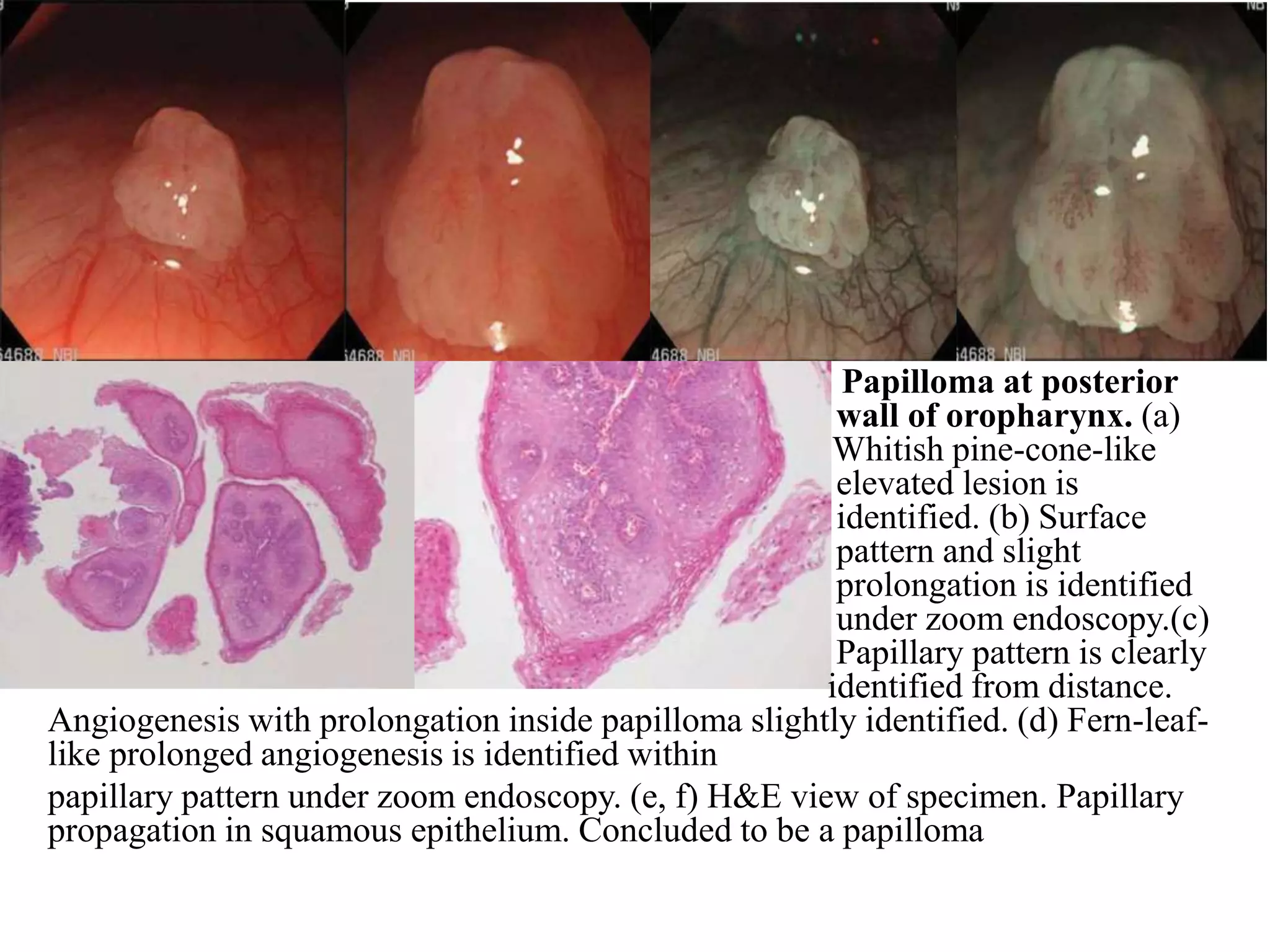
Papilloma at posterior
wall of oropharynx. (a)
Whitish pine-cone-like
elevated lesion is
identified. (b) Surface
pattern and slight
prolongation is identified
under zoom endoscopy.(c)
Papillary pattern is clearly
identified from distance.
Angiogenesis with prolongation inside papilloma slightly identified. (d) Fern-leaf-
like prolonged angiogenesis is identified within
papillary pattern under zoom endoscopy. (e, f) H&E view of specimen. Papillary
propagation in squamous epithelium. Concluded to be a papilloma
THANK YOU !!!

Narrow band imaging

  • 1.
    NARROW- BAND IMAGING Dr.JINU V IYPE 2ND YEAR PG DEPARTMENT OF ENT
  • 2.
    • Cummings otolaryngology– 6th edition. • Comprehensive Atlas of High Resolution Endoscopy and Narrowband Imaging by Jonathan Cohen
  • 3.
    Narrow-band imaging (NBI) •It is a newer endoscopic imaging technique that uses the absorption characteristics of light to enable a detailed analysis of vascular and mucosal structure within and outside a lesion. • In the larynx, it has been used to – Identification of recurrent respiratory papillomatosis – To screen for malignancies by identifying high-yield areas to sample for biopsy.
  • 4.
    Narrow-band imaging (NBI)is based on the principle, where white light of specific blue and green wavelengths is used to enhance the detail of certain aspects of the surface of the mucosa.
  • 5.
    • The bluenarrow-band wavelength (390 to 445 nm) is used for imaging superficial capillaries of the mucosal layer, is better absorbed by haemoglobin. • whereas thick vessels within the mucosal layer are best visualized using the green narrow band (530 to 550 nm)
  • 6.
    • With theuse of mechanical light-filtering technology to pass only the blue subset of the white light spectrum, structures with high hemoglobin concentration become more apparent with increased visualization of tissue’s vascular pattern
  • 7.
    NBI takes advantageof the differential absorption characteristics of tissues.
  • 9.
    • This createsa sharper contrast for better visualization of fine mucosal detail and helps to better identify subtle microvascular abnormalities. – True vocal fold scar – at the anterior commissure. White light imaging Narrow-band imaging 
  • 10.
    • Initially developedfor better identification of Barrett esophagus at the squamocolumnar junction of the lower esophageal sphincter.
  • 11.
    • Narrow-band imagingalso used for better identification of abnormalities at the Gastroesophageal junction Stomach Colon • And also improving the yield of biopsies by directing the examiner to the more suspicious areas.
  • 12.
    Esophagoscopy Normal light imagingof the GEJ was enhanced with narrow-band imaging during flexible esophagoscopy to help direct biopsy showing reflex changes without Barrett metaplasia Biopsy forceps Biopsy site
  • 13.
    • It iscurrently available for gastroscopes, including transnasal esophagoscopes and flexible laryngoscopes. • Also beginning to explore the utility of NBI in laryngeal and hypopharyngeal lesions.
  • 14.
    Vascular patterns associatedwith pathology include:- Dotted Tortuous Abruptly ending vessels
  • 15.
    • Squamous cellcarcinoma is more likely to be associated with tortuous and abruptly ending vessels • Dotted vascular pattern is more likely to be seen in adenocarcinoma.
  • 16.
    Function of thevarious switches on the NBI endoscopes: (1) switch to NBI from white light, (2) digital magnification and (3 and 4) to freeze and capture the image.
  • 17.
    Carcinoma in situ ofthe left true vocal fold. White light imaging Narrow-band imaging 
  • 18.
    Small nodule on arytenoid andcyst on vocal cord Small nodule on arytenoid and cyst on vocal cord seen more easily on NBI low-magnification view
  • 19.
  • 20.
    In-clinic evaluation withtransnasalflexible laryngoscopy with high definition permits remarkable clarity in imaging leukoplakia involving the left vocal cord Narrow-band imaging highlights vascularity and may add to the quality of the evaluation
  • 21.
    a b c d Carcinoma in situin left piriform sinus. (a, b) Lesion exists in left piriform sinus with intensive reddening (white light observation). (c, d) Compared to normal white light observation, the lesion is displayed clearly as a brownish area by NBI. Intensive speckle-like angiogenesis is clearly seen by NBI combined with zoom endoscopy.
  • 22.
    Carcinoma in situin left lateral wall of oropharynx. (a, b) Lesion exists in left lateral wall of the oropharynx. Area with slight reddening can be identified but, it is hard to identify its dimension. • Slight dot-type reddening identified by zoom endoscopy. (c, d) • Compared to white light observation, this lesion can be clearly identified using NBI as a brownish area. Especially, the border in melanosis is clearly seen. NBI frequently displays melanotic change as brownish area. • (e) Low magnification. Squamous carcinoma in situ. (f) High magnification – Partially, melanin pigment is identified
  • 23.
    Papilloma at posterior wallof oropharynx. (a) Whitish pine-cone-like elevated lesion is identified. (b) Surface pattern and slight prolongation is identified under zoom endoscopy.(c) Papillary pattern is clearly identified from distance. Angiogenesis with prolongation inside papilloma slightly identified. (d) Fern-leaf- like prolonged angiogenesis is identified within papillary pattern under zoom endoscopy. (e, f) H&E view of specimen. Papillary propagation in squamous epithelium. Concluded to be a papilloma
  • 24.

Editor's Notes

  • #5 The reflected light is captured by a charge-coupled device (CCD) chip at the tip of the instrument in order to reconstruct the images