Inception as
a Post Modern text.
Hyper-reality.
The film ‘Inception’ has many aspects of
hyper-reality. During this film, the mind is
opened into another reality which could be
seen as more desirable than real life reality.
This aspect of the film means a sense of a
new, better and more sought-after world and
so the audience are convinced that it is an
authentic world.
Intertextuality
The Penrose staircase is referenced during the
film ‘Inception’. This expands on the idea that
anything in a dream can be possible with the
architects creativity.
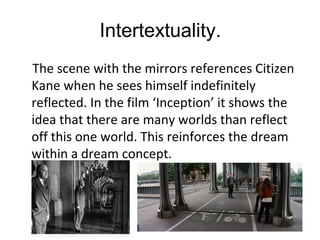
Intertextuality.
The scene with the mirrors references Citizen
Kane when he sees himself indefinitely
reflected. In the film ‘Inception’ it shows the
idea that there are many worlds than reflect
off this one world. This reinforces the dream
within a dream concept.
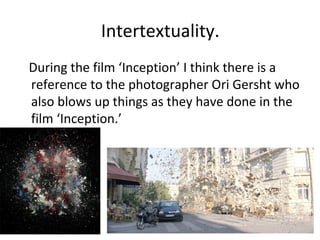
Intertextuality.
During the film ‘Inception’ I think there is a
reference to the photographer Ori Gersht who
also blows up things as they have done in the
film ‘Inception.’
Time bending.
The film ‘Inception’ has a ‘what if’ style nature.
It make the audience question what the world
would be like if we could alter peoples mental
states. It also asks the audience whether is it
right to invade a persons thoughts. The film
portrays a different shape of reality which
allows the viewer to personally decided
whether they prefer the ‘hyper-real’ situation,
or their own current situation.
Time bending.
The film ‘Inception’ has a ‘what if’ style nature.
It make the audience question what the world
would be like if we could alter peoples mental
states. It also asks the audience whether is it
right to invade a persons thoughts. The film
portrays a different shape of reality which
allows the viewer to personally decided
whether they prefer the ‘hyper-real’ situation,
or their own current situation.

Inception as a postmodern text

  • 1.
    Inception as a PostModern text.
  • 2.
    Hyper-reality. The film ‘Inception’has many aspects of hyper-reality. During this film, the mind is opened into another reality which could be seen as more desirable than real life reality. This aspect of the film means a sense of a new, better and more sought-after world and so the audience are convinced that it is an authentic world.
  • 3.
    Intertextuality The Penrose staircaseis referenced during the film ‘Inception’. This expands on the idea that anything in a dream can be possible with the architects creativity.
  • 4.
    Intertextuality. The scene withthe mirrors references Citizen Kane when he sees himself indefinitely reflected. In the film ‘Inception’ it shows the idea that there are many worlds than reflect off this one world. This reinforces the dream within a dream concept.
  • 5.
    Intertextuality. During the film‘Inception’ I think there is a reference to the photographer Ori Gersht who also blows up things as they have done in the film ‘Inception.’
  • 6.
    Time bending. The film‘Inception’ has a ‘what if’ style nature. It make the audience question what the world would be like if we could alter peoples mental states. It also asks the audience whether is it right to invade a persons thoughts. The film portrays a different shape of reality which allows the viewer to personally decided whether they prefer the ‘hyper-real’ situation, or their own current situation.
  • 7.
    Time bending. The film‘Inception’ has a ‘what if’ style nature. It make the audience question what the world would be like if we could alter peoples mental states. It also asks the audience whether is it right to invade a persons thoughts. The film portrays a different shape of reality which allows the viewer to personally decided whether they prefer the ‘hyper-real’ situation, or their own current situation.