BIOMEDIATED SYNTHESIS OF ZINC OXIDE
NANOPARTICLES USING CARICA PAPAYA AND ITS
CHARACTERIZATION
submitted by,
Christy Mary Joy
Application of ZnO NPs
• Rubber Industry.
• Pharmaceutical and cosmetic industry.
• Photo catalysis.
• Miscellaneous applications.
• Electronics and electro technology industries.
• Textile industry.
OBJECTIVES OF STUDY
1. To characterize synthesized ZnO NPs using ultraviolet-visible
(u-V) spectroscopy, X- ray Diffraction (XRD).
2. To synthesize ZnO NPs through a green synthesis pathway
using Carica papaya (papaya Leaf).
Methodology
Preparation of standard solution of zinc acetate:
Preparation of standard solution of Ammonium Carbonate:
PROCEDURE
• 100 ml of leaf extract was taken in a 500 ml clean beaker mounted on a magnetic
stirrer. 100 ml of 0.1 M ammonium carbonate solution and zinc acetate solutions
were simultaneously added to it from a burette drop by drop at the rate of one drop
in 2 seconds.
• During the addition, the solution was stirred vigorously about 2-3 hours till a
greenish precipitate was formed. The inert medium provided by papaya leaf extract
isolates the particles formed from aggregation.
• The precipitate is filtered off using funnel and filter paper and washed with distilled
water several times. It was then dried and transferred into a crucible and heated for
two hours at 400 ˚C in a muffle furnace . The sample was then transferred into a
mortar and grinded well .
• X-ray diffraction (XRD)
crystalline size of synthesized Zinc oxide particle using Scherer's
equation
D= 𝐾 λ /𝛽 𝑐𝑜𝑠Ө
where, β =𝐹𝑊𝐻𝑀ax 2*𝜋/180°
• UV-Visible spectroscopy
Band gap energy
Ebg = hc / λ
CHARACTERIZATION TECHNIQUES
RESULTS AND DISCUSION
 Characterization of Synthesized Zinc Oxide Nanoparticles
• In this work Zinc oxide nanoparticles are synthesized through biogenic green
method using Zinc acetate and ammonium carbonate as precursor and
papaya leaf as capping agent.
• The synthesized ZnO NPs was characterized accordingly using XRD, UV-V
Spectroscopy.
X-ray Diffraction (XRD)
XRD of synthesized ZnO nanoparticles
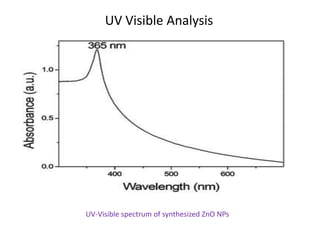
UV Visible Analysis
UV-Visible spectrum of synthesized ZnO NPs
CONCLUSION:
 The crystalline size of synthesized ZnO NP = 19.22 nm
 The energy band gap of as synthesized nanoparticles was
obtained to be equal to 3.3406 eV.
Green synthesis

Green synthesis

  • 1.
    BIOMEDIATED SYNTHESIS OFZINC OXIDE NANOPARTICLES USING CARICA PAPAYA AND ITS CHARACTERIZATION submitted by, Christy Mary Joy
  • 2.
    Application of ZnONPs • Rubber Industry. • Pharmaceutical and cosmetic industry. • Photo catalysis. • Miscellaneous applications. • Electronics and electro technology industries. • Textile industry.
  • 3.
    OBJECTIVES OF STUDY 1.To characterize synthesized ZnO NPs using ultraviolet-visible (u-V) spectroscopy, X- ray Diffraction (XRD). 2. To synthesize ZnO NPs through a green synthesis pathway using Carica papaya (papaya Leaf).
  • 4.
    Methodology Preparation of standardsolution of zinc acetate: Preparation of standard solution of Ammonium Carbonate:
  • 5.
    PROCEDURE • 100 mlof leaf extract was taken in a 500 ml clean beaker mounted on a magnetic stirrer. 100 ml of 0.1 M ammonium carbonate solution and zinc acetate solutions were simultaneously added to it from a burette drop by drop at the rate of one drop in 2 seconds. • During the addition, the solution was stirred vigorously about 2-3 hours till a greenish precipitate was formed. The inert medium provided by papaya leaf extract isolates the particles formed from aggregation. • The precipitate is filtered off using funnel and filter paper and washed with distilled water several times. It was then dried and transferred into a crucible and heated for two hours at 400 ˚C in a muffle furnace . The sample was then transferred into a mortar and grinded well .
  • 6.
    • X-ray diffraction(XRD) crystalline size of synthesized Zinc oxide particle using Scherer's equation D= 𝐾 λ /𝛽 𝑐𝑜𝑠Ө where, β =𝐹𝑊𝐻𝑀ax 2*𝜋/180° • UV-Visible spectroscopy Band gap energy Ebg = hc / λ CHARACTERIZATION TECHNIQUES
  • 7.
    RESULTS AND DISCUSION Characterization of Synthesized Zinc Oxide Nanoparticles • In this work Zinc oxide nanoparticles are synthesized through biogenic green method using Zinc acetate and ammonium carbonate as precursor and papaya leaf as capping agent. • The synthesized ZnO NPs was characterized accordingly using XRD, UV-V Spectroscopy.
  • 8.
    X-ray Diffraction (XRD) XRDof synthesized ZnO nanoparticles
  • 9.
    UV Visible Analysis UV-Visiblespectrum of synthesized ZnO NPs
  • 10.
    CONCLUSION:  The crystallinesize of synthesized ZnO NP = 19.22 nm  The energy band gap of as synthesized nanoparticles was obtained to be equal to 3.3406 eV.