welcome
CARMEL POLYTECHNIC COLLEGE
ALAPPUZHA
NAME : SARATH K S
REG NO: 20010056
BRANCH : CIVIL ENGINEERING
Nano concreate
CONTENTS
•
•
•
•
•
•
•
•
•
•
Introduction
What is Nano?
Why nanotechnology for concrete?
What is Nano concrete?
Nano materials
Results
scope
Advantages
Dis – Advantages
conclusion
INTRODUCTION
• Nano technology isone of the most active
research areaswhich haswide applications
in almost all the fields.
• As concrete ismost usable material in.
construction industry it’sbeen required to
improve itsquality.
• Improving concrete properties by addition
of Nano particles have shown significant
improvement than conventional concrete.
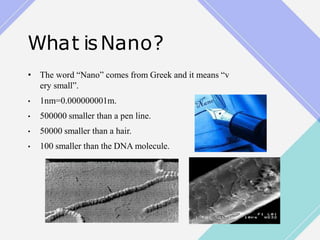
What isNano?
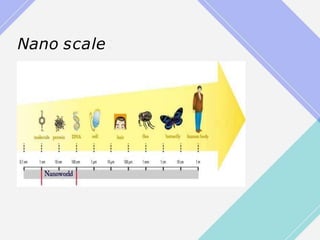
• The word “Nano” comes from Greek and it means “v
ery small”.
• 1nm=0.000000001m.
• 500000 smaller than a pen line.
• 50000 smaller than a hair.
• 100 smaller than the DNA molecule.
Nano scale:
Why nanotechnology for
concrete?
 Improves the material’s bulk properties.
 Ability to control or manipulate materials at
the atomic scale. NANOSCALE ATTACK
ON ASR (ALKALI SILICATE REACTION)
 To obtain thinner final products and fast
er setting time. Cost effectiveness.
 Lowered levels of environmental
contamination.
What is Nano concrete?
 A concrete made with Portland cement partic
les that are less than 500nm as a cementing
agent.
 Currently cement particle sizes range from a
few Nano-meters to a maximum of about100
micro meters.
NANO MATERIALS
 Nano materials are defined as a set of substances where at least
one dimension is less than approximately 100 nanometres.
Nanomaterial's are of interest because at this scale unique optical,
magnetic,electrical, and other properties emerge. These emergent
properties have the potential for great impacts in electronics,
medicine, and other fields.
 Some of main Nano materials used in concrete:
• Carbon Nanotubes.
• Nano-silica.
• Polycarboxylates.
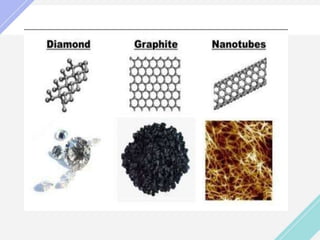
CARBON NANO TUBES
 Carbon nanotubes are molecular-scale tubes of
graphitic carbon with outstanding properties.
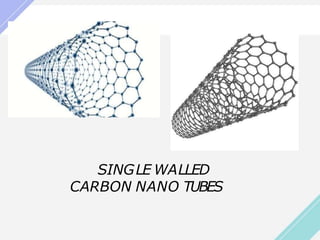
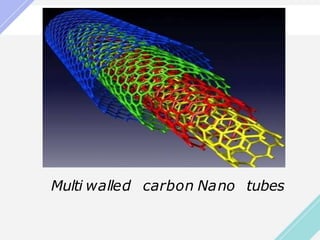
 They can be several millimetres in length and can have one
“layer” or wall (single walled nanotube) or more than one
wall (multi walled nanotube).
SINGLE WALLED
CARBON NANO TUBES
Multi walled carbon Nano tubes
PROPERTIES
 CNT are also highly flexible
 Mechanically, CNT appear to be the strongest
material. The smaller diameters.
 Stiffest and strongest fibers.
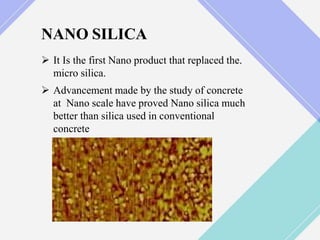
NANO SILICA
 It Is the first Nano product that replaced the.
micro silica.
 Advancement made by the study of concrete
at Nano scale have proved Nano silica much
better than silica used in conventional
concrete.
Nano silica
PROPERTIES
 High compressive strengths concretes ( 15 M
Pa and 75 MPa at 1 day; 40 MPa and 90 MP
a at 28 days and 48 MPa and 120 MPa at 120
days.)
 High workability with reduced water/cem
ent ratio.
 Use of super plasticizing additives is unnecessa
ry. Fills up all the micro pores and micro
spaces.
 Cement saving upto 35-45%.
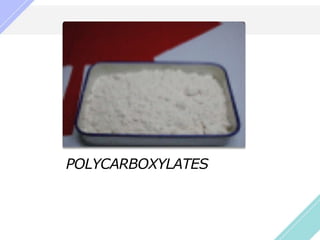
POLYCARBOXYLATES
• Polycarboxylates or polymer based concrete
admixtures are High Range Water Reducing admi
xture (HRWR).
• low dosage-reduce water as much as high
dosage of conventional admixtures.
• Higher dosage-produce Self Compacting
Concrete (SCC).
• This admixture type is very suitable for under
water anti- washout concrete.
POLYCARBOXYLATES
The Gartnerplatzbrucke, across Kassel river
in Germany
The jubilee church in Rome
RESULTS
 Resistance to compression - 40 to 90MPa in 1
day Resistance to compression from 70 a 100 MP
a (or more) in 28 days.
 Produces high resistance even with low addition
(1 to 1.5
 % of the cements weight) and gives self
compacting characteristics with higher propo
rtions (2.5 %).
 Meets the norms of environmental protection.
SCOPE
• If Portland cement can be formulated with
nano- size cement particles, it will open up a
large number of opportunities.
• The cement will not only be more economi
cal than organic polymers but also will be
fire resistant.
• A number of investigations have been carried
out for developing smart concrete using carbo
n fibers.
•
This will become a reality with nano-cement because
nano- carbontubes are much more effective than
carbon fibers. The thickness of the composite can be
reduced to microns and hence flexible and smart
cement composite can be manufactured.
ADVANTAGES OF NANO
CONCRETE
 Cessation of contamination caused by micro silica solid
particles.
 Lower cost per building site.
 Concrete with high initial and final compressive and tensile
strengths.
 Concrete with good workability.
Cessation of super plasticizing utilization.
Cessation of silicosis risk.
Dis-Advantagesof Nano
concrete
 Availability of sources for producing Nano materials is less.
 For producing Nano materials there are no such equipment’s
to grain the materialsup to Nano size.
 Usage of Nano materials in concrete is difficult to replace.
the materialsin concrete like cement.
CONCLUSION
 Well dispersed Nano particles increase the
viscosity of the liquid phase, improves the
segregation resistance and workability of th
e system.
 Accelerates the hydration.
 Better bond between aggregates and cement paste
.
 Improves the toughness, shear, tensile
strength and flexural strength of concrete.
Reference
1. Abdullah Keyvani, ‘’Huge opportunities for industry of
nano fibrous concrete technology’’, vol.3, No.1, Page N
o 3-10, December 2007.
2. Aiswarya. S, Prince Arulraj.G, AnandNarendran, ’’Exper
imental investigation on concrete containing nano-me
atakaolin’’, vol.3, No.1, Page No180-187, February 201
3.
3. Ali Nazari, ShadiRiahi, SeyedehFatemahShameki and A
. khademo, ‘’Assessment of the effects of cement paste
composite in presence of TIO2 nano particles’’, Page N
o 43-46, February 2010.
4. AlirezaNajigivi, ‘’Investigating the effect of using differe
nt types of SIO2 nano particles on the mechanical prop
ertiesof binary blended concrete’’, Part B 54, Page no 5
2-58, 2013
ANY
QUESTIONS
?
THANK YOU

nano concreate.pptx

  • 1.
  • 2.
    CARMEL POLYTECHNIC COLLEGE ALAPPUZHA NAME: SARATH K S REG NO: 20010056 BRANCH : CIVIL ENGINEERING
  • 3.
  • 4.
    CONTENTS • • • • • • • • • • Introduction What is Nano? Whynanotechnology for concrete? What is Nano concrete? Nano materials Results scope Advantages Dis – Advantages conclusion
  • 5.
    INTRODUCTION • Nano technologyisone of the most active research areaswhich haswide applications in almost all the fields. • As concrete ismost usable material in. construction industry it’sbeen required to improve itsquality. • Improving concrete properties by addition of Nano particles have shown significant improvement than conventional concrete.
  • 6.
    What isNano? • Theword “Nano” comes from Greek and it means “v ery small”. • 1nm=0.000000001m. • 500000 smaller than a pen line. • 50000 smaller than a hair. • 100 smaller than the DNA molecule.
  • 7.
  • 8.
    Why nanotechnology for concrete? Improves the material’s bulk properties.  Ability to control or manipulate materials at the atomic scale. NANOSCALE ATTACK ON ASR (ALKALI SILICATE REACTION)  To obtain thinner final products and fast er setting time. Cost effectiveness.  Lowered levels of environmental contamination.
  • 9.
    What is Nanoconcrete?  A concrete made with Portland cement partic les that are less than 500nm as a cementing agent.  Currently cement particle sizes range from a few Nano-meters to a maximum of about100 micro meters.
  • 10.
    NANO MATERIALS  Nanomaterials are defined as a set of substances where at least one dimension is less than approximately 100 nanometres. Nanomaterial's are of interest because at this scale unique optical, magnetic,electrical, and other properties emerge. These emergent properties have the potential for great impacts in electronics, medicine, and other fields.  Some of main Nano materials used in concrete: • Carbon Nanotubes. • Nano-silica. • Polycarboxylates.
  • 11.
    CARBON NANO TUBES Carbon nanotubes are molecular-scale tubes of graphitic carbon with outstanding properties.  They can be several millimetres in length and can have one “layer” or wall (single walled nanotube) or more than one wall (multi walled nanotube).
  • 13.
  • 14.
  • 15.
    PROPERTIES  CNT arealso highly flexible  Mechanically, CNT appear to be the strongest material. The smaller diameters.  Stiffest and strongest fibers.
  • 16.
    NANO SILICA  ItIs the first Nano product that replaced the. micro silica.  Advancement made by the study of concrete at Nano scale have proved Nano silica much better than silica used in conventional concrete. Nano silica
  • 17.
    PROPERTIES  High compressivestrengths concretes ( 15 M Pa and 75 MPa at 1 day; 40 MPa and 90 MP a at 28 days and 48 MPa and 120 MPa at 120 days.)  High workability with reduced water/cem ent ratio.  Use of super plasticizing additives is unnecessa ry. Fills up all the micro pores and micro spaces.  Cement saving upto 35-45%.
  • 18.
    POLYCARBOXYLATES • Polycarboxylates orpolymer based concrete admixtures are High Range Water Reducing admi xture (HRWR). • low dosage-reduce water as much as high dosage of conventional admixtures. • Higher dosage-produce Self Compacting Concrete (SCC). • This admixture type is very suitable for under water anti- washout concrete.
  • 19.
  • 20.
    The Gartnerplatzbrucke, acrossKassel river in Germany The jubilee church in Rome
  • 21.
    RESULTS  Resistance tocompression - 40 to 90MPa in 1 day Resistance to compression from 70 a 100 MP a (or more) in 28 days.  Produces high resistance even with low addition (1 to 1.5  % of the cements weight) and gives self compacting characteristics with higher propo rtions (2.5 %).  Meets the norms of environmental protection.
  • 22.
    SCOPE • If Portlandcement can be formulated with nano- size cement particles, it will open up a large number of opportunities. • The cement will not only be more economi cal than organic polymers but also will be fire resistant. • A number of investigations have been carried out for developing smart concrete using carbo n fibers.
  • 23.
    • This will becomea reality with nano-cement because nano- carbontubes are much more effective than carbon fibers. The thickness of the composite can be reduced to microns and hence flexible and smart cement composite can be manufactured.
  • 24.
    ADVANTAGES OF NANO CONCRETE Cessation of contamination caused by micro silica solid particles.  Lower cost per building site.  Concrete with high initial and final compressive and tensile strengths.  Concrete with good workability. Cessation of super plasticizing utilization. Cessation of silicosis risk.
  • 25.
    Dis-Advantagesof Nano concrete  Availabilityof sources for producing Nano materials is less.  For producing Nano materials there are no such equipment’s to grain the materialsup to Nano size.  Usage of Nano materials in concrete is difficult to replace. the materialsin concrete like cement.
  • 26.
    CONCLUSION  Well dispersedNano particles increase the viscosity of the liquid phase, improves the segregation resistance and workability of th e system.  Accelerates the hydration.  Better bond between aggregates and cement paste .  Improves the toughness, shear, tensile strength and flexural strength of concrete.
  • 27.
    Reference 1. Abdullah Keyvani,‘’Huge opportunities for industry of nano fibrous concrete technology’’, vol.3, No.1, Page N o 3-10, December 2007. 2. Aiswarya. S, Prince Arulraj.G, AnandNarendran, ’’Exper imental investigation on concrete containing nano-me atakaolin’’, vol.3, No.1, Page No180-187, February 201 3. 3. Ali Nazari, ShadiRiahi, SeyedehFatemahShameki and A . khademo, ‘’Assessment of the effects of cement paste composite in presence of TIO2 nano particles’’, Page N o 43-46, February 2010. 4. AlirezaNajigivi, ‘’Investigating the effect of using differe nt types of SIO2 nano particles on the mechanical prop ertiesof binary blended concrete’’, Part B 54, Page no 5 2-58, 2013
  • 28.
  • 29.