
NALCO was incorporated as public sector enterprise of the Ministry
of Mines, Government of India in 1981. It has units in Odisha at
places like Angul and Damanjodi.
It is Asia’s largest and the sixth largest integrated aluminium
complex, encompassing bauxite mining, alumina refining, aluminium
smelting and casting, power generation, rail and port operations.
The bauxite mines called PANCHPATMALLI mines is situated atop a
set of five mountains called PANCHPATMALLI. These mines are open
cast mines. The refinery complex for bauxite is located in Damanjodi.
The smelter unit of NALCO is located in NALCONAGAR, ANGUL .The
company’s head quarters are located in Bhubaneswar which is the
capital of the Indian state of Odisha.
NALCO produces various products such as Aluminium metal, Ingots ,
sows, billets, Wire rods, alloy wire rods, cast strips
OVERVIEWOF COMPANY’S WORKING
The various operations carried out in NALCO are divided in three
major areas :-
1) CARBON AREA
2) POTLINE AREA
3) CASTING AREA
1)CARBON AREA;-
It consists of Green Anode Plant (GAP) , baking oven and rodding
shop.
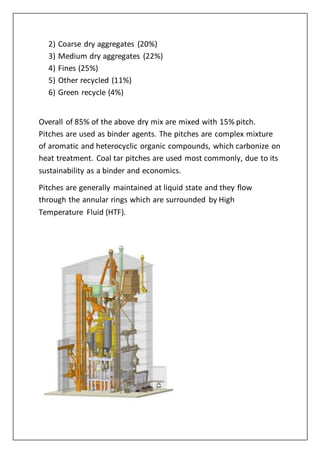
Green Anode Plant involves the production of Green anodes. The
word “GREEN” signifies that it is fresh or raw.
Raw materials used in preparation of green anodes are Calcined
petroleum coke (60-65%) , recycled material consisting of butts (22-
25%) returned from pot room and green scrap (5%) of various sizes
in definite proportions with coal tar pitch used as binder. These
fractions are drawn as per defined recipe.
Processes carried out in GAP are following:-
- Crushing and classification of dry aggregates.
- Mixing in proportion of dry aggregates.
- Addition of pitch and paste forming.
In Crushing process the Calcined petroleum coke are crushed and
classified in accordance of their sizes:-
1) Very coarse dry aggregates (22%)
2) Coarse dry aggregates (20%)
3) Medium dry aggregates (22%)
4) Fines (25%)
5) Other recycled (11%)
6) Green recycle (4%)
Overall of 85% of the above dry mix are mixed with 15% pitch.
Pitches are used as binder agents. The pitches are complex mixture
of aromatic and heterocyclic organic compounds, which carbonize on
heat treatment. Coal tar pitches are used most commonly, due to its
sustainability as a binder and economics.
Pitches are generally maintained at liquid state and they flow
through the annular rings which are surrounded by High
Temperature Fluid (HTF).
The carbon materials are continuously mixed to produce
homogenous paste before moulding it into green anode blocks on
vibrocompacting machines simply known as VIBROCOMPACTORS .
The moulded blocks are then cooled in water cooling systems.
BAKING:-
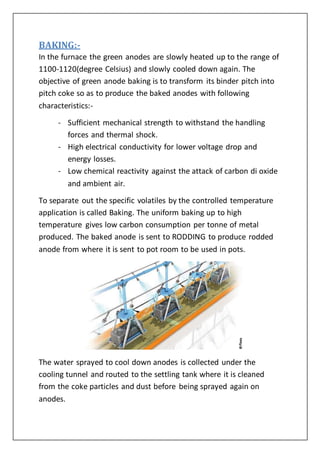
In the furnace the green anodes are slowly heated up to the range of
1100-1120(degree Celsius) and slowly cooled down again. The
objective of green anode baking is to transform its binder pitch into
pitch coke so as to produce the baked anodes with following
characteristics:-
- Sufficient mechanical strength to withstand the handling
forces and thermal shock.
- High electrical conductivity for lower voltage drop and
energy losses.
- Low chemical reactivity against the attack of carbon di oxide
and ambient air.
To separate out the specific volatiles by the controlled temperature
application is called Baking. The uniform baking up to high
temperature gives low carbon consumption per tonne of metal
produced. The baked anode is sent to RODDING to produce rodded
anode from where it is sent to pot room to be used in pots.
The water sprayed to cool down anodes is collected under the
cooling tunnel and routed to the settling tank where it is cleaned
from the coke particles and dust before being sprayed again on
anodes.
2)POTLINE:-
A Potline is a long building or a collection of buildings which
contains a series of “pots” or large electrolytic cells, in which
Aluminium is made by Hall – Heroult’s process.
The Hall- Heroult process is an example of Aluminium smelting
process and is used industrially. Aluminium cannot be produced by
an aqueous electrolytic process because h
ydrogen is electrochemically much nobler than aluminium. Thus
liquid aluminium is produced by electrolytic reduction of alumina
dissolved in an electrolyte (bath) mainly containing Cryolite which
lowers the melting temperature of alumina.
Aluminium is formed at about 960 degree Celsius but once formed
has a melting point of only 660 degree Celsius.
The smelting process required to produce aluminium from alumina is
continuous, the potline is usually is kept in production 24 hours a day
year round. A Smelter cannot be easily stopped or restarted. If
production is interrupted by a power supply failure for more than a
hour then the metal in the pots solidifies and will require expensive
rebuilding process.
An Aluminium rod with Iron studs is cast or rammed into grooves in
the top of anode block in order to support the anode and conduct
the electric current to the Anode when it has been poisitoned in the
cell.
As the electric current is passed through the bath it generates the
heat to keep the bath molten and causes the alumina to separate
into two constituent elements- aluminium and oxygen.
Just less than two tonnes of alumina and a about half tonne of
carbon products are needed to make a half tonne of aluminium.
Each pot contains 16 anodes mounted 8 anodes on both sides.
Each pot is fitted with microprocessor which continuously monitors
the pot to maintain optimum operations conditions. Each pot room
has a number of special multipurpose pot trending machines used
for tapping molten metal from the pots, for changing anodes, for
replenishing alumina feed hoppers and other productions
operations.
The molten metal is regularly siphoned from the pots using a method
called TAPPING.
3)CASTING AREA:-
Molten metal is carried from the pot line to the cast house in
transport ladles on specially designed vehicles. Overhead Cranes lift
the ladles and pour the molten aluminium into holding furnaces.
Here it is mixed with specific amount of alloy materials to produce
the prescribed chemical composition from the customer.
Properties such as strength, corrosion resistance and surface quality
can be affected by chemical composition and other processes.
The aluminium is then cast into extrusion billets, re-melt ingots, sows
and wire rods in the cast house.
EQUIPMENTS USED IN GAP
1)BUCKET ELEVATORS:-
A bucket elevator also called a green leg, is a mechanism for
hauling flowable bulk materials vertically.
It consists of
1) BUCKETS to contain the material.
2) A belt to carry the buckets and transmit the pull.
3) Means to drive the belt.
4) Accessories for loading the buckets and picking up of the
materials.
2)BELT CONVEYORS:-
The drive pulley is turned by a motor. A sprocket is put on the
drive pulley shaft. The chain is put around the drive pulley
sprocket. The chain moves when the motor is started and the
chain turns the pulley drive.
The tail pulley is located at the tail end of the conveyor and
turn freely.
Take up pulley or gravity pulley is provided to maintain
tension in the belt to prevent slacking.
3)SCREENING:-
Screening of the calcined petroleum cokes are done to
separate in accordance with their sizes i.e. very coarse dry
aggregates, coarse dry aggregates, medium dry aggregates
and fines.
Screen allows the passage of the aggregates of the required
sizes only carried down the processes.
4)BALL MILLS:-
A ball mill is a type of grinder used to grind the materials into
extremely fine powder for use in mineral dressing processes.
A ball mill works on the principle of impact; size reduction is
done by the impact as the balls drop from near the top of the
shell.
A ball mill consists of a hollow cylindrical shell rotating about
its axis. The axis of shell may be either horizontal or at small
angle to the horizontal it is partially filled with balls.
5)HAMMER MILL:-
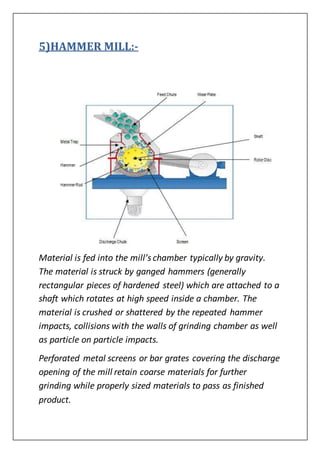
Material is fed into the mill’s chamber typically by gravity.
The material is struck by ganged hammers (generally
rectangular pieces of hardened steel) which are attached to a
shaft which rotates at high speed inside a chamber. The
material is crushed or shattered by the repeated hammer
impacts, collisions with the walls of grinding chamber as well
as particle on particle impacts.
Perforated metal screens or bar grates covering the discharge
opening of the mill retain coarse materials for further
grinding while properly sized materials to pass as finished
product.
6)DYNAMIC CLASSIFIERS:-
Dynamic classifier separates the coarse from fine coal by
allowing the fine coal to pass and rejecting the coarse
particles for regrinding. If the centrifugal force experienced by
the particle is greater than the drag force than the particle is
rejected for regrinding.
A dynamic classifier has inner rotating cage and outer
stationary vanes. Acting in concert they provide what is called
centrifugal or impinging classification.
7)CYCLONE SEPERATOR:-
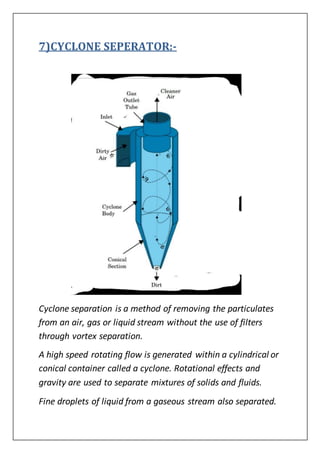
Cyclone separation is a method of removing the particulates
from an air, gas or liquid stream without the use of filters
through vortex separation.
A high speed rotating flow is generated within a cylindrical or
conical container called a cyclone. Rotational effects and
gravity are used to separate mixtures of solids and fluids.
Fine droplets of liquid from a gaseous stream also separated.
8)BAG FILTERS:-
A bag filters is a system used to enhance the quality of air
released from industrial and commercial purposes by
collecting dust and other impurities from air or gases.
It is designed to handle high volume dust loads , a dust
collectors system consist of blower, dust filter, a filter
cleaning system and dust removal system.
It is distinguished from air cleaners which use disposable
filters to remove dust.
nalco1122te

nalco1122te

  • 1.
    NALCO was incorporatedas public sector enterprise of the Ministry of Mines, Government of India in 1981. It has units in Odisha at places like Angul and Damanjodi. It is Asia’s largest and the sixth largest integrated aluminium complex, encompassing bauxite mining, alumina refining, aluminium smelting and casting, power generation, rail and port operations. The bauxite mines called PANCHPATMALLI mines is situated atop a set of five mountains called PANCHPATMALLI. These mines are open cast mines. The refinery complex for bauxite is located in Damanjodi. The smelter unit of NALCO is located in NALCONAGAR, ANGUL .The company’s head quarters are located in Bhubaneswar which is the capital of the Indian state of Odisha. NALCO produces various products such as Aluminium metal, Ingots , sows, billets, Wire rods, alloy wire rods, cast strips
  • 2.
    OVERVIEWOF COMPANY’S WORKING Thevarious operations carried out in NALCO are divided in three major areas :- 1) CARBON AREA 2) POTLINE AREA 3) CASTING AREA 1)CARBON AREA;- It consists of Green Anode Plant (GAP) , baking oven and rodding shop. Green Anode Plant involves the production of Green anodes. The word “GREEN” signifies that it is fresh or raw. Raw materials used in preparation of green anodes are Calcined petroleum coke (60-65%) , recycled material consisting of butts (22- 25%) returned from pot room and green scrap (5%) of various sizes in definite proportions with coal tar pitch used as binder. These fractions are drawn as per defined recipe. Processes carried out in GAP are following:- - Crushing and classification of dry aggregates. - Mixing in proportion of dry aggregates. - Addition of pitch and paste forming. In Crushing process the Calcined petroleum coke are crushed and classified in accordance of their sizes:- 1) Very coarse dry aggregates (22%)
  • 3.
    2) Coarse dryaggregates (20%) 3) Medium dry aggregates (22%) 4) Fines (25%) 5) Other recycled (11%) 6) Green recycle (4%) Overall of 85% of the above dry mix are mixed with 15% pitch. Pitches are used as binder agents. The pitches are complex mixture of aromatic and heterocyclic organic compounds, which carbonize on heat treatment. Coal tar pitches are used most commonly, due to its sustainability as a binder and economics. Pitches are generally maintained at liquid state and they flow through the annular rings which are surrounded by High Temperature Fluid (HTF).
  • 4.
    The carbon materialsare continuously mixed to produce homogenous paste before moulding it into green anode blocks on vibrocompacting machines simply known as VIBROCOMPACTORS . The moulded blocks are then cooled in water cooling systems.
  • 5.
    BAKING:- In the furnacethe green anodes are slowly heated up to the range of 1100-1120(degree Celsius) and slowly cooled down again. The objective of green anode baking is to transform its binder pitch into pitch coke so as to produce the baked anodes with following characteristics:- - Sufficient mechanical strength to withstand the handling forces and thermal shock. - High electrical conductivity for lower voltage drop and energy losses. - Low chemical reactivity against the attack of carbon di oxide and ambient air. To separate out the specific volatiles by the controlled temperature application is called Baking. The uniform baking up to high temperature gives low carbon consumption per tonne of metal produced. The baked anode is sent to RODDING to produce rodded anode from where it is sent to pot room to be used in pots. The water sprayed to cool down anodes is collected under the cooling tunnel and routed to the settling tank where it is cleaned from the coke particles and dust before being sprayed again on anodes.
  • 6.
    2)POTLINE:- A Potline isa long building or a collection of buildings which contains a series of “pots” or large electrolytic cells, in which Aluminium is made by Hall – Heroult’s process. The Hall- Heroult process is an example of Aluminium smelting process and is used industrially. Aluminium cannot be produced by an aqueous electrolytic process because h ydrogen is electrochemically much nobler than aluminium. Thus liquid aluminium is produced by electrolytic reduction of alumina dissolved in an electrolyte (bath) mainly containing Cryolite which lowers the melting temperature of alumina. Aluminium is formed at about 960 degree Celsius but once formed has a melting point of only 660 degree Celsius. The smelting process required to produce aluminium from alumina is continuous, the potline is usually is kept in production 24 hours a day year round. A Smelter cannot be easily stopped or restarted. If
  • 7.
    production is interruptedby a power supply failure for more than a hour then the metal in the pots solidifies and will require expensive rebuilding process. An Aluminium rod with Iron studs is cast or rammed into grooves in the top of anode block in order to support the anode and conduct the electric current to the Anode when it has been poisitoned in the cell. As the electric current is passed through the bath it generates the heat to keep the bath molten and causes the alumina to separate into two constituent elements- aluminium and oxygen. Just less than two tonnes of alumina and a about half tonne of carbon products are needed to make a half tonne of aluminium. Each pot contains 16 anodes mounted 8 anodes on both sides. Each pot is fitted with microprocessor which continuously monitors the pot to maintain optimum operations conditions. Each pot room has a number of special multipurpose pot trending machines used for tapping molten metal from the pots, for changing anodes, for replenishing alumina feed hoppers and other productions operations.
  • 8.
    The molten metalis regularly siphoned from the pots using a method called TAPPING. 3)CASTING AREA:- Molten metal is carried from the pot line to the cast house in transport ladles on specially designed vehicles. Overhead Cranes lift the ladles and pour the molten aluminium into holding furnaces. Here it is mixed with specific amount of alloy materials to produce the prescribed chemical composition from the customer. Properties such as strength, corrosion resistance and surface quality can be affected by chemical composition and other processes. The aluminium is then cast into extrusion billets, re-melt ingots, sows and wire rods in the cast house.
  • 10.
    EQUIPMENTS USED INGAP 1)BUCKET ELEVATORS:- A bucket elevator also called a green leg, is a mechanism for hauling flowable bulk materials vertically. It consists of 1) BUCKETS to contain the material. 2) A belt to carry the buckets and transmit the pull. 3) Means to drive the belt. 4) Accessories for loading the buckets and picking up of the materials.
  • 11.
    2)BELT CONVEYORS:- The drivepulley is turned by a motor. A sprocket is put on the drive pulley shaft. The chain is put around the drive pulley sprocket. The chain moves when the motor is started and the chain turns the pulley drive. The tail pulley is located at the tail end of the conveyor and turn freely. Take up pulley or gravity pulley is provided to maintain tension in the belt to prevent slacking.
  • 12.
    3)SCREENING:- Screening of thecalcined petroleum cokes are done to separate in accordance with their sizes i.e. very coarse dry aggregates, coarse dry aggregates, medium dry aggregates and fines. Screen allows the passage of the aggregates of the required sizes only carried down the processes.
  • 13.
    4)BALL MILLS:- A ballmill is a type of grinder used to grind the materials into extremely fine powder for use in mineral dressing processes. A ball mill works on the principle of impact; size reduction is done by the impact as the balls drop from near the top of the shell. A ball mill consists of a hollow cylindrical shell rotating about its axis. The axis of shell may be either horizontal or at small angle to the horizontal it is partially filled with balls.
  • 14.
    5)HAMMER MILL:- Material isfed into the mill’s chamber typically by gravity. The material is struck by ganged hammers (generally rectangular pieces of hardened steel) which are attached to a shaft which rotates at high speed inside a chamber. The material is crushed or shattered by the repeated hammer impacts, collisions with the walls of grinding chamber as well as particle on particle impacts. Perforated metal screens or bar grates covering the discharge opening of the mill retain coarse materials for further grinding while properly sized materials to pass as finished product.
  • 15.
    6)DYNAMIC CLASSIFIERS:- Dynamic classifierseparates the coarse from fine coal by allowing the fine coal to pass and rejecting the coarse particles for regrinding. If the centrifugal force experienced by the particle is greater than the drag force than the particle is rejected for regrinding. A dynamic classifier has inner rotating cage and outer stationary vanes. Acting in concert they provide what is called centrifugal or impinging classification.
  • 16.
    7)CYCLONE SEPERATOR:- Cyclone separationis a method of removing the particulates from an air, gas or liquid stream without the use of filters through vortex separation. A high speed rotating flow is generated within a cylindrical or conical container called a cyclone. Rotational effects and gravity are used to separate mixtures of solids and fluids. Fine droplets of liquid from a gaseous stream also separated.
  • 17.
    8)BAG FILTERS:- A bagfilters is a system used to enhance the quality of air released from industrial and commercial purposes by collecting dust and other impurities from air or gases. It is designed to handle high volume dust loads , a dust collectors system consist of blower, dust filter, a filter cleaning system and dust removal system. It is distinguished from air cleaners which use disposable filters to remove dust.