MINI PROJECT
ON
THERMO ACOUSTIC
REFRIGERATION
Abstract
Introduction
Objective
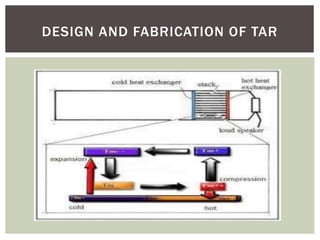
Design and Fabrication
Components
Experimental setup
Advantages
Disadvantages
Applications
Conclusion
CONTENTS
 Conventional refrigeration techniques have high energy costs
and continue to generate greenhouse gasses. Thermo-acoustic
is a combined branch of acoustics and thermodynamics which
studies the transfer of heat by sound waves. The Thermo-
acoustic refrigerator(TAR) uses sound energy to achieve
refrigeration.
 A prototype was designed, fabricated and tested for
exploration of this field and to demonstrate thermo-acoustic
effect. For the design,standing wave and a quarter wavelength
resonator with air as working fluid at ambient condition was
used.Possible modification in design has been discussed to
improve efficiency of TAR model.
ABSTRACT
 Refrigeration is the science of producing and maintaining
temperatures below that of the surrounding atmosphere.
 Until the beginning of the twenty-first century, CFC’S were
widely used as refrigerants. The use of CFC’s is banned
acknowledging its harmful effects on the environment.
 This led to the evolution of HCFC’s and HFC’s. However these
too have disadvantages. Both have high cost of production
and contribute to global warming.
 Thermo Acoustic Refrigeration (TAR)is one such green idea
for refrigeration.
INTRODUCTION
 Temperature difference (ΔT) between
hot end and cold end of the stack .
 The development of alternative cheap
and green refrigeration techniques as
the priority for the future.
OBJECTIVE
DESIGN AND FABRICATION OF TAR
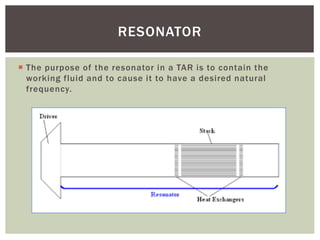
 The purpose of the resonator in a TAR is to contain the
working fluid and to cause it to have a desired natural
frequency.
RESONATOR
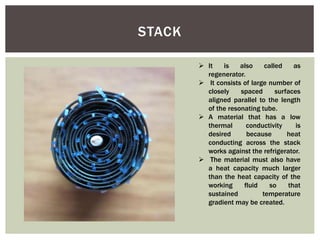
STACK
 It is also called as
regenerator.
 It consists of large number of
closely spaced surfaces
aligned parallel to the length
of the resonating tube.
 A material that has a low
thermal conductivity is
desired because heat
conducting across the stack
works against the refrigerator.
 The material must also have
a heat capacity much larger
than the heat capacity of the
working fluid so that
sustained temperature
gradient may be created.
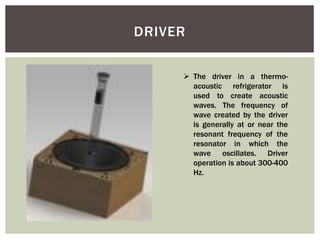
DRIVER
 The driver in a thermo-
acoustic refrigerator is
used to create acoustic
waves. The frequency of
wave created by the driver
is generally at or near the
resonant frequency of the
resonator in which the
wave oscillates. Driver
operation is about 300-400
Hz.
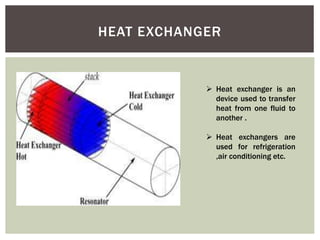
HEAT EXCHANGER
 Heat exchanger is an
device used to transfer
heat from one fluid to
another .
 Heat exchangers are
used for refrigeration
,air conditioning etc.
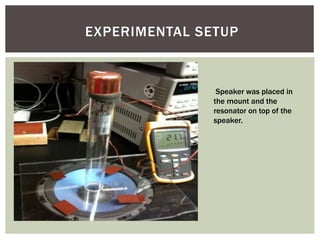
EXPERIMENTAL SETUP
Speaker was placed in
the mount and the
resonator on top of the
speaker.
 No moving parts for the process ,so very reliable and along
life span
 Environmentally friendly working medium,air,noble gas.
 The use of air or noble gas as working medium offers a large
window of appilication because there are no phase
transitions.
 Use of simple materials with no special requirements which
are commercially available in large quantities and therefore
relatively cheap.
 Thermo acoustic refrigeration works best with inert gases
such as helium and argon which harmless,nonflammable,non
toxic ,non ozone depleting or global warming and is judged
inexpensive to manufacture.
ADVANTAGES OF TAR
TAR is currently less efficient than the
traditional refrigerators.
Lack of suppliers producing customised
components.
There are not enough people who have
expertise on the combination of relevant
disciplines such as acoustic heat exchanger
design, etc.
DISADVANTAGES OF TAR
Cheap cooling
Electronic equipment cooling in Naval
ships
Space equipment cooling application
APPLICATIONS
 The conclusion that we can derive is that the model was
successful to demonstrate the Thermo-acoustic principle,
however it could not demonstrate a distinguishable thermo-
acoustic refrigeration phenomenon. The main reason for this
was the heat exchange process. The heat from the hot region
was not getting out of the system, thus getting accumulated
in between the upper portion of the stack and the lower
portion of heat exchanger
CONCLUSION

TAR ppt

  • 1.
  • 2.
    Abstract Introduction Objective Design and Fabrication Components Experimentalsetup Advantages Disadvantages Applications Conclusion CONTENTS
  • 3.
     Conventional refrigerationtechniques have high energy costs and continue to generate greenhouse gasses. Thermo-acoustic is a combined branch of acoustics and thermodynamics which studies the transfer of heat by sound waves. The Thermo- acoustic refrigerator(TAR) uses sound energy to achieve refrigeration.  A prototype was designed, fabricated and tested for exploration of this field and to demonstrate thermo-acoustic effect. For the design,standing wave and a quarter wavelength resonator with air as working fluid at ambient condition was used.Possible modification in design has been discussed to improve efficiency of TAR model. ABSTRACT
  • 4.
     Refrigeration isthe science of producing and maintaining temperatures below that of the surrounding atmosphere.  Until the beginning of the twenty-first century, CFC’S were widely used as refrigerants. The use of CFC’s is banned acknowledging its harmful effects on the environment.  This led to the evolution of HCFC’s and HFC’s. However these too have disadvantages. Both have high cost of production and contribute to global warming.  Thermo Acoustic Refrigeration (TAR)is one such green idea for refrigeration. INTRODUCTION
  • 5.
     Temperature difference(ΔT) between hot end and cold end of the stack .  The development of alternative cheap and green refrigeration techniques as the priority for the future. OBJECTIVE
  • 6.
  • 7.
     The purposeof the resonator in a TAR is to contain the working fluid and to cause it to have a desired natural frequency. RESONATOR
  • 8.
    STACK  It isalso called as regenerator.  It consists of large number of closely spaced surfaces aligned parallel to the length of the resonating tube.  A material that has a low thermal conductivity is desired because heat conducting across the stack works against the refrigerator.  The material must also have a heat capacity much larger than the heat capacity of the working fluid so that sustained temperature gradient may be created.
  • 9.
    DRIVER  The driverin a thermo- acoustic refrigerator is used to create acoustic waves. The frequency of wave created by the driver is generally at or near the resonant frequency of the resonator in which the wave oscillates. Driver operation is about 300-400 Hz.
  • 10.
    HEAT EXCHANGER  Heatexchanger is an device used to transfer heat from one fluid to another .  Heat exchangers are used for refrigeration ,air conditioning etc.
  • 11.
    EXPERIMENTAL SETUP Speaker wasplaced in the mount and the resonator on top of the speaker.
  • 12.
     No movingparts for the process ,so very reliable and along life span  Environmentally friendly working medium,air,noble gas.  The use of air or noble gas as working medium offers a large window of appilication because there are no phase transitions.  Use of simple materials with no special requirements which are commercially available in large quantities and therefore relatively cheap.  Thermo acoustic refrigeration works best with inert gases such as helium and argon which harmless,nonflammable,non toxic ,non ozone depleting or global warming and is judged inexpensive to manufacture. ADVANTAGES OF TAR
  • 13.
    TAR is currentlyless efficient than the traditional refrigerators. Lack of suppliers producing customised components. There are not enough people who have expertise on the combination of relevant disciplines such as acoustic heat exchanger design, etc. DISADVANTAGES OF TAR
  • 14.
    Cheap cooling Electronic equipmentcooling in Naval ships Space equipment cooling application APPLICATIONS
  • 15.
     The conclusionthat we can derive is that the model was successful to demonstrate the Thermo-acoustic principle, however it could not demonstrate a distinguishable thermo- acoustic refrigeration phenomenon. The main reason for this was the heat exchange process. The heat from the hot region was not getting out of the system, thus getting accumulated in between the upper portion of the stack and the lower portion of heat exchanger CONCLUSION