Nai-Talim: Connecting Knowledge to
life Outside the School
Dr. Sonali Channawar
Synopsis
 Introduction
 Objective
 Connecting Knowledge to life Outside the School
 Purpose
 Improvement Through Classroom Knowledge
 There are some ways to connecting knowledge with outside the school
 Major Functions of Learning knowledge Plays Important Role in school
Campus
 Major Functions of knowledge Plays Important Role in School Campus
outside the school Campus
 Conclusion
2
Introduction
Nai-Talim also known as Buniyadi Shikan or basic Education. Its principals reflect
knowledge and work not separated from each other. The word Nai-talim gave Mahatma
Gandhiji in 1937 in his newspaper “Harijan”.Nai-talim is the practice which talks about the
paradigm shift in education in basis requirement of skill development. Nai-talim is the way
of journey where every individual fill independent to survive her /his life by earning the
money, it’s a self-independent skill development process were enhancing the quality of
student to learn, to earn and to live for the happy life.
Nai -talim is the process of gaining the experience, knowledge and skill in
education and it improve the level of learning and earning skill in society through self-
learned experience. As we know the Nai -talim is made up of two word i.e. Nai as a New and
Talim as a Practice in education and it practices on development and understanding between
Hard-hearted Heart(3H).Nai talim is the combination and relationship between smart work
and its results that is relates to intelligence of the individual.
Presentation title 3
Presentation title 4
These two factors emphasizing the learning process by using the skill of Learning by
doing. Nai-talim helps the students to become self-reliant and think the importance and
realisation about child labour i.e., only a child work not labour, that means child should
understand the dignity of labour, equal work for all there is no any gender discrimination
(Channawar & Jajoo, 2019).
Nai-talim is the word given by Gandhiji and he believed that teaching learning process is the
strong tool to developing students’ self-reliance and quality for further work. By the help of
Nai -talim practices we can improve the quality of education and their self-employment
process and it gives positive direction towards
Nai -Talim is a combination of Knowledge and work, both are work together and this concept
translated with Gandhiji’s basic education. Gandhiji's was alive by their concept through basic
education and they want to upgrade the level of education and apply the policy and strategies
in all level of education where child is motivating for learning (Channawar & Jajoo, 2019).
Presentation title 5
Nai -Talim is a combination of Knowledge and work, both are work together and this
concept translated with Gandhiji’s basic education. Gandhijis was alive by their concept
through basic education and they want to upgrade the level of education and apply the
policy and strategies in all level of education where child is motivating for learning
(Channawar & Jajoo, 2019).
Nai-Talim also envisaged a different role for the new teacher, not simply as a professional
constrained by curricula and abstract standards, but rather as a person relating directly to the
students in the form of a dialogue. (Wikipedia, 2022). In Such type conditions learning
helps students to increase and achieve new knowledge, skill, new experience and new
abilities because of this connecting the students in local communities and this can be helpful
for changing their own life in various manner. Involvement of students in different
communities is helpful to change the observation and thinking towards the goal setting
strategies.
Main Objectives
Main objective of nai-talim is to achieve new experiences, new skill and new challenges in real word and
connecting theses knowledge in outside the life. Learning is continuous process of life and nai-talim is
continuous practicing and improving process of today’s education.
When we think about learning and their utility in education shown that there is so many ways to learn the knowledge, content, features,
aspects and traits through online and offline learning manner, flipped and blended learning, collaborative and cooperative learning,
instruction and inquiry-based learning.
In NCF 2005 gave five principles for curriculum development and among them “connecting knowledge to life outside the
school” is the first one. This is to understand the role of language in the context of learning so that methods of understanding are developed
in any subject. present school curriculum and examination system, is principle implies that the boundaries between the child’s daily life and
school knowledge need to be flexible. In this process language plays an important role in what child learn in his life. It is necessary to
understand the role of language in the context of learning so that methods of understanding are developed in any subject.
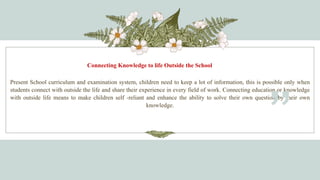
Connecting Knowledge to life Outside the School
”
Present School curriculum and examination system, children need to keep a lot of information, this is possible only when
students connect with outside the life and share their experience in every field of work. Connecting education or knowledge
with outside life means to make children self -reliant and enhance the ability to solve their own question by their own
knowledge.
Connecting Knowledge to life Outside the School
”
Presentation title 9
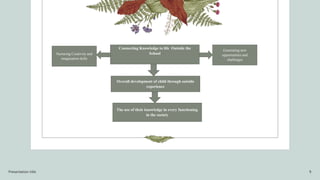
Connecting Knowledge to life Outside the
School
Overall development of child through outside
experience
The use of their knowledge in every functioning
in the society
Generating new
opportunities and
challenges
Nurturing Creativity and
imagination skills
Presentation title 10
There is also a relational aspect to outside learning experiences as it gives students and
instructors an opportunity to interact in more informal and meaningful ways.
From the bus ride there to the bus ride home, students and instructors can enhance their I
nterpersonal and team-building skills. Taking the class out in variable environments fosters a learning
model where everyone has to contribute and different student strengths rise to the surface and benefit the
group in dynamic ways (Hole, 2018)(Holton, 2017) (Larsen, 2017)
Presentation title 11
Purpose
The main purpose of this theme to enlarge and open the view of knowledge and work is “worship not labour.
Nai-Talim is the only source for activate participation in local communities and inculcating societal values among
children become the responsibility of the school, policy- maker and stakeholders. Developing mechanism needs
to involve in educational curriculum and uphold the graph of nation in high level of success.
Presentation title 12
Purpose of education
Prepare students for life
Developing new opportunities for students
Collaboration, networking and spreading the ideas, views and
opinion
Connecting classroom with real world
Designing meaningful framework for individual development
Presentation title 13
Improvement Through Classroom Knowledge
School is the powerful platform for connecting knowledge in classroom and outside the
classroom through various activities. The education or knowledge given in the school is
called formal education, whereas the education or knowledge received in the home or
society is called informal education. Students do not get all the knowledge in school but lot
of knowledge learn from outside the school through practical and real observation. In
school we are more frequently use the theory knowledge and some practical with activities.
Society and community enhancing the real-world knowledge, critical thinking and
concreate knowledge. The knowledge that the students get from the classroom, he or she
uses that knowledge in his life according to incidents that happen.
Presentation title 14
Reflection of Knowledge
Improve Learning Abilities-
Improving Leaning skills
Enhancing qualities
Developing Critical thinking
Motivating their though process
Accepting and welcoming the ideas
Connecting local communities
Increasing interactive skill
Developing leadership qualities
Presentation title 15
There are some ways to connecting knowledge with outside the school
1] Field trip -Field trips may be defined as “any journey taken under the auspices of the school for educational
purposes” (Sorrentino & Bell, 1970).Field trip gives first real-world experience to learn and observe the think in
minute manner. Due to experience of field trip develop students’ perception skill towards any work and also
changing the behaviour of the student. Field trip also increase the executive and leadership quality among
students to accepting any kind of challenges.
2] Exhibition-Through exhibition students put their efforts and develop curiosity to make impressive models
with their own talents, imagination and societal befit. When students give presentation confidently in-front of
public domain and also build confidence level from fear and remove hesitation while speaking with public.
Through exhibition teacher wants to make their students independent and encourage them to solve their
problem in every situation. Exhibition make them systematic by their planning, research, application and
analysis mode of behavioural strategies. These steps make them strong in self decision-making process.
Presentation title 16
3] Internship in various industries
An educational internship is directly connected with the learning experience that is related
to their practical work of study field and their interest. It gives opportunity for enhancing the
quality in career exploration and development of skills and learn the different innovative ideas
from the internship. After getting different opportunities to learn the professional experience and
gain the leadership quality and expanding the future good career possibilities and accessibilities
in various sector. Developing and create a strong career network on the basis of performance.
4] Social Awareness camp
Social awareness helps students to develop life skill by communicating and opening with others.
Social awareness improves the relationship and responsible decision-making strategies for
maintain the social decorum of the society. Through awareness student understand the
perspectives of their own values. These values help to change behaviour for solving the daily
problem and issues.
Presentation title 17
5] Cultural activities
Culture activities are enhancing life skills like creativity, self -confidence, self -discipline, effective
communication skill team work ability, community empowerment, capacity building among students.
Students are participating in inside and outside the school activities and competition at school, college,
university, state and national level are motivating to build their confidence.
6] Project based Learning
Project based learning are helpful for deeper engagement and interaction with learning subject matter and it
also encourage the students. Developing higher order thinking and make them strong in problem solving
situations. Due to project-based learning student learn new innovative ideas with new concept and topic and
for that they can search the relevant content for new knowledge. During this process student can achieve to
organize and present information will use in future work. Critical Thinking develop to think and visualising
the new outcomes results of their work.
Presentation title 18
7] Experiential learning
Experiential learning is an engaging student in activity (hands on practice and experience) with the theme of learning
by doing. Through experiential learning student direct connected with the real-world situation in class and outside the
class. experiential learning improves concreate learning, reflective observation, abstract conceptualization and active
experimentation. With help of student’s long-term experience useful to use in daily life and their workplace. learner
progress is depending these Kolb’s Cycle (concreate learning, reflective observation, abstract conceptualization and
active experimentation).
8] Technology connective activities
To thrive in the 21 st-century workplace, students need to have more than a working knowledge of certain
technological tools, such as electronic calendars, interacting with web pages, teleconferencing, electronic whiteboards,
etc. By integrating these technologies into the regular curriculum and on-going activities, institutions are ensuring that
their students are better prepared for the modern office (Explorance, 2022). Also, for industries work, School working
place anywhere students can use this technology skill in their job place in various manner. With the help of technology
make fun in the classroom through game-based learning. Technology enhances the quality of teaching in classroom
and increase the learning level of students.
Presentation title 19
9.Community engagement activity
In classroom teaching teacher can involves various activities and task on societal
based engagement, it helps students to understand and closer with the culture and
community of the society. Also organise the camp, tour and awareness program for
community engagement practices. Community engagement help students to get closer
with their community and understand themselves as a member of community and this
cultural society. Each and every student has to know the importance of community and
their engagement. It helps to increase the networks and learn so many things while
interacting with them. Community is the part of the society and student is the integral
part of the society for connecting the lives in mainstream living style. Nai-talim is
focuses to connect the students in community engagement activities and their habitat. It
gives extra and essential knowledge to know the basic source, origin, perspectives,
earning pattern, work and their abilities.
Presentation title 20
Major Functions of Learning knowledge Plays Important Role
in school Campus
Teaching (Focussed on theoretical knowledge)
Learning (Single way of practicing)
Socialization (study on values)
Modification in behaviours (How ,What Where etiquettes)
Acquaintance with culture
Help in Physical development
Preservation of tradition and conventions
Inculcation of fellow feelings
Environment education (closed in school environment)
Presentation title 21
Major Functions of knowledge Plays Important Role in School Campus outside
the school Campus
Physical fitness (in nature)
Environmental education (Learn save and protect strategies)
Development of human values (Trough various act loke nukkad natak and play)
Learning Adventures in life (practicing on defence and risk operating behaviour)
Recreational experience in life (Enthusiasm)
Development of hands-on experiences in various manner
Discipline (punctuality and Patience)
Keen observation (increase the practical knowledge)
Development of strong Communication (public domain)
Community Engagement (Learn and earn the Culture pattern)
Presentation title 22
Conclusion
Education is the bridge of literacy and strength of people. It gives self -reliance, increase
self-efficacy, motivate inner ability, strengthen the confidence, sharpen the observation,
helping to rich and target the goal. Teaching -learning process will help to connecting the
learned knowledge inside and outside the classroom. Connecting knowledge with life
outside the school so that the knowledge taught in local contexts as well as it can be used in
daily life. With this skill students make oneself feel proud and independent in every
working place.
23
BIBLIOGRAPHY
Channawar, & Jajoo. (2019, FEB). Ways to Make Nai Talim A Lifelong,Creative and Innovative Process. International
Journal for Reaserch in Engineering Application and Management (IJREAM), 04(11).
Explorance. (2022, May 20). 7 Reasons Why Students Need Technology in the Classroom. Retrieved from
http://explorance.com/blog/7-reasons-students-need-technology-classroom/
Hole, T. (2018). Working and Learning in a field Excursion. Cell BiologyEducation:Life Sciences Education, 17(2).
Holton, M. (2017). It Was Amazing to See Our Projects Come to Life ! Journal of Geography in Higher Education, 41(2),
198-212.
Larsen, C. (2017). The Real Value of Field Trips in the Early Weeks of Higher Education. The Student Perspective
.Educational Studies, 43(1), 110-121.
Sorrentino, A., & Bell, P. (1970). A Comparison of attributed values with empirically determined values of secondary
scool science field trips. Science Education, 233-236. doi:http://doi.org/10.1002/sce.3730540308
Wikipedia. (2022, June 6). Nai-Talim. Retrieved from http://en.wikipedia.org/wiki/Nai_Talim
Thank you Dr. Sonali Channawar

Nai-Talim: Connecting Knowledge to life Outside the School

  • 1.
    Nai-Talim: Connecting Knowledgeto life Outside the School Dr. Sonali Channawar
  • 2.
    Synopsis  Introduction  Objective Connecting Knowledge to life Outside the School  Purpose  Improvement Through Classroom Knowledge  There are some ways to connecting knowledge with outside the school  Major Functions of Learning knowledge Plays Important Role in school Campus  Major Functions of knowledge Plays Important Role in School Campus outside the school Campus  Conclusion 2
  • 3.
    Introduction Nai-Talim also knownas Buniyadi Shikan or basic Education. Its principals reflect knowledge and work not separated from each other. The word Nai-talim gave Mahatma Gandhiji in 1937 in his newspaper “Harijan”.Nai-talim is the practice which talks about the paradigm shift in education in basis requirement of skill development. Nai-talim is the way of journey where every individual fill independent to survive her /his life by earning the money, it’s a self-independent skill development process were enhancing the quality of student to learn, to earn and to live for the happy life. Nai -talim is the process of gaining the experience, knowledge and skill in education and it improve the level of learning and earning skill in society through self- learned experience. As we know the Nai -talim is made up of two word i.e. Nai as a New and Talim as a Practice in education and it practices on development and understanding between Hard-hearted Heart(3H).Nai talim is the combination and relationship between smart work and its results that is relates to intelligence of the individual. Presentation title 3
  • 4.
    Presentation title 4 Thesetwo factors emphasizing the learning process by using the skill of Learning by doing. Nai-talim helps the students to become self-reliant and think the importance and realisation about child labour i.e., only a child work not labour, that means child should understand the dignity of labour, equal work for all there is no any gender discrimination (Channawar & Jajoo, 2019). Nai-talim is the word given by Gandhiji and he believed that teaching learning process is the strong tool to developing students’ self-reliance and quality for further work. By the help of Nai -talim practices we can improve the quality of education and their self-employment process and it gives positive direction towards Nai -Talim is a combination of Knowledge and work, both are work together and this concept translated with Gandhiji’s basic education. Gandhiji's was alive by their concept through basic education and they want to upgrade the level of education and apply the policy and strategies in all level of education where child is motivating for learning (Channawar & Jajoo, 2019).
  • 5.
    Presentation title 5 Nai-Talim is a combination of Knowledge and work, both are work together and this concept translated with Gandhiji’s basic education. Gandhijis was alive by their concept through basic education and they want to upgrade the level of education and apply the policy and strategies in all level of education where child is motivating for learning (Channawar & Jajoo, 2019). Nai-Talim also envisaged a different role for the new teacher, not simply as a professional constrained by curricula and abstract standards, but rather as a person relating directly to the students in the form of a dialogue. (Wikipedia, 2022). In Such type conditions learning helps students to increase and achieve new knowledge, skill, new experience and new abilities because of this connecting the students in local communities and this can be helpful for changing their own life in various manner. Involvement of students in different communities is helpful to change the observation and thinking towards the goal setting strategies.
  • 6.
    Main Objectives Main objectiveof nai-talim is to achieve new experiences, new skill and new challenges in real word and connecting theses knowledge in outside the life. Learning is continuous process of life and nai-talim is continuous practicing and improving process of today’s education.
  • 7.
    When we thinkabout learning and their utility in education shown that there is so many ways to learn the knowledge, content, features, aspects and traits through online and offline learning manner, flipped and blended learning, collaborative and cooperative learning, instruction and inquiry-based learning. In NCF 2005 gave five principles for curriculum development and among them “connecting knowledge to life outside the school” is the first one. This is to understand the role of language in the context of learning so that methods of understanding are developed in any subject. present school curriculum and examination system, is principle implies that the boundaries between the child’s daily life and school knowledge need to be flexible. In this process language plays an important role in what child learn in his life. It is necessary to understand the role of language in the context of learning so that methods of understanding are developed in any subject. Connecting Knowledge to life Outside the School ”
  • 8.
    Present School curriculumand examination system, children need to keep a lot of information, this is possible only when students connect with outside the life and share their experience in every field of work. Connecting education or knowledge with outside life means to make children self -reliant and enhance the ability to solve their own question by their own knowledge. Connecting Knowledge to life Outside the School ”
  • 9.
    Presentation title 9 ConnectingKnowledge to life Outside the School Overall development of child through outside experience The use of their knowledge in every functioning in the society Generating new opportunities and challenges Nurturing Creativity and imagination skills
  • 10.
    Presentation title 10 Thereis also a relational aspect to outside learning experiences as it gives students and instructors an opportunity to interact in more informal and meaningful ways. From the bus ride there to the bus ride home, students and instructors can enhance their I nterpersonal and team-building skills. Taking the class out in variable environments fosters a learning model where everyone has to contribute and different student strengths rise to the surface and benefit the group in dynamic ways (Hole, 2018)(Holton, 2017) (Larsen, 2017)
  • 11.
    Presentation title 11 Purpose Themain purpose of this theme to enlarge and open the view of knowledge and work is “worship not labour. Nai-Talim is the only source for activate participation in local communities and inculcating societal values among children become the responsibility of the school, policy- maker and stakeholders. Developing mechanism needs to involve in educational curriculum and uphold the graph of nation in high level of success.
  • 12.
    Presentation title 12 Purposeof education Prepare students for life Developing new opportunities for students Collaboration, networking and spreading the ideas, views and opinion Connecting classroom with real world Designing meaningful framework for individual development
  • 13.
    Presentation title 13 ImprovementThrough Classroom Knowledge School is the powerful platform for connecting knowledge in classroom and outside the classroom through various activities. The education or knowledge given in the school is called formal education, whereas the education or knowledge received in the home or society is called informal education. Students do not get all the knowledge in school but lot of knowledge learn from outside the school through practical and real observation. In school we are more frequently use the theory knowledge and some practical with activities. Society and community enhancing the real-world knowledge, critical thinking and concreate knowledge. The knowledge that the students get from the classroom, he or she uses that knowledge in his life according to incidents that happen.
  • 14.
    Presentation title 14 Reflectionof Knowledge Improve Learning Abilities- Improving Leaning skills Enhancing qualities Developing Critical thinking Motivating their though process Accepting and welcoming the ideas Connecting local communities Increasing interactive skill Developing leadership qualities
  • 15.
    Presentation title 15 Thereare some ways to connecting knowledge with outside the school 1] Field trip -Field trips may be defined as “any journey taken under the auspices of the school for educational purposes” (Sorrentino & Bell, 1970).Field trip gives first real-world experience to learn and observe the think in minute manner. Due to experience of field trip develop students’ perception skill towards any work and also changing the behaviour of the student. Field trip also increase the executive and leadership quality among students to accepting any kind of challenges. 2] Exhibition-Through exhibition students put their efforts and develop curiosity to make impressive models with their own talents, imagination and societal befit. When students give presentation confidently in-front of public domain and also build confidence level from fear and remove hesitation while speaking with public. Through exhibition teacher wants to make their students independent and encourage them to solve their problem in every situation. Exhibition make them systematic by their planning, research, application and analysis mode of behavioural strategies. These steps make them strong in self decision-making process.
  • 16.
    Presentation title 16 3]Internship in various industries An educational internship is directly connected with the learning experience that is related to their practical work of study field and their interest. It gives opportunity for enhancing the quality in career exploration and development of skills and learn the different innovative ideas from the internship. After getting different opportunities to learn the professional experience and gain the leadership quality and expanding the future good career possibilities and accessibilities in various sector. Developing and create a strong career network on the basis of performance. 4] Social Awareness camp Social awareness helps students to develop life skill by communicating and opening with others. Social awareness improves the relationship and responsible decision-making strategies for maintain the social decorum of the society. Through awareness student understand the perspectives of their own values. These values help to change behaviour for solving the daily problem and issues.
  • 17.
    Presentation title 17 5]Cultural activities Culture activities are enhancing life skills like creativity, self -confidence, self -discipline, effective communication skill team work ability, community empowerment, capacity building among students. Students are participating in inside and outside the school activities and competition at school, college, university, state and national level are motivating to build their confidence. 6] Project based Learning Project based learning are helpful for deeper engagement and interaction with learning subject matter and it also encourage the students. Developing higher order thinking and make them strong in problem solving situations. Due to project-based learning student learn new innovative ideas with new concept and topic and for that they can search the relevant content for new knowledge. During this process student can achieve to organize and present information will use in future work. Critical Thinking develop to think and visualising the new outcomes results of their work.
  • 18.
    Presentation title 18 7]Experiential learning Experiential learning is an engaging student in activity (hands on practice and experience) with the theme of learning by doing. Through experiential learning student direct connected with the real-world situation in class and outside the class. experiential learning improves concreate learning, reflective observation, abstract conceptualization and active experimentation. With help of student’s long-term experience useful to use in daily life and their workplace. learner progress is depending these Kolb’s Cycle (concreate learning, reflective observation, abstract conceptualization and active experimentation). 8] Technology connective activities To thrive in the 21 st-century workplace, students need to have more than a working knowledge of certain technological tools, such as electronic calendars, interacting with web pages, teleconferencing, electronic whiteboards, etc. By integrating these technologies into the regular curriculum and on-going activities, institutions are ensuring that their students are better prepared for the modern office (Explorance, 2022). Also, for industries work, School working place anywhere students can use this technology skill in their job place in various manner. With the help of technology make fun in the classroom through game-based learning. Technology enhances the quality of teaching in classroom and increase the learning level of students.
  • 19.
    Presentation title 19 9.Communityengagement activity In classroom teaching teacher can involves various activities and task on societal based engagement, it helps students to understand and closer with the culture and community of the society. Also organise the camp, tour and awareness program for community engagement practices. Community engagement help students to get closer with their community and understand themselves as a member of community and this cultural society. Each and every student has to know the importance of community and their engagement. It helps to increase the networks and learn so many things while interacting with them. Community is the part of the society and student is the integral part of the society for connecting the lives in mainstream living style. Nai-talim is focuses to connect the students in community engagement activities and their habitat. It gives extra and essential knowledge to know the basic source, origin, perspectives, earning pattern, work and their abilities.
  • 20.
    Presentation title 20 MajorFunctions of Learning knowledge Plays Important Role in school Campus Teaching (Focussed on theoretical knowledge) Learning (Single way of practicing) Socialization (study on values) Modification in behaviours (How ,What Where etiquettes) Acquaintance with culture Help in Physical development Preservation of tradition and conventions Inculcation of fellow feelings Environment education (closed in school environment)
  • 21.
    Presentation title 21 MajorFunctions of knowledge Plays Important Role in School Campus outside the school Campus Physical fitness (in nature) Environmental education (Learn save and protect strategies) Development of human values (Trough various act loke nukkad natak and play) Learning Adventures in life (practicing on defence and risk operating behaviour) Recreational experience in life (Enthusiasm) Development of hands-on experiences in various manner Discipline (punctuality and Patience) Keen observation (increase the practical knowledge) Development of strong Communication (public domain) Community Engagement (Learn and earn the Culture pattern)
  • 22.
    Presentation title 22 Conclusion Educationis the bridge of literacy and strength of people. It gives self -reliance, increase self-efficacy, motivate inner ability, strengthen the confidence, sharpen the observation, helping to rich and target the goal. Teaching -learning process will help to connecting the learned knowledge inside and outside the classroom. Connecting knowledge with life outside the school so that the knowledge taught in local contexts as well as it can be used in daily life. With this skill students make oneself feel proud and independent in every working place.
  • 23.
    23 BIBLIOGRAPHY Channawar, & Jajoo.(2019, FEB). Ways to Make Nai Talim A Lifelong,Creative and Innovative Process. International Journal for Reaserch in Engineering Application and Management (IJREAM), 04(11). Explorance. (2022, May 20). 7 Reasons Why Students Need Technology in the Classroom. Retrieved from http://explorance.com/blog/7-reasons-students-need-technology-classroom/ Hole, T. (2018). Working and Learning in a field Excursion. Cell BiologyEducation:Life Sciences Education, 17(2). Holton, M. (2017). It Was Amazing to See Our Projects Come to Life ! Journal of Geography in Higher Education, 41(2), 198-212. Larsen, C. (2017). The Real Value of Field Trips in the Early Weeks of Higher Education. The Student Perspective .Educational Studies, 43(1), 110-121. Sorrentino, A., & Bell, P. (1970). A Comparison of attributed values with empirically determined values of secondary scool science field trips. Science Education, 233-236. doi:http://doi.org/10.1002/sce.3730540308 Wikipedia. (2022, June 6). Nai-Talim. Retrieved from http://en.wikipedia.org/wiki/Nai_Talim
  • 24.
    Thank you Dr.Sonali Channawar