ILLINOIS HIGH SCHOOL 
Ensuring a bright future for every child 
WELCOME
MULTIDISCIPLINARY TEAM 
 DIANA FIGUEROA– SPECIAL EDUCATION TEACHER 
 ELLEN SAGENDORPH- SPEECH PATHOLOGIST 
 RACHEL PETCHNIK- SOCIAL WORKER 
 BLANCA MOSQUERA- GENERAL EDUCATION 
TEACHER
REPORT CARD 
High School Overview
What is Special Education? 
 Special education as intervention 
 Preventive: Designed to keep minor problems from 
becoming a disability 
 Remedial: Attempt to eliminate the effects of a disability 
 Compensatory: Enable successful functioning in spite of the 
disability 
 Special education as instruction 
 Individually planned 
 Specialized 
 Intensive 
 Goal-directed
General Recommendations to Enhance Access 
for Students with Disabilities to General 
Education 
 Provide Supplementary Aids and Services 
 Universal Design for Learning 
 Access 
 Classroom Ecology 
 Educational and Assistive Technology 
 Assessment and Task Modifications 
 Teacher, paraprofessional, or peer support
Inclusion 
Definition 
 According to the WEAC: 
 Inclusion expresses commitment to educate each child, to the maximum 
extent appropriate, in the school and classroom he or she would otherwise 
attend 
 Involves bringing support services to the child 
 Requires only that the child will benefit from being in the class (versus 
struggling to keep up) 
 According to Module 3 
 Characteristics of inclusion: 
 Home-school placement 
 Principle of natural proportions 
 Restructuring teaching and learning 
 Age and grade appropriate placements 
 Consecutive phases of inclusion: 
 Mainstreaming 
 Regular education initiative 
 Inclusion through accommodations 
 Inclusion through restructuring
Inclusion 
 The article “Special Education Inclusion” from 
Education World describes five ways in which 
inclusion benefits children with disabilities. 
 Inclusion improves learning for both special education and 
regular education students 
 Children learn to accept individual differences 
 Children develop new friendships 
 Parent participation improves 
 It's a matter of civil rights
Practice to Implement to Support Inclusion at the 
High School Level 
 Implement the Consecutive Phases of Inclusion: 
 Mainstreaming 
 Regular Education Initiative 
 Inclusion through Accommodations 
 Inclusion through Restructuring
Definition of Emotional or Behavioral Disorders 
 A condition that is accompanied by one or more of 
the following characteristics: 
 An inability to learn that cannot be explained by intellectual, 
sensory, or health factors 
 An inability to build or maintain satisfactory interpersonal 
relationships with peers and teachers 
 Inappropriate types of behavior or feelings under normal 
circumstances 
 A general, pervasive mood of unhappiness and depression 
 A tendency to develop physical symptoms or fears associated 
with personal or school problems
Autism 
 “developmental disability that significantly affects a student’s verbal 
and non-verbal communication, social interaction, and educational 
performance and often manifests in children by the age of three” 
(Lord, 2010). 
 Appropriate umbrella term 
 Pervasive Developmental Disorder describes five related disorders; 
Autism among them (APA, 2000). 
 Autism, Asperger syndrome, Rett’s syndrome, childhood 
disintegrative disorder; and Pervasive Developmental-NOS 
 Autism Spectrum Disorders is the term most commonly used 
(Turnbull et al., 2014) (NICHY, 2010) 
 Caused by biological and environmental factors (Turnbull et al., 2014) 
 1 in 68 children in the U.S have Autism (CDC, 2014)
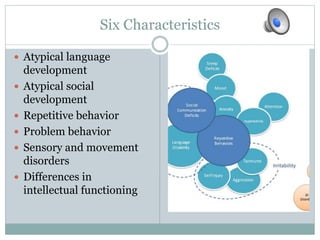
Six Characteristics 
 Atypical language 
development 
 Atypical social 
development 
 Repetitive behavior 
 Problem behavior 
 Sensory and movement 
disorders 
 Differences in 
intellectual functioning
Specific Academic Recommendations 
 Stable and organized classroom environment 
 Priming 
 Time modifications 
 Visual Supports and 
 Explicit instruction
Specific Behavioral/Social Accommodations 
 Stress-relief areas 
 Peer buddy 
 Functional Behavior Assessment/PBS
Visual Impairment 
 General Information 
 According to Module 11, the IDEA definition of visual 
impairment is, “Low vision; functionally blind; and totally 
blind. Visual impairment including blindness means an 
impairment in vision that, even with correction, adversely 
affects a child's educational performance. The term includes 
both partial sight and blindness.” 
 Characteristics could include: physical, clumsiness, behavior, 
poor hand-eye coordination, and poor academic performance
Visual Impairment 
 Specific Recommendations- Academic 
 Major academic challenge for VI students in the classroom: 
Concept development 
 Teaching challenges include: incidental learning, part-to-whole 
learning, and learning through observation 
 Suggestions for teaching from IRIS 
 Read aloud what is written 
 Describe all pictures, diagrams, and graphs 
 Invite students with low vision to reposition themselves as 
needed 
 Encourage students to use low-vision devices 
 Multi-sensory approaches 
 Hand-over-hand instruction
Visual Impairment 
 Specific Recommendations- Social/Emotional 
 IRIS page from Module 11 
 Students with visual impairments are sometimes unaware of social 
conventions 
 Some interventions may be as simple as encouraging students to face 
others when they are speaking 
 Could be overwhelming for students with visual impairments to 
address all necessary skills at once 
 Work on skills one or two at a time 
 School counselors and social workers advise students in matters 
related to school success and planning, including academics, 
attendance, social issues, and post-secondary transitions. 
 Collaborate with TVIs (teachers of students with visual impairments), 
O&M specialists (orientation and mobility), and families to ensure 
that psychosocial issues related to blindness are addressed 
appropriately
Specific Recommendations for 
Students with 
Emotional/Behavioral Disorders 
ELLEN SAGENDORPH
Behavioral Characteristics of Emotional or 
Behavioral Disorder 
 Externalizing Behaviors 
 Internalizing Behaviors
Characteristics of Emotional or Behavioral 
Disorders 
 Anxiety Disorder 
 Mood Disorder 
 Oppositional Defiant Disorder 
 Conduct Disorder 
 Schizophrenia
Academic Recommendations 
 Teach Conflict Resolution 
 Incorporate Positive Behavior Support
Social/Behavioral Recommendations 
 Incorporate Wrap-Around Services 
 Teach the Student Social Skills 
 Encourage Student Engagement
Current and Future Challenges 
 Bridge the research-to-practice gap 
 Increase the availability and intensity of early 
intervention and prevention programs 
 Improve students’ transition from school to adult 
life 
 Improve the special education—general education 
partnership
A PICTURE OF SUCCESSFUL INCLUSION AND 
GENERAL RECOMMENDATIONS 
 The most-effective inclusive classrooms have the following 
characteristics: 
 Kids are clustered in specific classes but distributed across all teachers. 
 Students receive instructional supports that maximize their 
participation in the general education curriculum and their 
engagement in the general population. 
 Teachers use a variety of strategies, including curriculum and 
instructional adaptations, peer tutoring, cooperative learning, and 
layered curriculum. 
 When this kind of educational program is in place, inclusion is 
practically invisible. 
 That's the way it is meant to be
References 
 Instructional Accommodations: Making the Learning 
Environment Accessible to Students with Visual 
Disabilities. (n.d.). Retrieved December 9, 2014, from 
http://iris.peabody.vanderbilt.edu/module/v02- 
successsight/#content 
 Special Education Inclusion. (2014). Retrieved December 
9, 2014, from 
http://www.educationworld.com/a_curr/curr320.shtml 
 Special Education Inclusion. (n.d.). Retrieved December 
9, 2014, from http://weac.org/articles/specialedinc/

Team 3 final

  • 1.
    ILLINOIS HIGH SCHOOL Ensuring a bright future for every child WELCOME
  • 2.
    MULTIDISCIPLINARY TEAM DIANA FIGUEROA– SPECIAL EDUCATION TEACHER  ELLEN SAGENDORPH- SPEECH PATHOLOGIST  RACHEL PETCHNIK- SOCIAL WORKER  BLANCA MOSQUERA- GENERAL EDUCATION TEACHER
  • 3.
    REPORT CARD HighSchool Overview
  • 5.
    What is SpecialEducation?  Special education as intervention  Preventive: Designed to keep minor problems from becoming a disability  Remedial: Attempt to eliminate the effects of a disability  Compensatory: Enable successful functioning in spite of the disability  Special education as instruction  Individually planned  Specialized  Intensive  Goal-directed
  • 6.
    General Recommendations toEnhance Access for Students with Disabilities to General Education  Provide Supplementary Aids and Services  Universal Design for Learning  Access  Classroom Ecology  Educational and Assistive Technology  Assessment and Task Modifications  Teacher, paraprofessional, or peer support
  • 7.
    Inclusion Definition According to the WEAC:  Inclusion expresses commitment to educate each child, to the maximum extent appropriate, in the school and classroom he or she would otherwise attend  Involves bringing support services to the child  Requires only that the child will benefit from being in the class (versus struggling to keep up)  According to Module 3  Characteristics of inclusion:  Home-school placement  Principle of natural proportions  Restructuring teaching and learning  Age and grade appropriate placements  Consecutive phases of inclusion:  Mainstreaming  Regular education initiative  Inclusion through accommodations  Inclusion through restructuring
  • 8.
    Inclusion  Thearticle “Special Education Inclusion” from Education World describes five ways in which inclusion benefits children with disabilities.  Inclusion improves learning for both special education and regular education students  Children learn to accept individual differences  Children develop new friendships  Parent participation improves  It's a matter of civil rights
  • 9.
    Practice to Implementto Support Inclusion at the High School Level  Implement the Consecutive Phases of Inclusion:  Mainstreaming  Regular Education Initiative  Inclusion through Accommodations  Inclusion through Restructuring
  • 10.
    Definition of Emotionalor Behavioral Disorders  A condition that is accompanied by one or more of the following characteristics:  An inability to learn that cannot be explained by intellectual, sensory, or health factors  An inability to build or maintain satisfactory interpersonal relationships with peers and teachers  Inappropriate types of behavior or feelings under normal circumstances  A general, pervasive mood of unhappiness and depression  A tendency to develop physical symptoms or fears associated with personal or school problems
  • 11.
    Autism  “developmentaldisability that significantly affects a student’s verbal and non-verbal communication, social interaction, and educational performance and often manifests in children by the age of three” (Lord, 2010).  Appropriate umbrella term  Pervasive Developmental Disorder describes five related disorders; Autism among them (APA, 2000).  Autism, Asperger syndrome, Rett’s syndrome, childhood disintegrative disorder; and Pervasive Developmental-NOS  Autism Spectrum Disorders is the term most commonly used (Turnbull et al., 2014) (NICHY, 2010)  Caused by biological and environmental factors (Turnbull et al., 2014)  1 in 68 children in the U.S have Autism (CDC, 2014)
  • 12.
    Six Characteristics Atypical language development  Atypical social development  Repetitive behavior  Problem behavior  Sensory and movement disorders  Differences in intellectual functioning
  • 13.
    Specific Academic Recommendations  Stable and organized classroom environment  Priming  Time modifications  Visual Supports and  Explicit instruction
  • 14.
    Specific Behavioral/Social Accommodations  Stress-relief areas  Peer buddy  Functional Behavior Assessment/PBS
  • 15.
    Visual Impairment General Information  According to Module 11, the IDEA definition of visual impairment is, “Low vision; functionally blind; and totally blind. Visual impairment including blindness means an impairment in vision that, even with correction, adversely affects a child's educational performance. The term includes both partial sight and blindness.”  Characteristics could include: physical, clumsiness, behavior, poor hand-eye coordination, and poor academic performance
  • 16.
    Visual Impairment Specific Recommendations- Academic  Major academic challenge for VI students in the classroom: Concept development  Teaching challenges include: incidental learning, part-to-whole learning, and learning through observation  Suggestions for teaching from IRIS  Read aloud what is written  Describe all pictures, diagrams, and graphs  Invite students with low vision to reposition themselves as needed  Encourage students to use low-vision devices  Multi-sensory approaches  Hand-over-hand instruction
  • 17.
    Visual Impairment Specific Recommendations- Social/Emotional  IRIS page from Module 11  Students with visual impairments are sometimes unaware of social conventions  Some interventions may be as simple as encouraging students to face others when they are speaking  Could be overwhelming for students with visual impairments to address all necessary skills at once  Work on skills one or two at a time  School counselors and social workers advise students in matters related to school success and planning, including academics, attendance, social issues, and post-secondary transitions.  Collaborate with TVIs (teachers of students with visual impairments), O&M specialists (orientation and mobility), and families to ensure that psychosocial issues related to blindness are addressed appropriately
  • 18.
    Specific Recommendations for Students with Emotional/Behavioral Disorders ELLEN SAGENDORPH
  • 19.
    Behavioral Characteristics ofEmotional or Behavioral Disorder  Externalizing Behaviors  Internalizing Behaviors
  • 20.
    Characteristics of Emotionalor Behavioral Disorders  Anxiety Disorder  Mood Disorder  Oppositional Defiant Disorder  Conduct Disorder  Schizophrenia
  • 21.
    Academic Recommendations Teach Conflict Resolution  Incorporate Positive Behavior Support
  • 22.
    Social/Behavioral Recommendations Incorporate Wrap-Around Services  Teach the Student Social Skills  Encourage Student Engagement
  • 23.
    Current and FutureChallenges  Bridge the research-to-practice gap  Increase the availability and intensity of early intervention and prevention programs  Improve students’ transition from school to adult life  Improve the special education—general education partnership
  • 24.
    A PICTURE OFSUCCESSFUL INCLUSION AND GENERAL RECOMMENDATIONS  The most-effective inclusive classrooms have the following characteristics:  Kids are clustered in specific classes but distributed across all teachers.  Students receive instructional supports that maximize their participation in the general education curriculum and their engagement in the general population.  Teachers use a variety of strategies, including curriculum and instructional adaptations, peer tutoring, cooperative learning, and layered curriculum.  When this kind of educational program is in place, inclusion is practically invisible.  That's the way it is meant to be
  • 25.
    References  InstructionalAccommodations: Making the Learning Environment Accessible to Students with Visual Disabilities. (n.d.). Retrieved December 9, 2014, from http://iris.peabody.vanderbilt.edu/module/v02- successsight/#content  Special Education Inclusion. (2014). Retrieved December 9, 2014, from http://www.educationworld.com/a_curr/curr320.shtml  Special Education Inclusion. (n.d.). Retrieved December 9, 2014, from http://weac.org/articles/specialedinc/

Editor's Notes

  • #12 -As of 2013, ASD -Retts and CDD no longer included in ASD diagnosis (Harker et al, 2014). (Via IRIS Peabody) -The term autism does not apply if the child’s educational performance is adversely affected primarily because the child has an emotional disturbance”, (IDEA). -Such as genes and exposure to toxins in the environment during prenatal development. -88% increase from two years ago. (centers for disease control and prevention)
  • #13 As the word "spectrum" suggests, people with autism spectrum disorder (ASD) may have challenges that run the gamut from mild to severe, with different levels of ability and disability. Someone may have no functional speech, or may have a rich vocabulary. He or she may be intellectually disabled or have an average or above average IQ. He may be socially withdrawn or may be socially active, although in an oblivious, eccentric way. He may be fixated on lining up toys in a certain order, or have an encyclopedic knowledge of animals or another favorite topic. (IAN, 2014) -There is a broad range of communication related issues due to atypical language development; This can include Interrupting others and not knowing the appropriate time to speak, reversing pronouns, echoing other’s language (Eigisti, de Marchena, Schuh, & Kelly, 2011; Llaneza et al., 2010) -This means delays in Social interactions and skills; leads to lack of peer relationships, impaired use of non verbal behaviors (facial expression, body gestures, eye-to-eye gaze), and difficulty understanding the feelings of others. -repetitive movements or verbalizations than can include; motor movements such as hand flapping, repeating phrases, insistence on sameness(Turnbull et al.,2014). Thus explaining why structure and predictability provide security for students with Autism. Disruptions can impede learning (Turnbull et al.,2014) -Self injury (scratching and banging of the head, and self biting) and Aggression (towards others such as kicking/hitting, biting, etc.) (Turnbull, et al.,2014) -Sensory disorders (tactile, visual, and or auditory sensitivity) and Movement disorders (for example abnormal posture and abnormal eye movements) (Turnbull et al., 2014) -occurs in children of all intelligence levels, However it must be noted that 75% of kids with autism have an intellectual disability. Lower IQ’s means increased severity in autism symptoms. (Turnbull et al., 2014) Nonetheless, Savant Syndrome reflects some of the varying intellectual functioning of individuals with Autism (Turnbull, et al.,2014)
  • #14 -instability and changes to a routine can result in anxiety so having strict seating arrangement and providing students with detailed agendas helps maintain predictability and consistency within the classroom and creating a greater sense of security for a student with autism. In a high school setting, this can mean stressing to others the importance of avoiding disruptions as to not interrupt a routine or schedule (turnbull et al., 2014) -Expose students to course material or tasks before instruction, so that students are more familiar with the material and ensure to ensure that important concepts are understood in greater depth, in addition to reducing stress for student. (CESA,2014) -Explain which concepts are most important before teaching a lesson - Ask parents to help prime their students at home by reminding them about upcoming tests, projects (CSESA, 2014) -Allowing students with Autism more time to complete assignment in order to avoid frustration (Turnbull et al.,2014) -Visual learners, need to see information to better interpret meaning. This can mean highlighting directions on worksheets or other material, labeling classroom drawers, and providing charts to track progress of an assignment or graphic organizers to take notes. This will help them stay focused (CESA, 2014). -They need expectations, instructions and feedback to be explicitly stated( (CESA, 2014). Specific strategies such as mnemonic devices can help remember steps of a task or assignment.
  • #15 -having and area in the classroom ( or school) designated for students with autism to “regain control during times of high anxiety or stress”. This avoids possible major disruptions to classmates. It is important to keep in mind that students must be told or explicitly taught when to access this “safe area”, as well as to when is the right time to return to class. -helps student w/ autism begin to build social skills with like minded peers they can work with the student during small tasks or group projects. The peer buddies can be motivated and trained to participate by offering community service hours for example. -Implementing a FBA in order to identify relationships between a student’s problem behaviors and circumstances that trigger those behaviors. These behaviors are of course that that impede learning. Once this has been identified Positive Behavior support is used to reduce or eliminate the specific problem behavior addressed (Turnbull et al., 2014)