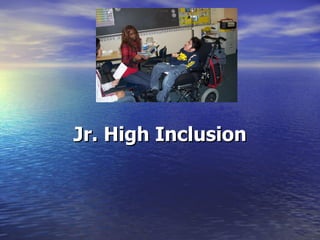
Jr. High Inclusion
Inclusion What does it Look Like? Is It Beneficial? These questions and many more will be answered by parents and administrators. Parents – students with disabilities  vs, students with out disabilities. Schools – differences within
Teacher Views Can Inhibit Must be sold on – beneficial for “All” LRE Legal mandates Needs to be a service not a placement Attitudes & Actions – 2005 Journal of Early Childhood Teacher  Education   Previous experience   Support from Administrators   Support from Resource personnel and TA’s Benefits   Increased Social Skills   Acceptance   Awareness Comfort Zone
Attitudes Are thoughts or ideas that reflect feelings and influence behaviors related to a particular object. Components Cognitive – Knowledge and thoughts Affective – Cognitive understanding of  a disability – can motivate or exclude Behavioral – To behave or respond in a particular way when around students with disabilities. Essential for a successful program
Social Civil Rights “ More Than a Least Restrictive Environment” Refocus from individual needs of one --- Social Civil Rights of “All” “ The Legal mandates that govern special education services have significantly more Teeth than those that have shaped educational programs for English Language Learners”  (Sylvester & Poe) Civil rights involve social rights that guarantee citizens the capacity to participate fully in  society.
Discussions What is possible What is desirable How do we address We need to remember that all students are part of a school – both academically and socially.  We want students to feel a sense of belonging, to acquire a sense of ownership in the school.
Full   Participation Not just one but the entire class Shift from labels to meeting needs of group Not so different – behavior, desire to learn Create Opportunities Focus on needs of community Move for changing students with disabilities to  structures of  classrooms and schools need to change Shift from focusing on deficits of students with disabilities to their  value as a community member
New teachers are receiving training in school put are we providing enough in-service opportunities for others. Benefits of inclusion – 1. Gains in academic achievement for all 2. Increased peer acceptance and friendships 3. Higher self-esteem “ What goes on in a place, not the location itself, is what makes a difference” (Zigmond) Attributes of classroom culture underlying successful inclusive classrooms. 1. Valuing of student voices and authority sharing 2. Accountability of students to each other 3. Attention to individual differences 4. School wide community spirit 5. High expectations for all
Sociocultural A sociocultural perspective holds that learning is social even to the extent that “all higher mental functions are internalized social relationships” (Vygotsky) Mainstream Social contexts and interactions must figure into theories of causation and intervention regarding students with disabilities. Shared activities and teacher’s actions – can have a significant effect on students’ learning itdentities. Failure to learn may involve complex dynamics such as: 1. Exclusion from aspects of community life 2. Teacher evaluations of learning potential 3. Deliberate social positioning 4. Power Relationships.
Classroom Students actively engaged – with peers and teacher Reinforce social skills 1. Seeking help 2. Giving help 3. Taking turns talking 4. Working independently Teacher 1.Provides cognitive tools for comprehension & engagement of  activity 2. Link current & prior knowledge 3. Prompt students 4 .Manage direction of discussion 5. Use cooperative learning – promotes individual learning,  interdependence, interpersonal skills and peer tutoring
Meet  In  The  Middle Grant from Department of Education to Special Olympics University of Minnesota Benefits Boys PE Class Avid Students Top School in the State
Goal Continuation of inclusion program Higher expectations not only from principal but staff Individualize plan for each student student to attend at least one General Ed class besides Music or PE.
Reference: Berry, R. (2006) Inclusion, Power, and Community: Teachers and Students Interpret the  Language of Community in an Inclusion Classroom.  American Educational Research  Journal.  Vol. 43:3, pp. 489-529. Benjamin, S. (2002) Valuing Diversity: A Cliché’ for the 21st Century?,  International Journal of  Inclusive Education  6(4): 309-23. Bloom B.S. (1956) Taxonomy of Educational Objectives, Handbook 1: The Cognitive Domain.  New York: Davi McKay Co. Inc. Fuller, C. and Jones, L (1997)  Extraordinary Kids , Family Publishing, Colorado Springs, Co Leo, E and Barton, Len (2006) Inclusion, Diversity and Leadership:  Perspectives, Possibilities  and Contradictions.  Educational Management Administration Leadership  2006; 34; 167 Leatherman, J and Niemeyer, J, Teachers’ Attidudes Toward Inclusion: Factors Influencing  Classroom Practice.  Journal of Early Childhood Teacher Education . Vol.26: 1-05;23-36 Niemeyer, J. A. and Proctor, R. (2002) The influence of experience on student teachers’ beliefs  about inclusion.  Journal of Early Childhood Teacher Education  23:1, pp. 49-57 Richmon, M. and Allison, D. (2003) ‘Towards a Conceptual Framework for Leadership Inquiry’,  Educational Management & Administration  31 (1); 31-50 Skilton-Sylvester, E and Slesaranski-Poe, G. More than a Least Restrictive Environment: Living  Up to the Civil Covenant in Building Inclusive Schools.  Perspectives on Urban  Education,  Spring 2009; 32-37. Special Olympics, “Meet In The Middle”. Stafford, S. and Green, V. (1996) Preschool integration: Strategies for teachers.  Childhood Education  79.pp.214-218.

Mi M Intro Pp

  • 1.
  • 2.
    Inclusion What doesit Look Like? Is It Beneficial? These questions and many more will be answered by parents and administrators. Parents – students with disabilities vs, students with out disabilities. Schools – differences within
  • 3.
    Teacher Views CanInhibit Must be sold on – beneficial for “All” LRE Legal mandates Needs to be a service not a placement Attitudes & Actions – 2005 Journal of Early Childhood Teacher Education Previous experience Support from Administrators Support from Resource personnel and TA’s Benefits Increased Social Skills Acceptance Awareness Comfort Zone
  • 4.
    Attitudes Are thoughtsor ideas that reflect feelings and influence behaviors related to a particular object. Components Cognitive – Knowledge and thoughts Affective – Cognitive understanding of a disability – can motivate or exclude Behavioral – To behave or respond in a particular way when around students with disabilities. Essential for a successful program
  • 5.
    Social Civil Rights“ More Than a Least Restrictive Environment” Refocus from individual needs of one --- Social Civil Rights of “All” “ The Legal mandates that govern special education services have significantly more Teeth than those that have shaped educational programs for English Language Learners” (Sylvester & Poe) Civil rights involve social rights that guarantee citizens the capacity to participate fully in society.
  • 6.
    Discussions What ispossible What is desirable How do we address We need to remember that all students are part of a school – both academically and socially. We want students to feel a sense of belonging, to acquire a sense of ownership in the school.
  • 7.
    Full Participation Not just one but the entire class Shift from labels to meeting needs of group Not so different – behavior, desire to learn Create Opportunities Focus on needs of community Move for changing students with disabilities to structures of classrooms and schools need to change Shift from focusing on deficits of students with disabilities to their value as a community member
  • 8.
    New teachers arereceiving training in school put are we providing enough in-service opportunities for others. Benefits of inclusion – 1. Gains in academic achievement for all 2. Increased peer acceptance and friendships 3. Higher self-esteem “ What goes on in a place, not the location itself, is what makes a difference” (Zigmond) Attributes of classroom culture underlying successful inclusive classrooms. 1. Valuing of student voices and authority sharing 2. Accountability of students to each other 3. Attention to individual differences 4. School wide community spirit 5. High expectations for all
  • 9.
    Sociocultural A socioculturalperspective holds that learning is social even to the extent that “all higher mental functions are internalized social relationships” (Vygotsky) Mainstream Social contexts and interactions must figure into theories of causation and intervention regarding students with disabilities. Shared activities and teacher’s actions – can have a significant effect on students’ learning itdentities. Failure to learn may involve complex dynamics such as: 1. Exclusion from aspects of community life 2. Teacher evaluations of learning potential 3. Deliberate social positioning 4. Power Relationships.
  • 10.
    Classroom Students activelyengaged – with peers and teacher Reinforce social skills 1. Seeking help 2. Giving help 3. Taking turns talking 4. Working independently Teacher 1.Provides cognitive tools for comprehension & engagement of activity 2. Link current & prior knowledge 3. Prompt students 4 .Manage direction of discussion 5. Use cooperative learning – promotes individual learning, interdependence, interpersonal skills and peer tutoring
  • 11.
    Meet In The Middle Grant from Department of Education to Special Olympics University of Minnesota Benefits Boys PE Class Avid Students Top School in the State
  • 12.
    Goal Continuation ofinclusion program Higher expectations not only from principal but staff Individualize plan for each student student to attend at least one General Ed class besides Music or PE.
  • 13.
    Reference: Berry, R.(2006) Inclusion, Power, and Community: Teachers and Students Interpret the Language of Community in an Inclusion Classroom. American Educational Research Journal. Vol. 43:3, pp. 489-529. Benjamin, S. (2002) Valuing Diversity: A Cliché’ for the 21st Century?, International Journal of Inclusive Education 6(4): 309-23. Bloom B.S. (1956) Taxonomy of Educational Objectives, Handbook 1: The Cognitive Domain. New York: Davi McKay Co. Inc. Fuller, C. and Jones, L (1997) Extraordinary Kids , Family Publishing, Colorado Springs, Co Leo, E and Barton, Len (2006) Inclusion, Diversity and Leadership: Perspectives, Possibilities and Contradictions. Educational Management Administration Leadership 2006; 34; 167 Leatherman, J and Niemeyer, J, Teachers’ Attidudes Toward Inclusion: Factors Influencing Classroom Practice. Journal of Early Childhood Teacher Education . Vol.26: 1-05;23-36 Niemeyer, J. A. and Proctor, R. (2002) The influence of experience on student teachers’ beliefs about inclusion. Journal of Early Childhood Teacher Education 23:1, pp. 49-57 Richmon, M. and Allison, D. (2003) ‘Towards a Conceptual Framework for Leadership Inquiry’, Educational Management & Administration 31 (1); 31-50 Skilton-Sylvester, E and Slesaranski-Poe, G. More than a Least Restrictive Environment: Living Up to the Civil Covenant in Building Inclusive Schools. Perspectives on Urban Education, Spring 2009; 32-37. Special Olympics, “Meet In The Middle”. Stafford, S. and Green, V. (1996) Preschool integration: Strategies for teachers. Childhood Education 79.pp.214-218.