Hospital-Physician Economic Relationships –  Assessing Their Fair Market Value  and Commercial Reasonableness
Agenda Conceptual Overview of Hospital/Physician Arrangements Commercial Reasonableness and Fair Market Value Issues Case Studies:  Applying the Concepts
Conceptual Overview of Hospital – Physician Economic Alignment Arrangements
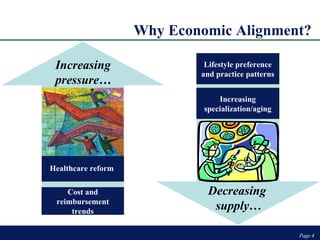
Why Economic Alignment? Page  Page  Lifestyle preference and practice patterns Increasing specialization/aging Decreasing  supply… Increasing  pressure… Healthcare reform  Cost and reimbursement trends
Common Types of Economic Relationships Direct employment arrangements  Management agreements Call pay arrangements Quality incentives Hospitalist strategies Joint-ventures Physician leasing arrangements Page  Page
Navigating the Regulatory Environment Page  Page  IRS Stark Anti- Kickback
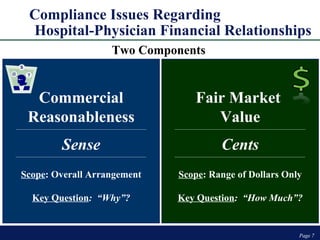
Compliance Issues Regarding  Hospital-Physician Financial Relationships Page  Page  Fair Market  Value ________________________________________________________________________ Cents ________________________________________________________________________ Scope : Range of Dollars Only Key Question :  “How Much”? Commercial Reasonableness ________________________________________________________________________ Sense ________________________________________________________________________ Scope : Overall Arrangement Key Question :  “Why”? Two Components
Commercial Reasonableness Department of Health and Human Services Definition 1 An arrangement which appears to be “a sensible, prudent business agreement, from the perspective of the particular parties involved, even in the absence of any potential referrals.” Stark Definition 2 “ An arrangement will be considered ‘commercially reasonable’ in the absence of referrals if the arrangement would make commercial sense if entered into by a reasonable entity of similar type and size and a reasonable physician of similar scope and specialty, even if there were no potential designated health services (“DHS”) referrals.” OIG Threshold  Compensation arrangements with physicians should be “reasonable and necessary.” Page  Page  1  63 Fed. Reg. 1700 (Jan. 9, 1998). 2  69 Fed. Reg. 16093 (March 26, 2004). 3 “OIG Compliance Program For Individual and Small Group Physician Practices,” Notice, 65 Fed. Reg. 59434 (Oct. 5, 2000); OIG Advisory Opinion No. 07-10, September 20, 2007, pg. 6, 10; “OIG Supplemental Compliance Program Guidance for Hospitals,” Notice, 70 Fed. Reg. 4858 (Jan. 31, 2005).
Factors in Determining CR Page  Page  Commercial  Reasonableness Determination Business Purpose Provider Facility Resource Independence & Oversight
Factors in Determining CR Page  Page  Business Purpose Analysis: Is the arrangement a reasonable necessity essential to the functioning of the Hospital? Is the business purpose clearly identifiable and appropriately defined? Do the proposed services  Are there other ways the same objective could be accomplished?
Factors in Determining CR  (continued) Provider Analysis: Does the proposed arrangement require a physician (and/or a certain specialty) to perform the services? Does the provider have any specialized skills/training/resources that should be taken into account? Does the provider have sufficient resources/time to provide the services and still cover their clinic responsibilities/patient load? Is the nature of the duties and accountability clearly defined and reasonable?
Factors in Determining CR  (continued) Facility Analysis:   Does the current patient demand and growth trend justify the proposed services? Are patient acuity levels such that the proposed services are necessary? Does the hospital have excess capacity/resources that will be better utilized as a result of the arrangement? Is the size of the hospital and its service offerings appropriate for the proposed services?
Factors in Determining CR  (continued) Resource Analysis: Is the proposed arrangement a necessary addition to the managerial and/or administrative efforts of the hospital’s medical staff? If the hospital is part of a larger health system, are there patient care protocols and procedures that can be coordinated among its facilities in lieu of the proposed arrangement? Does the proposed arrangement lend itself to potential fraud, waste, or abuse? (or reduce such risk?)
Factors in Determining CR  (continued) Independence and Oversight Analysis: Does the hospital actively monitor and evaluate other provider arrangements? Does the hospital maintain a formal process for executive management and legal counsel to review and approve such arrangements?  Will the hospital actively monitor the arrangement including related outcomes and take corrective action as necessary? Are the terms of the arrangement clearly spelled out in a written agreement?
Steps in Determining CR  Determine underlying business purpose and intended goals/objectives to be achieved Ascertain key relevant facts (who, what, when, where, why, how?) Evaluate underlying assumptions and reasoning Consider other outside factors as appropriate  Make determination regarding the arrangement’s commercial reasonableness and further action if necessary
Fair Market Value IRS Definition 1 Fair market value (“FMV”) is defined as the amount at which property would change hands between a willing seller and a willing buyer when neither is under compulsion and both have reasonable knowledge of the relevant facts OIG/Stark Definition 2 The value in arm’s-length transactions, consistent with the general market value The price that an asset would bring as the result of  bona fide  bargaining between well-informed buyers and sellers who are not otherwise in a position to generate business for the other party, or the compensation that would be included in a service agreement as the result of  bona fide  bargaining between well-informed parties to the agreement who are not otherwise in a position to generate business for the other party, on the date of acquisition of the asset or at the time of the service agreement Page  Page  1 Estate Tax Reg. 20.2031.1-1(b); Revenue Ruling 59-60, 1959-1, C.B. 237. 2 Federal Register / Vol. 69, No. 59 / Friday, March 26, 2004 / Rules and Regulations.
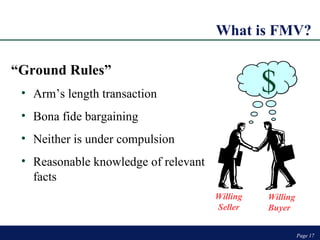
What is FMV? Page  Page  “ Ground Rules” Arm’s length transaction Bona fide bargaining Neither is under compulsion  Reasonable knowledge of relevant facts $ Willing Seller Willing Buyer $
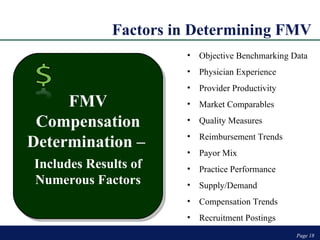
Factors in Determining FMV Page  Page  Objective Benchmarking Data Physician Experience Provider Productivity Market Comparables Quality Measures Reimbursement Trends Payor Mix Practice Performance Supply/Demand Compensation Trends Recruitment Postings FMV Compensation Determination –   Includes Results of Numerous Factors
Relevant OIG Opinions Page  Page  OIG Advisory Opinion No. 07-10 Hospital payments to physicians for on-call coverage & uncompensated inpatient care OIG Advisory Opinion No. 08-16 Hospital sharing performance-based compensation with a physician-owned entity OIG Advisory Opinion No. 09-05 Hospital payments to physicians for on-call services provided for uninsured patients OIG Advisory Opinion No. 09-09 Hospital ownership with physicians of a joint venture involving ownership of an ambulatory surgery center
Potential Implications Page  Page  United States v. Covenant Medical Center Recent settlement of $4.5 million Government alleged false claims to Medicare due to hospital’s financial relationships with five physicians U.S.    Covenant violated Stark  by paying commercially unreasonable compensation, exceeding fair market value Covenant denied wrongdoing and claimed physicians were highly productive Largest settlement ever in the Northern District of Iowa concerning health care fraud
Case Studies:  Applying the Concepts
Hospital proposes to enter into a clinical co-management agreement with a neurosurgery group to provide co-management of neurosurgery services at the hospital Hospital will pay $200k per year plus up to an additional $200k per year for meeting performance objectives for quality and efficiency Page  #1 Clinical Co-Management Arrangement
#1 Clinical Co-Management – Analysis Stark Proposed Exception – Incentive Payment and Shared Savings Program, July 7, 2008, not adopted yet No specific FMV requirement, but CMS considering 50% limit, required rebasing, other limits on amount and nature of payment Current Exceptions – Require: Set in advance Commercial reasonableness FMV Page
#1 Clinical Co-Management – Analysis Kickback Includes elements of both cost savings and quality incentives – see prior analysis Also includes medical director compensation issues Inducements to Limit Services Cost savings and quality incentives implicate the inducement statute Adequate protections needed, see advisory opinions Page
#1 Clinical Co-Management – Analysis   IRS Need to show benefit to hospital meets private benefit tests Special concern about conflict of interest issues Physician incentive compensation issues Page
#1 Clinical Co-Management – Analysis Commercial Reasonableness Issues: Is the neurosurgery department important to the hospital’s  overall business strategy and a significant service offering? Is the business purpose of the arrangement clearly spelled out and appropriate under the circumstances? What’s the current status of the neurosurgery department? Is it successful, growing, competitive in the marketplace, highly regarded?  Who is currently responsible?  Why change? Page
#1 Clinical Co-Management – Analysis Commercial Reasonableness Issues (continued): Are the performance objectives and quality metrics clearly defined and reasonable under the circumstances? What if some but not all of the goals are achieved? Regarding the quality metrics:  Are they specific to and appropriate for neurosurgery? Will they be a challenge or easy to achieve? Do the goals increase over time or stay the same?
#1 Clinical Co-Management – Analysis Commercial Reasonableness Issues (continued): Are the estimated hours required to provide the services reasonable?  Do all or substantially all of the management duties actually require a neurosurgeon? Does the group realistically have the time to devote to this initiative – considering patient demand and other responsibilities? Does the current patient volume and projected growth justify the initiative?
#1 Clinical Co-Management – Analysis Commercial Reasonableness Issues (continued): Are the neurosurgeons required to attend other hospital committee meetings, etc that would further limit their available for managing the service line?  Has the hospital established a process for monitoring and communicating outcomes from the initiative and making changes as necessary? How will the quality metrics be monitored How often will the outcomes be measured and communicated? Who will be responsible?
#1 Clinical Co-Management – Analysis Commercial Reasonableness Issues (continued): Consider supply vs. demand of neurosurgeons in the marketplace? Why this particular group? If the hospital is part of a larger health system, do patient care protocols and procedures and/or other resources exist that could accomplish the desired results in lieu of the proposed arrangement ?  Does the hospital have co-management agreements with other service lines? If so, how do the terms compare?
#1 Clinical Co-Management – Analysis FMV Issues: Determine if a neurosurgeon is required to perform all or substantially all of the requested services Determine total hours that will be devoted to managing the service line (per month, week, etc)  Evaluate the group’s historical productivity levels (may be difficult to obtain) i.e. 50% percentile, 75 th  percentile, or 25 th  percentile? Will the services be taking away from clinical time or helping to fill excess capacity? Page
#1 Clinical Co-Management – Analysis FMV Issues (continued): Do the physicians have any particular training or skills that would impact the value of their time? Consider recent trends in compensation rates for neurosurgeons Consider trends in reimbursement rates for neurosurgery services (difficult for income to increase in private practice if reimbursement rates are declining) Consider supply vs. demand for neurosurgeons in the market
#1 Clinical Co-Management – Analysis FMV Issues (continued): Determine benchmark compensation for neurosurgeons – if possible, based upon the group’s historical productivity levels  Consider physician compensation surveys such as: (MGMA, Sullivan Cotter, HHCS, AMGA, Merit Hawkins, etc) Determine whether national or regional data should be utilized and/or cost of living adjustment is warranted Determine the physician’s actual historical compensation levels (which may be difficult to obtain) and compare to benchmarks
#1 Clinical Co-Management – Analysis FMV Issues (continued): Consider other relevant market data, if available, such as:  Compensation levels of other neurosurgeons in the market Job postings with salary information Determine appropriate hourly compensation rate based on the benchmark and actual compensation data  Utilize hourly rate and estimated hours to determine FMV compensation for the services to be provided
Hospital proposes to enter into on-call agreement with various specialty groups Requires on-call availability and response Pay a per-diem rate The physician bills for his or her own professional medical services when called in, but many of the patients have no insurance #2 On-Call Arrangement  Page
#2  On-Call – Analysis Kickback General concerns can include: Specialist not typically used Based on referral patterns Unequal pay based on referrals Pay wars No written contract Duplicate payments Frequency and notice of call Financial impact on physician Relationship to regular medical income Page
#2 On-Call – Analysis OIG Opinion 09-05 Flat fee for ER visits to eligible patients Certification of FMV “appears to be supported” Only time in ED Follow-up obligations Rate is “scrupulously tailored” Tangible services Page
#2 On-Call – Analysis Stark Exceptions require: Set in advance Commercial reasonableness – ties back to kickback issues FMV Not based on volume or value of referrals Page
#2 On-Call – Analysis IRS Need to show benefit to hospital meets private benefit tests FMV issues Charitable purpose issues Page
#2  On-Call – Analysis Commercial Reasonableness Issues: Determine if a certain specialty is needed for the proposed on-call services (i.e. cardiology) Does the hospital pay for on-call services with other specialties or services lines? Does the group have the resources to provide the proposed coverage and still meet its other patient demands?  Are the proposed on-call services justified based on current volumes and projected growth trends  Page
#2  On-Call – Analysis Commercial Reasonableness Issues - continued Does the hospital have other employed physicians  or hospitalists that could provide the coverage? Do the terms of the call coverage agreement conform with the hospital’s protocols for patient care? Does the hospital have other facilities nearby that could provide the necessary call coverage? Are the projected call coverage hours reasonable under the circumstances?
#2  On-Call – Analysis Commercial Reasonableness Issues - continued Are the terms of the arrangement clearly spelled out in a written agreement? Does the agreement provide for any portion of the compensation to be “at risk” based upon achieving certain pre-defined quality or other metrics?
#2  On-Call – Analysis FMV Issues: Determine if restricted or unrestricted call Determine if certain specialty is required to provide the call services Determine total required hours of coverage i.e.: 24 hrs/day x 365 days/yr = 8,760 total hours Determine number of FTEs needed to provide the coverage i.e. 8,760 total hrs/2,000 std hrs/yr = 4.4 FTEs Page
#2  On-Call – Analysis FMV Issues (continued): Consider appropriate compensation benchmark data: On-call compensation survey: Sullivan Cotter Physician On-Call Pay Survey Report Physician compensation surveys such as: (MGMA, Sullivan Cotter, HHCS, AMGA, Merit Hawkins, etc) Locum tenens compensation data (i.e. The Delta Companies) Note: For unrestricted call arrangements, compensation data should be adjusted to reflect the probability of being called (i.e. actually having to provide services) Page
#2  On-Call – Analysis FMV Issues (continued): Determine if any portion of the proposed compensation is at risk subject to minimum quality or other predefined criteria Consider trends in compensation rates for the specialty Supply vs. demand for the specialty – including in the particular market Trends and known factors regarding reimbursement rates for the specialty
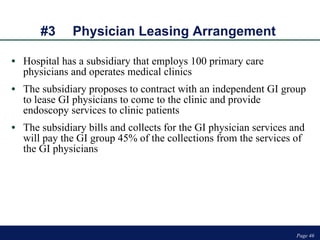
#3 Physician Leasing Arrangement  Hospital has a subsidiary that employs 100 primary care physicians and operates medical clinics The subsidiary proposes to contract with an independent GI group to lease GI physicians to come to the clinic and provide endoscopy services to clinic patients The subsidiary bills and collects for the GI physician services and will pay the GI group 45% of the collections from the services of the GI physicians Page
#3  Physician Leasing – Analysis Kickback Leasing through part-time employment meets employment safe harbor - OIG Advisory Opinion 08-22 Leasing through independent contract Issues of FMV and commercial reasonableness Purpose issues Page
#3  Physician Leasing – Analysis Stark Exceptions require: Set in advance (except employment) Commercial reasonableness FMV Volume or value test Page
#3  Physician Leasing – Analysis  IRS Need to show benefit to hospital meets private benefit tests Incentive compensation issues What about services at hospitals? Page
#3  Physician Leasing – Analysis Commercial Reasonableness Issues: Is the business purpose of the arrangement clearly defined? Are the GI services essential to the hospital being able to care for its patients – i.e. do patients currently have ready access to other endoscopy services? Are the endoscopy services important to the hospital’s business strategy and patient care goals? Will the proposed services contribute to the hospital’s profits (i.e. will the hospital make a profit on the services after paying the GI physician’s 45% of collections)?  Page
#3  Physician Leasing – Analysis Commercial Reasonableness Issues (continued): What is the demand for endoscopy services at the clinic? Is there sufficient volume to support the initiative? Note: in this particular case, the physicians are assuming some risk due to being compensated based on percentage of collections. However, can probably be mitigated somewhat via scheduling.  Does the hospital have other facilities or relationships that could provide the services? i.e. do they have other endoscopy facilities in the area?
#3  Physician Leasing – Analysis Commercial Reasonableness Issues (continued): Would it be reasonable for the hospital/subsidiary to employ as opposed to entering into the leasing arrangement? Will hospital management be monitoring the arrangement to ensure its objectives are being met without indications of fraud, waste or abuse? Are the terms of the arrangement clearly spelled out in writing?
#3  Physician Leasing – Analysis FMV Issues: Determine reasonableness of the proposed 45% fee Volume estimates for endoscopy services Fee schedule (payor mix adjusted) Less: billing and collecting expenses Less: overhead allocation Less: 45% of collections paid to GI group = Positive net profit to the hospital/subsidiary???
#3  Physician Leasing – Analysis FMV Issues (continued): 2.  Estimated cost of the physician services based on anticipated time to provide the services Determine anticipated physician staffing needs based on projected volume  Determine physician cost taking into consideration: Benchmark compensation data - productivity based Actual historical compensation of the GI group Benefits Malpractice insurance
#3  Physician Leasing – Analysis FMV Issues (continued): Consider lost opportunity cost to the GI group Benchmark net collections per FTE – productivity based Actual historical net revenue per physician Benefits Malpractice insurance Overhead allocation  Related questions: Does the group have excess capacity? Will the group need to hire physicians to service the leasing arrangement?
#4 Cost Savings Hospital proposes to pay a cardiology group 50% of hospital cost savings related to cardiac caths Savings come from national body’s recommendations and are in the general categories of product standardization and product substitution Page
#4 Cost Savings – Analysis Kickback Gainsharing Bulletin – July 1999 Definition – hospital gives the physician a percentage share of any reduction in the hospital’s costs for patient care attributable in part to the physician’s efforts Many plans require a determination by an independent consultant that the payment represents ‘fair market value’ for the collective physician effects  OIG Advisory Opinion 09-06 Concern of disguised remuneration Protections include caps, no new physicians, limited term, tie to actions that generate savings FMV certification Page
#4 Cost Savings – Analysis Inducements to Limit Services Gainsharing Bulletin prohibits based on cost savings on items or services furnished to patients 2005/2006 Advisory Opinions expand scope “ The Proposed Arrangement is markedly different from many “gainsharing” plans, particularly those that purport to pay physicians a percentage of generalized cost savings not tied to specific, identifiable cost-lowering activities.  Importantly, the Proposed Arrangement sets out the specific actions to be taken and ties the remuneration to the actual, verifiable cost savings attributable to those actions.  This transparency allows an assessment of the likely effect of the Proposed Arrangement on quality of care and ensures that the identified actions will be the cause of the savings.  By contrast, many gainsharing plans contain features that heighten the risk that payments will lead to inappropriate reductions or limitations of services.”  Page
#4 Cost Savings – Analysis Inducements to Limit Services (cont.) Focus on waste reduction, product standardization/substitution, and quality improvement OIG Advisory Opinion 09-06 Statute implicated Factors:  transparency, medical support, baseline thresholds, patient disclosure, limited term, per capita Page
#4 Cost Savings – Analysis Stark Proposed Exception – Incentive Payment and Shared Savings Program, July 7, 2008, not adopted yet No specific FMV requirement, but CMS considering 50% limit, required rebasing, and other limits on amount and nature of payment Current Exceptions – Require: Set in advance Commercial reasonableness FMV Page
#4 Cost Savings – Analysis IRS Need to show benefit to hospital meets private benefit tests Special concern about conflict of interest issues Difficulty of assessing fair market value Page
#4 Cost Savings – Analysis Commercial Reasonableness Issues Page
#4 Cost Savings – Analysis FMV Issues: Page
#5 Quality Initiatives Hospital proposes to pay a physician entity 50% of the pay for performance bonus received by the hospital from a private insurer for meeting specified standards for quality and efficiency Page
#5 Quality Initiatives – Analysis Kickback Gainsharing Bulletin – July 1999 – not included within OIG definition of gainsharing OIG Advisory Opinion 08-16 Quality enhancement agreement with physicians Payment of up to 50% of quality bonus from private insurer No sanctions Eligibility, cap, monitors, per capita, insurer role, limited term Includes FMV certification Page
#5 Quality Initiatives – Analysis Inducements to Limit Services OIG Advisory Opinion 08-16 Statute is implicated based on quality targets Safeguards Medical basis Protections for contra-indications Monitors Page
#5 Quality Initiatives – Analysis Stark Proposed Exception – Incentive Payment and Shared Savings Program, July 7, 2008, not adopted yet No specific FMV requirement, but CMS considering 50% limit, required rebasing, other limits on amount and nature of payment Current Exceptions – Require: Set in advance Commercial reasonableness FMV Page
#5 Quality Initiatives – Analysis IRS Need to show benefit to hospital meets private benefit tests Special concern about conflict of interest issues Difficulty of assessing fair market value Page
#5 Quality Initiatives – Analysis Commercial Reasonableness Issues: Page
#5 Quality Initiatives – Analysis FMV Issues:
Contact Information Page  Page  Knoxville  -  Atlanta  -  Tampa Bay  -  Austin W. James Lloyd (865) 673-0844 [email_address] John R. Holdenried (402) 636-8201 [email_address] Visit our web site at www.pyapc.com Visit our web site at www.bairdholm.com

Hosp Phy Economic Relationships

  • 1.
    Hospital-Physician Economic Relationships– Assessing Their Fair Market Value and Commercial Reasonableness
  • 2.
    Agenda Conceptual Overviewof Hospital/Physician Arrangements Commercial Reasonableness and Fair Market Value Issues Case Studies: Applying the Concepts
  • 3.
    Conceptual Overview ofHospital – Physician Economic Alignment Arrangements
  • 4.
    Why Economic Alignment?Page Page Lifestyle preference and practice patterns Increasing specialization/aging Decreasing supply… Increasing pressure… Healthcare reform Cost and reimbursement trends
  • 5.
    Common Types ofEconomic Relationships Direct employment arrangements Management agreements Call pay arrangements Quality incentives Hospitalist strategies Joint-ventures Physician leasing arrangements Page Page
  • 6.
    Navigating the RegulatoryEnvironment Page Page IRS Stark Anti- Kickback
  • 7.
    Compliance Issues Regarding Hospital-Physician Financial Relationships Page Page Fair Market Value ________________________________________________________________________ Cents ________________________________________________________________________ Scope : Range of Dollars Only Key Question : “How Much”? Commercial Reasonableness ________________________________________________________________________ Sense ________________________________________________________________________ Scope : Overall Arrangement Key Question : “Why”? Two Components
  • 8.
    Commercial Reasonableness Departmentof Health and Human Services Definition 1 An arrangement which appears to be “a sensible, prudent business agreement, from the perspective of the particular parties involved, even in the absence of any potential referrals.” Stark Definition 2 “ An arrangement will be considered ‘commercially reasonable’ in the absence of referrals if the arrangement would make commercial sense if entered into by a reasonable entity of similar type and size and a reasonable physician of similar scope and specialty, even if there were no potential designated health services (“DHS”) referrals.” OIG Threshold Compensation arrangements with physicians should be “reasonable and necessary.” Page Page 1 63 Fed. Reg. 1700 (Jan. 9, 1998). 2 69 Fed. Reg. 16093 (March 26, 2004). 3 “OIG Compliance Program For Individual and Small Group Physician Practices,” Notice, 65 Fed. Reg. 59434 (Oct. 5, 2000); OIG Advisory Opinion No. 07-10, September 20, 2007, pg. 6, 10; “OIG Supplemental Compliance Program Guidance for Hospitals,” Notice, 70 Fed. Reg. 4858 (Jan. 31, 2005).
  • 9.
    Factors in DeterminingCR Page Page Commercial Reasonableness Determination Business Purpose Provider Facility Resource Independence & Oversight
  • 10.
    Factors in DeterminingCR Page Page Business Purpose Analysis: Is the arrangement a reasonable necessity essential to the functioning of the Hospital? Is the business purpose clearly identifiable and appropriately defined? Do the proposed services Are there other ways the same objective could be accomplished?
  • 11.
    Factors in DeterminingCR (continued) Provider Analysis: Does the proposed arrangement require a physician (and/or a certain specialty) to perform the services? Does the provider have any specialized skills/training/resources that should be taken into account? Does the provider have sufficient resources/time to provide the services and still cover their clinic responsibilities/patient load? Is the nature of the duties and accountability clearly defined and reasonable?
  • 12.
    Factors in DeterminingCR (continued) Facility Analysis: Does the current patient demand and growth trend justify the proposed services? Are patient acuity levels such that the proposed services are necessary? Does the hospital have excess capacity/resources that will be better utilized as a result of the arrangement? Is the size of the hospital and its service offerings appropriate for the proposed services?
  • 13.
    Factors in DeterminingCR (continued) Resource Analysis: Is the proposed arrangement a necessary addition to the managerial and/or administrative efforts of the hospital’s medical staff? If the hospital is part of a larger health system, are there patient care protocols and procedures that can be coordinated among its facilities in lieu of the proposed arrangement? Does the proposed arrangement lend itself to potential fraud, waste, or abuse? (or reduce such risk?)
  • 14.
    Factors in DeterminingCR (continued) Independence and Oversight Analysis: Does the hospital actively monitor and evaluate other provider arrangements? Does the hospital maintain a formal process for executive management and legal counsel to review and approve such arrangements? Will the hospital actively monitor the arrangement including related outcomes and take corrective action as necessary? Are the terms of the arrangement clearly spelled out in a written agreement?
  • 15.
    Steps in DeterminingCR Determine underlying business purpose and intended goals/objectives to be achieved Ascertain key relevant facts (who, what, when, where, why, how?) Evaluate underlying assumptions and reasoning Consider other outside factors as appropriate Make determination regarding the arrangement’s commercial reasonableness and further action if necessary
  • 16.
    Fair Market ValueIRS Definition 1 Fair market value (“FMV”) is defined as the amount at which property would change hands between a willing seller and a willing buyer when neither is under compulsion and both have reasonable knowledge of the relevant facts OIG/Stark Definition 2 The value in arm’s-length transactions, consistent with the general market value The price that an asset would bring as the result of bona fide bargaining between well-informed buyers and sellers who are not otherwise in a position to generate business for the other party, or the compensation that would be included in a service agreement as the result of bona fide bargaining between well-informed parties to the agreement who are not otherwise in a position to generate business for the other party, on the date of acquisition of the asset or at the time of the service agreement Page Page 1 Estate Tax Reg. 20.2031.1-1(b); Revenue Ruling 59-60, 1959-1, C.B. 237. 2 Federal Register / Vol. 69, No. 59 / Friday, March 26, 2004 / Rules and Regulations.
  • 17.
    What is FMV?Page Page “ Ground Rules” Arm’s length transaction Bona fide bargaining Neither is under compulsion Reasonable knowledge of relevant facts $ Willing Seller Willing Buyer $
  • 18.
    Factors in DeterminingFMV Page Page Objective Benchmarking Data Physician Experience Provider Productivity Market Comparables Quality Measures Reimbursement Trends Payor Mix Practice Performance Supply/Demand Compensation Trends Recruitment Postings FMV Compensation Determination – Includes Results of Numerous Factors
  • 19.
    Relevant OIG OpinionsPage Page OIG Advisory Opinion No. 07-10 Hospital payments to physicians for on-call coverage & uncompensated inpatient care OIG Advisory Opinion No. 08-16 Hospital sharing performance-based compensation with a physician-owned entity OIG Advisory Opinion No. 09-05 Hospital payments to physicians for on-call services provided for uninsured patients OIG Advisory Opinion No. 09-09 Hospital ownership with physicians of a joint venture involving ownership of an ambulatory surgery center
  • 20.
    Potential Implications Page Page United States v. Covenant Medical Center Recent settlement of $4.5 million Government alleged false claims to Medicare due to hospital’s financial relationships with five physicians U.S.  Covenant violated Stark by paying commercially unreasonable compensation, exceeding fair market value Covenant denied wrongdoing and claimed physicians were highly productive Largest settlement ever in the Northern District of Iowa concerning health care fraud
  • 21.
    Case Studies: Applying the Concepts
  • 22.
    Hospital proposes toenter into a clinical co-management agreement with a neurosurgery group to provide co-management of neurosurgery services at the hospital Hospital will pay $200k per year plus up to an additional $200k per year for meeting performance objectives for quality and efficiency Page #1 Clinical Co-Management Arrangement
  • 23.
    #1 Clinical Co-Management– Analysis Stark Proposed Exception – Incentive Payment and Shared Savings Program, July 7, 2008, not adopted yet No specific FMV requirement, but CMS considering 50% limit, required rebasing, other limits on amount and nature of payment Current Exceptions – Require: Set in advance Commercial reasonableness FMV Page
  • 24.
    #1 Clinical Co-Management– Analysis Kickback Includes elements of both cost savings and quality incentives – see prior analysis Also includes medical director compensation issues Inducements to Limit Services Cost savings and quality incentives implicate the inducement statute Adequate protections needed, see advisory opinions Page
  • 25.
    #1 Clinical Co-Management– Analysis IRS Need to show benefit to hospital meets private benefit tests Special concern about conflict of interest issues Physician incentive compensation issues Page
  • 26.
    #1 Clinical Co-Management– Analysis Commercial Reasonableness Issues: Is the neurosurgery department important to the hospital’s overall business strategy and a significant service offering? Is the business purpose of the arrangement clearly spelled out and appropriate under the circumstances? What’s the current status of the neurosurgery department? Is it successful, growing, competitive in the marketplace, highly regarded? Who is currently responsible? Why change? Page
  • 27.
    #1 Clinical Co-Management– Analysis Commercial Reasonableness Issues (continued): Are the performance objectives and quality metrics clearly defined and reasonable under the circumstances? What if some but not all of the goals are achieved? Regarding the quality metrics: Are they specific to and appropriate for neurosurgery? Will they be a challenge or easy to achieve? Do the goals increase over time or stay the same?
  • 28.
    #1 Clinical Co-Management– Analysis Commercial Reasonableness Issues (continued): Are the estimated hours required to provide the services reasonable? Do all or substantially all of the management duties actually require a neurosurgeon? Does the group realistically have the time to devote to this initiative – considering patient demand and other responsibilities? Does the current patient volume and projected growth justify the initiative?
  • 29.
    #1 Clinical Co-Management– Analysis Commercial Reasonableness Issues (continued): Are the neurosurgeons required to attend other hospital committee meetings, etc that would further limit their available for managing the service line? Has the hospital established a process for monitoring and communicating outcomes from the initiative and making changes as necessary? How will the quality metrics be monitored How often will the outcomes be measured and communicated? Who will be responsible?
  • 30.
    #1 Clinical Co-Management– Analysis Commercial Reasonableness Issues (continued): Consider supply vs. demand of neurosurgeons in the marketplace? Why this particular group? If the hospital is part of a larger health system, do patient care protocols and procedures and/or other resources exist that could accomplish the desired results in lieu of the proposed arrangement ? Does the hospital have co-management agreements with other service lines? If so, how do the terms compare?
  • 31.
    #1 Clinical Co-Management– Analysis FMV Issues: Determine if a neurosurgeon is required to perform all or substantially all of the requested services Determine total hours that will be devoted to managing the service line (per month, week, etc) Evaluate the group’s historical productivity levels (may be difficult to obtain) i.e. 50% percentile, 75 th percentile, or 25 th percentile? Will the services be taking away from clinical time or helping to fill excess capacity? Page
  • 32.
    #1 Clinical Co-Management– Analysis FMV Issues (continued): Do the physicians have any particular training or skills that would impact the value of their time? Consider recent trends in compensation rates for neurosurgeons Consider trends in reimbursement rates for neurosurgery services (difficult for income to increase in private practice if reimbursement rates are declining) Consider supply vs. demand for neurosurgeons in the market
  • 33.
    #1 Clinical Co-Management– Analysis FMV Issues (continued): Determine benchmark compensation for neurosurgeons – if possible, based upon the group’s historical productivity levels Consider physician compensation surveys such as: (MGMA, Sullivan Cotter, HHCS, AMGA, Merit Hawkins, etc) Determine whether national or regional data should be utilized and/or cost of living adjustment is warranted Determine the physician’s actual historical compensation levels (which may be difficult to obtain) and compare to benchmarks
  • 34.
    #1 Clinical Co-Management– Analysis FMV Issues (continued): Consider other relevant market data, if available, such as: Compensation levels of other neurosurgeons in the market Job postings with salary information Determine appropriate hourly compensation rate based on the benchmark and actual compensation data Utilize hourly rate and estimated hours to determine FMV compensation for the services to be provided
  • 35.
    Hospital proposes toenter into on-call agreement with various specialty groups Requires on-call availability and response Pay a per-diem rate The physician bills for his or her own professional medical services when called in, but many of the patients have no insurance #2 On-Call Arrangement Page
  • 36.
    #2 On-Call– Analysis Kickback General concerns can include: Specialist not typically used Based on referral patterns Unequal pay based on referrals Pay wars No written contract Duplicate payments Frequency and notice of call Financial impact on physician Relationship to regular medical income Page
  • 37.
    #2 On-Call –Analysis OIG Opinion 09-05 Flat fee for ER visits to eligible patients Certification of FMV “appears to be supported” Only time in ED Follow-up obligations Rate is “scrupulously tailored” Tangible services Page
  • 38.
    #2 On-Call –Analysis Stark Exceptions require: Set in advance Commercial reasonableness – ties back to kickback issues FMV Not based on volume or value of referrals Page
  • 39.
    #2 On-Call –Analysis IRS Need to show benefit to hospital meets private benefit tests FMV issues Charitable purpose issues Page
  • 40.
    #2 On-Call– Analysis Commercial Reasonableness Issues: Determine if a certain specialty is needed for the proposed on-call services (i.e. cardiology) Does the hospital pay for on-call services with other specialties or services lines? Does the group have the resources to provide the proposed coverage and still meet its other patient demands? Are the proposed on-call services justified based on current volumes and projected growth trends Page
  • 41.
    #2 On-Call– Analysis Commercial Reasonableness Issues - continued Does the hospital have other employed physicians or hospitalists that could provide the coverage? Do the terms of the call coverage agreement conform with the hospital’s protocols for patient care? Does the hospital have other facilities nearby that could provide the necessary call coverage? Are the projected call coverage hours reasonable under the circumstances?
  • 42.
    #2 On-Call– Analysis Commercial Reasonableness Issues - continued Are the terms of the arrangement clearly spelled out in a written agreement? Does the agreement provide for any portion of the compensation to be “at risk” based upon achieving certain pre-defined quality or other metrics?
  • 43.
    #2 On-Call– Analysis FMV Issues: Determine if restricted or unrestricted call Determine if certain specialty is required to provide the call services Determine total required hours of coverage i.e.: 24 hrs/day x 365 days/yr = 8,760 total hours Determine number of FTEs needed to provide the coverage i.e. 8,760 total hrs/2,000 std hrs/yr = 4.4 FTEs Page
  • 44.
    #2 On-Call– Analysis FMV Issues (continued): Consider appropriate compensation benchmark data: On-call compensation survey: Sullivan Cotter Physician On-Call Pay Survey Report Physician compensation surveys such as: (MGMA, Sullivan Cotter, HHCS, AMGA, Merit Hawkins, etc) Locum tenens compensation data (i.e. The Delta Companies) Note: For unrestricted call arrangements, compensation data should be adjusted to reflect the probability of being called (i.e. actually having to provide services) Page
  • 45.
    #2 On-Call– Analysis FMV Issues (continued): Determine if any portion of the proposed compensation is at risk subject to minimum quality or other predefined criteria Consider trends in compensation rates for the specialty Supply vs. demand for the specialty – including in the particular market Trends and known factors regarding reimbursement rates for the specialty
  • 46.
    #3 Physician LeasingArrangement Hospital has a subsidiary that employs 100 primary care physicians and operates medical clinics The subsidiary proposes to contract with an independent GI group to lease GI physicians to come to the clinic and provide endoscopy services to clinic patients The subsidiary bills and collects for the GI physician services and will pay the GI group 45% of the collections from the services of the GI physicians Page
  • 47.
    #3 PhysicianLeasing – Analysis Kickback Leasing through part-time employment meets employment safe harbor - OIG Advisory Opinion 08-22 Leasing through independent contract Issues of FMV and commercial reasonableness Purpose issues Page
  • 48.
    #3 PhysicianLeasing – Analysis Stark Exceptions require: Set in advance (except employment) Commercial reasonableness FMV Volume or value test Page
  • 49.
    #3 PhysicianLeasing – Analysis IRS Need to show benefit to hospital meets private benefit tests Incentive compensation issues What about services at hospitals? Page
  • 50.
    #3 PhysicianLeasing – Analysis Commercial Reasonableness Issues: Is the business purpose of the arrangement clearly defined? Are the GI services essential to the hospital being able to care for its patients – i.e. do patients currently have ready access to other endoscopy services? Are the endoscopy services important to the hospital’s business strategy and patient care goals? Will the proposed services contribute to the hospital’s profits (i.e. will the hospital make a profit on the services after paying the GI physician’s 45% of collections)? Page
  • 51.
    #3 PhysicianLeasing – Analysis Commercial Reasonableness Issues (continued): What is the demand for endoscopy services at the clinic? Is there sufficient volume to support the initiative? Note: in this particular case, the physicians are assuming some risk due to being compensated based on percentage of collections. However, can probably be mitigated somewhat via scheduling. Does the hospital have other facilities or relationships that could provide the services? i.e. do they have other endoscopy facilities in the area?
  • 52.
    #3 PhysicianLeasing – Analysis Commercial Reasonableness Issues (continued): Would it be reasonable for the hospital/subsidiary to employ as opposed to entering into the leasing arrangement? Will hospital management be monitoring the arrangement to ensure its objectives are being met without indications of fraud, waste or abuse? Are the terms of the arrangement clearly spelled out in writing?
  • 53.
    #3 PhysicianLeasing – Analysis FMV Issues: Determine reasonableness of the proposed 45% fee Volume estimates for endoscopy services Fee schedule (payor mix adjusted) Less: billing and collecting expenses Less: overhead allocation Less: 45% of collections paid to GI group = Positive net profit to the hospital/subsidiary???
  • 54.
    #3 PhysicianLeasing – Analysis FMV Issues (continued): 2. Estimated cost of the physician services based on anticipated time to provide the services Determine anticipated physician staffing needs based on projected volume Determine physician cost taking into consideration: Benchmark compensation data - productivity based Actual historical compensation of the GI group Benefits Malpractice insurance
  • 55.
    #3 PhysicianLeasing – Analysis FMV Issues (continued): Consider lost opportunity cost to the GI group Benchmark net collections per FTE – productivity based Actual historical net revenue per physician Benefits Malpractice insurance Overhead allocation Related questions: Does the group have excess capacity? Will the group need to hire physicians to service the leasing arrangement?
  • 56.
    #4 Cost SavingsHospital proposes to pay a cardiology group 50% of hospital cost savings related to cardiac caths Savings come from national body’s recommendations and are in the general categories of product standardization and product substitution Page
  • 57.
    #4 Cost Savings– Analysis Kickback Gainsharing Bulletin – July 1999 Definition – hospital gives the physician a percentage share of any reduction in the hospital’s costs for patient care attributable in part to the physician’s efforts Many plans require a determination by an independent consultant that the payment represents ‘fair market value’ for the collective physician effects OIG Advisory Opinion 09-06 Concern of disguised remuneration Protections include caps, no new physicians, limited term, tie to actions that generate savings FMV certification Page
  • 58.
    #4 Cost Savings– Analysis Inducements to Limit Services Gainsharing Bulletin prohibits based on cost savings on items or services furnished to patients 2005/2006 Advisory Opinions expand scope “ The Proposed Arrangement is markedly different from many “gainsharing” plans, particularly those that purport to pay physicians a percentage of generalized cost savings not tied to specific, identifiable cost-lowering activities. Importantly, the Proposed Arrangement sets out the specific actions to be taken and ties the remuneration to the actual, verifiable cost savings attributable to those actions. This transparency allows an assessment of the likely effect of the Proposed Arrangement on quality of care and ensures that the identified actions will be the cause of the savings. By contrast, many gainsharing plans contain features that heighten the risk that payments will lead to inappropriate reductions or limitations of services.” Page
  • 59.
    #4 Cost Savings– Analysis Inducements to Limit Services (cont.) Focus on waste reduction, product standardization/substitution, and quality improvement OIG Advisory Opinion 09-06 Statute implicated Factors: transparency, medical support, baseline thresholds, patient disclosure, limited term, per capita Page
  • 60.
    #4 Cost Savings– Analysis Stark Proposed Exception – Incentive Payment and Shared Savings Program, July 7, 2008, not adopted yet No specific FMV requirement, but CMS considering 50% limit, required rebasing, and other limits on amount and nature of payment Current Exceptions – Require: Set in advance Commercial reasonableness FMV Page
  • 61.
    #4 Cost Savings– Analysis IRS Need to show benefit to hospital meets private benefit tests Special concern about conflict of interest issues Difficulty of assessing fair market value Page
  • 62.
    #4 Cost Savings– Analysis Commercial Reasonableness Issues Page
  • 63.
    #4 Cost Savings– Analysis FMV Issues: Page
  • 64.
    #5 Quality InitiativesHospital proposes to pay a physician entity 50% of the pay for performance bonus received by the hospital from a private insurer for meeting specified standards for quality and efficiency Page
  • 65.
    #5 Quality Initiatives– Analysis Kickback Gainsharing Bulletin – July 1999 – not included within OIG definition of gainsharing OIG Advisory Opinion 08-16 Quality enhancement agreement with physicians Payment of up to 50% of quality bonus from private insurer No sanctions Eligibility, cap, monitors, per capita, insurer role, limited term Includes FMV certification Page
  • 66.
    #5 Quality Initiatives– Analysis Inducements to Limit Services OIG Advisory Opinion 08-16 Statute is implicated based on quality targets Safeguards Medical basis Protections for contra-indications Monitors Page
  • 67.
    #5 Quality Initiatives– Analysis Stark Proposed Exception – Incentive Payment and Shared Savings Program, July 7, 2008, not adopted yet No specific FMV requirement, but CMS considering 50% limit, required rebasing, other limits on amount and nature of payment Current Exceptions – Require: Set in advance Commercial reasonableness FMV Page
  • 68.
    #5 Quality Initiatives– Analysis IRS Need to show benefit to hospital meets private benefit tests Special concern about conflict of interest issues Difficulty of assessing fair market value Page
  • 69.
    #5 Quality Initiatives– Analysis Commercial Reasonableness Issues: Page
  • 70.
    #5 Quality Initiatives– Analysis FMV Issues:
  • 71.
    Contact Information Page Page Knoxville - Atlanta - Tampa Bay - Austin W. James Lloyd (865) 673-0844 [email_address] John R. Holdenried (402) 636-8201 [email_address] Visit our web site at www.pyapc.com Visit our web site at www.bairdholm.com

Editor's Notes

  • #10 Key Elements under (iii): Supply and Demand of Physician Specialties Administrative Duties and Responsibilities Teaching Responsibilities The Operational and Financial Performance of the Entity for Whom the Hospital will be Contracting “ The Hassle Factor” Unionized Labor Previous Compensation Offers (bona fide offers from other institutions?) Years of Experience/Service Credentials and Specialized Training/Education Community Norms Academic Duties Cost of Living Medicare Rates for Clinical Services Profit Margin Physician Benefits Payor Reimbursement Trends (could include discussion of CMS publication/chart) Compensation Trends Consequences of Not Retaining an Individual/Entity to Perform the Contracting Services Key Elements under (iv): The Income Approach The Cost Approach (build/replacement) The Market Approach (market comp)
  • #11 Key Elements under (iii): Supply and Demand of Physician Specialties Administrative Duties and Responsibilities Teaching Responsibilities The Operational and Financial Performance of the Entity for Whom the Hospital will be Contracting “ The Hassle Factor” Unionized Labor Previous Compensation Offers (you could also mention bona fide offers from other institutions here) Years of Experience/Service Credentials and Specialized Training/Education Community Norms Academic Duties Cost of Living Medicare Rates for Clinical Services Profit Margin Physician Benefits Payor Reimbursement Trends (could include discussion of CMS publication/chart) Compensation Trends Consequences of Not Retaining an Individual/Entity to Perform the Contracting Services Key Elements under (iv): The Income Approach The Cost Approach (build/replacement) The Market Approach (market comp)
  • #19 Key Elements under (iii): Supply and Demand of Physician Specialties Administrative Duties and Responsibilities Teaching Responsibilities The Operational and Financial Performance of the Entity for Whom the Hospital will be Contracting “ The Hassle Factor” Unionized Labor Previous Compensation Offers (you could also mention bona fide offers from other institutions here) Years of Experience/Service Credentials and Specialized Training/Education Community Norms Academic Duties Cost of Living Medicare Rates for Clinical Services Profit Margin Physician Benefits Payor Reimbursement Trends (could include discussion of CMS publication/chart) Compensation Trends Consequences of Not Retaining an Individual/Entity to Perform the Contracting Services Key Elements under (iv): The Income Approach The Cost Approach (build/replacement) The Market Approach (market comp)
  • #20 Key Elements under (iii): Supply and Demand of Physician Specialties Administrative Duties and Responsibilities Teaching Responsibilities The Operational and Financial Performance of the Entity for Whom the Hospital will be Contracting “ The Hassle Factor” Unionized Labor Previous Compensation Offers (you could also mention bona fide offers from other institutions here) Years of Experience/Service Credentials and Specialized Training/Education Community Norms Academic Duties Cost of Living Medicare Rates for Clinical Services Profit Margin Physician Benefits Payor Reimbursement Trends (could include discussion of CMS publication/chart) Compensation Trends Consequences of Not Retaining an Individual/Entity to Perform the Contracting Services Key Elements under (iv): The Income Approach The Cost Approach (build/replacement) The Market Approach (market comp)
  • #21 Key Elements under (iii): Supply and Demand of Physician Specialties Administrative Duties and Responsibilities Teaching Responsibilities The Operational and Financial Performance of the Entity for Whom the Hospital will be Contracting “ The Hassle Factor” Unionized Labor Previous Compensation Offers (you could also mention bona fide offers from other institutions here) Years of Experience/Service Credentials and Specialized Training/Education Community Norms Academic Duties Cost of Living Medicare Rates for Clinical Services Profit Margin Physician Benefits Payor Reimbursement Trends (could include discussion of CMS publication/chart) Compensation Trends Consequences of Not Retaining an Individual/Entity to Perform the Contracting Services Key Elements under (iv): The Income Approach The Cost Approach (build/replacement) The Market Approach (market comp)