Sandeep K. Nigam, A.K.Srivastava, S.P. Singh, Sanjay Kumar Srivastava / International Journal of
          Engineering Research and Applications (IJERA)      ISSN: 2248-9622 www.ijera.com
                             Vol. 2, Issue 4, July-August 2012, pp.108-113
   “Modal dispersion curves of different types of metal-clad trapezoidal
           optical wave-guides and their comparative study”
       Sandeep K. Nigam, A.K.Srivastava, S.P. Singh, Sanjay Kumar Srivastava
                            Department of physics, K.N.I.P.S.S. sultanpur-2281189, (U.P)- India.


ABSTRACT
         In this contribution, we present the modal             II.THEORY
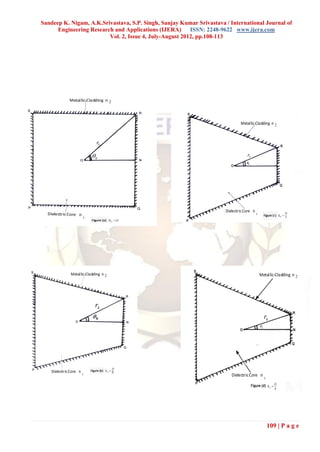
analysis of a new type of non-conventional optical                       Figures 1(b) – (e) shows the geometry of proposed
waveguide having different type of trapezoidal shape            optical waveguide, which has a trapezoidal shape. For such
cross-section. The characteristic equations have been           a wave guide with core and cladding of refractive
derived by using Goell’s point matching method                  indices n1 and n 2 , respectively and (n1  n2 ) n1 can be
(GPMM) under weak-guidance approximation. The                   taken as smaller than unity under weak guidance
dispersion curves are also interpreted in each case .The        approximation. The coordinate representation of a general
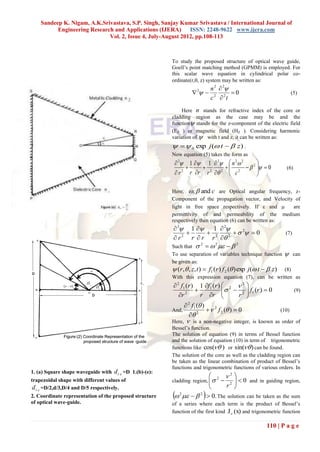
modal properties of proposed structure of optical wave          shape of trapezoidal wave guide is shown in figure (2)
guide are compared with those of standard square wave           [15].In order to find the coordinates on the various sides of
guide with metallic-cladding. It has been observed that         the trapezoid, we can use the following formula:
the effect of distortion of a square wave guide into a                            d t.c
trapezoidal shape with metallic cladding is to shift the         1  arc tan                                      (1)
lowest cut-off value (Vc) towards a large value and                                D
increase the number of modes.                                   Here,   d t ..c and D are transverse contraction on one
                                                                parallel side of trapezoid and side of square,
Keywords-Dispersion curves, integrated optics, Modal
                                                                respectively.
analysis, Metal-cladding.

I. INTRODUCTION                                                 Let the coordinate of a point on PS side of trapezoid
                                                                as shown in figure, (2), is (r , ) .
Much research work has done during the last forty years in
the field of optical fiber technology. This leads to high
capacity and high transmission rate system [1-8].Wave                          D
guide of unusual structure have generated great interest in     Where, r        sec(   ) ,      2 ,        (2)
                                                                               2
comparison of conventional structures of optical wave-
guides [9-17]. The materials used for production of optical     The coordinate on the RS side can be written as,
waveguides like dielectrics, metals chiral, liquid crystal,
polymers etc., have also played great role in revolutionized
                                                                                    D ( D  d t .c )
the communication technology[18-21]. Metal-clad optical         r                                                  (3)
wave guide have attracted the interest of many researchers,          2( D  d t .c ) cos 1  4 Dd t .c sin1
as they are widely used in integrated optics. Attenuation of
T.E.modes is less than that of T.M. modes in such types of
metal-clad optical waveguides [22-28]. Metal optical wave       The coordinate on RN side, can be written
guides are used as mode filter and mode analyzer. Metal         as,
optical waveguide play an important role in directional                         D
couplers .Therefore modal analysis of such waveguides is                    r  sec                  (4)
very important.                                                                 2
In this paper, we propose an optical wave-guide having                                 Where, 0    1
trapezoidal shape cross-section with metallic-cladding. This
proposed wave guide is analyzed in five different cases. In
each case, all boundaries of proposed wave-guide are
surrounded by metal instead of dielectric. For each case
modal characteristic equation and corresponding dispersion
curves are obtained by using Goell‟s point matching
method (GPMM) [29]. These dispersion curves are
compared with the dispersion curves of square waveguide
with metallic cladding and some important insight are
found which are of technical importance for optical fiber
communication.


                                                                                                                108 | P a g e
Sandeep K. Nigam, A.K.Srivastava, S.P. Singh, Sanjay Kumar Srivastava / International Journal of
      Engineering Research and Applications (IJERA)      ISSN: 2248-9622 www.ijera.com
                         Vol. 2, Issue 4, July-August 2012, pp.108-113


                                                                                      109 | P a g e
Sandeep K. Nigam, A.K.Srivastava, S.P. Singh, Sanjay Kumar Srivastava / International Journal of
          Engineering Research and Applications (IJERA)      ISSN: 2248-9622 www.ijera.com
                             Vol. 2, Issue 4, July-August 2012, pp.108-113


                                                            To study the proposed structure of optical wave guide,
                                                            Goell‟s point matching method (GPMM) is employed. For
                                                            this scalar wave equation in cylindrical polar co-
                                                            ordinate(r,, z) system may be written as:
                                                                           n 2  2
                                                                         2 2 0
                                                                        2
                                                                                                                          (5)
                                                                           c  t
                                                                 Here n stands for refractive index of the core or
                                                            cladding region as the case may be and the
                                                            function stands for the z-component of the electric field
                                                            (EZ ) or magnetic field (HZ ). Considering harmonic
                                                            variation of  with t and z, it can be written as:
                                                               0 exp j ( t   z ) .
                                                            Now equation (5) takes the form as
                                                              2 1  1  2                  n 2 2  
                                                                                            2   2   0
                                                                                               c                   (6)
                                                              r 2 r r r 2  2                       

                                                            Here, ,  and c are Optical angular frequency, z-
                                                            Component of the propagation vector, and Velocity of
                                                            light in free space respectively. If  and       are
                                                            permittivity of and permeability of the medium
                                                            respectively then equation (6) can be written as:
                                                             2 1        1  2
                                                                          2         2  0                       (7)
                                                            r  2
                                                                     r  r r    2

                                                            Such that      
                                                                        2   2        2

                                                            To use separation of variables technique function             can
                                                            be given as:
                                                             (r, , z, t )  f1 (r ) f 2 ( ) exp j ( t   z)
                                                                                                         (8)
                                                            With this expression equation (7), can be written as
                                                             2 f1 (r ) 1 f1 (r )  2  2 
                                                                                     2  f1 (r )  0
                                                                         r r          r 
                                                                                                                           (9)
                                                               r 2                       
                                                                  2 f1 ( )
                                                            And,               2 f 2 ( )  0                    (10)
                                                                      2

                                                            Here,  is a non-negative integer, is known as order of
                                                            Bessel‟s function.
                                                            The solution of equation (9) in terms of Bessel function
                                                            and the solution of equation (10) in term of trigonometric
                                                            functions like cos( ) or sin( ) can be found.
                                                            The solution of the core as well as the cladding region can
                                                            be taken as the linear combination of product of Bessel‟s
                                                            functions and trigonometric functions of various orders. In
1. (a) Square shape waveguide with   d t .c =D 1.(b)-(e):
                                                                                           2 
                                                            cladding region,                  0 and in guiding region,
                                                                                    2
trapezoidal shape with different values of
                                                                                           r2 
 d t .c =D/2,d/3,D/4 and D/5 respectively.                                                    
2. Coordinate representation of the proposed structure            0. The solution can be taken as the sum
                                                               2            2

of optical wave-guide.                                      of a series where each term is the product of Bessel‟s
                                                            function of the first kind J (x) and trigonometric function

                                                                                                            110 | P a g e
Sandeep K. Nigam, A.K.Srivastava, S.P. Singh, Sanjay Kumar Srivastava / International Journal of
                 Engineering Research and Applications (IJERA)      ISSN: 2248-9622 www.ijera.com
                                    Vol. 2, Issue 4, July-August 2012, pp.108-113
of same order where as in the outer non-guiding region, the                        The quantities   rk and  k are the polar coordinate of the
solution can be taken as linear combination of the product
                                                                                   points on the core-cladding boundary. The equation
of modified Bessel‟s functions of second kind K ( x) and                          (16) gives the 28 simultaneous equations involving 28
the trigonometric functions. However, there will be no                             unknown constants Aq and Bq and their coefficients
series corresponding to the metallic, non-guiding region
where, the field will be identically vanishes If                                   form a determinant  of order 28×28. A non -trivial
 1 and  2 represents the solution in the core and                                solution will exist for these sets of equation if ,
                                                                                                   =0                         (17)
cladding regions respectively, then we     have
                                                                                   The equation (17) is the characteristic equation, which
                                                                                   contains all the information regarding to the modal
 1  A0 J 0 (u r)  A1 J1 (u r) cos (  )  B1 J1 (u r) sin (  )         (11)    properties of proposed optical waveguides. The solution of
 A2 J 2 (u r) cos ( 2 )  B2 J 2 (u r) sin ( 2 )  ...............              equation (17) gives propagation constants  for sustained
                                                                                   modes in core region. In each case dispersion curve is
                                                                                   obtained and interpreted.
      and,            2  0                                        (12)
                                                                                   III.
                                                                                   NUMERICAL,ESTIMATION,RESULTS
The Parameters „r‟ and „  ‟ in the above                                          AND DISCUSSION
equations (11) represents the polar-coordinates of                                          The modal properties of the proposed optical
the various points on the boundary of proposed                                     waveguides can be found explicitly from the characteristics
structure of optical wave guide. The parameters                                    equation (17) on the basis of numerical calculations. We
„u’ and ‘w’ is defined as                                                          plot  -V Curves (dispersion curves) of the proposed
         2n1                                                                    optical wave-guides by which propagation properties of
   u2           (Core-region parameter)
                    2
                                                                                   different modes can be analyzed. For plotting the
                                                                                dispersion curves, the eigen values of  are obtained by
                                                                   (13)            solving characteristics equation (17). The L.H.S of this
            2  n2                                                               characteristics equation contain the propagation constant
w2   2            0 (Cladding-region parameter)
                                                                                  , angular frequency  , permeability  , side of square
                                                                  (14)             waveguide D and  1 and  2 which represent the relative
                                                                                   permittivity of core and cladding regions, respectively. By
                                                                                   keeping  ,  ,  1 ,  2 and D fixed at proper values, we
In order to study the proposed structure of an optical wave
guide. In Goell‟s point-matching method, the fields in
core region and cladding region are matched at selective                           select a large number of equispaced       values of       in
points on boundary of the wave guide. In this case twenty
                                                                                   propagation region   n1k 0    n2 k 0 ( where k 0 wave-
eight points are taken on the core-cladding boundary to
obtain reasonable results. Matching the field along with                             vector corresponding to free space) and corresponding
their derivatives at chosen points on the boundary of the                            values of  are calculated . In all the five cases of the
wave-guide in each case following equations is f                                     proposed waveguides for which transverse contraction on
 13                               13                                                 one parallel side of proposed waveguide of trapezoidal
      Aq J q (u r ) cos q  
                  k         k      Bq Jq (u rk ) sin q k                           cross-section
q 0                             q 0                                                are d t .c  0 , d  D , d t .c  D , d  D and. d  D .
                                                                                                       t .c                 t .c       t .c
      13                               13                                                                   2          3         4          5
     Cq Kq (w rk ) cos qk   Dq Kq (w rk )sin qk  0                         ( 15) have taken 0  1.55 m ,
                                                                                     We
    q 0                      q 0                                                 n1  1.48 and n2  1.46.
                                                                                   Now,  versus  plots gives the graphical representation
                                               (15)
Since, in proposed structure of optical wave guide, the
non-guiding region (cladding region) is metallic, therefore                        of the characteristics equation (17), shown in figure (3) and
last two terms in equation (15) will be vanished, and also                         zero crossing are noted which gives the possible values of
derivative part has no significance. So equation (15) takes                         for a fixed value of D .This process can be repeated
the form as:                                                                       by selecting different values of D .Also, the dimensionless
                                                                                   wave guide parameter V is given by as:
 13                              13
                                                                                                     2 
 Aq J q (u rk ) cos q k   Bq J q (u rk ) sin q k  0         (16)                          V= 
                                                                                                         D n1 2  n2 2
                                                                                                                              (18)
q 0                          q 0                                                                   0 
                                                                                    Here   0   is free space wavelength.
      For, k= 1, 2,3…….28.


                                                                                                                                111 | P a g e
Sandeep K. Nigam, A.K.Srivastava, S.P. Singh, Sanjay Kumar Srivastava / International Journal of
          Engineering Research and Applications (IJERA)      ISSN: 2248-9622 www.ijera.com
                             Vol. 2, Issue 4, July-August 2012, pp.108-113


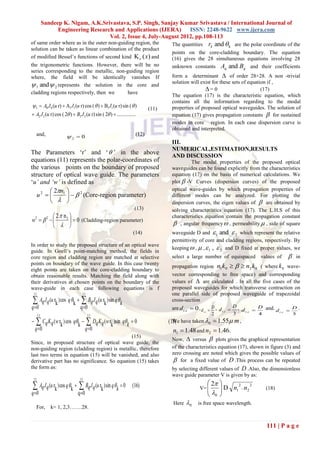
Fig. 3. Graph showing admissible values of                      Fig.4. (a)
for different modes in proposed structure of
optical wave guides.

Thus, we can plot  versus V curves corresponding to the
different modes in each case. Figures 4(b)-e) shows
dispersion curves of the metal-clad trapezoidal optical
waveguide with different values of transverse contraction
( d t .c ) on one parallel side of proposed wave guide of
trapezoidal cross-section. Figure 4(a) shows dispersion
curves for metal- clad square waveguide, for d t .c =0. Here,
we have found some important and interesting results after
comparative study of obtained dispersion curves 4. (b)- (e)
for different cases of the proposed optical waveguide,
which are as follows:
1. The lowest cut off values ( VC ) of trapezoidal cross-
section of the optical waveguide are slightly greater than
the lowest cut-off values of square cross-section.
                                                                                 Fig.(b)
2. The number of modes in trapezoidal shape optical wave
guide is larger for V=8 than square shape cross-section of
optical wave guide for same value of V. Also, the number
of modes increases with increase in transverse contraction
( d t .c ) on one parallel side of the trapezoidal shape of
optical waveguides .In this way, we conclude that more
power is transmitted through metal-clad trapezoidal optical
waveguide than square shaped optical waveguide with a
common value of V.
3. It can be noticed that for larger values of transverse
contraction ( d t .c ), cut-off values of all the modes become
closely spaced and most of them lie between=2.8 to 7.4.
Table-1 binds the obtained interesting results for the
different trapezoidal shape optical waveguides.


                                                                              Fig.(c)


                                                                                           112 | P a g e
Sandeep K. Nigam, A.K.Srivastava, S.P. Singh, Sanjay Kumar Srivastava / International Journal of
             Engineering Research and Applications (IJERA)      ISSN: 2248-9622 www.ijera.com
                                Vol. 2, Issue 4, July-August 2012, pp.108-113

                                                           IV. COCLUSION
                                                           The authors hope that the predicated results will be of
                                                           sufficient interest to induce researchers worldwide
                                                           take up the experimental verification of the results reported
                                                           in the present work.

                                                           AKNOWLEDGEMENT
                                                           Authors are thankful to Prof.S.P.Ojha and Dr.Vivek Singh
                                                           for their academic help and encouragement throughout
                                                           this work.

                                                           REFERENCES
                                                           [1]     A.Ghatak and K.Thyagarajan, Introduction to fiber
                                                                   optics, (Cambridge University press, Cambridge,
                                                                   England, 1999)
                                                           [2.]    N.S.Kapany, Fiber optics principles               and
                                                                   applications,( Acadmemic,New York, 1967)
                                                           [3]     A.K.Ghatak and B.Kulshaw, V.Nagrajan, and
                                                                   B.D.Kurana, (Trend in fiber and optical
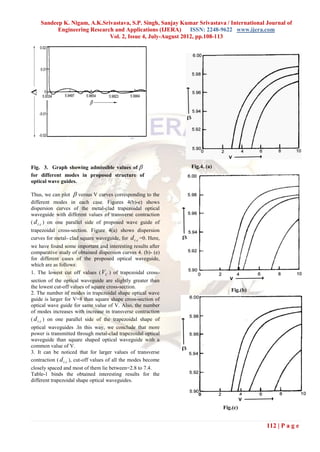
Fig. (d)
                                                                   communications and Viva Book Pvt. Ltd. New
                                                                   Delhi, India, 1996)
                                                           [4]     KeiserG: Optical Fiber Communication.( McGrew-
                                                                   Hill, Singapore 1986.)
                                                           [5]     Tamir T: Integrated optics. (Springer Verlagm New
                                                                   York 1979)
                                                           [6]     Marcuse D: Light Transmission Optics . (Van
                                                                   Nostrand, New York 1972)
                                                           [7]     Dyott RB, Day CR, Brain MC: Glass Fiber
                                                                   waveguide with Triangular core. Electron Ltt. 9
                                                                   (1973) 228-290.
                                                           [8]     Kawakami S, Nishidha S: Characteristics of a
                                                                   doubly clad optical fiber with low index inner
                                                                   cladding. IEEE J. Quantum Electron. QE-10 (1974)
                                                                   879.
                                                           [9]     A.Kumar, V. Thyagranjan, and A.K. Ghatak,
                                                                   “Modal Anaylsis of rectangular core dielectric
                                                                   waveguides: An accurate perturbation approach”
                                                                   Opt. Lett. 8, (1983).63-65.
Fig.(e)
                                                           [10]    U.K. Singh, P. Khastgir, O.N. Singh: Modal
                                                                   analysis of annular optical waveguides bounded by
4. (a)Dispersion curves for square waveguide with                  non-coaxial dielectric cylindrical boundaries by
metallic cladding and (b)-(e),shows dispersion curves              Goell‟s point matching method. Optik 109 (1998)
for trapezoidal optical wave guides with metallic-                 150-154.
cladding for different values of transverse contraction    [11]    V. Mishra, P.K choudhury,P.Khastgir and S.P.Ojha.,
on one parallel side of square shape wave guide.                   An Modal Propgation of a wavguide with a regular
                                                                   pentagonal cross-section with conducting and non-
TABLE-1(Effect of transverse contraction (d t.c ) on the           conducting boundaries, Micro wave Opt. Technol
one parallel side of the proposed optical wave guide of            Lett 8 (1995). 280-282.
trapezoidal cross-section.                                 [12].   V.Singh, S.P. Ojha and L.K.singh, Modal behavior
                                                                   cut-off condition and dispersion characteristics of an
S.No       d t.c   Lowest cut-   Number                            optical waveguide with core cross-section bounded
                       off       of modes                          by two spirals ,Microwave and optical Technology
                   value(V C )    at V=8                           Letters, 21(1999) 121-124.
                                                           [13].   H.P. Singh, Vivek Singh and V.P.Arora Modal
  1.        D          2.8          3                             analysis and dispersion curves of curvilinear
  2.       D/2         2.9          4                             triangular cored light guide ,using Goell‟s point
  3.       D/3         3.0          4                             matching method, optik119,1(2008) 29-33.
  4.       D/4         3.1          5
  5.       D/5         3.4          6

                                                                                                         113 | P a g e
Sandeep K. Nigam, A.K.Srivastava, S.P. Singh, Sanjay Kumar Srivastava / International Journal of
             Engineering Research and Applications (IJERA)      ISSN: 2248-9622 www.ijera.com
                                Vol. 2, Issue 4, July-August 2012, pp.108-113
[14]    C.B.P. Verma, U.K. Singh, V.B. Singh, O.N.Singh-               Electromagnetic waves and application, vol. 18,
        II. Confocal and concentric annular elliptic light             No9, 1157-1169,(2004).
        guide                                                   [29]   21. J.E. Goell, A circular- harmonic computer
                                                                       analysis of rectangular dielectric waveguides, Bell
        their modal characteristics. Optik 112, (2001).105-            Syst Tech J 48 (1969), 2133-2160.
        108
[15]    S.K. Srivastava and S.P.ojha, acomparative study of
        different types of dielectric trapezoid optical wave
        guides under weak guidance approximation,
        Microwave opt Technol Lett 32 (2000), 461-464.
[16]    N.Kumar, S.K.Srivastava, and S.P.Ojha, A
        comparative      study     of    modal     dispersion
        characteristics of different types concave shaped
        dielectrics waveguide, Microwave Opt. Technol Lett
        (2002) 337-342..
[17]    A.K.Singh, P.Kastgir, O.N.Singh and S.P.Ojha,
        Local field configuration modes in weakly guiding
        fiber with a canonically annular core:A
        comparatively study, Japan J App Phy 32 (1993),
        171.
[18]    S.L.Tsao, J.Wu, andY.L.Her,Triangular finite
        analysis of a trapezoid polymer optical waveguide,
        Microwave and Opt Technol Lett 15 (1997), 87-89.
[19]    E. Jackman and E.P. Raynes, Electro-optic response
        time in liquid crystal, Phys Rev 39A (1972), 69.
[20]    M.P.S. Rao, V. Singh, B.Prasad, and S.P.Ojha, An
        analytical study of the dispersion curves of an
        annular wave guide made of liquid crystal,Photon ,
        5 (1998), 73-88.
[21]    S.Ganguly, Kh.S. Singh, S.P. Ojha, and P.Khastgir,
        Modal cutoff conditions for a chirowaveguide with a
        chiral core of large annular cross-section bounded
        by a dielectric media, Microwave Opt Techno Lett 8
        (1995), 18-21.
[22]    H.J. Fink, Propagation of modes in optical
        waveguide with various dielectric and metallic
        claddings, IEEE J Quantum Electron QE-12(1976),
        265-367.
[23.]   23. Y. Yamanoto, T. Kamiya, H.Yanai, Propagation
        characteristics of a partially metal clad optical
        waveguide: metal clad optical strip line, App. Opt.
        14 (1975) 322-326.
[24]    J.N. polky and G.L. Mitchell, Metal-cad planar
        dielectric waveguide for integrated optics, J Opt Soc
        Amer 64 (1974), 274-279.
[25]    T. Takano and J.Hamasaki, Prppogating modes of a
        metal-clad dielectric slab waveguide for integrated
        optics, IEEE J Quantum Electron QE -8(1972), 206-
        212.
[26.]   A. Reisinger, Attenuation Properties of optical
        wavwguides with a metal boundary, Appl. Phys Lett
        23 (1973), 237-239.
[27].   V.N.Mishra, V.singh, S.P. Ojha , and B.Prasad,
        Dispersion characteristics of a Metal-clad
        rectangular cored light guide under the weak
        guidance condition, optic 111 (2000), 423-426.
[28.]   P.C.Pandey D.Singh, S.P. Ojha, Effect of metal-
        cladding on the modal dispersion characteristics of
        an annular wave guide with the guiding region
        section bounded by a square and circle, J. of


                                                                                                          114 | P a g e

N24108113

  • 1.
    Sandeep K. Nigam,A.K.Srivastava, S.P. Singh, Sanjay Kumar Srivastava / International Journal of Engineering Research and Applications (IJERA) ISSN: 2248-9622 www.ijera.com Vol. 2, Issue 4, July-August 2012, pp.108-113 “Modal dispersion curves of different types of metal-clad trapezoidal optical wave-guides and their comparative study” Sandeep K. Nigam, A.K.Srivastava, S.P. Singh, Sanjay Kumar Srivastava Department of physics, K.N.I.P.S.S. sultanpur-2281189, (U.P)- India. ABSTRACT In this contribution, we present the modal II.THEORY analysis of a new type of non-conventional optical Figures 1(b) – (e) shows the geometry of proposed waveguide having different type of trapezoidal shape optical waveguide, which has a trapezoidal shape. For such cross-section. The characteristic equations have been a wave guide with core and cladding of refractive derived by using Goell’s point matching method indices n1 and n 2 , respectively and (n1  n2 ) n1 can be (GPMM) under weak-guidance approximation. The taken as smaller than unity under weak guidance dispersion curves are also interpreted in each case .The approximation. The coordinate representation of a general modal properties of proposed structure of optical wave shape of trapezoidal wave guide is shown in figure (2) guide are compared with those of standard square wave [15].In order to find the coordinates on the various sides of guide with metallic-cladding. It has been observed that the trapezoid, we can use the following formula: the effect of distortion of a square wave guide into a d t.c trapezoidal shape with metallic cladding is to shift the 1  arc tan (1) lowest cut-off value (Vc) towards a large value and D increase the number of modes. Here, d t ..c and D are transverse contraction on one parallel side of trapezoid and side of square, Keywords-Dispersion curves, integrated optics, Modal respectively. analysis, Metal-cladding. I. INTRODUCTION Let the coordinate of a point on PS side of trapezoid as shown in figure, (2), is (r , ) . Much research work has done during the last forty years in the field of optical fiber technology. This leads to high capacity and high transmission rate system [1-8].Wave D guide of unusual structure have generated great interest in Where, r  sec(   ) ,      2 , (2) 2 comparison of conventional structures of optical wave- guides [9-17]. The materials used for production of optical The coordinate on the RS side can be written as, waveguides like dielectrics, metals chiral, liquid crystal, polymers etc., have also played great role in revolutionized D ( D  d t .c ) the communication technology[18-21]. Metal-clad optical r (3) wave guide have attracted the interest of many researchers, 2( D  d t .c ) cos 1  4 Dd t .c sin1 as they are widely used in integrated optics. Attenuation of T.E.modes is less than that of T.M. modes in such types of metal-clad optical waveguides [22-28]. Metal optical wave The coordinate on RN side, can be written guides are used as mode filter and mode analyzer. Metal as, optical waveguide play an important role in directional D couplers .Therefore modal analysis of such waveguides is r  sec (4) very important. 2 In this paper, we propose an optical wave-guide having Where, 0    1 trapezoidal shape cross-section with metallic-cladding. This proposed wave guide is analyzed in five different cases. In each case, all boundaries of proposed wave-guide are surrounded by metal instead of dielectric. For each case modal characteristic equation and corresponding dispersion curves are obtained by using Goell‟s point matching method (GPMM) [29]. These dispersion curves are compared with the dispersion curves of square waveguide with metallic cladding and some important insight are found which are of technical importance for optical fiber communication. 108 | P a g e
  • 2.
    Sandeep K. Nigam,A.K.Srivastava, S.P. Singh, Sanjay Kumar Srivastava / International Journal of Engineering Research and Applications (IJERA) ISSN: 2248-9622 www.ijera.com Vol. 2, Issue 4, July-August 2012, pp.108-113 109 | P a g e
  • 3.
    Sandeep K. Nigam,A.K.Srivastava, S.P. Singh, Sanjay Kumar Srivastava / International Journal of Engineering Research and Applications (IJERA) ISSN: 2248-9622 www.ijera.com Vol. 2, Issue 4, July-August 2012, pp.108-113 To study the proposed structure of optical wave guide, Goell‟s point matching method (GPMM) is employed. For this scalar wave equation in cylindrical polar co- ordinate(r,, z) system may be written as: n 2  2    2 2 0 2 (5) c  t Here n stands for refractive index of the core or cladding region as the case may be and the function stands for the z-component of the electric field (EZ ) or magnetic field (HZ ). Considering harmonic variation of  with t and z, it can be written as:    0 exp j ( t   z ) . Now equation (5) takes the form as  2 1  1  2  n 2 2      2   2   0  c  (6)  r 2 r r r 2  2   Here, ,  and c are Optical angular frequency, z- Component of the propagation vector, and Velocity of light in free space respectively. If  and  are permittivity of and permeability of the medium respectively then equation (6) can be written as:  2 1  1  2   2   2  0 (7) r 2 r  r r  2 Such that       2 2 2 To use separation of variables technique function  can be given as:  (r, , z, t )  f1 (r ) f 2 ( ) exp j ( t   z) (8) With this expression equation (7), can be written as  2 f1 (r ) 1 f1 (r )  2  2      2  f1 (r )  0 r r  r  (9) r 2    2 f1 ( ) And,   2 f 2 ( )  0 (10)  2 Here,  is a non-negative integer, is known as order of Bessel‟s function. The solution of equation (9) in terms of Bessel function and the solution of equation (10) in term of trigonometric functions like cos( ) or sin( ) can be found. The solution of the core as well as the cladding region can be taken as the linear combination of product of Bessel‟s functions and trigonometric functions of various orders. In 1. (a) Square shape waveguide with d t .c =D 1.(b)-(e):  2  cladding region,      0 and in guiding region, 2 trapezoidal shape with different values of  r2  d t .c =D/2,d/3,D/4 and D/5 respectively.   2. Coordinate representation of the proposed structure       0. The solution can be taken as the sum 2 2 of optical wave-guide. of a series where each term is the product of Bessel‟s function of the first kind J (x) and trigonometric function 110 | P a g e
  • 4.
    Sandeep K. Nigam,A.K.Srivastava, S.P. Singh, Sanjay Kumar Srivastava / International Journal of Engineering Research and Applications (IJERA) ISSN: 2248-9622 www.ijera.com Vol. 2, Issue 4, July-August 2012, pp.108-113 of same order where as in the outer non-guiding region, the The quantities rk and  k are the polar coordinate of the solution can be taken as linear combination of the product points on the core-cladding boundary. The equation of modified Bessel‟s functions of second kind K ( x) and (16) gives the 28 simultaneous equations involving 28 the trigonometric functions. However, there will be no unknown constants Aq and Bq and their coefficients series corresponding to the metallic, non-guiding region where, the field will be identically vanishes If form a determinant  of order 28×28. A non -trivial  1 and  2 represents the solution in the core and solution will exist for these sets of equation if , =0 (17) cladding regions respectively, then we have The equation (17) is the characteristic equation, which contains all the information regarding to the modal  1  A0 J 0 (u r)  A1 J1 (u r) cos (  )  B1 J1 (u r) sin (  ) (11) properties of proposed optical waveguides. The solution of  A2 J 2 (u r) cos ( 2 )  B2 J 2 (u r) sin ( 2 )  ............... equation (17) gives propagation constants  for sustained modes in core region. In each case dispersion curve is obtained and interpreted. and, 2  0 (12) III. NUMERICAL,ESTIMATION,RESULTS The Parameters „r‟ and „  ‟ in the above AND DISCUSSION equations (11) represents the polar-coordinates of The modal properties of the proposed optical the various points on the boundary of proposed waveguides can be found explicitly from the characteristics structure of optical wave guide. The parameters equation (17) on the basis of numerical calculations. We „u’ and ‘w’ is defined as plot  -V Curves (dispersion curves) of the proposed  2n1  optical wave-guides by which propagation properties of u2      (Core-region parameter) 2 different modes can be analyzed. For plotting the    dispersion curves, the eigen values of  are obtained by (13) solving characteristics equation (17). The L.H.S of this  2  n2  characteristics equation contain the propagation constant w2   2     0 (Cladding-region parameter)     , angular frequency  , permeability  , side of square (14) waveguide D and  1 and  2 which represent the relative permittivity of core and cladding regions, respectively. By keeping  ,  ,  1 ,  2 and D fixed at proper values, we In order to study the proposed structure of an optical wave guide. In Goell‟s point-matching method, the fields in core region and cladding region are matched at selective select a large number of equispaced values of  in points on boundary of the wave guide. In this case twenty propagation region n1k 0    n2 k 0 ( where k 0 wave- eight points are taken on the core-cladding boundary to obtain reasonable results. Matching the field along with vector corresponding to free space) and corresponding their derivatives at chosen points on the boundary of the values of  are calculated . In all the five cases of the wave-guide in each case following equations is f proposed waveguides for which transverse contraction on 13 13 one parallel side of proposed waveguide of trapezoidal  Aq J q (u r ) cos q   k k  Bq Jq (u rk ) sin q k cross-section q 0 q 0 are d t .c  0 , d  D , d t .c  D , d  D and. d  D . t .c t .c t .c 13 13 2 3 4 5   Cq Kq (w rk ) cos qk   Dq Kq (w rk )sin qk  0 ( 15) have taken 0  1.55 m , We q 0 q 0 n1  1.48 and n2  1.46. Now,  versus  plots gives the graphical representation (15) Since, in proposed structure of optical wave guide, the non-guiding region (cladding region) is metallic, therefore of the characteristics equation (17), shown in figure (3) and last two terms in equation (15) will be vanished, and also zero crossing are noted which gives the possible values of derivative part has no significance. So equation (15) takes  for a fixed value of D .This process can be repeated the form as: by selecting different values of D .Also, the dimensionless wave guide parameter V is given by as: 13 13  2   Aq J q (u rk ) cos q k   Bq J q (u rk ) sin q k  0 (16) V=    D n1 2  n2 2  (18) q 0 q 0  0  Here 0 is free space wavelength. For, k= 1, 2,3…….28. 111 | P a g e
  • 5.
    Sandeep K. Nigam,A.K.Srivastava, S.P. Singh, Sanjay Kumar Srivastava / International Journal of Engineering Research and Applications (IJERA) ISSN: 2248-9622 www.ijera.com Vol. 2, Issue 4, July-August 2012, pp.108-113 Fig. 3. Graph showing admissible values of  Fig.4. (a) for different modes in proposed structure of optical wave guides. Thus, we can plot  versus V curves corresponding to the different modes in each case. Figures 4(b)-e) shows dispersion curves of the metal-clad trapezoidal optical waveguide with different values of transverse contraction ( d t .c ) on one parallel side of proposed wave guide of trapezoidal cross-section. Figure 4(a) shows dispersion curves for metal- clad square waveguide, for d t .c =0. Here, we have found some important and interesting results after comparative study of obtained dispersion curves 4. (b)- (e) for different cases of the proposed optical waveguide, which are as follows: 1. The lowest cut off values ( VC ) of trapezoidal cross- section of the optical waveguide are slightly greater than the lowest cut-off values of square cross-section. Fig.(b) 2. The number of modes in trapezoidal shape optical wave guide is larger for V=8 than square shape cross-section of optical wave guide for same value of V. Also, the number of modes increases with increase in transverse contraction ( d t .c ) on one parallel side of the trapezoidal shape of optical waveguides .In this way, we conclude that more power is transmitted through metal-clad trapezoidal optical waveguide than square shaped optical waveguide with a common value of V. 3. It can be noticed that for larger values of transverse contraction ( d t .c ), cut-off values of all the modes become closely spaced and most of them lie between=2.8 to 7.4. Table-1 binds the obtained interesting results for the different trapezoidal shape optical waveguides. Fig.(c) 112 | P a g e
  • 6.
    Sandeep K. Nigam,A.K.Srivastava, S.P. Singh, Sanjay Kumar Srivastava / International Journal of Engineering Research and Applications (IJERA) ISSN: 2248-9622 www.ijera.com Vol. 2, Issue 4, July-August 2012, pp.108-113 IV. COCLUSION The authors hope that the predicated results will be of sufficient interest to induce researchers worldwide take up the experimental verification of the results reported in the present work. AKNOWLEDGEMENT Authors are thankful to Prof.S.P.Ojha and Dr.Vivek Singh for their academic help and encouragement throughout this work. REFERENCES [1] A.Ghatak and K.Thyagarajan, Introduction to fiber optics, (Cambridge University press, Cambridge, England, 1999) [2.] N.S.Kapany, Fiber optics principles and applications,( Acadmemic,New York, 1967) [3] A.K.Ghatak and B.Kulshaw, V.Nagrajan, and B.D.Kurana, (Trend in fiber and optical Fig. (d) communications and Viva Book Pvt. Ltd. New Delhi, India, 1996) [4] KeiserG: Optical Fiber Communication.( McGrew- Hill, Singapore 1986.) [5] Tamir T: Integrated optics. (Springer Verlagm New York 1979) [6] Marcuse D: Light Transmission Optics . (Van Nostrand, New York 1972) [7] Dyott RB, Day CR, Brain MC: Glass Fiber waveguide with Triangular core. Electron Ltt. 9 (1973) 228-290. [8] Kawakami S, Nishidha S: Characteristics of a doubly clad optical fiber with low index inner cladding. IEEE J. Quantum Electron. QE-10 (1974) 879. [9] A.Kumar, V. Thyagranjan, and A.K. Ghatak, “Modal Anaylsis of rectangular core dielectric waveguides: An accurate perturbation approach” Opt. Lett. 8, (1983).63-65. Fig.(e) [10] U.K. Singh, P. Khastgir, O.N. Singh: Modal analysis of annular optical waveguides bounded by 4. (a)Dispersion curves for square waveguide with non-coaxial dielectric cylindrical boundaries by metallic cladding and (b)-(e),shows dispersion curves Goell‟s point matching method. Optik 109 (1998) for trapezoidal optical wave guides with metallic- 150-154. cladding for different values of transverse contraction [11] V. Mishra, P.K choudhury,P.Khastgir and S.P.Ojha., on one parallel side of square shape wave guide. An Modal Propgation of a wavguide with a regular pentagonal cross-section with conducting and non- TABLE-1(Effect of transverse contraction (d t.c ) on the conducting boundaries, Micro wave Opt. Technol one parallel side of the proposed optical wave guide of Lett 8 (1995). 280-282. trapezoidal cross-section. [12]. V.Singh, S.P. Ojha and L.K.singh, Modal behavior cut-off condition and dispersion characteristics of an S.No d t.c Lowest cut- Number optical waveguide with core cross-section bounded off of modes by two spirals ,Microwave and optical Technology value(V C ) at V=8 Letters, 21(1999) 121-124. [13]. H.P. Singh, Vivek Singh and V.P.Arora Modal 1. D  2.8 3 analysis and dispersion curves of curvilinear 2. D/2  2.9 4 triangular cored light guide ,using Goell‟s point 3. D/3  3.0 4 matching method, optik119,1(2008) 29-33. 4. D/4  3.1 5 5. D/5  3.4 6 113 | P a g e
  • 7.
    Sandeep K. Nigam,A.K.Srivastava, S.P. Singh, Sanjay Kumar Srivastava / International Journal of Engineering Research and Applications (IJERA) ISSN: 2248-9622 www.ijera.com Vol. 2, Issue 4, July-August 2012, pp.108-113 [14] C.B.P. Verma, U.K. Singh, V.B. Singh, O.N.Singh- Electromagnetic waves and application, vol. 18, II. Confocal and concentric annular elliptic light No9, 1157-1169,(2004). guide [29] 21. J.E. Goell, A circular- harmonic computer analysis of rectangular dielectric waveguides, Bell their modal characteristics. Optik 112, (2001).105- Syst Tech J 48 (1969), 2133-2160. 108 [15] S.K. Srivastava and S.P.ojha, acomparative study of different types of dielectric trapezoid optical wave guides under weak guidance approximation, Microwave opt Technol Lett 32 (2000), 461-464. [16] N.Kumar, S.K.Srivastava, and S.P.Ojha, A comparative study of modal dispersion characteristics of different types concave shaped dielectrics waveguide, Microwave Opt. Technol Lett (2002) 337-342.. [17] A.K.Singh, P.Kastgir, O.N.Singh and S.P.Ojha, Local field configuration modes in weakly guiding fiber with a canonically annular core:A comparatively study, Japan J App Phy 32 (1993), 171. [18] S.L.Tsao, J.Wu, andY.L.Her,Triangular finite analysis of a trapezoid polymer optical waveguide, Microwave and Opt Technol Lett 15 (1997), 87-89. [19] E. Jackman and E.P. Raynes, Electro-optic response time in liquid crystal, Phys Rev 39A (1972), 69. [20] M.P.S. Rao, V. Singh, B.Prasad, and S.P.Ojha, An analytical study of the dispersion curves of an annular wave guide made of liquid crystal,Photon , 5 (1998), 73-88. [21] S.Ganguly, Kh.S. Singh, S.P. Ojha, and P.Khastgir, Modal cutoff conditions for a chirowaveguide with a chiral core of large annular cross-section bounded by a dielectric media, Microwave Opt Techno Lett 8 (1995), 18-21. [22] H.J. Fink, Propagation of modes in optical waveguide with various dielectric and metallic claddings, IEEE J Quantum Electron QE-12(1976), 265-367. [23.] 23. Y. Yamanoto, T. Kamiya, H.Yanai, Propagation characteristics of a partially metal clad optical waveguide: metal clad optical strip line, App. Opt. 14 (1975) 322-326. [24] J.N. polky and G.L. Mitchell, Metal-cad planar dielectric waveguide for integrated optics, J Opt Soc Amer 64 (1974), 274-279. [25] T. Takano and J.Hamasaki, Prppogating modes of a metal-clad dielectric slab waveguide for integrated optics, IEEE J Quantum Electron QE -8(1972), 206- 212. [26.] A. Reisinger, Attenuation Properties of optical wavwguides with a metal boundary, Appl. Phys Lett 23 (1973), 237-239. [27]. V.N.Mishra, V.singh, S.P. Ojha , and B.Prasad, Dispersion characteristics of a Metal-clad rectangular cored light guide under the weak guidance condition, optic 111 (2000), 423-426. [28.] P.C.Pandey D.Singh, S.P. Ojha, Effect of metal- cladding on the modal dispersion characteristics of an annular wave guide with the guiding region section bounded by a square and circle, J. of 114 | P a g e