I CONFIDENTIAL               I


              FINAL EXAMINATION SEMESTER I
                     SESSION 2009/2010

COURSE CODE                   SEE 2523 / SZE 2523

COURSE                        ELECTROMAGNETIC FIELD THEORY

LECTURERS                     ASSOC. PROF. DR. NORAZAN BIN MOHD
                              KASSIM
                              DR. YOU KOK YEOW
                              MDM. FATIMAH BT MOHAMAD

PROGRAMME                      SEC / SEE / SEI / SEL / SEM !SEP / SET /
                               SEW

SECTION                        01 - 03

TIME                           2 HOURS 30 MINUTES

DATE                           9 NOVEMBER 2009


INSTRUCTION TO CANDIDATE

ANSWER FOUR (4) QUESTIONS ONLY.


THIS EXAMINATION BOOKLET CONSISTS OF 9 PAGES INCLUDING THE FRONT
COVER
SEE 2523
                                               2

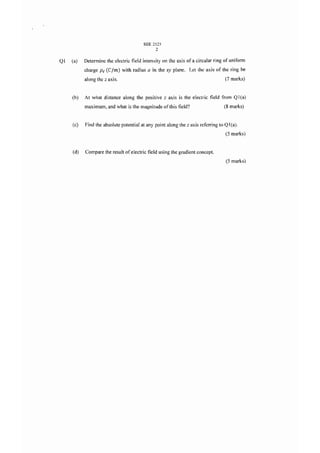
QI   (a)   Determine the electric field intensity on the axis of a circular ring of uniform
           charge Pi (C 1m) with radius a in the .xy plane. Let the axis of the ring be
           along the z axis.                                                      (7 marks)


     (b)   At what distance along the positive z axis is the electric field from Ql(a)
           maximum, and what is the magnitude of this field?                      (8 marks)


     (c)   Find the absolute potential at any point along the z axis referring to Q 1(a).
                                                                                  (5 marks)


     (d)   Compare the result of electric field using the gradient concept.
                                                                                   (5 marks)
SEE 2523
                                                3

Q2     (a)   With the aid of suitable diagrams and Maxwell 's equation s, develop the
             boundary condition equations for two dielectric materials with different
             permittivities.
                                                                            (5 marks)

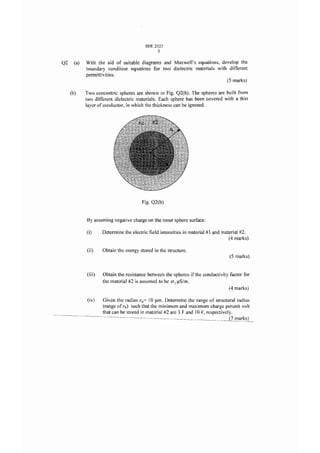
     (b)     Two concentric spheres are shown in Fig. Q2(b). The spheres are built from
             two different dielectric materials . Each sphere has been covered with a thin
             layer of conductor, in wh ich the th ickness can be ignored .


                                        Fig. Q2(b)


             By assuming negative charge on the inner sphere surface:

             (i)     Determine the electric field intensities in material # 1 and material #2.
                                                                                     (4 marks)

             (ii)    Obtain the energy stored in the structure.
                                                                                    (5 marks)


             (iii)   Obtain the resistance between the spheres if the conductivity factor for
                     the material #2 is assumed to be (Yl !1S/m .
                                                                                  (4 marks)

             (iv)    Given the radius r a"" 10 urn. Determine the range of structural radiu s
                     (range of rb) such that the minimum and maximum charge perunit volt
                     that can be stored in material #2 are 3 F and 10 F, respectively.
                                                                                    (7 marks)
SEE 2523
                                                  4

Q3   (a)   Compare the usefulness of Ampere's Circuital Law and Biot Savart Law in
           determining the magnetic field intensity B of a current carrying circuit.
                                                                                        (5 marks)
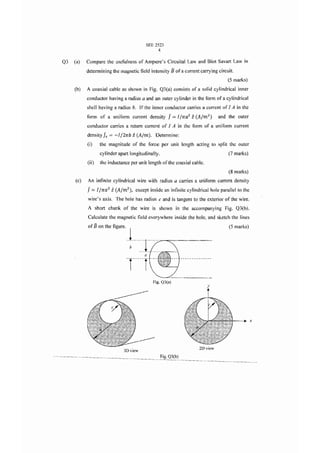
     (b)   A coaxial cable as shown in Fig. Q3(a) consists of a solid cylindrical inner
           conductor having a radius a and an outer cylinder in the form of a cylindrical
           shell having a radius b. If the inner conductor carries a current of I A in the
           form of a uniform current density            J == IIrra 2 i   (Alm 2 )   and the outer
           conductor carries a return current of 1 A in the form of a uniform current
           density Js   = -Il2rrb i    (Aim). Determine:
           (i)    the magnitude of the force per unit length acting 10 split the outer
                  cylinder apart longitudinally.                                        (7 marks)
           (ii)   the inductance per unit length of the coaxial cable .
                                                                                        (8 marks)
     (e)   An infinite cylindrical wire with radius a carries a uniform current density
           J == l ltta? i   (A/m 2 ) , except inside an infinite cylindrical hole parallel to the
           wire's axis. The hole has radius c and is tangent to the exterior of the wire.
           A short chunk of the wire is shown in the accompanying Fig. Q3(b) .
           Calculate the magnetic field everywhere inside the hole, and sketch the lines
           of B on the figure .                                                         (S marks)


                                  · ·~· · : I
                                           a
                                  -r----r
                                                Fig. Q3(a)
                                                                              y


                                                                                                    x


                                                                          2D view
                                3D view
                                                    Fig. Q3(b)
SEE 2523
                                                         5

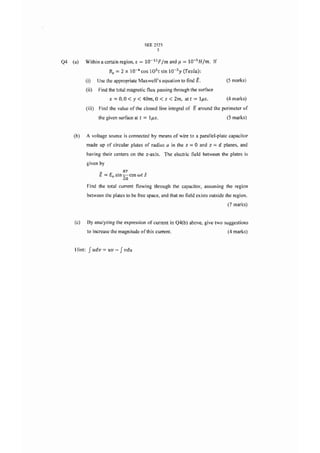
Q4   (a)    Within a certain region, e = 1O- 1 1F [m and f.-l         = lO-sHlm.       If
                             B;   = 2 x 10-   4                   3
                                                  cos lOSt sin 10- y (Testa):
            (i)       Use the appropriate Maxwell's equation to find         E.             (5 marks)
              (ii)    Find the total magnetic flux passing through the surface
                             x   = 0,0< Y < 40m, 0 < z <         2m, at t   = lfiS.          (4 marks)
              (iii)   Find the value of the closed line integral of         E around   the perimeter of
                      the given surface at t       = lfiS.                                   (5 marks)


     (b)      A voltage source is connected by means of wire to a parallel-plate capacitor
              made up of circular plates of radius a in the z           =0     and z   = d planes,   and
              having their centers on the z-axis. The electric field between the plates is
              given by
                       _            n:T
                       E   = £0 sin 20 cos wt z
              Find the total current flowing through the capacitor, assuming the region
              between the plates to be free space, and that no field exists outside the region.
                                                                                             (7 marks)


      (c)     By analyzing the expression of current in Q4(b) above, give two suggestions
              to increase the magnitude ofthis current.                                      (4 marks)


      Hint:    Judv =       uv -   Jvdu
SEE 2523
                                                 6

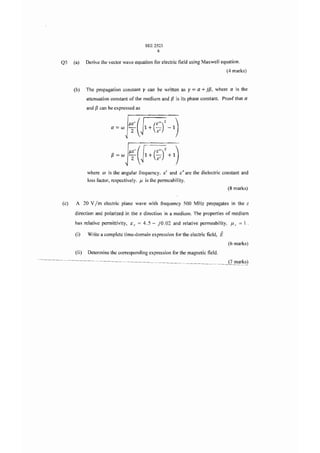
Q5    (a)    Derive the vector wave equation for electric field using Maxwell equation.
                                                                                             (4 marks)


      (b)    The propagation constant y can be written as y                = a + jf3, where    a is the
             attenuation constant of the medium and f3 is its phase constant. Proof that a
             and f3 can be expressed as


                           a=w     T ( 1+"7 -1 )
                                   j1E'  (E")2


                                   j1E' ( [ (E")2 +1 )
                           f3=WT~1+7

             where   OJ   is the angular frequency.   E;'   and   E;"   are the dielectric constant and
             loss factor, respectively. J.1 is the permeability.
                                                                                              (8 marks)


(c)    A 20 V    1m electric    plane wave with frequency 500 MHz propagates in the z

      direction and polarized in the x direction in a medium. The properties of medium
      has relative permittivity, e r = 4.5 - jO .02 and relative permeability, J.1 r               =1.
      (i)    Write a complete time-domain expression for the electric field,             E
                                                                                              (6 marks)
      (ii)   Determine the corresponding expression for the magnetic field.
                                                                                              (7 marks)
SEE 2523
                                                                     7

              ELECTROSTATIC FIELD                                            I            MAGNETOSTATIC FIELD
Coulomb's Law           - J dQ
                        E::=        ---2
                                                    "
                                                    aR                       I Biot-Savart Law H =
                                                                                               -              f~ XClR
                                                                                                               4;d(2
                                    47!&oR

Gauss's Law        db.ds=Qm                                                      Ampere Circuital law         dH· a1 = len
Force on a point charge              F =EQ.                                      Force on a moving charge F = Q(u x B)
                                                                                 Force on a current element F = I dI x 7f
Electric field for finite line charge                                            Magnetic field for finite current

E =.--t1..-F(Sina 2 + sinal ) + ~(cosa2 -cosa)}
                                                                                    -       I               .
                                                                                    H     =-(sina 2 + sina1)¢
                                                                                           47lr
     47l"&o    r                                    r
Electric field for infinite line charge                                          Magnetic field for infinite current
                                                                                   - I·
   E=J:L,.                                                                         H=-¢
        27l"&or                                                                            27lr
Electric flux density D = cE                                                     Magnetic flux density        B=pH
Electric flux If/ =Q=QD. ds
                E                                                                Magnetic flux If/ =         JB . ds
                                                                 »»
                                                                                                 m

Divergence theorem          Q ds = j (v
                             D.                                                  Stoke's theorem          c}H.dI = j (vx H) ds
                                s                       ,                                                 I        s


Potential difference VAB             ::=   -1 E.
                                            B
                                                            dI

Absolute potential          V
                                =
                                     J47l"~R
                                        dO

Gradient of potential           ~      E = -V' V                                 Magnetic potential, (A) -1 B = V' x A
Energy stored in an electric field                                               Energy stored in a magnetic field
   WE =!
          2
               J . E)1v
               v
                (15                                                                         ::=   !
                                                                                        w; ~ (B. H)1v
Total current in a conductor
   l=fJ·ds where] = 0-£
Polarization vector         P =D-8aE                                             Magnetization vector M == XmH
                                                                                                  where Xm = u; -1
Bound surface charge density                                                     Magnetized surface current density
         pso=P.n                                                                        J,m=Mxn
Volume surface charge density                                                    Magnetized volume current density
         Pv
          o::=-Y'P                                                                  ]m =YxM
Electrical boundary conditions                                                   Magnetic boundary conditions
                   =
   .L1" - Dg, p, and £'1 E21               =                                       B...
                                                                                      = Bz,. and ~I - H2t = J,
                                                                                                                                 --
Resistance R =-
    .           I                                                                Inductance L ::=!:.- where A= 11/,,/'/
                       as                                                                             I
Capacitance C =         g
                        Vao
Poisson's equation V'2V ::= _fr
                                               E:
Laplace equation v'v = 0
Maxwell equation y. D = Pv. V' x                                 E =0            Maxwell equation V'. B = 0, 'YxH=J
SEE 2523
                                                     8


                                TIME VARYING FIELD
Maxwell equation V'. D== p,                         Gauss's Law for electric field

                        I
                               -    a8
                             x E = --                    Faraday's Law
                                        if
                        1·8=0                            Gauss's Law for magnetic field
                           - - aD
                        lxH=J+-                         Ampere Circuital Law
                                             if

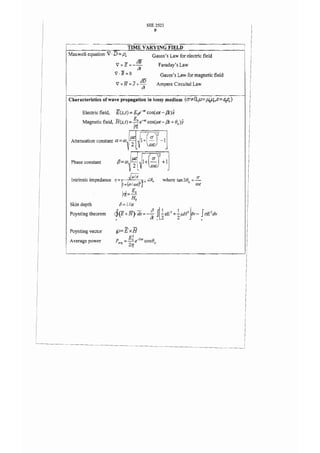
Characteristics of wave propagation in lossy medium (a*O,/-l=AA,E=fioE,.)

      Electric field,   E(z,t) == Eoe-a: cos(a>t -           /lz)x
      Magnetic field, H(z,t)     =~e-«" cos(aJt- fJz+ 8n )y

 Attenuation constan!   a"Q)~~ ~I+(:J -I
 Phase constant

                                 j;i&
 Intrinsic impedance    '7=11+(CT I (j)£)" FLBn            where tan 28       =.!!...
                                                                          n     OJf:

                              I~ = Eo
                                  n,
                                                         III "
Skin depth                   o==l/a

Poynting theorem        .r~ -) - a
                        I..!.E xH ·ds=--
                        s a ,. 2
                                                               1
                                                          -6£ +-pH
                                                               2
                                                                      2}       v-       I aE dv
                                                                                        .'
                                                                                             2


Poynting vector         tJ=ExH
Average power           Pavg =-e -2«" cos en
                              E;
                                 217
SEE 2523
                                          9

Kecerunan "Gradient"

       Vj   = xOf + Yoj + Z oj
               ox        By   oz
       Vj = Poj + i
                 Of + Z oj
            or r or/! 8z
       Vj=p a +~ Of +- L Of
             j
            ar r ae rsine or/!


Kecapahan "Divergence"

          -    aA        oA, aA
       V -A   = - ' +-" +-'
                ax        By oz
       «: =.!.[acrAJ] +.!. OAf +aA,
                r    or       r or/!   OZ
       V   -:4 =~ [O(r'A,)]+_I_ [O(Aa Sine)]+_I_OA f
                r'   or    r sin e'  8e      r sine' or/!


Ikal "Curl"


   -
       = x 8;- 8A  + Y a;-a; ) +Z a;--8; J
         _(OA,     j _(8A, OA, _lOA, oA,
                     y
Vx A            az
                                        rA;)
VxA =r[ -8A, - - +r/! - -OA,) +- [oC - -8A,]
    -   _ 1 - oA; j "( 8A,    - Z-            -
          r or/! oz     oz or " r Or          or/!
V x A = _P_[OCAf sine) _8Aa] +~[_1_8A, _ 8(rA;)] +i( 8crAa) - oA, J
        rsine     ae     ar/!  r sine or/!   or    r   or     oe


Laplacian

See 2523 sze 2523 2

  • 1.
    I CONFIDENTIAL I FINAL EXAMINATION SEMESTER I SESSION 2009/2010 COURSE CODE SEE 2523 / SZE 2523 COURSE ELECTROMAGNETIC FIELD THEORY LECTURERS ASSOC. PROF. DR. NORAZAN BIN MOHD KASSIM DR. YOU KOK YEOW MDM. FATIMAH BT MOHAMAD PROGRAMME SEC / SEE / SEI / SEL / SEM !SEP / SET / SEW SECTION 01 - 03 TIME 2 HOURS 30 MINUTES DATE 9 NOVEMBER 2009 INSTRUCTION TO CANDIDATE ANSWER FOUR (4) QUESTIONS ONLY. THIS EXAMINATION BOOKLET CONSISTS OF 9 PAGES INCLUDING THE FRONT COVER
  • 2.
    SEE 2523 2 QI (a) Determine the electric field intensity on the axis of a circular ring of uniform charge Pi (C 1m) with radius a in the .xy plane. Let the axis of the ring be along the z axis. (7 marks) (b) At what distance along the positive z axis is the electric field from Ql(a) maximum, and what is the magnitude of this field? (8 marks) (c) Find the absolute potential at any point along the z axis referring to Q 1(a). (5 marks) (d) Compare the result of electric field using the gradient concept. (5 marks)
  • 3.
    SEE 2523 3 Q2 (a) With the aid of suitable diagrams and Maxwell 's equation s, develop the boundary condition equations for two dielectric materials with different permittivities. (5 marks) (b) Two concentric spheres are shown in Fig. Q2(b). The spheres are built from two different dielectric materials . Each sphere has been covered with a thin layer of conductor, in wh ich the th ickness can be ignored . Fig. Q2(b) By assuming negative charge on the inner sphere surface: (i) Determine the electric field intensities in material # 1 and material #2. (4 marks) (ii) Obtain the energy stored in the structure. (5 marks) (iii) Obtain the resistance between the spheres if the conductivity factor for the material #2 is assumed to be (Yl !1S/m . (4 marks) (iv) Given the radius r a"" 10 urn. Determine the range of structural radiu s (range of rb) such that the minimum and maximum charge perunit volt that can be stored in material #2 are 3 F and 10 F, respectively. (7 marks)
  • 4.
    SEE 2523 4 Q3 (a) Compare the usefulness of Ampere's Circuital Law and Biot Savart Law in determining the magnetic field intensity B of a current carrying circuit. (5 marks) (b) A coaxial cable as shown in Fig. Q3(a) consists of a solid cylindrical inner conductor having a radius a and an outer cylinder in the form of a cylindrical shell having a radius b. If the inner conductor carries a current of I A in the form of a uniform current density J == IIrra 2 i (Alm 2 ) and the outer conductor carries a return current of 1 A in the form of a uniform current density Js = -Il2rrb i (Aim). Determine: (i) the magnitude of the force per unit length acting 10 split the outer cylinder apart longitudinally. (7 marks) (ii) the inductance per unit length of the coaxial cable . (8 marks) (e) An infinite cylindrical wire with radius a carries a uniform current density J == l ltta? i (A/m 2 ) , except inside an infinite cylindrical hole parallel to the wire's axis. The hole has radius c and is tangent to the exterior of the wire. A short chunk of the wire is shown in the accompanying Fig. Q3(b) . Calculate the magnetic field everywhere inside the hole, and sketch the lines of B on the figure . (S marks) · ·~· · : I a -r----r Fig. Q3(a) y x 2D view 3D view Fig. Q3(b)
  • 5.
    SEE 2523 5 Q4 (a) Within a certain region, e = 1O- 1 1F [m and f.-l = lO-sHlm. If B; = 2 x 10- 4 3 cos lOSt sin 10- y (Testa): (i) Use the appropriate Maxwell's equation to find E. (5 marks) (ii) Find the total magnetic flux passing through the surface x = 0,0< Y < 40m, 0 < z < 2m, at t = lfiS. (4 marks) (iii) Find the value of the closed line integral of E around the perimeter of the given surface at t = lfiS. (5 marks) (b) A voltage source is connected by means of wire to a parallel-plate capacitor made up of circular plates of radius a in the z =0 and z = d planes, and having their centers on the z-axis. The electric field between the plates is given by _ n:T E = £0 sin 20 cos wt z Find the total current flowing through the capacitor, assuming the region between the plates to be free space, and that no field exists outside the region. (7 marks) (c) By analyzing the expression of current in Q4(b) above, give two suggestions to increase the magnitude ofthis current. (4 marks) Hint: Judv = uv - Jvdu
  • 6.
    SEE 2523 6 Q5 (a) Derive the vector wave equation for electric field using Maxwell equation. (4 marks) (b) The propagation constant y can be written as y = a + jf3, where a is the attenuation constant of the medium and f3 is its phase constant. Proof that a and f3 can be expressed as a=w T ( 1+"7 -1 ) j1E' (E")2 j1E' ( [ (E")2 +1 ) f3=WT~1+7 where OJ is the angular frequency. E;' and E;" are the dielectric constant and loss factor, respectively. J.1 is the permeability. (8 marks) (c) A 20 V 1m electric plane wave with frequency 500 MHz propagates in the z direction and polarized in the x direction in a medium. The properties of medium has relative permittivity, e r = 4.5 - jO .02 and relative permeability, J.1 r =1. (i) Write a complete time-domain expression for the electric field, E (6 marks) (ii) Determine the corresponding expression for the magnetic field. (7 marks)
  • 7.
    SEE 2523 7 ELECTROSTATIC FIELD I MAGNETOSTATIC FIELD Coulomb's Law - J dQ E::= ---2 " aR I Biot-Savart Law H = - f~ XClR 4;d(2 47!&oR Gauss's Law db.ds=Qm Ampere Circuital law dH· a1 = len Force on a point charge F =EQ. Force on a moving charge F = Q(u x B) Force on a current element F = I dI x 7f Electric field for finite line charge Magnetic field for finite current E =.--t1..-F(Sina 2 + sinal ) + ~(cosa2 -cosa)} - I . H =-(sina 2 + sina1)¢ 47lr 47l"&o r r Electric field for infinite line charge Magnetic field for infinite current - I· E=J:L,. H=-¢ 27l"&or 27lr Electric flux density D = cE Magnetic flux density B=pH Electric flux If/ =Q=QD. ds E Magnetic flux If/ = JB . ds »» m Divergence theorem Q ds = j (v D. Stoke's theorem c}H.dI = j (vx H) ds s , I s Potential difference VAB ::= -1 E. B dI Absolute potential V = J47l"~R dO Gradient of potential ~ E = -V' V Magnetic potential, (A) -1 B = V' x A Energy stored in an electric field Energy stored in a magnetic field WE =! 2 J . E)1v v (15 ::= ! w; ~ (B. H)1v Total current in a conductor l=fJ·ds where] = 0-£ Polarization vector P =D-8aE Magnetization vector M == XmH where Xm = u; -1 Bound surface charge density Magnetized surface current density pso=P.n J,m=Mxn Volume surface charge density Magnetized volume current density Pv o::=-Y'P ]m =YxM Electrical boundary conditions Magnetic boundary conditions = .L1" - Dg, p, and £'1 E21 = B... = Bz,. and ~I - H2t = J, -- Resistance R =- . I Inductance L ::=!:.- where A= 11/,,/'/ as I Capacitance C = g Vao Poisson's equation V'2V ::= _fr E: Laplace equation v'v = 0 Maxwell equation y. D = Pv. V' x E =0 Maxwell equation V'. B = 0, 'YxH=J
  • 8.
    SEE 2523 8 TIME VARYING FIELD Maxwell equation V'. D== p, Gauss's Law for electric field I - a8 x E = -- Faraday's Law if 1·8=0 Gauss's Law for magnetic field - - aD lxH=J+- Ampere Circuital Law if Characteristics of wave propagation in lossy medium (a*O,/-l=AA,E=fioE,.) Electric field, E(z,t) == Eoe-a: cos(a>t - /lz)x Magnetic field, H(z,t) =~e-«" cos(aJt- fJz+ 8n )y Attenuation constan! a"Q)~~ ~I+(:J -I Phase constant j;i& Intrinsic impedance '7=11+(CT I (j)£)" FLBn where tan 28 =.!!... n OJf: I~ = Eo n, III " Skin depth o==l/a Poynting theorem .r~ -) - a I..!.E xH ·ds=-- s a ,. 2 1 -6£ +-pH 2 2} v- I aE dv .' 2 Poynting vector tJ=ExH Average power Pavg =-e -2«" cos en E; 217
  • 9.
    SEE 2523 9 Kecerunan "Gradient" Vj = xOf + Yoj + Z oj ox By oz Vj = Poj + i Of + Z oj or r or/! 8z Vj=p a +~ Of +- L Of j ar r ae rsine or/! Kecapahan "Divergence" - aA oA, aA V -A = - ' +-" +-' ax By oz «: =.!.[acrAJ] +.!. OAf +aA, r or r or/! OZ V -:4 =~ [O(r'A,)]+_I_ [O(Aa Sine)]+_I_OA f r' or r sin e' 8e r sine' or/! Ikal "Curl" - = x 8;- 8A + Y a;-a; ) +Z a;--8; J _(OA, j _(8A, OA, _lOA, oA, y Vx A az rA;) VxA =r[ -8A, - - +r/! - -OA,) +- [oC - -8A,] - _ 1 - oA; j "( 8A, - Z- - r or/! oz oz or " r Or or/! V x A = _P_[OCAf sine) _8Aa] +~[_1_8A, _ 8(rA;)] +i( 8crAa) - oA, J rsine ae ar/! r sine or/! or r or oe Laplacian