ISSN: 2277 – 9043
             International Journal of Advanced Research in Computer Science and Electronics Engineering (IJARCSEE)
                                                                                      Volume 1, Issue 6, August 2012


    THEORITICAL ANALYSIS OF MICROSTRIP
     LINE USING QUASI-STATIC APPROACH
                                          Akanksha lal, Mukesh Kumar, Rohini Saxena

Abstract- In this paper we propose the estimation of the                   II. STRUCTURE AND FORMULATION
characteristic impedance and the effective dielectric constant
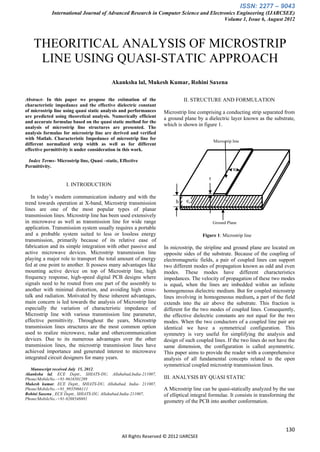
of microstrip line using quasi static analysis and performances   Microstrip line comprising a conducting strip separated from
are predicted using theoretical analysis. Numerically efficient   a ground plane by a dielectric layer known as the substrate,
and accurate formulae based on the quasi static method for the
analysis of microstrip line structures are presented. The
                                                                  which is shown in figure 1.
analysis formulas for microstrip line are derived and verified
with Matlab. Characteristic Impedance of microstrip line for
                                                                                            Microstrip line
different normalized strip width as well as for different
effective permittivity is under consideration in this work.

 Index Terms- Microstrip line, Quasi –static, Effective
Permittivity.
                                                                                                       W

                                                                                        t
                    I. INTRODUCTION

   In today’s modern communication industry and with the
trend towards operation at X-band, Microstrip transmission             h    ∈𝑟
lines are one of the most popular types of planar
transmission lines. Microstrip line has been used extensively
in microwave as well as transmission line for wide range                                    Ground Plane
application. Transmission system usually requires a portable
and a probable system suited to less or lossless energy                              Figure 1: Microstrip line
transmission, primarily because of its relative ease of
fabrication and its simple integration with other passive and     In microstrip, the stripline and ground plane are located on
active microwave devices. Microstrip transmission line            opposite sides of the substrate. Because of the coupling of
playing a major role to transport the total amount of energy      electromagnetic fields, a pair of coupled lines can support
fed at one point to another. It possess many advantages like      two different modes of propagation known as odd and even
mounting active device on top of Microstrip line, high            modes. These modes have different characteristics
frequency response, high-speed digital PCB designs where          impedances. The velocity of propagation of these two modes
signals need to be routed from one part of the assembly to        is equal, when the lines are imbedded within an infinite
another with minimal distortion, and avoiding high cross-         homogeneous dielectric medium. But for coupled microstrip
talk and radiation. Motivated by these inherent advantages,       lines involving in homogeneous medium, a part of the field
main concern is led towards the analysis of Microstrip line       extends into the air above the substrate. This fraction is
especially the variation of characteristic impedance of           different for the two modes of coupled lines. Consequently,
Microstrip line with various transmission line parameter,         the effective dielectric constants are not equal for the two
effective permittivity. Throughout the years, Microstrip          modes. When the two conductors of a coupled line pair are
transmission lines structures are the most common option          identical we have a symmetrical configuration. This
used to realize microwave, radar and othercommunication           symmetry is very useful for simplifying the analysis and
devices. Due to its numerous advantages over the other            design of such coupled lines. If the two lines do not have the
transmission lines, the microstrip transmission lines have        same dimension, the configuration is called asymmetric.
achieved importance and generated interest to microwave           This paper aims to provide the reader with a comprehensive
integrated circuit designers for many years.                      analysis of all fundamental concepts related to the open
                                                                  symmetrical coupled microstrip transmission lines.
  Manuscript received July 15, 2012.
Akanksha lal, ECE Deptt., SHIATS-DU, Allahabad,India-211007,
Phone/MobileNo.-+91-9616501289                                    III. ANALYSIS BY QUASI STATIC
Mukesh kumar, ECE Deptt., SHIATS-DU, Allahabad, India- 211007,
Phone/MobileNo.-+91_9935966111                                    A Microstrip line can be quasi-statically analyzed by the use
Rohini Saxena , ECE Deptt., SHIATS-DU, Allahabad,India-211007,    of elliptical integral formulae. It consists in transforming the
Phone/MobileNo.-+91-9208548881
                                                                  geometry of the PCB into another conformation.


                                                                                                                             130
                                               All Rights Reserved © 2012 IJARCSEE
ISSN: 2277 – 9043
                 International Journal of Advanced Research in Computer Science and Electronics Engineering (IJARCSEE)
                                                                                          Volume 1, Issue 6, August 2012

                                                                   1
                                                                       (∈ 𝑟 +) ≤∈ 𝑒𝑓𝑓 ≤∈ 𝑟                                                            (4)
                                     Strip                         2
                                     conduct
                                     or                            Several different equations have been developed for use in
                                                                   calculating characteristic impedance for microstrip design.
                                               x   z               Probably the most useful are the following which are
                       w                                           reported to be accurate to within about 1%.

             t                                                                          60          h   W                                           (5)
                                                                          Zo                   ln  8     
                                                       y                                 eff       W   4h 
    h
           Dielectric substrate                0

                       r                                                          Where
                      Ground
                                                                                                                 
                                                                                                                      1
                                                                                                                                      2
                      plane                                                   r  1  r  1       h                          W        W
                                                                                                                           0.041    for  1
                                                                                                                      2
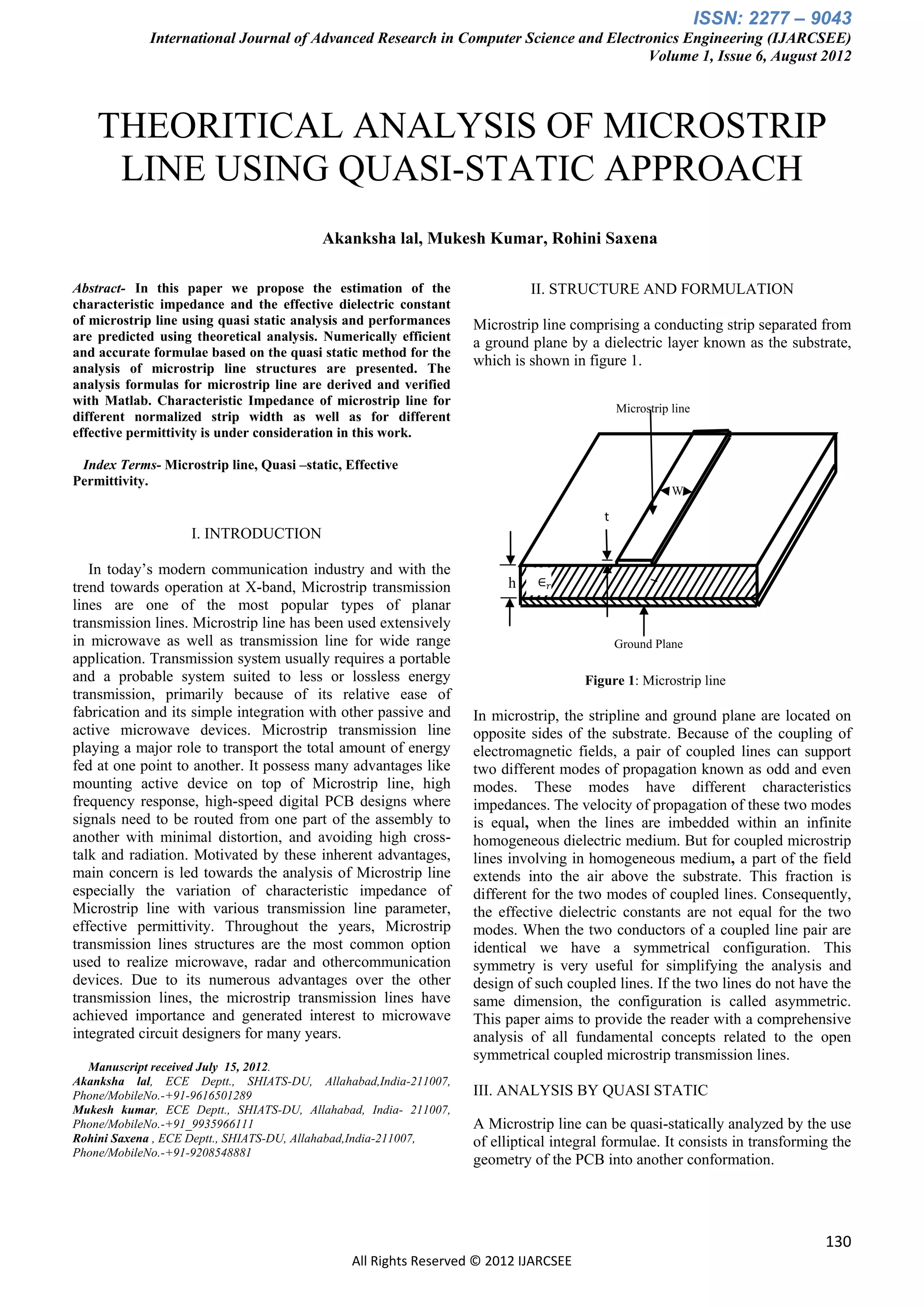
         Figure 2: Symmetric diagram of microstrip line             eff                    1  12 
                                                                               2          2                W                    h     h
                                                                                                                                      
Where ℎ is the hight of substrate, 𝑡 is thickness of microstrip                                                                                       (6)
line, 𝑊 is slot width of microstrip line. One of the most
challenging problems associated with this configuration
arises from the fact that the small strip is not immersed in a                                      120
                                                                   Zo 
single dielectric. On one side there is the board dielectric,                           W                     W          
                                                                                 eff    h  1.393  0.667 ln  h  1.444 
and on the top is usually air. The technique that has been                                                               
developed to handle this challenge uses, the concept of                                                                                               (7)
effective relative dielectric constant , ∈ 𝑒𝑓𝑓 . This value            Where
represents some intermediate value between the relative                                                                          
                                                                                                                                      1
                                                                                                                                          
                                                                                r 1        1        h                          2        W
                                                                                                                                           for  1
dielectric constant of the board material,∈ 𝑟 , and that of air     eff                  r     1  12   
                                                                                   2                2                    W                 h
(assumed equal to 1) that can be used to compute microstrip                                                                              
parameters as though the strip were completely surrounded                                                                   (8)
by material of that effective relative dielectric constant. One    These are relatively equations for the calculation of
obvious advantage of the microstrip structure is the "open"        characteristic impedance, given 𝑊, ℎ, and ∈ 𝑒𝑓𝑓 . However,
line which makes it very easy to connect components. Aside         the more useful calculation involves determination of the
from the difficulty of calculating the value of ∈ 𝑒𝑓𝑓 , there is     𝑊 ratio, given a required characteristic impedance. Here,
another important effect. It is clear that ∈ 𝑒𝑓𝑓 will depend on        ℎ
                                                                   then, is the design challenge since the equations are
both 𝑊and ℎ. Hence, the phase velocity along the microstrip
                                                                   transcendental for the 𝑊 ℎ parameter. Now, modify to the
will depend on these parameters. Assuming the relative
permeability of all materials in the line design is well           above equations which is a consequence of considering the
approximated by 𝜇 𝑟 = 1, the phase velocity will be given by       finite thickness (t) of the microstrip. This modification is in
                                                                   the form of an "effective" Microstrip width (𝑊𝑒 ), which is
         c
vp                                                        (1)     used to replace W in those equations:
          eff
                                                                                    t               2h            W       1
 Since the characteristic impedance 𝑍 𝑜 of the line will also      We  W           1  ln     for   
                                                                                   
                                                                                            t      h   2
depend on these parameters, every time we need to design a
microstrip with a new characteristic impedance, we will be
                                                                                                                                                      (9)
faced with the additional complication of having to deal
with a change in phase velocity (or delay time) and
                                                                                   t         4W     W  1
consequently of the wavelength of waves on that microstrip.        We  W            1  ln       for 
To get an idea of the range of εeff, consider the cases of a                               t       h 2
very wide width W and then a very narrow width W.                                                                                                     (10)

          𝑚𝑎𝑥𝑖𝑚𝑢𝑚 ∈ 𝑒𝑓𝑓 =∈ 𝑟                               (2)
                                                                                       IV. RESULT AND DISCUSSION
Eqn. (3.56) is in the form of an "effective" microstrip width
(𝑊𝑒 ), which is used to replace 𝑊.                                 a.) CHARACTERISTIC IMPEDANCE V/S
 For a wide microstrip, nearly all of the electric field lines          NORMALISED STRIP WIDTH
will be concentrated between the metal planes, similar to the
case of a parallel plate capacitor, and for narrow width W         Normalized strip width is known as ratio of width of
the electric field lines will be about equally divided between     Microstrip line and height of the substrate. The graph
the air and the board dielectric so that:                          represents the variation of characteristic impedance with
                                                                   normalized strip width for substrate is chosen to be of glass
                       1                                           fiber.
 𝑚𝑎𝑥𝑖𝑚𝑢𝑚 ∈ 𝑒𝑓𝑓 =            ∈ 𝑟+ 1                         (3)
                       2

This gives a range:


                                                                                                                                                        131
ISSN: 2277 – 9043
                         International Journal of Advanced Research in Computer Science and Electronics Engineering (IJARCSEE)
                                                                                                  Volume 1, Issue 6, August 2012

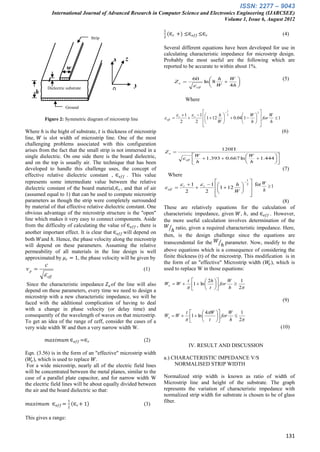
1.1 Normalized strip width when 𝒘 𝒉 ≤ 𝟏                                                                       when the value of normalized strip width is greater than
                                                                                                              equal to 1.
Graph 1.1 shows the variation of characteristic impedance                                                                                  Microstrip characteristic impedance
with normalized strip width.                                                                                                 70
                                                                                                                             65
                               microstrip characteristic impedance, W/h<=1
              900                                                                                                            60
                                                                                                                             55
              800


                                                                                                                  Zo(ohms)
                                                                                                                             50
              700
                                                                                                                             45
              600                                                                                                            40
   Zo(ohms)


              500                                                                                                            35
                                                                                                                             30
              400
                                                                                                                             25
              300
                                                                                                                             20           3.5    3.6     3.7    3.8                    4.1   4.2
                                                                                                                                   3.4                                 3.9       4
              200                                                                                                                                𝜖 𝑓𝑓 (𝑒𝑓𝑓𝑒𝑐𝑡𝑖𝑣𝑒 𝑝𝑒𝑟𝑚𝑖𝑡𝑡𝑖𝑣𝑖𝑡𝑦)
              100
                    0   0.1   0.2       0.3         0.4     0.5     0.6   0.7       0.8         0.9       1
                                                          W/h ratio                                           Graph2.1: variation of characteristic impedance v/s
               Graph1.1. variation of characteristic impedance                                                           effective permittivity
                         v/snormalized strip width
                                                                                                              2.2 Effective permittivity for 𝒘 𝒉 ≤ 𝟏
1.2 Normalized strip width when 𝒘 𝒉 ≥ 𝟏
Grap1.2 shows the variation of characteristic impedance                                                       Figure 4.4 shows the variation of characteristic impedance
with normalized strip width.                                                                                  with different value of effective permittivity. In the graph it
        .                                                                                                     is clear that, as we increase the effective relative
                              microstrip characteristic impedance, W/h=>1
                                                                                                              permittivity, the value of characteristic impedance decreases
              70                                                                                              when the value of normalized strip width is less than equal
              65                                                                                              to 1.
              60
                                                                                                                                                 microstrip characteristic impedance
              55                                                                                                             180
              50
   Zo(ohms)


                                                                                                                             160
              45

              40                                                                                                             140
              35
                                                                                                              Zo(ohms)


                                                                                                                             120
              30

              25                                                                                                             100
              20
                   1    1.5         2         2.5        3          3.5         4         4.5         5
                                                      W/h ratio                                                              80

                                                                                                                             60                                 3.3   3.35   3.4       3.45 3.5
Graph1.2. variation of characteristic impedance v/s                                                                                 3.1   3.15    3.2   3.25
          normalized strip width

                                                                                                                             Graph2.2: variation of characteristic impedance v/s
         As seen in both the above graph, that when                                                                                     effective permittivity
normalized strip width is kept between 1 to 5, then the
characteristic impedance decreases with increases in                                                                   The characteristic impedance of any type of
normalized strip width. But when the same normalized strip                                                    transmission line decreases with increase in relative
width is kept between 0 to 1 then there is a sudden and rapid                                                 permittivity and can be expressed by using formula from
decrease in characteristic impedance                                                                          transmission line is given by

                                                                                                                                     R  jL
                                                                                                              Z0 
b.)CHARACTERISTIC IMPEDANCE V/S                                                                                                      G  jC                                                       (11)
   EFFECTIVE PERMITIVITY
                                                                                                              Where,                     R= Resistance per unit length,
2.1 Effective permittivity for 𝒘 𝒉 ≥ 𝟏                                                                          L  Inductance per unit length

Graph 2.1 shows the variation of characteristic impedance                                                      G  Conductance per unit length
with different value of effective permittivity. In this graph it
is clear that, as we increase the effective relative                                                              C  Capacitance per unit length
permittivity, the value of characteristic impedance decreases
                                                                                                                                                                                                     132
                                                                                           All Rights Reserved © 2012 IJARCSEE
ISSN: 2277 – 9043
             International Journal of Advanced Research in Computer Science and Electronics Engineering (IJARCSEE)
                                                                                      Volume 1, Issue 6, August 2012

Form the above mention formula, the condition arises                           [11]  M. E. Goldforb and R. A. Pucel, “Modding Via Hole Grounds
                                                                                    in Microstrip,” IEEE Microwave and Guided Ware Letters,
R  C  L  G for distortion less transmission line. Since                          Vol.1, No. 6, PP. 135-137, June 1991.
there is no wires or long conducting element L and G                           [12] M. Kahrizi, K. Sarkar and Zoran A. Maricevic, “Dynamic
                                                                                    Analysis of a Microstrip Line Over a Perforated Ground Plane”,
cannot be changed so it is very evident from the above                              IEEE Transaction on Microwave Theory and Techniques, Vol.
condition that only R and C can be inversely proportional                           42, No. 5, May 1994.
                                                                               [13] N. Jain and B. Brown, “Dispersion Characteristics of
to each other as C is dependent on relative permittivity and                        Microstrip Transmission line on Glass Microwave IC’S”, IEEE
 R can be treated as characteristic impedance it can be                             Microwave and Guided Wave Letter, Vol. 7, No. 10, Oct. 1997.
                                                                               [14] R.J. Akello, B. Easter, and I.M. Stephenson, “Equivalent
knuckled with the fact that whenever C Increases R                                  circuit of the symmetric                    crossover junction,
decreases.                                                                          “Electronics Letters, vol.13,no.4,PP.117-118, Feb 1977.

                    V. CONCLUSION

Work has been done to demonstrate the utility of microstrip
line and its advantages especially energy is to be transferred
from one point to another, in a very compact and efficient                                      AUTHOR’S PROFILE
form. A simple and inexpensive method also known as
quasi-static has been applied for calculating the                            Akanksha lal is working as a Asst. Prof. in the Department of
                                                                          Electronics & Communication Engineering in SHIATS, Allahabad. She
characteristic impedance as well as effective permittivity.               received her M.Tech. Degree in Advanced Communication Systems
Variation of characteristic impedance for different value of              Engineering from SHIATS, Allahabad in 2010. His research is focused on
normalized strip width as well as different value of effective            Microwave Engineering,Wireless communication.
                                                                             Mukesh Kumar is working as a Asst. Prof. in the Department of
permittivity is represented. It has been observed that                    Electronics & Communication Engineering in SHIATS, Allahabad. He
characteristic impedance decreases with advancement of                    received his M.Tech. Degree in Advanced Communication Systems
normalized strip width and also decreases for increasing                  Engineering from SHIATS, Allahabad in 2010. His research is focused on
                                                                          Microwave Engineering, Wireless Sensors Networks and Computer
effective permittivity. This property can be applied in                   Networks as well as Optical fiber communication.
microwave transmission theory to design different antenna                    Rohini Saxena is working as a Asst. Prof. in the Department of
models for different purposes along with the advantage of                 Electronics & Communication Engineering in SHIATS, Allahabad. She
                                                                          received her M.Tech. Degree in Advanced Communication Systems
minimal distortion, and avoiding high cross-talk and                      Engineering from SHIATS, Allahabad in 2009. His research is focused on
radiation.                                                                Microwave Engineering, Wireless Sensors Networks and Computer
                                                                          Networks and Mobile communication.

                        VI. REFRENCES
                                                                          .
    [1]  Baklem and A. Dmar, “Invarted Defected Ground Structure for
         Microstrip line filter reducing Packaging Complicity,
         Department of Electrical, Czech Technical University, 2008.
    [2] A. Z. Elsherbeni, C. E. Smith and B. Moumnch, “Minimization
         of the Coupling between a two Conductor Mirostrip
         Transmission Line using Finite difference Method”, Journal of
         Electromagnetic Waves and Application, Vol. 10, No. 4, 509-
         513, 1006.
    [3] B. Easter, “The Equivalent Circuit of some Microstrip
         Discontinuities”, IEEE Transaction on Microwave Theory and
         Techniques, Vol. 23, No. 8, PP.655-660 Aug. 1975.
    [4] C. K. Wu and H. S. Wu, “Electric- Magnetic- Electric Slow-
         Wave Microstrip Line and Bond pass Filter of Compressed
         Size”, IEEE Transaction on Microwave Theory and Techniques,
         Vol. 50, No. 8, Aug, 2002.
    [5] E. Tunier. Lee B. T., M. Islam and D. P. Nickirk, “Quasi-Static
         Conductor Loss Calculations in Transmission Theory and
         Techniques, Vol. 42, PP. 1807-1815, 1994.
    [6] E. Tunnier, and P. Nickirk, “Highly Accurate Quasi-Static
         Modding of Microstrip Lines over Lossy Subptrates”, IEEE
         Microwave and Guided Wave Letter, Vol. 2, No. 10, October
         1992.
    [7] E. Yamshita, “Variational Method for the Analysis of
         Microstrip Like Transmission Lines”, IEEE Transaction on
         Microwave Theory and Techniques, Vol. 16 No. 8, Aug, 1968.
    [8] H. Wang, Y. Ji, and T. H. Hubiay, “Experimental and
         Numerical study of the Radiation from Microstrip Bends”,
         University of Missouri-Rolla, 2000.
    [9] J. C. Rautis, and V. Demir, “Microstrip Conductor loss Models
         for Electro-Magnetic Analysis”, IEEE Transaction on
         Microwave Theory and Techniques, Vol. 51, No. 3, March.
         2003.
    [10] J. S. Lim, C.S. Kim and J. S. Park, “Design of 10.1B 900
         Branch Line Coupler using Microstrip Line with defected
         ground Structure”, Electronics Letters, Vol. 56, No. 21, Oct.
         2000.


                                                                                                                                             133

130 133

  • 1.
    ISSN: 2277 –9043 International Journal of Advanced Research in Computer Science and Electronics Engineering (IJARCSEE) Volume 1, Issue 6, August 2012 THEORITICAL ANALYSIS OF MICROSTRIP LINE USING QUASI-STATIC APPROACH Akanksha lal, Mukesh Kumar, Rohini Saxena Abstract- In this paper we propose the estimation of the II. STRUCTURE AND FORMULATION characteristic impedance and the effective dielectric constant of microstrip line using quasi static analysis and performances Microstrip line comprising a conducting strip separated from are predicted using theoretical analysis. Numerically efficient a ground plane by a dielectric layer known as the substrate, and accurate formulae based on the quasi static method for the analysis of microstrip line structures are presented. The which is shown in figure 1. analysis formulas for microstrip line are derived and verified with Matlab. Characteristic Impedance of microstrip line for Microstrip line different normalized strip width as well as for different effective permittivity is under consideration in this work. Index Terms- Microstrip line, Quasi –static, Effective Permittivity. W t I. INTRODUCTION In today’s modern communication industry and with the trend towards operation at X-band, Microstrip transmission h ∈𝑟 lines are one of the most popular types of planar transmission lines. Microstrip line has been used extensively in microwave as well as transmission line for wide range Ground Plane application. Transmission system usually requires a portable and a probable system suited to less or lossless energy Figure 1: Microstrip line transmission, primarily because of its relative ease of fabrication and its simple integration with other passive and In microstrip, the stripline and ground plane are located on active microwave devices. Microstrip transmission line opposite sides of the substrate. Because of the coupling of playing a major role to transport the total amount of energy electromagnetic fields, a pair of coupled lines can support fed at one point to another. It possess many advantages like two different modes of propagation known as odd and even mounting active device on top of Microstrip line, high modes. These modes have different characteristics frequency response, high-speed digital PCB designs where impedances. The velocity of propagation of these two modes signals need to be routed from one part of the assembly to is equal, when the lines are imbedded within an infinite another with minimal distortion, and avoiding high cross- homogeneous dielectric medium. But for coupled microstrip talk and radiation. Motivated by these inherent advantages, lines involving in homogeneous medium, a part of the field main concern is led towards the analysis of Microstrip line extends into the air above the substrate. This fraction is especially the variation of characteristic impedance of different for the two modes of coupled lines. Consequently, Microstrip line with various transmission line parameter, the effective dielectric constants are not equal for the two effective permittivity. Throughout the years, Microstrip modes. When the two conductors of a coupled line pair are transmission lines structures are the most common option identical we have a symmetrical configuration. This used to realize microwave, radar and othercommunication symmetry is very useful for simplifying the analysis and devices. Due to its numerous advantages over the other design of such coupled lines. If the two lines do not have the transmission lines, the microstrip transmission lines have same dimension, the configuration is called asymmetric. achieved importance and generated interest to microwave This paper aims to provide the reader with a comprehensive integrated circuit designers for many years. analysis of all fundamental concepts related to the open symmetrical coupled microstrip transmission lines. Manuscript received July 15, 2012. Akanksha lal, ECE Deptt., SHIATS-DU, Allahabad,India-211007, Phone/MobileNo.-+91-9616501289 III. ANALYSIS BY QUASI STATIC Mukesh kumar, ECE Deptt., SHIATS-DU, Allahabad, India- 211007, Phone/MobileNo.-+91_9935966111 A Microstrip line can be quasi-statically analyzed by the use Rohini Saxena , ECE Deptt., SHIATS-DU, Allahabad,India-211007, of elliptical integral formulae. It consists in transforming the Phone/MobileNo.-+91-9208548881 geometry of the PCB into another conformation. 130 All Rights Reserved © 2012 IJARCSEE
  • 2.
    ISSN: 2277 –9043 International Journal of Advanced Research in Computer Science and Electronics Engineering (IJARCSEE) Volume 1, Issue 6, August 2012 1 (∈ 𝑟 +) ≤∈ 𝑒𝑓𝑓 ≤∈ 𝑟 (4) Strip 2 conduct or Several different equations have been developed for use in calculating characteristic impedance for microstrip design. x z Probably the most useful are the following which are w reported to be accurate to within about 1%. t 60  h W  (5) Zo  ln  8   y  eff  W 4h  h Dielectric substrate 0 r Where Ground   1 2 plane  r  1  r  1  h  W W  0.041    for  1 2 Figure 2: Symmetric diagram of microstrip line  eff   1  12  2 2  W  h  h   Where ℎ is the hight of substrate, 𝑡 is thickness of microstrip (6) line, 𝑊 is slot width of microstrip line. One of the most challenging problems associated with this configuration arises from the fact that the small strip is not immersed in a 120 Zo  single dielectric. On one side there is the board dielectric, W W   eff  h  1.393  0.667 ln  h  1.444  and on the top is usually air. The technique that has been    developed to handle this challenge uses, the concept of (7) effective relative dielectric constant , ∈ 𝑒𝑓𝑓 . This value Where represents some intermediate value between the relative   1   r 1   1  h  2 W  for  1 dielectric constant of the board material,∈ 𝑟 , and that of air  eff   r 1  12  2 2  W  h (assumed equal to 1) that can be used to compute microstrip   parameters as though the strip were completely surrounded (8) by material of that effective relative dielectric constant. One These are relatively equations for the calculation of obvious advantage of the microstrip structure is the "open" characteristic impedance, given 𝑊, ℎ, and ∈ 𝑒𝑓𝑓 . However, line which makes it very easy to connect components. Aside the more useful calculation involves determination of the from the difficulty of calculating the value of ∈ 𝑒𝑓𝑓 , there is 𝑊 ratio, given a required characteristic impedance. Here, another important effect. It is clear that ∈ 𝑒𝑓𝑓 will depend on ℎ then, is the design challenge since the equations are both 𝑊and ℎ. Hence, the phase velocity along the microstrip transcendental for the 𝑊 ℎ parameter. Now, modify to the will depend on these parameters. Assuming the relative permeability of all materials in the line design is well above equations which is a consequence of considering the approximated by 𝜇 𝑟 = 1, the phase velocity will be given by finite thickness (t) of the microstrip. This modification is in the form of an "effective" Microstrip width (𝑊𝑒 ), which is c vp  (1) used to replace W in those equations:  eff t   2h   W 1 Since the characteristic impedance 𝑍 𝑜 of the line will also We  W  1  ln   for     t  h 2 depend on these parameters, every time we need to design a microstrip with a new characteristic impedance, we will be (9) faced with the additional complication of having to deal with a change in phase velocity (or delay time) and t   4W  W 1 consequently of the wavelength of waves on that microstrip. We  W  1  ln   for  To get an idea of the range of εeff, consider the cases of a   t  h 2 very wide width W and then a very narrow width W. (10) 𝑚𝑎𝑥𝑖𝑚𝑢𝑚 ∈ 𝑒𝑓𝑓 =∈ 𝑟 (2) IV. RESULT AND DISCUSSION Eqn. (3.56) is in the form of an "effective" microstrip width (𝑊𝑒 ), which is used to replace 𝑊. a.) CHARACTERISTIC IMPEDANCE V/S For a wide microstrip, nearly all of the electric field lines NORMALISED STRIP WIDTH will be concentrated between the metal planes, similar to the case of a parallel plate capacitor, and for narrow width W Normalized strip width is known as ratio of width of the electric field lines will be about equally divided between Microstrip line and height of the substrate. The graph the air and the board dielectric so that: represents the variation of characteristic impedance with normalized strip width for substrate is chosen to be of glass 1 fiber. 𝑚𝑎𝑥𝑖𝑚𝑢𝑚 ∈ 𝑒𝑓𝑓 = ∈ 𝑟+ 1 (3) 2 This gives a range: 131
  • 3.
    ISSN: 2277 –9043 International Journal of Advanced Research in Computer Science and Electronics Engineering (IJARCSEE) Volume 1, Issue 6, August 2012 1.1 Normalized strip width when 𝒘 𝒉 ≤ 𝟏 when the value of normalized strip width is greater than equal to 1. Graph 1.1 shows the variation of characteristic impedance Microstrip characteristic impedance with normalized strip width. 70 65 microstrip characteristic impedance, W/h<=1 900 60 55 800 Zo(ohms) 50 700 45 600 40 Zo(ohms) 500 35 30 400 25 300 20 3.5 3.6 3.7 3.8 4.1 4.2 3.4 3.9 4 200 𝜖 𝑓𝑓 (𝑒𝑓𝑓𝑒𝑐𝑡𝑖𝑣𝑒 𝑝𝑒𝑟𝑚𝑖𝑡𝑡𝑖𝑣𝑖𝑡𝑦) 100 0 0.1 0.2 0.3 0.4 0.5 0.6 0.7 0.8 0.9 1 W/h ratio Graph2.1: variation of characteristic impedance v/s Graph1.1. variation of characteristic impedance effective permittivity v/snormalized strip width 2.2 Effective permittivity for 𝒘 𝒉 ≤ 𝟏 1.2 Normalized strip width when 𝒘 𝒉 ≥ 𝟏 Grap1.2 shows the variation of characteristic impedance Figure 4.4 shows the variation of characteristic impedance with normalized strip width. with different value of effective permittivity. In the graph it . is clear that, as we increase the effective relative microstrip characteristic impedance, W/h=>1 permittivity, the value of characteristic impedance decreases 70 when the value of normalized strip width is less than equal 65 to 1. 60 microstrip characteristic impedance 55 180 50 Zo(ohms) 160 45 40 140 35 Zo(ohms) 120 30 25 100 20 1 1.5 2 2.5 3 3.5 4 4.5 5 W/h ratio 80 60 3.3 3.35 3.4 3.45 3.5 Graph1.2. variation of characteristic impedance v/s 3.1 3.15 3.2 3.25 normalized strip width Graph2.2: variation of characteristic impedance v/s As seen in both the above graph, that when effective permittivity normalized strip width is kept between 1 to 5, then the characteristic impedance decreases with increases in The characteristic impedance of any type of normalized strip width. But when the same normalized strip transmission line decreases with increase in relative width is kept between 0 to 1 then there is a sudden and rapid permittivity and can be expressed by using formula from decrease in characteristic impedance transmission line is given by R  jL Z0  b.)CHARACTERISTIC IMPEDANCE V/S G  jC (11) EFFECTIVE PERMITIVITY Where, R= Resistance per unit length, 2.1 Effective permittivity for 𝒘 𝒉 ≥ 𝟏 L  Inductance per unit length Graph 2.1 shows the variation of characteristic impedance G  Conductance per unit length with different value of effective permittivity. In this graph it is clear that, as we increase the effective relative C  Capacitance per unit length permittivity, the value of characteristic impedance decreases 132 All Rights Reserved © 2012 IJARCSEE
  • 4.
    ISSN: 2277 –9043 International Journal of Advanced Research in Computer Science and Electronics Engineering (IJARCSEE) Volume 1, Issue 6, August 2012 Form the above mention formula, the condition arises [11] M. E. Goldforb and R. A. Pucel, “Modding Via Hole Grounds in Microstrip,” IEEE Microwave and Guided Ware Letters, R  C  L  G for distortion less transmission line. Since Vol.1, No. 6, PP. 135-137, June 1991. there is no wires or long conducting element L and G [12] M. Kahrizi, K. Sarkar and Zoran A. Maricevic, “Dynamic Analysis of a Microstrip Line Over a Perforated Ground Plane”, cannot be changed so it is very evident from the above IEEE Transaction on Microwave Theory and Techniques, Vol. condition that only R and C can be inversely proportional 42, No. 5, May 1994. [13] N. Jain and B. Brown, “Dispersion Characteristics of to each other as C is dependent on relative permittivity and Microstrip Transmission line on Glass Microwave IC’S”, IEEE R can be treated as characteristic impedance it can be Microwave and Guided Wave Letter, Vol. 7, No. 10, Oct. 1997. [14] R.J. Akello, B. Easter, and I.M. Stephenson, “Equivalent knuckled with the fact that whenever C Increases R circuit of the symmetric crossover junction, decreases. “Electronics Letters, vol.13,no.4,PP.117-118, Feb 1977. V. CONCLUSION Work has been done to demonstrate the utility of microstrip line and its advantages especially energy is to be transferred from one point to another, in a very compact and efficient AUTHOR’S PROFILE form. A simple and inexpensive method also known as quasi-static has been applied for calculating the Akanksha lal is working as a Asst. Prof. in the Department of Electronics & Communication Engineering in SHIATS, Allahabad. She characteristic impedance as well as effective permittivity. received her M.Tech. Degree in Advanced Communication Systems Variation of characteristic impedance for different value of Engineering from SHIATS, Allahabad in 2010. His research is focused on normalized strip width as well as different value of effective Microwave Engineering,Wireless communication. Mukesh Kumar is working as a Asst. Prof. in the Department of permittivity is represented. It has been observed that Electronics & Communication Engineering in SHIATS, Allahabad. He characteristic impedance decreases with advancement of received his M.Tech. Degree in Advanced Communication Systems normalized strip width and also decreases for increasing Engineering from SHIATS, Allahabad in 2010. His research is focused on Microwave Engineering, Wireless Sensors Networks and Computer effective permittivity. This property can be applied in Networks as well as Optical fiber communication. microwave transmission theory to design different antenna Rohini Saxena is working as a Asst. Prof. in the Department of models for different purposes along with the advantage of Electronics & Communication Engineering in SHIATS, Allahabad. She received her M.Tech. Degree in Advanced Communication Systems minimal distortion, and avoiding high cross-talk and Engineering from SHIATS, Allahabad in 2009. His research is focused on radiation. Microwave Engineering, Wireless Sensors Networks and Computer Networks and Mobile communication. VI. REFRENCES . [1] Baklem and A. Dmar, “Invarted Defected Ground Structure for Microstrip line filter reducing Packaging Complicity, Department of Electrical, Czech Technical University, 2008. [2] A. Z. Elsherbeni, C. E. Smith and B. Moumnch, “Minimization of the Coupling between a two Conductor Mirostrip Transmission Line using Finite difference Method”, Journal of Electromagnetic Waves and Application, Vol. 10, No. 4, 509- 513, 1006. [3] B. Easter, “The Equivalent Circuit of some Microstrip Discontinuities”, IEEE Transaction on Microwave Theory and Techniques, Vol. 23, No. 8, PP.655-660 Aug. 1975. [4] C. K. Wu and H. S. Wu, “Electric- Magnetic- Electric Slow- Wave Microstrip Line and Bond pass Filter of Compressed Size”, IEEE Transaction on Microwave Theory and Techniques, Vol. 50, No. 8, Aug, 2002. [5] E. Tunier. Lee B. T., M. Islam and D. P. Nickirk, “Quasi-Static Conductor Loss Calculations in Transmission Theory and Techniques, Vol. 42, PP. 1807-1815, 1994. [6] E. Tunnier, and P. Nickirk, “Highly Accurate Quasi-Static Modding of Microstrip Lines over Lossy Subptrates”, IEEE Microwave and Guided Wave Letter, Vol. 2, No. 10, October 1992. [7] E. Yamshita, “Variational Method for the Analysis of Microstrip Like Transmission Lines”, IEEE Transaction on Microwave Theory and Techniques, Vol. 16 No. 8, Aug, 1968. [8] H. Wang, Y. Ji, and T. H. Hubiay, “Experimental and Numerical study of the Radiation from Microstrip Bends”, University of Missouri-Rolla, 2000. [9] J. C. Rautis, and V. Demir, “Microstrip Conductor loss Models for Electro-Magnetic Analysis”, IEEE Transaction on Microwave Theory and Techniques, Vol. 51, No. 3, March. 2003. [10] J. S. Lim, C.S. Kim and J. S. Park, “Design of 10.1B 900 Branch Line Coupler using Microstrip Line with defected ground Structure”, Electronics Letters, Vol. 56, No. 21, Oct. 2000. 133