Presented by
JAHID HASAN AZAD PREMON
P-151038
INTERNATIONAL ISLAMIC UNIVERSITY CHITTAGONG
MYOPIA
1. Myopia
2. Types of Myopia
3. Etiological Classification.
4. Clinical Verities.
5. Congenital myopia
6. Simple Myopia
7. Pathological Myopia
8. Simple myopia
9. Pathological Myopia
10. Acquired Myopia
11. Treatment of myopia
Presentation Layout
Derived from two Greek root words.
(Greek: muÕpia, from muene: “to shut ”-ops (gen.opos) means ‘eye’.
Myopia or shortsightedness is a type of refractive error which parallel rays of light coming
from infinity are focused in front of retina with accommodation is at rest.
MYOPIA
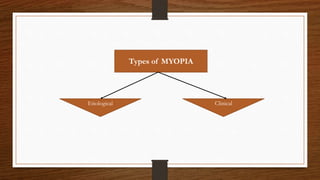
Etiological Clinical
Types of MYOPIA
1.Axial myopia: -commonest form
-increase in antero-posterior length of the eyeball.
2.Curvatural myopia: -increased curvature of cornea, lens or both.
3.Position myopia: -produced by anterior placement of crystalline lens in eye.
4.Index myopia: increase in the refractive index of crystalline lens associated
with nuclear sclerosis.
5.Myopia due to excessive accommodation: Spasm of accommodation.
Etiological classification
Clinical Verities
1.Congenital myopia
2.simple or developmental myopia.
3.Pathological or degenerative myopia.
4.Acquired myopia which may be…….
-post traumatic
-post keratitic
-Drug induced
-pseudo myopia
-Space myopia
-Night myopia
-Consecutive myopia.
Congenital myopia
Present since birth
Seen more frequently in many children who were born prematurely or
with various birth defects .
Usually error is about 8-10D , which mostly remains constant
May sometimes be associated with other congential anomalies such as
cataract , microphthalmos ,aniridia & megalocornea
Simple Myopia
 Poor vision for distance
 May develop convergence
weakness & exophoria &
suppression in one eye .
 Change in physiological
outlook.
Signs
 Eyes are large and prominent.
 Slight deep anterior chamber
 Fundus is normal
 Usually error does not exceed
6-8D
Symptoms
Rapidly progressive associated with degenerative changes in the eye.
Pathological Myopia
Symptoms Signs
 Floating black opacities.
 Defective Vision
 Night blindness.
 Eye large(appearing
elongated)
 Cornea large
 LENS show opacities at
the posterior pole due to
aberration of lenticular
metabolism.
Acquired Myopia
Causes:
Index Myopia : seen in nuclear sclerosis, incipient cataract.
Curvatural Myopia: increase in corneal curvature in diseased conditions like corneal
eclastasias & conical cornea.
Positional Myopia: conditions producing anterior subluxation of LENS.
Consecutive Myopia: surgical overcorrection of Hypermetropia
Pseudo myopia: May develop after too full a hypermetropic correction I children.
Treatment of myopia
It can be treated by …..
corneal refractory therapy
Glasses
Contact lenses
Refractive surgery
Vision therapy
Thanks to all

myopia

  • 1.
    Presented by JAHID HASANAZAD PREMON P-151038 INTERNATIONAL ISLAMIC UNIVERSITY CHITTAGONG MYOPIA
  • 2.
    1. Myopia 2. Typesof Myopia 3. Etiological Classification. 4. Clinical Verities. 5. Congenital myopia 6. Simple Myopia 7. Pathological Myopia 8. Simple myopia 9. Pathological Myopia 10. Acquired Myopia 11. Treatment of myopia Presentation Layout
  • 3.
    Derived from twoGreek root words. (Greek: muÕpia, from muene: “to shut ”-ops (gen.opos) means ‘eye’. Myopia or shortsightedness is a type of refractive error which parallel rays of light coming from infinity are focused in front of retina with accommodation is at rest. MYOPIA
  • 4.
  • 5.
    1.Axial myopia: -commonestform -increase in antero-posterior length of the eyeball. 2.Curvatural myopia: -increased curvature of cornea, lens or both. 3.Position myopia: -produced by anterior placement of crystalline lens in eye. 4.Index myopia: increase in the refractive index of crystalline lens associated with nuclear sclerosis. 5.Myopia due to excessive accommodation: Spasm of accommodation. Etiological classification
  • 6.
    Clinical Verities 1.Congenital myopia 2.simpleor developmental myopia. 3.Pathological or degenerative myopia. 4.Acquired myopia which may be……. -post traumatic -post keratitic -Drug induced -pseudo myopia -Space myopia -Night myopia -Consecutive myopia.
  • 7.
    Congenital myopia Present sincebirth Seen more frequently in many children who were born prematurely or with various birth defects . Usually error is about 8-10D , which mostly remains constant May sometimes be associated with other congential anomalies such as cataract , microphthalmos ,aniridia & megalocornea
  • 8.
    Simple Myopia  Poorvision for distance  May develop convergence weakness & exophoria & suppression in one eye .  Change in physiological outlook. Signs  Eyes are large and prominent.  Slight deep anterior chamber  Fundus is normal  Usually error does not exceed 6-8D Symptoms
  • 9.
    Rapidly progressive associatedwith degenerative changes in the eye. Pathological Myopia Symptoms Signs  Floating black opacities.  Defective Vision  Night blindness.  Eye large(appearing elongated)  Cornea large  LENS show opacities at the posterior pole due to aberration of lenticular metabolism.
  • 10.
    Acquired Myopia Causes: Index Myopia: seen in nuclear sclerosis, incipient cataract. Curvatural Myopia: increase in corneal curvature in diseased conditions like corneal eclastasias & conical cornea. Positional Myopia: conditions producing anterior subluxation of LENS. Consecutive Myopia: surgical overcorrection of Hypermetropia Pseudo myopia: May develop after too full a hypermetropic correction I children.
  • 11.
    Treatment of myopia Itcan be treated by ….. corneal refractory therapy Glasses Contact lenses Refractive surgery Vision therapy
  • 12.