MYOPATHY
A myopathy is a condition of the muscles that is characterized by
muscle weakening. This can be congenital or acquired.
Primary muscle disorders in neonates consist of a heterogeneous
group of diseases that can be broadly divided into congenital
muscular dystrophies and congenital myopathies.
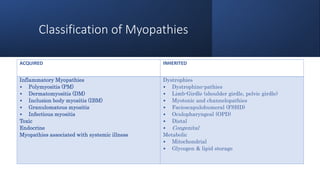
Classification of Myopathies
ACQUIRED INHERITED
Inflammatory Myopathies
• Polymyositis (PM)
• Dermatomyositis (DM)
• Inclusion body myositis (IBM)
• Granulomatous myositis
• Infectious myositis
Toxic
Endocrine
Myopathies associated with systemic illness
Dystrophies
• Dystrophino-pathies
• Limb-Girdle (shoulder girdle, pelvic girdle)
• Myotonic and channelopathies
• Facioscapulohumeral (FSHD)
• Oculopharyngeal (OPD)
• Distal
• Congenital
Metabolic
• Mitochondrial
• Glycogen & lipid storage
Congenital
myopathies
When an infant has
myopathy, he or she is
typically described as being
"floppy," having difficulties
breathing or eating and being
slower to reach
developmental milestones
such as turning over or
sitting up than other babies
his or her age.
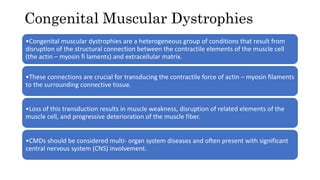
Congenital Muscular Dystrophies
•Congenital muscular dystrophies are a heterogeneous group of conditions that result from
disruption of the structural connection between the contractile elements of the muscle cell
(the actin – myosin fi laments) and extracellular matrix.
•These connections are crucial for transducing the contractile force of actin – myosin filaments
to the surrounding connective tissue.
•Loss of this transduction results in muscle weakness, disruption of related elements of the
muscle cell, and progressive deterioration of the muscle fiber.
•CMDs should be considered multi- organ system diseases and often present with significant
central nervous system (CNS) involvement.
TYPES
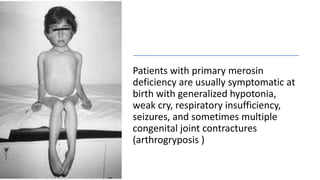
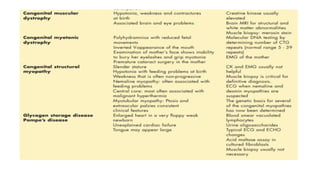
Patients with primary merosin
deficiency are usually symptomatic at
birth with generalized hypotonia,
weak cry, respiratory insufficiency,
seizures, and sometimes multiple
congenital joint contractures
(arthrogryposis )
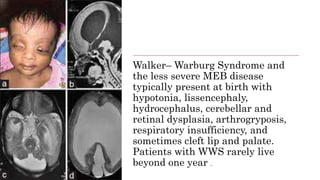
Walker– Warburg Syndrome and
the less severe MEB disease
typically present at birth with
hypotonia, lissencephaly,
hydrocephalus, cerebellar and
retinal dysplasia, arthrogryposis,
respiratory insufficiency, and
sometimes cleft lip and palate.
Patients with WWS rarely live
beyond one year .
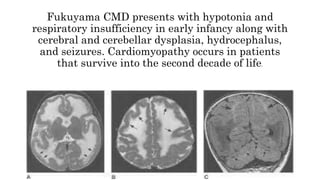
Fukuyama CMD presents with hypotonia and
respiratory insufficiency in early infancy along with
cerebral and cerebellar dysplasia, hydrocephalus,
and seizures. Cardiomyopathy occurs in patients
that survive into the second decade of life.
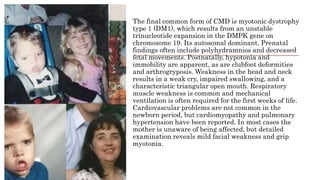
The final common form of CMD is myotonic dystrophy
type 1 (DM1), which results from an unstable
trinucleotide expansion in the DMPK gene on
chromosome 19. Its autosomal dominant. Prenatal
findings often include polyhydramnios and decreased
fetal movements. Postnatally, hypotonia and
immobility are apparent, as are clubfoot deformities
and arthrogryposis. Weakness in the head and neck
results in a weak cry, impaired swallowing, and a
characteristic triangular open mouth. Respiratory
muscle weakness is common and mechanical
ventilation is often required for the first weeks of life.
Cardiovascular problems are not common in the
newborn period, but cardiomyopathy and pulmonary
hypertension have been reported. In most cases the
mother is unaware of being affected, but detailed
examination reveals mild facial weakness and grip
myotonia.
Muscular dystrophies associated with older
pediatric patients have also been reported in
patients younger than one year of age. In
particular, limb-girdle muscular dystrophy and
Emery– Dreifuss muscular dystrophy have been
described in the newborn period, presenting with
reduced fetal movements and severe hypotonia at
birth.
Congenital Myopathies
Congenital myopathies are primary muscle disorders that are
typically nonprogressive and characterized by “non-
dystrophic” changes on muscle biopsy, i.e., no degeneration of
the muscle. Traditionally, CMs are classified by
histopathologic staining patterns.
The current classification of congenital myopathy includes
seven separate forms, each with its own set of symptoms,
consequences, therapeutic choices, and long-term prognosis.
As such, the congenital myopathies can be divided into 6
pathologic categories.
•nemaline myopathy (subtypes: rod, core-rod, cap and zebra
body myopathy).
•core myopathy (subtypes: central core and multi-minicore
myopathy).
•centronuclear myopathy (subtypes: myotubular myopathy
and autosomal centronuclear myopathy).
•congenital fiber-type disproportion myopathy.
•myosin storage myopathy; and
•nonspecific myopathic changes
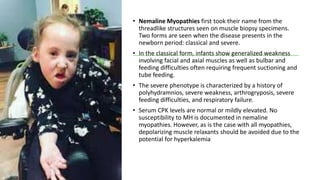
• Nemaline Myopathies first took their name from the
threadlike structures seen on muscle biopsy specimens.
Two forms are seen when the disease presents in the
newborn period: classical and severe.
• In the classical form, infants show generalized weakness
involving facial and axial muscles as well as bulbar and
feeding difficulties often requiring frequent suctioning and
tube feeding.
• The severe phenotype is characterized by a history of
polyhydramnios, severe weakness, arthrogryposis, severe
feeding difficulties, and respiratory failure.
• Serum CPK levels are normal or mildly elevated. No
susceptibility to MH is documented in nemaline
myopathies. However, as is the case with all myopathies,
depolarizing muscle relaxants should be avoided due to the
potential for hyperkalemia
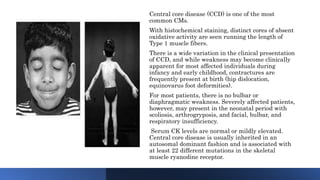
Central core disease (CCD) is one of the most
common CMs.
With histochemical staining, distinct cores of absent
oxidative activity are seen running the length of
Type 1 muscle fibers.
There is a wide variation in the clinical presentation
of CCD, and while weakness may become clinically
apparent for most affected individuals during
infancy and early childhood, contractures are
frequently present at birth (hip dislocation,
equinovarus foot deformities).
For most patients, there is no bulbar or
diaphragmatic weakness. Severely affected patients,
however, may present in the neonatal period with
scoliosis, arthrogryposis, and facial, bulbar, and
respiratory insufficiency.
Serum CK levels are normal or mildly elevated.
Central core disease is usually inherited in an
autosomal dominant fashion and is associated with
at least 22 different mutations in the skeletal
muscle ryanodine receptor.
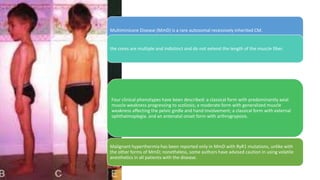
Multiminicore Disease (MmD) is a rare autosomal recessively inherited CM.
the cores are multiple and indistinct and do not extend the length of the muscle fiber.
Four clinical phenotypes have been described: a classical form with predominantly axial
muscle weakness progressing to scoliosis; a moderate form with generalized muscle
weakness affecting the pelvic girdle and hand involvement; a classical form with external
ophthalmoplegia. and an antenatal onset form with arthrogryposis.
Malignant hyperthermia has been reported only in MmD with RyR1 mutations, unlike with
the other forms of MmD; nonetheless, some authors have advised caution in using volatile
anesthetics in all patients with the disease.
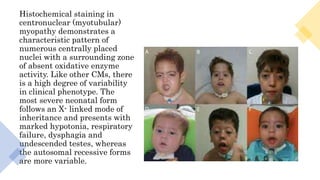
Histochemical staining in
centronuclear (myotubular)
myopathy demonstrates a
characteristic pattern of
numerous centrally placed
nuclei with a surrounding zone
of absent oxidative enzyme
activity. Like other CMs, there
is a high degree of variability
in clinical phenotype. The
most severe neonatal form
follows an X- linked mode of
inheritance and presents with
marked hypotonia, respiratory
failure, dysphagia and
undescended testes, whereas
the autosomal recessive forms
are more variable.
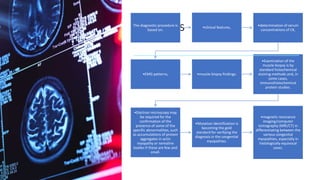
Diagnosis
The diagnostic procedure is
based on.
•clinical features, •determination of serum
concentrations of CK,
•EMG patterns, •muscle biopsy findings.
•Examination of the
muscle biopsy is by
standard histochemical
staining methods and, in
some cases,
immunohistochemical
protein studies.
•Electron microscopy may
be required for the
confirmation of the
presence of some of the
specific abnormalities, such
as accumulations of protein
aggregates in actin
myopathy or nemaline
bodies if these are few and
small.
•Mutation identification is
becoming the gold
standard for verifying the
diagnosis in the congenital
myopathies.
•magnetic resonance
imaging/computer
tomography (MRI/CT) in
differentiating between the
various congenital
myopathies, especially in
histologically equivocal
cases.
Myopathy
Myopathy
Myopathy
Myopathy

Myopathy

  • 1.
  • 2.
    A myopathy isa condition of the muscles that is characterized by muscle weakening. This can be congenital or acquired. Primary muscle disorders in neonates consist of a heterogeneous group of diseases that can be broadly divided into congenital muscular dystrophies and congenital myopathies.
  • 3.
    Classification of Myopathies ACQUIREDINHERITED Inflammatory Myopathies • Polymyositis (PM) • Dermatomyositis (DM) • Inclusion body myositis (IBM) • Granulomatous myositis • Infectious myositis Toxic Endocrine Myopathies associated with systemic illness Dystrophies • Dystrophino-pathies • Limb-Girdle (shoulder girdle, pelvic girdle) • Myotonic and channelopathies • Facioscapulohumeral (FSHD) • Oculopharyngeal (OPD) • Distal • Congenital Metabolic • Mitochondrial • Glycogen & lipid storage
  • 4.
    Congenital myopathies When an infanthas myopathy, he or she is typically described as being "floppy," having difficulties breathing or eating and being slower to reach developmental milestones such as turning over or sitting up than other babies his or her age.
  • 5.
    Congenital Muscular Dystrophies •Congenitalmuscular dystrophies are a heterogeneous group of conditions that result from disruption of the structural connection between the contractile elements of the muscle cell (the actin – myosin fi laments) and extracellular matrix. •These connections are crucial for transducing the contractile force of actin – myosin filaments to the surrounding connective tissue. •Loss of this transduction results in muscle weakness, disruption of related elements of the muscle cell, and progressive deterioration of the muscle fiber. •CMDs should be considered multi- organ system diseases and often present with significant central nervous system (CNS) involvement.
  • 6.
  • 7.
    Patients with primarymerosin deficiency are usually symptomatic at birth with generalized hypotonia, weak cry, respiratory insufficiency, seizures, and sometimes multiple congenital joint contractures (arthrogryposis )
  • 8.
    Walker– Warburg Syndromeand the less severe MEB disease typically present at birth with hypotonia, lissencephaly, hydrocephalus, cerebellar and retinal dysplasia, arthrogryposis, respiratory insufficiency, and sometimes cleft lip and palate. Patients with WWS rarely live beyond one year .
  • 9.
    Fukuyama CMD presentswith hypotonia and respiratory insufficiency in early infancy along with cerebral and cerebellar dysplasia, hydrocephalus, and seizures. Cardiomyopathy occurs in patients that survive into the second decade of life.
  • 10.
    The final commonform of CMD is myotonic dystrophy type 1 (DM1), which results from an unstable trinucleotide expansion in the DMPK gene on chromosome 19. Its autosomal dominant. Prenatal findings often include polyhydramnios and decreased fetal movements. Postnatally, hypotonia and immobility are apparent, as are clubfoot deformities and arthrogryposis. Weakness in the head and neck results in a weak cry, impaired swallowing, and a characteristic triangular open mouth. Respiratory muscle weakness is common and mechanical ventilation is often required for the first weeks of life. Cardiovascular problems are not common in the newborn period, but cardiomyopathy and pulmonary hypertension have been reported. In most cases the mother is unaware of being affected, but detailed examination reveals mild facial weakness and grip myotonia.
  • 11.
    Muscular dystrophies associatedwith older pediatric patients have also been reported in patients younger than one year of age. In particular, limb-girdle muscular dystrophy and Emery– Dreifuss muscular dystrophy have been described in the newborn period, presenting with reduced fetal movements and severe hypotonia at birth.
  • 12.
    Congenital Myopathies Congenital myopathiesare primary muscle disorders that are typically nonprogressive and characterized by “non- dystrophic” changes on muscle biopsy, i.e., no degeneration of the muscle. Traditionally, CMs are classified by histopathologic staining patterns. The current classification of congenital myopathy includes seven separate forms, each with its own set of symptoms, consequences, therapeutic choices, and long-term prognosis.
  • 13.
    As such, thecongenital myopathies can be divided into 6 pathologic categories. •nemaline myopathy (subtypes: rod, core-rod, cap and zebra body myopathy). •core myopathy (subtypes: central core and multi-minicore myopathy). •centronuclear myopathy (subtypes: myotubular myopathy and autosomal centronuclear myopathy). •congenital fiber-type disproportion myopathy. •myosin storage myopathy; and •nonspecific myopathic changes
  • 14.
    • Nemaline Myopathiesfirst took their name from the threadlike structures seen on muscle biopsy specimens. Two forms are seen when the disease presents in the newborn period: classical and severe. • In the classical form, infants show generalized weakness involving facial and axial muscles as well as bulbar and feeding difficulties often requiring frequent suctioning and tube feeding. • The severe phenotype is characterized by a history of polyhydramnios, severe weakness, arthrogryposis, severe feeding difficulties, and respiratory failure. • Serum CPK levels are normal or mildly elevated. No susceptibility to MH is documented in nemaline myopathies. However, as is the case with all myopathies, depolarizing muscle relaxants should be avoided due to the potential for hyperkalemia
  • 15.
    Central core disease(CCD) is one of the most common CMs. With histochemical staining, distinct cores of absent oxidative activity are seen running the length of Type 1 muscle fibers. There is a wide variation in the clinical presentation of CCD, and while weakness may become clinically apparent for most affected individuals during infancy and early childhood, contractures are frequently present at birth (hip dislocation, equinovarus foot deformities). For most patients, there is no bulbar or diaphragmatic weakness. Severely affected patients, however, may present in the neonatal period with scoliosis, arthrogryposis, and facial, bulbar, and respiratory insufficiency. Serum CK levels are normal or mildly elevated. Central core disease is usually inherited in an autosomal dominant fashion and is associated with at least 22 different mutations in the skeletal muscle ryanodine receptor.
  • 16.
    Multiminicore Disease (MmD)is a rare autosomal recessively inherited CM. the cores are multiple and indistinct and do not extend the length of the muscle fiber. Four clinical phenotypes have been described: a classical form with predominantly axial muscle weakness progressing to scoliosis; a moderate form with generalized muscle weakness affecting the pelvic girdle and hand involvement; a classical form with external ophthalmoplegia. and an antenatal onset form with arthrogryposis. Malignant hyperthermia has been reported only in MmD with RyR1 mutations, unlike with the other forms of MmD; nonetheless, some authors have advised caution in using volatile anesthetics in all patients with the disease.
  • 17.
    Histochemical staining in centronuclear(myotubular) myopathy demonstrates a characteristic pattern of numerous centrally placed nuclei with a surrounding zone of absent oxidative enzyme activity. Like other CMs, there is a high degree of variability in clinical phenotype. The most severe neonatal form follows an X- linked mode of inheritance and presents with marked hypotonia, respiratory failure, dysphagia and undescended testes, whereas the autosomal recessive forms are more variable.
  • 18.
    Diagnosis The diagnostic procedureis based on. •clinical features, •determination of serum concentrations of CK, •EMG patterns, •muscle biopsy findings. •Examination of the muscle biopsy is by standard histochemical staining methods and, in some cases, immunohistochemical protein studies. •Electron microscopy may be required for the confirmation of the presence of some of the specific abnormalities, such as accumulations of protein aggregates in actin myopathy or nemaline bodies if these are few and small. •Mutation identification is becoming the gold standard for verifying the diagnosis in the congenital myopathies. •magnetic resonance imaging/computer tomography (MRI/CT) in differentiating between the various congenital myopathies, especially in histologically equivocal cases.