
Global Strategy for Diagnosis,
   Management and Prevention of
Chronic Obstructive Pulmonary Disease

               Revised 2011
               Dr. Mashfiqul Hasan
                 Resident, Phase A
        Respiratory wing, Dept of Medicine
                      BSMMU
                                             1
G lobal Initiative for Chronic
O bstructive
L ung
D isease
        © Global Initiative for Chronic Obstructive Lung Disease
                                                                   2
WORLD COPD DAY
    November 14, 2012


Raising COPD Awareness Worldwide
“It’s Not Too Late.”
                       4
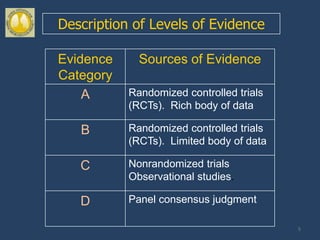
Description of Levels of Evidence

Evidence     Sources of Evidence
Category
    A      Randomized controlled trials
           (RCTs). Rich body of data

   B       Randomized controlled trials
           (RCTs). Limited body of data

   C       Nonrandomized trials
           Observational studies.

   D       Panel consensus judgment

                                          5
Global Strategy for Diagnosis, Management and
Prevention of COPD, 2011: Chapters


                  Definition and Overview
                  Diagnosis and Assessment
                  Therapeutic Options
                  Manage Stable COPD
                  Manage Exacerbations
REVISED 2011

                  Manage Comorbidities
                                             6
Definition of COPD

   COPD, a common preventable and treatable
    disease, is characterized by persistent airflow
    limitation that is usually progressive and
    associated with an enhanced chronic
    inflammatory response in the airways and the
    lung to noxious particles or gases.
   Exacerbations and comorbidities


                                                7
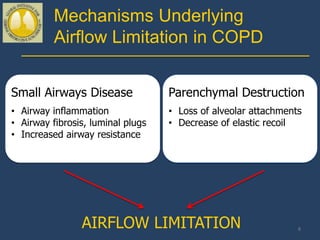
Mechanisms Underlying
          Airflow Limitation in COPD


Small Airways Disease              Parenchymal Destruction
• Airway inflammation              • Loss of alveolar attachments
• Airway fibrosis, luminal plugs   • Decrease of elastic recoil
• Increased airway resistance


                AIRFLOW LIMITATION                              8
Emphysema & chronic bronchitis
   Not included in the definition
   Emphysema
       Pathological term
       Only one of several structural abnormalities
   Chronic bronchitis
       Independent disease entity
       May precede or follow development of
        airflow limitation                       9
Burden of COPD

   Leading cause of morbidity and mortality
    worldwide

   6th leading cause of death in 1990

   Will be the 3rd leading cause of death by the
    year 2020
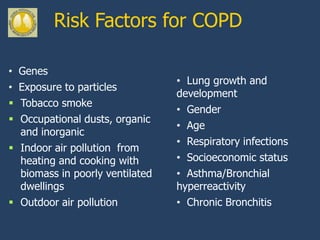
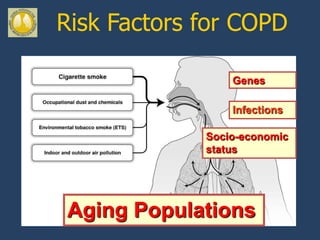
Risk Factors for COPD

• Genes
                                 • Lung growth and
• Exposure to particles
                                 development
 Tobacco smoke
                                 • Gender
 Occupational dusts, organic
                                 • Age
  and inorganic
                                 • Respiratory infections
 Indoor air pollution from
  heating and cooking with       • Socioeconomic status
  biomass in poorly ventilated   • Asthma/Bronchial
  dwellings                      hyperreactivity
 Outdoor air pollution          • Chronic Bronchitis
Risk Factors for COPD

                 Genes

                 Infections

             Socio-economic
             status


Aging Populations
Global Strategy for Diagnosis, Management and
Prevention of COPD, 2011: Chapters


                  Definition and Overview
                  Diagnosis and Assessment
                  Therapeutic Options
                  Manage Stable COPD
                  Manage Exacerbations
REVISED 2011

                  Manage Comorbidities
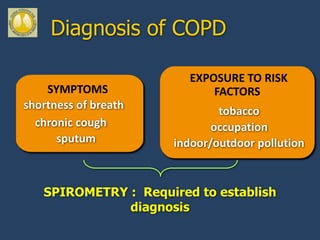
Diagnosis of COPD

                        EXPOSURE TO RISK
    SYMPTOMS                FACTORS
shortness of breath           tobacco
  chronic cough              occupation
      sputum          indoor/outdoor pollution


   SPIROMETRY : Required to establish
              diagnosis
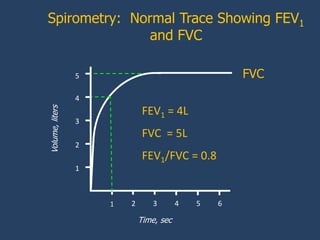
Spirometry: Normal Trace Showing FEV1
               and FVC

                 5                                   FVC
                 4
Volume, liters


                              FEV1 = 4L
                 3
                              FVC = 5L
                 2
                              FEV1/FVC = 0.8
                 1


                     1   2       3       4   5   6

                             Time, sec
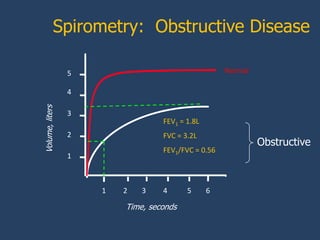
Spirometry: Obstructive Disease

                 5                                  Normal

                 4
Volume, liters


                 3
                                  FEV1 = 1.8L
                 2                FVC = 3.2L
                                                             Obstructive
                                  FEV1/FVC = 0.56
                 1


                     1   2   3    4      5      6

                         Time, seconds
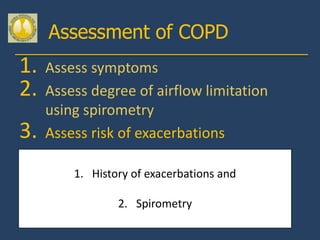
Assessment of COPD

1. Assess symptoms
2. Assess degree of airflow limitation
   using spirometry
3. Assess risk of exacerbations

4. Assess comorbidities
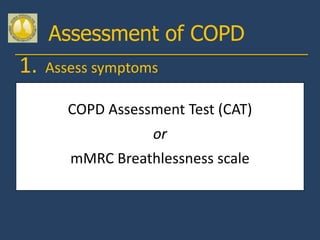
Assessment of COPD
1.   Assess symptoms
 Assess degree of airflow limitation using spirometry
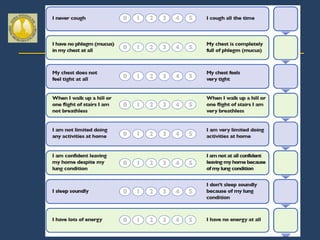
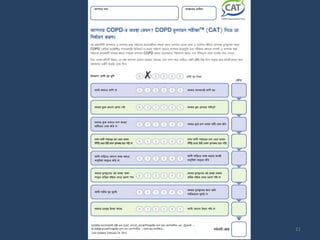
 Assess risk of exacerbations Test (CAT)
        COPD Assessment
 Assess comorbidities
                         or
        mMRC Breathlessness scale
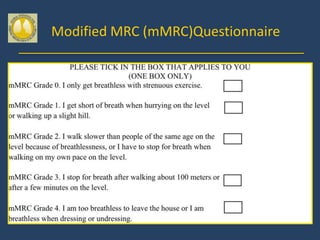
Modified MRC (mMRC)Questionnaire
21
Assessment of COPD
1.   Assess symptoms
2.   Assess degree of airflow limitation


      Spirometry for grading severity
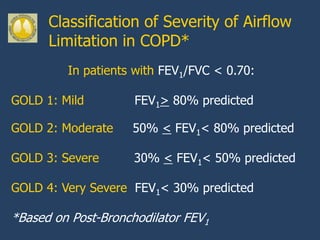
Classification of Severity of Airflow
      Limitation in COPD*
         In patients with FEV1/FVC < 0.70:

GOLD 1: Mild         FEV1> 80% predicted

GOLD 2: Moderate    50% < FEV1< 80% predicted

GOLD 3: Severe       30% < FEV1< 50% predicted

GOLD 4: Very Severe FEV1< 30% predicted

*Based on Post-Bronchodilator FEV1
Assessment of COPD
1. Assess symptoms
2. Assess degree of airflow limitation
   using spirometry
3. Assess risk of exacerbations
 Assess comorbidities
        1. History of exacerbations and

                2. Spirometry
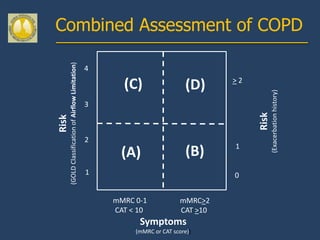
Combined Assessment of COPD

       (GOLD Classification of Airflow Limitation)
                                                     4

                                                           (C)                 (D)      >2


                                                                                                    (Exacerbation history)
                                                     3


                                                                                             Risk
Risk


                                                     2
                                                                                        1
                                                          (A)                   (B)
                                                     1                                  0


                                                         mMRC 0-1             mMRC>2
                                                         CAT < 10             CAT >10
                                                               Symptoms
                                                              (mMRC or CAT score))
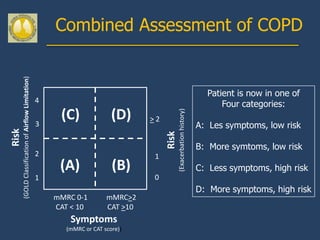
(GOLD Classification of Airflow Limitation)       Combined Assessment of COPD


                                                                                                                          Patient is now in one of
                                                     4
                                                                                                                              Four categories:
                                                          (C)              (D)


                                                                                               (Exacerbation history)
                                                                                   >2
                                                     3                                                                  A: Les symptoms, low risk
Risk


                                                                                        Risk
                                                                                                                        B: More symtoms, low risk
                                                     2                              1
                                                          (A)              (B)                                          C: Less symptoms, high risk
                                                     1                              0
                                                                                                                        D: More symptoms, high risk
                                                         mMRC 0-1        mMRC>2
                                                         CAT < 10        CAT >10
                                                             Symptoms
                                                           (mMRC or CAT score))
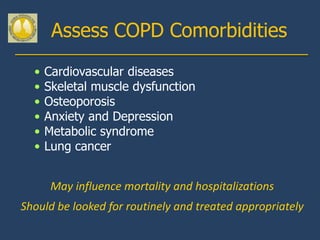
Assess COPD Comorbidities
  •   Cardiovascular diseases
  •   Skeletal muscle dysfunction
  •   Osteoporosis
  •   Anxiety and Depression
  •   Metabolic syndrome
  •   Lung cancer


       May influence mortality and hospitalizations
Should be looked for routinely and treated appropriately
Additional Investigations

•Chest X-ray

•Lung Volumes and Diffusing Capacity

•Oximetry and Arterial Blood Gases

•Alpha-1 Antitrypsin Deficiency Screening

•Exercise Testing
Global Strategy for Diagnosis, Management and
Prevention of COPD, 2011: Chapters


                  Definition and Overview
                  Diagnosis and Assessment
                  Therapeutic Options
                  Manage Stable COPD
                  Manage Exacerbations
REVISED 2011

                  Manage Comorbidities
Smoking cessation


• Greatest capacity to influence the natural
  history of COPD


                                               30
Treating tobacco use &
           dependence
• Warrants repeated treatment
• Effective treatment exist & should be
  offered
• Smoking cessation counseling
• Pharmacotherapies : varenicline,
  bupropion, nicotine gum, inhaler, nasal
  spray, patch
• Cost effective
                                            31
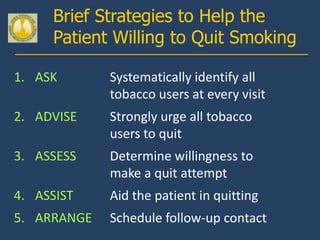
Brief Strategies to Help the
     Patient Willing to Quit Smoking

1. ASK       Systematically identify all
             tobacco users at every visit
2. ADVISE    Strongly urge all tobacco
             users to quit
3. ASSESS    Determine willingness to
             make a quit attempt
4. ASSIST    Aid the patient in quitting
5. ARRANGE   Schedule follow-up contact
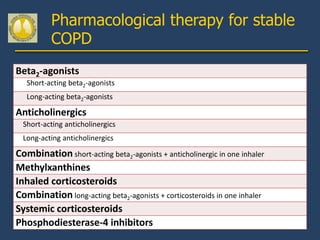
Pharmacological therapy for stable
          COPD
Beta2-agonists
   Short-acting beta2-agonists
   Long-acting beta2-agonists

Anticholinergics
  Short-acting anticholinergics
  Long-acting anticholinergics

Combination short-acting beta2-agonists + anticholinergic in one inhaler
Methylxanthines
Inhaled corticosteroids
Combination long-acting beta2-agonists + corticosteroids in one inhaler
Systemic corticosteroids
Phosphodiesterase-4 inhibitors
Bronchodilators in COPD

• Central to the symptom management
• Inhaled : preferred
• Choice depends on availability & individual
  patient response
• As needed or regular
• Long acting : convenient, more effective
• Combination

                                            34
ICS in COPD
• Controversial
• Limited to specific indications
• Regular treatment with ICS improves
  symptoms, lung function and quality of life in
  patients with FEV1 <60% predicted
  (Evidence A)
• Does not modify the long term decline of
  FEV1 nor mortality (Evidence A)
• Adverse effects

                                               35
Other pharmacological
                treatments
•   Phosphodiesterase 4 inhibitors: Roflumilast
•   Vaccines
•   Antibiotics
•   Mucolytic & antioxidant agents
•   Immunoregulators
•   Antitussive
•   Vasodilators
•   Narcotics
•   Nedocromil & leukotriene modifier

                                                  36
Non-pharmacologic therapies :
     pulmonary rehabilitation
 Improvements in exercise tolerance and
  symptoms of dyspnea and fatigue
 Effective pulmonary rehabilitation
  program duration: 6 weeks
 If exercise training is maintained at home
  the patient's health status remains above
  pre-rehabilitation levels
Other treatments

• O2 therapy
• Ventilatory support
• Surgical treatments
  – Lung volume reduction surgery
  – Bronchoscopic lung volume reduction
  – Lung transplantation
  – Bullectomy

                                          38
Global Strategy for Diagnosis, Management and
Prevention of COPD, 2011: Major Chapters


                  Definition and Overview
                  Diagnosis and Assessment
                  Therapeutic Options
                  Manage Stable COPD
                  Manage Exacerbations
REVISED 2011

                  Manage Comorbidities
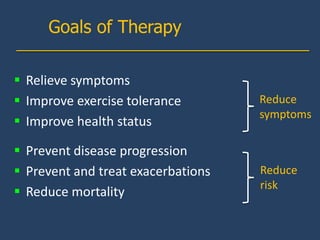
Goals of Therapy

 Relieve symptoms
 Improve exercise tolerance        Reduce
                                    symptoms
 Improve health status

 Prevent disease progression
 Prevent and treat exacerbations   Reduce
                                    risk
 Reduce mortality
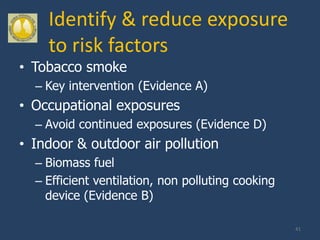
Identify & reduce exposure
    to risk factors
• Tobacco smoke
  – Key intervention (Evidence A)
• Occupational exposures
  – Avoid continued exposures (Evidence D)
• Indoor & outdoor air pollution
  – Biomass fuel
  – Efficient ventilation, non polluting cooking
    device (Evidence B)

                                                   41
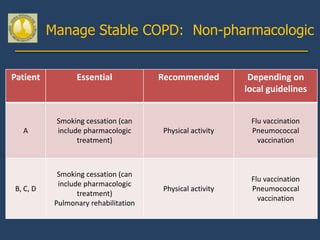
Manage Stable COPD: Non-pharmacologic


Patient          Essential            Recommended          Depending on
                                                          local guidelines


           Smoking cessation (can                          Flu vaccination
  A        include pharmacologic      Physical activity    Pneumococcal
                 treatment)                                  vaccination


            Smoking cessation (can
                                                           Flu vaccination
            include pharmacologic
B, C, D                               Physical activity    Pneumococcal
                  treatment)
                                                             vaccination
           Pulmonary rehabilitation
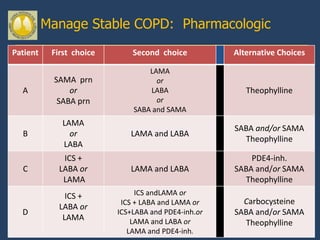
Manage Stable COPD: Pharmacologic
Patient    First choice       Second choice          Alternative Choices

                                  LAMA
           SAMA prn                 or
  A            or                 LABA                  Theophylline
            SABA prn                or
                              SABA and SAMA
              LAMA
                                                     SABA and/or SAMA
  B             or           LAMA and LABA
                                                       Theophylline
              LABA
              ICS +                                      PDE4-inh.
  C          LABA or         LAMA and LABA           SABA and/or SAMA
              LAMA                                     Theophylline
               ICS +           ICS andLAMA or
                           ICS + LABA and LAMA or      Carbocysteine
             LABA or
  D                       ICS+LABA and PDE4-inh.or   SABA and/or SAMA
              LAMA            LAMA and LABA or         Theophylline
                             LAMA and PDE4-inh.
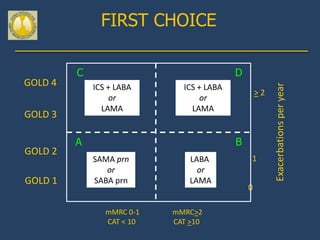
FIRST CHOICE

         C                                D
GOLD 4


                                                       Exacerbations per year
             ICS + LABA      ICS + LABA
                                                  >2
                  or              or
               LAMA            LAMA
GOLD 3

         A                                B
GOLD 2
             SAMA prn          LABA           1
                or               or
GOLD 1       SABA prn          LAMA
                                              0

                mMRC 0-1   mMRC>2
                CAT < 10   CAT >10
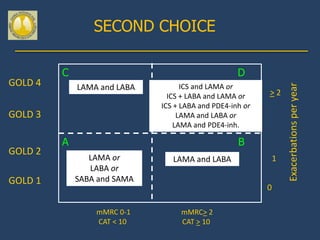
SECOND CHOICE

         C                                         D
GOLD 4


                                                                  Exacerbations per year
             LAMA and LABA         ICS and LAMA or
                               ICS + LABA and LAMA or     >2
                             ICS + LABA and PDE4-inh or
GOLD 3                            LAMA and LABA or
                                 LAMA and PDE4-inh.

         A                                         B
GOLD 2
                LAMA or         LAMA and LABA                 1
                LABA or
GOLD 1       SABA and SAMA
                                                          0

                 mMRC 0-1         mMRC> 2
                 CAT < 10         CAT > 10
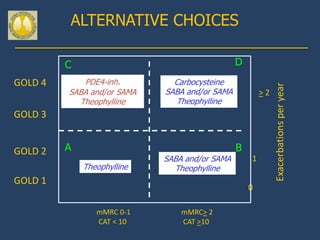
ALTERNATIVE CHOICES

         C                                     D
GOLD 4      PDE4-inh.         Carbocysteine


                                                            Exacerbations per year
         SABA and/or SAMA   SABA and/or SAMA           >2
           Theophylline       Theophylline
GOLD 3


GOLD 2   A                                     B
                            SABA and/or SAMA       1
             Theophylline     Theophylline
GOLD 1
                                                   0

                mMRC 0-1        mMRC> 2
                CAT < 10        CAT >10
Monitoring & follow up

• Disease progression & development of
  complications
• Monitor pharmacotherapy
• Exacerbation history
• Comorbidities


                                         47
Global Strategy for Diagnosis, Management and
Prevention of COPD, 2011: Chapters


                  Definition and Overview
                  Diagnosis and Assessment
                  Therapeutic Options
                  Manage Stable COPD
                  Manage Exacerbations
REVISED 2011

                  Manage Comorbidities
Acute Exacerbation

• an acute event
• characterized by a worsening of the
 patient’s respiratory symptoms
• that is beyond normal day-to-day
 variations and
• leads to a change in medication
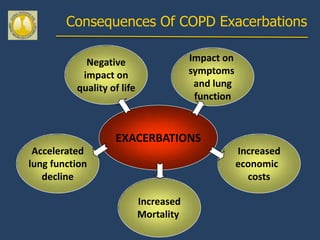
Consequences Of COPD Exacerbations

            Negative                    Impact on
           impact on                    symptoms
          quality of life                and lung
                                         function


                   EXACERBATIONS
 Accelerated                                        Increased
lung function                                       economic
   decline                                            costs

                            Increased
                            Mortality
Precipitating factors

• Respiratory tract infection (Bacterial
 or viral)
• Exposure to pollutants
• Interruption of maintenance therapy
• Overlaping
Investigation for acute exacerbation

• Pulse oxymetry, ABG
• Chest radiograph
• ECG
• CBC
• Sputum for CS
• Biochemical tests
• Spirometry : Not recommended
Potential indications for hospital
       assessment and admission

•   Marked increase in the intensity of symptoms
•   Onset of new physical signs
•   Failure to respond to initial medical management
•   Severe underlying COPD
•   Frequent exacerbations
•   Serious comorbidities
•   Older age
•   Insufficeint home support
Treatment of exacerbation


• Pharmacologic treatment

• Respiratory support
Pharmacologic treatment


• Short acting bronchodilators
• Systemic corticosteroid
• Antibiotics
Pharmacologic treatment

•   Short acting bronchodilators
       • Short acting inhaled β2 agonist with or
        without short acting anticholinergic
        (Evidence C)
       • No significant difference betweent MDI with
        or without spacer and nebuliser
       • IV methylxanthines only to be used in
        selected cases (Evidence B)
Pharmacologic treatment:          Coticosteroids


• Shorten recovery time, improve FEV1 &
 PaO2, reduce the risk of early relapse,
 treatment failure & length of hospital stay
 (Evidence A)
• 30-40 mg prednisolone for 10-14 days
 (Evidence D)
• Nebulised budesonide may be an alternative
Pharmacologic treatment:                    Antibiotics


• Indications
      • Increased dyspoea, sputum purulence, sputum
       volume (Evidence B)
      • Increased sputum purulence with one other cardinal
       symptoms (Evidence C)
      • Mechanical ventilation (Evidence B)
• Length of antibiotic therapy : 5-10 days (Evidence D)
• The choice of antibiotic
• Route of administration
Pharmacologic treatment:   others


•   Appropriate fluid balance
•   Diuretics
•   Anticoagulants
•   Treatment of comorbidities
•   Nutrition
Respiratory support


• Oxygen therapy
  – Key component of hospital treatment
  – Target saturation of 88-92%
  – ABG should be checked 30-60 minutes later
  – Venturi masks for accurate & controlled delivery
Ventilatory support


• Non-invasive

• Invasive
Indications for NIV
At least one of following:
• Respiratory acidosis
• Severe dyspnea with clinical signs suggestive
  of respiratory muscle fatigue, increased work
  of breathing or both (Use of respiratory
  accessory muscles, paradoxical motion of the
  abdomen, or retraction of the intercostal
  spaces)
Indications for ICU admission
– Severe dyspnoea that responds inadequately
  to initial emergency therapy
– Changes in mental status
– Persistent or worsening hypoxemia (PaO2 <
  5.3 kPa, 40 mm Hg) and/or severe/worsening
  respiratory acidosis (PH <7.25) despite
  supplemental O2 & noninvasive ventilation
– Need for invasive mechanical ventilation
– Need for vasopressors – hemodynamic
  instability
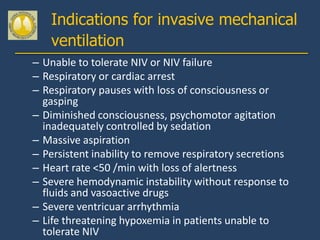
Indications for invasive mechanical
    ventilation
– Unable to tolerate NIV or NIV failure
– Respiratory or cardiac arrest
– Respiratory pauses with loss of consciousness or
  gasping
– Diminished consciousness, psychomotor agitation
  inadequately controlled by sedation
– Massive aspiration
– Persistent inability to remove respiratory secretions
– Heart rate <50 /min with loss of alertness
– Severe hemodynamic instability without response to
  fluids and vasoactive drugs
– Severe ventricuar arrhythmia
– Life threatening hypoxemia in patients unable to
  tolerate NIV
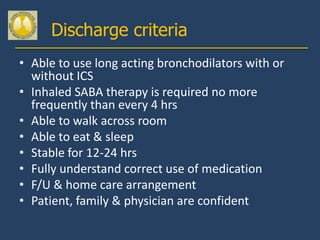
Discharge criteria
• Able to use long acting bronchodilators with or
  without ICS
• Inhaled SABA therapy is required no more
  frequently than every 4 hrs
• Able to walk across room
• Able to eat & sleep
• Stable for 12-24 hrs
• Fully understand correct use of medication
• F/U & home care arrangement
• Patient, family & physician are confident
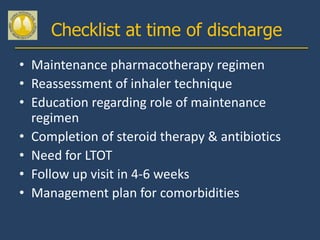
Checklist at time of discharge
• Maintenance pharmacotherapy regimen
• Reassessment of inhaler technique
• Education regarding role of maintenance
  regimen
• Completion of steroid therapy & antibiotics
• Need for LTOT
• Follow up visit in 4-6 weeks
• Management plan for comorbidities
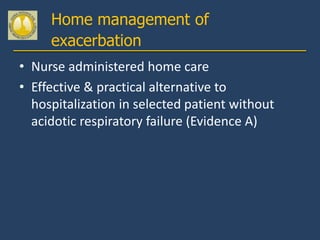
Home management of
     exacerbation
• Nurse administered home care
• Effective & practical alternative to
  hospitalization in selected patient without
  acidotic respiratory failure (Evidence A)
68

My presentation on GOLD

  • 1.
    Global Strategy forDiagnosis, Management and Prevention of Chronic Obstructive Pulmonary Disease Revised 2011 Dr. Mashfiqul Hasan Resident, Phase A Respiratory wing, Dept of Medicine BSMMU 1
  • 2.
    G lobal Initiativefor Chronic O bstructive L ung D isease © Global Initiative for Chronic Obstructive Lung Disease 2
  • 3.
    WORLD COPD DAY November 14, 2012 Raising COPD Awareness Worldwide
  • 4.
  • 5.
    Description of Levelsof Evidence Evidence Sources of Evidence Category A Randomized controlled trials (RCTs). Rich body of data B Randomized controlled trials (RCTs). Limited body of data C Nonrandomized trials Observational studies. D Panel consensus judgment 5
  • 6.
    Global Strategy forDiagnosis, Management and Prevention of COPD, 2011: Chapters  Definition and Overview  Diagnosis and Assessment  Therapeutic Options  Manage Stable COPD  Manage Exacerbations REVISED 2011  Manage Comorbidities 6
  • 7.
    Definition of COPD  COPD, a common preventable and treatable disease, is characterized by persistent airflow limitation that is usually progressive and associated with an enhanced chronic inflammatory response in the airways and the lung to noxious particles or gases.  Exacerbations and comorbidities 7
  • 8.
    Mechanisms Underlying Airflow Limitation in COPD Small Airways Disease Parenchymal Destruction • Airway inflammation • Loss of alveolar attachments • Airway fibrosis, luminal plugs • Decrease of elastic recoil • Increased airway resistance AIRFLOW LIMITATION 8
  • 9.
    Emphysema & chronicbronchitis  Not included in the definition  Emphysema  Pathological term  Only one of several structural abnormalities  Chronic bronchitis  Independent disease entity  May precede or follow development of airflow limitation 9
  • 10.
    Burden of COPD  Leading cause of morbidity and mortality worldwide  6th leading cause of death in 1990  Will be the 3rd leading cause of death by the year 2020
  • 11.
    Risk Factors forCOPD • Genes • Lung growth and • Exposure to particles development  Tobacco smoke • Gender  Occupational dusts, organic • Age and inorganic • Respiratory infections  Indoor air pollution from heating and cooking with • Socioeconomic status biomass in poorly ventilated • Asthma/Bronchial dwellings hyperreactivity  Outdoor air pollution • Chronic Bronchitis
  • 12.
    Risk Factors forCOPD Genes Infections Socio-economic status Aging Populations
  • 13.
    Global Strategy forDiagnosis, Management and Prevention of COPD, 2011: Chapters  Definition and Overview  Diagnosis and Assessment  Therapeutic Options  Manage Stable COPD  Manage Exacerbations REVISED 2011  Manage Comorbidities
  • 14.
    Diagnosis of COPD EXPOSURE TO RISK SYMPTOMS FACTORS shortness of breath tobacco chronic cough occupation sputum indoor/outdoor pollution SPIROMETRY : Required to establish diagnosis
  • 15.
    Spirometry: Normal TraceShowing FEV1 and FVC 5 FVC 4 Volume, liters FEV1 = 4L 3 FVC = 5L 2 FEV1/FVC = 0.8 1 1 2 3 4 5 6 Time, sec
  • 16.
    Spirometry: Obstructive Disease 5 Normal 4 Volume, liters 3 FEV1 = 1.8L 2 FVC = 3.2L Obstructive FEV1/FVC = 0.56 1 1 2 3 4 5 6 Time, seconds
  • 17.
    Assessment of COPD 1.Assess symptoms 2. Assess degree of airflow limitation using spirometry 3. Assess risk of exacerbations 4. Assess comorbidities
  • 18.
    Assessment of COPD 1. Assess symptoms Assess degree of airflow limitation using spirometry Assess risk of exacerbations Test (CAT) COPD Assessment Assess comorbidities or mMRC Breathlessness scale
  • 19.
  • 21.
  • 22.
    Assessment of COPD 1. Assess symptoms 2. Assess degree of airflow limitation Spirometry for grading severity
  • 23.
    Classification of Severityof Airflow Limitation in COPD* In patients with FEV1/FVC < 0.70: GOLD 1: Mild FEV1> 80% predicted GOLD 2: Moderate 50% < FEV1< 80% predicted GOLD 3: Severe 30% < FEV1< 50% predicted GOLD 4: Very Severe FEV1< 30% predicted *Based on Post-Bronchodilator FEV1
  • 24.
    Assessment of COPD 1.Assess symptoms 2. Assess degree of airflow limitation using spirometry 3. Assess risk of exacerbations Assess comorbidities 1. History of exacerbations and 2. Spirometry
  • 25.
    Combined Assessment ofCOPD (GOLD Classification of Airflow Limitation) 4 (C) (D) >2 (Exacerbation history) 3 Risk Risk 2 1 (A) (B) 1 0 mMRC 0-1 mMRC>2 CAT < 10 CAT >10 Symptoms (mMRC or CAT score))
  • 26.
    (GOLD Classification ofAirflow Limitation) Combined Assessment of COPD Patient is now in one of 4 Four categories: (C) (D) (Exacerbation history) >2 3 A: Les symptoms, low risk Risk Risk B: More symtoms, low risk 2 1 (A) (B) C: Less symptoms, high risk 1 0 D: More symptoms, high risk mMRC 0-1 mMRC>2 CAT < 10 CAT >10 Symptoms (mMRC or CAT score))
  • 27.
    Assess COPD Comorbidities • Cardiovascular diseases • Skeletal muscle dysfunction • Osteoporosis • Anxiety and Depression • Metabolic syndrome • Lung cancer May influence mortality and hospitalizations Should be looked for routinely and treated appropriately
  • 28.
    Additional Investigations •Chest X-ray •LungVolumes and Diffusing Capacity •Oximetry and Arterial Blood Gases •Alpha-1 Antitrypsin Deficiency Screening •Exercise Testing
  • 29.
    Global Strategy forDiagnosis, Management and Prevention of COPD, 2011: Chapters  Definition and Overview  Diagnosis and Assessment  Therapeutic Options  Manage Stable COPD  Manage Exacerbations REVISED 2011  Manage Comorbidities
  • 30.
    Smoking cessation • Greatestcapacity to influence the natural history of COPD 30
  • 31.
    Treating tobacco use& dependence • Warrants repeated treatment • Effective treatment exist & should be offered • Smoking cessation counseling • Pharmacotherapies : varenicline, bupropion, nicotine gum, inhaler, nasal spray, patch • Cost effective 31
  • 32.
    Brief Strategies toHelp the Patient Willing to Quit Smoking 1. ASK Systematically identify all tobacco users at every visit 2. ADVISE Strongly urge all tobacco users to quit 3. ASSESS Determine willingness to make a quit attempt 4. ASSIST Aid the patient in quitting 5. ARRANGE Schedule follow-up contact
  • 33.
    Pharmacological therapy forstable COPD Beta2-agonists Short-acting beta2-agonists Long-acting beta2-agonists Anticholinergics Short-acting anticholinergics Long-acting anticholinergics Combination short-acting beta2-agonists + anticholinergic in one inhaler Methylxanthines Inhaled corticosteroids Combination long-acting beta2-agonists + corticosteroids in one inhaler Systemic corticosteroids Phosphodiesterase-4 inhibitors
  • 34.
    Bronchodilators in COPD •Central to the symptom management • Inhaled : preferred • Choice depends on availability & individual patient response • As needed or regular • Long acting : convenient, more effective • Combination 34
  • 35.
    ICS in COPD •Controversial • Limited to specific indications • Regular treatment with ICS improves symptoms, lung function and quality of life in patients with FEV1 <60% predicted (Evidence A) • Does not modify the long term decline of FEV1 nor mortality (Evidence A) • Adverse effects 35
  • 36.
    Other pharmacological treatments • Phosphodiesterase 4 inhibitors: Roflumilast • Vaccines • Antibiotics • Mucolytic & antioxidant agents • Immunoregulators • Antitussive • Vasodilators • Narcotics • Nedocromil & leukotriene modifier 36
  • 37.
    Non-pharmacologic therapies : pulmonary rehabilitation  Improvements in exercise tolerance and symptoms of dyspnea and fatigue  Effective pulmonary rehabilitation program duration: 6 weeks  If exercise training is maintained at home the patient's health status remains above pre-rehabilitation levels
  • 38.
    Other treatments • O2therapy • Ventilatory support • Surgical treatments – Lung volume reduction surgery – Bronchoscopic lung volume reduction – Lung transplantation – Bullectomy 38
  • 39.
    Global Strategy forDiagnosis, Management and Prevention of COPD, 2011: Major Chapters  Definition and Overview  Diagnosis and Assessment  Therapeutic Options  Manage Stable COPD  Manage Exacerbations REVISED 2011  Manage Comorbidities
  • 40.
    Goals of Therapy Relieve symptoms  Improve exercise tolerance Reduce symptoms  Improve health status  Prevent disease progression  Prevent and treat exacerbations Reduce risk  Reduce mortality
  • 41.
    Identify & reduceexposure to risk factors • Tobacco smoke – Key intervention (Evidence A) • Occupational exposures – Avoid continued exposures (Evidence D) • Indoor & outdoor air pollution – Biomass fuel – Efficient ventilation, non polluting cooking device (Evidence B) 41
  • 42.
    Manage Stable COPD:Non-pharmacologic Patient Essential Recommended Depending on local guidelines Smoking cessation (can Flu vaccination A include pharmacologic Physical activity Pneumococcal treatment) vaccination Smoking cessation (can Flu vaccination include pharmacologic B, C, D Physical activity Pneumococcal treatment) vaccination Pulmonary rehabilitation
  • 43.
    Manage Stable COPD:Pharmacologic Patient First choice Second choice Alternative Choices LAMA SAMA prn or A or LABA Theophylline SABA prn or SABA and SAMA LAMA SABA and/or SAMA B or LAMA and LABA Theophylline LABA ICS + PDE4-inh. C LABA or LAMA and LABA SABA and/or SAMA LAMA Theophylline ICS + ICS andLAMA or ICS + LABA and LAMA or Carbocysteine LABA or D ICS+LABA and PDE4-inh.or SABA and/or SAMA LAMA LAMA and LABA or Theophylline LAMA and PDE4-inh.
  • 44.
    FIRST CHOICE C D GOLD 4 Exacerbations per year ICS + LABA ICS + LABA >2 or or LAMA LAMA GOLD 3 A B GOLD 2 SAMA prn LABA 1 or or GOLD 1 SABA prn LAMA 0 mMRC 0-1 mMRC>2 CAT < 10 CAT >10
  • 45.
    SECOND CHOICE C D GOLD 4 Exacerbations per year LAMA and LABA ICS and LAMA or ICS + LABA and LAMA or >2 ICS + LABA and PDE4-inh or GOLD 3 LAMA and LABA or LAMA and PDE4-inh. A B GOLD 2 LAMA or LAMA and LABA 1 LABA or GOLD 1 SABA and SAMA 0 mMRC 0-1 mMRC> 2 CAT < 10 CAT > 10
  • 46.
    ALTERNATIVE CHOICES C D GOLD 4 PDE4-inh. Carbocysteine Exacerbations per year SABA and/or SAMA SABA and/or SAMA >2 Theophylline Theophylline GOLD 3 GOLD 2 A B SABA and/or SAMA 1 Theophylline Theophylline GOLD 1 0 mMRC 0-1 mMRC> 2 CAT < 10 CAT >10
  • 47.
    Monitoring & followup • Disease progression & development of complications • Monitor pharmacotherapy • Exacerbation history • Comorbidities 47
  • 48.
    Global Strategy forDiagnosis, Management and Prevention of COPD, 2011: Chapters  Definition and Overview  Diagnosis and Assessment  Therapeutic Options  Manage Stable COPD  Manage Exacerbations REVISED 2011  Manage Comorbidities
  • 49.
    Acute Exacerbation • anacute event • characterized by a worsening of the patient’s respiratory symptoms • that is beyond normal day-to-day variations and • leads to a change in medication
  • 50.
    Consequences Of COPDExacerbations Negative Impact on impact on symptoms quality of life and lung function EXACERBATIONS Accelerated Increased lung function economic decline costs Increased Mortality
  • 51.
    Precipitating factors • Respiratorytract infection (Bacterial or viral) • Exposure to pollutants • Interruption of maintenance therapy • Overlaping
  • 52.
    Investigation for acuteexacerbation • Pulse oxymetry, ABG • Chest radiograph • ECG • CBC • Sputum for CS • Biochemical tests • Spirometry : Not recommended
  • 53.
    Potential indications forhospital assessment and admission • Marked increase in the intensity of symptoms • Onset of new physical signs • Failure to respond to initial medical management • Severe underlying COPD • Frequent exacerbations • Serious comorbidities • Older age • Insufficeint home support
  • 54.
    Treatment of exacerbation •Pharmacologic treatment • Respiratory support
  • 55.
    Pharmacologic treatment • Shortacting bronchodilators • Systemic corticosteroid • Antibiotics
  • 56.
    Pharmacologic treatment • Short acting bronchodilators • Short acting inhaled β2 agonist with or without short acting anticholinergic (Evidence C) • No significant difference betweent MDI with or without spacer and nebuliser • IV methylxanthines only to be used in selected cases (Evidence B)
  • 57.
    Pharmacologic treatment: Coticosteroids • Shorten recovery time, improve FEV1 & PaO2, reduce the risk of early relapse, treatment failure & length of hospital stay (Evidence A) • 30-40 mg prednisolone for 10-14 days (Evidence D) • Nebulised budesonide may be an alternative
  • 58.
    Pharmacologic treatment: Antibiotics • Indications • Increased dyspoea, sputum purulence, sputum volume (Evidence B) • Increased sputum purulence with one other cardinal symptoms (Evidence C) • Mechanical ventilation (Evidence B) • Length of antibiotic therapy : 5-10 days (Evidence D) • The choice of antibiotic • Route of administration
  • 59.
    Pharmacologic treatment: others • Appropriate fluid balance • Diuretics • Anticoagulants • Treatment of comorbidities • Nutrition
  • 60.
    Respiratory support • Oxygentherapy – Key component of hospital treatment – Target saturation of 88-92% – ABG should be checked 30-60 minutes later – Venturi masks for accurate & controlled delivery
  • 61.
  • 62.
    Indications for NIV Atleast one of following: • Respiratory acidosis • Severe dyspnea with clinical signs suggestive of respiratory muscle fatigue, increased work of breathing or both (Use of respiratory accessory muscles, paradoxical motion of the abdomen, or retraction of the intercostal spaces)
  • 63.
    Indications for ICUadmission – Severe dyspnoea that responds inadequately to initial emergency therapy – Changes in mental status – Persistent or worsening hypoxemia (PaO2 < 5.3 kPa, 40 mm Hg) and/or severe/worsening respiratory acidosis (PH <7.25) despite supplemental O2 & noninvasive ventilation – Need for invasive mechanical ventilation – Need for vasopressors – hemodynamic instability
  • 64.
    Indications for invasivemechanical ventilation – Unable to tolerate NIV or NIV failure – Respiratory or cardiac arrest – Respiratory pauses with loss of consciousness or gasping – Diminished consciousness, psychomotor agitation inadequately controlled by sedation – Massive aspiration – Persistent inability to remove respiratory secretions – Heart rate <50 /min with loss of alertness – Severe hemodynamic instability without response to fluids and vasoactive drugs – Severe ventricuar arrhythmia – Life threatening hypoxemia in patients unable to tolerate NIV
  • 65.
    Discharge criteria • Ableto use long acting bronchodilators with or without ICS • Inhaled SABA therapy is required no more frequently than every 4 hrs • Able to walk across room • Able to eat & sleep • Stable for 12-24 hrs • Fully understand correct use of medication • F/U & home care arrangement • Patient, family & physician are confident
  • 66.
    Checklist at timeof discharge • Maintenance pharmacotherapy regimen • Reassessment of inhaler technique • Education regarding role of maintenance regimen • Completion of steroid therapy & antibiotics • Need for LTOT • Follow up visit in 4-6 weeks • Management plan for comorbidities
  • 67.
    Home management of exacerbation • Nurse administered home care • Effective & practical alternative to hospitalization in selected patient without acidotic respiratory failure (Evidence A)
  • 68.