


Arterial blood gas analysis

           Dr. Mashfiqul Hasan
              5 steps


12/11/12                             1
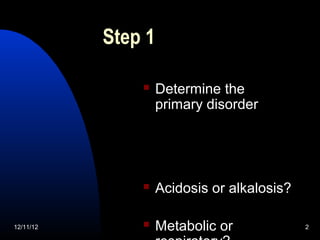
Step 1

                   Determine the
                    primary disorder


                   Acidosis or alkalosis?

12/11/12           Metabolic or             2
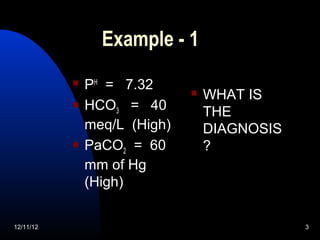
Example - 1
              PH = 7.32         WHAT IS
              HCO3 = 40          THE
               meq/L (High)       DIAGNOSIS
              PaCO2 = 60         ?
               mm of Hg
               (High)


12/11/12                                      3
Respiratory   acidosis


12/11/12                             4
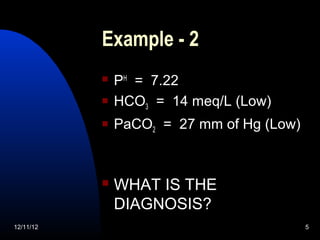
Example - 2
              PH = 7.22
              HCO3 = 14 meq/L (Low)
              PaCO2 = 27 mm of Hg (Low)


              WHAT IS THE
               DIAGNOSIS?
12/11/12                                   5
Metabolic
           acidosis


12/11/12               6
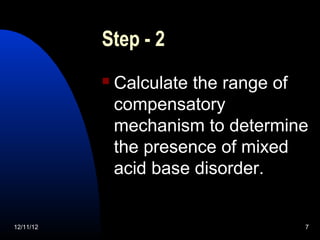
Step - 2
              Calculate the range of
               compensatory
               mechanism to determine
               the presence of mixed
               acid base disorder.


12/11/12                            7
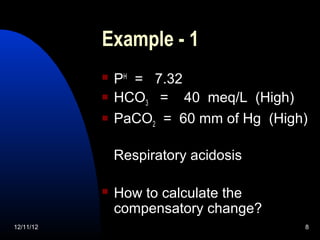
Example - 1
              PH = 7.32
              HCO3 = 40 meq/L (High)
              PaCO2 = 60 mm of Hg (High)

               Respiratory acidosis

              How to calculate the
               compensatory change?
12/11/12                                8
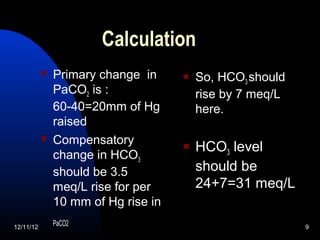
Calculation
              Primary change in        So, HCO3 should
               PaCO2 is :                rise by 7 meq/L
               60-40=20mm of Hg          here.
               raised
              Compensatory             HCO3 level
               change in HCO3
               should be 3.5             should be
               meq/L rise for per        24+7=31 meq/L
               10 mm of Hg rise in
12/11/12
               PaCO2                                       9
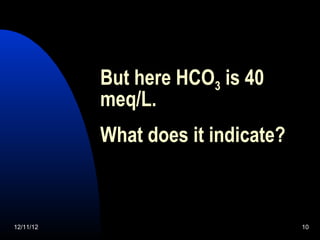
But here HCO3 is 40
           meq/L.
           What does it indicate?


12/11/12                            10
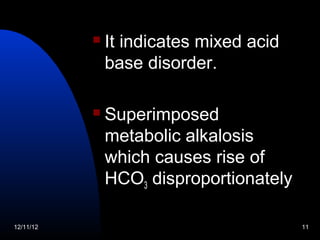
   It indicates mixed acid
               base disorder.

              Superimposed
               metabolic alkalosis
               which causes rise of
               HCO3 disproportionately

12/11/12                                 11
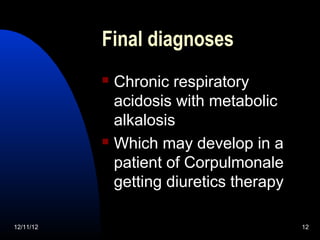
Final diagnoses
            Chronic respiratory
             acidosis with metabolic
             alkalosis
            Which may develop in a

             patient of Corpulmonale
             getting diuretics therapy

12/11/12                                 12
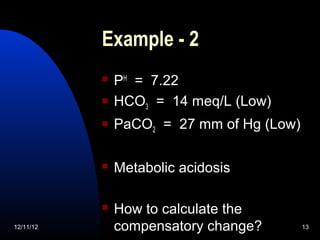
Example - 2
              PH = 7.22
              HCO3 = 14 meq/L (Low)
              PaCO2 = 27 mm of Hg (Low)

              Metabolic acidosis

              How to calculate the
12/11/12       compensatory change?        13
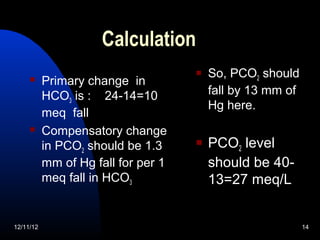
Calculation
                                        So, PCO2 should
          Primary change in
           HCO3 is : 24-14=10            fall by 13 mm of
                                         Hg here.
           meq fall
          Compensatory change
           in PCO2 should be 1.3        PCO2 level
           mm of Hg fall for per 1       should be 40-
           meq fall in HCO3              13=27 meq/L


12/11/12                                                    14
PaCO2 is consistent with
           calculation

            So there is no mixed acid
             base disorder according
             to step 2.
            Final diagnosis is

             metabolic acidosis.

12/11/12                                 15
Step - 3

              Calculate the anion
               gap.


12/11/12                             16
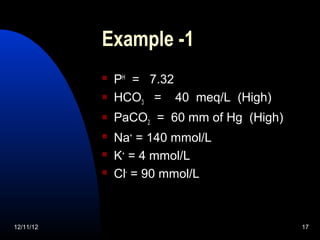
Example -1
              PH = 7.32
              HCO3 = 40 meq/L (High)
              PaCO2 = 60 mm of Hg (High)
              Na+ = 140 mmol/L
              K+ = 4 mmol/L
              Cl- = 90 mmol/L


12/11/12                                    17
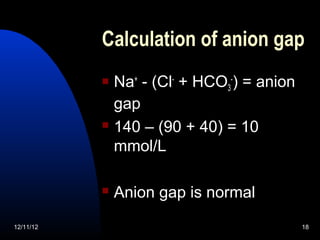
Calculation of anion gap
            Na+ - (Cl- + HCO3-) = anion
             gap
            140 – (90 + 40) = 10

             mmol/L

              Anion gap is normal
12/11/12                                   18
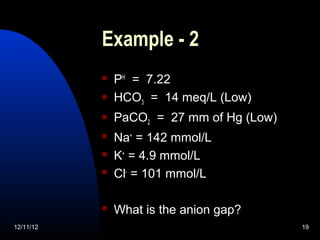
Example - 2
              PH = 7.22
              HCO3 = 14 meq/L (Low)
              PaCO2 = 27 mm of Hg (Low)
              Na+ = 142 mmol/L
              K+ = 4.9 mmol/L
              Cl- = 101 mmol/L

              What is the anion gap?
12/11/12                                   19
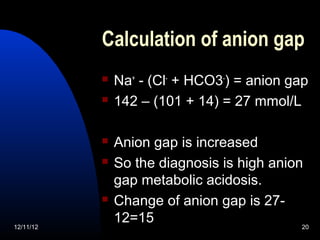
Calculation of anion gap
              Na+ - (Cl- + HCO3-) = anion gap
              142 – (101 + 14) = 27 mmol/L

              Anion gap is increased
              So the diagnosis is high anion
               gap metabolic acidosis.
              Change of anion gap is 27-
12/11/12
               12=15                         20
Step - 4
              Calculate the HCO3-
               concentration if the
               anion gap is
               increased.


12/11/12                              21
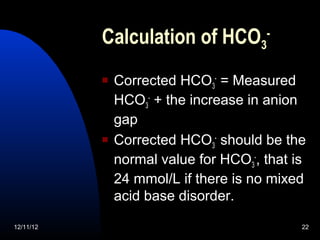
Calculation of HCO3-
              Corrected HCO3- = Measured
               HCO3- + the increase in anion
               gap
              Corrected HCO3- should be the
               normal value for HCO3-, that is
               24 mmol/L if there is no mixed
               acid base disorder.

12/11/12                                     22
Example 2
              PH = 7.22
              HCO3 = 14 meq/L (Low)
              PaCO2 = 27 mm of Hg (Low)
              Na+ = 142 mmol/L
              K+ = 4.9 mmol/L
              Cl- = 101 mmol/L
              Anion gap = 27 mmol/L
              Change in anion gap = 15 mmol/L
12/11/12                                         23
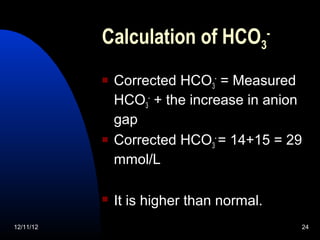
Calculation of HCO3-
              Corrected HCO3- = Measured
               HCO3- + the increase in anion
               gap
              Corrected HCO3- = 14+15 = 29
               mmol/L

              It is higher than normal.
12/11/12                                   24
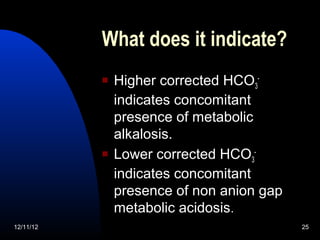
What does it indicate?
              Higher corrected HCO3-
               indicates concomitant
               presence of metabolic
               alkalosis.
              Lower corrected HCO3-
               indicates concomitant
               presence of non anion gap
               metabolic acidosis.
12/11/12                                   25
Final diagnosis of
           example 2
              High Anion gap Metabolic
               acidosis with concomitant
               metabolic alkalosis

              Which may be present in
               alcoholic ketoacidosis with
               excessive vomiting

12/11/12                                     26
Final step


12/11/12                27
Final step
              Examine the patient to
               determine whether the
               clinical signs are
               compatible with the acid
               base analysis thus
               obtained.

12/11/12                                  28
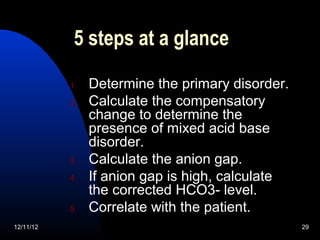
5 steps at a glance

           1.   Determine the primary disorder.
           2.   Calculate the compensatory
                change to determine the
                presence of mixed acid base
                disorder.
           3.   Calculate the anion gap.
           4.   If anion gap is high, calculate
                the corrected HCO3- level.
           5.   Correlate with the patient.
12/11/12                                          29
Thanks for patient
           hearing


12/11/12                        30

Arterial blood gas analysis

  • 1.
    Arterial blood gasanalysis Dr. Mashfiqul Hasan  5 steps 12/11/12 1
  • 2.
    Step 1  Determine the primary disorder  Acidosis or alkalosis? 12/11/12  Metabolic or 2
  • 3.
    Example - 1  PH = 7.32  WHAT IS  HCO3 = 40 THE meq/L (High) DIAGNOSIS  PaCO2 = 60 ? mm of Hg (High) 12/11/12 3
  • 4.
    Respiratory acidosis 12/11/12 4
  • 5.
    Example - 2  PH = 7.22  HCO3 = 14 meq/L (Low)  PaCO2 = 27 mm of Hg (Low)  WHAT IS THE DIAGNOSIS? 12/11/12 5
  • 6.
    Metabolic acidosis 12/11/12 6
  • 7.
    Step - 2  Calculate the range of compensatory mechanism to determine the presence of mixed acid base disorder. 12/11/12 7
  • 8.
    Example - 1  PH = 7.32  HCO3 = 40 meq/L (High)  PaCO2 = 60 mm of Hg (High) Respiratory acidosis  How to calculate the compensatory change? 12/11/12 8
  • 9.
    Calculation  Primary change in  So, HCO3 should PaCO2 is : rise by 7 meq/L 60-40=20mm of Hg here. raised  Compensatory  HCO3 level change in HCO3 should be 3.5 should be meq/L rise for per 24+7=31 meq/L 10 mm of Hg rise in 12/11/12 PaCO2 9
  • 10.
    But here HCO3is 40 meq/L. What does it indicate? 12/11/12 10
  • 11.
    It indicates mixed acid base disorder.  Superimposed metabolic alkalosis which causes rise of HCO3 disproportionately 12/11/12 11
  • 12.
    Final diagnoses  Chronic respiratory acidosis with metabolic alkalosis  Which may develop in a patient of Corpulmonale getting diuretics therapy 12/11/12 12
  • 13.
    Example - 2  PH = 7.22  HCO3 = 14 meq/L (Low)  PaCO2 = 27 mm of Hg (Low)  Metabolic acidosis  How to calculate the 12/11/12 compensatory change? 13
  • 14.
    Calculation  So, PCO2 should  Primary change in HCO3 is : 24-14=10 fall by 13 mm of Hg here. meq fall  Compensatory change in PCO2 should be 1.3  PCO2 level mm of Hg fall for per 1 should be 40- meq fall in HCO3 13=27 meq/L 12/11/12 14
  • 15.
    PaCO2 is consistentwith calculation  So there is no mixed acid base disorder according to step 2.  Final diagnosis is metabolic acidosis. 12/11/12 15
  • 16.
    Step - 3  Calculate the anion gap. 12/11/12 16
  • 17.
    Example -1  PH = 7.32  HCO3 = 40 meq/L (High)  PaCO2 = 60 mm of Hg (High)  Na+ = 140 mmol/L  K+ = 4 mmol/L  Cl- = 90 mmol/L 12/11/12 17
  • 18.
    Calculation of aniongap  Na+ - (Cl- + HCO3-) = anion gap  140 – (90 + 40) = 10 mmol/L  Anion gap is normal 12/11/12 18
  • 19.
    Example - 2  PH = 7.22  HCO3 = 14 meq/L (Low)  PaCO2 = 27 mm of Hg (Low)  Na+ = 142 mmol/L  K+ = 4.9 mmol/L  Cl- = 101 mmol/L  What is the anion gap? 12/11/12 19
  • 20.
    Calculation of aniongap  Na+ - (Cl- + HCO3-) = anion gap  142 – (101 + 14) = 27 mmol/L  Anion gap is increased  So the diagnosis is high anion gap metabolic acidosis.  Change of anion gap is 27- 12/11/12 12=15 20
  • 21.
    Step - 4  Calculate the HCO3- concentration if the anion gap is increased. 12/11/12 21
  • 22.
    Calculation of HCO3-  Corrected HCO3- = Measured HCO3- + the increase in anion gap  Corrected HCO3- should be the normal value for HCO3-, that is 24 mmol/L if there is no mixed acid base disorder. 12/11/12 22
  • 23.
    Example 2  PH = 7.22  HCO3 = 14 meq/L (Low)  PaCO2 = 27 mm of Hg (Low)  Na+ = 142 mmol/L  K+ = 4.9 mmol/L  Cl- = 101 mmol/L  Anion gap = 27 mmol/L  Change in anion gap = 15 mmol/L 12/11/12 23
  • 24.
    Calculation of HCO3-  Corrected HCO3- = Measured HCO3- + the increase in anion gap  Corrected HCO3- = 14+15 = 29 mmol/L  It is higher than normal. 12/11/12 24
  • 25.
    What does itindicate?  Higher corrected HCO3- indicates concomitant presence of metabolic alkalosis.  Lower corrected HCO3- indicates concomitant presence of non anion gap metabolic acidosis. 12/11/12 25
  • 26.
    Final diagnosis of example 2  High Anion gap Metabolic acidosis with concomitant metabolic alkalosis  Which may be present in alcoholic ketoacidosis with excessive vomiting 12/11/12 26
  • 27.
  • 28.
    Final step  Examine the patient to determine whether the clinical signs are compatible with the acid base analysis thus obtained. 12/11/12 28
  • 29.
    5 steps ata glance 1. Determine the primary disorder. 2. Calculate the compensatory change to determine the presence of mixed acid base disorder. 3. Calculate the anion gap. 4. If anion gap is high, calculate the corrected HCO3- level. 5. Correlate with the patient. 12/11/12 29
  • 30.
    Thanks for patient hearing 12/11/12 30