DISCOVERED of GOLD
• Gold has been known since prehistoric times
and was one of the first metals to be worked,
mainly because it was to be found as nuggets
or as particles in the beds of streams.
• Gold artifacts dated to 5000 years ago have
been found in Egyptian tombs; gold was
already being beaten into sheets, foil and
wire in Egypt at this time.
PHYSICAL PROPERTIES OF
GOLD
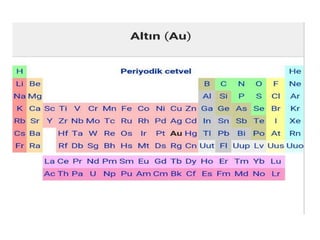
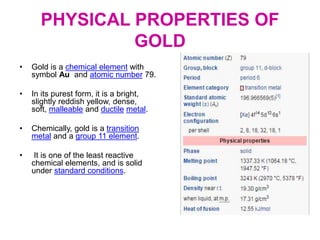
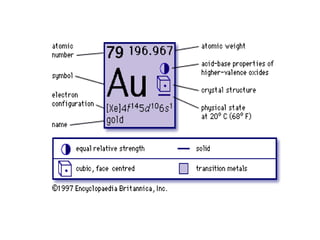
• Gold is a chemical element with
symbol Au and atomic number 79.
• In its purest form, it is a bright,
slightly reddish yellow, dense,
soft, malleable and ductile metal.
• Chemically, gold is a transition
metal and a group 11 element.
• It is one of the least reactive
chemical elements, and is solid
under standard conditions.
PHYSICAL PROPERTIES OF
GOLD
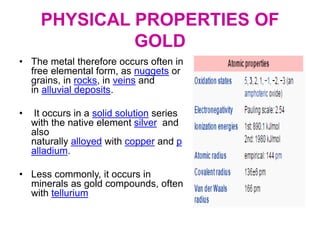
• The metal therefore occurs often in
free elemental form, as nuggets or
grains, in rocks, in veins and
in alluvial deposits.
• It occurs in a solid solution series
with the native element silver and
also
naturally alloyed with copper and p
alladium.
• Less commonly, it occurs in
minerals as gold compounds, often
with tellurium
CHEMICAL PROPERTIES of
GOLD
• Gold resists attacks by individual acids,
but it can be dissolved by aqua regia.
• The acid mixture causes the formation of a
soluble gold tetrachloride anion.
• Gold metal also dissolves
in alkaline solutions of cyanide, which are
used in mining and electroplating.
CHEMICAL PROPERTIES of
GOLD
• It is insoluble in nitric acid, which
dissolves silver and base metals, a
property that has long been used
to refine gold and to confirm the presence
of gold in items, giving rise to the term acid
test; it dissolves in mercury, though,
forming amalgam alloys, but this is not
a chemical reaction.
CHEMICAL PROPERTIES of
GOLD
• Gold is unaffected by oxygen at any
temperature; similarly, it does not react with
ozone. Gold is strongly attacked by fluorine at
dull-red heat to form gold(III) fluoride.
• Gold does not react with sulfur
directly,but gold(III) sulfide can be made by
passing hydrogen sulfide through a dilute
solution of gold(III) chloride or chlorauric acid.
CHEMICAL PROPERTIES of
GOLD
• Gold readily dissolves in mercury at room temperature
to form an amalgam, and forms alloys with many other
metals at higher temperatures. These alloys can be
produced to modify the hardness and other
metallurgical properties, to control melting point or to
create exotic colors
• Common oxidation states of gold include +1and +3
.Gold ions in solution are
readily reduced and precipitated as metal by adding
any other metal as the reducing agent.
• The added metal is oxidized and dissolves, allowing
the gold to be displaced from solution and be
recovered as a solid precipitate
COLOR
• Most pure metals are gray or silvery white, gold is
slightly reddish yellow.
• This color is determined by the density of loosely
bound (valence) electrons; those electrons oscillate as
a collective "plasma" medium described in terms of
a quasiparticle called a plasmon.
• The frequency of these oscillations lies in the
ultraviolet range for most metals, but it falls into the
visible range for gold due to subtle relativistic
effects that affect the orbitals around gold atoms.
• Similar effects impart a golden hue to
metallic caesium.
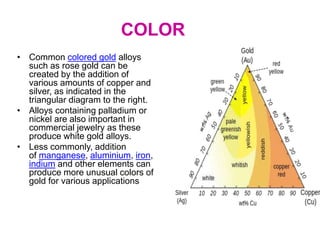
• Common colored gold alloys
such as rose gold can be
created by the addition of
various amounts of copper and
silver, as indicated in the
triangular diagram to the right.
• Alloys containing palladium or
nickel are also important in
commercial jewelry as these
produce white gold alloys.
• Less commonly, addition
of manganese, aluminium, iron,
indium and other elements can
produce more unusual colors of
gold for various applications
COLOR
OCCURRENCE of GOLD
• Many pyrite and pyrhotite minerals contain
gold from which the metal is recovered during
the extraction
of copper, silver, lead, zinc and nickel.
• Although in low concentrations, gold is also
present in the sea water, being conservatively
estimated that the oceans contain 70 million
tons of gold in solution.
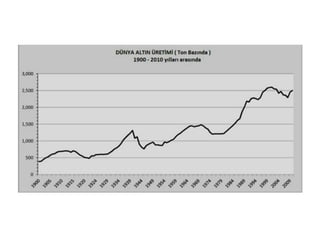
• The major world producers of gold are South
Africa, Canada, the United States and
Australia.
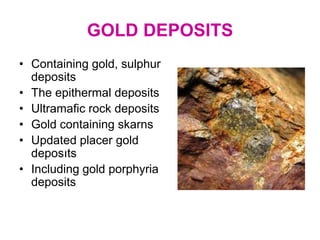
GOLD DEPOSITS
• Containing gold, sulphur
deposits
• The epithermal deposits
• Ultramafic rock deposits
• Gold containing skarns
• Updated placer gold
deposıts
• Including gold porphyria
deposits
USES FOR GOLD
• As a natural element, gold has many special
qualities that make it an important raw material in
a number of scientific applications.
• Besides it’s value to the jewelry, finance,and
refining industries, gold is also prized in:
-Dentistry
-Medicine
-Electronics
-Aerospace
Gold in Dentistry
• Gold is distincly useful to dentistry for two reasons:
-It’s very malleable and easy to work with.
-It’s completely inert to saliva and other body
chemistry
• These qualities make gold a perfect material to
build crowns and bridges that form to the unique
shape of teeth.
• Also, gold dental parts will never corrode and are
not harmful if swallowed.
-That’s why gold teeth are so common.
Gold in Medicine
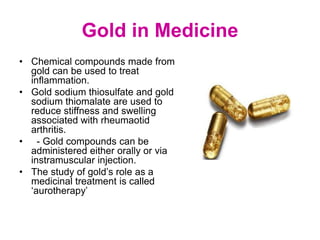
• Chemical compounds made from
gold can be used to treat
inflammation.
• Gold sodium thiosulfate and gold
sodium thiomalate are used to
reduce stiffness and swelling
associated with rheumaotid
arthritis.
• - Gold compounds can be
administered either orally or via
instramuscular injection.
• The study of gold’s role as a
medicinal treatment is called
‘aurotherapy’
Gold in Electronics
• Gold is a top-notch electrical
conductor , so it’s used to
build capacitors and establish
electrical connections.
• -Gold is an important
component in nearly every
electrical device.
• Unlike copper and silver –
which are also prized for their
electrical conductivity- gold
never corrodes.
• -Electronic devices that use
gold tend to last much longer.
Gold in Aerospace
• Gold offers excellent protection
from electromagnetic radiation.
• -Astronaut helmets take
advantage of this protection by
coating the visor with a layer of
gold pounded so thin, it’s see-
through.
• The windshields of jets are also
use a see-through layer of gold
• -An electric current can be
passed through the gold-
infused windshield to instantly
clear away water, fog, and frost.
FOOD AND DRINK
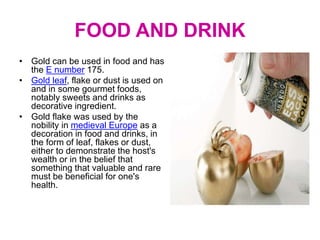
• Gold can be used in food and has
the E number 175.
• Gold leaf, flake or dust is used on
and in some gourmet foods,
notably sweets and drinks as
decorative ingredient.
• Gold flake was used by the
nobility in medieval Europe as a
decoration in food and drinks, in
the form of leaf, flakes or dust,
either to demonstrate the host's
wealth or in the belief that
something that valuable and rare
must be beneficial for one's
health.
FOOD AND DRINK
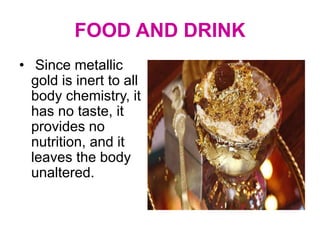
• Since metallic
gold is inert to all
body chemistry, it
has no taste, it
provides no
nutrition, and it
leaves the body
unaltered.
Gold
Gold
Gold
Gold
Gold
Gold

Gold

  • 2.
    DISCOVERED of GOLD •Gold has been known since prehistoric times and was one of the first metals to be worked, mainly because it was to be found as nuggets or as particles in the beds of streams. • Gold artifacts dated to 5000 years ago have been found in Egyptian tombs; gold was already being beaten into sheets, foil and wire in Egypt at this time.
  • 5.
    PHYSICAL PROPERTIES OF GOLD •Gold is a chemical element with symbol Au and atomic number 79. • In its purest form, it is a bright, slightly reddish yellow, dense, soft, malleable and ductile metal. • Chemically, gold is a transition metal and a group 11 element. • It is one of the least reactive chemical elements, and is solid under standard conditions.
  • 6.
    PHYSICAL PROPERTIES OF GOLD •The metal therefore occurs often in free elemental form, as nuggets or grains, in rocks, in veins and in alluvial deposits. • It occurs in a solid solution series with the native element silver and also naturally alloyed with copper and p alladium. • Less commonly, it occurs in minerals as gold compounds, often with tellurium
  • 8.
    CHEMICAL PROPERTIES of GOLD •Gold resists attacks by individual acids, but it can be dissolved by aqua regia. • The acid mixture causes the formation of a soluble gold tetrachloride anion. • Gold metal also dissolves in alkaline solutions of cyanide, which are used in mining and electroplating.
  • 9.
    CHEMICAL PROPERTIES of GOLD •It is insoluble in nitric acid, which dissolves silver and base metals, a property that has long been used to refine gold and to confirm the presence of gold in items, giving rise to the term acid test; it dissolves in mercury, though, forming amalgam alloys, but this is not a chemical reaction.
  • 10.
    CHEMICAL PROPERTIES of GOLD •Gold is unaffected by oxygen at any temperature; similarly, it does not react with ozone. Gold is strongly attacked by fluorine at dull-red heat to form gold(III) fluoride. • Gold does not react with sulfur directly,but gold(III) sulfide can be made by passing hydrogen sulfide through a dilute solution of gold(III) chloride or chlorauric acid.
  • 11.
    CHEMICAL PROPERTIES of GOLD •Gold readily dissolves in mercury at room temperature to form an amalgam, and forms alloys with many other metals at higher temperatures. These alloys can be produced to modify the hardness and other metallurgical properties, to control melting point or to create exotic colors • Common oxidation states of gold include +1and +3 .Gold ions in solution are readily reduced and precipitated as metal by adding any other metal as the reducing agent. • The added metal is oxidized and dissolves, allowing the gold to be displaced from solution and be recovered as a solid precipitate
  • 12.
    COLOR • Most puremetals are gray or silvery white, gold is slightly reddish yellow. • This color is determined by the density of loosely bound (valence) electrons; those electrons oscillate as a collective "plasma" medium described in terms of a quasiparticle called a plasmon. • The frequency of these oscillations lies in the ultraviolet range for most metals, but it falls into the visible range for gold due to subtle relativistic effects that affect the orbitals around gold atoms. • Similar effects impart a golden hue to metallic caesium.
  • 13.
    • Common coloredgold alloys such as rose gold can be created by the addition of various amounts of copper and silver, as indicated in the triangular diagram to the right. • Alloys containing palladium or nickel are also important in commercial jewelry as these produce white gold alloys. • Less commonly, addition of manganese, aluminium, iron, indium and other elements can produce more unusual colors of gold for various applications COLOR
  • 14.
    OCCURRENCE of GOLD •Many pyrite and pyrhotite minerals contain gold from which the metal is recovered during the extraction of copper, silver, lead, zinc and nickel. • Although in low concentrations, gold is also present in the sea water, being conservatively estimated that the oceans contain 70 million tons of gold in solution. • The major world producers of gold are South Africa, Canada, the United States and Australia.
  • 15.
    GOLD DEPOSITS • Containinggold, sulphur deposits • The epithermal deposits • Ultramafic rock deposits • Gold containing skarns • Updated placer gold deposıts • Including gold porphyria deposits
  • 18.
    USES FOR GOLD •As a natural element, gold has many special qualities that make it an important raw material in a number of scientific applications. • Besides it’s value to the jewelry, finance,and refining industries, gold is also prized in: -Dentistry -Medicine -Electronics -Aerospace
  • 19.
    Gold in Dentistry •Gold is distincly useful to dentistry for two reasons: -It’s very malleable and easy to work with. -It’s completely inert to saliva and other body chemistry • These qualities make gold a perfect material to build crowns and bridges that form to the unique shape of teeth. • Also, gold dental parts will never corrode and are not harmful if swallowed. -That’s why gold teeth are so common.
  • 20.
    Gold in Medicine •Chemical compounds made from gold can be used to treat inflammation. • Gold sodium thiosulfate and gold sodium thiomalate are used to reduce stiffness and swelling associated with rheumaotid arthritis. • - Gold compounds can be administered either orally or via instramuscular injection. • The study of gold’s role as a medicinal treatment is called ‘aurotherapy’
  • 21.
    Gold in Electronics •Gold is a top-notch electrical conductor , so it’s used to build capacitors and establish electrical connections. • -Gold is an important component in nearly every electrical device. • Unlike copper and silver – which are also prized for their electrical conductivity- gold never corrodes. • -Electronic devices that use gold tend to last much longer.
  • 22.
    Gold in Aerospace •Gold offers excellent protection from electromagnetic radiation. • -Astronaut helmets take advantage of this protection by coating the visor with a layer of gold pounded so thin, it’s see- through. • The windshields of jets are also use a see-through layer of gold • -An electric current can be passed through the gold- infused windshield to instantly clear away water, fog, and frost.
  • 23.
    FOOD AND DRINK •Gold can be used in food and has the E number 175. • Gold leaf, flake or dust is used on and in some gourmet foods, notably sweets and drinks as decorative ingredient. • Gold flake was used by the nobility in medieval Europe as a decoration in food and drinks, in the form of leaf, flakes or dust, either to demonstrate the host's wealth or in the belief that something that valuable and rare must be beneficial for one's health.
  • 24.
    FOOD AND DRINK •Since metallic gold is inert to all body chemistry, it has no taste, it provides no nutrition, and it leaves the body unaltered.