General Packet Radio Service (GPRS)  A new Dimension to Wireless Communication
Contents of Presentation GPRS and its Features GPRS Network Architecture  GPRS Protocol Architecture GPRS Backbone Network GPRS interworking with External Network Call routing in GPRS Session Management in GPRS Location Management in GPRS Mobility Management in GPRS Logical Channels of GPRS GPRS Applications
Constraints with existing network Data Rates too slow – about 9.6 kbps Connection setup time too long  Inefficient resource utilization for bursty traffic Proves expensive for bursty traffic utilization No efficient method for packet transfers
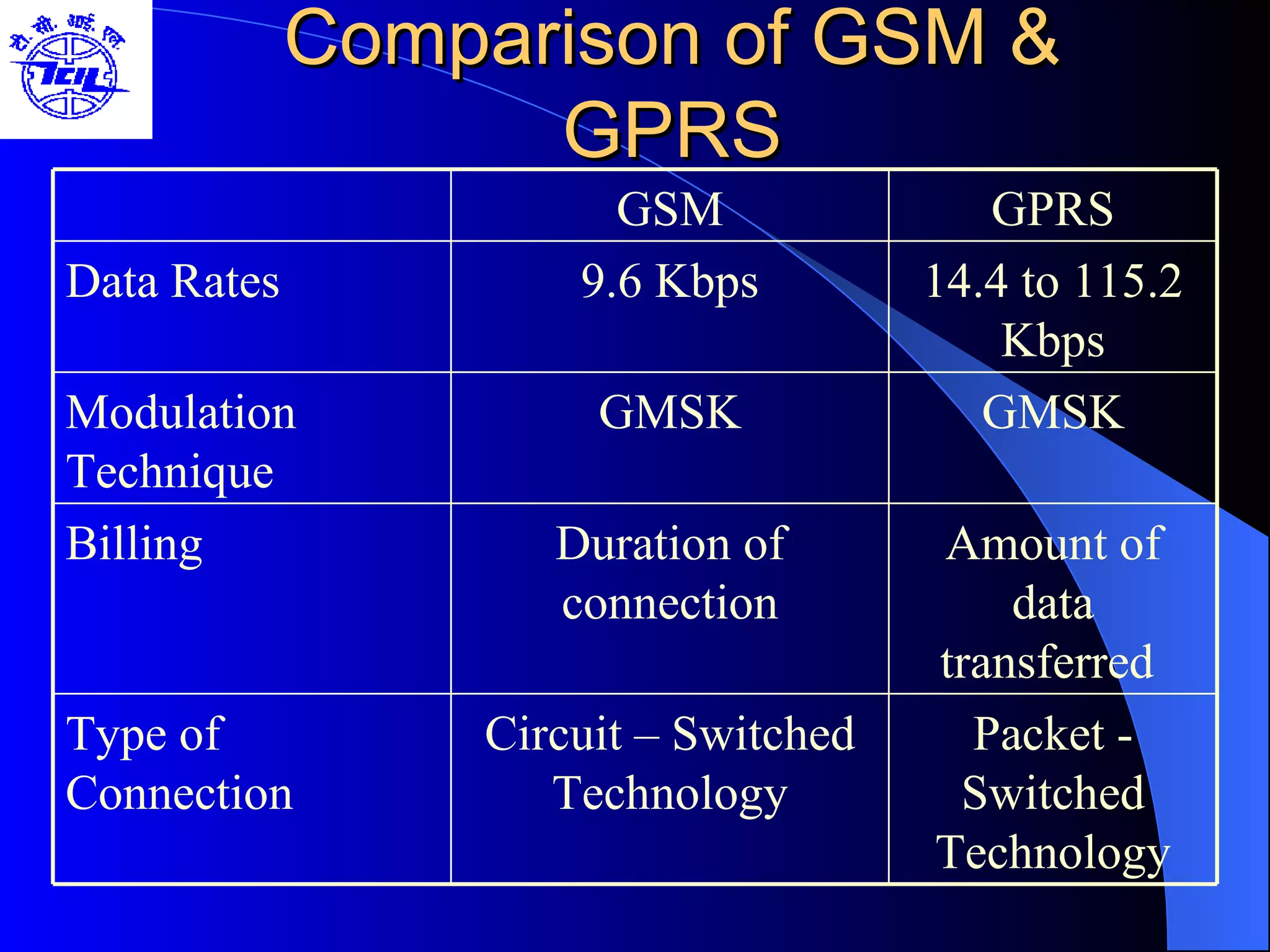
Comparison of GSM & GPRS Amount of data transferred  Duration of connection Billing  Packet - Switched Technology Circuit – Switched Technology Type of Connection GMSK GMSK Modulation Technique 14.4 to 115.2 Kbps 9.6 Kbps Data Rates GPRS GSM
GPRS in INDIA BPL Mobile Bharti Cellular Hutchison Max Hutchison Essar Idea Cellular
What is GPRS ? General Packet Radio Service (GPRS) is a new bearer service for GSM that greatly improves and simplifies wireless access to packet data networks GPRS applies packet radio principal to transfer user data packets in an efficient way b/w MS & external packet data network
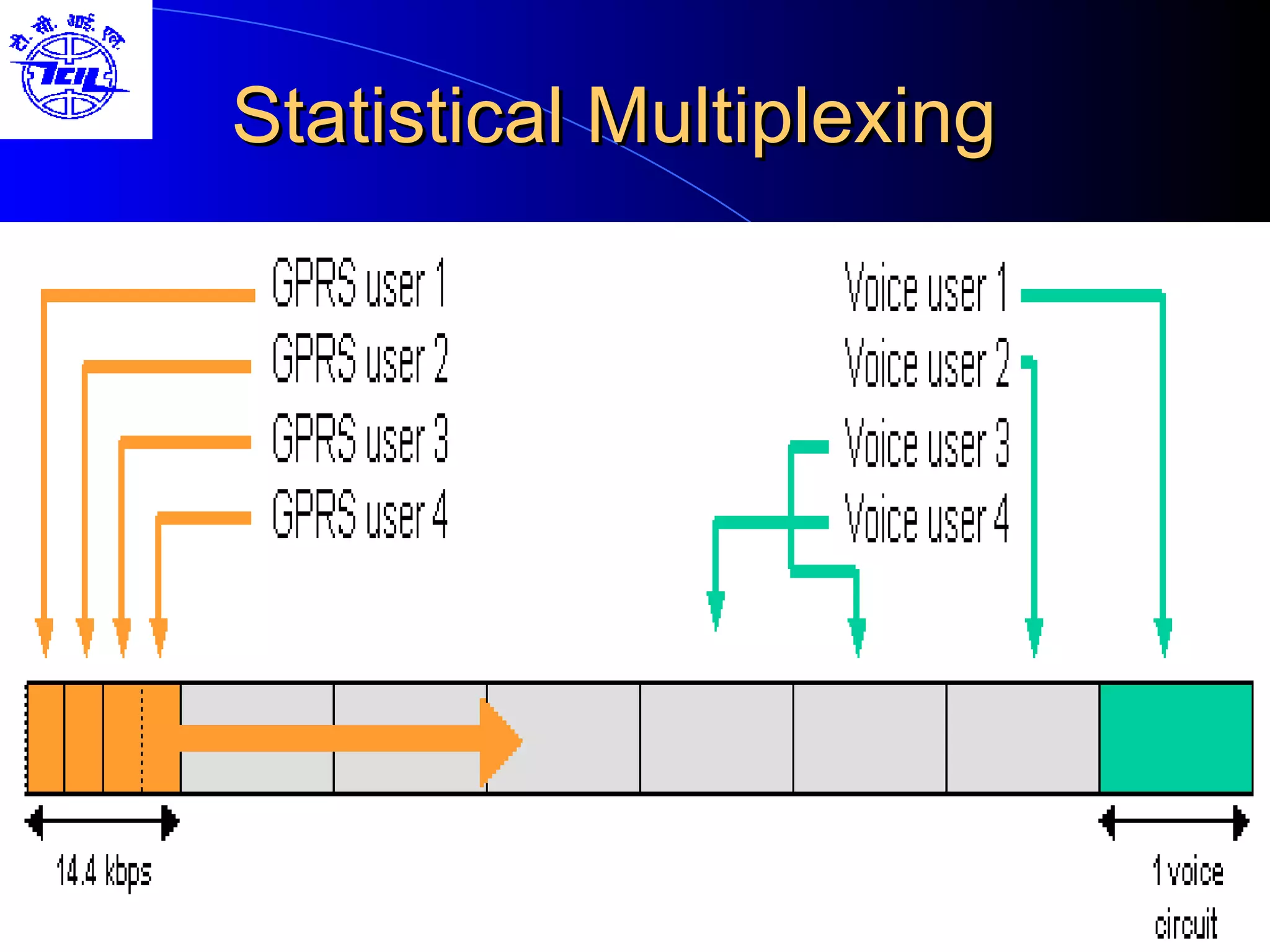
Benefits of GPRS New Data Services High Speed (Data Rate 14.4 – 115 kbps) Efficient use of radio bandwith (Statistical Multiplexing)  Circuit switching & Packet Switching can be used in parallel Constant connectivity
Statistical Multiplexing
Salient Features of GPRS Important step on the path to 3G Standardized by ETSI  GPRS is an overlay network over the GSM Provides Data Packet delivery service Support for leading internet communication protocols  Billing based on volume of data transferred  Utilizes existing GSM authentication and privacy procedures.
High Data Rate GPRS uses radio channel i.e. 200 kHz wide Radio channel carries digital data stream of 271 kbps This rate is divided into 8 time slots each carrying 34 kbps per time slot Data rate 14 kbps per time slot achieved after corrections GPRS can combine upto 8 time slots giving data rate of 114 kbps
GPRS Services Offers end-to-end packet switched data transfer Bearer Services PTP  - Point-To-Point service (CLNS mode) PTM - Point-To-Multipoint service(CONS Mode) PTM-M Multicast service PTM-G Group call service  Supplementary Services   SMS Short Message Service CFU Call Forwarding Unconditional
GPRS Services (Contd.) CFNRc  Call Forwarding on mobile subscriber    not reachable CUG  Closed User Group Tele action, access to data bases Quality of Service GPRS allows defining QoS profiles Service precedence, reliability, delay,throughput
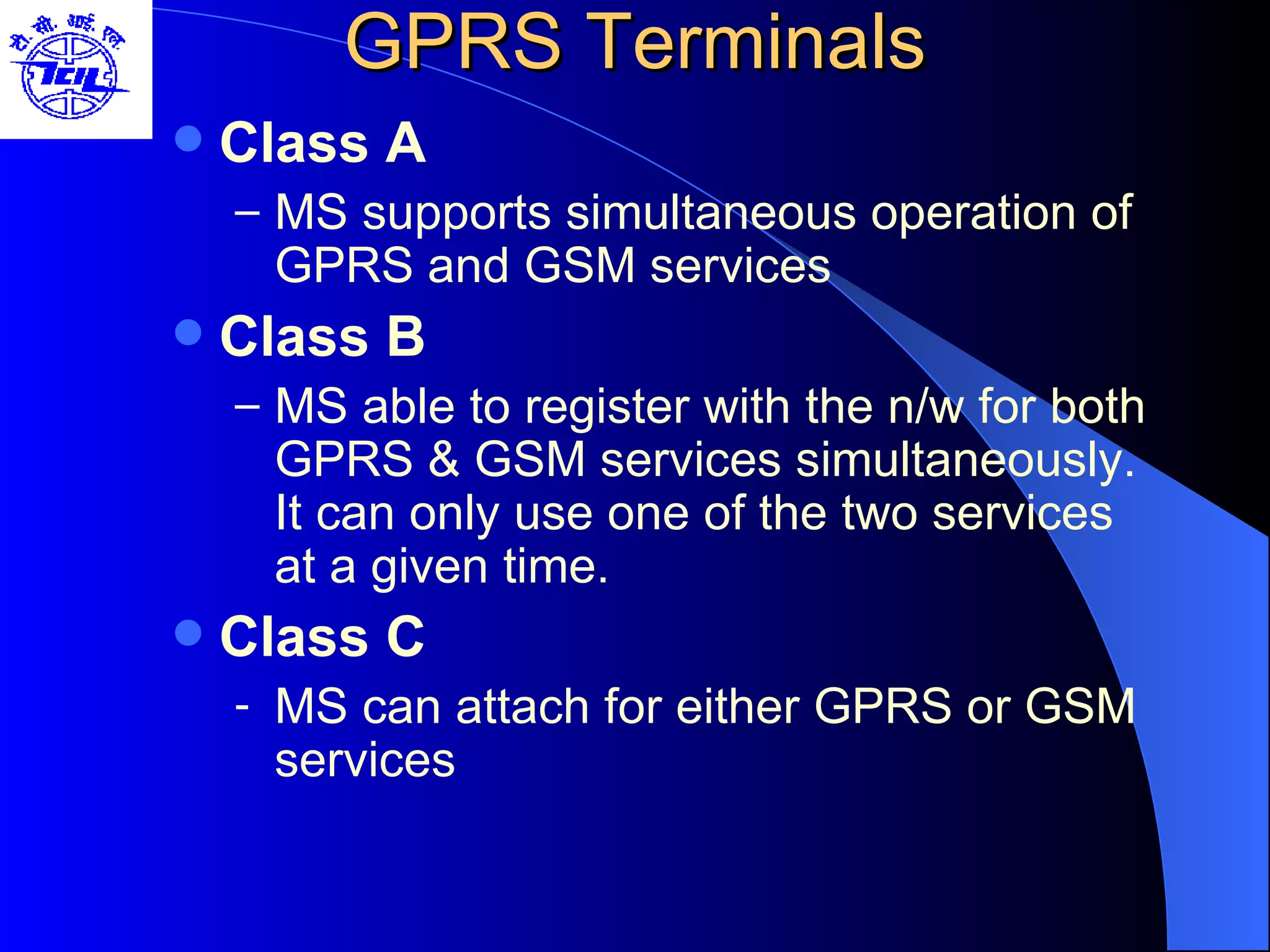
GPRS Terminals   Class A MS supports simultaneous operation of GPRS and GSM services Class B MS able to register with the n/w for both GPRS & GSM services simultaneously. It can only use one of the two services at a given time. Class C MS can attach for either GPRS or GSM services
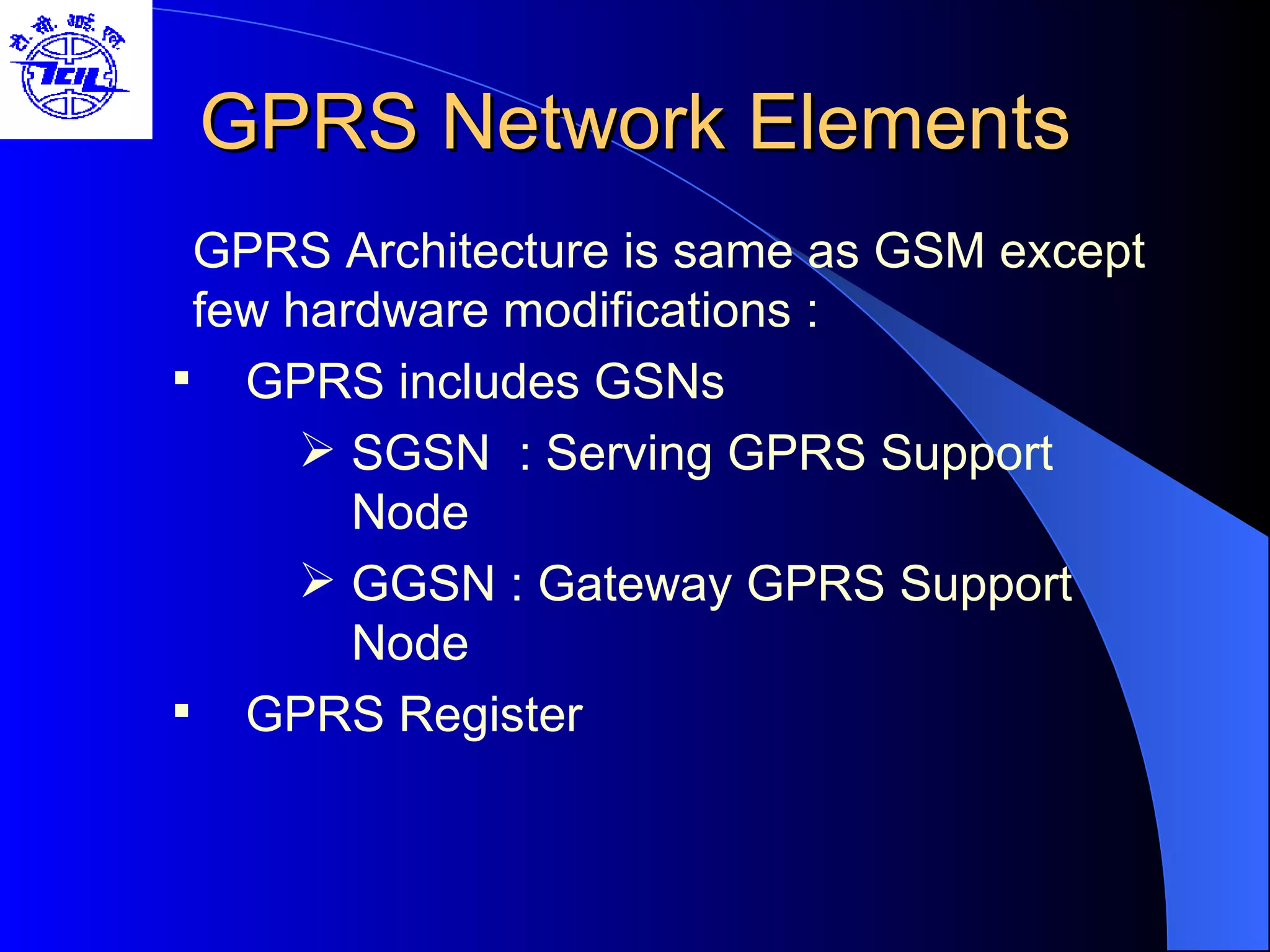
GPRS Network Elements GPRS Architecture is same as GSM except few hardware modifications : GPRS includes GSNs SGSN  : Serving GPRS Support Node GGSN : Gateway GPRS Support Node GPRS Register
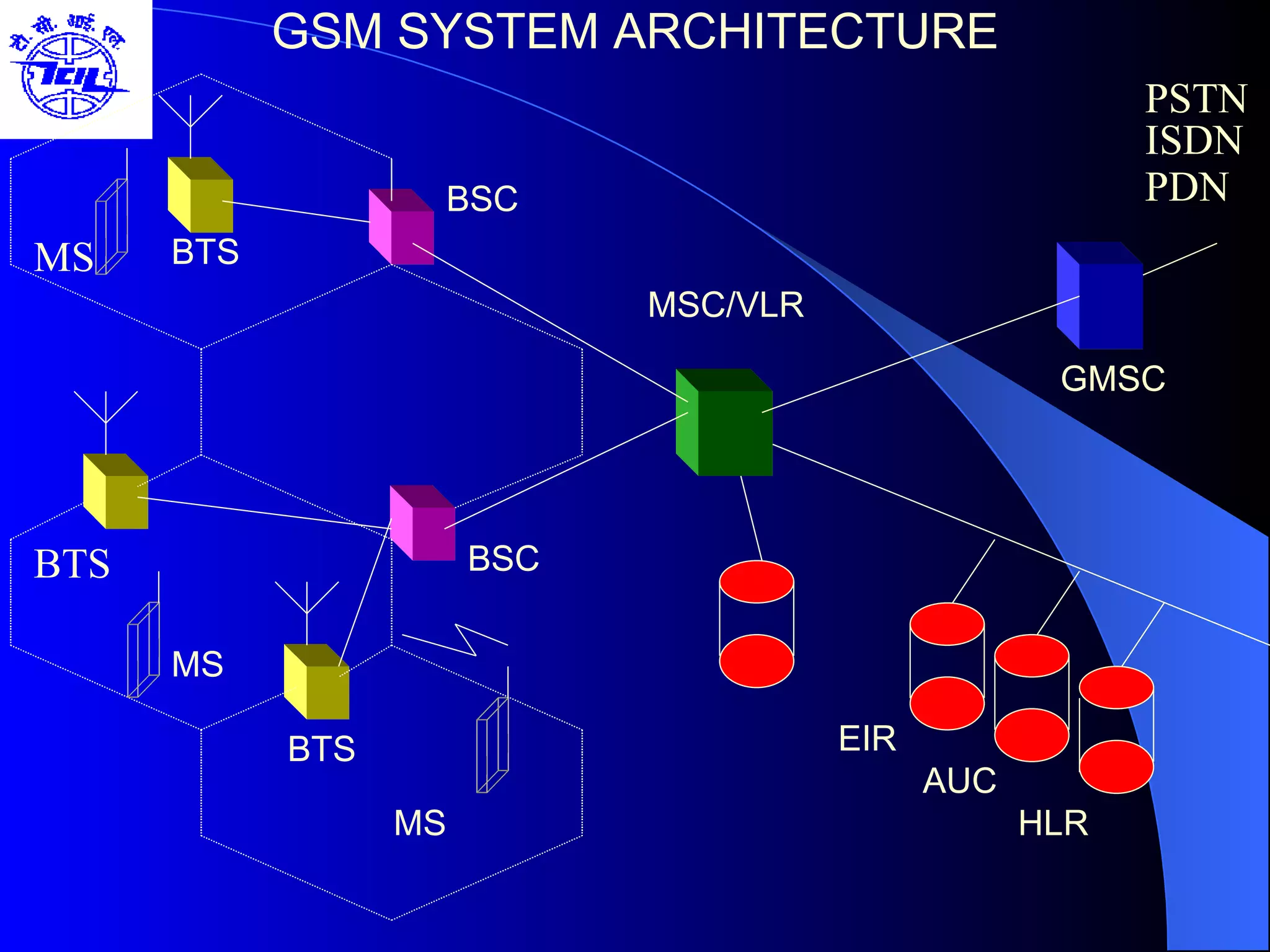
GSM SYSTEM ARCHITECTURE MS BTS PSTN ISDN PDN BSC BSC MSC/VLR MS MS BTS BTS GMSC EIR AUC HLR
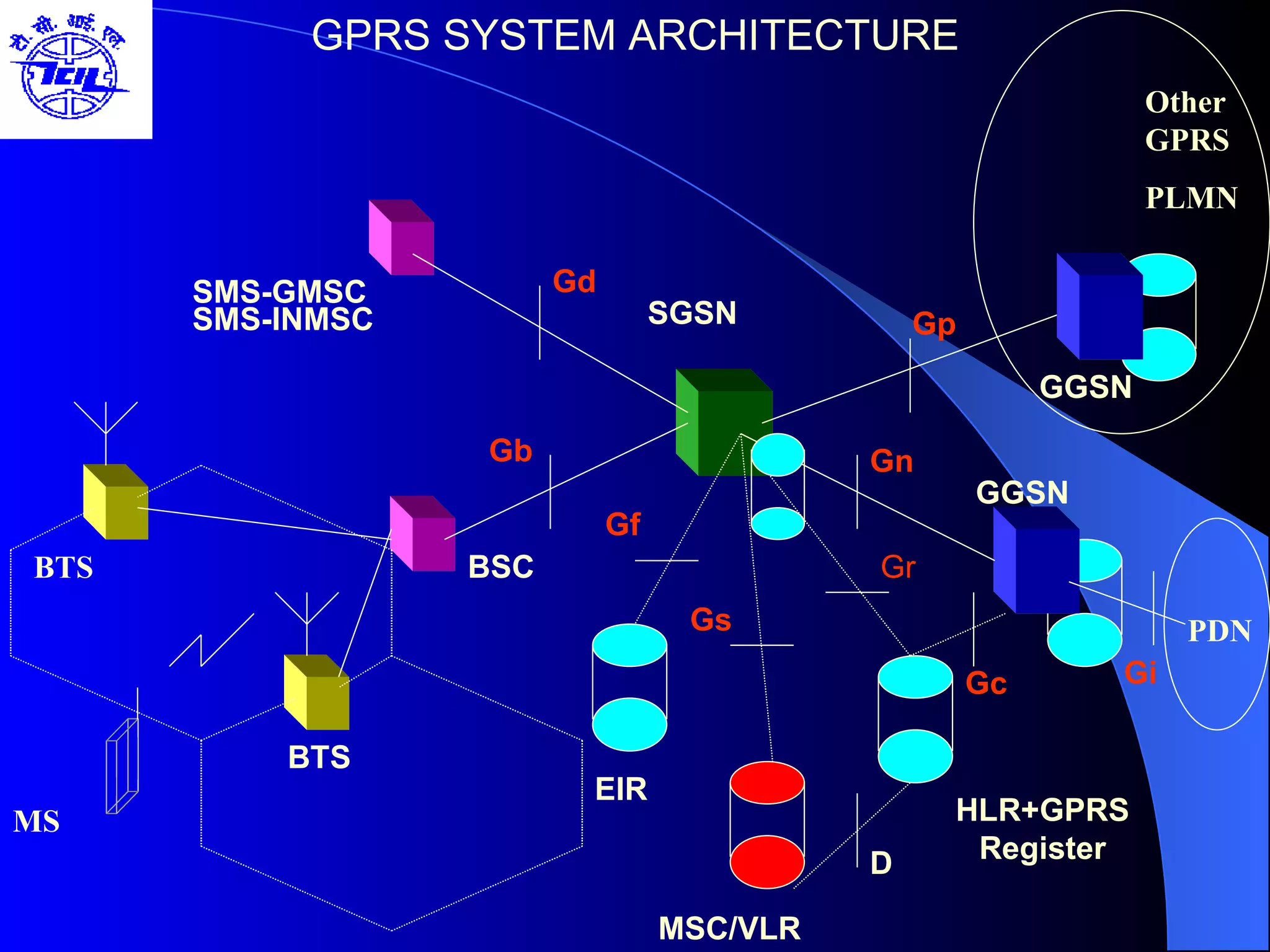
GPRS SYSTEM ARCHITECTURE BSC SGSN MS BTS BTS Other GPRS PLMN GGSN PDN Gb Gd Gp Gn Gf Gs Gc GGSN EIR HLR+GPRS Register MSC/VLR D SMS-GMSC SMS-INMSC Gi Gr
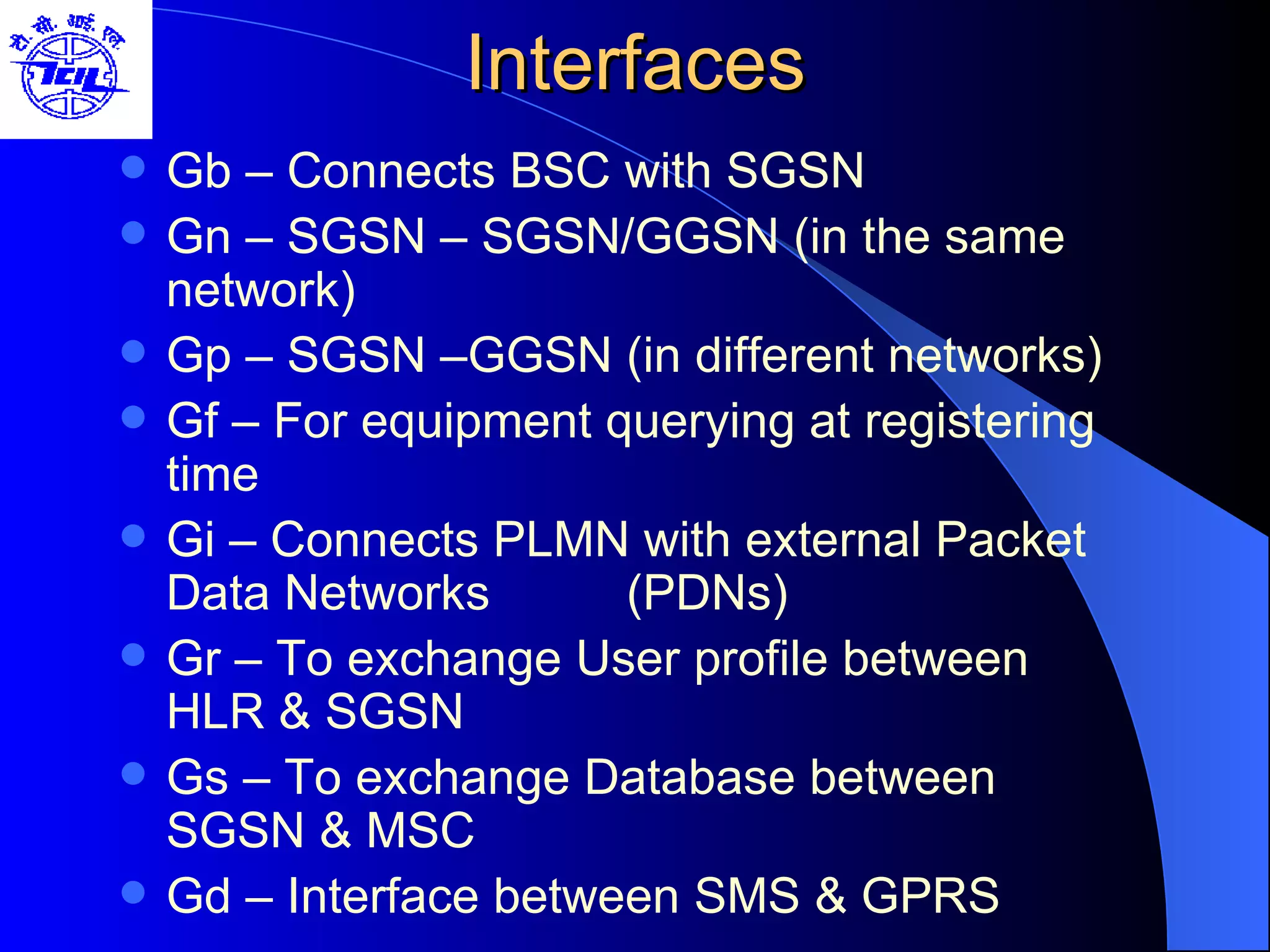
Interfaces Gb – Connects BSC with SGSN Gn – SGSN – SGSN/GGSN (in the same network) Gp – SGSN –GGSN (in different networks) Gf – For equipment querying at registering time Gi – Connects PLMN with external Packet Data Networks  (PDNs) Gr – To exchange User profile between HLR & SGSN Gs – To exchange Database between SGSN & MSC Gd – Interface between SMS & GPRS
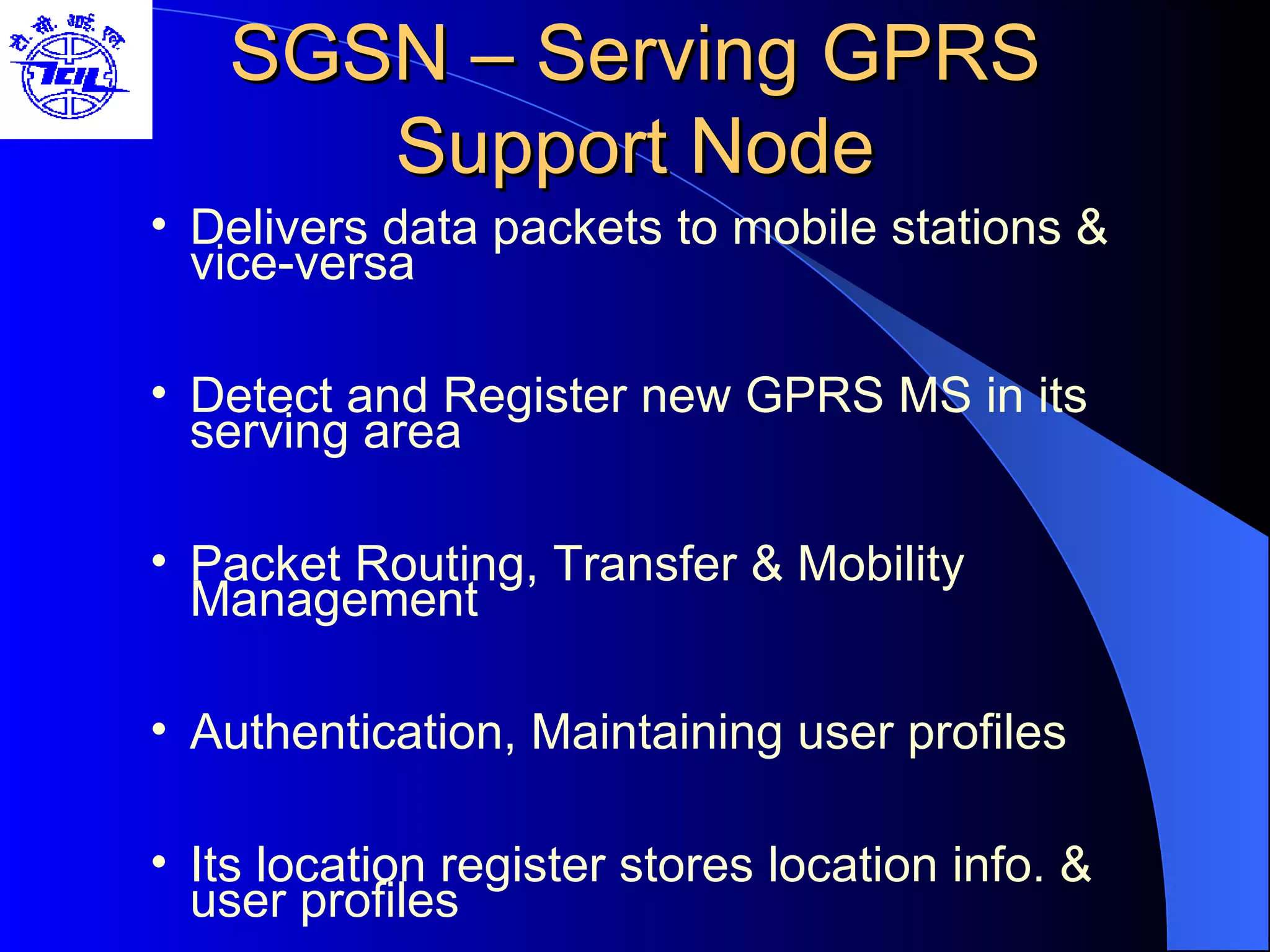
SGSN – Serving GPRS Support Node Delivers data packets to mobile stations & vice-versa Detect and Register new GPRS MS in its serving area Packet Routing, Transfer & Mobility Management Authentication, Maintaining user profiles Its location register stores location info. & user profiles
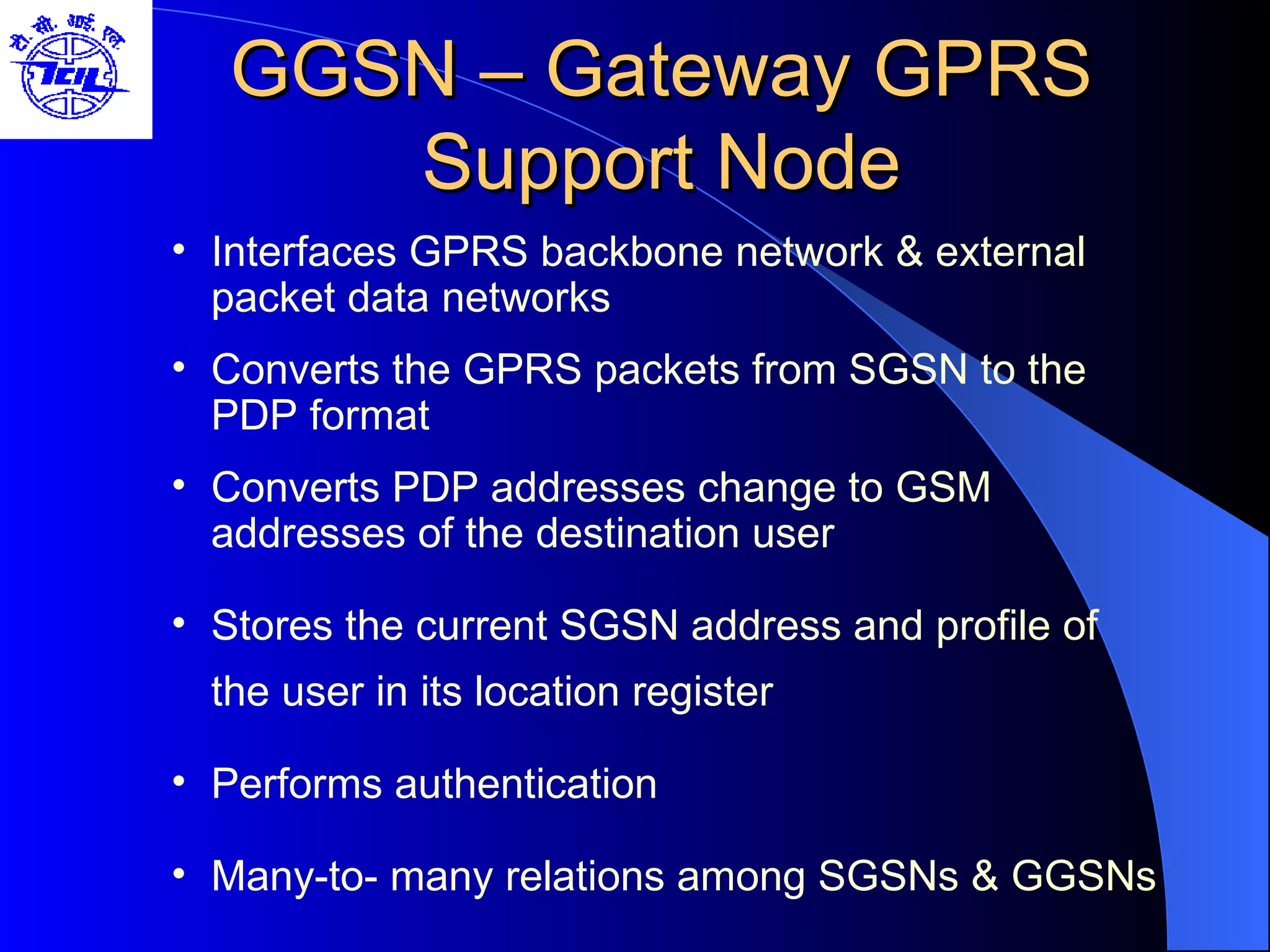
GGSN – Gateway GPRS Support Node Interfaces GPRS backbone network & external packet data networks Converts the GPRS packets from SGSN to the PDP format Converts PDP addresses change to GSM addresses of the destination user Stores the current SGSN address and profile of the user in its location register Performs authentication Many-to- many relations among SGSNs & GGSNs
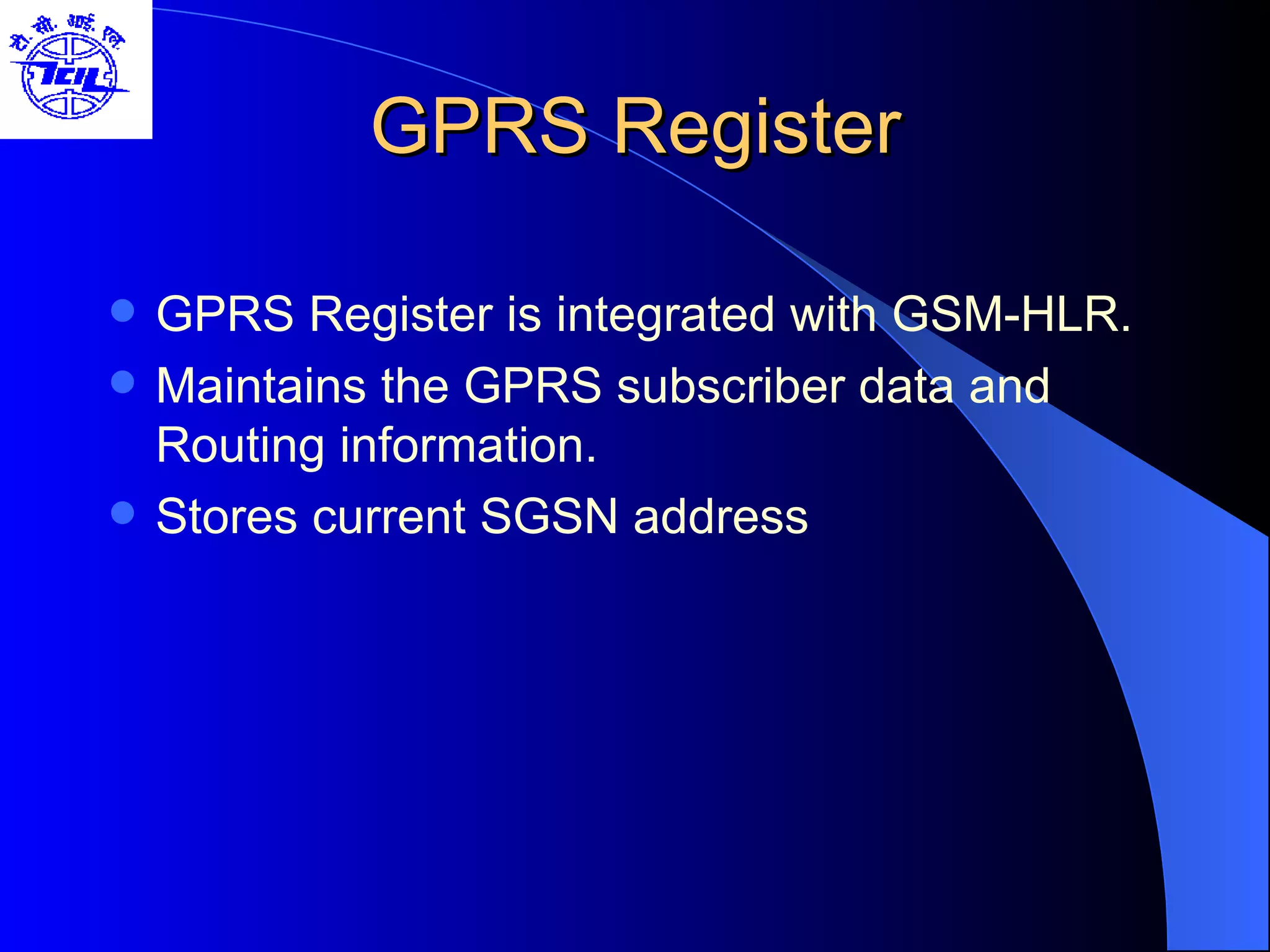
GPRS Register GPRS Register is integrated with GSM-HLR. Maintains the GPRS subscriber data and Routing information. Stores current SGSN address
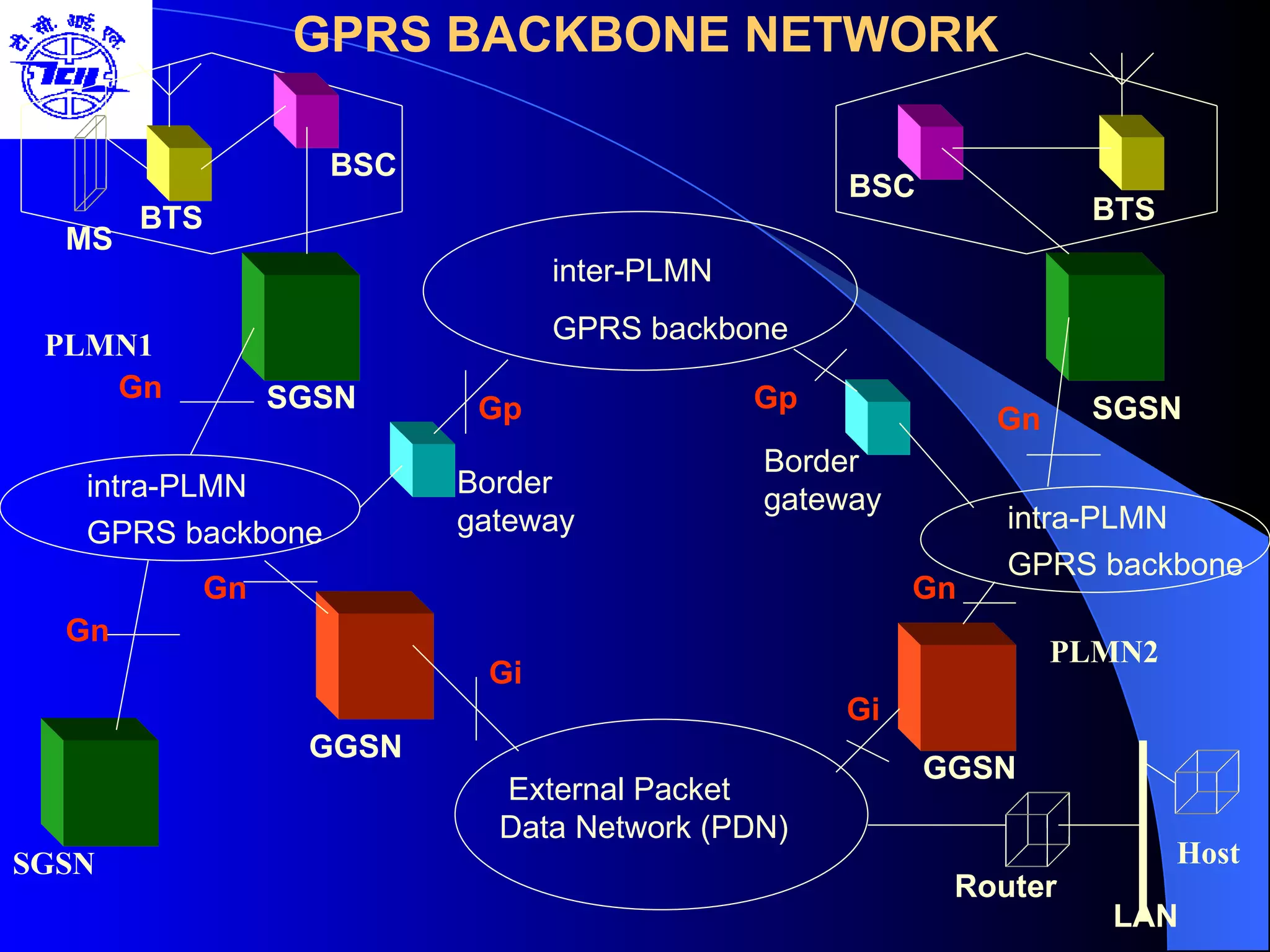
GPRS Backbone Network  GSNs are connected through IP based backbone Two Backbones: Intra PLMN backbone networks that connects GSNs of the same PLMN & are private IP networks Inter PLMN backbone networks that connects GSNs of the different PLMN. Roaming agreement is necessary  GPRS Tunneling protocol (GTP) PLMN- Inter PLMN interconnect are called Border gateways (performs security functions to protect Intra- PLMN backbone against unauthorized users and attacks).
GPRS BACKBONE NETWORK inter-PLMN GPRS backbone External Packet Data Network (PDN) intra-PLMN GPRS backbone intra-PLMN GPRS backbone PLMN1 PLMN2 SGSN SGSN SGSN GGSN GGSN Border gateway Border gateway Gp Gn Gi Gn Gn BTS BTS BSC BSC Host Router  LAN   MS Gi Gn Gn Gp
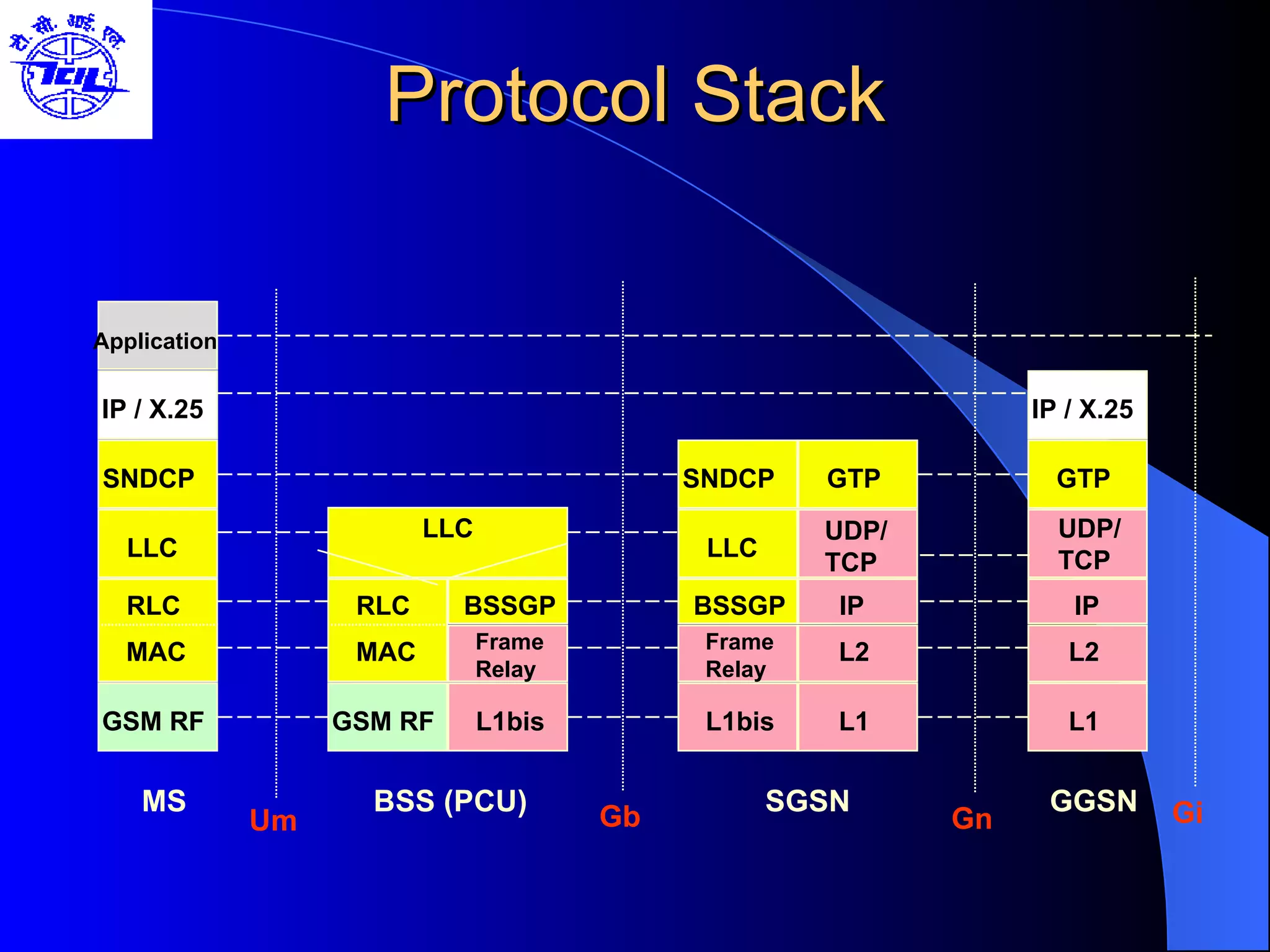
Protocol Stack GSM RF SNDCP IP / X.25 Application Um Gn Gb MAC RLC LLC IP / X.25 GTP L1 L2 LLC GSM RF Frame Relay MAC RLC BSSGP L1bis BSSGP Frame Relay LLC SNDCP GTP L1bis L1 L2 IP MS BSS (PCU) SGSN GGSN Gi IP UDP/ TCP UDP/ TCP
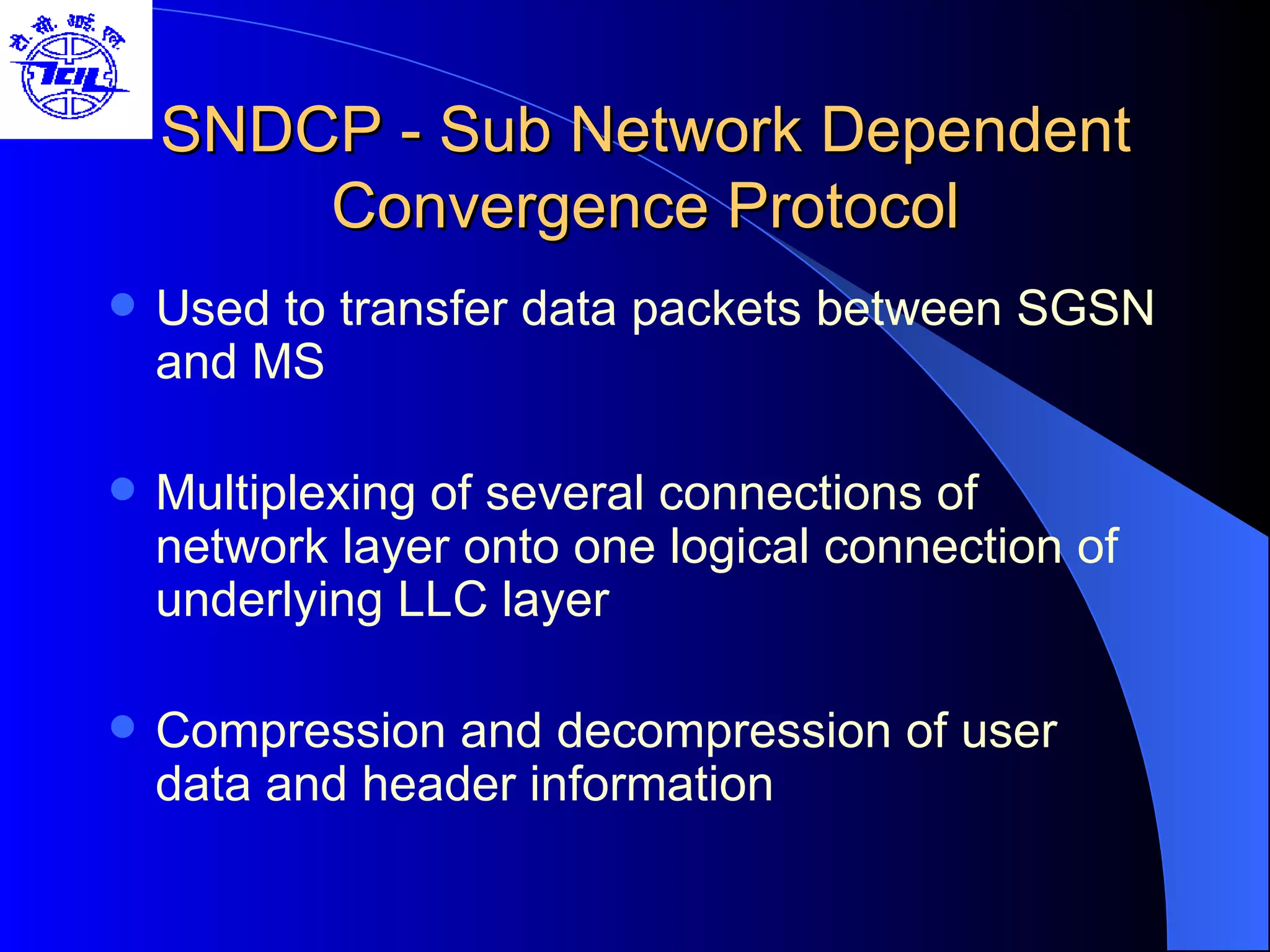
SNDCP - Sub Network Dependent Convergence Protocol Used to transfer data packets between SGSN and MS Multiplexing of several connections of network layer onto one logical connection of underlying LLC layer Compression and decompression of user data and header information
Data Link layer Divided into two sub layers : LLC layer (between MS-SGSN) RLC/MAC (between MS-BSS)
LLC-Logical Link Control Establishes highly reliable logical link between MS & its assigned SGSN Works either in acknowledged or unacknowledged modes Data confidentiality is ensured by ciphering functions
RLC/MAC Layer Radio Link Control(RLC) Establish a reliable link between MS & BSS Segmentation and reassembly of LLC frames into RLC data blocks Medium Access Control(MAC) Controls access attempts of an MS on radio channels shared by several MSs Employs algos. for contention resolution, multiuser multiplexing on PDTCH Both ack and unack. Modes of operation are supported in RLC/MAC layer
Physical Layer Divided into two sub layers : Physical Link Layer (PLL) Physical RF Layer (RFL) PLL – Provides a physical channel between MS and BSS Channel coding, interleaving, detection of physical link congestion RFL - Operates below PLL
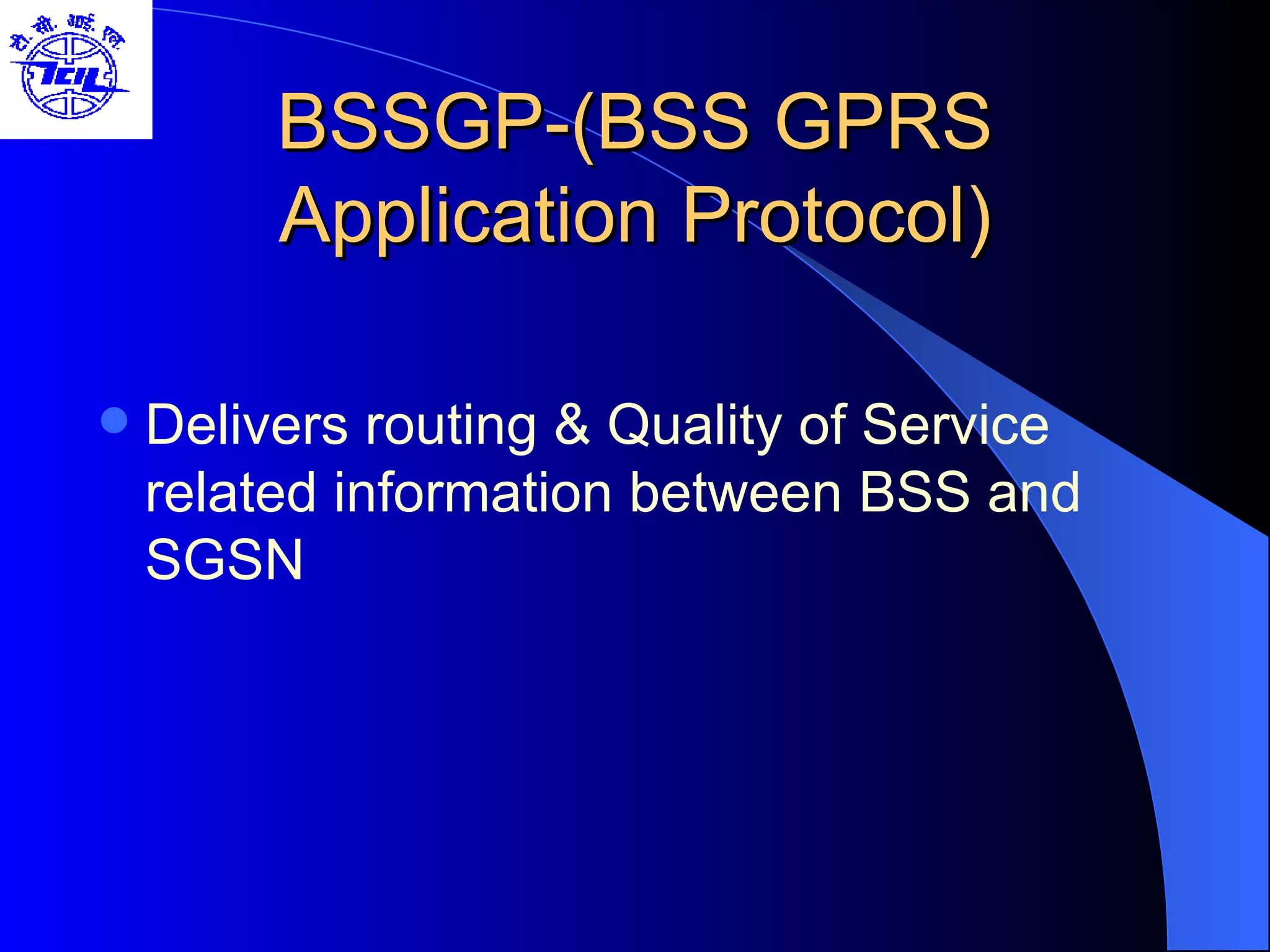
BSSGP-(BSS GPRS Application Protocol) Delivers routing & Quality of Service related information between BSS and SGSN
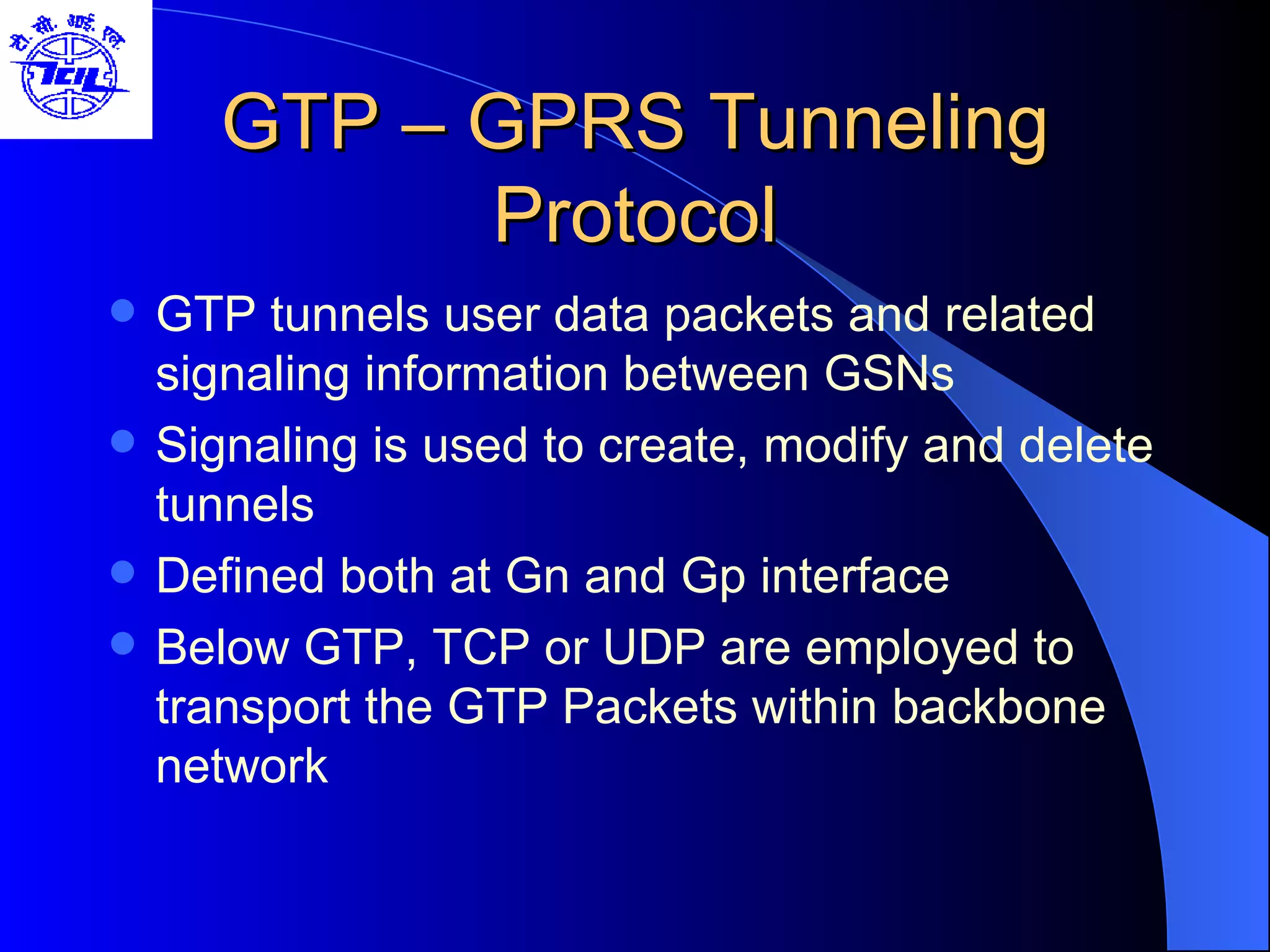
GTP – GPRS Tunneling Protocol GTP tunnels user data packets and related signaling information between GSNs Signaling is used to create, modify and delete tunnels Defined both at Gn and Gp interface Below GTP, TCP or UDP are employed to transport the GTP Packets within backbone network
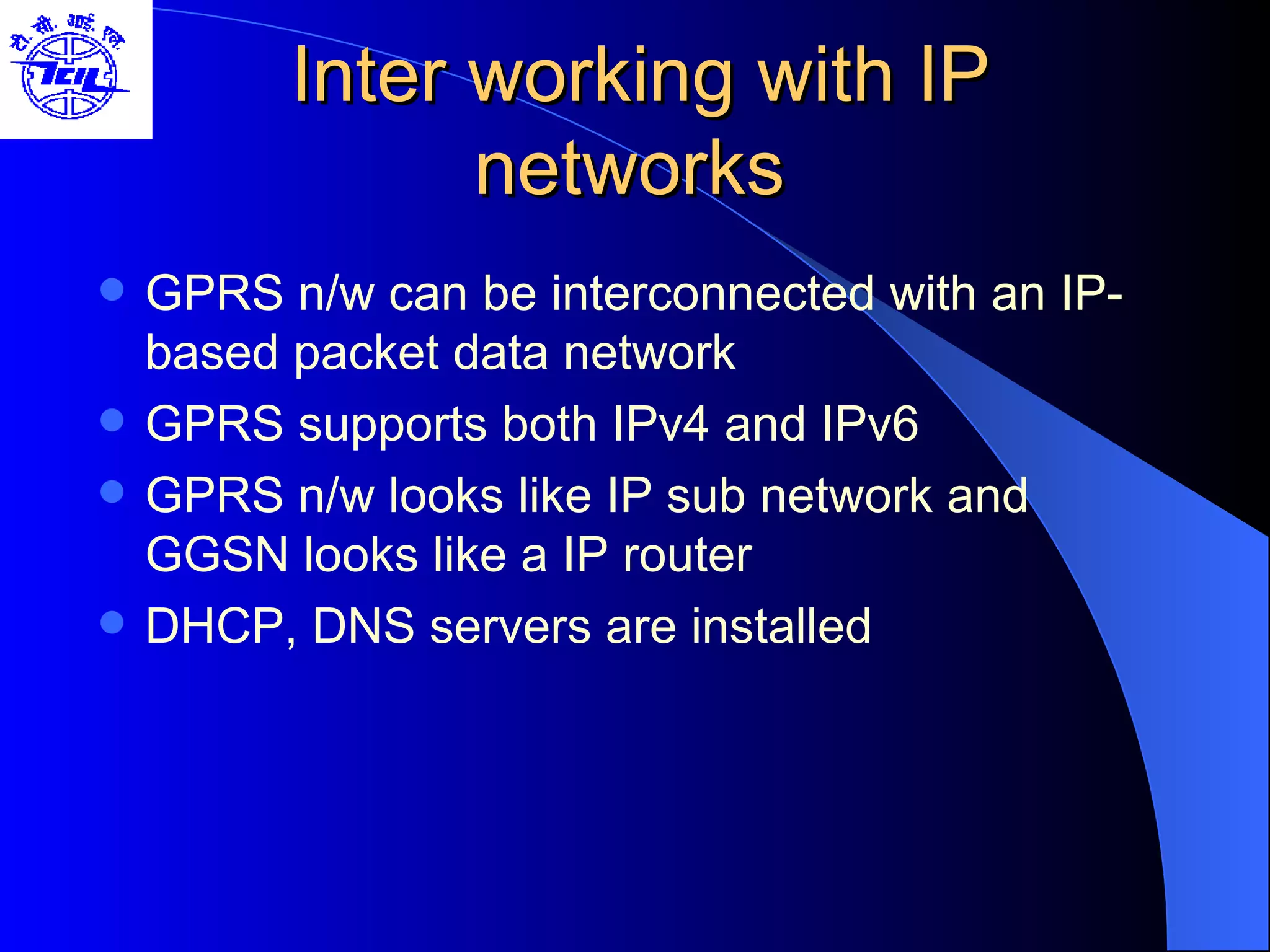
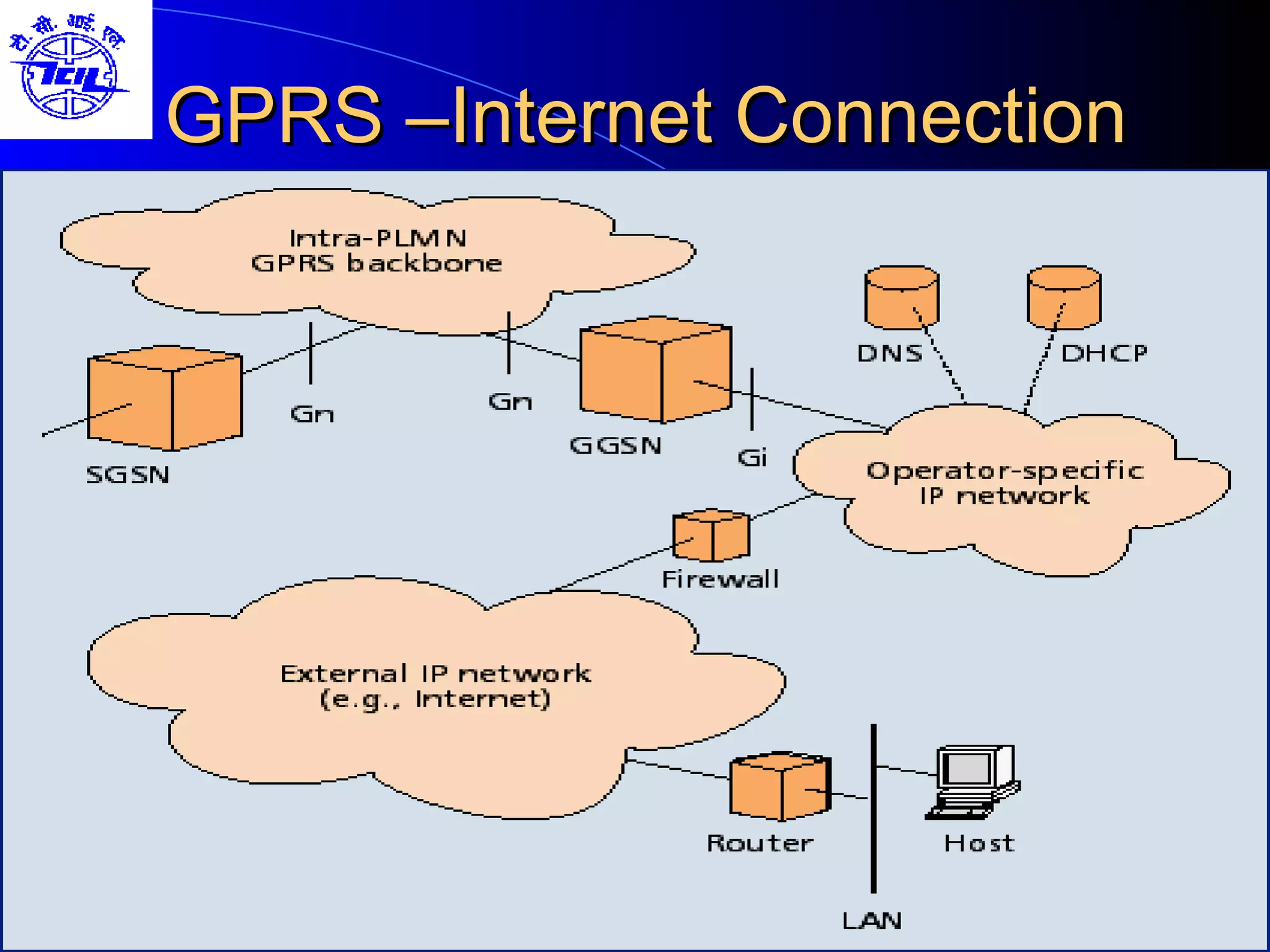
Inter working with IP networks  GPRS n/w can be interconnected with an IP-based packet data network GPRS supports both IPv4 and IPv6  GPRS n/w looks like IP sub network and GGSN looks like a IP router DHCP, DNS servers are installed
GPRS –Internet Connection
CALL ROUTING DATA CALL ORGINATING DATA CALL TERMINATING
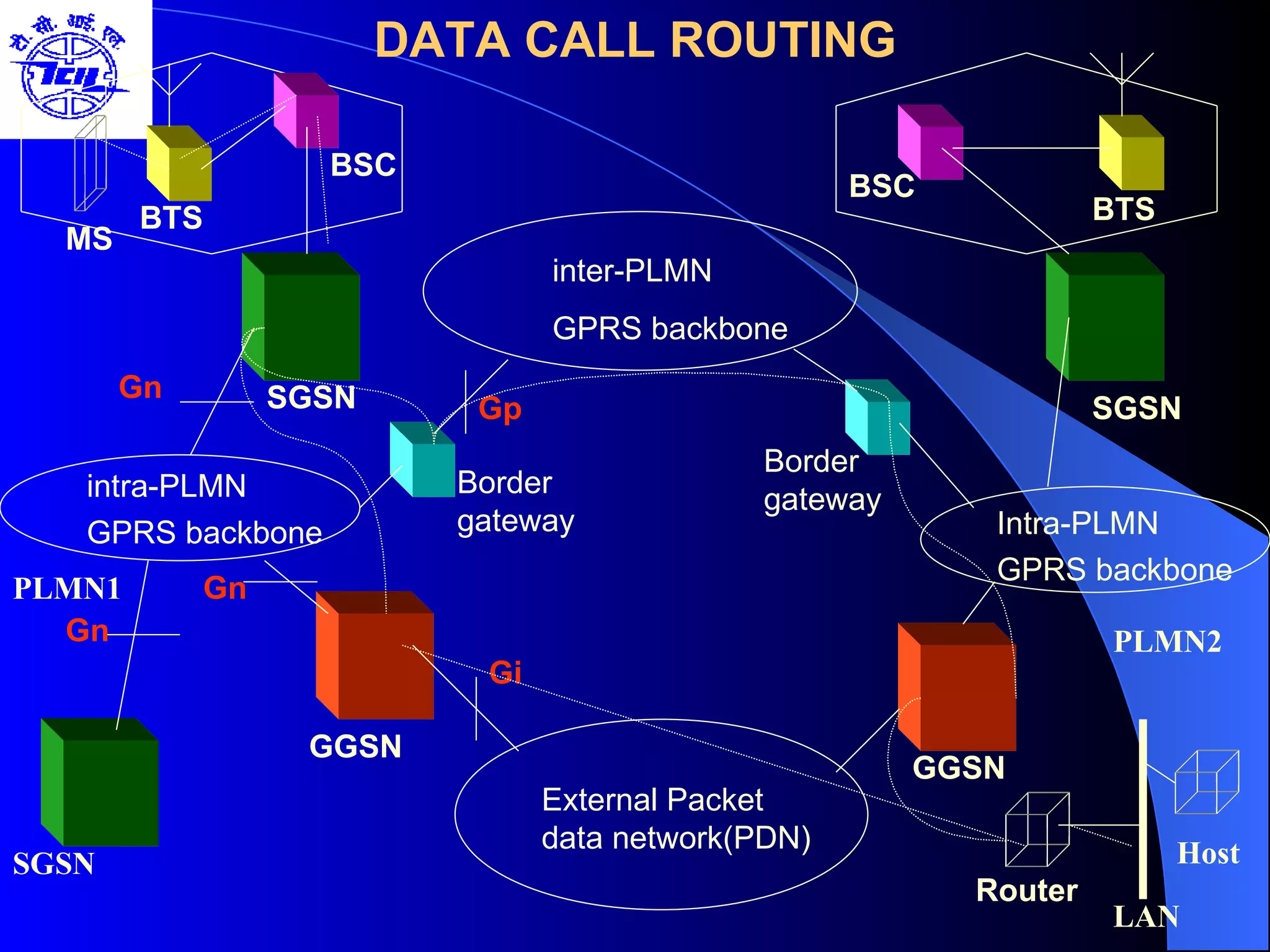
DATA CALL ROUTING inter-PLMN GPRS backbone External Packet data network(PDN) Intra-PLMN GPRS backbone intra-PLMN GPRS backbone PLMN1 PLMN2 SGSN SGSN SGSN GGSN GGSN Border gateway Border gateway Gp Gn Gi Gn Gn BTS BTS BSC BSC Host Router  LAN   MS
SESSION  MANAGEMENT IN GPRS
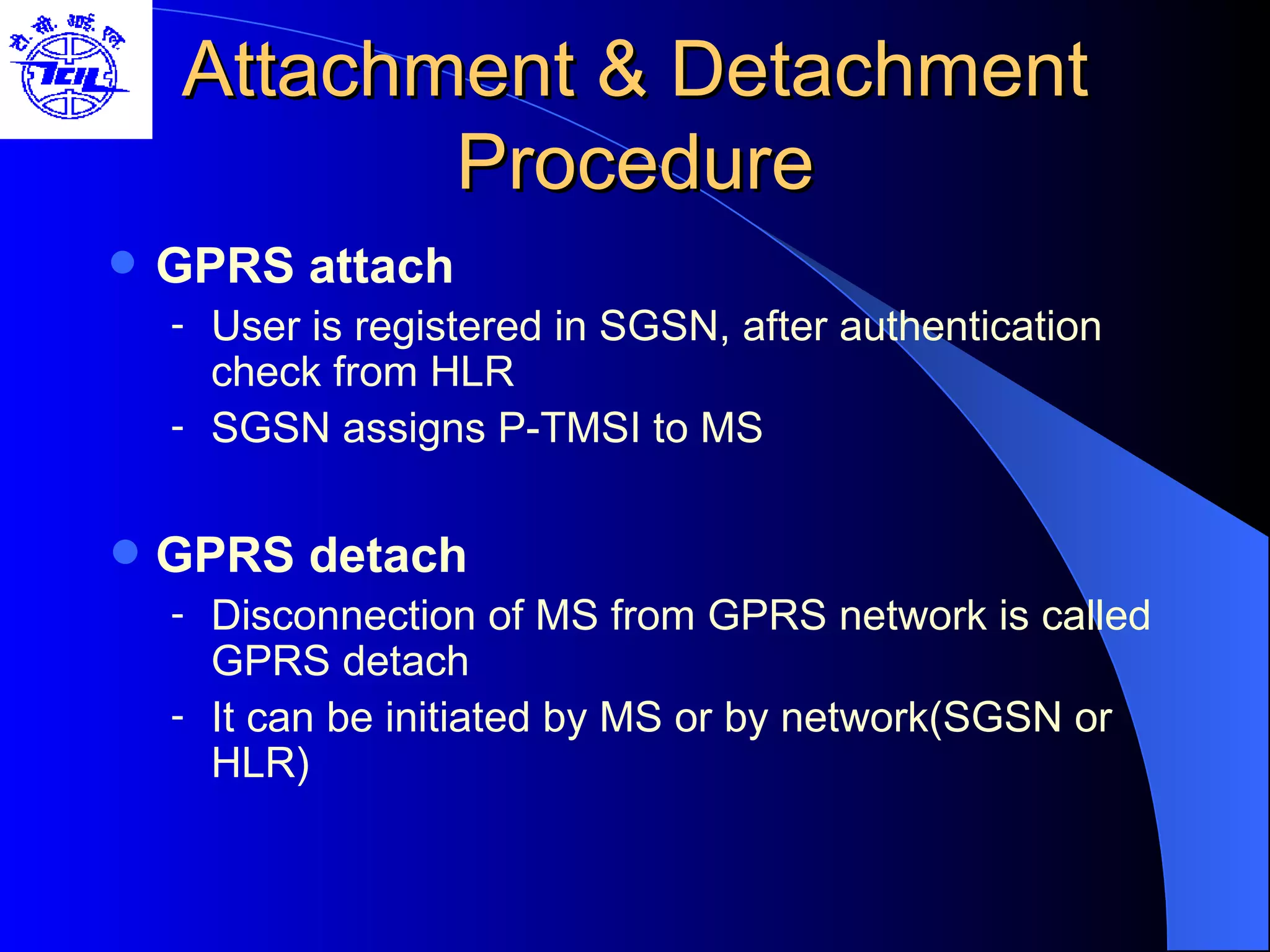
Attachment & Detachment Procedure GPRS attach User is registered in SGSN, after authentication check from HLR SGSN assigns P-TMSI to MS GPRS detach Disconnection of MS from GPRS network is called GPRS detach It can be initiated by MS or by network(SGSN or HLR)
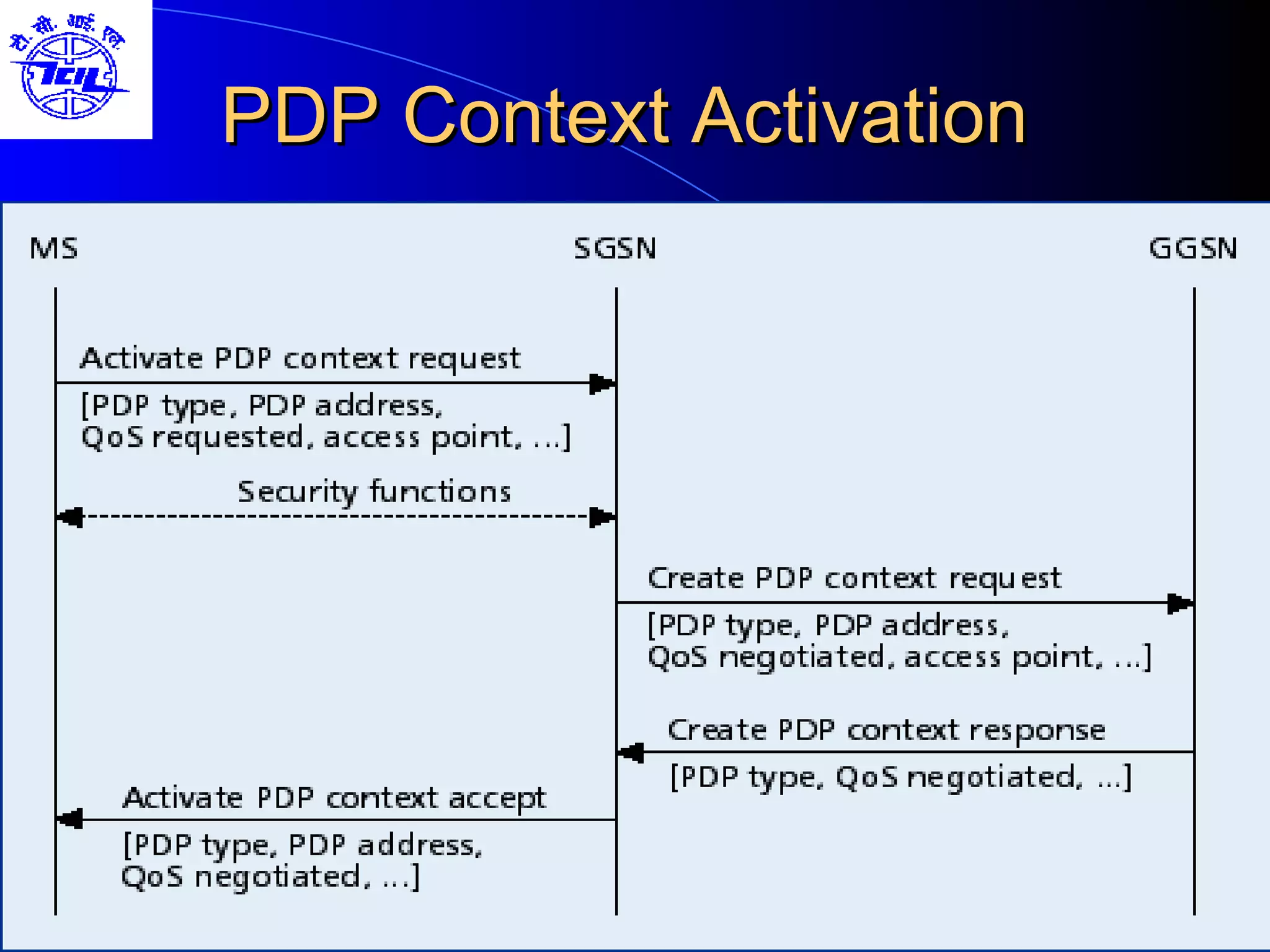
Session Management Mobile Station applies for PDP address For each session  PDP context  is created & it contains  PDP type PDP addressed assigned to MS Address of GGSN that servers access point   to PDN With active PDP context MS  able to send or receive data packets Allocation of PDP address can be static or dynamic
PDP Context Activation
LOCATION MANAGEMENT IN GPRS
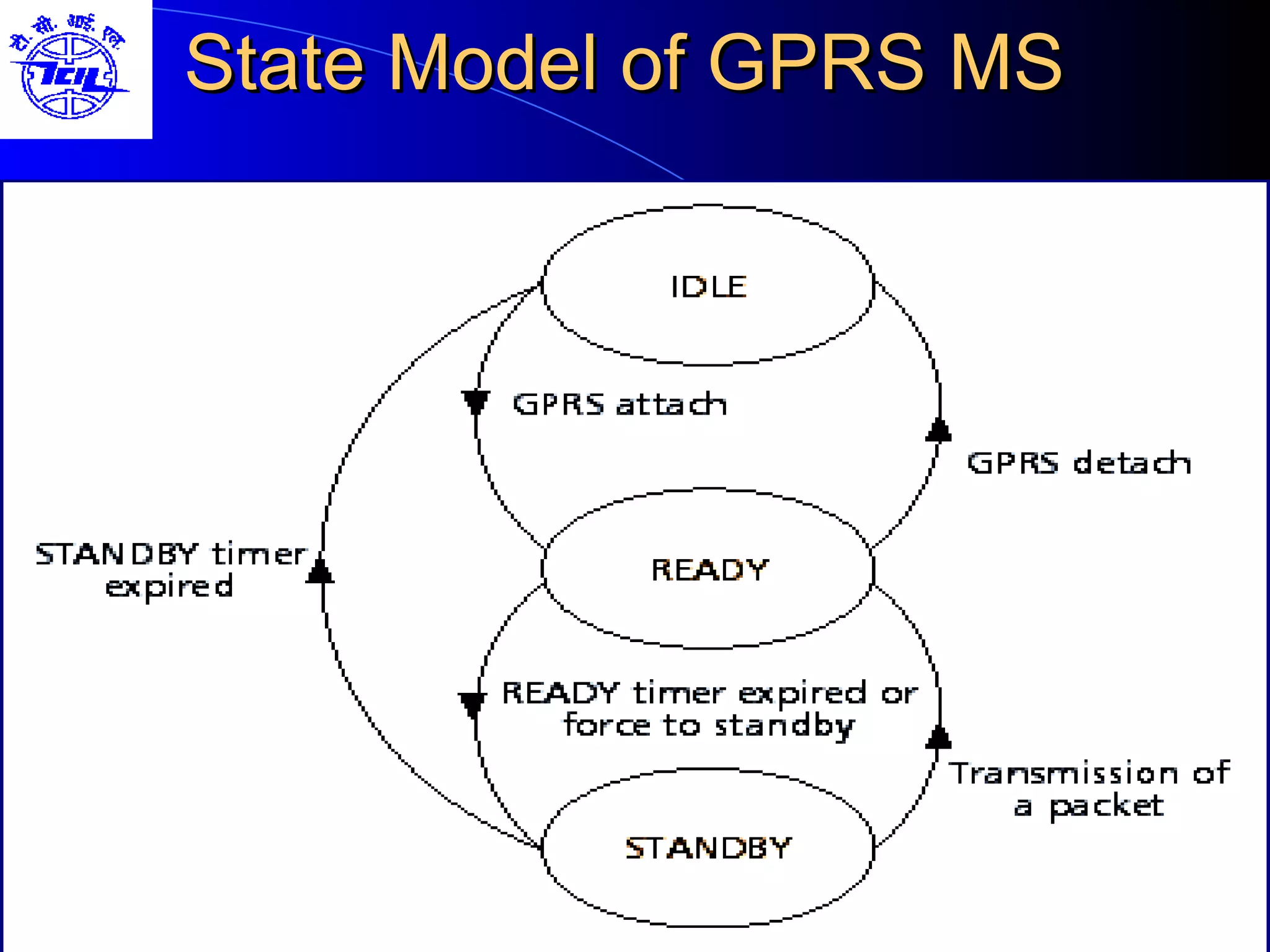
State Model of GPRS MS
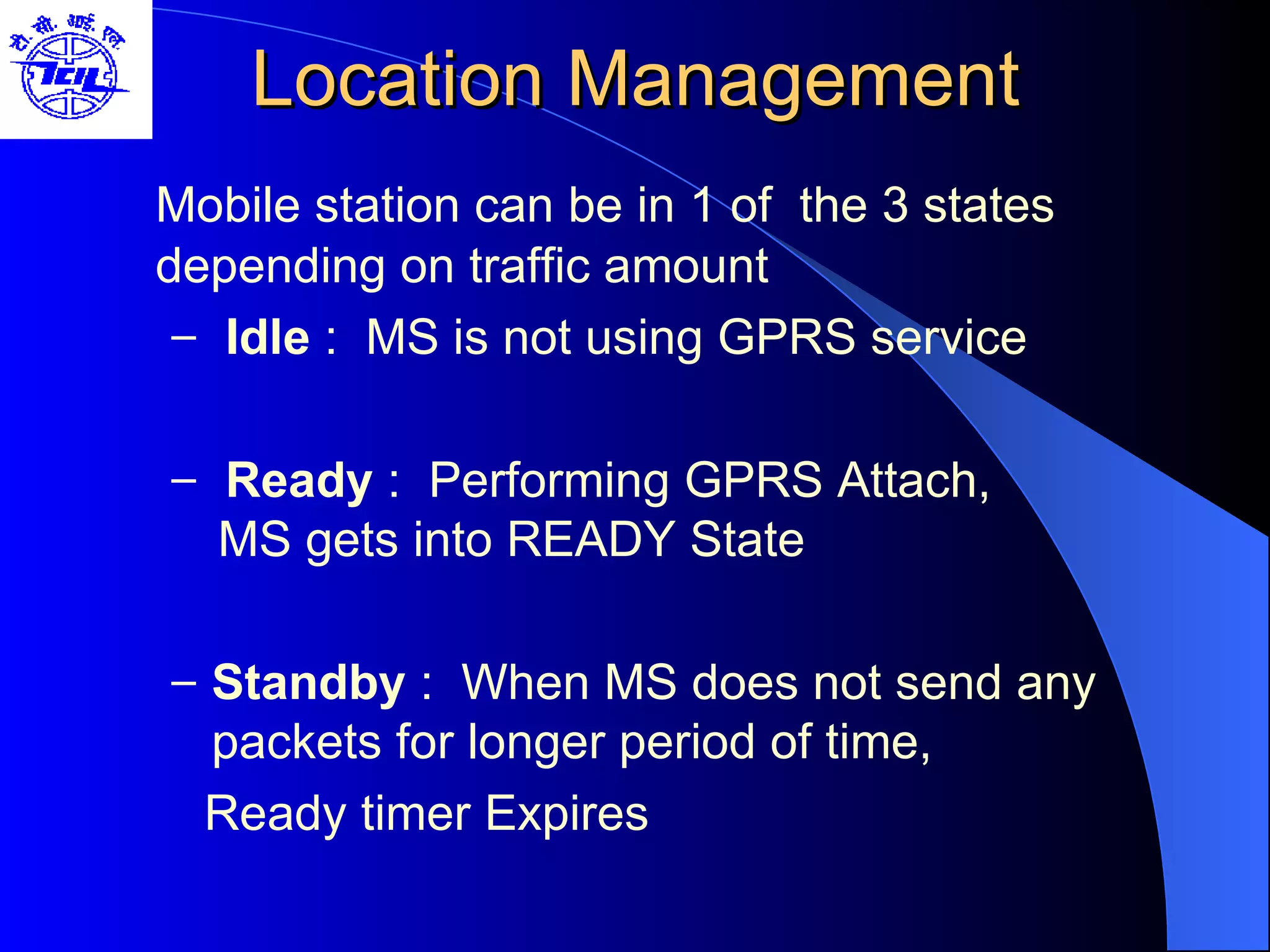
Location Management Mobile station can be in 1 of  the 3 states depending on traffic amount Idle  :  MS is not using GPRS service Ready  :  Performing GPRS Attach,    MS gets into READY State Standby  :  When MS does not send any packets for longer period of time, Ready timer Expires
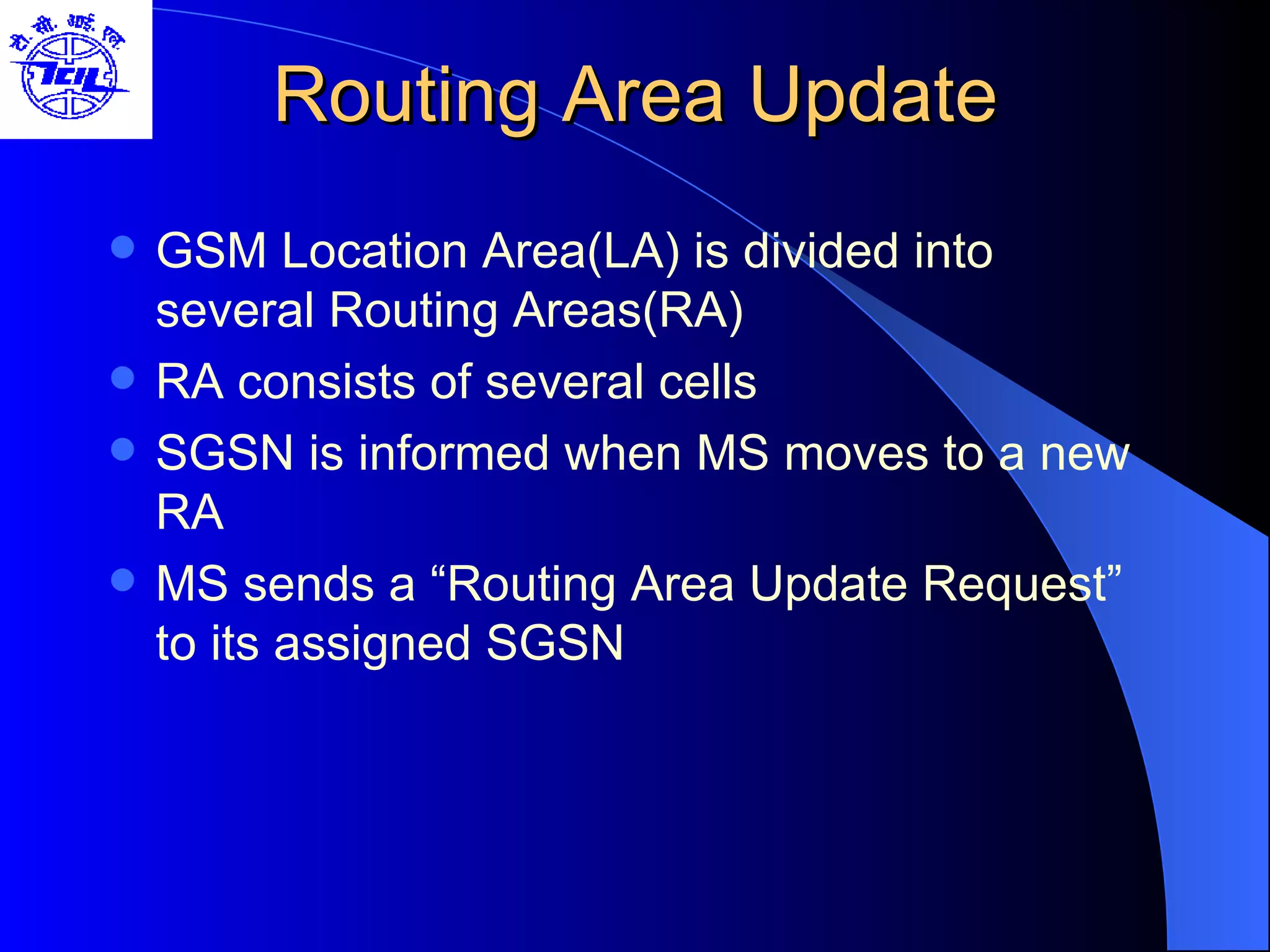
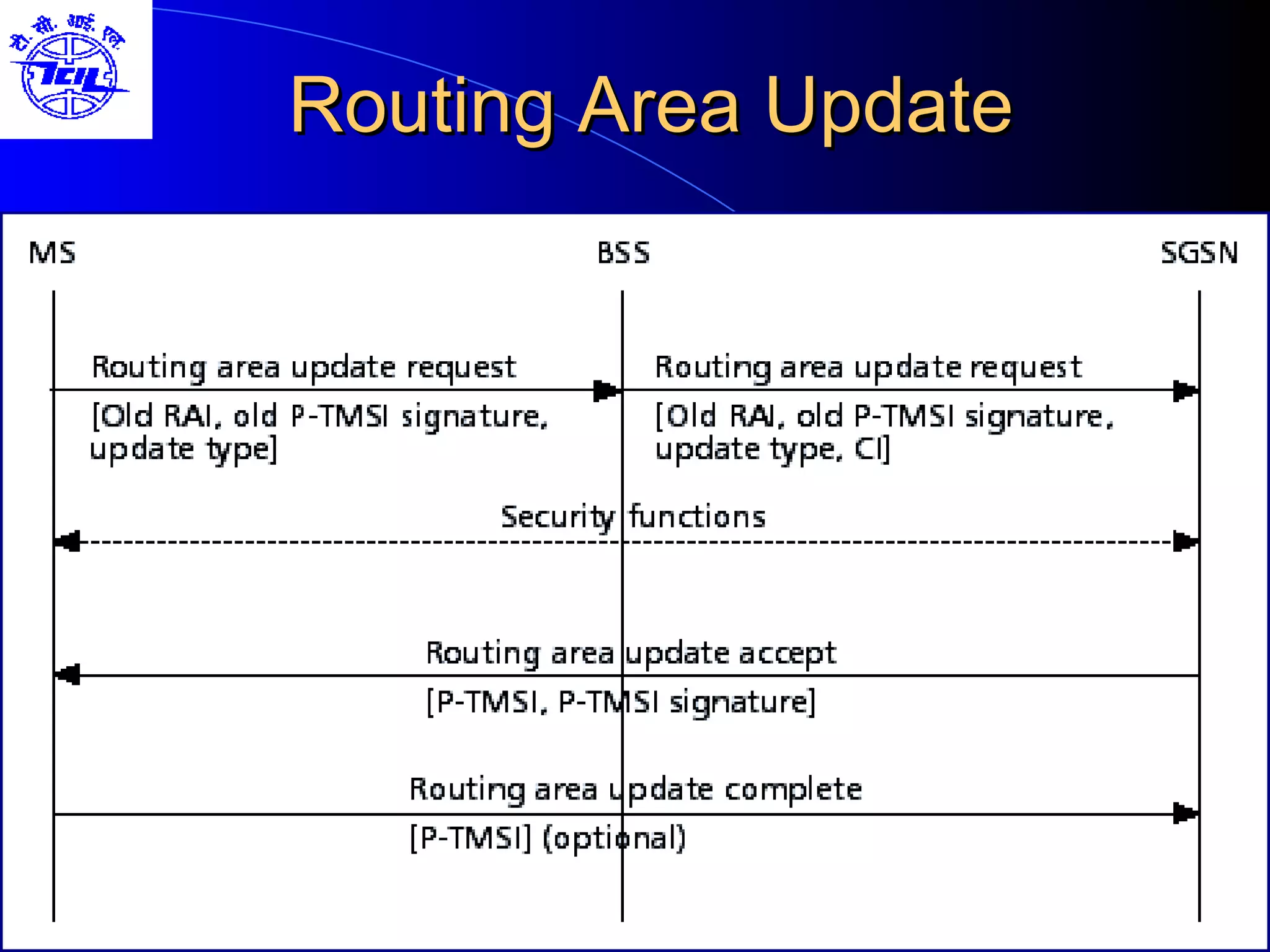
Routing Area Update GSM Location Area(LA) is divided into several Routing Areas(RA) RA consists of several cells SGSN is informed when MS moves to a new RA MS sends a “Routing Area Update Request” to its assigned SGSN
Types of Routing Area Update Intra SGSN Routing Area Update Inter SGSN Routing Area Update
Routing Area Update
Mobility Management Consists of two levels: Micro mobility management : Tracks the current RA or cell of MS It is performed by SGSN Macro mobility management : Keep tracks of MS’s current SGSN Stores it in HLR, VLR, and GGSN
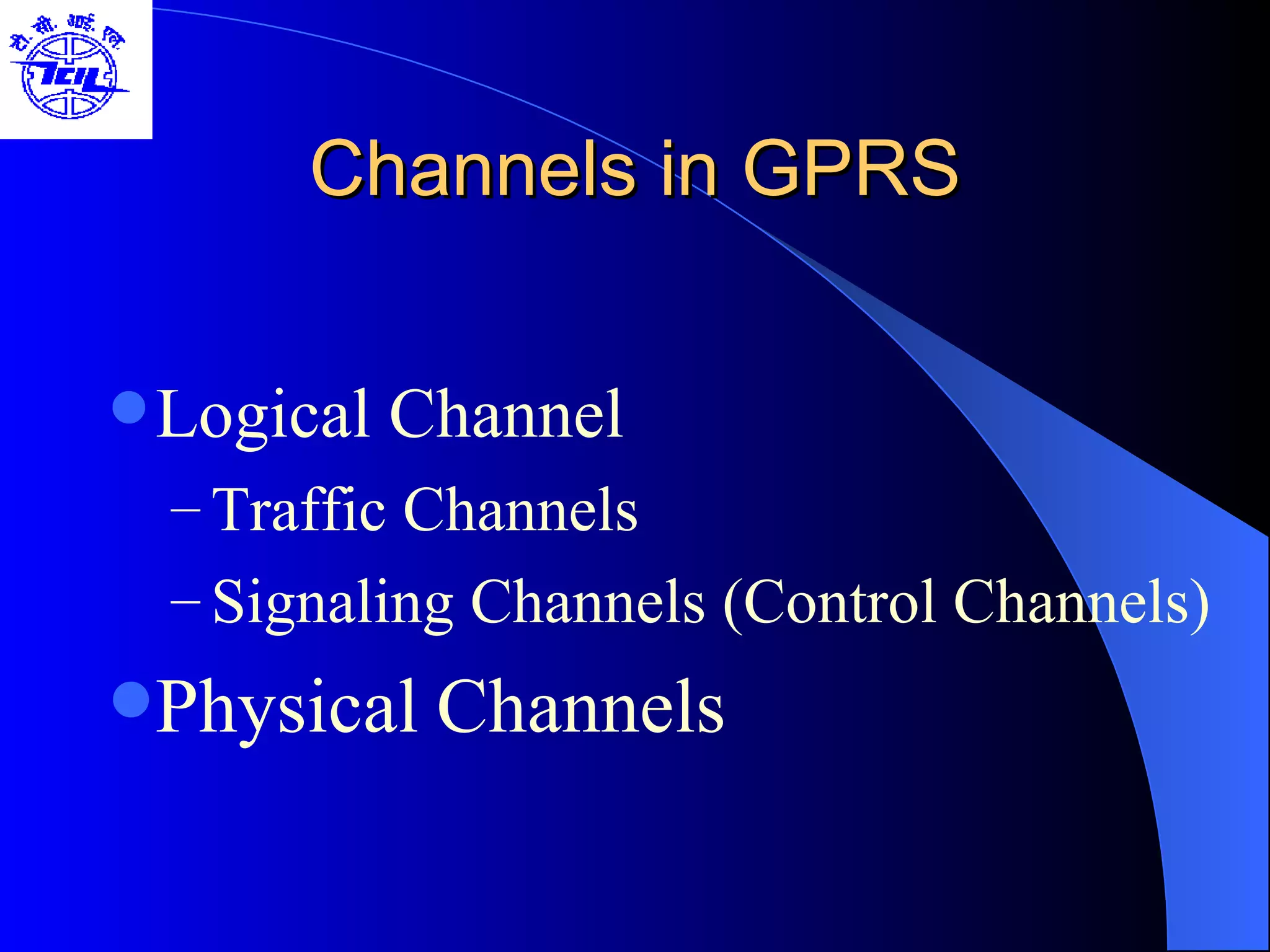
Channels in GPRS Logical Channel Traffic Channels Signaling Channels (Control Channels) Physical   Channels
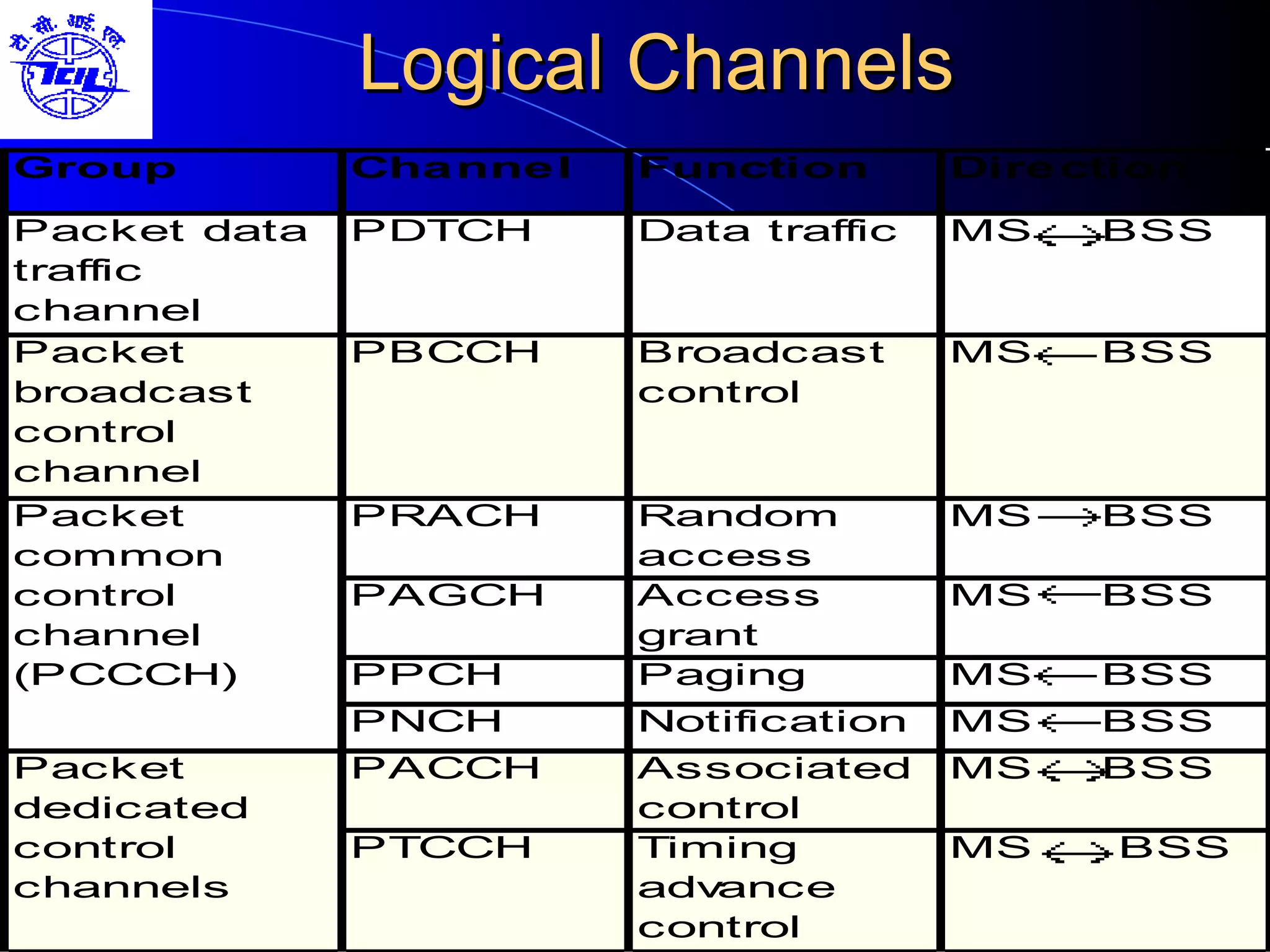
Logical Channels
Packet Data Channel(PDCH) Physical Channel for GPRS Traffic PDCH are taken from all channels available in the cell Depending on current traffic load and priority of service, the physical channel are allocated to either GPRS or GSM services.  Physical channels not currently used by GSM can be allocated as PDCH to increase the QOS for GPRS
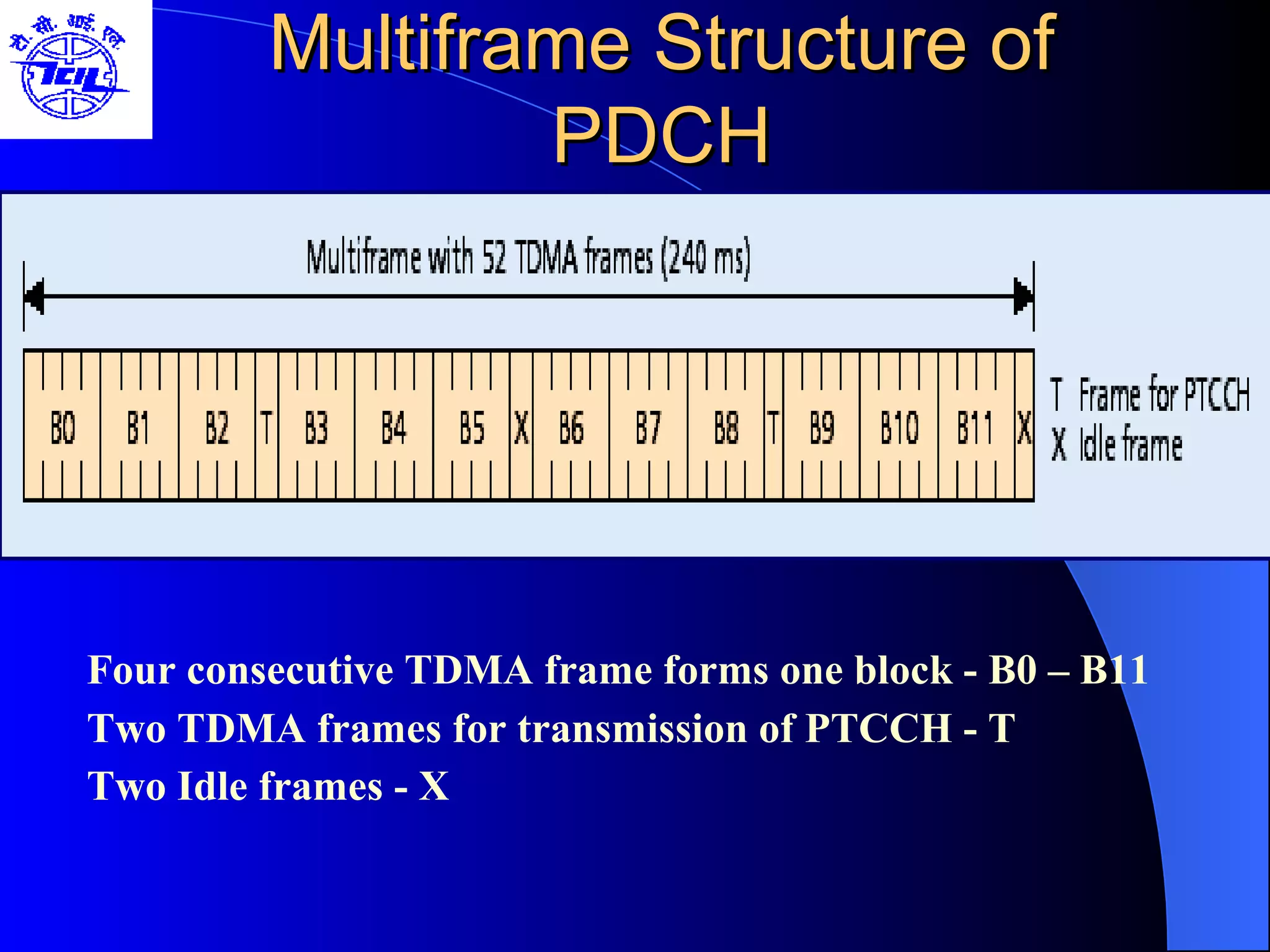
Multiframe Structure of PDCH Four consecutive TDMA frame forms one block - B0 – B11 Two TDMA frames for transmission of PTCCH - T Two Idle frames - X
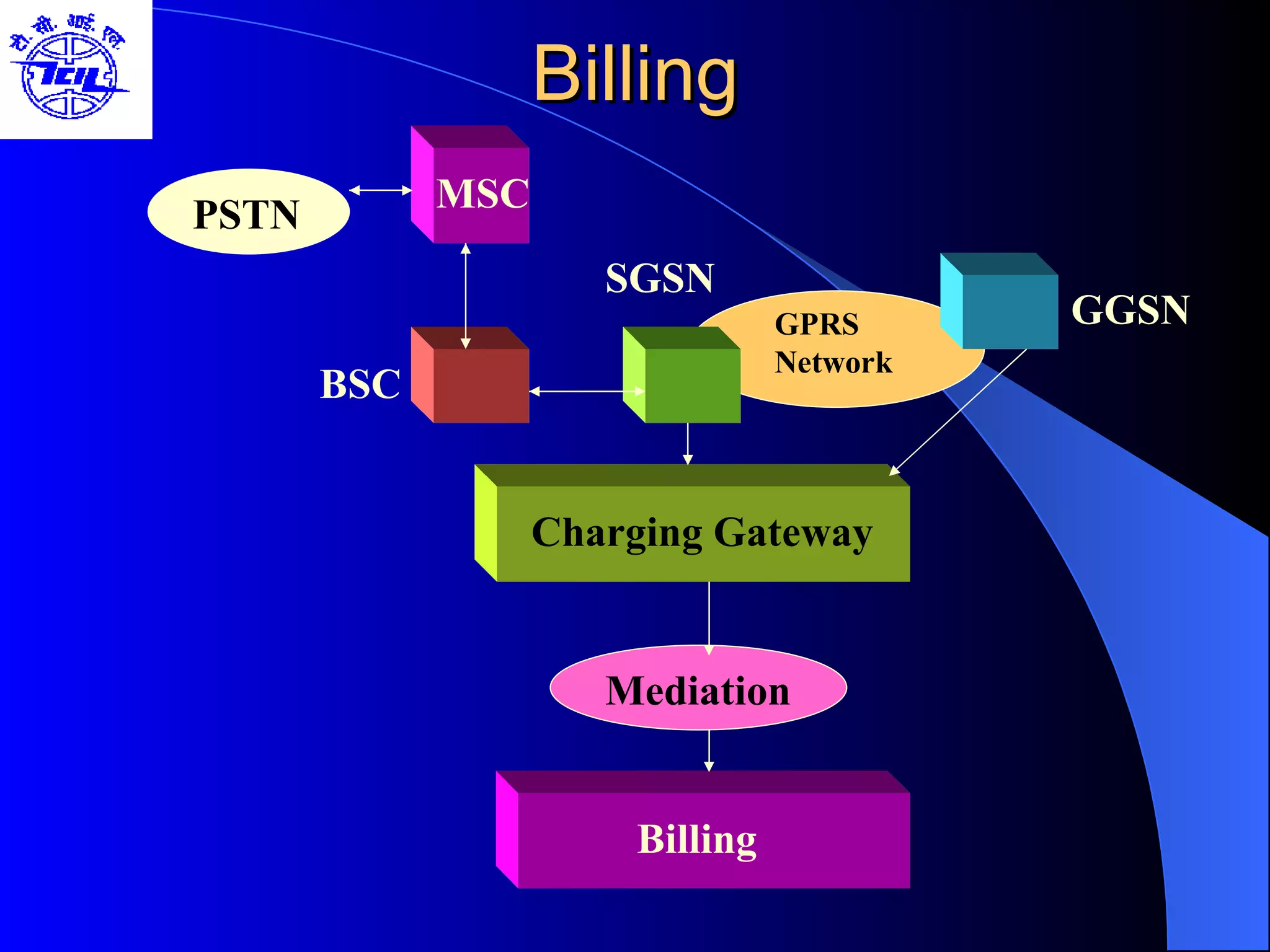
Billing GGSN MSC PSTN  BSC SGSN GPRS Network Charging Gateway Mediation MSC Billing
Applications of GPRS Web browsing Corporate & Internet Email  Vehicle Positioning Remote LAN Access Home Automation Document Sharing/Collaborative working
THANK   YOU

Gprs

  • 1.
    General Packet RadioService (GPRS) A new Dimension to Wireless Communication
  • 2.
    Contents of PresentationGPRS and its Features GPRS Network Architecture GPRS Protocol Architecture GPRS Backbone Network GPRS interworking with External Network Call routing in GPRS Session Management in GPRS Location Management in GPRS Mobility Management in GPRS Logical Channels of GPRS GPRS Applications
  • 3.
    Constraints with existingnetwork Data Rates too slow – about 9.6 kbps Connection setup time too long Inefficient resource utilization for bursty traffic Proves expensive for bursty traffic utilization No efficient method for packet transfers
  • 4.
    Comparison of GSM& GPRS Amount of data transferred Duration of connection Billing Packet - Switched Technology Circuit – Switched Technology Type of Connection GMSK GMSK Modulation Technique 14.4 to 115.2 Kbps 9.6 Kbps Data Rates GPRS GSM
  • 5.
    GPRS in INDIABPL Mobile Bharti Cellular Hutchison Max Hutchison Essar Idea Cellular
  • 6.
    What is GPRS? General Packet Radio Service (GPRS) is a new bearer service for GSM that greatly improves and simplifies wireless access to packet data networks GPRS applies packet radio principal to transfer user data packets in an efficient way b/w MS & external packet data network
  • 7.
    Benefits of GPRSNew Data Services High Speed (Data Rate 14.4 – 115 kbps) Efficient use of radio bandwith (Statistical Multiplexing) Circuit switching & Packet Switching can be used in parallel Constant connectivity
  • 8.
  • 9.
    Salient Features ofGPRS Important step on the path to 3G Standardized by ETSI GPRS is an overlay network over the GSM Provides Data Packet delivery service Support for leading internet communication protocols Billing based on volume of data transferred Utilizes existing GSM authentication and privacy procedures.
  • 10.
    High Data RateGPRS uses radio channel i.e. 200 kHz wide Radio channel carries digital data stream of 271 kbps This rate is divided into 8 time slots each carrying 34 kbps per time slot Data rate 14 kbps per time slot achieved after corrections GPRS can combine upto 8 time slots giving data rate of 114 kbps
  • 11.
    GPRS Services Offersend-to-end packet switched data transfer Bearer Services PTP - Point-To-Point service (CLNS mode) PTM - Point-To-Multipoint service(CONS Mode) PTM-M Multicast service PTM-G Group call service Supplementary Services SMS Short Message Service CFU Call Forwarding Unconditional
  • 12.
    GPRS Services (Contd.)CFNRc Call Forwarding on mobile subscriber not reachable CUG Closed User Group Tele action, access to data bases Quality of Service GPRS allows defining QoS profiles Service precedence, reliability, delay,throughput
  • 13.
    GPRS Terminals Class A MS supports simultaneous operation of GPRS and GSM services Class B MS able to register with the n/w for both GPRS & GSM services simultaneously. It can only use one of the two services at a given time. Class C MS can attach for either GPRS or GSM services
  • 14.
    GPRS Network ElementsGPRS Architecture is same as GSM except few hardware modifications : GPRS includes GSNs SGSN : Serving GPRS Support Node GGSN : Gateway GPRS Support Node GPRS Register
  • 15.
    GSM SYSTEM ARCHITECTUREMS BTS PSTN ISDN PDN BSC BSC MSC/VLR MS MS BTS BTS GMSC EIR AUC HLR
  • 16.
    GPRS SYSTEM ARCHITECTUREBSC SGSN MS BTS BTS Other GPRS PLMN GGSN PDN Gb Gd Gp Gn Gf Gs Gc GGSN EIR HLR+GPRS Register MSC/VLR D SMS-GMSC SMS-INMSC Gi Gr
  • 17.
    Interfaces Gb –Connects BSC with SGSN Gn – SGSN – SGSN/GGSN (in the same network) Gp – SGSN –GGSN (in different networks) Gf – For equipment querying at registering time Gi – Connects PLMN with external Packet Data Networks (PDNs) Gr – To exchange User profile between HLR & SGSN Gs – To exchange Database between SGSN & MSC Gd – Interface between SMS & GPRS
  • 18.
    SGSN – ServingGPRS Support Node Delivers data packets to mobile stations & vice-versa Detect and Register new GPRS MS in its serving area Packet Routing, Transfer & Mobility Management Authentication, Maintaining user profiles Its location register stores location info. & user profiles
  • 19.
    GGSN – GatewayGPRS Support Node Interfaces GPRS backbone network & external packet data networks Converts the GPRS packets from SGSN to the PDP format Converts PDP addresses change to GSM addresses of the destination user Stores the current SGSN address and profile of the user in its location register Performs authentication Many-to- many relations among SGSNs & GGSNs
  • 20.
    GPRS Register GPRSRegister is integrated with GSM-HLR. Maintains the GPRS subscriber data and Routing information. Stores current SGSN address
  • 21.
    GPRS Backbone Network GSNs are connected through IP based backbone Two Backbones: Intra PLMN backbone networks that connects GSNs of the same PLMN & are private IP networks Inter PLMN backbone networks that connects GSNs of the different PLMN. Roaming agreement is necessary GPRS Tunneling protocol (GTP) PLMN- Inter PLMN interconnect are called Border gateways (performs security functions to protect Intra- PLMN backbone against unauthorized users and attacks).
  • 22.
    GPRS BACKBONE NETWORKinter-PLMN GPRS backbone External Packet Data Network (PDN) intra-PLMN GPRS backbone intra-PLMN GPRS backbone PLMN1 PLMN2 SGSN SGSN SGSN GGSN GGSN Border gateway Border gateway Gp Gn Gi Gn Gn BTS BTS BSC BSC Host Router LAN MS Gi Gn Gn Gp
  • 23.
    Protocol Stack GSMRF SNDCP IP / X.25 Application Um Gn Gb MAC RLC LLC IP / X.25 GTP L1 L2 LLC GSM RF Frame Relay MAC RLC BSSGP L1bis BSSGP Frame Relay LLC SNDCP GTP L1bis L1 L2 IP MS BSS (PCU) SGSN GGSN Gi IP UDP/ TCP UDP/ TCP
  • 24.
    SNDCP - SubNetwork Dependent Convergence Protocol Used to transfer data packets between SGSN and MS Multiplexing of several connections of network layer onto one logical connection of underlying LLC layer Compression and decompression of user data and header information
  • 25.
    Data Link layerDivided into two sub layers : LLC layer (between MS-SGSN) RLC/MAC (between MS-BSS)
  • 26.
    LLC-Logical Link ControlEstablishes highly reliable logical link between MS & its assigned SGSN Works either in acknowledged or unacknowledged modes Data confidentiality is ensured by ciphering functions
  • 27.
    RLC/MAC Layer RadioLink Control(RLC) Establish a reliable link between MS & BSS Segmentation and reassembly of LLC frames into RLC data blocks Medium Access Control(MAC) Controls access attempts of an MS on radio channels shared by several MSs Employs algos. for contention resolution, multiuser multiplexing on PDTCH Both ack and unack. Modes of operation are supported in RLC/MAC layer
  • 28.
    Physical Layer Dividedinto two sub layers : Physical Link Layer (PLL) Physical RF Layer (RFL) PLL – Provides a physical channel between MS and BSS Channel coding, interleaving, detection of physical link congestion RFL - Operates below PLL
  • 29.
    BSSGP-(BSS GPRS ApplicationProtocol) Delivers routing & Quality of Service related information between BSS and SGSN
  • 30.
    GTP – GPRSTunneling Protocol GTP tunnels user data packets and related signaling information between GSNs Signaling is used to create, modify and delete tunnels Defined both at Gn and Gp interface Below GTP, TCP or UDP are employed to transport the GTP Packets within backbone network
  • 31.
    Inter working withIP networks GPRS n/w can be interconnected with an IP-based packet data network GPRS supports both IPv4 and IPv6 GPRS n/w looks like IP sub network and GGSN looks like a IP router DHCP, DNS servers are installed
  • 32.
  • 33.
    CALL ROUTING DATACALL ORGINATING DATA CALL TERMINATING
  • 34.
    DATA CALL ROUTINGinter-PLMN GPRS backbone External Packet data network(PDN) Intra-PLMN GPRS backbone intra-PLMN GPRS backbone PLMN1 PLMN2 SGSN SGSN SGSN GGSN GGSN Border gateway Border gateway Gp Gn Gi Gn Gn BTS BTS BSC BSC Host Router LAN MS
  • 35.
  • 36.
    Attachment & DetachmentProcedure GPRS attach User is registered in SGSN, after authentication check from HLR SGSN assigns P-TMSI to MS GPRS detach Disconnection of MS from GPRS network is called GPRS detach It can be initiated by MS or by network(SGSN or HLR)
  • 37.
    Session Management MobileStation applies for PDP address For each session PDP context is created & it contains PDP type PDP addressed assigned to MS Address of GGSN that servers access point to PDN With active PDP context MS able to send or receive data packets Allocation of PDP address can be static or dynamic
  • 38.
  • 39.
  • 40.
  • 41.
    Location Management Mobilestation can be in 1 of the 3 states depending on traffic amount Idle : MS is not using GPRS service Ready : Performing GPRS Attach, MS gets into READY State Standby : When MS does not send any packets for longer period of time, Ready timer Expires
  • 42.
    Routing Area UpdateGSM Location Area(LA) is divided into several Routing Areas(RA) RA consists of several cells SGSN is informed when MS moves to a new RA MS sends a “Routing Area Update Request” to its assigned SGSN
  • 43.
    Types of RoutingArea Update Intra SGSN Routing Area Update Inter SGSN Routing Area Update
  • 44.
  • 45.
    Mobility Management Consistsof two levels: Micro mobility management : Tracks the current RA or cell of MS It is performed by SGSN Macro mobility management : Keep tracks of MS’s current SGSN Stores it in HLR, VLR, and GGSN
  • 46.
    Channels in GPRSLogical Channel Traffic Channels Signaling Channels (Control Channels) Physical Channels
  • 47.
  • 48.
    Packet Data Channel(PDCH)Physical Channel for GPRS Traffic PDCH are taken from all channels available in the cell Depending on current traffic load and priority of service, the physical channel are allocated to either GPRS or GSM services. Physical channels not currently used by GSM can be allocated as PDCH to increase the QOS for GPRS
  • 49.
    Multiframe Structure ofPDCH Four consecutive TDMA frame forms one block - B0 – B11 Two TDMA frames for transmission of PTCCH - T Two Idle frames - X
  • 50.
    Billing GGSN MSCPSTN BSC SGSN GPRS Network Charging Gateway Mediation MSC Billing
  • 51.
    Applications of GPRSWeb browsing Corporate & Internet Email Vehicle Positioning Remote LAN Access Home Automation Document Sharing/Collaborative working
  • 52.
    THANK YOU