Presented By- Pooja Choudhary
1
2
Defination of computer.
Types of computer –
 Mini computers
 Micro computers
 Mainframe computers
 Super computers
Queries.
Vote of thanks.
What is an computer?
 A computer is a electronic device that can
be programmed to carry out a set of
arithmetic or logical operations
automatically. Conventionally, a computer
consists of at least one processing element,
typically a central processing unit (CPU), and
some form of memory.
3
Mini computers.
Micro computers.
Mainframe computers.
Super computers.
4
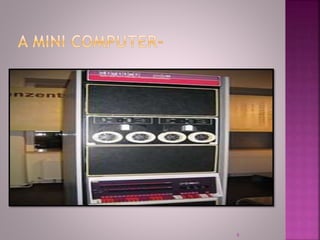
 A minicomputer, or colloquially mini, is a class of
smaller computers that developed in the mid-1960s and
sold for much less than mainframe and mid-size computers
from IBM and its direct competitors. In a 1970 survey,
the New York Times suggested a consensus definition of a
minicomputer as a machine costing less than 25,000
USD, with an input-output device such as a teleprinter and
at least4K words of memory, that is capable of running
programs in a higher level language, such
as Fortran or BASIC.The class formed a distinct group with
its own software architectures and operating systems.
Minis were designed for control, instrumentation, human
interaction, and communication switching as distinct from
calculation and record keeping. Many were sold indirectly
to Original Equipment Manufacturers (OEMs) for final end
use application. During the two decade lifetime of the
minicomputer class (1965-1985), almost 100 companies
formed and only a half dozen remained.
5
6
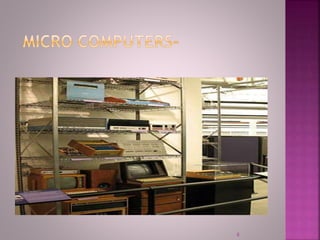
 A microcomputer is a small, relatively
inexpensive computer with a microprocessor as
its central processing unit (CPU).It includes a
microprocessor, memory, and input/output (I/O)
facilities. Microcomputers became popular in
the 1970s and 80s with the advent of
increasingly powerful microprocessors. The
predecessors to these
computers, mainframes and minicomputers ,
were comparatively much larger and more
expensive (though indeed present-day
mainframes such as the IBM System z machines
use one or more custom microprocessors as their
CPUs). Many microcomputers (when equipped
with a keyboard and screen for input and
output) are also personal computers.
7
8
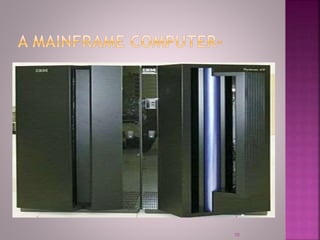
 Mainframe computers are computers used
primarily by corporate and governmental
organizations for critical applications, bulk data
processing such as census, industry and
consumer statistics, enterprise resource
planning and transaction processing.
 The term originally referred to the large
cabinets called "main frames" that housed
the central processing unit and main memory of
early computers. Later, the term was used to
distinguish high-end commercial machines from
less powerful units . Most large-scale computer
system architectures were established in the
1960s, but continue to evolve.
9
10
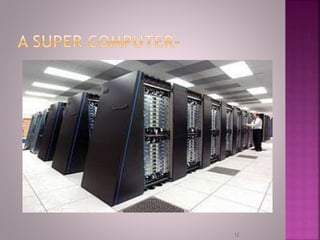
 A supercomputer is a computer at the frontline of
contemporary processing capacity – particularly speed of
calculation which can happen at speeds of nanoseconds.
 Supercomputers were introduced in the 1960s, made
initially and, for decades, primarily by Seymour
Cray at Control Data Corporation (CDC), Cray
Research and subsequent companies bearing his name or
monogram. While the supercomputers of the 1970s used
only a few processors, in the 1990s machines with
thousands of processors began to appear and, by the end
of the 20th century, massively parallel supercomputers
with tens of thousands of "off-the-shelf" processors were
the norm. As of November 2013, China's Tianhe-
2 supercomputer is the fastest in the world at
33.86 petaFLOPS, or 33.86 quadrillion floating point
operations per second.
11
12
13
Pooja
choudhary
14

My computer

  • 1.
  • 2.
    2 Defination of computer. Typesof computer –  Mini computers  Micro computers  Mainframe computers  Super computers Queries. Vote of thanks.
  • 3.
    What is ancomputer?  A computer is a electronic device that can be programmed to carry out a set of arithmetic or logical operations automatically. Conventionally, a computer consists of at least one processing element, typically a central processing unit (CPU), and some form of memory. 3
  • 4.
  • 5.
     A minicomputer,or colloquially mini, is a class of smaller computers that developed in the mid-1960s and sold for much less than mainframe and mid-size computers from IBM and its direct competitors. In a 1970 survey, the New York Times suggested a consensus definition of a minicomputer as a machine costing less than 25,000 USD, with an input-output device such as a teleprinter and at least4K words of memory, that is capable of running programs in a higher level language, such as Fortran or BASIC.The class formed a distinct group with its own software architectures and operating systems. Minis were designed for control, instrumentation, human interaction, and communication switching as distinct from calculation and record keeping. Many were sold indirectly to Original Equipment Manufacturers (OEMs) for final end use application. During the two decade lifetime of the minicomputer class (1965-1985), almost 100 companies formed and only a half dozen remained. 5
  • 6.
  • 7.
     A microcomputeris a small, relatively inexpensive computer with a microprocessor as its central processing unit (CPU).It includes a microprocessor, memory, and input/output (I/O) facilities. Microcomputers became popular in the 1970s and 80s with the advent of increasingly powerful microprocessors. The predecessors to these computers, mainframes and minicomputers , were comparatively much larger and more expensive (though indeed present-day mainframes such as the IBM System z machines use one or more custom microprocessors as their CPUs). Many microcomputers (when equipped with a keyboard and screen for input and output) are also personal computers. 7
  • 8.
  • 9.
     Mainframe computersare computers used primarily by corporate and governmental organizations for critical applications, bulk data processing such as census, industry and consumer statistics, enterprise resource planning and transaction processing.  The term originally referred to the large cabinets called "main frames" that housed the central processing unit and main memory of early computers. Later, the term was used to distinguish high-end commercial machines from less powerful units . Most large-scale computer system architectures were established in the 1960s, but continue to evolve. 9
  • 10.
  • 11.
     A supercomputeris a computer at the frontline of contemporary processing capacity – particularly speed of calculation which can happen at speeds of nanoseconds.  Supercomputers were introduced in the 1960s, made initially and, for decades, primarily by Seymour Cray at Control Data Corporation (CDC), Cray Research and subsequent companies bearing his name or monogram. While the supercomputers of the 1970s used only a few processors, in the 1990s machines with thousands of processors began to appear and, by the end of the 20th century, massively parallel supercomputers with tens of thousands of "off-the-shelf" processors were the norm. As of November 2013, China's Tianhe- 2 supercomputer is the fastest in the world at 33.86 petaFLOPS, or 33.86 quadrillion floating point operations per second. 11
  • 12.
  • 13.
  • 14.