Molecularbiology
L4
Page 1 of 6
Mutation, Repair and Recombination
 Mutation: A gene mutation is a permanent change in the DNA sequence that makes up
a gene. Mutations range in size from a single DNA building block (DNA base) to a large
segment of a chromosome.
 Two types of events that reshape genomes: (1) rearrangements, which reorganize the
DNA sequences within one or more chromosomes, and (2) changes in chromosome
number involving losses or gains of entire chromosomes or sets of chromosomes
 Point mutation: The simplest mutation – alterations of single base pairs of DNA or of a
small number of adjacent base pairs—that is, mutations that map to a single location, or
“point,” within a gene.
 Mutations that affect the processes of cell growth and cell death can result in
tumorigenesis .
o Mutations that are passed from parent to child are called hereditary mutations (because
they are present in the egg and sperm cells, which are also called germ cells). This type
of mutation is present throughout a person’s life in virtually every cell in the body.
o Mutations that occur only in an egg or sperm cell, or those that occur just after fertilization,
are called new (de novo) mutations. De novo mutations may explain genetic disorders in
which an affected child has a mutation in every cell, but has no family history of the
disorder.
o Acquired (or somatic) mutations occur in the DNA of individual cells at some time during
a person’s life. Acquired mutations in somatic cells cannot be passed on to the next
generation.
o Mutations may also occur in a single cell within an early embryo. As all the cells divide
during growth and development, the individual will have some cells with the mutation and
some cells without the genetic change. This situation is called mosaicism.
 Types of point mutations
The two main types of point mutation in DNA are base substitutions and base
additions or deletions.
o Base substitutions: one base pair is replaced by another. Base substitutions also can
be divided into transitions and transversions.
• Transition is the replacement of a base by the other base of the same chemical
category (purine replaced by purine; pyrimidine replaced by pyrimidine.
• Transversion is the opposite—the replacement of a base of one chemical
category by a base of the other (pyrimidine replaced by purine; purine replaced by
pyrimidine).
o Addition or deletion mutations: additions or deletions of nucleotide pairs, the
convention is to call them base-pair additions or deletions.
 The Effects of mutations
The direct effect that a mutation has on the functioning of a genome and its indirect effect
on the phenotype of the organism in which it occurs. The direct effect is relatively easy to
assess because you can use your understanding of gene structure and expression to predict
the impact that a mutation will have on genome function. The indirect effects are more
complex because these relate to the phenotype of the mutated organism which is often
difficult to correlate with the activities of individual genes.
Now, consider what happens when a mutation arises in a polypeptide-coding part of a gene.
For single-base substitutions, there are several possible outcomes, but all are direct
Molecularbiology
L4
Page 2 of 6
consequences of two aspects of the genetic code: degeneracy of the code and the existence
of translation termination codons:
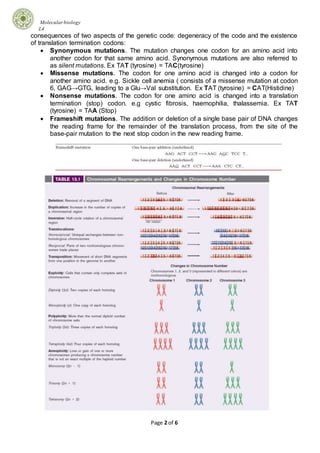
 Synonymous mutations. The mutation changes one codon for an amino acid into
another codon for that same amino acid. Synonymous mutations are also referred to
as silent mutations. Ex TAT (tyrosine) = TAC(tyrosine)
 Missense mutations. The codon for one amino acid is changed into a codon for
another amino acid. e.g. Sickle cell anemia ( consists of a missense mutation at codon
6, GAG→GTG, leading to a Glu→Val substitution. Ex TAT (tyrosine) = CAT(Histidine)
 Nonsense mutations. The codon for one amino acid is changed into a translation
termination (stop) codon. e.g cystic fibrosis, haemophilia, thalassemia. Ex TAT
(tyrosine) = TAA (Stop)
 Frameshift mutations. The addition or deletion of a single base pair of DNA changes
the reading frame for the remainder of the translation process, from the site of the
base-pair mutation to the next stop codon in the new reading frame.
Molecularbiology
L4
Page 3 of 6
 The causes of mutations
o The high accuracy of DNA replication (one error per 1010 bases incorporated)
depends on a combination of proper base pairing of template strand and incoming
nucleotide in the active site of the DNA polymerase, proof reading of the
incorporated base by 3'→5' exonuclease and mismatch repair.
Some mutations are spontaneous errors in replication that evade the proofreading
function of the DNA polymerases that synthesize new polynucleotides at the
replication fork. These mutations are called mismatches because they are positions
where the nucleotide that is inserted into the daughter polynucleotide does not match,
by base-pairing, the nucleotide at the corresponding position in the template DNA. If
the mismatch is retained in the daughter double helix then one of the granddaughter
molecules produced during the next round of DNA replication will carry a permanent
double-stranded version of the mutation.
o Other mutations arise because a physical and chemical mutagen has reacted with
the parent DNA, causing a structural change that affects the base-pairing capability of
the altered nucleotide. Usually this alteration affects only one strand of the parent
double helix, so only one of the daughter molecules carries the mutation, but two of
the granddaughter molecules produced during the next round of replication will have it.
 Physical mutagens: such as Ionizing (e.g. X- and ϒ-rays) and nonionizing
(e.g. UV) radiation
 Chemical mutagens: such as Base analogs, Nitrous acid, Alkylating and
arylating agents. Most chemical mutagens are carcinogenic.
Mutagens cause mutations in three different ways:
 Some act as base analogs and are mistakenly used as substrates when new
DNA is synthesized at the replication fork.
 Some react directly with DNA, causing structural changes that lead to
miscopying of the template strand when the DNA is replicated. These
structural changes are diverse,
 Some mutagens act indirectly on DNA. They do not themselves affect DNA
structure, but instead cause the cell to synthesize chemicals such as
peroxides that have a direct mutagenic effect.
Molecularbiology
L4
Page 4 of 6
DNA repair
Thousands of damage events that genomes suffer every day, coupled with the errors
that occur when the genome replicates, it is essential that cells possess efficient repair
systems. Without these repair systems a genome would not be able to maintain its essential
cellular functions for more than a few hours before key genes became inactivated by DNA
damage. Similarly, cell lineages would accumulate replication errors at such a rate that their
genomes would become dysfunctional after a few cell divisions.
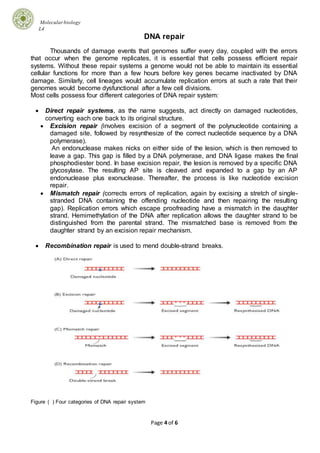
Most cells possess four different categories of DNA repair system:
 Direct repair systems, as the name suggests, act directly on damaged nucleotides,
converting each one back to its original structure.
 Excision repair (involves excision of a segment of the polynucleotide containing a
damaged site, followed by resynthesize of the correct nucleotide sequence by a DNA
polymerase).
An endonuclease makes nicks on either side of the lesion, which is then removed to
leave a gap. This gap is filled by a DNA polymerase, and DNA ligase makes the final
phosphodiester bond. In base excision repair, the lesion is removed by a specific DNA
glycosylase. The resulting AP site is cleaved and expanded to a gap by an AP
endonuclease plus exonuclease. Thereafter, the process is like nucleotide excision
repair.
 Mismatch repair (corrects errors of replication, again by excising a stretch of single-
stranded DNA containing the offending nucleotide and then repairing the resulting
gap). Replication errors which escape proofreading have a mismatch in the daughter
strand. Hemimethylation of the DNA after replication allows the daughter strand to be
distinguished from the parental strand. The mismatched base is removed from the
daughter strand by an excision repair mechanism.
 Recombination repair is used to mend double-strand breaks.
Figure ( ) Four categories of DNA repair system
Molecularbiology
L4
Page 5 of 6
Recombination
Any process involving the re-arrangement of sequences of nucleotides in one or more
molecules of nucleic acid – including events such as e.g. additions, deletions, inversions,
replacements and amalgamations. Any molecule which has undergone such a process is
referred to by the adjective recombinant; this term is also employed to describe cells (and
also viruses) in which recombination has occurred.
Recombination was first recognized as the process responsible for crossing-over and
exchange of DNA segments between homologous chromosomes during meiosis of
eukaryotic cells, and was subsequently implicated in the integration of transferred DNA into
bacterial genomes after conjugation, transduction or transformation.
Recombination includes:
• Homologous recombination: (The exchange of homologous regions between two DNA
molecules occurs extensively in eukaryotes during meiosis). This is the most important
version of recombination in nature, being responsible for meiotic crossing-over and the
integration of transferred DNA into bacterial genomes.
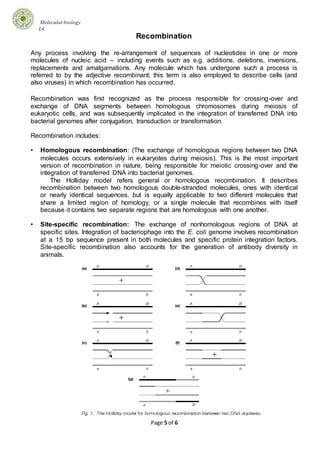
The Holliday model refers general or homologous recombination. It describes
recombination between two homologous double-stranded molecules, ones with identical
or nearly identical sequences, but is equally applicable to two different molecules that
share a limited region of homology, or a single molecule that recombines with itself
because it contains two separate regions that are homologous with one another.
• Site-specific recombination: The exchange of nonhomologous regions of DNA at
specific sites. Integration of bacteriophage into the E. coli genome involves recombination
at a 15 bp sequence present in both molecules and specific protein integration factors.
Site-specific recombination also accounts for the generation of antibody diversity in
animals.
Molecularbiology
L4
Page 6 of 6
Transposition
 Transposition is a process that utilizes recombination, the end result being the transfer
of a segment of DNA from one position in the genome to another. A characteristic
feature of transposition is that the transferred segment is flanked by a pair of short direct
repeats which, are formed during the transposition process.
 Transposons or transposable elements are small DNA sequences that can move to
virtually any position in a cells genome .Replicated copies of transposable DNA elements
can insert themselves anywhere in the genome. All transposons encode a transposase
which catalyzes the insertion. The Tn transposon series carry other genes, including one
for a β-lactamase, which confers penicillin resistance on the organism. The spread of
antibiotic resistance among bacterial populations is a consequence of the transposition of
resistance genes into plasmids, which replicate readily within the bacteria, and the ability
of transposons to cross prokaryotic species barriers.
Various types of transposable element known in eukaryotes and prokaryotes and broadly
divided into three categories on the basis of their transposition mechanism:
• DNA transposons that transpose replicatively, the original transposon remaining in
place and a new copy appearing elsewhere in the genome;
• DNA transposons that transpose conservatively, the original transposon moving to
a new site by a cut-and-paste process;
• Retroelements, genetic elements, all of which transpose via an RNA intermediate.
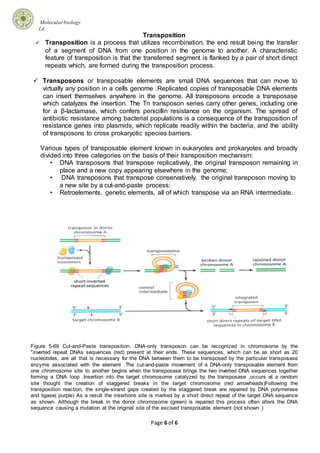
Figure 5-69 Cut-and-Paste transposition. DNA-only transposon can be recognized in chromosome by the
"inverted repeat DNAs sequences (red) present at their ends. These sequences, which can be as short as 20
nucleotides, are all that is necessary for the DNA between them to be transposed by the particular transposase
enzyme associated with the element .The cut-and-paste movement of a DNA-only transposable element from
one chromosome site to another begins when the transposase brings the two inverted DNA sequences together
forming a DNA loop .Insertion into the target chromosome catalyzed by the transposase ,occurs at a random
site thought the creation of staggered breaks in the target chromosome (red arrowheads)Following the
transposition reaction, the single-strand gaps created by the staggered break are repaired by DNA polymerase
and ligase( purple) As a result the insertions site is marked by a short direct repeat of the target DNA sequence
as shown. Although the break in the donor chromosome (green) is repaired this process often alters the DNA
sequence causing a mutation at the original site of the excised transposable element (not shown )

mutation recombination and transposition

  • 1.
    Molecularbiology L4 Page 1 of6 Mutation, Repair and Recombination  Mutation: A gene mutation is a permanent change in the DNA sequence that makes up a gene. Mutations range in size from a single DNA building block (DNA base) to a large segment of a chromosome.  Two types of events that reshape genomes: (1) rearrangements, which reorganize the DNA sequences within one or more chromosomes, and (2) changes in chromosome number involving losses or gains of entire chromosomes or sets of chromosomes  Point mutation: The simplest mutation – alterations of single base pairs of DNA or of a small number of adjacent base pairs—that is, mutations that map to a single location, or “point,” within a gene.  Mutations that affect the processes of cell growth and cell death can result in tumorigenesis . o Mutations that are passed from parent to child are called hereditary mutations (because they are present in the egg and sperm cells, which are also called germ cells). This type of mutation is present throughout a person’s life in virtually every cell in the body. o Mutations that occur only in an egg or sperm cell, or those that occur just after fertilization, are called new (de novo) mutations. De novo mutations may explain genetic disorders in which an affected child has a mutation in every cell, but has no family history of the disorder. o Acquired (or somatic) mutations occur in the DNA of individual cells at some time during a person’s life. Acquired mutations in somatic cells cannot be passed on to the next generation. o Mutations may also occur in a single cell within an early embryo. As all the cells divide during growth and development, the individual will have some cells with the mutation and some cells without the genetic change. This situation is called mosaicism.  Types of point mutations The two main types of point mutation in DNA are base substitutions and base additions or deletions. o Base substitutions: one base pair is replaced by another. Base substitutions also can be divided into transitions and transversions. • Transition is the replacement of a base by the other base of the same chemical category (purine replaced by purine; pyrimidine replaced by pyrimidine. • Transversion is the opposite—the replacement of a base of one chemical category by a base of the other (pyrimidine replaced by purine; purine replaced by pyrimidine). o Addition or deletion mutations: additions or deletions of nucleotide pairs, the convention is to call them base-pair additions or deletions.  The Effects of mutations The direct effect that a mutation has on the functioning of a genome and its indirect effect on the phenotype of the organism in which it occurs. The direct effect is relatively easy to assess because you can use your understanding of gene structure and expression to predict the impact that a mutation will have on genome function. The indirect effects are more complex because these relate to the phenotype of the mutated organism which is often difficult to correlate with the activities of individual genes. Now, consider what happens when a mutation arises in a polypeptide-coding part of a gene. For single-base substitutions, there are several possible outcomes, but all are direct
  • 2.
    Molecularbiology L4 Page 2 of6 consequences of two aspects of the genetic code: degeneracy of the code and the existence of translation termination codons:  Synonymous mutations. The mutation changes one codon for an amino acid into another codon for that same amino acid. Synonymous mutations are also referred to as silent mutations. Ex TAT (tyrosine) = TAC(tyrosine)  Missense mutations. The codon for one amino acid is changed into a codon for another amino acid. e.g. Sickle cell anemia ( consists of a missense mutation at codon 6, GAG→GTG, leading to a Glu→Val substitution. Ex TAT (tyrosine) = CAT(Histidine)  Nonsense mutations. The codon for one amino acid is changed into a translation termination (stop) codon. e.g cystic fibrosis, haemophilia, thalassemia. Ex TAT (tyrosine) = TAA (Stop)  Frameshift mutations. The addition or deletion of a single base pair of DNA changes the reading frame for the remainder of the translation process, from the site of the base-pair mutation to the next stop codon in the new reading frame.
  • 3.
    Molecularbiology L4 Page 3 of6  The causes of mutations o The high accuracy of DNA replication (one error per 1010 bases incorporated) depends on a combination of proper base pairing of template strand and incoming nucleotide in the active site of the DNA polymerase, proof reading of the incorporated base by 3'→5' exonuclease and mismatch repair. Some mutations are spontaneous errors in replication that evade the proofreading function of the DNA polymerases that synthesize new polynucleotides at the replication fork. These mutations are called mismatches because they are positions where the nucleotide that is inserted into the daughter polynucleotide does not match, by base-pairing, the nucleotide at the corresponding position in the template DNA. If the mismatch is retained in the daughter double helix then one of the granddaughter molecules produced during the next round of DNA replication will carry a permanent double-stranded version of the mutation. o Other mutations arise because a physical and chemical mutagen has reacted with the parent DNA, causing a structural change that affects the base-pairing capability of the altered nucleotide. Usually this alteration affects only one strand of the parent double helix, so only one of the daughter molecules carries the mutation, but two of the granddaughter molecules produced during the next round of replication will have it.  Physical mutagens: such as Ionizing (e.g. X- and ϒ-rays) and nonionizing (e.g. UV) radiation  Chemical mutagens: such as Base analogs, Nitrous acid, Alkylating and arylating agents. Most chemical mutagens are carcinogenic. Mutagens cause mutations in three different ways:  Some act as base analogs and are mistakenly used as substrates when new DNA is synthesized at the replication fork.  Some react directly with DNA, causing structural changes that lead to miscopying of the template strand when the DNA is replicated. These structural changes are diverse,  Some mutagens act indirectly on DNA. They do not themselves affect DNA structure, but instead cause the cell to synthesize chemicals such as peroxides that have a direct mutagenic effect.
  • 4.
    Molecularbiology L4 Page 4 of6 DNA repair Thousands of damage events that genomes suffer every day, coupled with the errors that occur when the genome replicates, it is essential that cells possess efficient repair systems. Without these repair systems a genome would not be able to maintain its essential cellular functions for more than a few hours before key genes became inactivated by DNA damage. Similarly, cell lineages would accumulate replication errors at such a rate that their genomes would become dysfunctional after a few cell divisions. Most cells possess four different categories of DNA repair system:  Direct repair systems, as the name suggests, act directly on damaged nucleotides, converting each one back to its original structure.  Excision repair (involves excision of a segment of the polynucleotide containing a damaged site, followed by resynthesize of the correct nucleotide sequence by a DNA polymerase). An endonuclease makes nicks on either side of the lesion, which is then removed to leave a gap. This gap is filled by a DNA polymerase, and DNA ligase makes the final phosphodiester bond. In base excision repair, the lesion is removed by a specific DNA glycosylase. The resulting AP site is cleaved and expanded to a gap by an AP endonuclease plus exonuclease. Thereafter, the process is like nucleotide excision repair.  Mismatch repair (corrects errors of replication, again by excising a stretch of single- stranded DNA containing the offending nucleotide and then repairing the resulting gap). Replication errors which escape proofreading have a mismatch in the daughter strand. Hemimethylation of the DNA after replication allows the daughter strand to be distinguished from the parental strand. The mismatched base is removed from the daughter strand by an excision repair mechanism.  Recombination repair is used to mend double-strand breaks. Figure ( ) Four categories of DNA repair system
  • 5.
    Molecularbiology L4 Page 5 of6 Recombination Any process involving the re-arrangement of sequences of nucleotides in one or more molecules of nucleic acid – including events such as e.g. additions, deletions, inversions, replacements and amalgamations. Any molecule which has undergone such a process is referred to by the adjective recombinant; this term is also employed to describe cells (and also viruses) in which recombination has occurred. Recombination was first recognized as the process responsible for crossing-over and exchange of DNA segments between homologous chromosomes during meiosis of eukaryotic cells, and was subsequently implicated in the integration of transferred DNA into bacterial genomes after conjugation, transduction or transformation. Recombination includes: • Homologous recombination: (The exchange of homologous regions between two DNA molecules occurs extensively in eukaryotes during meiosis). This is the most important version of recombination in nature, being responsible for meiotic crossing-over and the integration of transferred DNA into bacterial genomes. The Holliday model refers general or homologous recombination. It describes recombination between two homologous double-stranded molecules, ones with identical or nearly identical sequences, but is equally applicable to two different molecules that share a limited region of homology, or a single molecule that recombines with itself because it contains two separate regions that are homologous with one another. • Site-specific recombination: The exchange of nonhomologous regions of DNA at specific sites. Integration of bacteriophage into the E. coli genome involves recombination at a 15 bp sequence present in both molecules and specific protein integration factors. Site-specific recombination also accounts for the generation of antibody diversity in animals.
  • 6.
    Molecularbiology L4 Page 6 of6 Transposition  Transposition is a process that utilizes recombination, the end result being the transfer of a segment of DNA from one position in the genome to another. A characteristic feature of transposition is that the transferred segment is flanked by a pair of short direct repeats which, are formed during the transposition process.  Transposons or transposable elements are small DNA sequences that can move to virtually any position in a cells genome .Replicated copies of transposable DNA elements can insert themselves anywhere in the genome. All transposons encode a transposase which catalyzes the insertion. The Tn transposon series carry other genes, including one for a β-lactamase, which confers penicillin resistance on the organism. The spread of antibiotic resistance among bacterial populations is a consequence of the transposition of resistance genes into plasmids, which replicate readily within the bacteria, and the ability of transposons to cross prokaryotic species barriers. Various types of transposable element known in eukaryotes and prokaryotes and broadly divided into three categories on the basis of their transposition mechanism: • DNA transposons that transpose replicatively, the original transposon remaining in place and a new copy appearing elsewhere in the genome; • DNA transposons that transpose conservatively, the original transposon moving to a new site by a cut-and-paste process; • Retroelements, genetic elements, all of which transpose via an RNA intermediate. Figure 5-69 Cut-and-Paste transposition. DNA-only transposon can be recognized in chromosome by the "inverted repeat DNAs sequences (red) present at their ends. These sequences, which can be as short as 20 nucleotides, are all that is necessary for the DNA between them to be transposed by the particular transposase enzyme associated with the element .The cut-and-paste movement of a DNA-only transposable element from one chromosome site to another begins when the transposase brings the two inverted DNA sequences together forming a DNA loop .Insertion into the target chromosome catalyzed by the transposase ,occurs at a random site thought the creation of staggered breaks in the target chromosome (red arrowheads)Following the transposition reaction, the single-strand gaps created by the staggered break are repaired by DNA polymerase and ligase( purple) As a result the insertions site is marked by a short direct repeat of the target DNA sequence as shown. Although the break in the donor chromosome (green) is repaired this process often alters the DNA sequence causing a mutation at the original site of the excised transposable element (not shown )