Mussolini
By: Daniel DelaRosa,
Chris Hallstrand, Jessiney
Regueiro, Sophia Viteri
Methods used by Mussolini
● Magazines
● Dissatisfaction of the Italian people over outcome of WWI
○ Black Shirts
● Violence
● Gain support of the Roman Catholic church
○ Changed personal behaviours to be able to represent a “good” catholic
● “Strike Busting”
○ Violence and force to suppress industrialists striking
● Appeasement with trade unions (until he came into power)
● Education
● Sent those who opposed him to foreign countries or small villages in Italy
● Limited/Removed individual freedoms such as freedom of speech
● Police force
Why they were needed
● To rise to power
● To maintain control
● Gain support from different political parties, the church, the minorities, the
working class… people of Italy
● Keep opposition to a minimum
● To have the people who are against him suppressed
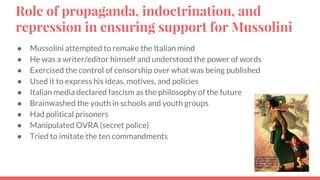
Role of propaganda, indoctrination, and
repression in ensuring support for Mussolini
● Mussolini attempted to remake the Italian mind
● He was a writer/editor himself and understood the power of words
● Exercised the control of censorship over what was being published
● Used it to express his ideas, motives, and policies
● Italian media declared fascism as the philosophy of the future
● Brainwashed the youth in schools and youth groups
● Had political prisoners
● Manipulated OVRA (secret police)
● Tried to imitate the ten commandments
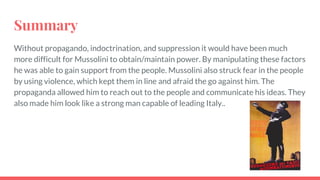
Summary
Without propagando, indoctrination, and suppression it would have been much
more difficult for Mussolini to obtain/maintain power. By manipulating these factors
he was able to gain support from the people. Mussolini also struck fear in the people
by using violence, which kept them in line and afraid the go against him. The
propaganda allowed him to reach out to the people and communicate his ideas. They
also made him look like a strong man capable of leading Italy..
Principal Methods Mussolini used to convey
his message to the Italian people
Newspaper:
● Hostile editors or journalists could be arrested or replaced
● Most popular journalists remained in their posts and reinforced reader's acceptance of what they said.
● State controlled what the papers said and most censorship was done by the editors
● The reporting of crime, unemployment, disorders etc were forbidden, along with most foreign papers banned.
● Authorities were allowed to confiscate newspapers on the grounds they published false information likely to incite
class hatred or bring the government into contempt. Pro-Fascist journals were supported, and by 1926, government
permission was needed to publish
Radio:
● Mussolini’s major speeches were broadcast live at large loudspeakers in various piazzas(town squares)
● Opera Nazionale Dopolavoro ran community listening meetings which helped spread fascist ideas, especially in
rural areas and to the illiterate
● With the spread of ownership of radio units during the Fascist regime, radio became the major tool for
propagandizing the population. It was used to broadcast Mussolini's open-air speeches, and as an instrument for
propagandizing youth. American author Ezra Pound broadcast on shortwave radio to propagandize the United
States
Principal Methods Mussolini used to convey
his message to the Italian people
Posters:
● Most visual means of propaganda
● Many walls plastered by the party and govt agencies with simple slogans and striking images of the Duce.
● Important as there was considerable illiteracy.
● Occasionally, opposition posters were displayed briefly, but generally the government had removed them completely.
Youth Groups:
● Young Fascists and University Fascist Groups existed to channel talent to the Fascist Party, and for several years
were the party's only source of new members. Students soon learned they had to join the university groups to
advance. Mussolini proclaimed their purpose was to inspire the youth for power and conquests, and as Fascist.
● Up to the age of fourteen, the groups were mainly sports for physical fitness, but at fourteen, militaristic drills were
added. They were given songs and commandments to mold their views. Everything from cultural institutes to camps
was deployed to consolidate activities about fascism
Principal Methods Mussolini used to convey
his message to the Italian people
Personality Cult
● Il Duce was the center of Fascism and portrayed as such. The cult of the Duce was in many respects the
unifying force of the fascist regime, acting as a common denominator of various political groups and social
classes in the fascist party and the Italian society. This leadership cult helped reconcile Italians with the
regime despite annoyance with local officials.
Fertility
● Slogans urged maternity as the female form of patriotism. Mussolini instructed the heads of fascist women's
organizations to go home and tell the women that they needed many births. To help the "battle of births",
assistance had to be given to mothers and newborns, and the founding of an organization to do so was
trumpeted. Contraception was decried as producing medical problems.
● Mussolini also called for a more rural Italy to increase births
Principal Methods Mussolini used to convey
his message to the Italian people
Slogans:
● Slogans were widely used, inscribed on walls
Marches
● Two major marches were devised as propaganda: the March on Rome, where Mussolini demanded power, and
the March of the Iron Will, to capture the Ethiopian capital. The notion of a "march on Rome" as a concept to
inspire heroism and sacrifice, and the Fascists made full use of the notion
Songs
● Songs were widely used for propaganda purposes. Even prior to the seizure of power, Mussolini was praised in
song. Its anthem was Giovinezza ("Youth")
Schools
● Curriculums for schools were immediately overhauled for Fascist purposes,, so that elementary schools were
soon spending twenty percent of their time teaching children to be good Fascists. Teachers were removed if
they did not conform, and textbooks were required to emphasize the "Fascist soul."
Methods used to ensure limited opposition
•The Press Law required that journalists had to be on an official register.
•The Ministry of Popular Culture controlled most of the literary and radio channels in
Italy from 1937 to 1944 with the avowed purpose of telling the truth about fascism, and
denying the lies of its enemies.
•Endless publicity revolved about Mussolini. Newspapers were instructed exactly what to
report on him.
~He was generally portrayed in a macho manner, although he also appeared as a
Renaissance man, military, or family man.
~He was also portrayed as a practitioner of various sports to create an image of a valiant
and fearless hero.
Methods used to ensure limited opposition
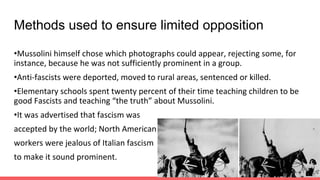
•Mussolini himself chose which photographs could appear, rejecting some, for
instance, because he was not sufficiently prominent in a group.
•Anti-fascists were deported, moved to rural areas, sentenced or killed.
•Elementary schools spent twenty percent of their time teaching children to be
good Fascists and teaching “the truth” about Mussolini.
•It was advertised that fascism was
accepted by the world; North American
workers were jealous of Italian fascism
to make it sound prominent.
Methods used to ensure limited opposition
•OVRA's main purpose was to stop any anti-fascist activity and resistance
groups, using violence to threaten them.
•Fascists controlled the police, so anti-fascists had no protection.
•Ability to sentence anti-fascists to harsh prison terms or even sentence to death
penalty.
•OVRA operated and maintained the CPC (Casellario Politico Centrale) - a special
archive of personal information on anti-fascists which included beliefs, cultures,
habits and even specific personal details of the character.
Effectiveness
● Missouri’s use of propaganda proved quite effective in giving him massive
support.
● People really fell for the blatant pandering Mussolini was doing.
● On the other hand, it proved eventually that Mussolini wasn't as in control as he
thought.
● This was made obvious by the abrupt end of his regime in 1943.
Importance
● Missouri’s use of propaganda and repression proved important in classifying
him.as a totalitarian rule.
● It also showed his true insecurities and how he needed the constant approval
and acceptance from the Italian people.
● Sadly, most of his policies in the end did not end up working and he wound up
alone again.

Mussolini PART 2

  • 1.
    Mussolini By: Daniel DelaRosa, ChrisHallstrand, Jessiney Regueiro, Sophia Viteri
  • 2.
    Methods used byMussolini ● Magazines ● Dissatisfaction of the Italian people over outcome of WWI ○ Black Shirts ● Violence ● Gain support of the Roman Catholic church ○ Changed personal behaviours to be able to represent a “good” catholic ● “Strike Busting” ○ Violence and force to suppress industrialists striking ● Appeasement with trade unions (until he came into power) ● Education ● Sent those who opposed him to foreign countries or small villages in Italy ● Limited/Removed individual freedoms such as freedom of speech ● Police force
  • 3.
    Why they wereneeded ● To rise to power ● To maintain control ● Gain support from different political parties, the church, the minorities, the working class… people of Italy ● Keep opposition to a minimum ● To have the people who are against him suppressed
  • 4.
    Role of propaganda,indoctrination, and repression in ensuring support for Mussolini ● Mussolini attempted to remake the Italian mind ● He was a writer/editor himself and understood the power of words ● Exercised the control of censorship over what was being published ● Used it to express his ideas, motives, and policies ● Italian media declared fascism as the philosophy of the future ● Brainwashed the youth in schools and youth groups ● Had political prisoners ● Manipulated OVRA (secret police) ● Tried to imitate the ten commandments
  • 5.
    Summary Without propagando, indoctrination,and suppression it would have been much more difficult for Mussolini to obtain/maintain power. By manipulating these factors he was able to gain support from the people. Mussolini also struck fear in the people by using violence, which kept them in line and afraid the go against him. The propaganda allowed him to reach out to the people and communicate his ideas. They also made him look like a strong man capable of leading Italy..
  • 6.
    Principal Methods Mussoliniused to convey his message to the Italian people Newspaper: ● Hostile editors or journalists could be arrested or replaced ● Most popular journalists remained in their posts and reinforced reader's acceptance of what they said. ● State controlled what the papers said and most censorship was done by the editors ● The reporting of crime, unemployment, disorders etc were forbidden, along with most foreign papers banned. ● Authorities were allowed to confiscate newspapers on the grounds they published false information likely to incite class hatred or bring the government into contempt. Pro-Fascist journals were supported, and by 1926, government permission was needed to publish Radio: ● Mussolini’s major speeches were broadcast live at large loudspeakers in various piazzas(town squares) ● Opera Nazionale Dopolavoro ran community listening meetings which helped spread fascist ideas, especially in rural areas and to the illiterate ● With the spread of ownership of radio units during the Fascist regime, radio became the major tool for propagandizing the population. It was used to broadcast Mussolini's open-air speeches, and as an instrument for propagandizing youth. American author Ezra Pound broadcast on shortwave radio to propagandize the United States
  • 7.
    Principal Methods Mussoliniused to convey his message to the Italian people Posters: ● Most visual means of propaganda ● Many walls plastered by the party and govt agencies with simple slogans and striking images of the Duce. ● Important as there was considerable illiteracy. ● Occasionally, opposition posters were displayed briefly, but generally the government had removed them completely. Youth Groups: ● Young Fascists and University Fascist Groups existed to channel talent to the Fascist Party, and for several years were the party's only source of new members. Students soon learned they had to join the university groups to advance. Mussolini proclaimed their purpose was to inspire the youth for power and conquests, and as Fascist. ● Up to the age of fourteen, the groups were mainly sports for physical fitness, but at fourteen, militaristic drills were added. They were given songs and commandments to mold their views. Everything from cultural institutes to camps was deployed to consolidate activities about fascism
  • 8.
    Principal Methods Mussoliniused to convey his message to the Italian people Personality Cult ● Il Duce was the center of Fascism and portrayed as such. The cult of the Duce was in many respects the unifying force of the fascist regime, acting as a common denominator of various political groups and social classes in the fascist party and the Italian society. This leadership cult helped reconcile Italians with the regime despite annoyance with local officials. Fertility ● Slogans urged maternity as the female form of patriotism. Mussolini instructed the heads of fascist women's organizations to go home and tell the women that they needed many births. To help the "battle of births", assistance had to be given to mothers and newborns, and the founding of an organization to do so was trumpeted. Contraception was decried as producing medical problems. ● Mussolini also called for a more rural Italy to increase births
  • 9.
    Principal Methods Mussoliniused to convey his message to the Italian people Slogans: ● Slogans were widely used, inscribed on walls Marches ● Two major marches were devised as propaganda: the March on Rome, where Mussolini demanded power, and the March of the Iron Will, to capture the Ethiopian capital. The notion of a "march on Rome" as a concept to inspire heroism and sacrifice, and the Fascists made full use of the notion Songs ● Songs were widely used for propaganda purposes. Even prior to the seizure of power, Mussolini was praised in song. Its anthem was Giovinezza ("Youth") Schools ● Curriculums for schools were immediately overhauled for Fascist purposes,, so that elementary schools were soon spending twenty percent of their time teaching children to be good Fascists. Teachers were removed if they did not conform, and textbooks were required to emphasize the "Fascist soul."
  • 10.
    Methods used toensure limited opposition •The Press Law required that journalists had to be on an official register. •The Ministry of Popular Culture controlled most of the literary and radio channels in Italy from 1937 to 1944 with the avowed purpose of telling the truth about fascism, and denying the lies of its enemies. •Endless publicity revolved about Mussolini. Newspapers were instructed exactly what to report on him. ~He was generally portrayed in a macho manner, although he also appeared as a Renaissance man, military, or family man. ~He was also portrayed as a practitioner of various sports to create an image of a valiant and fearless hero.
  • 11.
    Methods used toensure limited opposition •Mussolini himself chose which photographs could appear, rejecting some, for instance, because he was not sufficiently prominent in a group. •Anti-fascists were deported, moved to rural areas, sentenced or killed. •Elementary schools spent twenty percent of their time teaching children to be good Fascists and teaching “the truth” about Mussolini. •It was advertised that fascism was accepted by the world; North American workers were jealous of Italian fascism to make it sound prominent.
  • 12.
    Methods used toensure limited opposition •OVRA's main purpose was to stop any anti-fascist activity and resistance groups, using violence to threaten them. •Fascists controlled the police, so anti-fascists had no protection. •Ability to sentence anti-fascists to harsh prison terms or even sentence to death penalty. •OVRA operated and maintained the CPC (Casellario Politico Centrale) - a special archive of personal information on anti-fascists which included beliefs, cultures, habits and even specific personal details of the character.
  • 13.
    Effectiveness ● Missouri’s useof propaganda proved quite effective in giving him massive support. ● People really fell for the blatant pandering Mussolini was doing. ● On the other hand, it proved eventually that Mussolini wasn't as in control as he thought. ● This was made obvious by the abrupt end of his regime in 1943.
  • 14.
    Importance ● Missouri’s useof propaganda and repression proved important in classifying him.as a totalitarian rule. ● It also showed his true insecurities and how he needed the constant approval and acceptance from the Italian people. ● Sadly, most of his policies in the end did not end up working and he wound up alone again.