How did Mussolini use propaganda to strengthen his regime?   Objectives: What were the aims and methods of Fascist propaganda? How did Mussolini use culture for propaganda purposes? Starter activity: List 10 methods the Fascist government might have used to spread its ideas and win support. Wednesday 5th September 2005
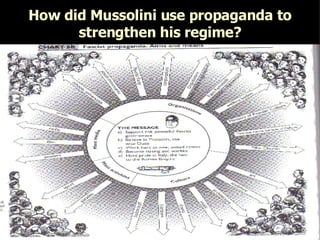
How did Mussolini use propaganda to strengthen his regime?
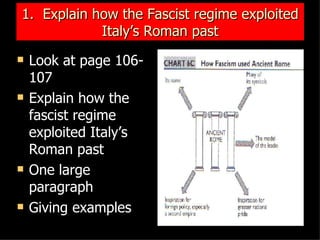
1.  Explain how the Fascist regime exploited Italy’s Roman past Look at page 106-107 Explain how the fascist regime exploited Italy’s Roman past One large paragraph Giving examples
2. How did propaganda develop in Fascist Italy? Summary Mussolini = journalist   Newspapers were the most important information and propaganda instrument Radio and  film =  slow start  but then = major propaganda tool especially  newsreels Enthusiasm    vast  parades  and  sporting  activities Technology    Difficult for fascist regimes to exist without technology? Microphone and loud speaker = voice to the masses Architecture   used to impress people = reinforced concrete, improved transportation for massive pieces of stone  Electrification, planes, railways, cars and tanks all in their way gave added power to the regime
How did propaganda develop in Fascist Italy? Analysis Development = gradual process Tannenbaum ‘amateurish’? Not as effective as Nazis Press office  gradually  extended its original role in the 1930s to cover radio, film and  eventually  all aspects of  culture. 1935 PO   Ministry    1937 Ministry of Popular Culture    nicknames ‘minculpop’    limited effect? Due to bureaucratic inefficiency Failure to win popular support for German alliance and government’s anti-Semitic policies in the late 1930s BIG BUT!! Most Italians believed, and some still do despite evidence to the contrary, that Fascism reduced crime, vice and poverty
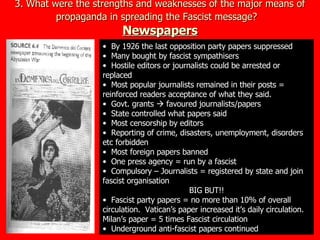
3. What were the strengths and weaknesses of the major means of propaganda in spreading the Fascist message?   Newspapers By 1926 the last opposition party papers suppressed Many bought by fascist sympathisers Hostile editors or journalists could be arrested or replaced Most popular journalists remained in their posts = reinforced readers acceptance of what they said. Govt. grants    favoured journalists/papers State controlled what papers said Most censorship by editors Reporting of crime, disasters, unemployment, disorders etc forbidden Most foreign papers banned One press agency = run by a fascist Compulsory – Journalists = registered by state and join fascist organisation BIG BUT!! Fascist party papers = no more than 10% of overall circulation.  Vatican’s paper increased it’s daily circulation.  Milan’s paper = 5 times Fascist circulation Underground anti-fascist papers continued
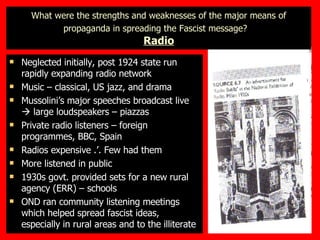
What were the strengths and weaknesses of the major means of propaganda in spreading the Fascist message?   Radio Neglected initially, post 1924 state run rapidly expanding radio network Music – classical, US jazz, and drama Mussolini’s major speeches broadcast live    large loudspeakers – piazzas Private radio listeners – foreign programmes, BBC, Spain  Radios expensive .’. Few had them More listened in public 1930s govt. provided sets for a new rural agency (ERR) – schools OND ran community listening meetings which helped spread fascist ideas, especially in rural areas and to the illiterate
What were the strengths and weaknesses of the major means of propaganda in spreading the Fascist message?   Cinema Govt. slow to realise it’s potential 1924 LUCE created – produce newsreels & documentaries. M previewed them! Shown before main film Censored Italian 7 imported films Autarky principle for film industry too – restricted Hollywood imports – subsidies 1937 IRI – Hollywood by the Tiber! Revival of domestic films Most films escapist/historical drama, few explicitly fascist – few propaganda films Increased no.s cinema – Dopolavora showed films, mobile cinemas – rural  Cinema offered escapism, false sense of security and national pride
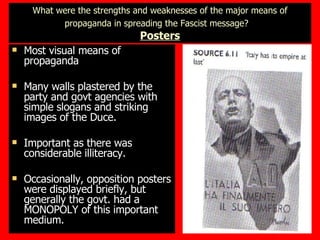
What were the strengths and weaknesses of the major means of propaganda in spreading the Fascist message?   Posters Most visual means of propaganda Many walls plastered by the party and govt agencies with simple slogans and striking images of the Duce. Important as there was considerable illiteracy. Occasionally, opposition posters were displayed briefly, but generally the govt. had a MONOPOLY of this important medium.
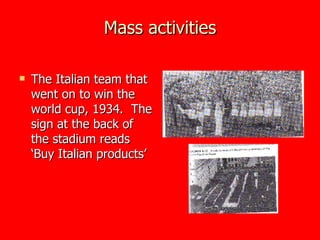
Mass activities The Italian team that went on to win the world cup, 1934.  The sign at the back of the stadium reads ‘Buy Italian products’
How did Mussolini use culture for propaganda purposes? Objectives: 1. Why was there considerable cultural diversity in Fascist Italy? 2. How effectively were the Arts and culture used for propaganda purposes?
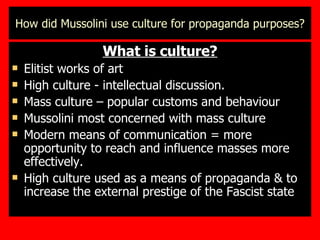
How did Mussolini use culture for propaganda purposes? What is culture? Elitist works of art High culture - intellectual discussion. Mass culture – popular customs and behaviour Mussolini most concerned with mass culture Modern means of communication = more opportunity to reach and influence masses more effectively. High culture used as a means of propaganda & to increase the external prestige of the Fascist state
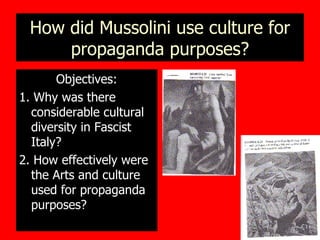
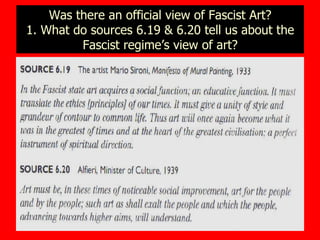
Was there an official view of Fascist Art? 1. What do sources 6.19 & 6.20 tell us about the Fascist regime’s view of art?
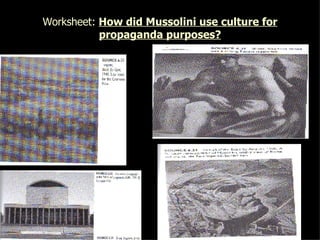
Worksheet:  How did Mussolini use culture for propaganda purposes?
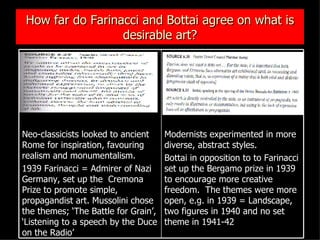
How far do Farinacci and Bottai agree on what is desirable art? Modernists experimented in more diverse, abstract styles.  Bottai in opposition to to Farinacci set up the Bergamo prize in 1939 to encourage more creative freedom.  The themes were more open, e.g. in 1939 = Landscape, two figures in 1940 and no set theme in 1941-42 Neo-classicists looked to ancient Rome for inspiration, favouring realism and monumentalism. 1939 Farinacci = Admirer of Nazi Germany, set up the  Cremona Prize to promote simple, propagandist art. Mussolini chose the themes; ‘The Battle for Grain’, ‘Listening to a speech by the Duce on the Radio’
Control The government tried to control art through promoting competitions, at regional, national and international level.  Winners received govt. funds and commissions Private commissioning largely unaffected…. until late 1930s. Artists expected to join the Syndicate of Professionals and Artists.  BIG BUT!! Artists were not required to subscribe to an official view of art. This meant that unlike Nazi Germany, Fascist Italy experienced no loss of major artists.
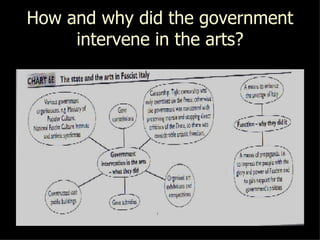
How and why did the government intervene in the arts?
Literature, Drama & Music Less attention    did not reach the masses.  Drama = minority pursuit despite efforts of OND & National Fascist Culture Institute.  NFCI    organised conferences, free concerts & publications.  200,000 members by 1941 = overwhelmingly middle class. Music = less potential for direct propaganda    musicians required to  join the Fascist Union of Musicians.  Encouraged to reject foreign influences and develop ‘cultural AUTARKY’.  However, considerable diversity was still maintained. In theory Ministry of Popular Culture was supposed to control music but in practice music escaped major regimentation
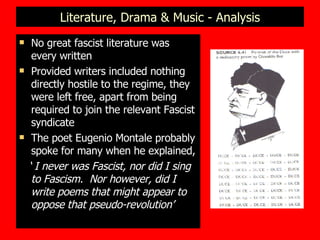
Literature, Drama & Music - Analysis No great fascist literature was every written  Provided writers included nothing directly hostile to the regime, they were left free, apart from being required to join the relevant Fascist syndicate  The poet Eugenio Montale probably spoke for many when he explained, ‘  I never was Fascist, nor did I sing to Fascism.  Nor however, did I write poems that might appear to oppose that pseudo-revolution’
Philosophy and Intellectual Ideas Mussolini was particularly  concerned to develop a philosophy of Fascism.  He considered this would boost the regime’s international reputation, and help establish a new Fascist elite. Communism = Writings of Marx and Lenin.  Nazism = Mein Kampf.  Fascism = nothing! Mussolini wanted to form a clear doctrine of Fascism. 1925 over 200 intellectuals met at Bologna to produce the Manifesto of Fascist intellectuals.  ‘Without fascism there can be no true culture!’  Counter Manifesto declared fascism and culture incompatible.
Philosophy and Intellectual Ideas - Analysis The attempt to intellectualise the diverse & contradictory ideas in the Fascist movement  had  little impact . Amongst the educated, Fascism was seen primarily as a vehicle  for  career advancement  rather than intellectual inspiration. Most intellectuals were  not committed  Fascists Famous philosopher Croce retained his influence – critical of regime – government took little action. Catholic Church  still influential    student’s federation & Catholic University in Milan. Italian intelligentsia, though politically conformist, did not become intellectually engaged with the regime.  The historian Zaggario has argue that  ‘ Italian academic culture was largely impervious (resistant) to Fascistisation’
 
Homework Activity page 121 All of it!!

Fascist Prpaganda

  • 1.
    How did Mussoliniuse propaganda to strengthen his regime? Objectives: What were the aims and methods of Fascist propaganda? How did Mussolini use culture for propaganda purposes? Starter activity: List 10 methods the Fascist government might have used to spread its ideas and win support. Wednesday 5th September 2005
  • 2.
    How did Mussoliniuse propaganda to strengthen his regime?
  • 3.
    1. Explainhow the Fascist regime exploited Italy’s Roman past Look at page 106-107 Explain how the fascist regime exploited Italy’s Roman past One large paragraph Giving examples
  • 4.
    2. How didpropaganda develop in Fascist Italy? Summary Mussolini = journalist  Newspapers were the most important information and propaganda instrument Radio and film = slow start but then = major propaganda tool especially newsreels Enthusiasm  vast parades and sporting activities Technology  Difficult for fascist regimes to exist without technology? Microphone and loud speaker = voice to the masses Architecture  used to impress people = reinforced concrete, improved transportation for massive pieces of stone Electrification, planes, railways, cars and tanks all in their way gave added power to the regime
  • 5.
    How did propagandadevelop in Fascist Italy? Analysis Development = gradual process Tannenbaum ‘amateurish’? Not as effective as Nazis Press office gradually extended its original role in the 1930s to cover radio, film and eventually all aspects of culture. 1935 PO  Ministry  1937 Ministry of Popular Culture  nicknames ‘minculpop’  limited effect? Due to bureaucratic inefficiency Failure to win popular support for German alliance and government’s anti-Semitic policies in the late 1930s BIG BUT!! Most Italians believed, and some still do despite evidence to the contrary, that Fascism reduced crime, vice and poverty
  • 6.
    3. What werethe strengths and weaknesses of the major means of propaganda in spreading the Fascist message? Newspapers By 1926 the last opposition party papers suppressed Many bought by fascist sympathisers Hostile editors or journalists could be arrested or replaced Most popular journalists remained in their posts = reinforced readers acceptance of what they said. Govt. grants  favoured journalists/papers State controlled what papers said Most censorship by editors Reporting of crime, disasters, unemployment, disorders etc forbidden Most foreign papers banned One press agency = run by a fascist Compulsory – Journalists = registered by state and join fascist organisation BIG BUT!! Fascist party papers = no more than 10% of overall circulation. Vatican’s paper increased it’s daily circulation. Milan’s paper = 5 times Fascist circulation Underground anti-fascist papers continued
  • 7.
    What were thestrengths and weaknesses of the major means of propaganda in spreading the Fascist message? Radio Neglected initially, post 1924 state run rapidly expanding radio network Music – classical, US jazz, and drama Mussolini’s major speeches broadcast live  large loudspeakers – piazzas Private radio listeners – foreign programmes, BBC, Spain Radios expensive .’. Few had them More listened in public 1930s govt. provided sets for a new rural agency (ERR) – schools OND ran community listening meetings which helped spread fascist ideas, especially in rural areas and to the illiterate
  • 8.
    What were thestrengths and weaknesses of the major means of propaganda in spreading the Fascist message? Cinema Govt. slow to realise it’s potential 1924 LUCE created – produce newsreels & documentaries. M previewed them! Shown before main film Censored Italian 7 imported films Autarky principle for film industry too – restricted Hollywood imports – subsidies 1937 IRI – Hollywood by the Tiber! Revival of domestic films Most films escapist/historical drama, few explicitly fascist – few propaganda films Increased no.s cinema – Dopolavora showed films, mobile cinemas – rural Cinema offered escapism, false sense of security and national pride
  • 9.
    What were thestrengths and weaknesses of the major means of propaganda in spreading the Fascist message? Posters Most visual means of propaganda Many walls plastered by the party and govt agencies with simple slogans and striking images of the Duce. Important as there was considerable illiteracy. Occasionally, opposition posters were displayed briefly, but generally the govt. had a MONOPOLY of this important medium.
  • 10.
    Mass activities TheItalian team that went on to win the world cup, 1934. The sign at the back of the stadium reads ‘Buy Italian products’
  • 11.
    How did Mussoliniuse culture for propaganda purposes? Objectives: 1. Why was there considerable cultural diversity in Fascist Italy? 2. How effectively were the Arts and culture used for propaganda purposes?
  • 12.
    How did Mussoliniuse culture for propaganda purposes? What is culture? Elitist works of art High culture - intellectual discussion. Mass culture – popular customs and behaviour Mussolini most concerned with mass culture Modern means of communication = more opportunity to reach and influence masses more effectively. High culture used as a means of propaganda & to increase the external prestige of the Fascist state
  • 13.
    Was there anofficial view of Fascist Art? 1. What do sources 6.19 & 6.20 tell us about the Fascist regime’s view of art?
  • 14.
    Worksheet: Howdid Mussolini use culture for propaganda purposes?
  • 15.
    How far doFarinacci and Bottai agree on what is desirable art? Modernists experimented in more diverse, abstract styles. Bottai in opposition to to Farinacci set up the Bergamo prize in 1939 to encourage more creative freedom. The themes were more open, e.g. in 1939 = Landscape, two figures in 1940 and no set theme in 1941-42 Neo-classicists looked to ancient Rome for inspiration, favouring realism and monumentalism. 1939 Farinacci = Admirer of Nazi Germany, set up the Cremona Prize to promote simple, propagandist art. Mussolini chose the themes; ‘The Battle for Grain’, ‘Listening to a speech by the Duce on the Radio’
  • 16.
    Control The governmenttried to control art through promoting competitions, at regional, national and international level. Winners received govt. funds and commissions Private commissioning largely unaffected…. until late 1930s. Artists expected to join the Syndicate of Professionals and Artists. BIG BUT!! Artists were not required to subscribe to an official view of art. This meant that unlike Nazi Germany, Fascist Italy experienced no loss of major artists.
  • 17.
    How and whydid the government intervene in the arts?
  • 18.
    Literature, Drama &Music Less attention  did not reach the masses. Drama = minority pursuit despite efforts of OND & National Fascist Culture Institute. NFCI  organised conferences, free concerts & publications. 200,000 members by 1941 = overwhelmingly middle class. Music = less potential for direct propaganda  musicians required to join the Fascist Union of Musicians. Encouraged to reject foreign influences and develop ‘cultural AUTARKY’. However, considerable diversity was still maintained. In theory Ministry of Popular Culture was supposed to control music but in practice music escaped major regimentation
  • 19.
    Literature, Drama &Music - Analysis No great fascist literature was every written Provided writers included nothing directly hostile to the regime, they were left free, apart from being required to join the relevant Fascist syndicate The poet Eugenio Montale probably spoke for many when he explained, ‘ I never was Fascist, nor did I sing to Fascism. Nor however, did I write poems that might appear to oppose that pseudo-revolution’
  • 20.
    Philosophy and IntellectualIdeas Mussolini was particularly concerned to develop a philosophy of Fascism. He considered this would boost the regime’s international reputation, and help establish a new Fascist elite. Communism = Writings of Marx and Lenin. Nazism = Mein Kampf. Fascism = nothing! Mussolini wanted to form a clear doctrine of Fascism. 1925 over 200 intellectuals met at Bologna to produce the Manifesto of Fascist intellectuals. ‘Without fascism there can be no true culture!’ Counter Manifesto declared fascism and culture incompatible.
  • 21.
    Philosophy and IntellectualIdeas - Analysis The attempt to intellectualise the diverse & contradictory ideas in the Fascist movement had little impact . Amongst the educated, Fascism was seen primarily as a vehicle for career advancement rather than intellectual inspiration. Most intellectuals were not committed Fascists Famous philosopher Croce retained his influence – critical of regime – government took little action. Catholic Church still influential  student’s federation & Catholic University in Milan. Italian intelligentsia, though politically conformist, did not become intellectually engaged with the regime. The historian Zaggario has argue that ‘ Italian academic culture was largely impervious (resistant) to Fascistisation’
  • 22.
  • 23.
    Homework Activity page121 All of it!!