Hitler’s Success
Melissa Calil
Daniel De La Rosa
Ryann Puente
Was Hitler a Successful Ruler of Germany by 1941?
Although many of his ideas were reprehensible as well as being responsible for the deaths of millions of
people during his campaign, Adolf Hitler's ability as a leader is well known. From his roots as a soldier and
member of the working class, Hitler was able to use his perspective, charisma and oratory skills to gain
the support of the people and eventually the appointment of chancellor of Germany.
His policies resulted in a swift recovery from the effects of the Great Depression, and this earned him the
enduring affection of the people. Unfortunately, his methods of improving the German quality of life also
entailed the extermination of “inferiors” but despite the horrors that resulted, the fact that he was able to
inspire his followers to such atrocities stands as a testament to his skill as a leader of men.
Was Hitler a Successful Ruler of Germany by 1941?
Successful in the Eye of the People? Yes
He was a true spokesman of the people, for the people. From microcosmic pep talks to his fellow
workman on building sites, to talks in beer houses, to speeches in basements, to town halls.
He was a very strong oratory leader, who used speeches to spread his message across Germany and
unite the people. His motivational speeches gained the respect and support of the people, giving him a
better chance at staying power longer.
The organisations that were under control were instilled with the Nazi ideology. Using this policy, Hitler
started up youth groups that were riddled with Nazi policies and values and made them compulsory for
youth between the ages 10-18 for both the males and females. Hitler also managed to force all labour
unions under the Nazi Labour Front.
Was Hitler a Successful Ruler of Germany by 1941?
Propaganda/Publicity Success? Yes
Joseph Goebbels was appointed Reich Minister of Propaganda and proved to be an expert in his mastery
of the dark art of propaganda.
With his use of propaganda, Hitler was able to speak to the people and encourage them to support him;
he used pictures of him working in the fields, with children, and making himself look like a friendly, athletic
man. He did this to make him seem like an ally to the people, and a man that was on their side.
Was Hitler a Successful Ruler of Germany by 1941?
Successful Politically? Yes
Throughout Hitler’s political career, his common theme was about cleaning up Germany.
He banned supermarkets, because he wanted local small businesses to prosper. He banned degrading
modern art, as he recognised it for what it was. He banned vivisection (animal experiments), because in
his wisdom he could see how futile and unnecessary they were.
He encouraged healthy youth activities and social programmes to enhance cultural pride and individual
self worth, such as sports and recreational activities. He helped develop beauty, cleanliness and pride
back into the German people.
Was Hitler a Successful Ruler of Germany by 1941?
Having stumbled on his father’s war books, Hitler was able to prepare himself for his ruthless and meteoric
rise to power. Some salient points were
1. His decision to take power politically and not forcefully
2. Transforming the Workers Party from a discussion group into a political party
3. Becoming Chairman of the Party in 1921
4. Running for election from 1930 to 1933 and eventually becoming chancellor in a coalition
government with President Von Lindenberg
5. By 1937, Hitler was ready to outline the plan for military aggression in Europe.
In all his political career, Hitler would deal ruthlessly with anyone who opposed him and was relentless in
his quest to become the Dictator of Germany.
Was Hitler a Successful Ruler of Germany by 1941?
Successful Economically? Yes
Hitler successfully pulled the German economy out of depression and quickly too by ignoring the terms of
the Treaty of Versailles. Once the Nazi party had taken over Germany, Hitler appointed Dr Hjalmar
Schacht, a gifted economist to upturn the economy. Under the command of Schacht, the German Gross
National Product grew approximately 102% between 1932 to 1937. With the dramatic increase of
rearmament, unemployment decreased from 6 million down to 2 million by 1935. Unemployment dropped
so much under Hitler’s rule that by 1939 there was a job shortage . By January 1st 1938, aryanization was
introduced. This meant that Jews or anyone else that was “non-Aryan” were forbidden to have businesses
or trades. This meant that there were more employment opportunities for Aryans (pure Germans).
Was Hitler a Successful Ruler of Germany by 1941?
Hitler had been successful in many of his political, economic and social aims and also became the Führer
of Germany. Although he was successful many times, he never achieved his goals that were most
important to him.
One of these failures is the loss of World War II which resulted in his suicide. Because of his many
failures, Hitler is not seen as a successful dictator. However he had great triumph in pulling the German
economy out of depression and quickly climbed up to the titles Fuhrer and Chancellor. In terms of what he
succeeded in, Hitler was a successful dictator, although he did not achieve in some of his major goals.
“Hitler has done more harm than good in Germany before 1939”
Social Harm:
- Loss of freedom/ freedom of speech
- Only “German” culture was allowed to be expressed; therefore cultural diversity
was banned.
- Installment of fear in the German people
- Isolation of the Jews and the effects of the Nuremberg Laws
- Rise of anti-semitism
- Prejudice against other minorities (handicapped, homosexuals, gypsies)
- Sterilization of the handicapped
“Hitler has done more harm than good in Germany before 1939”
Economic/Military Harm:
- Wages fell
- Trade unions were banned
- Job discrimination against women
- Government debt was over 40 billion reichsmarks
- Military spending was at an all time high
While Hitler did harm Germany economically, there were benefits that he also
produced.
“Hitler has done more harm than good in Germany before 1939” (False)
Although on the surface it may seem like Hitler did more harm than good,
there are some cases where the opposite can be concluded:
Happiness:
People felt no specific need to lock their doors due to increased security.
The Strength Through Joy program rewarded people with holidays and activities.
There was a sense of pride and excitement about Germany due to multiple rallies and
parades.
Propaganda and brainwashing gave people a sense, albeit false, of hope and assurance.
The Law for the Encouragement of Marriage gave newly-wed couples a loan of 1000 marks,
“Hitler has done more harm than good in Germany before 1939” (False)
Unemployment:
Public works caused a major drop in unemployment rates.
Government spending grew radically.
Economy:
The Farm Law assured farmers sales and given subsidies.
Autarky was introduced.
The New Plan of 1934 subsidized industries.
There was a major boost in production.
“Hitler has done more harm than good in Germany before 1939” (False)
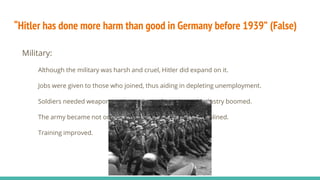
Military:
Although the military was harsh and cruel, Hitler did expand on it.
Jobs were given to those who joined, thus aiding in depleting unemployment.
Soldiers needed weapons and supplies so factories and industry boomed.
The army became not only more numerous, but more disciplined.
Training improved.

Hitler

  • 1.
  • 2.
    Was Hitler aSuccessful Ruler of Germany by 1941? Although many of his ideas were reprehensible as well as being responsible for the deaths of millions of people during his campaign, Adolf Hitler's ability as a leader is well known. From his roots as a soldier and member of the working class, Hitler was able to use his perspective, charisma and oratory skills to gain the support of the people and eventually the appointment of chancellor of Germany. His policies resulted in a swift recovery from the effects of the Great Depression, and this earned him the enduring affection of the people. Unfortunately, his methods of improving the German quality of life also entailed the extermination of “inferiors” but despite the horrors that resulted, the fact that he was able to inspire his followers to such atrocities stands as a testament to his skill as a leader of men.
  • 3.
    Was Hitler aSuccessful Ruler of Germany by 1941? Successful in the Eye of the People? Yes He was a true spokesman of the people, for the people. From microcosmic pep talks to his fellow workman on building sites, to talks in beer houses, to speeches in basements, to town halls. He was a very strong oratory leader, who used speeches to spread his message across Germany and unite the people. His motivational speeches gained the respect and support of the people, giving him a better chance at staying power longer. The organisations that were under control were instilled with the Nazi ideology. Using this policy, Hitler started up youth groups that were riddled with Nazi policies and values and made them compulsory for youth between the ages 10-18 for both the males and females. Hitler also managed to force all labour unions under the Nazi Labour Front.
  • 4.
    Was Hitler aSuccessful Ruler of Germany by 1941? Propaganda/Publicity Success? Yes Joseph Goebbels was appointed Reich Minister of Propaganda and proved to be an expert in his mastery of the dark art of propaganda. With his use of propaganda, Hitler was able to speak to the people and encourage them to support him; he used pictures of him working in the fields, with children, and making himself look like a friendly, athletic man. He did this to make him seem like an ally to the people, and a man that was on their side.
  • 5.
    Was Hitler aSuccessful Ruler of Germany by 1941? Successful Politically? Yes Throughout Hitler’s political career, his common theme was about cleaning up Germany. He banned supermarkets, because he wanted local small businesses to prosper. He banned degrading modern art, as he recognised it for what it was. He banned vivisection (animal experiments), because in his wisdom he could see how futile and unnecessary they were. He encouraged healthy youth activities and social programmes to enhance cultural pride and individual self worth, such as sports and recreational activities. He helped develop beauty, cleanliness and pride back into the German people.
  • 6.
    Was Hitler aSuccessful Ruler of Germany by 1941? Having stumbled on his father’s war books, Hitler was able to prepare himself for his ruthless and meteoric rise to power. Some salient points were 1. His decision to take power politically and not forcefully 2. Transforming the Workers Party from a discussion group into a political party 3. Becoming Chairman of the Party in 1921 4. Running for election from 1930 to 1933 and eventually becoming chancellor in a coalition government with President Von Lindenberg 5. By 1937, Hitler was ready to outline the plan for military aggression in Europe. In all his political career, Hitler would deal ruthlessly with anyone who opposed him and was relentless in his quest to become the Dictator of Germany.
  • 7.
    Was Hitler aSuccessful Ruler of Germany by 1941? Successful Economically? Yes Hitler successfully pulled the German economy out of depression and quickly too by ignoring the terms of the Treaty of Versailles. Once the Nazi party had taken over Germany, Hitler appointed Dr Hjalmar Schacht, a gifted economist to upturn the economy. Under the command of Schacht, the German Gross National Product grew approximately 102% between 1932 to 1937. With the dramatic increase of rearmament, unemployment decreased from 6 million down to 2 million by 1935. Unemployment dropped so much under Hitler’s rule that by 1939 there was a job shortage . By January 1st 1938, aryanization was introduced. This meant that Jews or anyone else that was “non-Aryan” were forbidden to have businesses or trades. This meant that there were more employment opportunities for Aryans (pure Germans).
  • 8.
    Was Hitler aSuccessful Ruler of Germany by 1941? Hitler had been successful in many of his political, economic and social aims and also became the Führer of Germany. Although he was successful many times, he never achieved his goals that were most important to him. One of these failures is the loss of World War II which resulted in his suicide. Because of his many failures, Hitler is not seen as a successful dictator. However he had great triumph in pulling the German economy out of depression and quickly climbed up to the titles Fuhrer and Chancellor. In terms of what he succeeded in, Hitler was a successful dictator, although he did not achieve in some of his major goals.
  • 9.
    “Hitler has donemore harm than good in Germany before 1939” Social Harm: - Loss of freedom/ freedom of speech - Only “German” culture was allowed to be expressed; therefore cultural diversity was banned. - Installment of fear in the German people - Isolation of the Jews and the effects of the Nuremberg Laws - Rise of anti-semitism - Prejudice against other minorities (handicapped, homosexuals, gypsies) - Sterilization of the handicapped
  • 10.
    “Hitler has donemore harm than good in Germany before 1939” Economic/Military Harm: - Wages fell - Trade unions were banned - Job discrimination against women - Government debt was over 40 billion reichsmarks - Military spending was at an all time high While Hitler did harm Germany economically, there were benefits that he also produced.
  • 11.
    “Hitler has donemore harm than good in Germany before 1939” (False) Although on the surface it may seem like Hitler did more harm than good, there are some cases where the opposite can be concluded: Happiness: People felt no specific need to lock their doors due to increased security. The Strength Through Joy program rewarded people with holidays and activities. There was a sense of pride and excitement about Germany due to multiple rallies and parades. Propaganda and brainwashing gave people a sense, albeit false, of hope and assurance. The Law for the Encouragement of Marriage gave newly-wed couples a loan of 1000 marks,
  • 12.
    “Hitler has donemore harm than good in Germany before 1939” (False) Unemployment: Public works caused a major drop in unemployment rates. Government spending grew radically. Economy: The Farm Law assured farmers sales and given subsidies. Autarky was introduced. The New Plan of 1934 subsidized industries. There was a major boost in production.
  • 13.
    “Hitler has donemore harm than good in Germany before 1939” (False) Military: Although the military was harsh and cruel, Hitler did expand on it. Jobs were given to those who joined, thus aiding in depleting unemployment. Soldiers needed weapons and supplies so factories and industry boomed. The army became not only more numerous, but more disciplined. Training improved.