8 Stages of Genocide
How Atrocity Occurs in our World
1. CLASSIFICATION:
•

•

Classification is the categorizing of people into groups. They are classified by
race, religion and/or nationality. An us versus them attitude is introduced and
promoted.
Classification will always take place; it has happened in Ireland. There are
divisions drawn between Protestants and Catholics, and between Nationals
and Non-Nationals. There are ways of insuring that these classifications don't
escalate. If both sides find a common ground, tolerance can grow.
What are some ways that you place people into
classifications? What groups, or cliques, do you
recognize?
2. SYMBOLIZATION:
•

We give names or other symbols to
the classifications. We name people
"Jews" or "Gypsies", or distinguish
them by colors or dress; and apply
them to members of groups.
Classification and symbolization are
universally human and do not
necessarily result in genocide
unless they lead to dehumanization.
What symbols identify the members of the groups that
you identified earlier? How do you recognize them?
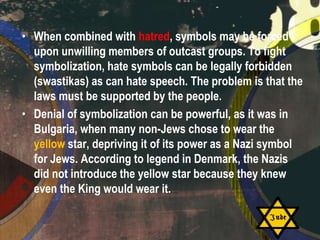
• When combined with hatred, symbols may be forced
upon unwilling members of outcast groups. To fight
symbolization, hate symbols can be legally forbidden
(swastikas) as can hate speech. The problem is that the
laws must be supported by the people.
• Denial of symbolization can be powerful, as it was in
Bulgaria, when many non-Jews chose to wear the
yellow star, depriving it of its power as a Nazi symbol
for Jews. According to legend in Denmark, the Nazis
did not introduce the yellow star because they knew
even the King would wear it.
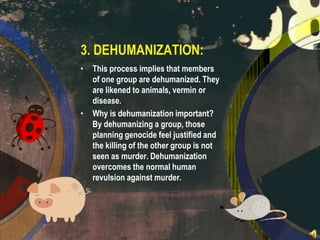
3. DEHUMANIZATION:
•

•

This process implies that members
of one group are dehumanized. They
are likened to animals, vermin or
disease.
Why is dehumanization important?
By dehumanizing a group, those
planning genocide feel justified and
the killing of the other group is not
seen as murder. Dehumanization
overcomes the normal human
revulsion against murder.
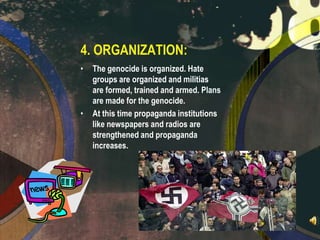
4. ORGANIZATION:
•

•

The genocide is organized. Hate
groups are organized and militias
are formed, trained and armed. Plans
are made for the genocide.
At this time propaganda institutions
like newspapers and radios are
strengthened and propaganda
increases.
5. POLARIZATION:
•

•

Polarization is used to describe the
way that extremists drive the two
groups involved in genocide apart.
The us versus them attitude is
emphasized.
At this time a new view is formed, if
you are not with us, you are against
us. Moderates (those in the middle)
are called traitors and are
persecuted. Some are even killed. It
now becomes a kill or be killed
situation.
6. PREPARATION:
•

•

Plans are made for the fast
approaching genocide. Lists are
drawn up of those who are to be
killed. Trial massacres are
conducted to give the murderers
practice. If these massacres go
ignored by the international
community, genocide is ready to
proceed.
At this time an international force
should be sent to intervene and
humanitarian assistance should be
organized for the inevitable tide of
refugees.
7. EXTERMINATION:
•

•

This is when the killing begins. It is
termed "extermination" as the killers
believe their victims to be less than
human and that they are purifying
society.
At this stage, only rapid and
overwhelming armed intervention
can stop genocide.
8. DENIAL:

During and after every genocide the crime is denied by the perpetrators.
How can you deny genocide?
You lie, block investigations and dispose of the evidence.
The killers hide the bodies in mass graves and intimidate any witnesses brave
enough to speak out.
Most say that the genocide was justified by claiming that the killings were part
of a war or a repression of terrorism.
 The best response to denial is punishment by an international tribunal or
national courts. There the evidence can be heard, and the perpetrators
punished.
Modern-day
genocide
The past repeats itself
History of the word “Genocide”
•

•

•

•

In 1944, a Polish-Jewish lawyer
named Raphael Lemkin coined the
term genocide.
He took the Greek word “geno” (race
or tribe) and combined it with the
Latin word “cide”, which means
killing.
On December 9th, 1948, the United
Nations approved the Convention on
the Prevention and Punishment of
the Crime of Genocide.
The UN made it an international
crime to commit genocide, with all of
its member nations agreeing to
“undertake to prevent and punish”
the crime.
Definition of the word “Genocide”
Genocide is defined as any of the following
acts committed with the intent to
destroy, in whole or in part, a national,
ethical, racial or religious group, as
such:

A.

Killing members of the
group

B.

Causing serious bodily or
mental harm to members
of the group
Deliberately inflicting on
the group conditions of life
calculated to bring about
its physical destruction in
whole or in part
Imposing measures
intending to prevent births
in the group
Forcibly transferring
children from the group to
another group

C.

D.

E.
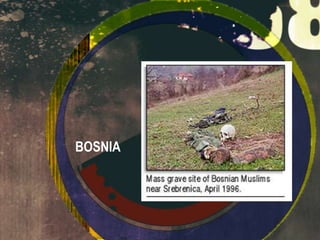
BOSNIA
Genocide in Bosnia 1992-1995
•
•
•
•

•

•

In April 1992, Bosnia declared themselves to be an
independent country from Yugoslavia.
The president of Yugoslavia, Slobodan Milosevic, who was
Serbian, attacked Bosnia, which was made up of mostly
Muslims, who the Serbs viewed as ethnically inferior.
In the capital of Sarajevo, Serbian snipers targeted
innocent civilians, including children (3, 500).
While the UN instructed its troops to do nothing, the Serbs
rounded up Muslims, put the men and boys into makeshift
concentration camps, and raped the women and girls.
President Bill Clinton eventually brokered a peace
agreement in 1995, but the Serbs broke it when they
captured UN troops and forced them to watch as they
selected and slaughtered 8,000 men and boys between the
ages of twelve and sixty and raped mass numbers of
females.
In August of 1995, NATO stepped in and ended the conflict
by bombing the Serbs, but not until the death toll in
Bosnia reached 200,000 Muslims killed, 20,000
missing, and more than 2,000,000 displaced.
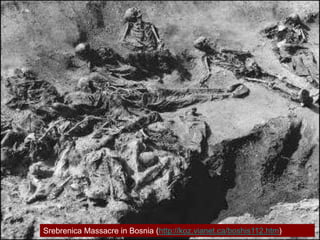
Srebrenica Massacre in Bosnia (http://koz.vianet.ca/boshis112.htm)
Words without deeds violates the moral and
legal obligation we have under the genocide
convention but, more importantly, violates our
sense of right and wrong and the standards we
have as human beings about looking to care
for one another.
-Jon Corzine

Modern day genocide

  • 1.
    8 Stages ofGenocide How Atrocity Occurs in our World
  • 2.
    1. CLASSIFICATION: • • Classification isthe categorizing of people into groups. They are classified by race, religion and/or nationality. An us versus them attitude is introduced and promoted. Classification will always take place; it has happened in Ireland. There are divisions drawn between Protestants and Catholics, and between Nationals and Non-Nationals. There are ways of insuring that these classifications don't escalate. If both sides find a common ground, tolerance can grow.
  • 3.
    What are someways that you place people into classifications? What groups, or cliques, do you recognize?
  • 4.
    2. SYMBOLIZATION: • We givenames or other symbols to the classifications. We name people "Jews" or "Gypsies", or distinguish them by colors or dress; and apply them to members of groups. Classification and symbolization are universally human and do not necessarily result in genocide unless they lead to dehumanization.
  • 5.
    What symbols identifythe members of the groups that you identified earlier? How do you recognize them?
  • 6.
    • When combinedwith hatred, symbols may be forced upon unwilling members of outcast groups. To fight symbolization, hate symbols can be legally forbidden (swastikas) as can hate speech. The problem is that the laws must be supported by the people. • Denial of symbolization can be powerful, as it was in Bulgaria, when many non-Jews chose to wear the yellow star, depriving it of its power as a Nazi symbol for Jews. According to legend in Denmark, the Nazis did not introduce the yellow star because they knew even the King would wear it.
  • 7.
    3. DEHUMANIZATION: • • This processimplies that members of one group are dehumanized. They are likened to animals, vermin or disease. Why is dehumanization important? By dehumanizing a group, those planning genocide feel justified and the killing of the other group is not seen as murder. Dehumanization overcomes the normal human revulsion against murder.
  • 8.
    4. ORGANIZATION: • • The genocideis organized. Hate groups are organized and militias are formed, trained and armed. Plans are made for the genocide. At this time propaganda institutions like newspapers and radios are strengthened and propaganda increases.
  • 9.
    5. POLARIZATION: • • Polarization isused to describe the way that extremists drive the two groups involved in genocide apart. The us versus them attitude is emphasized. At this time a new view is formed, if you are not with us, you are against us. Moderates (those in the middle) are called traitors and are persecuted. Some are even killed. It now becomes a kill or be killed situation.
  • 10.
    6. PREPARATION: • • Plans aremade for the fast approaching genocide. Lists are drawn up of those who are to be killed. Trial massacres are conducted to give the murderers practice. If these massacres go ignored by the international community, genocide is ready to proceed. At this time an international force should be sent to intervene and humanitarian assistance should be organized for the inevitable tide of refugees.
  • 11.
    7. EXTERMINATION: • • This iswhen the killing begins. It is termed "extermination" as the killers believe their victims to be less than human and that they are purifying society. At this stage, only rapid and overwhelming armed intervention can stop genocide.
  • 12.
    8. DENIAL:  During andafter every genocide the crime is denied by the perpetrators. How can you deny genocide? You lie, block investigations and dispose of the evidence. The killers hide the bodies in mass graves and intimidate any witnesses brave enough to speak out. Most say that the genocide was justified by claiming that the killings were part of a war or a repression of terrorism.  The best response to denial is punishment by an international tribunal or national courts. There the evidence can be heard, and the perpetrators punished.
  • 13.
  • 14.
    History of theword “Genocide” • • • • In 1944, a Polish-Jewish lawyer named Raphael Lemkin coined the term genocide. He took the Greek word “geno” (race or tribe) and combined it with the Latin word “cide”, which means killing. On December 9th, 1948, the United Nations approved the Convention on the Prevention and Punishment of the Crime of Genocide. The UN made it an international crime to commit genocide, with all of its member nations agreeing to “undertake to prevent and punish” the crime.
  • 15.
    Definition of theword “Genocide” Genocide is defined as any of the following acts committed with the intent to destroy, in whole or in part, a national, ethical, racial or religious group, as such: A. Killing members of the group B. Causing serious bodily or mental harm to members of the group Deliberately inflicting on the group conditions of life calculated to bring about its physical destruction in whole or in part Imposing measures intending to prevent births in the group Forcibly transferring children from the group to another group C. D. E.
  • 16.
  • 17.
    Genocide in Bosnia1992-1995 • • • • • • In April 1992, Bosnia declared themselves to be an independent country from Yugoslavia. The president of Yugoslavia, Slobodan Milosevic, who was Serbian, attacked Bosnia, which was made up of mostly Muslims, who the Serbs viewed as ethnically inferior. In the capital of Sarajevo, Serbian snipers targeted innocent civilians, including children (3, 500). While the UN instructed its troops to do nothing, the Serbs rounded up Muslims, put the men and boys into makeshift concentration camps, and raped the women and girls. President Bill Clinton eventually brokered a peace agreement in 1995, but the Serbs broke it when they captured UN troops and forced them to watch as they selected and slaughtered 8,000 men and boys between the ages of twelve and sixty and raped mass numbers of females. In August of 1995, NATO stepped in and ended the conflict by bombing the Serbs, but not until the death toll in Bosnia reached 200,000 Muslims killed, 20,000 missing, and more than 2,000,000 displaced.
  • 18.
    Srebrenica Massacre inBosnia (http://koz.vianet.ca/boshis112.htm)
  • 19.
    Words without deedsviolates the moral and legal obligation we have under the genocide convention but, more importantly, violates our sense of right and wrong and the standards we have as human beings about looking to care for one another. -Jon Corzine