about
organic
introduction
follow
Topics
about
THE SPEAKER
KEITH HERNANDEZ
A NATURAL FARMING PRACTICTIONER,
SPEAKER, AND AGRICULTURE TRAINER FOR
NGOS’AND LGU’S
Topics
follow
introduction
about
introduction
Topics
follow
www.facebook.com/projectnaturalfarming
Gmail : keith.f.hernandez@gmail.com
Smart : 09983343277
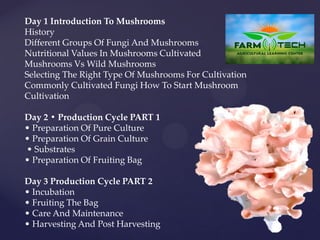
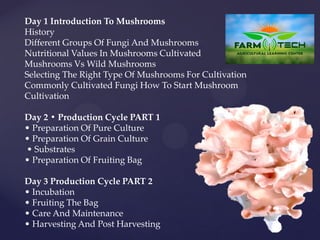
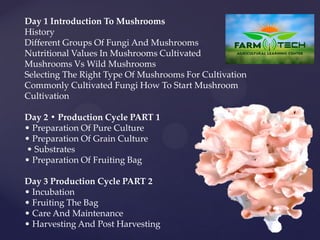
Day 1 Introduction To Mushrooms
History
Different Groups Of Fungi And Mushrooms
Nutritional Values In Mushrooms Cultivated
Mushrooms Vs Wild Mushrooms
Selecting The Right Type Of Mushrooms For Cultivation
Commonly Cultivated Fungi How To Start Mushroom
Cultivation
Day 2 • Production Cycle PART 1
• Preparation Of Pure Culture
• Preparation Of Grain Culture
• Substrates
• Preparation Of Fruiting Bag
Day 3 Production Cycle PART 2
• Incubation
• Fruiting The Bag
• Care And Maintenance
• Harvesting And Post Harvesting
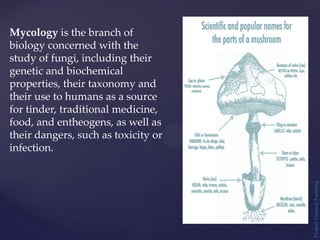
Mycology is the branch of
biology concerned with the
study of fungi, including their
genetic and biochemical
properties, their taxonomy and
their use to humans as a source
for tinder, traditional medicine,
food, and entheogens, as well as
their dangers, such as toxicity or
infection.
Project
Natural
Farming
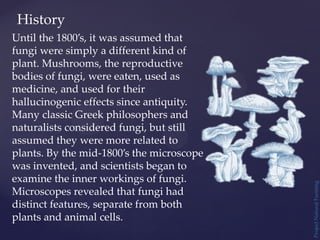
Until the 1800’s, it was assumed that
fungi were simply a different kind of
plant. Mushrooms, the reproductive
bodies of fungi, were eaten, used as
medicine, and used for their
hallucinogenic effects since antiquity.
Many classic Greek philosophers and
naturalists considered fungi, but still
assumed they were more related to
plants. By the mid-1800’s the microscope
was invented, and scientists began to
examine the inner workings of fungi.
Microscopes revealed that fungi had
distinct features, separate from both
plants and animal cells.
History
Project
Natural
Farming
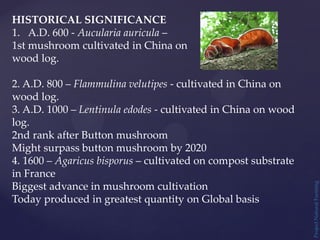
HISTORICAL SIGNIFICANCE
1. A.D. 600 - Aucularia auricula –
1st mushroom cultivated in China on
wood log.
2. A.D. 800 – Flammulina velutipes - cultivated in China on
wood log.
3. A.D. 1000 – Lentinula edodes - cultivated in China on wood
log.
2nd rank after Button mushroom
Might surpass button mushroom by 2020
4. 1600 – Agaricus bisporus – cultivated on compost substrate
in France
Biggest advance in mushroom cultivation
Today produced in greatest quantity on Global basis
Project
Natural
Farming
Project
Natural
Farming
MUSHROOM IN POP CULTURE
Mushrooms can be found in
forests around the world. Given
the proper environment,
mushrooms will grow and can
offer a good source of natural
vitamins and minerals.
Mushrooms can also bring
illness and even death to people
who are unaware of certain
types of wild mushrooms.
Cultivated mushrooms are
therefore the preferred and
most reliable source of supply.
Project
Natural
Farming
Project
Natural
Farming
Nature of mushrooms
Mushrooms or fungi do not contain
chlorophyll; they must feed on plants
or animal matter. Some mushrooms
feed only on dead matter while others
feed on living plants or animals, which
they sometimes harm or benefit.
Mushrooms need a controlled
environment with appropriate
humidity, light, temperature,
ventilation, air pressure, pH and
nutrients. They also need a disease
free environment.
https://www.youtube.com/watch?v=7ojzbeaZDqk
NATURE
There are three different groups of mushrooms or fungi:
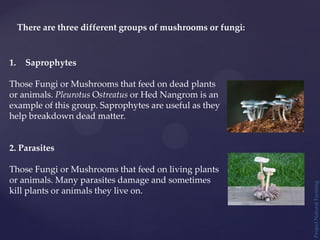
1. Saprophytes
Those Fungi or Mushrooms that feed on dead plants
or animals. Pleurotus Ostreatus or Hed Nangrom is an
example of this group. Saprophytes are useful as they
help breakdown dead matter.
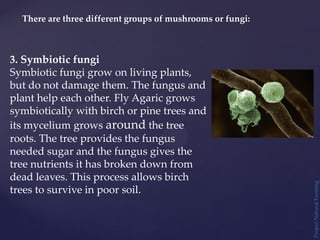
2. Parasites
Those Fungi or Mushrooms that feed on living plants
or animals. Many parasites damage and sometimes
kill plants or animals they live on.
Project
Natural
Farming
There are three different groups of mushrooms or fungi:
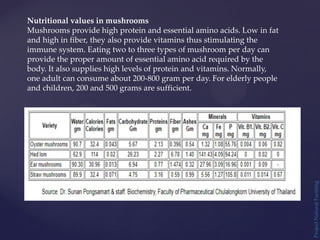
3. Symbiotic fungi
Symbiotic fungi grow on living plants,
but do not damage them. The fungus and
plant help each other. Fly Agaric grows
symbiotically with birch or pine trees and
its mycelium grows around the tree
roots. The tree provides the fungus
needed sugar and the fungus gives the
tree nutrients it has broken down from
dead leaves. This process allows birch
trees to survive in poor soil.
Project
Natural
Farming
Project
Natural
Farming
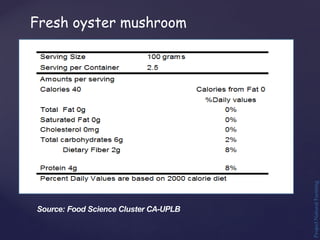
Nutritional values in mushrooms
Mushrooms provide high protein and essential amino acids. Low in fat
and high in fiber, they also provide vitamins thus stimulating the
immune system. Eating two to three types of mushroom per day can
provide the proper amount of essential amino acid required by the
body. It also supplies high levels of protein and vitamins. Normally,
one adult can consume about 200-800 gram per day. For elderly people
and children, 200 and 500 grams are sufficient.
Project
Natural
Farming
Fresh oyster mushroom
Source: Food Science Cluster CA-UPLB
Mushroom Life Cycle
Project
Natural
Farming
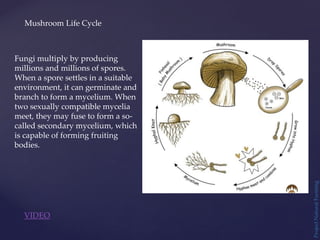
Fungi multiply by producing
millions and millions of spores.
When a spore settles in a suitable
environment, it can germinate and
branch to form a mycelium. When
two sexually compatible mycelia
meet, they may fuse to form a so-
called secondary mycelium, which
is capable of forming fruiting
bodies.
VIDEO
Project
Natural
Farming
Cultivated mushrooms Vs wild mushrooms
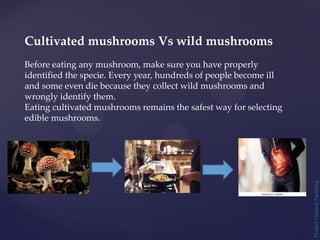
Before eating any mushroom, make sure you have properly
identified the specie. Every year, hundreds of people become ill
and some even die because they collect wild mushrooms and
wrongly identify them.
Eating cultivated mushrooms remains the safest way for selecting
edible mushrooms.
CATEGORIES OF MUSHROOM
1. EDIBLE MUSHROOMS – 2 types Fleshy and Edible
i. Cultivable
ii. Noncultivable
Edibility
No poisonous effects on humans
desirable taste and aroma .
Nutritive value
Edible mushrooms include many fungal species that
are either harvested wild or cultivated
Project
Natural
Farming
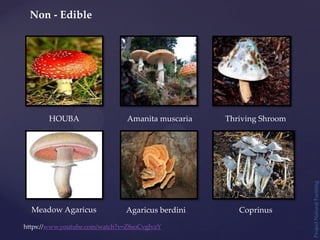
Non - Edible
HOUBA Amanita muscaria Thriving Shroom
Meadow Agaricus Agaricus berdini Coprinus
https://www.youtube.com/watch?v=Z8soCvgJvzY
Project
Natural
Farming
Project
Natural
Farming
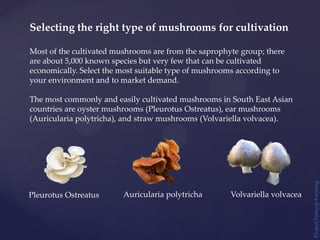
Selecting the right type of mushrooms for cultivation
Most of the cultivated mushrooms are from the saprophyte group; there
are about 5,000 known species but very few that can be cultivated
economically. Select the most suitable type of mushrooms according to
your environment and to market demand.
The most commonly and easily cultivated mushrooms in South East Asian
countries are oyster mushrooms (Pleurotus Ostreatus), ear mushrooms
(Auricularia polytricha), and straw mushrooms (Volvariella volvacea).
Pleurotus Ostreatus Auricularia polytricha Volvariella volvacea
Project
Natural
Farming
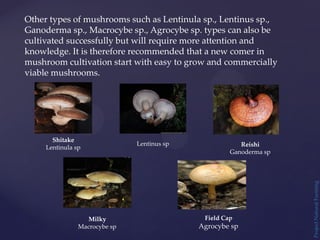
Other types of mushrooms such as Lentinula sp., Lentinus sp.,
Ganoderma sp., Macrocybe sp., Agrocybe sp. types can also be
cultivated successfully but will require more attention and
knowledge. It is therefore recommended that a new comer in
mushroom cultivation start with easy to grow and commercially
viable mushrooms.
Shitake
Lentinula sp
Lentinus sp Reishi
Ganoderma sp
Milky
Macrocybe sp
Field Cap
Agrocybe sp
Project
Natural
Farming
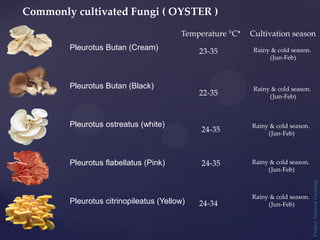
Pleurotus Butan (Cream)
Pleurotus Butan (Black)
Pleurotus ostreatus (white)
Pleurotus flabellatus (Pink)
Pleurotus citrinopileatus (Yellow)
Commonly cultivated Fungi ( OYSTER )
Temperature °C* Cultivation season
23-35
22-35
24-35
24-35
24-34
Rainy & cold season.
(Jun-Feb)
Rainy & cold season.
(Jun-Feb)
Rainy & cold season.
(Jun-Feb)
Rainy & cold season.
(Jun-Feb)
Rainy & cold season.
(Jun-Feb)
Project
Natural
Farming
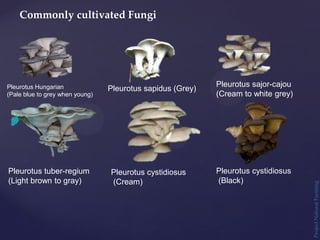
Commonly cultivated Fungi
Pleurotus Hungarian
(Pale blue to grey when young)
Pleurotus sapidus (Grey)
Pleurotus sajor-cajou
(Cream to white grey)
Pleurotus tuber-regium
(Light brown to gray)
Pleurotus cystidiosus
(Cream)
Pleurotus cystidiosus
(Black)
Project
Natural
Farming
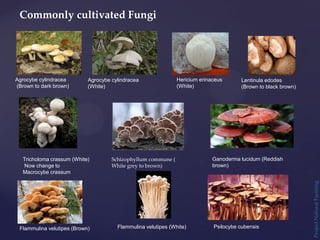
Commonly cultivated Fungi
Agrocybe cylindracea
(Brown to dark brown)
Agrocybe cylindracea
(White)
Hericium erinaceus
(White)
Lentinula edodes
(Brown to black brown)
Tricholoma crassum (White)
Now change to
Macrocybe crassum
Schizophyllum commune (
White grey to brown)
Flammulina velutipes (Brown) Flammulina velutipes (White)
Ganoderma lucidum (Reddish
brown)
Psilocybe cubensis
Project
Natural
Farming
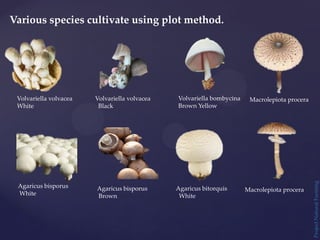
Various species cultivate using plot method.
Volvariella volvacea
White
Volvariella volvacea
Black
Volvariella bombycina
Brown Yellow
Agaricus bisporus
White
Agaricus bisporus
Brown
Agaricus bitorquis
White
Macrolepiota procera
Project
Natural
Farming
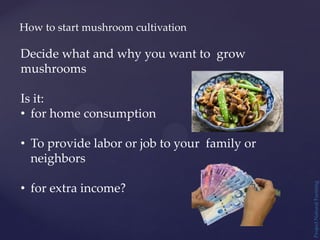
How to start mushroom cultivation
Decide what and why you want to grow
mushrooms
Is it:
• for home consumption
• To provide labor or job to your family or
neighbors
• for extra income?
Project
Natural
Farming
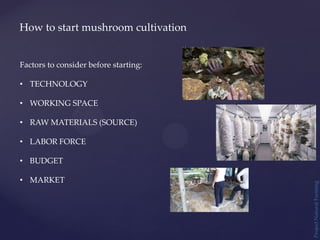
How to start mushroom cultivation
Factors to consider before starting:
• TECHNOLOGY
• WORKING SPACE
• RAW MATERIALS (SOURCE)
• LABOR FORCE
• BUDGET
• MARKET
TECHNOLOGY
Project
Natural
Farming
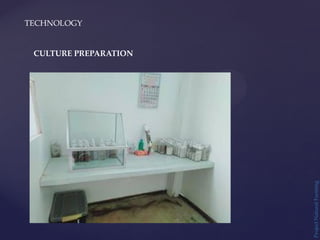
CULTURE PREPARATION
TECHNOLOGY
Project
Natural
Farming
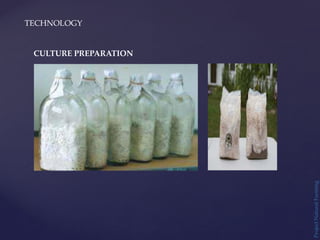
CULTURE PREPARATION
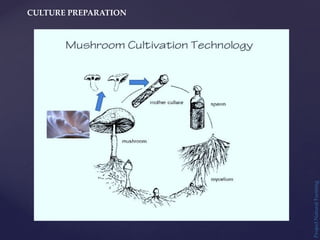
CULTURE PREPARATION
Project
Natural
Farming
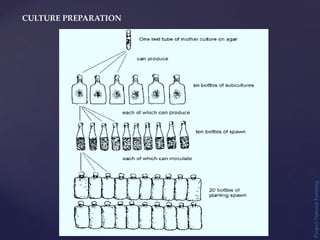
CULTURE PREPARATION
Project
Natural
Farming
TECHNOLOGY
Project
Natural
Farming
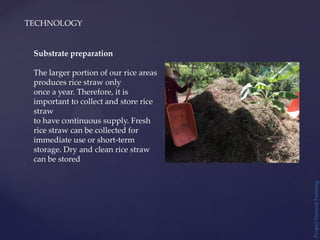
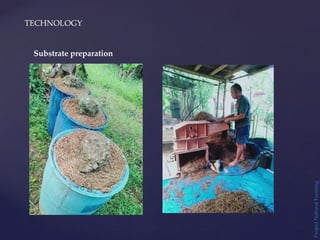
Substrate preparation
The larger portion of our rice areas
produces rice straw only
once a year. Therefore, it is
important to collect and store rice
straw
to have continuous supply. Fresh
rice straw can be collected for
immediate use or short-term
storage. Dry and clean rice straw
can be stored
TECHNOLOGY
Project
Natural
Farming
Substrate preparation
TECHNOLOGY
Project
Natural
Farming
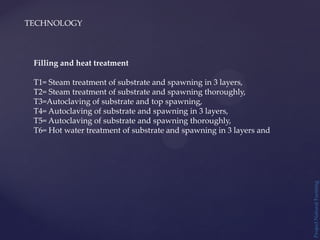
Filling and heat treatment
T1= Steam treatment of substrate and spawning in 3 layers,
T2= Steam treatment of substrate and spawning thoroughly,
T3=Autoclaving of substrate and top spawning,
T4= Autoclaving of substrate and spawning in 3 layers,
T5= Autoclaving of substrate and spawning thoroughly,
T6= Hot water treatment of substrate and spawning in 3 layers and
TECHNOLOGY
Project
Natural
Farming
Filling and heat treatment
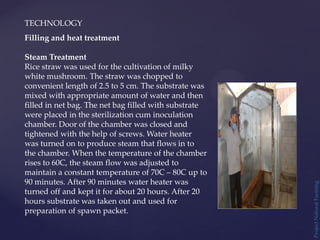
Steam Treatment
Rice straw was used for the cultivation of milky
white mushroom. The straw was chopped to
convenient length of 2.5 to 5 cm. The substrate was
mixed with appropriate amount of water and then
filled in net bag. The net bag filled with substrate
were placed in the sterilization cum inoculation
chamber. Door of the chamber was closed and
tightened with the help of screws. Water heater
was turned on to produce steam that flows in to
the chamber. When the temperature of the chamber
rises to 60C, the steam flow was adjusted to
maintain a constant temperature of 70C – 80C up to
90 minutes. After 90 minutes water heater was
turned off and kept it for about 20 hours. After 20
hours substrate was taken out and used for
preparation of spawn packet.
TECHNOLOGY
Project
Natural
Farming
Filling and heat treatment
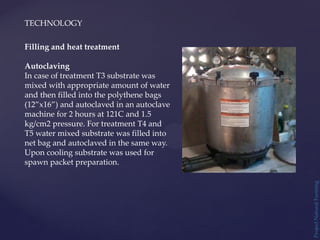
Autoclaving
In case of treatment T3 substrate was
mixed with appropriate amount of water
and then filled into the polythene bags
(12”x16”) and autoclaved in an autoclave
machine for 2 hours at 121C and 1.5
kg/cm2 pressure. For treatment T4 and
T5 water mixed substrate was filled into
net bag and autoclaved in the same way.
Upon cooling substrate was used for
spawn packet preparation.
TECHNOLOGY
Project
Natural
Farming
Filling and heat treatment
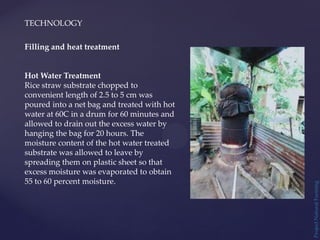
Hot Water Treatment
Rice straw substrate chopped to
convenient length of 2.5 to 5 cm was
poured into a net bag and treated with hot
water at 60C in a drum for 60 minutes and
allowed to drain out the excess water by
hanging the bag for 20 hours. The
moisture content of the hot water treated
substrate was allowed to leave by
spreading them on plastic sheet so that
excess moisture was evaporated to obtain
55 to 60 percent moisture.
TECHNOLOGY
Project
Natural
Farming
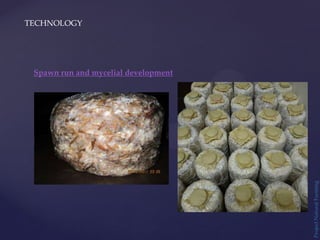
Spawn run and mycelial development
TECHNOLOGY
Project
Natural
Farming
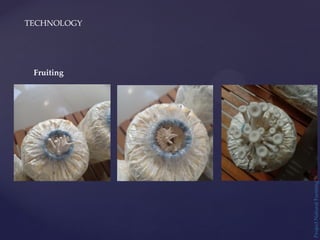
Fruiting
TECHNOLOGY
Project
Natural
Farming
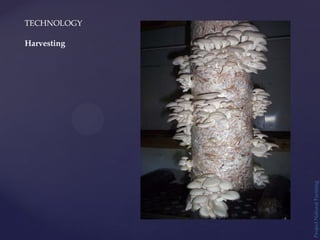
Harvesting
WORKING SPACE
Project
Natural
Farming
Mushroom farms
Certain factors should be kept in mind when selecting
a site for a mushroom farm:
• distance to the market
• availability of good quality substrate material
• transportation of both product and substrate
material
• ready availability of clean water
WORKING SPACE
Project
Natural
Farming
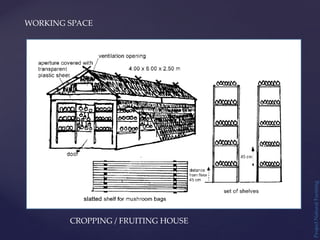
CROPPING / FRUITING HOUSE
WORKING SPACE
Project
Natural
Farming
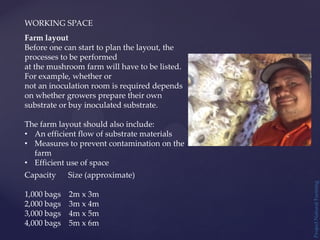
Farm layout
Before one can start to plan the layout, the
processes to be performed
at the mushroom farm will have to be listed.
For example, whether or
not an inoculation room is required depends
on whether growers prepare their own
substrate or buy inoculated substrate.
The farm layout should also include:
• An efficient flow of substrate materials
• Measures to prevent contamination on the
farm
• Efficient use of space
Capacity Size (approximate)
1,000 bags 2m x 3m
2,000 bags 3m x 4m
3,000 bags 4m x 5m
4,000 bags 5m x 6m
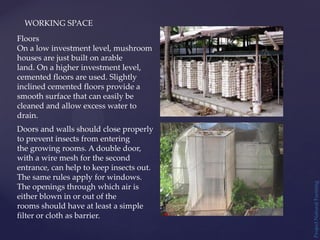
Floors
On a low investment level, mushroom
houses are just built on arable
land. On a higher investment level,
cemented floors are used. Slightly
inclined cemented floors provide a
smooth surface that can easily be
cleaned and allow excess water to
drain.
Doors and walls should close properly
to prevent insects from entering
the growing rooms. A double door,
with a wire mesh for the second
entrance, can help to keep insects out.
The same rules apply for windows.
The openings through which air is
either blown in or out of the
rooms should have at least a simple
filter or cloth as barrier.
WORKING SPACE
Project
Natural
Farming
Project
Natural
Farming
WORKING SPACE
Project
Natural
Farming
WORKING SPACE
Project
Natural
Farming
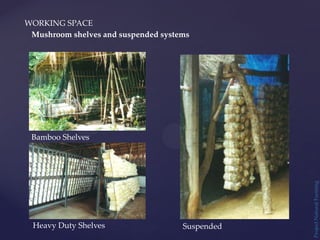
Bamboo Shelves
Heavy Duty Shelves Suspended
Mushroom shelves and suspended systems
Project
Natural
Farming
WORKING SPACE
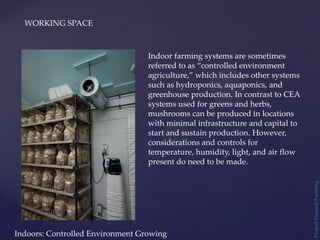
Indoors: Controlled Environment Growing
Indoor farming systems are sometimes
referred to as “controlled environment
agriculture,” which includes other systems
such as hydroponics, aquaponics, and
greenhouse production. In contrast to CEA
systems used for greens and herbs,
mushrooms can be produced in locations
with minimal infrastructure and capital to
start and sustain production. However,
considerations and controls for
temperature, humidity, light, and air flow
present do need to be made.
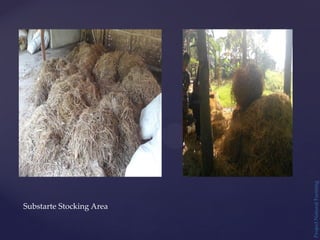
Substarte Stocking Area
Project
Natural
Farming
Project
Natural
Farming
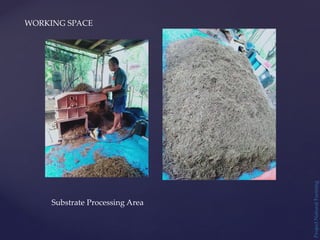
WORKING SPACE
Substrate Processing Area
Project
Natural
Farming
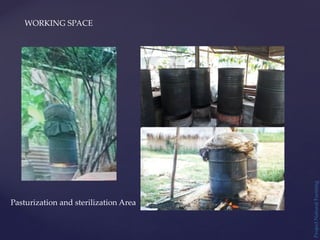
WORKING SPACE
Pasturization and sterilization Area
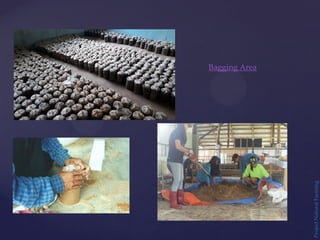
Bagging Area
Project
Natural
Farming
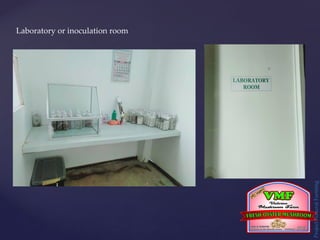
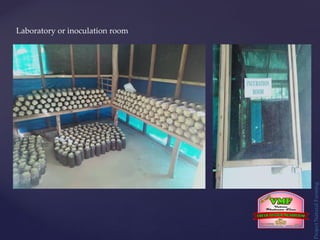
Laboratory or inoculation room
Project
Natural
Farming
Laboratory or inoculation room
Project
Natural
Farming
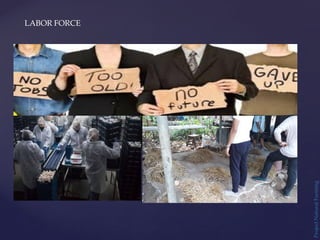
LABOR FORCE
Project
Natural
Farming
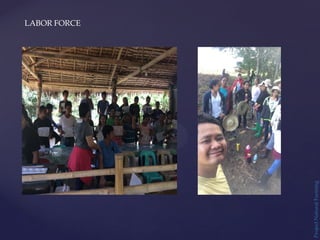
LABOR FORCE
Project
Natural
Farming
BUDGET
Project
Natural
Farming
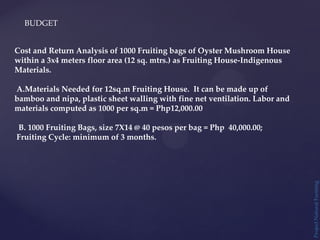
Cost and Return Analysis of 1000 Fruiting bags of Oyster Mushroom House
within a 3x4 meters floor area (12 sq. mtrs.) as Fruiting House-Indigenous
Materials.
A.Materials Needed for 12sq.m Fruiting House. It can be made up of
bamboo and nipa, plastic sheet walling with fine net ventilation. Labor and
materials computed as 1000 per sq.m = Php12,000.00
B. 1000 Fruiting Bags, size 7X14 @ 40 pesos per bag = Php 40,000.00;
Fruiting Cycle: minimum of 3 months.
BUDGET
Project
Natural
Farming
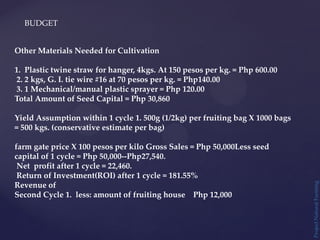
Other Materials Needed for Cultivation
1. Plastic twine straw for hanger, 4kgs. At 150 pesos per kg. = Php 600.00
2. 2 kgs, G. I. tie wire #16 at 70 pesos per kg. = Php140.00
3. 1 Mechanical/manual plastic sprayer = Php 120.00
Total Amount of Seed Capital = Php 30,860
Yield Assumption within 1 cycle 1. 500g (1/2kg) per fruiting bag X 1000 bags
= 500 kgs. (conservative estimate per bag)
farm gate price X 100 pesos per kilo Gross Sales = Php 50,000Less seed
capital of 1 cycle = Php 50,000--Php27,540.
Net profit after 1 cycle = 22,460.
Return of Investment(ROI) after 1 cycle = 181.55%
Revenue of
Second Cycle 1. less: amount of fruiting house Php 12,000
BUDGET
Project
Natural
Farming
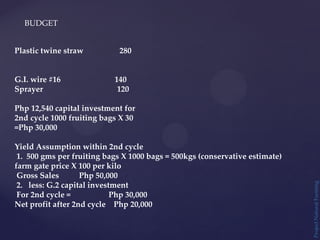
Plastic twine straw 280
G.I. wire #16 140
Sprayer 120
Php 12,540 capital investment for
2nd cycle 1000 fruiting bags X 30
=Php 30,000
Yield Assumption within 2nd cycle
1. 500 gms per fruiting bags X 1000 bags = 500kgs (conservative estimate)
farm gate price X 100 per kilo
Gross Sales Php 50,000
2. less: G.2 capital investment
For 2nd cycle = Php 30,000
Net profit after 2nd cycle Php 20,000
MARKET
Project
Natural
Farming
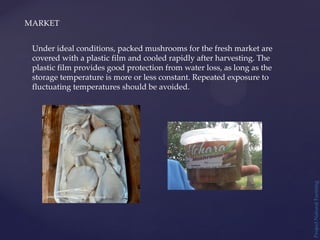
Under ideal conditions, packed mushrooms for the fresh market are
covered with a plastic film and cooled rapidly after harvesting. The
plastic film provides good protection from water loss, as long as the
storage temperature is more or less constant. Repeated exposure to
fluctuating temperatures should be avoided.
Five factors that affect mushroom growth
With any types of mushrooms, these are the vital factors that affect their growth:
Temperature. Temperature varies depending on the type of mushrooms. For instance,
paddy straw mushrooms requires a temperature of 35 to 38-degree celsius, while
shiitake mushrooms will only grow in colder temperatures.
Humidity. The amount of water in the air must be maintained at 80 to 90%.
Light. The place where the mushrooms will be grown must have no direct sun.
Food. Give enough food for the mushrooms using the substrate that is particular to
their needs. Straw mushrooms require a substrate that is rich in nitrogen and
potassium hence, it includes banana leaves and kakawate leaves.
Maintenance. Proper care is important in raising mushrooms. Regardless of variety,
make sure to maintain cleanliness by using alcohol and by wearing protective clothing
every time you plant, nurture, and harvest them.
Project
Natural
Farming
Project
Natural
Farming
End of day 1
QUESTIONS ?
about
organic
introduction
follow
Topics
about
THE SPEAKER
KEITH HERNANDEZ
A NATURAL FARMING PRACTICTIONER,
SPEAKER, AND AGRICULTURE TRAINER FOR
NGOS’AND LGU’S
Topics
follow
introduction
about
introduction
Topics
follow
www.facebook.com/projectnaturalfarming
Gmail : keith.f.hernandez@gmail.com
Smart : 09983343277
Day 1 Introduction To Mushrooms
History
Different Groups Of Fungi And Mushrooms
Nutritional Values In Mushrooms Cultivated
Mushrooms Vs Wild Mushrooms
Selecting The Right Type Of Mushrooms For Cultivation
Commonly Cultivated Fungi How To Start Mushroom
Cultivation
Day 2 • Production Cycle PART 1
• Preparation Of Pure Culture
• Preparation Of Grain Culture
• Substrates
• Preparation Of Fruiting Bag
Day 3 Production Cycle PART 2
• Incubation
• Fruiting The Bag
• Care And Maintenance
• Harvesting And Post Harvesting
Project
Natural
Farming
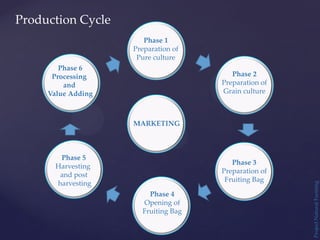
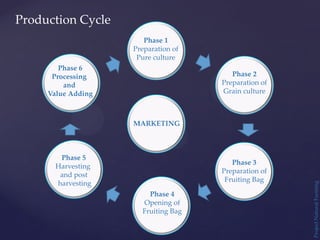
Phase 2
Preparation of
Grain culture
MARKETING
Phase 3
Preparation of
Fruiting Bag
Phase 4
Opening of
Fruiting Bag
Phase 5
Harvesting
and post
harvesting
Phase 6
Processing
and
Value Adding
Production Cycle
Phase 1
Preparation of
Pure culture
Project
Natural
Farming
Project
Natural
Farming
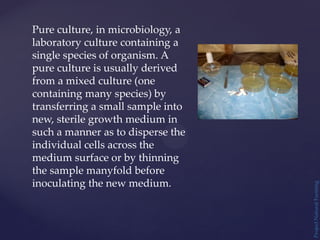
Pure culture, in microbiology, a
laboratory culture containing a
single species of organism. A
pure culture is usually derived
from a mixed culture (one
containing many species) by
transferring a small sample into
new, sterile growth medium in
such a manner as to disperse the
individual cells across the
medium surface or by thinning
the sample manyfold before
inoculating the new medium.
Project
Natural
Farming
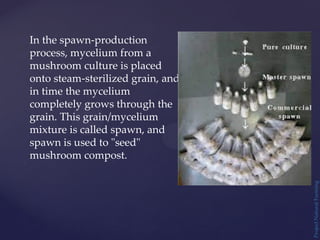
In the spawn-production
process, mycelium from a
mushroom culture is placed
onto steam-sterilized grain, and
in time the mycelium
completely grows through the
grain. This grain/mycelium
mixture is called spawn, and
spawn is used to "seed"
mushroom compost.
Project
Natural
Farming
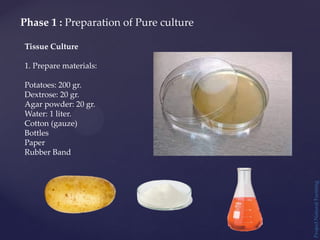
Phase 1 : Preparation of Pure culture
Tissue Culture
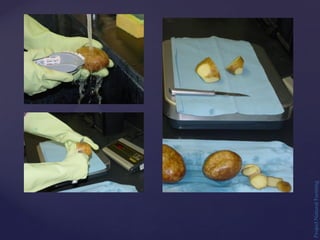
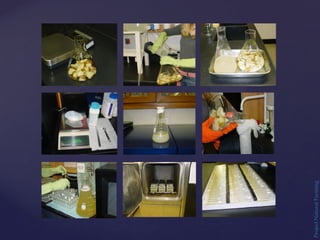
1. Prepare materials:
Potatoes: 200 gr.
Dextrose: 20 gr.
Agar powder: 20 gr.
Water: 1 liter.
Cotton (gauze)
Bottles
Paper
Rubber Band
Project
Natural
Farming
Project
Natural
Farming
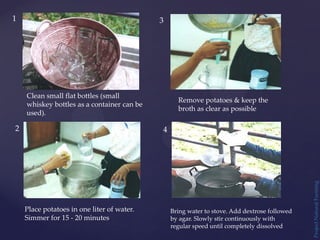
Clean small flat bottles (small
whiskey bottles as a container can be
used).
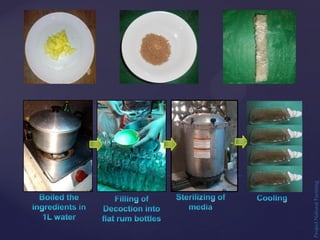
Place potatoes in one liter of water.
Simmer for 15 - 20 minutes
Remove potatoes & keep the
broth as clear as possible
Bring water to stove. Add dextrose followed
by agar. Slowly stir continuously with
regular speed until completely dissolved
Project
Natural
Farming
1
2
3
4
Project
Natural
Farming
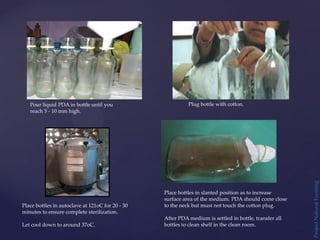
Pour liquid PDA in bottle until you
reach 5 - 10 mm high.
Plug bottle with cotton.
Place bottles in autoclave at 121oC for 20 - 30
minutes to ensure complete sterilization.
Let cool down to around 37oC.
Place bottles in slanted position as to increase
surface area of the medium. PDA should come close
to the neck but must not touch the cotton plug.
After PDA medium is settled in bottle, transfer all
bottles to clean shelf in the clean room.
Project
Natural
Farming
Project
Natural
Farming
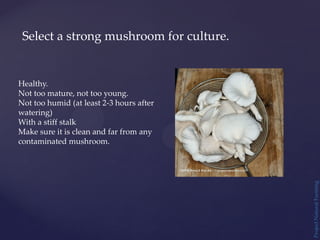
Select a strong mushroom for culture.
Healthy.
Not too mature, not too young.
Not too humid (at least 2-3 hours after
watering)
With a stiff stalk
Make sure it is clean and far from any
contaminated mushroom.
Project
Natural
Farming
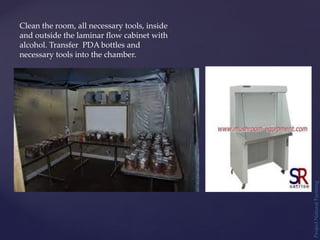
Clean the room, all necessary tools, inside
and outside the laminar flow cabinet with
alcohol. Transfer PDA bottles and
necessary tools into the chamber.
Project
Natural
Farming
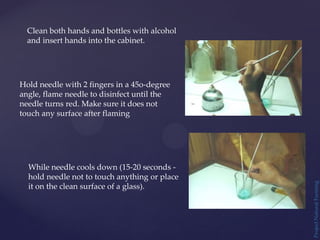
Clean both hands and bottles with alcohol
and insert hands into the cabinet.
Hold needle with 2 fingers in a 45o-degree
angle, flame needle to disinfect until the
needle turns red. Make sure it does not
touch any surface after flaming
While needle cools down (15-20 seconds -
hold needle not to touch anything or place
it on the clean surface of a glass).
Project
Natural
Farming
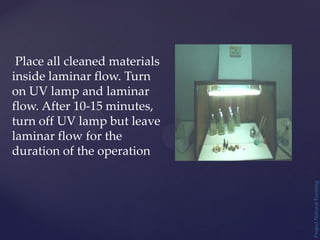
Place all cleaned materials
inside laminar flow. Turn
on UV lamp and laminar
flow. After 10-15 minutes,
turn off UV lamp but leave
laminar flow for the
duration of the operation
Project
Natural
Farming
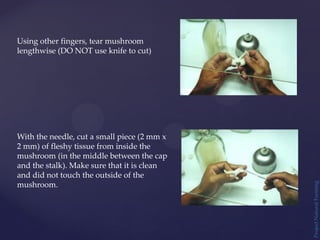
Using other fingers, tear mushroom
lengthwise (DO NOT use knife to cut)
With the needle, cut a small piece (2 mm x
2 mm) of fleshy tissue from inside the
mushroom (in the middle between the cap
and the stalk). Make sure that it is clean
and did not touch the outside of the
mushroom.
Project
Natural
Farming
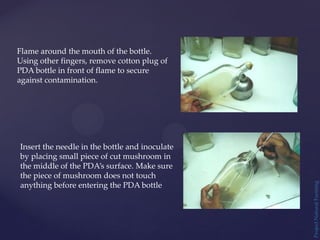
Flame around the mouth of the bottle.
Using other fingers, remove cotton plug of
PDA bottle in front of flame to secure
against contamination.
Insert the needle in the bottle and inoculate
by placing small piece of cut mushroom in
the middle of the PDA’s surface. Make sure
the piece of mushroom does not touch
anything before entering the PDA bottle
Project
Natural
Farming
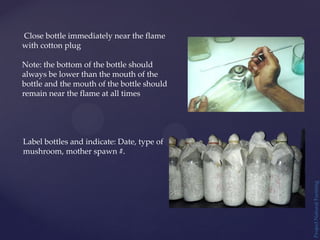
Close bottle immediately near the flame
with cotton plug
Note: the bottom of the bottle should
always be lower than the mouth of the
bottle and the mouth of the bottle should
remain near the flame at all times
Label bottles and indicate: Date, type of
mushroom, mother spawn #.
Project
Natural
Farming
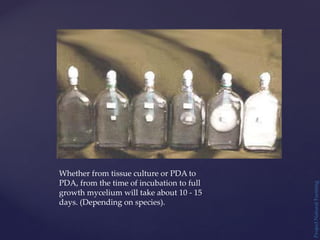
Whether from tissue culture or PDA to
PDA, from the time of incubation to full
growth mycelium will take about 10 - 15
days. (Depending on species).
Project
Natural
Farming
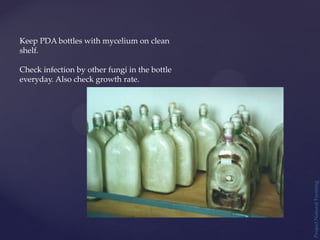
Keep PDA bottles with mycelium on clean
shelf.
Check infection by other fungi in the bottle
everyday. Also check growth rate.
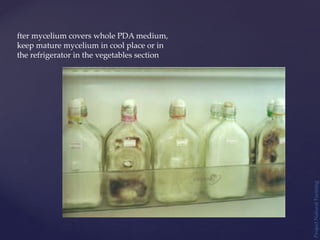
fter mycelium covers whole PDA medium,
keep mature mycelium in cool place or in
the refrigerator in the vegetables section
Project
Natural
Farming
Project
Natural
Farming
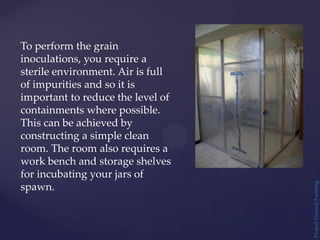
To perform the grain
inoculations, you require a
sterile environment. Air is full
of impurities and so it is
important to reduce the level of
containments where possible.
This can be achieved by
constructing a simple clean
room. The room also requires a
work bench and storage shelves
for incubating your jars of
spawn.
Project
Natural
Farming
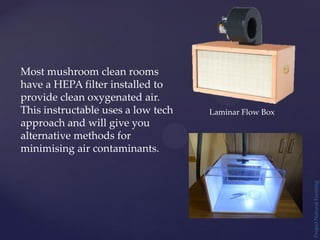
Most mushroom clean rooms
have a HEPA filter installed to
provide clean oxygenated air.
This instructable uses a low tech
approach and will give you
alternative methods for
minimising air contaminants.
Laminar Flow Box
Project
Natural
Farming
Prepare Grain
Preparation Of Grain Culture
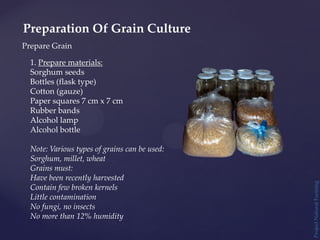
1. Prepare materials:
Sorghum seeds
Bottles (flask type)
Cotton (gauze)
Paper squares 7 cm x 7 cm
Rubber bands
Alcohol lamp
Alcohol bottle
Note: Various types of grains can be used:
Sorghum, millet, wheat
Grains must:
Have been recently harvested
Contain few broken kernels
Little contamination
No fungi, no insects
No more than 12% humidity
Project
Natural
Farming
Prepare Grain
Preparation Of Grain Culture
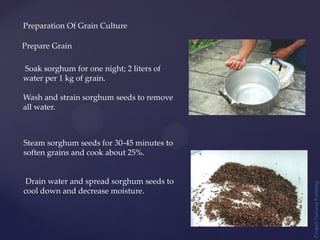
Soak sorghum for one night; 2 liters of
water per 1 kg of grain.
Wash and strain sorghum seeds to remove
all water.
Steam sorghum seeds for 30-45 minutes to
soften grains and cook about 25%.
Drain water and spread sorghum seeds to
cool down and decrease moisture.
Project
Natural
Farming
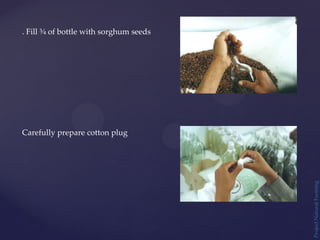
. Fill ¾ of bottle with sorghum seeds
Carefully prepare cotton plug
Project
Natural
Farming
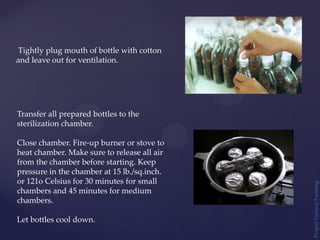
Tightly plug mouth of bottle with cotton
and leave out for ventilation.
Transfer all prepared bottles to the
sterilization chamber.
Close chamber. Fire-up burner or stove to
heat chamber. Make sure to release all air
from the chamber before starting. Keep
pressure in the chamber at 15 lb./sq.inch.
or 121o Celsius for 30 minutes for small
chambers and 45 minutes for medium
chambers.
Let bottles cool down.
Project
Natural
Farming
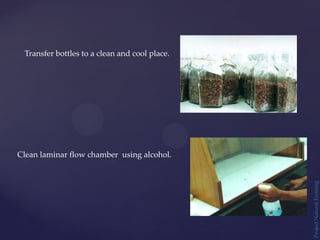
Transfer bottles to a clean and cool place.
Clean laminar flow chamber using alcohol.
Project
Natural
Farming
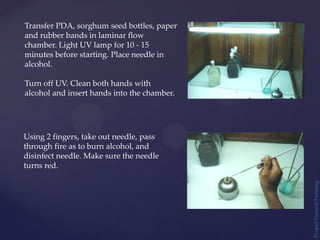
Transfer PDA, sorghum seed bottles, paper
and rubber bands in laminar flow
chamber. Light UV lamp for 10 - 15
minutes before starting. Place needle in
alcohol.
Turn off UV. Clean both hands with
alcohol and insert hands into the chamber.
Using 2 fingers, take out needle, pass
through fire as to burn alcohol, and
disinfect needle. Make sure the needle
turns red.
Project
Natural
Farming
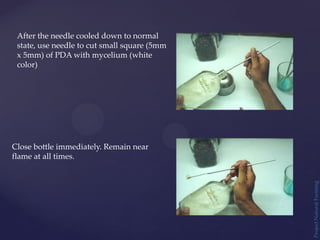
After the needle cooled down to normal
state, use needle to cut small square (5mm
x 5mm) of PDA with mycelium (white
color)
Close bottle immediately. Remain near
flame at all times.
Project
Natural
Farming
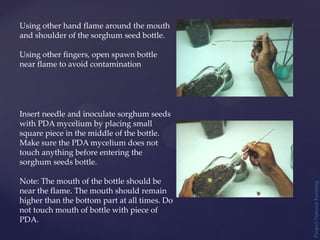
Using other hand flame around the mouth
and shoulder of the sorghum seed bottle.
Using other fingers, open spawn bottle
near flame to avoid contamination
Insert needle and inoculate sorghum seeds
with PDA mycelium by placing small
square piece in the middle of the bottle.
Make sure the PDA mycelium does not
touch anything before entering the
sorghum seeds bottle.
Note: The mouth of the bottle should be
near the flame. The mouth should remain
higher than the bottom part at all times. Do
not touch mouth of bottle with piece of
PDA.
Project
Natural
Farming
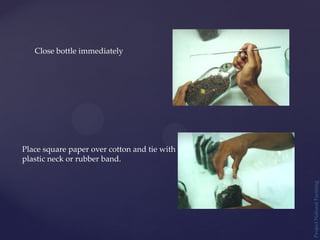
Close bottle immediately
Place square paper over cotton and tie with
plastic neck or rubber band.
Project
Natural
Farming
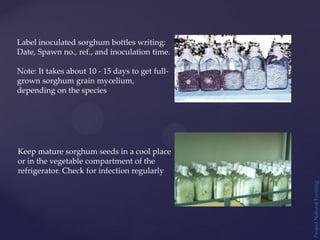
Label inoculated sorghum bottles writing:
Date, Spawn no., ref., and inoculation time.
Note: It takes about 10 - 15 days to get full-
grown sorghum grain mycelium,
depending on the species
Keep mature sorghum seeds in a cool place
or in the vegetable compartment of the
refrigerator. Check for infection regularly
Project
Natural
Farming
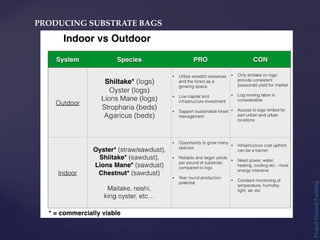
PRODUCING SUBSTRATE BAGS
Project
Natural
Farming
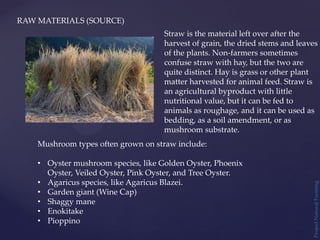
RAW MATERIALS (SOURCE)
Straw is the material left over after the
harvest of grain, the dried stems and leaves
of the plants. Non-farmers sometimes
confuse straw with hay, but the two are
quite distinct. Hay is grass or other plant
matter harvested for animal feed. Straw is
an agricultural byproduct with little
nutritional value, but it can be fed to
animals as roughage, and it can be used as
bedding, as a soil amendment, or as
mushroom substrate.
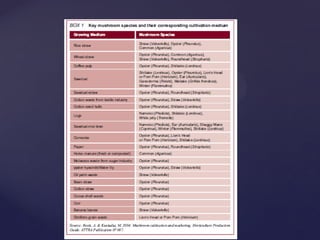
Mushroom types often grown on straw include:
• Oyster mushroom species, like Golden Oyster, Phoenix
Oyster, Veiled Oyster, Pink Oyster, and Tree Oyster.
• Agaricus species, like Agaricus Blazei.
• Garden giant (Wine Cap)
• Shaggy mane
• Enokitake
• Pioppino
RAW MATERIALS (SOURCE)
Saw dust or wood-chips—or, better yet,
both—make a good, productive substrate,
but are usually mixed with bran of some
type (grain or soy) for added nutrition[iv].
As with logs, the species of tree the
material came from matters, but many
hardwoods are suitable and material from
different species can be mixed. There are
many different recipes, each with their
advantages and disadvantages for different
crops.
Growers with access to waste sawdust and chips may be able to get material for
free. Otherwise, pellets of compressed hardwood sawdust are available at
reasonable prices. Just soak the pellets in water and they break apart easily.
Mushrooms that do well on sawdust mixes include:
• Reishi
• Lion’s mane
• Shiitaki
• Maitake
• King oyster
Project
Natural
Farming
Project
Natural
Farming
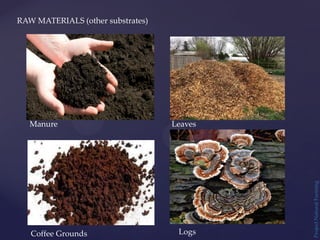
RAW MATERIALS (other substrates)
Manure
Logs
Leaves
Coffee Grounds
Project
Natural
Farming
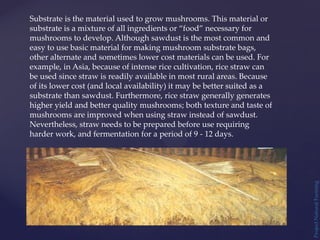
Substrate is the material used to grow mushrooms. This material or
substrate is a mixture of all ingredients or “food” necessary for
mushrooms to develop. Although sawdust is the most common and
easy to use basic material for making mushroom substrate bags,
other alternate and sometimes lower cost materials can be used. For
example, in Asia, because of intense rice cultivation, rice straw can
be used since straw is readily available in most rural areas. Because
of its lower cost (and local availability) it may be better suited as a
substrate than sawdust. Furthermore, rice straw generally generates
higher yield and better quality mushrooms; both texture and taste of
mushrooms are improved when using straw instead of sawdust.
Nevertheless, straw needs to be prepared before use requiring
harder work, and fermentation for a period of 9 - 12 days.
Project
Natural
Farming
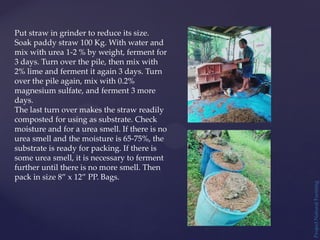
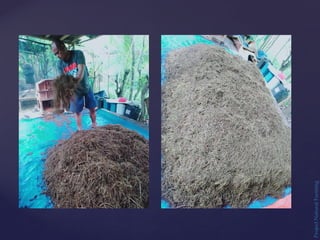
Put straw in grinder to reduce its size.
Soak paddy straw 100 Kg. With water and
mix with urea 1-2 % by weight, ferment for
3 days. Turn over the pile, then mix with
2% lime and ferment it again 3 days. Turn
over the pile again, mix with 0.2%
magnesium sulfate, and ferment 3 more
days.
The last turn over makes the straw readily
composted for using as substrate. Check
moisture and for a urea smell. If there is no
urea smell and the moisture is 65-75%, the
substrate is ready for packing. If there is
some urea smell, it is necessary to ferment
further until there is no more smell. Then
pack in size 8” x 12” PP. Bags.
Project
Natural
Farming
Project
Natural
Farming
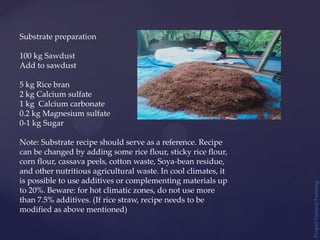
Substrate preparation
100 kg Sawdust
Add to sawdust
5 kg Rice bran
2 kg Calcium sulfate
1 kg Calcium carbonate
0.2 kg Magnesium sulfate
0-1 kg Sugar
Note: Substrate recipe should serve as a reference. Recipe
can be changed by adding some rice flour, sticky rice flour,
corn flour, cassava peels, cotton waste, Soya-bean residue,
and other nutritious agricultural waste. In cool climates, it
is possible to use additives or complementing materials up
to 20%. Beware: for hot climatic zones, do not use more
than 7.5% additives. (If rice straw, recipe needs to be
modified as above mentioned)
Project
Natural
Farming
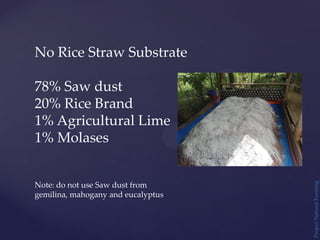
No Rice Straw Substrate
78% Saw dust
20% Rice Brand
1% Agricultural Lime
1% Molases
Note: do not use Saw dust from
gemilina, mahogany and eucalyptus
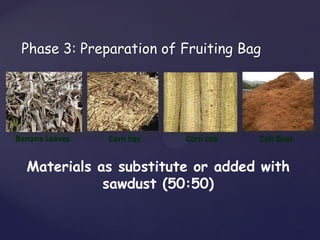
Phase 3: Preparation of Fruiting Bag
Banana Leaves Corn hay Corn cob Coir Dust
Materials as substitute or added with
sawdust (50:50)
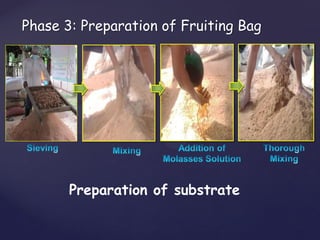
Phase 3: Preparation of Fruiting Bag
Preparation of substrate
Project
Natural
Farming
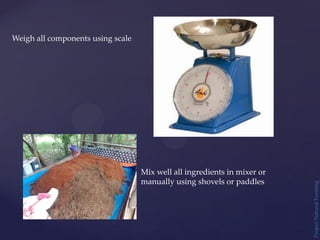
Weigh all components using scale
Mix well all ingredients in mixer or
manually using shovels or paddles
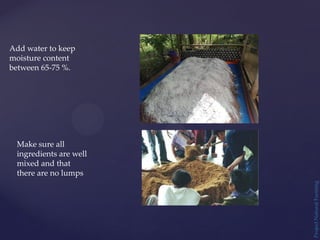
Add water to keep
moisture content
between 65-75 %.
Make sure all
ingredients are well
mixed and that
there are no lumps
Project
Natural
Farming
Project
Natural
Farming
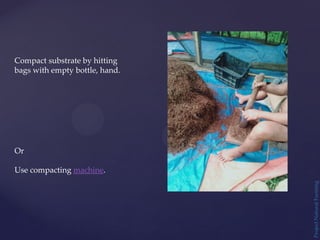
Compact substrate by hitting
bags with empty bottle, hand.
Or
Use compacting machine.
Project
Natural
Farming
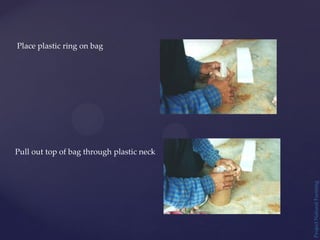
Place plastic ring on bag
Pull out top of bag through plastic neck
Project
Natural
Farming
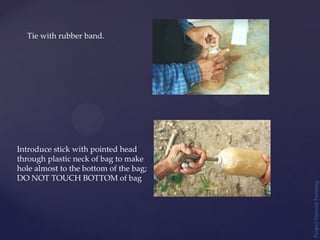
Tie with rubber band.
Introduce stick with pointed head
through plastic neck of bag to make
hole almost to the bottom of the bag;
DO NOT TOUCH BOTTOM of bag
Project
Natural
Farming
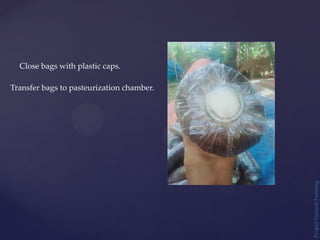
Transfer bags to pasteurization chamber.
Close bags with plastic caps.
Project
Natural
Farming
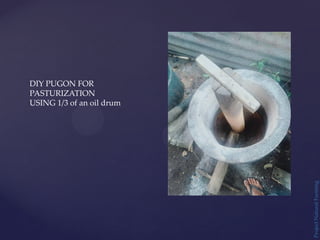
DIY PUGON FOR
PASTURIZATION
USING 1/3 of an oil drum
Project
Natural
Farming
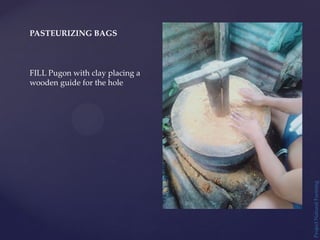
FILL Pugon with clay placing a
wooden guide for the hole
PASTEURIZING BAGS
Project
Natural
Farming
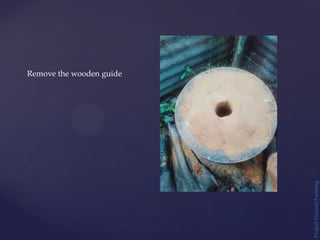
Remove the wooden guide
Project
Natural
Farming
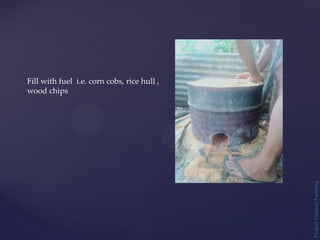
Fill with fuel i.e. corn cobs, rice hull ,
wood chips
Project
Natural
Farming
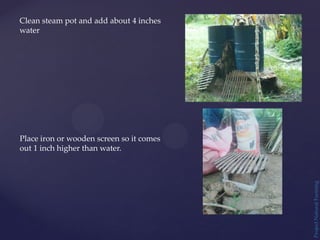
Clean steam pot and add about 4 inches
water
Place iron or wooden screen so it comes
out 1 inch higher than water.
Project
Natural
Farming
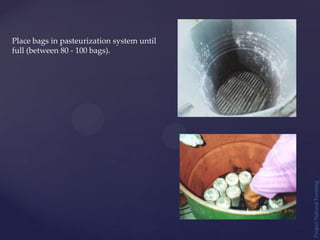
Place bags in pasteurization system until
full (between 80 - 100 bags).
Project
Natural
Farming
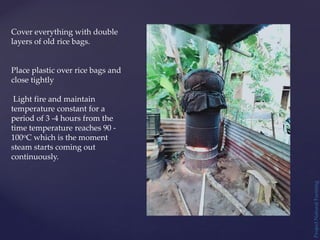
Cover everything with double
layers of old rice bags.
Place plastic over rice bags and
close tightly
Light fire and maintain
temperature constant for a
period of 3 -4 hours from the
time temperature reaches 90 -
100oC which is the moment
steam starts coming out
continuously.
Project
Natural
Farming
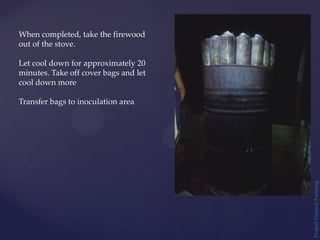
When completed, take the firewood
out of the stove.
Let cool down for approximately 20
minutes. Take off cover bags and let
cool down more
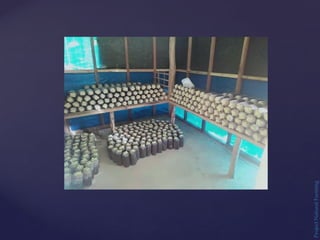
Transfer bags to inoculation area
Project
Natural
Farming
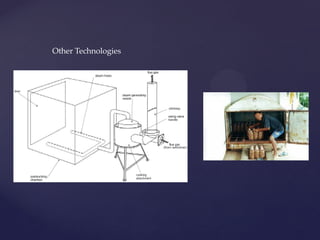
Other Technologies
Project
Natural
Farming
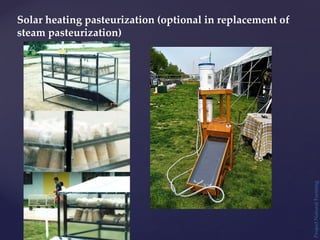
Solar heating pasteurization (optional in replacement of
steam pasteurization)
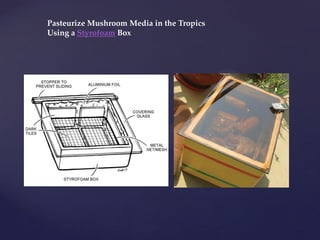
Pasteurize Mushroom Media in the Tropics
Using a Styrofoam Box
Project
Natural
Farming
End of day 2
QUESTIONS ?
about
organic
introduction
follow
Topics
about
THE SPEAKER
KEITH HERNANDEZ
A NATURAL FARMING PRACTICTIONER,
SPEAKER, AND AGRICULTURE TRAINER FOR
NGOS’AND LGU’S
Topics
follow
introduction
about
introduction
Topics
follow
www.facebook.com/projectnaturalfarming
Gmail : keith.f.hernandez@gmail.com
Smart : 09983343277
Day 1 Introduction To Mushrooms
History
Different Groups Of Fungi And Mushrooms
Nutritional Values In Mushrooms Cultivated
Mushrooms Vs Wild Mushrooms
Selecting The Right Type Of Mushrooms For Cultivation
Commonly Cultivated Fungi How To Start Mushroom
Cultivation
Day 2 • Production Cycle PART 1
• Preparation Of Pure Culture
• Preparation Of Grain Culture
• Substrates
• Preparation Of Fruiting Bag
Day 3 Production Cycle PART 2
• Incubation
• Fruiting The Bag
• Care And Maintenance
• Harvesting And Post Harvesting
Project
Natural
Farming
Phase 2
Preparation of
Grain culture
MARKETING
Phase 3
Preparation of
Fruiting Bag
Phase 4
Opening of
Fruiting Bag
Phase 5
Harvesting
and post
harvesting
Phase 6
Processing
and
Value Adding
Production Cycle
Phase 1
Preparation of
Pure culture
Project
Natural
Farming
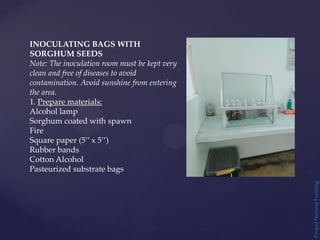
INOCULATING BAGS WITH
SORGHUM SEEDS
Note: The inoculation room must be kept very
clean and free of diseases to avoid
contamination. Avoid sunshine from entering
the area.
1. Prepare materials:
Alcohol lamp
Sorghum coated with spawn
Fire
Square paper (5’’ x 5’’)
Rubber bands
Cotton Alcohol
Pasteurized substrate bags
Project
Natural
Farming
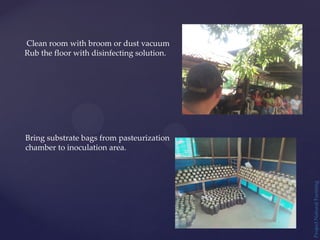
Clean room with broom or dust vacuum
Rub the floor with disinfecting solution.
Bring substrate bags from pasteurization
chamber to inoculation area.
Project
Natural
Farming
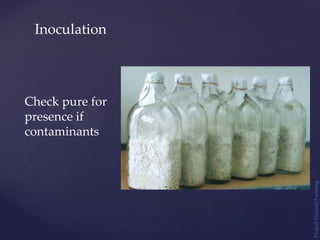
Inoculation
Check pure for
presence if
contaminants
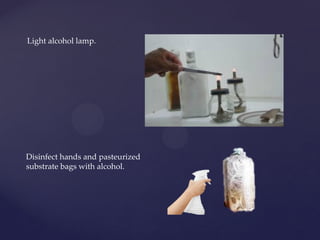
Light alcohol lamp.
Disinfect hands and pasteurized
substrate bags with alcohol.
Project
Natural
Farming
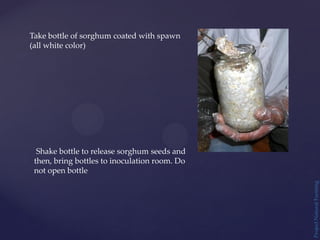
Take bottle of sorghum coated with spawn
(all white color)
Shake bottle to release sorghum seeds and
then, bring bottles to inoculation room. Do
not open bottle
Project
Natural
Farming
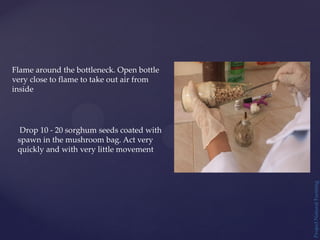
Flame around the bottleneck. Open bottle
very close to flame to take out air from
inside
Drop 10 - 20 sorghum seeds coated with
spawn in the mushroom bag. Act very
quickly and with very little movement
Project
Natural
Farming
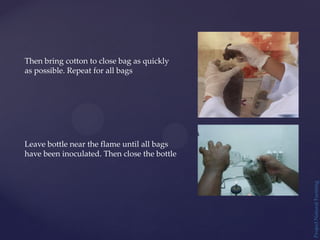
Then bring cotton to close bag as quickly
as possible. Repeat for all bags
Leave bottle near the flame until all bags
have been inoculated. Then close the bottle
Project
Natural
Farming
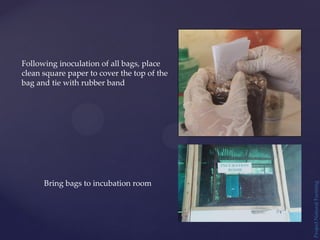
Following inoculation of all bags, place
clean square paper to cover the top of the
bag and tie with rubber band
Bring bags to incubation room
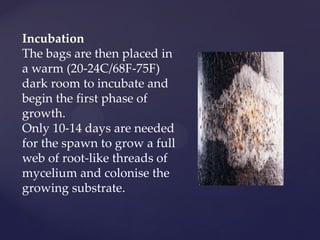
Incubation
The bags are then placed in
a warm (20-24C/68F-75F)
dark room to incubate and
begin the first phase of
growth.
Only 10-14 days are needed
for the spawn to grow a full
web of root-like threads of
mycelium and colonise the
growing substrate.
Project
Natural
Farming
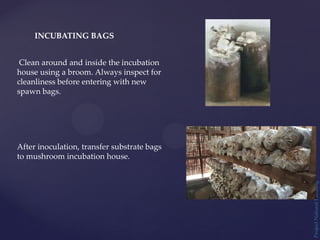
INCUBATING BAGS
Clean around and inside the incubation
house using a broom. Always inspect for
cleanliness before entering with new
spawn bags.
After inoculation, transfer substrate bags
to mushroom incubation house.
Project
Natural
Farming
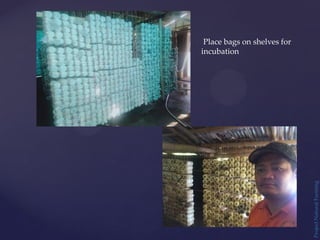
Place bags on shelves for
incubation
Project
Natural
Farming
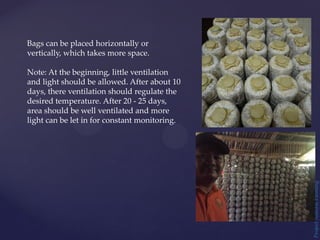
Bags can be placed horizontally or
vertically, which takes more space.
Note: At the beginning, little ventilation
and light should be allowed. After about 10
days, there ventilation should regulate the
desired temperature. After 20 - 25 days,
area should be well ventilated and more
light can be let in for constant monitoring.
Project
Natural
Farming
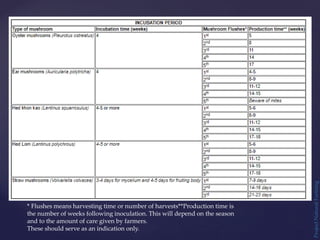
* Flushes means harvesting time or number of harvests**Production time is
the number of weeks following inoculation. This will depend on the season
and to the amount of care given by farmers.
These should serve as an indication only.
Project
Natural
Farming
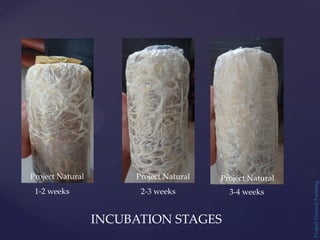
Project Natural Project Natural Project Natural
INCUBATION STAGES
1-2 weeks 2-3 weeks 3-4 weeks
Project
Natural
Farming
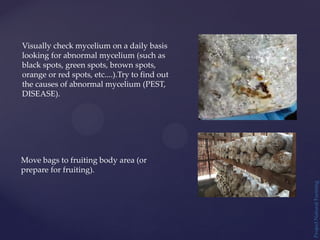
Visually check mycelium on a daily basis
looking for abnormal mycelium (such as
black spots, green spots, brown spots,
orange or red spots, etc....).Try to find out
the causes of abnormal mycelium (PEST,
DISEASE).
Move bags to fruiting body area (or
prepare for fruiting).
Project
Natural
Farming
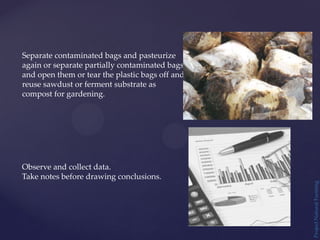
Separate contaminated bags and pasteurize
again or separate partially contaminated bags
and open them or tear the plastic bags off and
reuse sawdust or ferment substrate as
compost for gardening.
Observe and collect data.
Take notes before drawing conclusions.
Project
Natural
Farming
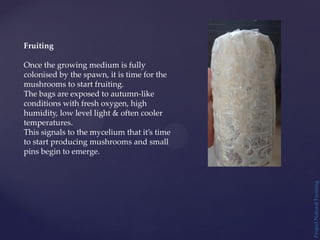
Fruiting
Once the growing medium is fully
colonised by the spawn, it is time for the
mushrooms to start fruiting.
The bags are exposed to autumn-like
conditions with fresh oxygen, high
humidity, low level light & often cooler
temperatures.
This signals to the mycelium that it’s time
to start producing mushrooms and small
pins begin to emerge.
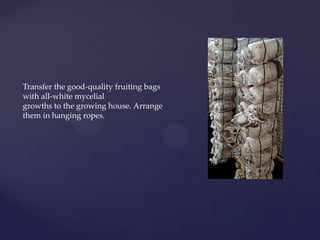
Transfer the good-quality fruiting bags
with all-white mycelial
growths to the growing house. Arrange
them in hanging ropes.
Project
Natural
Farming
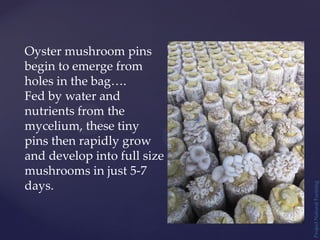
Oyster mushroom pins
begin to emerge from
holes in the bag….
Fed by water and
nutrients from the
mycelium, these tiny
pins then rapidly grow
and develop into full size
mushrooms in just 5-7
days.
Project
Natural
Farming
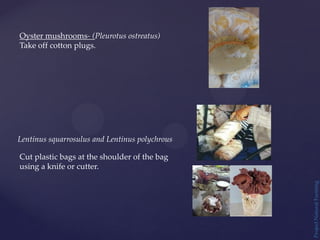
Oyster mushrooms- (Pleurotus ostreatus)
Take off cotton plugs.
Cut plastic bags at the shoulder of the bag
using a knife or cutter.
Lentinus squarrosulus and Lentinus polychrous
Project
Natural
Farming
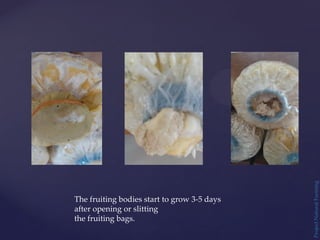
The fruiting bodies start to grow 3-5 days
after opening or slitting
the fruiting bags.
Project
Natural
Farming
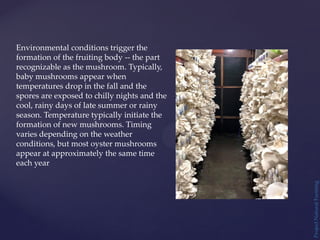
Environmental conditions trigger the
formation of the fruiting body -- the part
recognizable as the mushroom. Typically,
baby mushrooms appear when
temperatures drop in the fall and the
spores are exposed to chilly nights and the
cool, rainy days of late summer or rainy
season. Temperature typically initiate the
formation of new mushrooms. Timing
varies depending on the weather
conditions, but most oyster mushrooms
appear at approximately the same time
each year
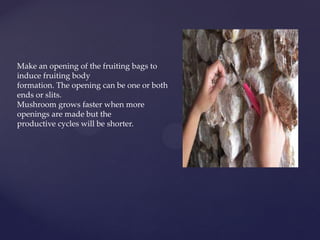
Make an opening of the fruiting bags to
induce fruiting body
formation. The opening can be one or both
ends or slits.
Mushroom grows faster when more
openings are made but the
productive cycles will be shorter.
Project
Natural
Farming
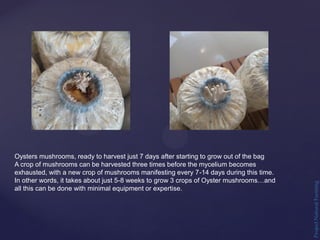
Oysters mushrooms, ready to harvest just 7 days after starting to grow out of the bag
A crop of mushrooms can be harvested three times before the mycelium becomes
exhausted, with a new crop of mushrooms manifesting every 7-14 days during this time.
In other words, it takes about just 5-8 weeks to grow 3 crops of Oyster mushrooms…and
all this can be done with minimal equipment or expertise.
Project
Natural
Farming
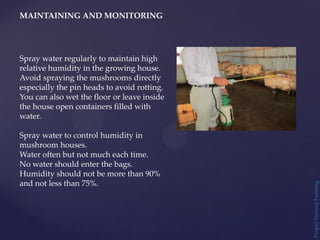
MAINTAINING AND MONITORING
Spray water regularly to maintain high
relative humidity in the growing house.
Avoid spraying the mushrooms directly
especially the pin heads to avoid rotting.
You can also wet the floor or leave inside
the house open containers filled with
water.
Spray water to control humidity in
mushroom houses.
Water often but not much each time.
No water should enter the bags.
Humidity should not be more than 90%
and not less than 75%.
Temperature control
Temperature control is done to some
extent by wetting the jute covering.
The evaporation that will take place
will lower the temperature in the
growing rooms. Temperature can be
lowered by several degrees, depending
on the outside temperature and air current
through the netting,.
Hygrometer Humidity Gauge Indicator
Indoor Thermometer Temperature And
Humidity Monitor
Project
Natural
Farming
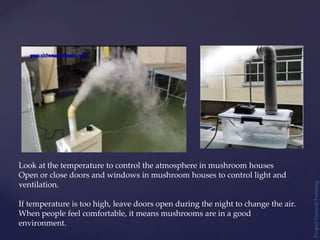
Look at the temperature to control the atmosphere in mushroom houses
Open or close doors and windows in mushroom houses to control light and
ventilation.
If temperature is too high, leave doors open during the night to change the air.
When people feel comfortable, it means mushrooms are in a good
environment.
Project
Natural
Farming
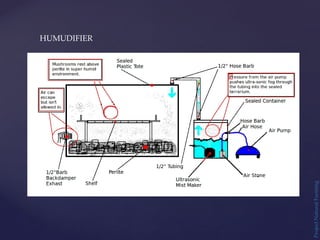
HUMUDIFIER
Project
Natural
Farming
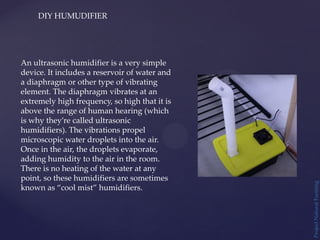
DIY HUMUDIFIER
An ultrasonic humidifier is a very simple
device. It includes a reservoir of water and
a diaphragm or other type of vibrating
element. The diaphragm vibrates at an
extremely high frequency, so high that it is
above the range of human hearing (which
is why they’re called ultrasonic
humidifiers). The vibrations propel
microscopic water droplets into the air.
Once in the air, the droplets evaporate,
adding humidity to the air in the room.
There is no heating of the water at any
point, so these humidifiers are sometimes
known as “cool mist” humidifiers.
Project
Natural
Farming
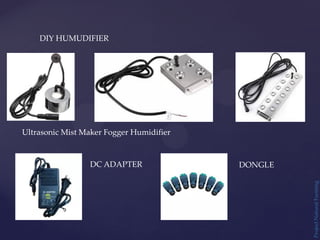
DIY HUMUDIFIER
Ultrasonic Mist Maker Fogger Humidifier
DC ADAPTER DONGLE
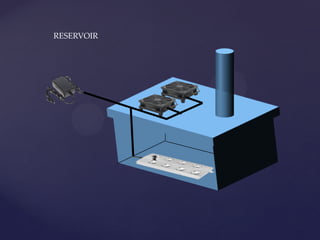
COMPUTER FAN
STORAGE BOX
PVC PIPE
DIY HUMUDIFIER
RESERVOIR
Project
Natural
Farming
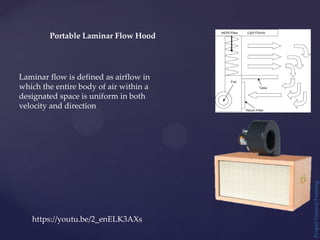
Portable Laminar Flow Hood
Laminar flow is defined as airflow in
which the entire body of air within a
designated space is uniform in both
velocity and direction
https://youtu.be/2_enELK3AXs
Project
Natural
Farming
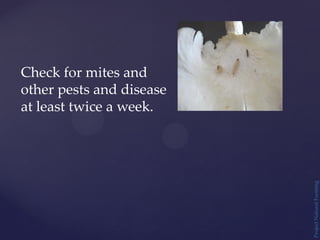
Check for mites and
other pests and disease
at least twice a week.
Insect pests
• Few insect pests attack the mushrooms
• Small larvae of flies, beetles, springtails are very
commonly noticed, in addition to mites and
nematodes.
• Absolute cleanliness is a must to prevent the
infestation of the insect pests in mushroom sheds.
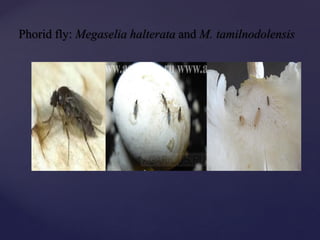
Phorid fly: Megaselia halterata and M. tamilnodolensis
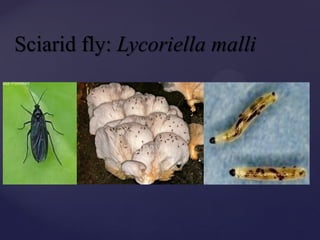
Sciarid fly: Lycoriella malli
Damage
• The larvae feed on the mycelium and show rotting
patches in the beds
• Young buds are also eaten by the larvae
• They also tunnel into grown up mushroom and cause
rotting of the mushrooms
• The flies spread the disease from one bed to others
Favourable conditions
• Temperature of 16-24 oC is highly favorable and
moisture contents of 70 % and above show more
incidence
• More severe in button mushroom cultivation, when
compared to oyster and milky mushrooms
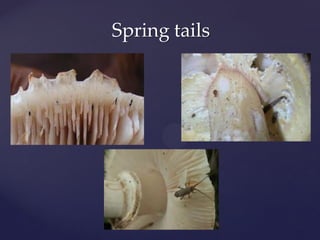
Spring tails
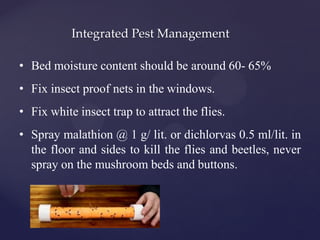
Integrated Pest Management
• Bed moisture content should be around 60- 65%
• Fix insect proof nets in the windows.
• Fix white insect trap to attract the flies.
• Spray malathion @ 1 g/ lit. or dichlorvas 0.5 ml/lit. in
the floor and sides to kill the flies and beetles, never
spray on the mushroom beds and buttons.
Mushroom diseases
Factors that cause diseases in mushrooms
• Biotic factors
– Fungi,
– bacteria and
– viruses
• Abiotic factors
– Air,
– temperature,
– nutrition and
– other environmental factors
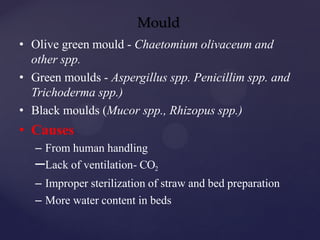
Mould
• Olive green mould - Chaetomium olivaceum and
other spp.
• Green moulds - Aspergillus spp. Penicillim spp. and
Trichoderma spp.)
• Black moulds (Mucor spp., Rhizopus spp.)
• Causes
– From human handling
–Lack of ventilation- CO2
– Improper sterilization of straw and bed preparation
– More water content in beds
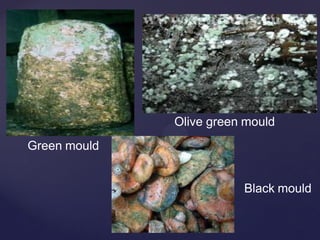
Green mould
Olive green mould
Black mould
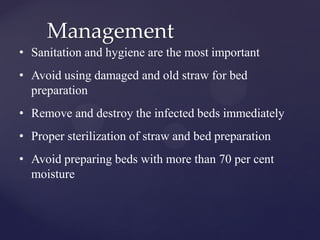
Management
• Sanitation and hygiene are the most important
• Avoid using damaged and old straw for bed
preparation
• Remove and destroy the infected beds immediately
• Proper sterilization of straw and bed preparation
• Avoid preparing beds with more than 70 per cent
moisture
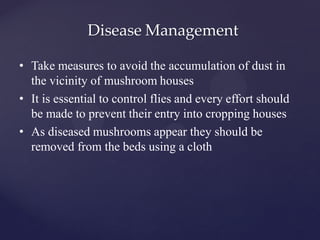
Disease Management
• Take measures to avoid the accumulation of dust in
the vicinity of mushroom houses
• It is essential to control flies and every effort should
be made to prevent their entry into cropping houses
• As diseased mushrooms appear they should be
removed from the beds using a cloth
Bacterial blotch/ bacterial
pit / brown blotch
•
•
•
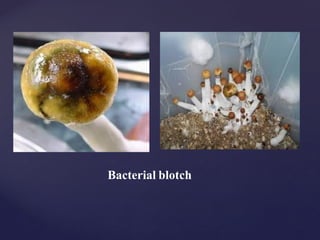
 Pseudomonas - produces pale-yellow spots on the
surface of the pileus, which later turn brown
 The incidence is more
when themushrooms are watered
heavily in the early bud stage
 Because of very high humidity film of water
always present on
the surface of buttons leading to browning and rotting,
•
emitting a fowl smell
In addition, the water splash from the infected bed also carries
the bacterial inoculum
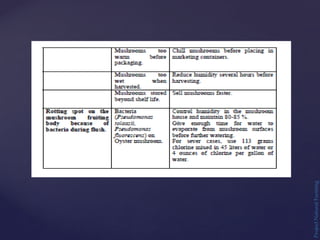
Bacterial blotch
Wet Spot/Sour Rot
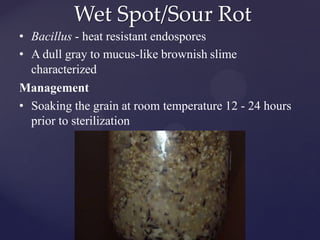
• Bacillus - heat resistant endospores
• A dull gray to mucus-like brownish slime
characterized
Management
• Soaking the grain at room temperature 12 - 24 hours
prior to sterilization
ment
•
•
•
•
•
•
•
•
Clean the mushroom houses throughly befire a new crop
Clean and disinfect equipment frequently
Remove the infected beds periodically to avoid further
spread
Avoid using damaged and old straw for bed preparation
Avoid pouring excess water to the beds
Lowering humidity with good air circulation
Avoid preparing beds with more than 70 per cent moisture
Spray water mixed with bleaching powder @ 2 g / 10 litres
of water.
HOW TO KEEP DISEASES AND PESTS OUT
• Clean water
– A mist sprayer will not splash, so it is better.
• Filtered air
– “Air-lock” entrance room
• Careful pasteurization
– 55-60°C (131-140°F) for 30 to 60 minutes.
• Clean workers
– Hand wash after working with substrate
• Clean surroundings
– Brush, weeds, stumps and old logs should be cleaned
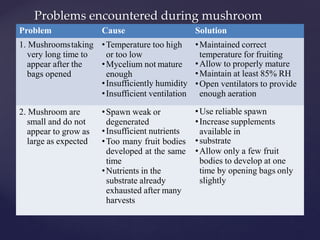
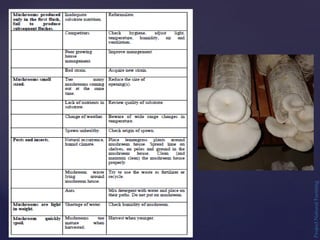
Problems encountered during mushroom
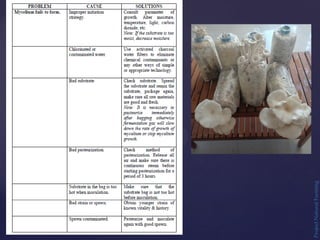
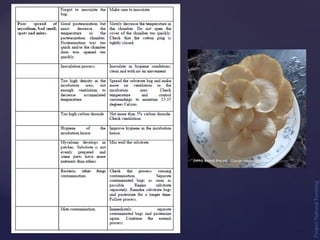
Problem Cause Solution
1. Mushroomstaking
very long time to
appear after the
bags opened
•Temperature too high
or too low
•Mycelium not mature
enough
•Insufficiently humidity
•Insufficient ventilation
•Maintained correct
temperature for fruiting
•Allow to properly mature
•Maintain at least 85% RH
•Open ventilators to provide
enough aeration
2. Mushroom are
small and do not
appear to grow as
large as expected
•Spawn weak or
degenerated
•Insufficient nutrients
•Too many fruit bodies
developed at the same
time
•Nutrients in the
substrate already
exhausted after many
harvests
•Use reliable spawn
•Increase supplements
available in
•substrate
•Allow only a few fruit
bodies to develop at one
time by opening bags only
slightly
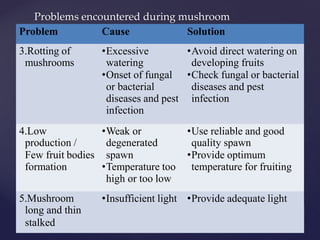
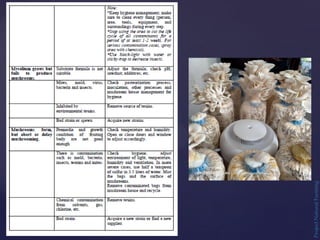
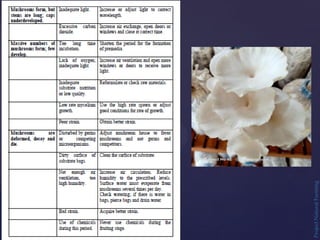
Problems encountered during mushroom
Problem Cause Solution
3.Rotting of •Excessive •Avoid direct watering on
mushrooms watering developing fruits
•Onset of fungal •Check fungal or bacterial
or bacterial diseases and pest
diseases and pest infection
infection
4.Low •Weak or •Use reliable and good
production / degenerated quality spawn
Few fruit bodies spawn •Provide optimum
formation •Temperature too temperature for fruiting
high or too low
5.Mushroom •Insufficient light •Provide adequate light
long and thin
stalked
Project
Natural
Farming
Project
Natural
Farming
Project
Natural
Farming
Project
Natural
Farming
Project
Natural
Farming
Project
Natural
Farming
Project
Natural
Farming
Project
Natural
Farming
www.facebook.com/projectnaturalfarming
keith.f.hernandez@gmail.com
Smart : 09983343277

MUSHPROD PRESENTATION.pdf

  • 1.
  • 2.
    about THE SPEAKER KEITH HERNANDEZ ANATURAL FARMING PRACTICTIONER, SPEAKER, AND AGRICULTURE TRAINER FOR NGOS’AND LGU’S Topics follow introduction
  • 3.
  • 5.
    Day 1 IntroductionTo Mushrooms History Different Groups Of Fungi And Mushrooms Nutritional Values In Mushrooms Cultivated Mushrooms Vs Wild Mushrooms Selecting The Right Type Of Mushrooms For Cultivation Commonly Cultivated Fungi How To Start Mushroom Cultivation Day 2 • Production Cycle PART 1 • Preparation Of Pure Culture • Preparation Of Grain Culture • Substrates • Preparation Of Fruiting Bag Day 3 Production Cycle PART 2 • Incubation • Fruiting The Bag • Care And Maintenance • Harvesting And Post Harvesting
  • 6.
    Mycology is thebranch of biology concerned with the study of fungi, including their genetic and biochemical properties, their taxonomy and their use to humans as a source for tinder, traditional medicine, food, and entheogens, as well as their dangers, such as toxicity or infection. Project Natural Farming
  • 7.
    Until the 1800’s,it was assumed that fungi were simply a different kind of plant. Mushrooms, the reproductive bodies of fungi, were eaten, used as medicine, and used for their hallucinogenic effects since antiquity. Many classic Greek philosophers and naturalists considered fungi, but still assumed they were more related to plants. By the mid-1800’s the microscope was invented, and scientists began to examine the inner workings of fungi. Microscopes revealed that fungi had distinct features, separate from both plants and animal cells. History Project Natural Farming
  • 8.
    HISTORICAL SIGNIFICANCE 1. A.D.600 - Aucularia auricula – 1st mushroom cultivated in China on wood log. 2. A.D. 800 – Flammulina velutipes - cultivated in China on wood log. 3. A.D. 1000 – Lentinula edodes - cultivated in China on wood log. 2nd rank after Button mushroom Might surpass button mushroom by 2020 4. 1600 – Agaricus bisporus – cultivated on compost substrate in France Biggest advance in mushroom cultivation Today produced in greatest quantity on Global basis Project Natural Farming
  • 9.
  • 10.
    Mushrooms can befound in forests around the world. Given the proper environment, mushrooms will grow and can offer a good source of natural vitamins and minerals. Mushrooms can also bring illness and even death to people who are unaware of certain types of wild mushrooms. Cultivated mushrooms are therefore the preferred and most reliable source of supply. Project Natural Farming
  • 11.
    Project Natural Farming Nature of mushrooms Mushroomsor fungi do not contain chlorophyll; they must feed on plants or animal matter. Some mushrooms feed only on dead matter while others feed on living plants or animals, which they sometimes harm or benefit. Mushrooms need a controlled environment with appropriate humidity, light, temperature, ventilation, air pressure, pH and nutrients. They also need a disease free environment. https://www.youtube.com/watch?v=7ojzbeaZDqk NATURE
  • 12.
    There are threedifferent groups of mushrooms or fungi: 1. Saprophytes Those Fungi or Mushrooms that feed on dead plants or animals. Pleurotus Ostreatus or Hed Nangrom is an example of this group. Saprophytes are useful as they help breakdown dead matter. 2. Parasites Those Fungi or Mushrooms that feed on living plants or animals. Many parasites damage and sometimes kill plants or animals they live on. Project Natural Farming
  • 13.
    There are threedifferent groups of mushrooms or fungi: 3. Symbiotic fungi Symbiotic fungi grow on living plants, but do not damage them. The fungus and plant help each other. Fly Agaric grows symbiotically with birch or pine trees and its mycelium grows around the tree roots. The tree provides the fungus needed sugar and the fungus gives the tree nutrients it has broken down from dead leaves. This process allows birch trees to survive in poor soil. Project Natural Farming
  • 14.
    Project Natural Farming Nutritional values inmushrooms Mushrooms provide high protein and essential amino acids. Low in fat and high in fiber, they also provide vitamins thus stimulating the immune system. Eating two to three types of mushroom per day can provide the proper amount of essential amino acid required by the body. It also supplies high levels of protein and vitamins. Normally, one adult can consume about 200-800 gram per day. For elderly people and children, 200 and 500 grams are sufficient.
  • 15.
  • 16.
    Mushroom Life Cycle Project Natural Farming Fungimultiply by producing millions and millions of spores. When a spore settles in a suitable environment, it can germinate and branch to form a mycelium. When two sexually compatible mycelia meet, they may fuse to form a so- called secondary mycelium, which is capable of forming fruiting bodies. VIDEO
  • 17.
    Project Natural Farming Cultivated mushrooms Vswild mushrooms Before eating any mushroom, make sure you have properly identified the specie. Every year, hundreds of people become ill and some even die because they collect wild mushrooms and wrongly identify them. Eating cultivated mushrooms remains the safest way for selecting edible mushrooms.
  • 18.
    CATEGORIES OF MUSHROOM 1.EDIBLE MUSHROOMS – 2 types Fleshy and Edible i. Cultivable ii. Noncultivable Edibility No poisonous effects on humans desirable taste and aroma . Nutritive value Edible mushrooms include many fungal species that are either harvested wild or cultivated Project Natural Farming
  • 19.
    Non - Edible HOUBAAmanita muscaria Thriving Shroom Meadow Agaricus Agaricus berdini Coprinus https://www.youtube.com/watch?v=Z8soCvgJvzY Project Natural Farming
  • 20.
    Project Natural Farming Selecting the righttype of mushrooms for cultivation Most of the cultivated mushrooms are from the saprophyte group; there are about 5,000 known species but very few that can be cultivated economically. Select the most suitable type of mushrooms according to your environment and to market demand. The most commonly and easily cultivated mushrooms in South East Asian countries are oyster mushrooms (Pleurotus Ostreatus), ear mushrooms (Auricularia polytricha), and straw mushrooms (Volvariella volvacea). Pleurotus Ostreatus Auricularia polytricha Volvariella volvacea
  • 21.
    Project Natural Farming Other types ofmushrooms such as Lentinula sp., Lentinus sp., Ganoderma sp., Macrocybe sp., Agrocybe sp. types can also be cultivated successfully but will require more attention and knowledge. It is therefore recommended that a new comer in mushroom cultivation start with easy to grow and commercially viable mushrooms. Shitake Lentinula sp Lentinus sp Reishi Ganoderma sp Milky Macrocybe sp Field Cap Agrocybe sp
  • 22.
    Project Natural Farming Pleurotus Butan (Cream) PleurotusButan (Black) Pleurotus ostreatus (white) Pleurotus flabellatus (Pink) Pleurotus citrinopileatus (Yellow) Commonly cultivated Fungi ( OYSTER ) Temperature °C* Cultivation season 23-35 22-35 24-35 24-35 24-34 Rainy & cold season. (Jun-Feb) Rainy & cold season. (Jun-Feb) Rainy & cold season. (Jun-Feb) Rainy & cold season. (Jun-Feb) Rainy & cold season. (Jun-Feb)
  • 23.
    Project Natural Farming Commonly cultivated Fungi PleurotusHungarian (Pale blue to grey when young) Pleurotus sapidus (Grey) Pleurotus sajor-cajou (Cream to white grey) Pleurotus tuber-regium (Light brown to gray) Pleurotus cystidiosus (Cream) Pleurotus cystidiosus (Black)
  • 24.
    Project Natural Farming Commonly cultivated Fungi Agrocybecylindracea (Brown to dark brown) Agrocybe cylindracea (White) Hericium erinaceus (White) Lentinula edodes (Brown to black brown) Tricholoma crassum (White) Now change to Macrocybe crassum Schizophyllum commune ( White grey to brown) Flammulina velutipes (Brown) Flammulina velutipes (White) Ganoderma lucidum (Reddish brown) Psilocybe cubensis
  • 25.
    Project Natural Farming Various species cultivateusing plot method. Volvariella volvacea White Volvariella volvacea Black Volvariella bombycina Brown Yellow Agaricus bisporus White Agaricus bisporus Brown Agaricus bitorquis White Macrolepiota procera Macrolepiota procera
  • 26.
    Project Natural Farming How to startmushroom cultivation Decide what and why you want to grow mushrooms Is it: • for home consumption • To provide labor or job to your family or neighbors • for extra income?
  • 27.
    Project Natural Farming How to startmushroom cultivation Factors to consider before starting: • TECHNOLOGY • WORKING SPACE • RAW MATERIALS (SOURCE) • LABOR FORCE • BUDGET • MARKET
  • 28.
  • 29.
  • 30.
  • 31.
  • 32.
    TECHNOLOGY Project Natural Farming Substrate preparation The largerportion of our rice areas produces rice straw only once a year. Therefore, it is important to collect and store rice straw to have continuous supply. Fresh rice straw can be collected for immediate use or short-term storage. Dry and clean rice straw can be stored
  • 33.
  • 34.
    TECHNOLOGY Project Natural Farming Filling and heattreatment T1= Steam treatment of substrate and spawning in 3 layers, T2= Steam treatment of substrate and spawning thoroughly, T3=Autoclaving of substrate and top spawning, T4= Autoclaving of substrate and spawning in 3 layers, T5= Autoclaving of substrate and spawning thoroughly, T6= Hot water treatment of substrate and spawning in 3 layers and
  • 35.
    TECHNOLOGY Project Natural Farming Filling and heattreatment Steam Treatment Rice straw was used for the cultivation of milky white mushroom. The straw was chopped to convenient length of 2.5 to 5 cm. The substrate was mixed with appropriate amount of water and then filled in net bag. The net bag filled with substrate were placed in the sterilization cum inoculation chamber. Door of the chamber was closed and tightened with the help of screws. Water heater was turned on to produce steam that flows in to the chamber. When the temperature of the chamber rises to 60C, the steam flow was adjusted to maintain a constant temperature of 70C – 80C up to 90 minutes. After 90 minutes water heater was turned off and kept it for about 20 hours. After 20 hours substrate was taken out and used for preparation of spawn packet.
  • 36.
    TECHNOLOGY Project Natural Farming Filling and heattreatment Autoclaving In case of treatment T3 substrate was mixed with appropriate amount of water and then filled into the polythene bags (12”x16”) and autoclaved in an autoclave machine for 2 hours at 121C and 1.5 kg/cm2 pressure. For treatment T4 and T5 water mixed substrate was filled into net bag and autoclaved in the same way. Upon cooling substrate was used for spawn packet preparation.
  • 37.
    TECHNOLOGY Project Natural Farming Filling and heattreatment Hot Water Treatment Rice straw substrate chopped to convenient length of 2.5 to 5 cm was poured into a net bag and treated with hot water at 60C in a drum for 60 minutes and allowed to drain out the excess water by hanging the bag for 20 hours. The moisture content of the hot water treated substrate was allowed to leave by spreading them on plastic sheet so that excess moisture was evaporated to obtain 55 to 60 percent moisture.
  • 38.
  • 39.
  • 40.
  • 41.
    WORKING SPACE Project Natural Farming Mushroom farms Certainfactors should be kept in mind when selecting a site for a mushroom farm: • distance to the market • availability of good quality substrate material • transportation of both product and substrate material • ready availability of clean water
  • 42.
  • 43.
    WORKING SPACE Project Natural Farming Farm layout Beforeone can start to plan the layout, the processes to be performed at the mushroom farm will have to be listed. For example, whether or not an inoculation room is required depends on whether growers prepare their own substrate or buy inoculated substrate. The farm layout should also include: • An efficient flow of substrate materials • Measures to prevent contamination on the farm • Efficient use of space Capacity Size (approximate) 1,000 bags 2m x 3m 2,000 bags 3m x 4m 3,000 bags 4m x 5m 4,000 bags 5m x 6m
  • 44.
    Floors On a lowinvestment level, mushroom houses are just built on arable land. On a higher investment level, cemented floors are used. Slightly inclined cemented floors provide a smooth surface that can easily be cleaned and allow excess water to drain. Doors and walls should close properly to prevent insects from entering the growing rooms. A double door, with a wire mesh for the second entrance, can help to keep insects out. The same rules apply for windows. The openings through which air is either blown in or out of the rooms should have at least a simple filter or cloth as barrier. WORKING SPACE Project Natural Farming
  • 45.
  • 46.
  • 47.
    WORKING SPACE Project Natural Farming Bamboo Shelves HeavyDuty Shelves Suspended Mushroom shelves and suspended systems
  • 48.
    Project Natural Farming WORKING SPACE Indoors: ControlledEnvironment Growing Indoor farming systems are sometimes referred to as “controlled environment agriculture,” which includes other systems such as hydroponics, aquaponics, and greenhouse production. In contrast to CEA systems used for greens and herbs, mushrooms can be produced in locations with minimal infrastructure and capital to start and sustain production. However, considerations and controls for temperature, humidity, light, and air flow present do need to be made.
  • 49.
  • 50.
  • 51.
  • 52.
  • 53.
    Laboratory or inoculationroom Project Natural Farming
  • 54.
    Laboratory or inoculationroom Project Natural Farming
  • 55.
  • 56.
  • 57.
    BUDGET Project Natural Farming Cost and ReturnAnalysis of 1000 Fruiting bags of Oyster Mushroom House within a 3x4 meters floor area (12 sq. mtrs.) as Fruiting House-Indigenous Materials. A.Materials Needed for 12sq.m Fruiting House. It can be made up of bamboo and nipa, plastic sheet walling with fine net ventilation. Labor and materials computed as 1000 per sq.m = Php12,000.00 B. 1000 Fruiting Bags, size 7X14 @ 40 pesos per bag = Php 40,000.00; Fruiting Cycle: minimum of 3 months.
  • 58.
    BUDGET Project Natural Farming Other Materials Neededfor Cultivation 1. Plastic twine straw for hanger, 4kgs. At 150 pesos per kg. = Php 600.00 2. 2 kgs, G. I. tie wire #16 at 70 pesos per kg. = Php140.00 3. 1 Mechanical/manual plastic sprayer = Php 120.00 Total Amount of Seed Capital = Php 30,860 Yield Assumption within 1 cycle 1. 500g (1/2kg) per fruiting bag X 1000 bags = 500 kgs. (conservative estimate per bag) farm gate price X 100 pesos per kilo Gross Sales = Php 50,000Less seed capital of 1 cycle = Php 50,000--Php27,540. Net profit after 1 cycle = 22,460. Return of Investment(ROI) after 1 cycle = 181.55% Revenue of Second Cycle 1. less: amount of fruiting house Php 12,000
  • 59.
    BUDGET Project Natural Farming Plastic twine straw280 G.I. wire #16 140 Sprayer 120 Php 12,540 capital investment for 2nd cycle 1000 fruiting bags X 30 =Php 30,000 Yield Assumption within 2nd cycle 1. 500 gms per fruiting bags X 1000 bags = 500kgs (conservative estimate) farm gate price X 100 per kilo Gross Sales Php 50,000 2. less: G.2 capital investment For 2nd cycle = Php 30,000 Net profit after 2nd cycle Php 20,000
  • 60.
    MARKET Project Natural Farming Under ideal conditions,packed mushrooms for the fresh market are covered with a plastic film and cooled rapidly after harvesting. The plastic film provides good protection from water loss, as long as the storage temperature is more or less constant. Repeated exposure to fluctuating temperatures should be avoided.
  • 61.
    Five factors thataffect mushroom growth With any types of mushrooms, these are the vital factors that affect their growth: Temperature. Temperature varies depending on the type of mushrooms. For instance, paddy straw mushrooms requires a temperature of 35 to 38-degree celsius, while shiitake mushrooms will only grow in colder temperatures. Humidity. The amount of water in the air must be maintained at 80 to 90%. Light. The place where the mushrooms will be grown must have no direct sun. Food. Give enough food for the mushrooms using the substrate that is particular to their needs. Straw mushrooms require a substrate that is rich in nitrogen and potassium hence, it includes banana leaves and kakawate leaves. Maintenance. Proper care is important in raising mushrooms. Regardless of variety, make sure to maintain cleanliness by using alcohol and by wearing protective clothing every time you plant, nurture, and harvest them. Project Natural Farming
  • 62.
  • 63.
  • 64.
    about THE SPEAKER KEITH HERNANDEZ ANATURAL FARMING PRACTICTIONER, SPEAKER, AND AGRICULTURE TRAINER FOR NGOS’AND LGU’S Topics follow introduction
  • 65.
  • 67.
    Day 1 IntroductionTo Mushrooms History Different Groups Of Fungi And Mushrooms Nutritional Values In Mushrooms Cultivated Mushrooms Vs Wild Mushrooms Selecting The Right Type Of Mushrooms For Cultivation Commonly Cultivated Fungi How To Start Mushroom Cultivation Day 2 • Production Cycle PART 1 • Preparation Of Pure Culture • Preparation Of Grain Culture • Substrates • Preparation Of Fruiting Bag Day 3 Production Cycle PART 2 • Incubation • Fruiting The Bag • Care And Maintenance • Harvesting And Post Harvesting
  • 68.
    Project Natural Farming Phase 2 Preparation of Grainculture MARKETING Phase 3 Preparation of Fruiting Bag Phase 4 Opening of Fruiting Bag Phase 5 Harvesting and post harvesting Phase 6 Processing and Value Adding Production Cycle Phase 1 Preparation of Pure culture
  • 69.
  • 70.
    Project Natural Farming Pure culture, inmicrobiology, a laboratory culture containing a single species of organism. A pure culture is usually derived from a mixed culture (one containing many species) by transferring a small sample into new, sterile growth medium in such a manner as to disperse the individual cells across the medium surface or by thinning the sample manyfold before inoculating the new medium.
  • 71.
    Project Natural Farming In the spawn-production process,mycelium from a mushroom culture is placed onto steam-sterilized grain, and in time the mycelium completely grows through the grain. This grain/mycelium mixture is called spawn, and spawn is used to "seed" mushroom compost.
  • 72.
    Project Natural Farming Phase 1 :Preparation of Pure culture Tissue Culture 1. Prepare materials: Potatoes: 200 gr. Dextrose: 20 gr. Agar powder: 20 gr. Water: 1 liter. Cotton (gauze) Bottles Paper Rubber Band
  • 73.
  • 74.
  • 75.
    Clean small flatbottles (small whiskey bottles as a container can be used). Place potatoes in one liter of water. Simmer for 15 - 20 minutes Remove potatoes & keep the broth as clear as possible Bring water to stove. Add dextrose followed by agar. Slowly stir continuously with regular speed until completely dissolved Project Natural Farming 1 2 3 4
  • 76.
    Project Natural Farming Pour liquid PDAin bottle until you reach 5 - 10 mm high. Plug bottle with cotton. Place bottles in autoclave at 121oC for 20 - 30 minutes to ensure complete sterilization. Let cool down to around 37oC. Place bottles in slanted position as to increase surface area of the medium. PDA should come close to the neck but must not touch the cotton plug. After PDA medium is settled in bottle, transfer all bottles to clean shelf in the clean room.
  • 77.
  • 78.
    Project Natural Farming Select a strongmushroom for culture. Healthy. Not too mature, not too young. Not too humid (at least 2-3 hours after watering) With a stiff stalk Make sure it is clean and far from any contaminated mushroom.
  • 79.
    Project Natural Farming Clean the room,all necessary tools, inside and outside the laminar flow cabinet with alcohol. Transfer PDA bottles and necessary tools into the chamber.
  • 80.
    Project Natural Farming Clean both handsand bottles with alcohol and insert hands into the cabinet. Hold needle with 2 fingers in a 45o-degree angle, flame needle to disinfect until the needle turns red. Make sure it does not touch any surface after flaming While needle cools down (15-20 seconds - hold needle not to touch anything or place it on the clean surface of a glass).
  • 81.
    Project Natural Farming Place all cleanedmaterials inside laminar flow. Turn on UV lamp and laminar flow. After 10-15 minutes, turn off UV lamp but leave laminar flow for the duration of the operation
  • 82.
    Project Natural Farming Using other fingers,tear mushroom lengthwise (DO NOT use knife to cut) With the needle, cut a small piece (2 mm x 2 mm) of fleshy tissue from inside the mushroom (in the middle between the cap and the stalk). Make sure that it is clean and did not touch the outside of the mushroom.
  • 83.
    Project Natural Farming Flame around themouth of the bottle. Using other fingers, remove cotton plug of PDA bottle in front of flame to secure against contamination. Insert the needle in the bottle and inoculate by placing small piece of cut mushroom in the middle of the PDA’s surface. Make sure the piece of mushroom does not touch anything before entering the PDA bottle
  • 84.
    Project Natural Farming Close bottle immediatelynear the flame with cotton plug Note: the bottom of the bottle should always be lower than the mouth of the bottle and the mouth of the bottle should remain near the flame at all times Label bottles and indicate: Date, type of mushroom, mother spawn #.
  • 85.
    Project Natural Farming Whether from tissueculture or PDA to PDA, from the time of incubation to full growth mycelium will take about 10 - 15 days. (Depending on species).
  • 86.
    Project Natural Farming Keep PDA bottleswith mycelium on clean shelf. Check infection by other fungi in the bottle everyday. Also check growth rate.
  • 87.
    fter mycelium coverswhole PDA medium, keep mature mycelium in cool place or in the refrigerator in the vegetables section Project Natural Farming
  • 88.
    Project Natural Farming To perform thegrain inoculations, you require a sterile environment. Air is full of impurities and so it is important to reduce the level of containments where possible. This can be achieved by constructing a simple clean room. The room also requires a work bench and storage shelves for incubating your jars of spawn.
  • 89.
    Project Natural Farming Most mushroom cleanrooms have a HEPA filter installed to provide clean oxygenated air. This instructable uses a low tech approach and will give you alternative methods for minimising air contaminants. Laminar Flow Box
  • 90.
    Project Natural Farming Prepare Grain Preparation OfGrain Culture 1. Prepare materials: Sorghum seeds Bottles (flask type) Cotton (gauze) Paper squares 7 cm x 7 cm Rubber bands Alcohol lamp Alcohol bottle Note: Various types of grains can be used: Sorghum, millet, wheat Grains must: Have been recently harvested Contain few broken kernels Little contamination No fungi, no insects No more than 12% humidity
  • 91.
    Project Natural Farming Prepare Grain Preparation OfGrain Culture Soak sorghum for one night; 2 liters of water per 1 kg of grain. Wash and strain sorghum seeds to remove all water. Steam sorghum seeds for 30-45 minutes to soften grains and cook about 25%. Drain water and spread sorghum seeds to cool down and decrease moisture.
  • 92.
    Project Natural Farming . Fill ¾of bottle with sorghum seeds Carefully prepare cotton plug
  • 93.
    Project Natural Farming Tightly plug mouthof bottle with cotton and leave out for ventilation. Transfer all prepared bottles to the sterilization chamber. Close chamber. Fire-up burner or stove to heat chamber. Make sure to release all air from the chamber before starting. Keep pressure in the chamber at 15 lb./sq.inch. or 121o Celsius for 30 minutes for small chambers and 45 minutes for medium chambers. Let bottles cool down.
  • 94.
    Project Natural Farming Transfer bottles toa clean and cool place. Clean laminar flow chamber using alcohol.
  • 95.
    Project Natural Farming Transfer PDA, sorghumseed bottles, paper and rubber bands in laminar flow chamber. Light UV lamp for 10 - 15 minutes before starting. Place needle in alcohol. Turn off UV. Clean both hands with alcohol and insert hands into the chamber. Using 2 fingers, take out needle, pass through fire as to burn alcohol, and disinfect needle. Make sure the needle turns red.
  • 96.
    Project Natural Farming After the needlecooled down to normal state, use needle to cut small square (5mm x 5mm) of PDA with mycelium (white color) Close bottle immediately. Remain near flame at all times.
  • 97.
    Project Natural Farming Using other handflame around the mouth and shoulder of the sorghum seed bottle. Using other fingers, open spawn bottle near flame to avoid contamination Insert needle and inoculate sorghum seeds with PDA mycelium by placing small square piece in the middle of the bottle. Make sure the PDA mycelium does not touch anything before entering the sorghum seeds bottle. Note: The mouth of the bottle should be near the flame. The mouth should remain higher than the bottom part at all times. Do not touch mouth of bottle with piece of PDA.
  • 98.
    Project Natural Farming Close bottle immediately Placesquare paper over cotton and tie with plastic neck or rubber band.
  • 99.
    Project Natural Farming Label inoculated sorghumbottles writing: Date, Spawn no., ref., and inoculation time. Note: It takes about 10 - 15 days to get full- grown sorghum grain mycelium, depending on the species Keep mature sorghum seeds in a cool place or in the vegetable compartment of the refrigerator. Check for infection regularly
  • 100.
  • 101.
    Project Natural Farming RAW MATERIALS (SOURCE) Strawis the material left over after the harvest of grain, the dried stems and leaves of the plants. Non-farmers sometimes confuse straw with hay, but the two are quite distinct. Hay is grass or other plant matter harvested for animal feed. Straw is an agricultural byproduct with little nutritional value, but it can be fed to animals as roughage, and it can be used as bedding, as a soil amendment, or as mushroom substrate. Mushroom types often grown on straw include: • Oyster mushroom species, like Golden Oyster, Phoenix Oyster, Veiled Oyster, Pink Oyster, and Tree Oyster. • Agaricus species, like Agaricus Blazei. • Garden giant (Wine Cap) • Shaggy mane • Enokitake • Pioppino
  • 102.
    RAW MATERIALS (SOURCE) Sawdust or wood-chips—or, better yet, both—make a good, productive substrate, but are usually mixed with bran of some type (grain or soy) for added nutrition[iv]. As with logs, the species of tree the material came from matters, but many hardwoods are suitable and material from different species can be mixed. There are many different recipes, each with their advantages and disadvantages for different crops. Growers with access to waste sawdust and chips may be able to get material for free. Otherwise, pellets of compressed hardwood sawdust are available at reasonable prices. Just soak the pellets in water and they break apart easily. Mushrooms that do well on sawdust mixes include: • Reishi • Lion’s mane • Shiitaki • Maitake • King oyster Project Natural Farming
  • 103.
    Project Natural Farming RAW MATERIALS (othersubstrates) Manure Logs Leaves Coffee Grounds
  • 104.
    Project Natural Farming Substrate is thematerial used to grow mushrooms. This material or substrate is a mixture of all ingredients or “food” necessary for mushrooms to develop. Although sawdust is the most common and easy to use basic material for making mushroom substrate bags, other alternate and sometimes lower cost materials can be used. For example, in Asia, because of intense rice cultivation, rice straw can be used since straw is readily available in most rural areas. Because of its lower cost (and local availability) it may be better suited as a substrate than sawdust. Furthermore, rice straw generally generates higher yield and better quality mushrooms; both texture and taste of mushrooms are improved when using straw instead of sawdust. Nevertheless, straw needs to be prepared before use requiring harder work, and fermentation for a period of 9 - 12 days.
  • 105.
    Project Natural Farming Put straw ingrinder to reduce its size. Soak paddy straw 100 Kg. With water and mix with urea 1-2 % by weight, ferment for 3 days. Turn over the pile, then mix with 2% lime and ferment it again 3 days. Turn over the pile again, mix with 0.2% magnesium sulfate, and ferment 3 more days. The last turn over makes the straw readily composted for using as substrate. Check moisture and for a urea smell. If there is no urea smell and the moisture is 65-75%, the substrate is ready for packing. If there is some urea smell, it is necessary to ferment further until there is no more smell. Then pack in size 8” x 12” PP. Bags.
  • 106.
  • 107.
    Project Natural Farming Substrate preparation 100 kgSawdust Add to sawdust 5 kg Rice bran 2 kg Calcium sulfate 1 kg Calcium carbonate 0.2 kg Magnesium sulfate 0-1 kg Sugar Note: Substrate recipe should serve as a reference. Recipe can be changed by adding some rice flour, sticky rice flour, corn flour, cassava peels, cotton waste, Soya-bean residue, and other nutritious agricultural waste. In cool climates, it is possible to use additives or complementing materials up to 20%. Beware: for hot climatic zones, do not use more than 7.5% additives. (If rice straw, recipe needs to be modified as above mentioned)
  • 108.
    Project Natural Farming No Rice StrawSubstrate 78% Saw dust 20% Rice Brand 1% Agricultural Lime 1% Molases Note: do not use Saw dust from gemilina, mahogany and eucalyptus
  • 109.
    Phase 3: Preparationof Fruiting Bag Banana Leaves Corn hay Corn cob Coir Dust Materials as substitute or added with sawdust (50:50)
  • 111.
    Phase 3: Preparationof Fruiting Bag Preparation of substrate
  • 112.
    Project Natural Farming Weigh all componentsusing scale Mix well all ingredients in mixer or manually using shovels or paddles
  • 113.
    Add water tokeep moisture content between 65-75 %. Make sure all ingredients are well mixed and that there are no lumps Project Natural Farming
  • 114.
    Project Natural Farming Compact substrate byhitting bags with empty bottle, hand. Or Use compacting machine.
  • 115.
    Project Natural Farming Place plastic ringon bag Pull out top of bag through plastic neck
  • 116.
    Project Natural Farming Tie with rubberband. Introduce stick with pointed head through plastic neck of bag to make hole almost to the bottom of the bag; DO NOT TOUCH BOTTOM of bag
  • 117.
    Project Natural Farming Transfer bags topasteurization chamber. Close bags with plastic caps.
  • 118.
  • 119.
    Project Natural Farming FILL Pugon withclay placing a wooden guide for the hole PASTEURIZING BAGS
  • 120.
  • 121.
    Project Natural Farming Fill with fueli.e. corn cobs, rice hull , wood chips
  • 122.
    Project Natural Farming Clean steam potand add about 4 inches water Place iron or wooden screen so it comes out 1 inch higher than water.
  • 123.
    Project Natural Farming Place bags inpasteurization system until full (between 80 - 100 bags).
  • 124.
    Project Natural Farming Cover everything withdouble layers of old rice bags. Place plastic over rice bags and close tightly Light fire and maintain temperature constant for a period of 3 -4 hours from the time temperature reaches 90 - 100oC which is the moment steam starts coming out continuously.
  • 125.
    Project Natural Farming When completed, takethe firewood out of the stove. Let cool down for approximately 20 minutes. Take off cover bags and let cool down more Transfer bags to inoculation area
  • 126.
  • 127.
  • 128.
    Project Natural Farming Solar heating pasteurization(optional in replacement of steam pasteurization)
  • 129.
    Pasteurize Mushroom Mediain the Tropics Using a Styrofoam Box
  • 130.
  • 131.
  • 132.
    about THE SPEAKER KEITH HERNANDEZ ANATURAL FARMING PRACTICTIONER, SPEAKER, AND AGRICULTURE TRAINER FOR NGOS’AND LGU’S Topics follow introduction
  • 133.
  • 135.
    Day 1 IntroductionTo Mushrooms History Different Groups Of Fungi And Mushrooms Nutritional Values In Mushrooms Cultivated Mushrooms Vs Wild Mushrooms Selecting The Right Type Of Mushrooms For Cultivation Commonly Cultivated Fungi How To Start Mushroom Cultivation Day 2 • Production Cycle PART 1 • Preparation Of Pure Culture • Preparation Of Grain Culture • Substrates • Preparation Of Fruiting Bag Day 3 Production Cycle PART 2 • Incubation • Fruiting The Bag • Care And Maintenance • Harvesting And Post Harvesting
  • 136.
    Project Natural Farming Phase 2 Preparation of Grainculture MARKETING Phase 3 Preparation of Fruiting Bag Phase 4 Opening of Fruiting Bag Phase 5 Harvesting and post harvesting Phase 6 Processing and Value Adding Production Cycle Phase 1 Preparation of Pure culture
  • 137.
    Project Natural Farming INOCULATING BAGS WITH SORGHUMSEEDS Note: The inoculation room must be kept very clean and free of diseases to avoid contamination. Avoid sunshine from entering the area. 1. Prepare materials: Alcohol lamp Sorghum coated with spawn Fire Square paper (5’’ x 5’’) Rubber bands Cotton Alcohol Pasteurized substrate bags
  • 138.
    Project Natural Farming Clean room withbroom or dust vacuum Rub the floor with disinfecting solution. Bring substrate bags from pasteurization chamber to inoculation area.
  • 139.
  • 140.
    Light alcohol lamp. Disinfecthands and pasteurized substrate bags with alcohol.
  • 141.
    Project Natural Farming Take bottle ofsorghum coated with spawn (all white color) Shake bottle to release sorghum seeds and then, bring bottles to inoculation room. Do not open bottle
  • 142.
    Project Natural Farming Flame around thebottleneck. Open bottle very close to flame to take out air from inside Drop 10 - 20 sorghum seeds coated with spawn in the mushroom bag. Act very quickly and with very little movement
  • 143.
    Project Natural Farming Then bring cottonto close bag as quickly as possible. Repeat for all bags Leave bottle near the flame until all bags have been inoculated. Then close the bottle
  • 144.
    Project Natural Farming Following inoculation ofall bags, place clean square paper to cover the top of the bag and tie with rubber band Bring bags to incubation room
  • 145.
    Incubation The bags arethen placed in a warm (20-24C/68F-75F) dark room to incubate and begin the first phase of growth. Only 10-14 days are needed for the spawn to grow a full web of root-like threads of mycelium and colonise the growing substrate.
  • 146.
    Project Natural Farming INCUBATING BAGS Clean aroundand inside the incubation house using a broom. Always inspect for cleanliness before entering with new spawn bags. After inoculation, transfer substrate bags to mushroom incubation house.
  • 147.
  • 148.
    Project Natural Farming Bags can beplaced horizontally or vertically, which takes more space. Note: At the beginning, little ventilation and light should be allowed. After about 10 days, there ventilation should regulate the desired temperature. After 20 - 25 days, area should be well ventilated and more light can be let in for constant monitoring.
  • 149.
    Project Natural Farming * Flushes meansharvesting time or number of harvests**Production time is the number of weeks following inoculation. This will depend on the season and to the amount of care given by farmers. These should serve as an indication only.
  • 150.
    Project Natural Farming Project Natural ProjectNatural Project Natural INCUBATION STAGES 1-2 weeks 2-3 weeks 3-4 weeks
  • 151.
    Project Natural Farming Visually check myceliumon a daily basis looking for abnormal mycelium (such as black spots, green spots, brown spots, orange or red spots, etc....).Try to find out the causes of abnormal mycelium (PEST, DISEASE). Move bags to fruiting body area (or prepare for fruiting).
  • 152.
    Project Natural Farming Separate contaminated bagsand pasteurize again or separate partially contaminated bags and open them or tear the plastic bags off and reuse sawdust or ferment substrate as compost for gardening. Observe and collect data. Take notes before drawing conclusions.
  • 153.
    Project Natural Farming Fruiting Once the growingmedium is fully colonised by the spawn, it is time for the mushrooms to start fruiting. The bags are exposed to autumn-like conditions with fresh oxygen, high humidity, low level light & often cooler temperatures. This signals to the mycelium that it’s time to start producing mushrooms and small pins begin to emerge.
  • 154.
    Transfer the good-qualityfruiting bags with all-white mycelial growths to the growing house. Arrange them in hanging ropes.
  • 155.
    Project Natural Farming Oyster mushroom pins beginto emerge from holes in the bag…. Fed by water and nutrients from the mycelium, these tiny pins then rapidly grow and develop into full size mushrooms in just 5-7 days.
  • 156.
    Project Natural Farming Oyster mushrooms- (Pleurotusostreatus) Take off cotton plugs. Cut plastic bags at the shoulder of the bag using a knife or cutter. Lentinus squarrosulus and Lentinus polychrous
  • 157.
    Project Natural Farming The fruiting bodiesstart to grow 3-5 days after opening or slitting the fruiting bags.
  • 158.
    Project Natural Farming Environmental conditions triggerthe formation of the fruiting body -- the part recognizable as the mushroom. Typically, baby mushrooms appear when temperatures drop in the fall and the spores are exposed to chilly nights and the cool, rainy days of late summer or rainy season. Temperature typically initiate the formation of new mushrooms. Timing varies depending on the weather conditions, but most oyster mushrooms appear at approximately the same time each year
  • 159.
    Make an openingof the fruiting bags to induce fruiting body formation. The opening can be one or both ends or slits. Mushroom grows faster when more openings are made but the productive cycles will be shorter.
  • 160.
    Project Natural Farming Oysters mushrooms, readyto harvest just 7 days after starting to grow out of the bag A crop of mushrooms can be harvested three times before the mycelium becomes exhausted, with a new crop of mushrooms manifesting every 7-14 days during this time. In other words, it takes about just 5-8 weeks to grow 3 crops of Oyster mushrooms…and all this can be done with minimal equipment or expertise.
  • 161.
    Project Natural Farming MAINTAINING AND MONITORING Spraywater regularly to maintain high relative humidity in the growing house. Avoid spraying the mushrooms directly especially the pin heads to avoid rotting. You can also wet the floor or leave inside the house open containers filled with water. Spray water to control humidity in mushroom houses. Water often but not much each time. No water should enter the bags. Humidity should not be more than 90% and not less than 75%.
  • 162.
    Temperature control Temperature controlis done to some extent by wetting the jute covering. The evaporation that will take place will lower the temperature in the growing rooms. Temperature can be lowered by several degrees, depending on the outside temperature and air current through the netting,. Hygrometer Humidity Gauge Indicator Indoor Thermometer Temperature And Humidity Monitor
  • 163.
    Project Natural Farming Look at thetemperature to control the atmosphere in mushroom houses Open or close doors and windows in mushroom houses to control light and ventilation. If temperature is too high, leave doors open during the night to change the air. When people feel comfortable, it means mushrooms are in a good environment.
  • 164.
  • 165.
    Project Natural Farming DIY HUMUDIFIER An ultrasonichumidifier is a very simple device. It includes a reservoir of water and a diaphragm or other type of vibrating element. The diaphragm vibrates at an extremely high frequency, so high that it is above the range of human hearing (which is why they’re called ultrasonic humidifiers). The vibrations propel microscopic water droplets into the air. Once in the air, the droplets evaporate, adding humidity to the air in the room. There is no heating of the water at any point, so these humidifiers are sometimes known as “cool mist” humidifiers.
  • 166.
    Project Natural Farming DIY HUMUDIFIER Ultrasonic MistMaker Fogger Humidifier DC ADAPTER DONGLE
  • 167.
    COMPUTER FAN STORAGE BOX PVCPIPE DIY HUMUDIFIER
  • 168.
  • 169.
    Project Natural Farming Portable Laminar FlowHood Laminar flow is defined as airflow in which the entire body of air within a designated space is uniform in both velocity and direction https://youtu.be/2_enELK3AXs
  • 170.
    Project Natural Farming Check for mitesand other pests and disease at least twice a week.
  • 171.
    Insect pests • Fewinsect pests attack the mushrooms • Small larvae of flies, beetles, springtails are very commonly noticed, in addition to mites and nematodes. • Absolute cleanliness is a must to prevent the infestation of the insect pests in mushroom sheds.
  • 172.
    Phorid fly: Megaseliahalterata and M. tamilnodolensis
  • 173.
  • 174.
    Damage • The larvaefeed on the mycelium and show rotting patches in the beds • Young buds are also eaten by the larvae • They also tunnel into grown up mushroom and cause rotting of the mushrooms • The flies spread the disease from one bed to others
  • 175.
    Favourable conditions • Temperatureof 16-24 oC is highly favorable and moisture contents of 70 % and above show more incidence • More severe in button mushroom cultivation, when compared to oyster and milky mushrooms
  • 176.
  • 177.
    Integrated Pest Management •Bed moisture content should be around 60- 65% • Fix insect proof nets in the windows. • Fix white insect trap to attract the flies. • Spray malathion @ 1 g/ lit. or dichlorvas 0.5 ml/lit. in the floor and sides to kill the flies and beetles, never spray on the mushroom beds and buttons.
  • 178.
  • 179.
    Factors that causediseases in mushrooms • Biotic factors – Fungi, – bacteria and – viruses • Abiotic factors – Air, – temperature, – nutrition and – other environmental factors
  • 180.
    Mould • Olive greenmould - Chaetomium olivaceum and other spp. • Green moulds - Aspergillus spp. Penicillim spp. and Trichoderma spp.) • Black moulds (Mucor spp., Rhizopus spp.) • Causes – From human handling –Lack of ventilation- CO2 – Improper sterilization of straw and bed preparation – More water content in beds
  • 181.
    Green mould Olive greenmould Black mould
  • 182.
    Management • Sanitation andhygiene are the most important • Avoid using damaged and old straw for bed preparation • Remove and destroy the infected beds immediately • Proper sterilization of straw and bed preparation • Avoid preparing beds with more than 70 per cent moisture
  • 183.
    Disease Management • Takemeasures to avoid the accumulation of dust in the vicinity of mushroom houses • It is essential to control flies and every effort should be made to prevent their entry into cropping houses • As diseased mushrooms appear they should be removed from the beds using a cloth
  • 184.
    Bacterial blotch/ bacterial pit/ brown blotch • • •  Pseudomonas - produces pale-yellow spots on the surface of the pileus, which later turn brown  The incidence is more when themushrooms are watered heavily in the early bud stage  Because of very high humidity film of water always present on the surface of buttons leading to browning and rotting, • emitting a fowl smell In addition, the water splash from the infected bed also carries the bacterial inoculum
  • 185.
  • 186.
    Wet Spot/Sour Rot •Bacillus - heat resistant endospores • A dull gray to mucus-like brownish slime characterized Management • Soaking the grain at room temperature 12 - 24 hours prior to sterilization
  • 187.
    ment • • • • • • • • Clean the mushroomhouses throughly befire a new crop Clean and disinfect equipment frequently Remove the infected beds periodically to avoid further spread Avoid using damaged and old straw for bed preparation Avoid pouring excess water to the beds Lowering humidity with good air circulation Avoid preparing beds with more than 70 per cent moisture Spray water mixed with bleaching powder @ 2 g / 10 litres of water.
  • 188.
    HOW TO KEEPDISEASES AND PESTS OUT • Clean water – A mist sprayer will not splash, so it is better. • Filtered air – “Air-lock” entrance room • Careful pasteurization – 55-60°C (131-140°F) for 30 to 60 minutes. • Clean workers – Hand wash after working with substrate • Clean surroundings – Brush, weeds, stumps and old logs should be cleaned
  • 189.
    Problems encountered duringmushroom Problem Cause Solution 1. Mushroomstaking very long time to appear after the bags opened •Temperature too high or too low •Mycelium not mature enough •Insufficiently humidity •Insufficient ventilation •Maintained correct temperature for fruiting •Allow to properly mature •Maintain at least 85% RH •Open ventilators to provide enough aeration 2. Mushroom are small and do not appear to grow as large as expected •Spawn weak or degenerated •Insufficient nutrients •Too many fruit bodies developed at the same time •Nutrients in the substrate already exhausted after many harvests •Use reliable spawn •Increase supplements available in •substrate •Allow only a few fruit bodies to develop at one time by opening bags only slightly
  • 190.
    Problems encountered duringmushroom Problem Cause Solution 3.Rotting of •Excessive •Avoid direct watering on mushrooms watering developing fruits •Onset of fungal •Check fungal or bacterial or bacterial diseases and pest diseases and pest infection infection 4.Low •Weak or •Use reliable and good production / degenerated quality spawn Few fruit bodies spawn •Provide optimum formation •Temperature too temperature for fruiting high or too low 5.Mushroom •Insufficient light •Provide adequate light long and thin stalked
  • 191.
  • 192.
  • 193.
  • 194.
  • 195.
  • 196.
  • 197.
  • 198.